Cost of repairing a wooden fence
By Housey · Last reviewed 19th of May 2026
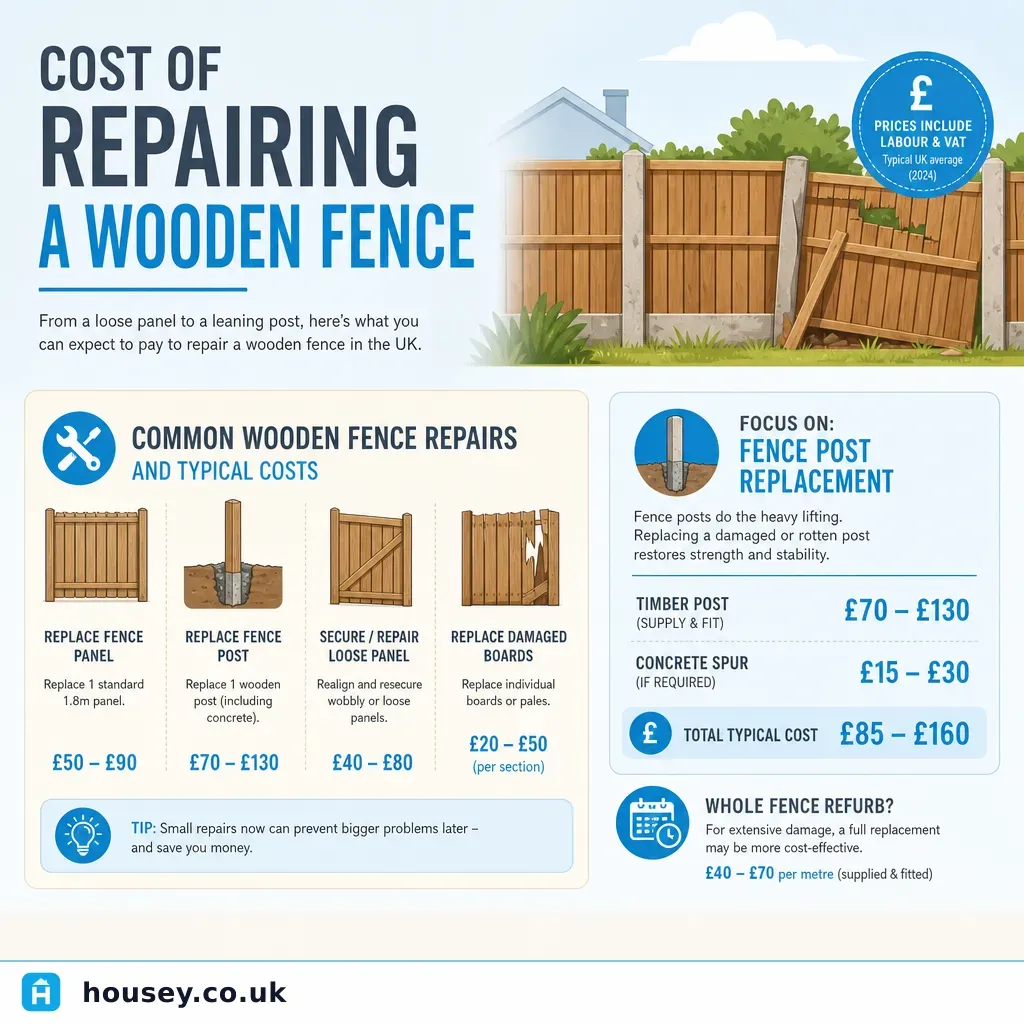
Cost of repairing a wooden fence
Fence damage rarely announces itself at a convenient time — a winter storm brings down a panel overnight, a rotten post finally gives way after years of gradual decay, or a pre-sale survey flags deteriorating close-board fencing across an entire boundary run. For UK homeowners, getting this right matters: underestimating the problem leads to a failed repair within a season, while over-specifying means spending more than necessary on a fence that needs only targeted attention.
Key points
- Minor repairs such as replacing up to three boards or refixing a loose panel typically cost £100–£300 including labour (indicative UK costs, last reviewed 2026-05-19).
- Replacing a single rotten fence post costs approximately £150–£350 including labour; fitting a concrete repair spur as an alternative costs around £80–£200 per post.
- Fences above 2 m on a boundary, or above 1 m fronting a highway, may require planning permission under the Town and Country Planning Act 1990 — check with your local planning authority before rebuilding.
- Pressure-treated softwood (Scandinavian pine or spruce) is the standard UK fence timber; untreated or poor-quality boards are the most common cause of premature panel failure.
- Boundary responsibility is usually indicated by the "T" mark on your HM Land Registry title plan — confirm this before commissioning repairs that affect a shared boundary.
How much does fence repair cost?
Repair costs vary considerably depending on the type and extent of damage, your fence style, and your location. The table below gives indicative ranges for the most common repair types.
Repair type | Indicative cost (inc. labour) | Typical time |
|---|---|---|
Refix blown or loose panel | £80–£150 | 1–2 hours |
Replace 1–3 fence boards | £100–£300 | Half day |
Fit concrete repair spur to rotten post | £80–£200 per post | 1–2 hours per post |
Replace single fence post | £150–£350 per post | 2–4 hours |
Replace 3–5 panels and posts | £500–£900 | 1 day |
Repair mixed damage over 20 m run | £800–£1,500+ | 1–2 days |
Indicative UK costs, last reviewed 2026-05-19. Prices vary by region, access, timber grade, and contractor. Obtain at least two written quotes before proceeding.
What drives the cost?
Post condition is the biggest variable. Posts are the most expensive element to replace, and if multiple posts are rotten at ground level a full replacement run is often more economical than piecemeal repairs.
Timber type also matters. Pressure-treated softwood is the most affordable option. Hardwoods such as oak or sweet chestnut cost two to three times more but last significantly longer with lower ongoing maintenance.
Fence style affects both materials and labour time. Close-board (feather-edge) fencing is the most common style and the most straightforward to repair. Hit-and-miss panels, slatted designs, or purpose-made decorative fencing may require custom-cut boards.
Access adds cost if the fence is at the rear of a property with restricted entry. Steep ground or a narrow side passage can mean extra handling time and a higher quote.
Location affects labour rates meaningfully. Contractors in London and the South East typically charge 20–40% more than those in the Midlands or the North of England.
Repair vs replace: how to decide
- Repair if fence posts are solid and undamaged, fewer than three or four panels are affected, and the fence is under ten years old. Spot repairs in these circumstances usually represent good value.
- Replace if more than 30–40% of posts are rotten or significantly leaning, the fence is over 15–20 years old, or the total repair cost would exceed 60–70% of a full new installation.
- Ask a contractor to inspect if you cannot see clearly whether posts are rotten at ground level — probing with a screwdriver gives a rough indication, but a fencer will check below the soil line where decay typically begins.
- Check your title plan if there is any uncertainty about which boundary you own before commissioning work that affects a shared fence line.
Homeowner inspection checklist
A brief pre-quote inspection helps you describe the problem accurately and reduces the chance of surprises.
- Walk the entire fence line and photograph every damaged section.
- Gently push each post — significant lean or movement at the base suggests rot below ground.
- Probe the base of each post with a screwdriver: soft or crumbling timber indicates active rot.
- Check gravel boards (horizontal boards at ground level) — rotten gravel boards accelerate post decay significantly.
- Note the approximate fence height and style (close-board, lap panel, post-and-rail, and so on).
- Check your title plan via HM Land Registry to confirm which boundaries you are responsible for.
- Note whether any section of fence fronts a public highway or sits within a conservation area.
When to get professional help
Most fence repairs are suitable for a competent local fencer or landscaper. Seek professional advice if:
- Posts are leaning significantly towards a public footpath or neighbouring property, creating a potential safety liability.
- You need to replace or raise a fence that approaches 2 m in height, or 1 m if it fronts a highway — planning permission may be required.
- A boundary dispute with a neighbour is unresolved — begin significant repair work only after the boundary position has been agreed or a solicitor has advised.
- The fence supports a retaining function or has unusual footings — ask a structural engineer or chartered surveyor before removing or altering it.
How Housey can help
Housey connects UK homeowners with trusted local landscapers and fencing specialists who can inspect the damage, confirm what is worth repairing, and provide clear, itemised quotes. Compare quotes through your Housey dashboard before committing to any contractor.
Frequently asked questions
Does a neighbour have to contribute to fence repair costs?
Not automatically. In England and Wales, responsibility for maintaining a boundary fence usually rests with the owner of that boundary, indicated by the "T" mark on the HM Land Registry title plan. There is no general legal right to demand a contribution from a neighbour unless a deed or covenant sets this out explicitly. Citizens Advice provides clear guidance on boundary disputes.
Do I need planning permission to replace a garden fence?
Generally, you can replace or repair a fence up to 2 m high without planning permission under permitted development rights in England. A fence adjacent to a highway is limited to 1 m. Conservation areas and listed building curtilages may have stricter rules. Always check with your local planning authority before replacing a fence that approaches or exceeds these heights.
How long should a repaired wooden fence last?
Pressure-treated softwood posts last around 15–25 years in the ground; panels typically last 10–20 years depending on exposure and maintenance. Annual treatment with a preservative oil or stain significantly extends panel life. Replacing posts with concrete or steel socket alternatives increases longevity and is worth considering when existing posts are marginal.
What is a concrete repair spur?
A concrete repair spur is a short concrete post bolted alongside a rotten timber post to restore structural stability without a full post replacement. It works well when the existing post is rotten only at ground level but still sound higher up. A competent fencer will assess whether the remaining post height and condition are suitable before recommending this approach.
Sources and further reading
- Fences, gates and garden walls — permitted development rules — Planning Portal
- Your property boundary — HM Land Registry / GOV.UK
- Neighbour disputes: boundaries and fences — Citizens Advice
- What needs planning permission — GOV.UK
Useful next reads
 Improvement & Build
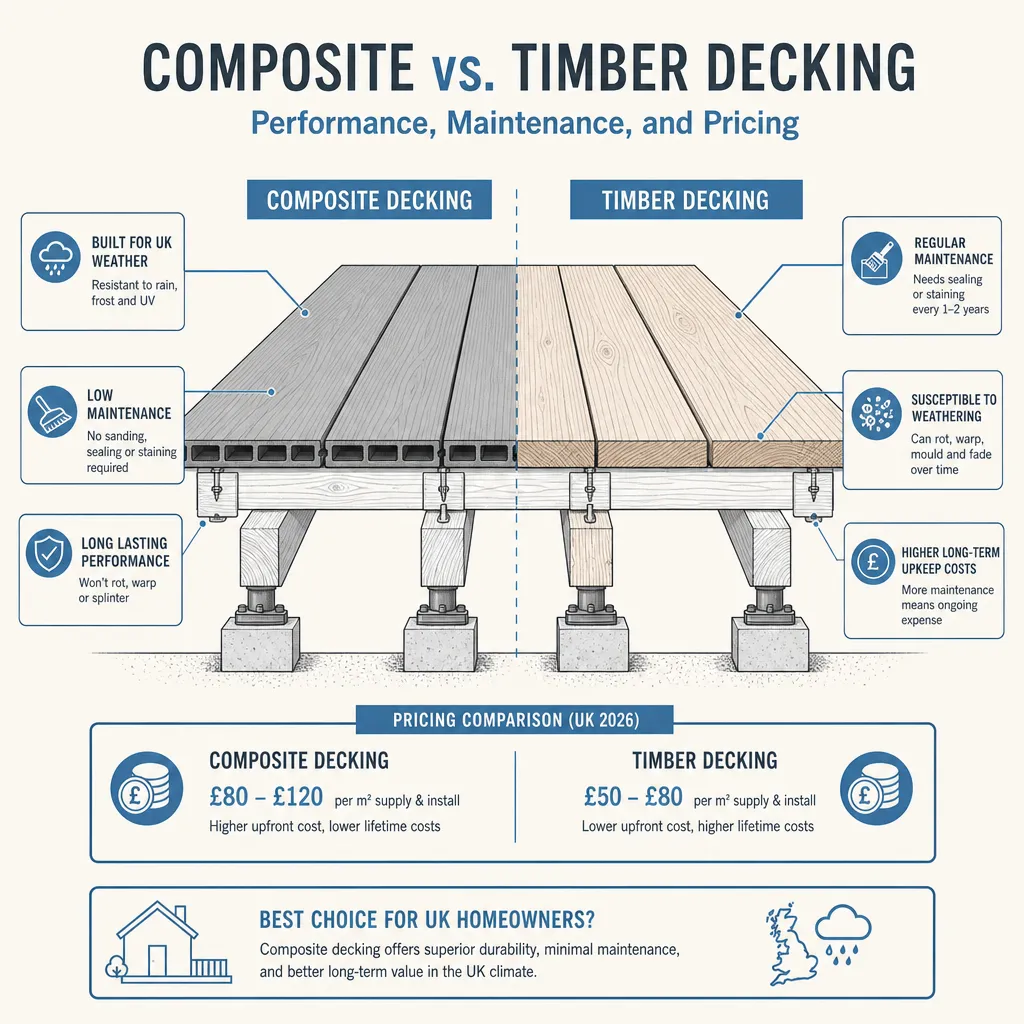
Composite vs. Timber Decking: Performance, Maintenance, and Pricing
Composite decking costs more upfront — typically £120–£220 per m² installed versus £80–£150 for treated softwood — but requires far less maintenance and carries a 25-year warranty.
 Improvement & Build
Replacing a Conservatory Roof: Options, Maintenance, and Costs
Conservatory roofs can be replaced with polycarbonate, glass, or solid tiled systems.
 Improvement & Build
Conservatory Refurbishment: Renovation Options and Investment
Conservatory refurbishment can range from a like-for-like glazing swap to a full solid roof conversion with new frames and flooring.
 Improvement & Build
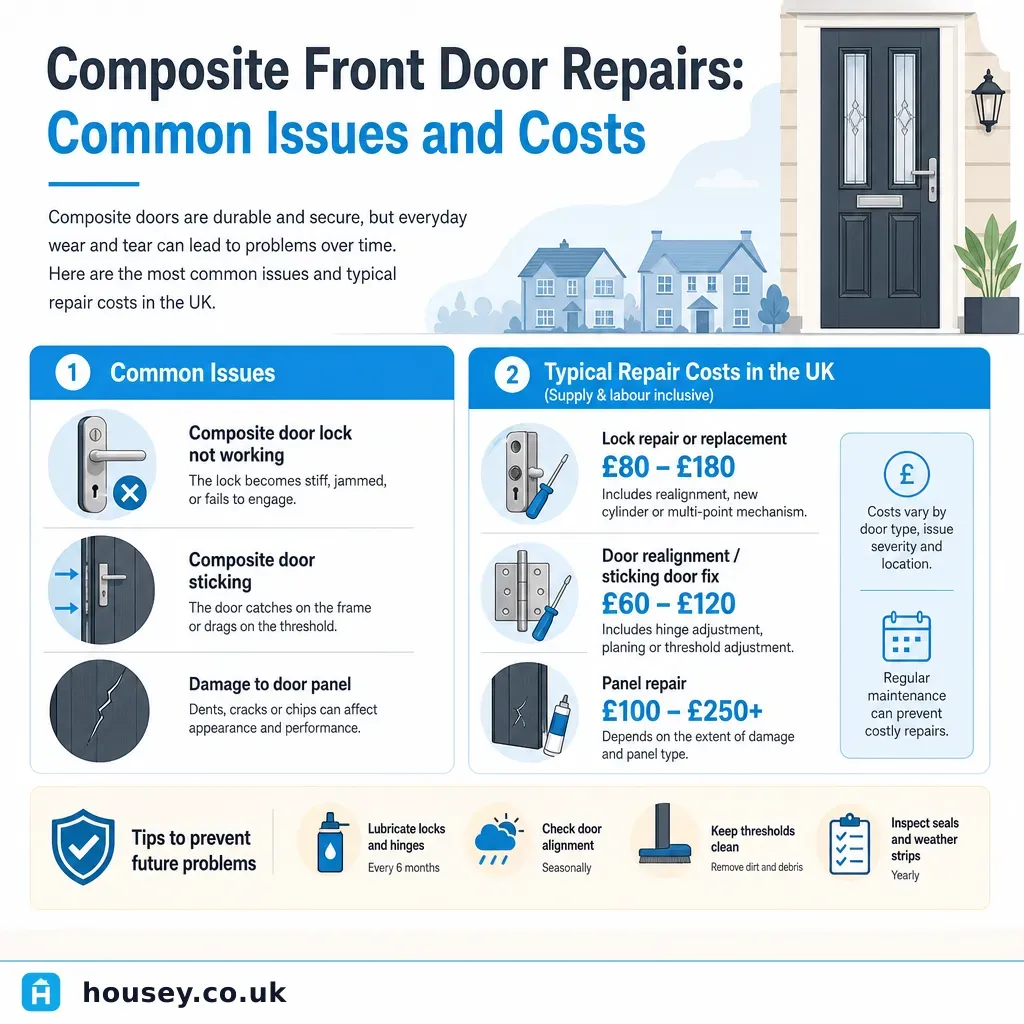
Composite Front Door Repairs: Common Issues and Costs
Common composite front door problems include misalignment, failing perimeter seals, multipoint lock faults, and cosmetic GRP damage.
 Improvement & Build
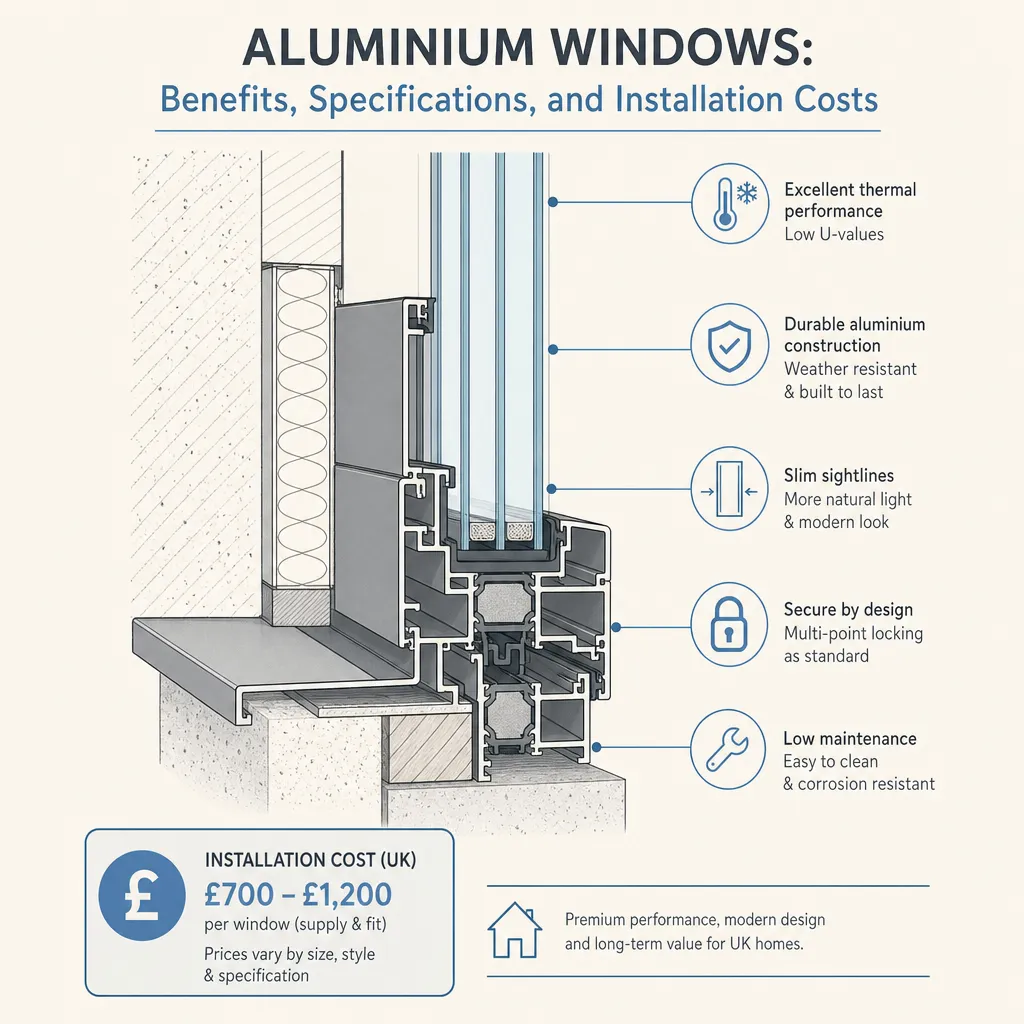
Aluminium Windows: Benefits, Specifications, and Installation Costs
Aluminium windows typically cost £600–£1,800 per window installed in the UK, depending on size and specification.