The Cost of Retrofitting: Access and Equity in Home Energy Upgrades
By Housey · Last reviewed 18th of May 2026
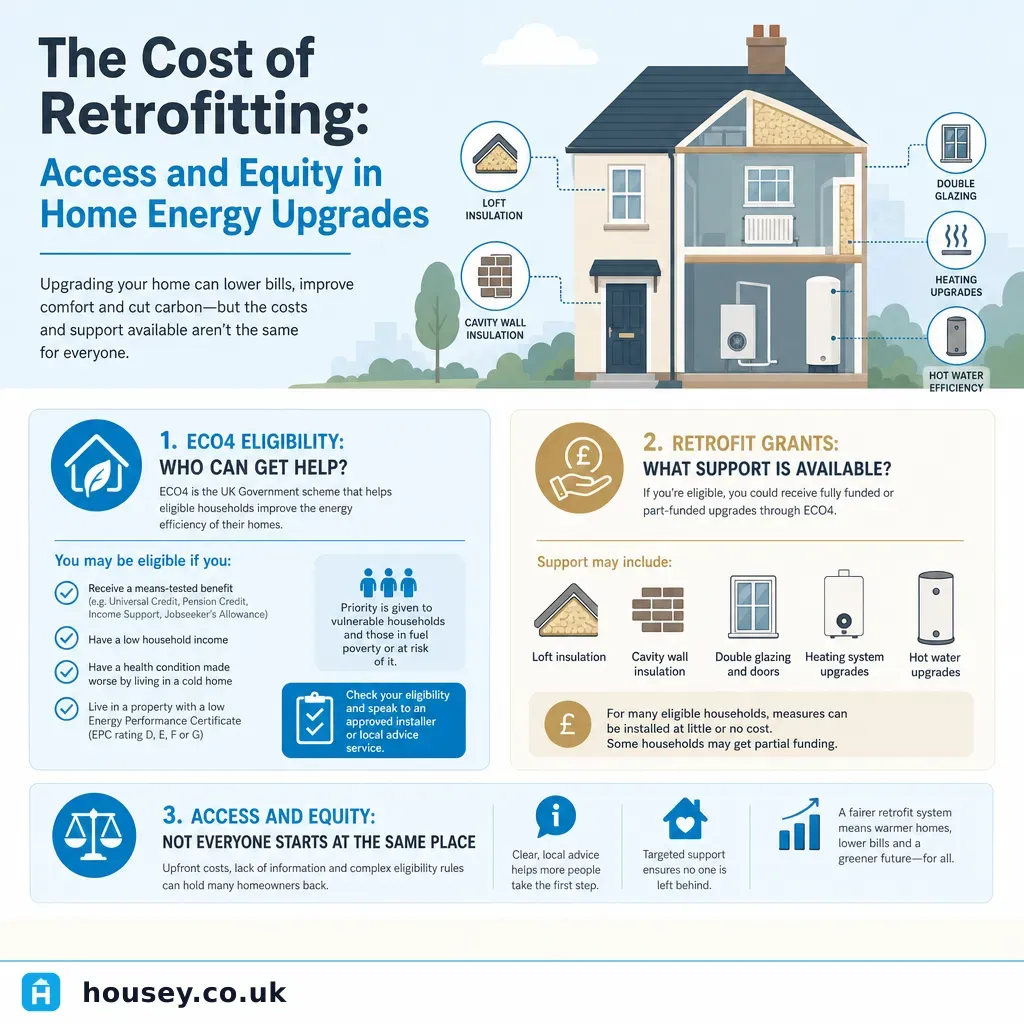
The Cost of Retrofitting: Access and Equity in Home Energy Upgrades
Home energy retrofit sits at the intersection of environmental policy and personal finance — and for many UK homeowners, the upfront cost remains the single biggest obstacle. The question of who can actually afford to upgrade tends to arise when a household receives an energy bill shock, sees a poor EPC rating ahead of a sale or remortgage, or wants to reduce its carbon footprint ahead of tightening regulations. What the funding landscape looks like in practice depends enormously on property type, household income, and local authority area.
Key points
- ECO4, the government's main retrofit grant scheme, covers up to 100% of eligible measure costs for low-income or fuel-poor households with EPC D–G-rated properties.
- The Boiler Upgrade Scheme (BUS) provides a £7,500 grant towards an air source or ground source heat pump for eligible properties in England and Wales.
- The Great British Insulation Scheme (GBIS) targets EPC D–G homes in lower council tax bands (A–D in England) or households receiving certain means-tested benefits.
- PAS 2035, the British Standard for domestic retrofit, requires a qualified Retrofit Coordinator to oversee any publicly funded whole-house retrofit project.
- Solid wall insulation typically costs £8,000–£22,000 per property, making it one of the least affordable measures without grant support (indicative UK costs, last reviewed 2026-05-18).
What retrofit actually costs — and who bears it
The term 'retrofit' covers a wide range of measures, from draught-proofing a Victorian terrace for a few hundred pounds to a full fabric-first package with external wall insulation, a heat pump, and mechanical ventilation costing well over £30,000. The gap between these figures illustrates why access to upgrade works remains deeply uneven across the UK housing stock.
Indicative UK retrofit costs, last reviewed 2026-05-18. Costs vary significantly by property size, type, and location — always obtain multiple quotes from accredited installers.
Measure | Typical cost range | Common grant route |
|---|---|---|
Loft insulation | £300–£600 | GBIS, ECO4 |
Cavity wall insulation | £500–£1,500 | GBIS, ECO4 |
External solid wall insulation | £8,000–£22,000 | ECO4 |
Internal solid wall insulation | £5,500–£12,000 | ECO4 |
Air source heat pump | £8,000–£15,000 | BUS (£7,500 grant) |
Double or triple glazing (whole house) | £5,000–£15,000 | Limited grant support |
Solar PV (3–4 kWp) | £5,000–£9,000 | 0% VAT applies |
Sources: Energy Saving Trust cost estimates; GOV.UK grant scheme pages.
For homeowners who do not qualify for means-tested grants, these sums represent a significant capital outlay — particularly for those in low-equity positions, on fixed incomes, or in leasehold flats where building-level works require collective agreement from all residents or a management company.
The main grant schemes and who qualifies
ECO4 (Energy Company Obligation, phase 4)
ECO4 is the UK government's largest domestic retrofit programme, obliging large energy suppliers to fund insulation, heating, and other efficiency measures in fuel-poor or low-income households. Key eligibility criteria include:
- The property must be rated EPC D, E, F, or G.
- The household must receive certain means-tested benefits — such as Universal Credit, Pension Credit, or Child Tax Credit — or be referred through the ECO4 Flex route via their local authority.
- The proposed measure must be cost-effective under the scheme's scoring rules.
ECO4 can cover 100% of eligible installation costs, making it the most significant route to fully funded retrofit for qualifying households. Applications are made through your energy supplier or an approved ECO4 installer.
Great British Insulation Scheme (GBIS)
GBIS targets a slightly broader group than ECO4, including households in lower council tax bands (A–D in England) as well as those on qualifying benefits. It focuses primarily on insulation measures — loft, cavity wall, and solid wall — rather than heating systems. Eligibility is checked at application; the GOV.UK guidance on GBIS sets out the current criteria in full.
Boiler Upgrade Scheme (BUS)
The Boiler Upgrade Scheme provides a £7,500 grant towards an air source or ground source heat pump in England and Wales. It is open to most owner-occupiers and landlords regardless of income, but applies only where the property holds a valid EPC with no outstanding recommendations for loft or cavity wall insulation (with limited exceptions). The grant is paid directly to the MCS-certified installer and deducted from the quoted price.
Warm Homes Plan and future funding
The UK government's Warm Homes Plan, introduced in 2024, aims to direct further investment into home insulation and low-carbon heating, with a focus on households in fuel poverty. Schemes and eligibility thresholds are subject to change; the Energy Saving Trust and GOV.UK maintain up-to-date information on current and forthcoming programmes.
Who is left out — and why
Grant schemes have meaningful coverage gaps:
- Owner-occupiers above income thresholds who do not qualify for means-tested routes face full market costs, with limited alternatives beyond 0% VAT on energy-saving materials and installations.
- Leaseholders in flats often require landlord or management company consent, and building-level works such as external wall insulation require collective agreement that is difficult to coordinate.
- Homeowners in rural or hard-to-treat areas may face higher contractor costs, fewer approved installers, and greater difficulty meeting scheme requirements.
- Properties with non-standard construction — timber frame, solid stone, listed buildings — often require bespoke solutions that standard grant frameworks do not readily accommodate.
Which funding route might apply to you?
- Choose ECO4 if your household receives Universal Credit, Pension Credit, or another means-tested benefit and your property is rated EPC D–G. Apply via your energy supplier or an approved ECO4 installer.
- Check GBIS if your property is rated EPC D–G and you are in council tax band A–D (England) but do not receive qualifying benefits. Apply via your energy supplier.
- Check the Boiler Upgrade Scheme if you want to replace a gas or oil boiler with a heat pump, regardless of income. Apply via an MCS-certified installer who will manage the grant application on your behalf.
- If you do not qualify for any grant scheme, consider a retrofit assessment to prioritise measures by payback period, and explore green mortgage or unsecured green loan products available from some lenders.
- If you are a social housing tenant, contact your landlord — social landlords have separate obligations and funding routes that differ from the private market.
- Ask your local authority about ECO4 Flex referrals if you are on a low income but do not currently receive qualifying means-tested benefits.
What a retrofit assessment can tell you
Before committing to any measure, a professional retrofit assessment — carried out under PAS 2035 by a qualified assessor — identifies your property's current thermal performance, recommends a sequenced improvement plan, and flags moisture or ventilation risks that can arise if measures are installed in the wrong order. This is especially important for solid-wall properties and older homes built before cavity walls became standard practice in UK construction.
An insulation assessment can confirm whether your walls are suitable for cavity fill before you commission works, potentially saving the cost of a survey that leads to an abortive installation.
When to get professional help
A qualified energy-efficiency consultant can help you navigate the grant landscape, review your current EPC, and identify which measures are most cost-effective for your property before you commit to any scheme or installer.
Seek professional input if:
- Your property is pre-1919, solid-walled, or of non-standard construction.
- You have experienced damp, condensation, or mould — these problems can worsen if insulation or airtightness measures are added without sufficient ventilation improvements.
- You are considering a heat pump, where correct sizing depends on a detailed heat loss calculation carried out during a heat pump survey.
- You are unsure which grant scheme, if any, applies to your household and property.
How Housey can help
Housey connects UK homeowners with qualified retrofit assessors and energy-efficiency consultants who can review your property, confirm grant eligibility, and provide independent advice before you spend. Browse retrofit assessments and insulation assessments to find accredited specialists in your area.
Frequently asked questions
Can I get a retrofit grant if I own my home outright?
Ownership does not affect ECO4 or GBIS eligibility — what matters is your household income or benefits status and your EPC rating. For heat pumps, the Boiler Upgrade Scheme is open to most owner-occupiers regardless of income, subject to scheme conditions such as holding a valid EPC with no outstanding loft or cavity wall insulation recommendations.
What happens if my property does not qualify for any retrofit grant?
If you do not meet ECO4 or GBIS criteria, energy-saving installations such as insulation and heat pumps are currently subject to 0% VAT. Some lenders offer green mortgage products or unsecured green loans for retrofit works. A retrofit assessor can help you prioritise measures with the best payback period given your available budget.
Does a poor EPC rating affect my mortgage or remortgage?
Some lenders factor EPC ratings into their mortgage products — green mortgages may offer preferential rates for EPC A–C properties. A low rating rarely blocks a mortgage outright, but it may narrow the range of products available to you. Speak to a mortgage broker if you are concerned about how your property's energy rating affects your financing options.
How long does a whole-house retrofit project take from assessment to completion?
Simple single measures such as loft or cavity wall insulation can usually be installed in a day once a contractor is appointed. A whole-house retrofit under PAS 2035 — involving a Retrofit Coordinator, full assessment, design, and staged installation — typically takes several months from initial assessment to final works, depending on measure complexity and installer availability.
Sources and further reading
- ECO4 scheme: improve your home's energy efficiency — GOV.UK
- Great British Insulation Scheme — GOV.UK
- Boiler Upgrade Scheme: apply for a grant — GOV.UK
- Grants and schemes for homeowners — Energy Saving Trust
- PAS 2035: Retrofitting dwellings for improved energy efficiency — BSI / TrustMark
Useful next reads
 Energy & Retrofit
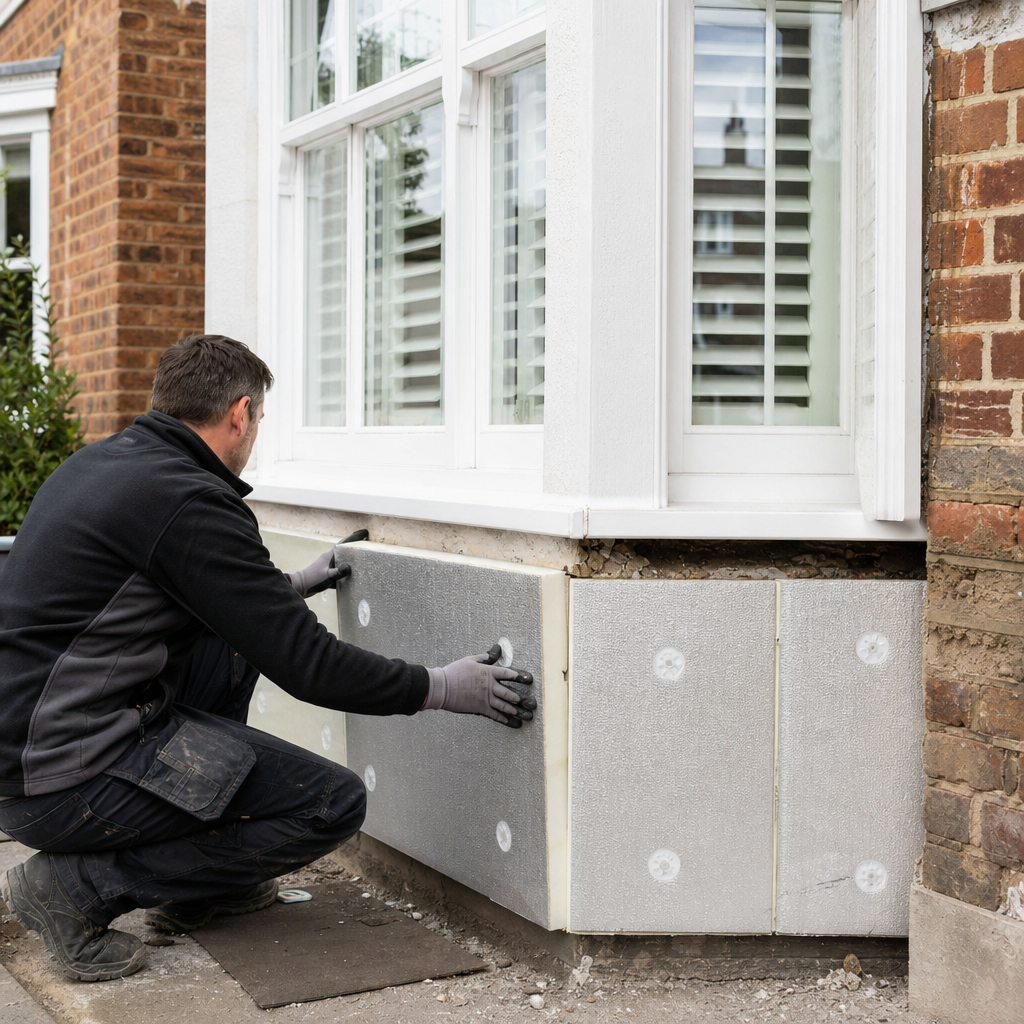
Insulating Solid Masonry Walls Under Bay Windows: Technical Guidance
Insulating solid masonry walls under bay windows requires specialist detailing at angled wall faces, window reveals, and the bay floor and ceiling junctions.
 Energy & Retrofit
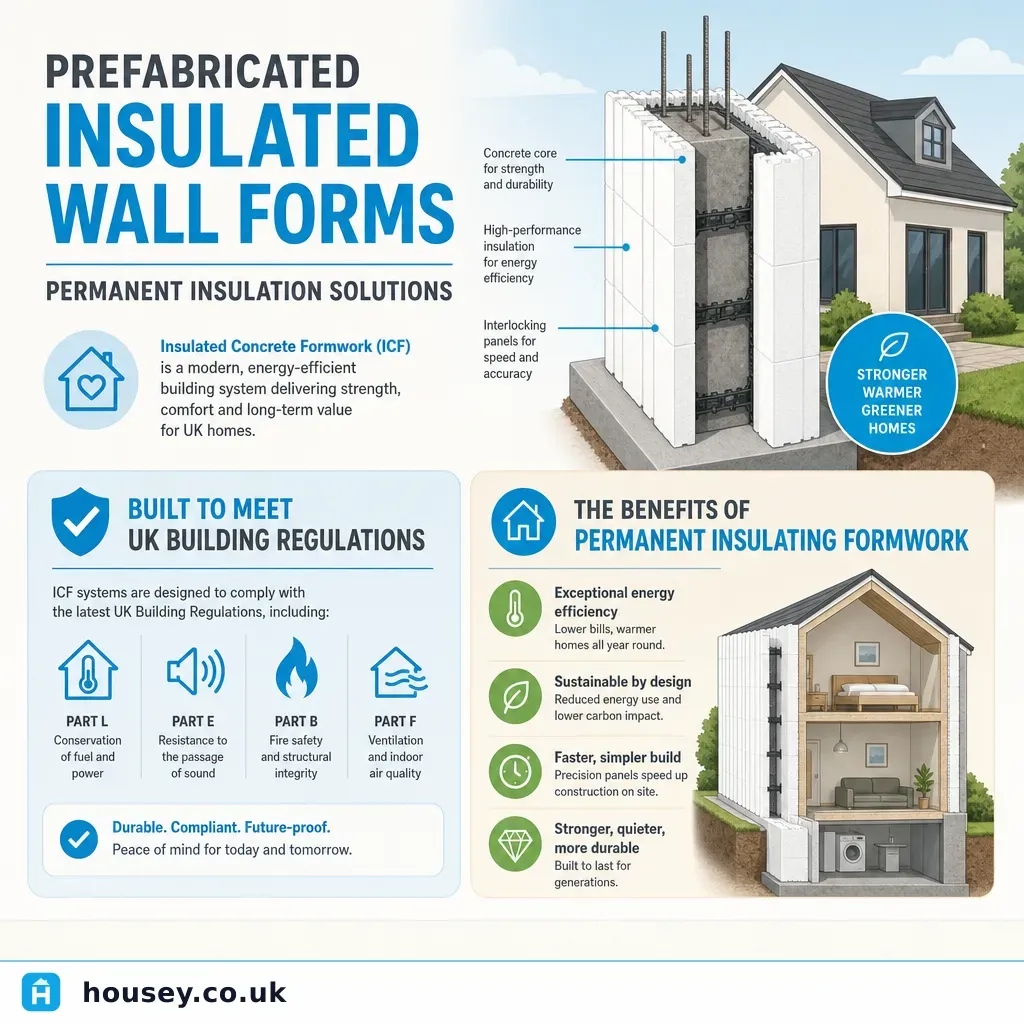
Prefabricated Insulated Wall Forms: Permanent Insulation Solutions
Prefabricated insulated wall forms — including ICF and SIPs systems — deliver high thermal performance by combining permanent insulation with structural concrete or timber in a single wall assembly.
 Energy & Retrofit
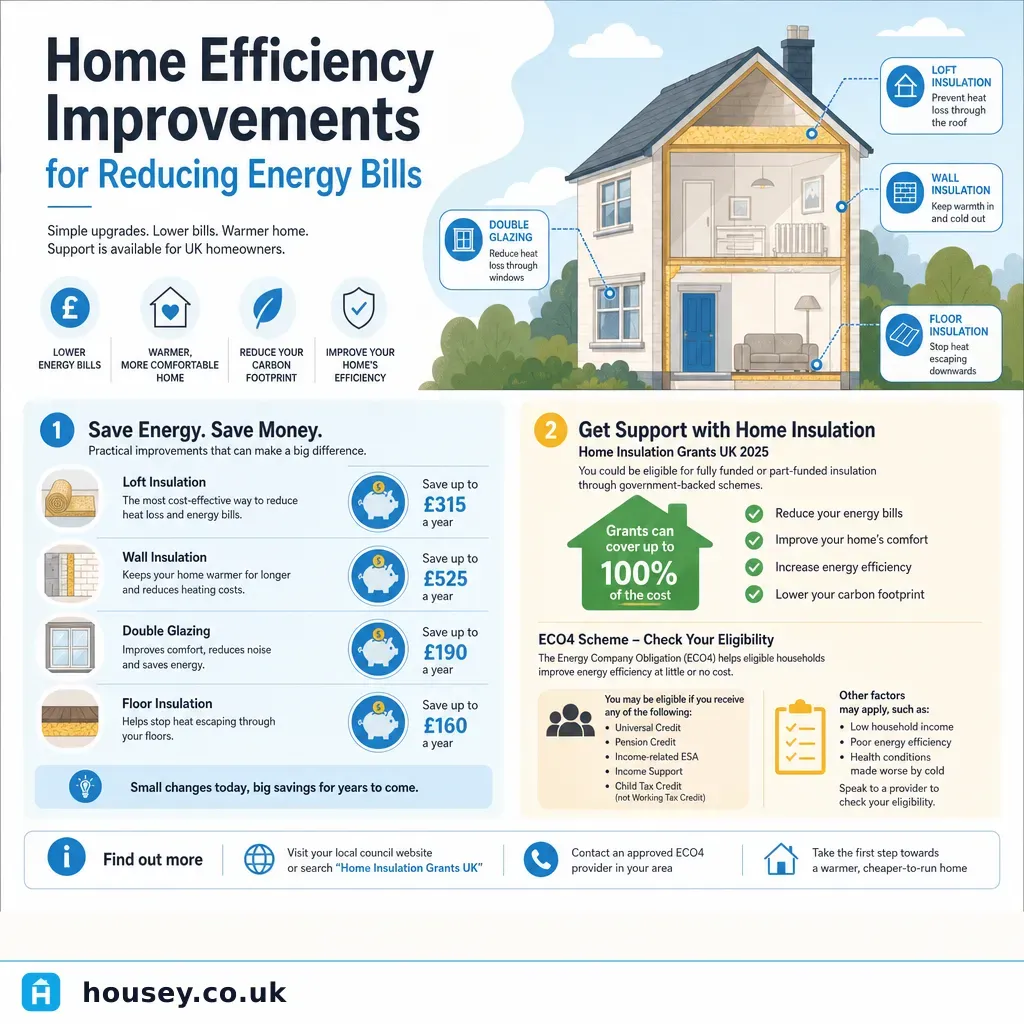
Home Efficiency Improvements for Reducing Energy Bills
The most cost-effective UK home efficiency improvements are usually loft insulation, cavity wall insulation, draught-proofing, and upgrading heating controls.
 Energy & Retrofit
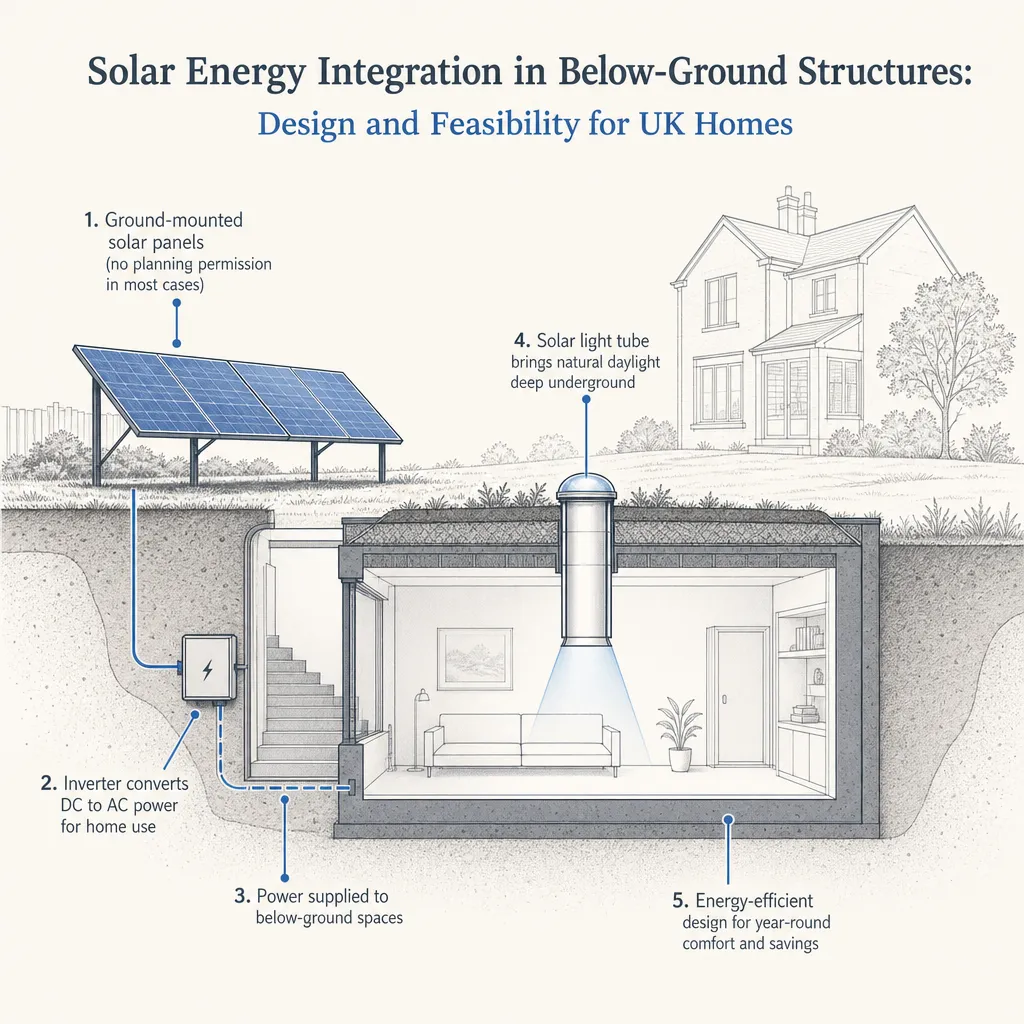
Solar Energy Integration in Below-Ground Structures: Design and Feasibility
Below-ground structures cannot host solar panels on their own roofs but can use surface-mounted panels connected via cable runs, solar light tubes for daylighting, and battery storage.
 Energy & Retrofit
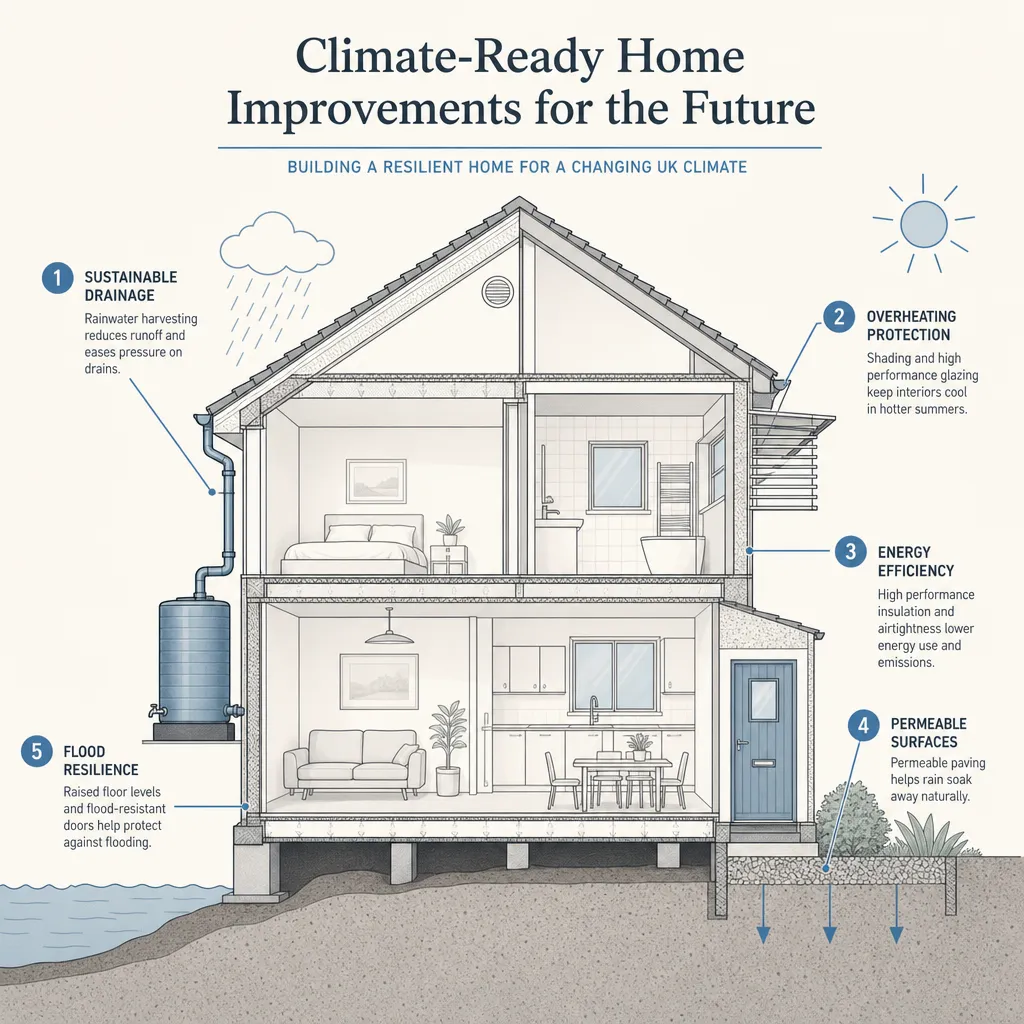
Climate-Ready Home Improvements for the Future
Climate-ready home improvements tackle four main risks for UK properties: overheating, increased rainfall and flooding, storm damage, and energy cost volatility.