Solar Energy Integration in Below-Ground Structures: Design and Feasibility
By Housey · Last reviewed 24th of May 2026
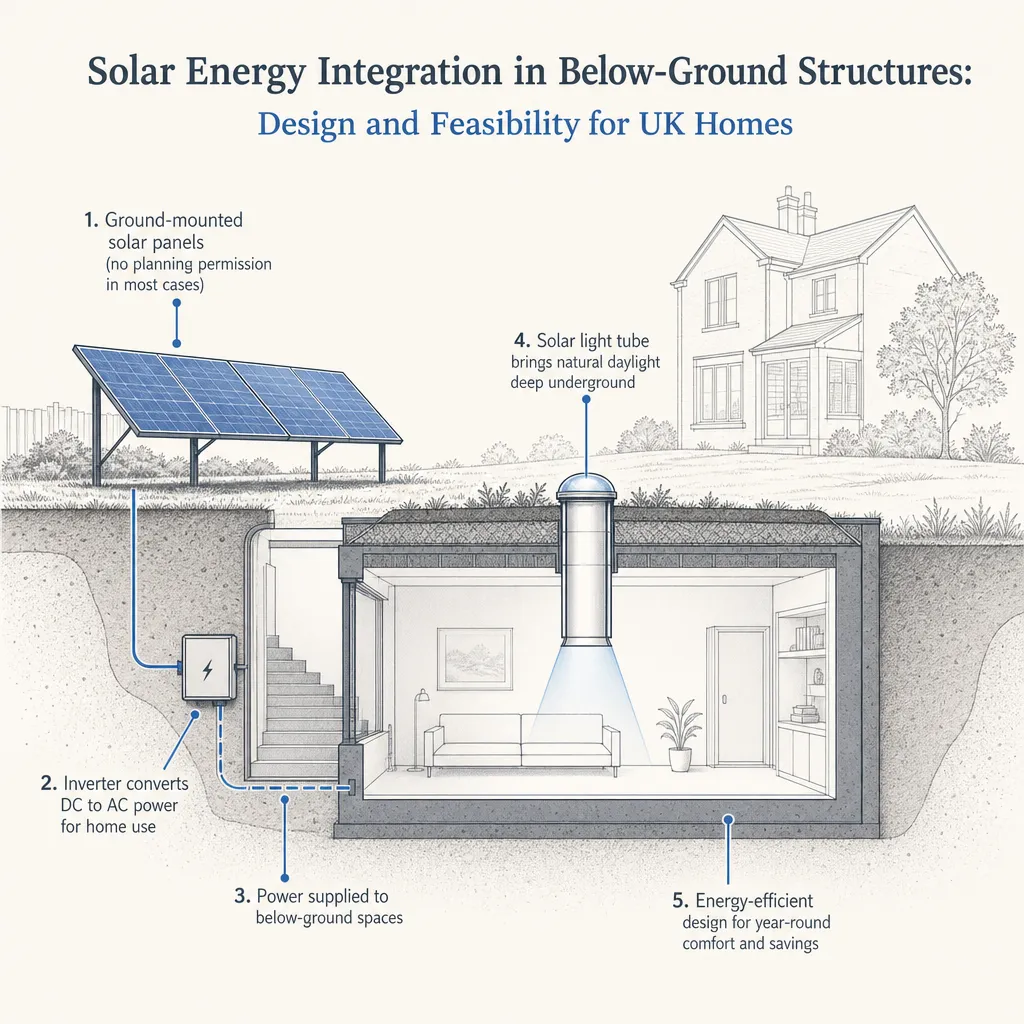
Solar Energy Integration in Below-Ground Structures: Design and Feasibility
As basement extensions, earth-sheltered homes, and underground utility spaces become more common in UK residential projects, questions about incorporating solar energy arise during the design and planning stage. The fundamental challenge is straightforward: solar photovoltaic (PV) panels require direct sunlight, which a fully buried structure cannot provide from its own footprint. Understanding the realistic options — and their planning, MCS certification, and structural implications — before committing to a specification can save significant cost and disappointment.
Key points
- Solar PV panels cannot be installed directly above a fully below-ground structure but can be mounted on any adjacent surface-level area — a roof, ground-level terrace, or outbuilding — and connected via cable runs to power the underground space.
- The Smart Export Guarantee (SEG), which replaced the Feed-in Tariff, is available for qualifying MCS-certified solar PV systems regardless of whether the property includes below-ground space.
- In England, roof-mounted solar panels on most residential properties are permitted development under Schedule 2, Part 14 of the Town and Country Planning (General Permitted Development) (England) Order 2015, subject to conditions; conservation areas and listed buildings are exceptions.
- Solar thermal panels — which heat water rather than generate electricity — are often simpler to integrate with a below-ground plant room, utility space, or swimming pool than a full PV system.
- Solar light tubes (tubular daylighting devices) channel daylight into below-ground rooms via a reflective tube and roof-mounted dome; they reduce artificial lighting energy demand but do not generate electricity.
Why below-ground structures create a solar design challenge
A standard solar PV or thermal panel requires an unobstructed, southerly-facing surface with good direct sunlight exposure. A fully buried structure has no such surface. The practical solution used in most UK residential projects is a distributed solar design: panels are sited at ground level or on an adjacent structure, and cabling or pipework routes the energy or heat down into the underground space.
This approach works well for basement extensions where the main house has a south-facing roof, earth-sheltered homes with an exposed south-facing wall or terrace, and underground utility or plant rooms served by a solar system installed elsewhere on the site.
Solar integration methods: comparison
Method | Best for | Not ideal for | Planning considerations | Typical professional |
|---|---|---|---|---|
Roof-mounted PV on main house, powering underground space | Basement extensions below an existing house with a suitable roof | Standalone underground structures with no surface building | Usually permitted development on residential roofs | MCS-certified solar PV installer |
Ground-mounted PV array | Rural plots with open land, earth-sheltered homes with adjacent clear ground | Urban gardens with limited space or heavy shading | May need planning permission depending on size and siting | MCS-certified solar PV installer |
Solar thermal (roof or ground-mounted) | Plant rooms, utility spaces, underground hot-water storage, swimming pools | Where electricity generation is the primary goal | Usually permitted development; similar rules to PV | MCS-certified solar thermal installer |
Solar light tubes (tubular daylighting) | Reducing lighting energy demand in below-ground rooms | Replacing electricity generation | Typically no planning permission needed | Specialist installer or competent builder |
Battery storage paired with surface PV | Storing daytime generation for use in underground spaces at night or on overcast days | Standalone use without a connected generation source | No separate planning requirement | MCS-certified installer or registered electrician |
Which solar approach suits your project?
Use this decision guide to match your situation to the right strategy:
- Choose roof-mounted PV on the main house if your property has a south-facing pitched roof in reasonable condition, a basement extension below, and you want to maximise electricity generation and Smart Export Guarantee income.
- Choose ground-mounted PV if you have a standalone or earth-sheltered underground structure with adjacent open land, minimal shading to the south, and sufficient ground area for an array.
- Choose solar thermal if your primary need is hot water for an underground space — a swimming pool, wet room, or plant room — and you prefer a lower-capital-cost system than full PV.
- Choose solar light tubes if your main challenge is daylighting rather than electricity generation; these can substantially reduce artificial lighting loads and combine well with any of the above strategies.
- Ask a solar surveyor and a structural engineer if you are uncertain about roof condition, solar resource, shading analysis, or how cables or pipework can be safely routed through the building envelope.
Planning permission and permitted development
In England, solar PV and solar thermal panels on residential properties generally benefit from permitted development rights under Schedule 2, Part 14 of the Town and Country Planning (General Permitted Development) (England) Order 2015, provided:
- Panels on a pitched roof do not protrude more than 200 mm beyond the roof slope.
- On a flat roof, panels are no higher than 1 m above the highest part of the roof (excluding chimneys).
- The property is not in a conservation area or World Heritage Site, where additional restrictions apply.
- The property is not a listed building, which requires separate listed building consent.
Ground-mounted panels are also often permitted development but are subject to different criteria, including size limits and distance from the property boundary. Check the GOV.UK guidance on permitted development rights for householders for your specific situation before commissioning any installation.
Cable routing and structural considerations
Connecting a surface solar system to a below-ground space requires careful planning of cable routes and penetrations:
- All DC and AC cabling must comply with BS 7671 (IET Wiring Regulations, 18th Edition) and be installed by a registered electrician (NICEIC or NAPIT) working alongside the solar installer.
- Any penetration through the external envelope of a below-ground structure — particularly through a waterproofing membrane — must be made without compromising structural waterproofing integrity. This is a specialist task: consult the waterproofing manufacturer or a structural waterproofing designer before specifying penetration details.
- In a new-build below-ground project, conduits for future cable or pipework routing should be incorporated during the structural design phase, with puddle flanges or proprietary sealing systems at wall penetrations.
- Where an existing basement is being retrofitted, a structural engineer should advise on any penetrations through retaining walls or floor slabs before a solar installer attempts to route cabling.
When to get professional help
Solar integration for a below-ground project involves at least two disciplines: a solar PV or thermal designer and a structural or waterproofing specialist. Seek professional advice if:
- You are uncertain about solar resource, shading, or orientation — a solar survey will model actual site yield before you commit.
- Cable routing requires penetration of a basement waterproofing system or a retaining structure.
- Your property is listed or in a conservation area and permitted development rights do not apply.
- You intend to claim the Smart Export Guarantee — MCS certification of the system is a requirement.
- The below-ground structure was not designed with solar integration in mind and no conduit routes exist.
How Housey can help
Housey can connect you with experienced solar surveyors who will assess your site's solar potential, recommend the most practical integration strategy for your below-ground project, and clarify planning and MCS requirements before any installation begins.
Frequently asked questions
Can I get the Smart Export Guarantee for a solar system serving an underground room?
Yes, provided the system meets MCS certification requirements and is connected to the grid via a qualifying smart export meter. The Smart Export Guarantee applies to the generating system itself, not to where within the property the electricity is used. Any MCS-certified system installed on a residential property can qualify, regardless of whether part of the property is below ground.
Do I need planning permission for solar panels that power a basement?
In most cases, roof-mounted solar panels on a standard residential property are permitted development in England and do not require planning permission. Ground-mounted systems may need permission depending on size and location. Conservation areas and listed buildings have additional restrictions. Always check with your local planning authority if you are unsure whether permitted development applies to your site.
What is the best way to bring natural light into an underground room?
Solar light tubes (tubular daylighting devices) are the most practical solution for rooms directly below a roof. They use a highly reflective tube to channel daylight from a roof-mounted dome into a below-ground or internal space, significantly reducing dependence on artificial lighting. They do not generate electricity but can substantially reduce lighting energy consumption and improve the liveability of underground rooms.
How do I find an MCS-certified solar installer?
The Microgeneration Certification Scheme (MCS) maintains a searchable database of certified solar installers at mcscertified.com. MCS certification is a requirement for systems qualifying for the Smart Export Guarantee. Always verify an installer's current certification status directly with MCS before signing a contract, as certification can lapse if annual assessments are not maintained.
Sources and further reading
- Smart Export Guarantee guidance — GOV.UK
- Permitted development rights for householders — technical guidance — GOV.UK Planning Portal
- Microgeneration Certification Scheme — MCS
- Solar panels for your home — Energy Saving Trust
- BS 7671 IET Wiring Regulations — IET
Useful next reads
 Energy & Retrofit
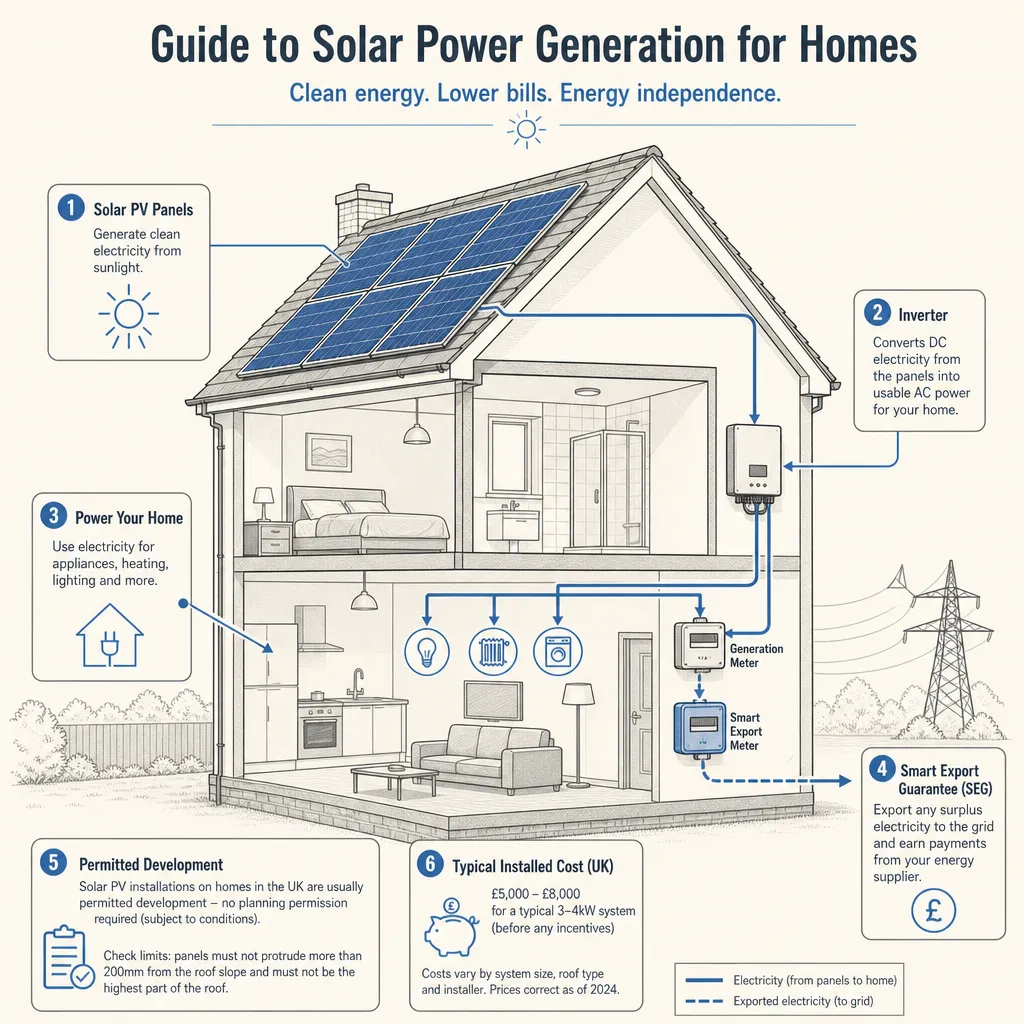
Guide to Solar Power Generation for Homes
Solar photovoltaic (PV) panels convert daylight into electricity and export surplus to the grid via the Smart Export Guarantee (SEG).
 Energy & Retrofit
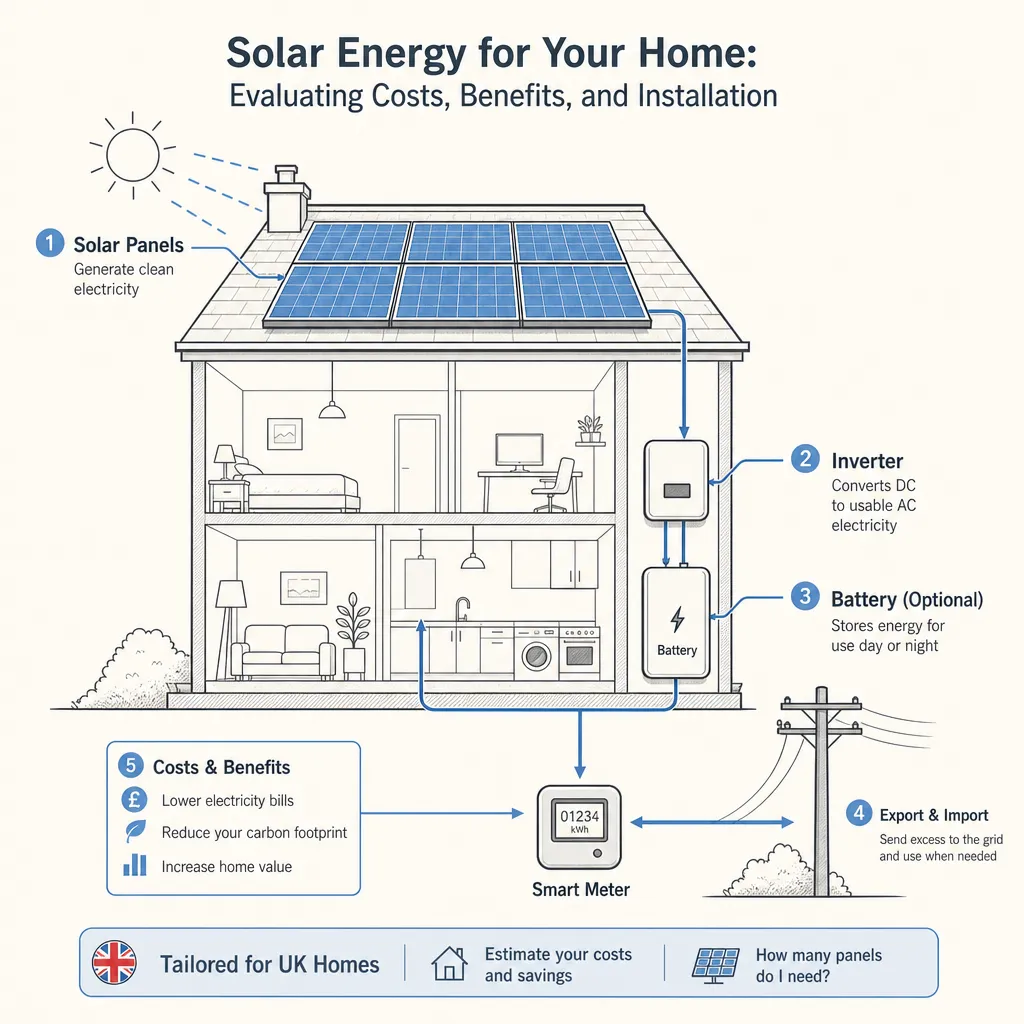
Solar Energy for Your Home: Evaluating Costs, Benefits, and Installation
A typical UK home solar PV system of 3–4 kWp costs approximately £5,000–£8,000 fully installed and can generate 2,600–3,800 kWh per year, covering 40–60% of average household electricity use.
 Energy & Retrofit
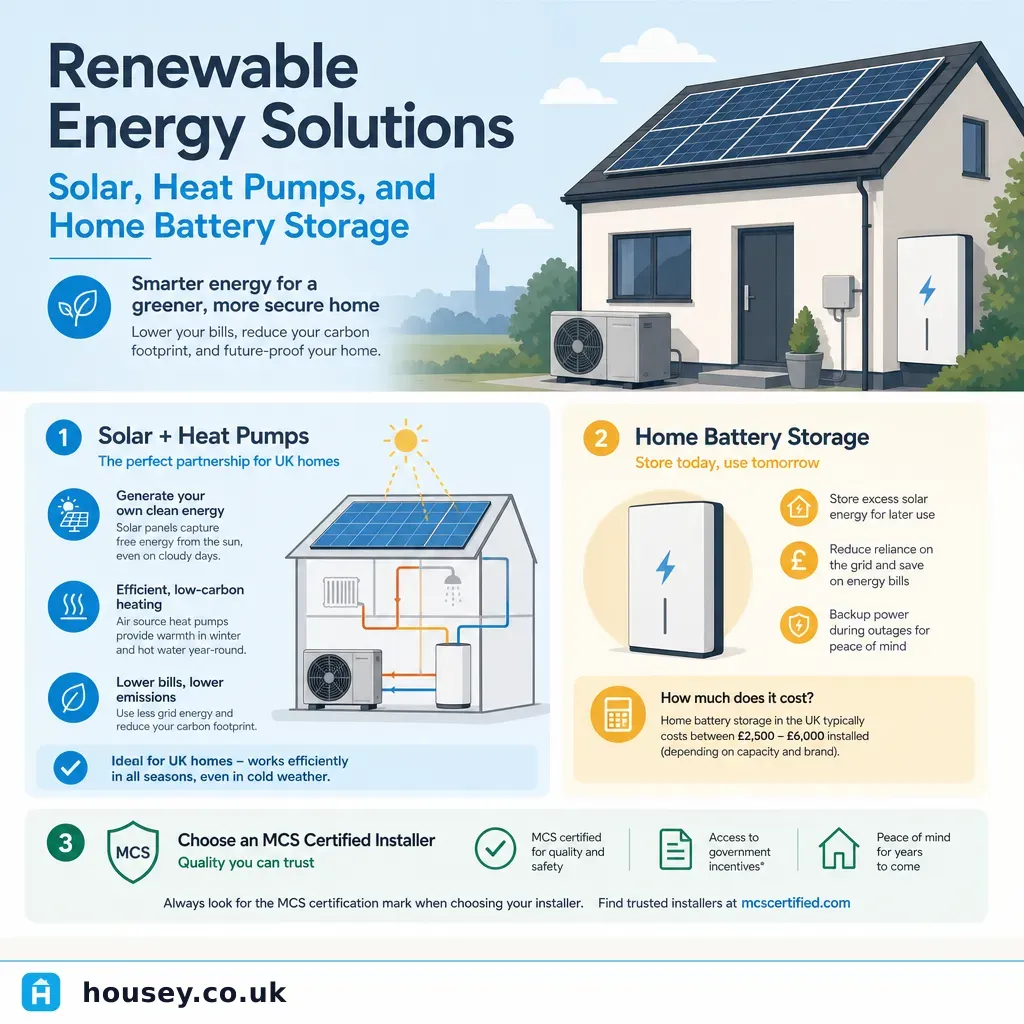
Renewable Energy Solutions: Solar, Heat Pumps, and Home Battery Storage
UK homeowners can reduce energy bills and carbon emissions by combining solar PV panels, air source heat pumps, and home battery storage.
 Energy & Retrofit
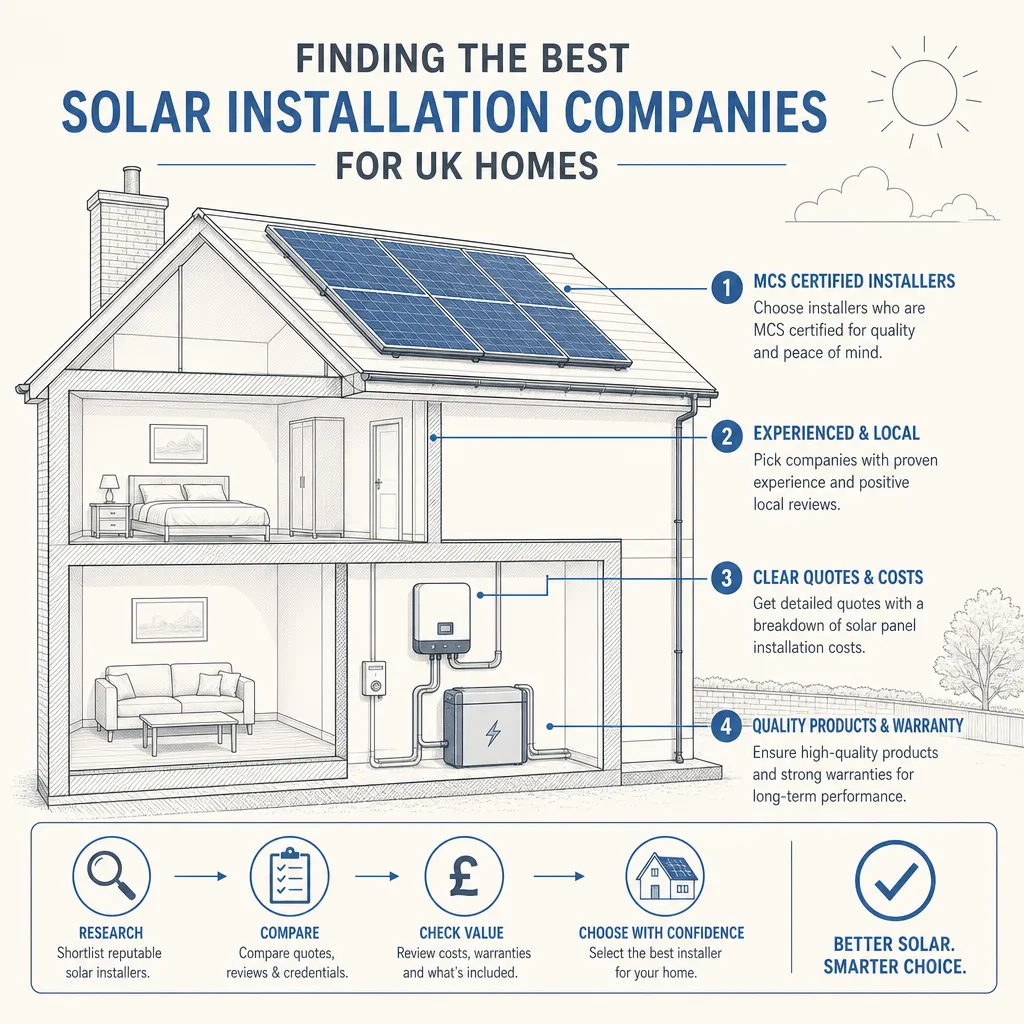
Finding the Best Solar Installation Companies for UK Homes
To find a reliable solar installation company in the UK, look for MCS (Microgeneration Certification Scheme) certification — required for Smart Export Guarantee eligibility — plus NICEIC or NAPIT electrical registration.
 Energy & Retrofit
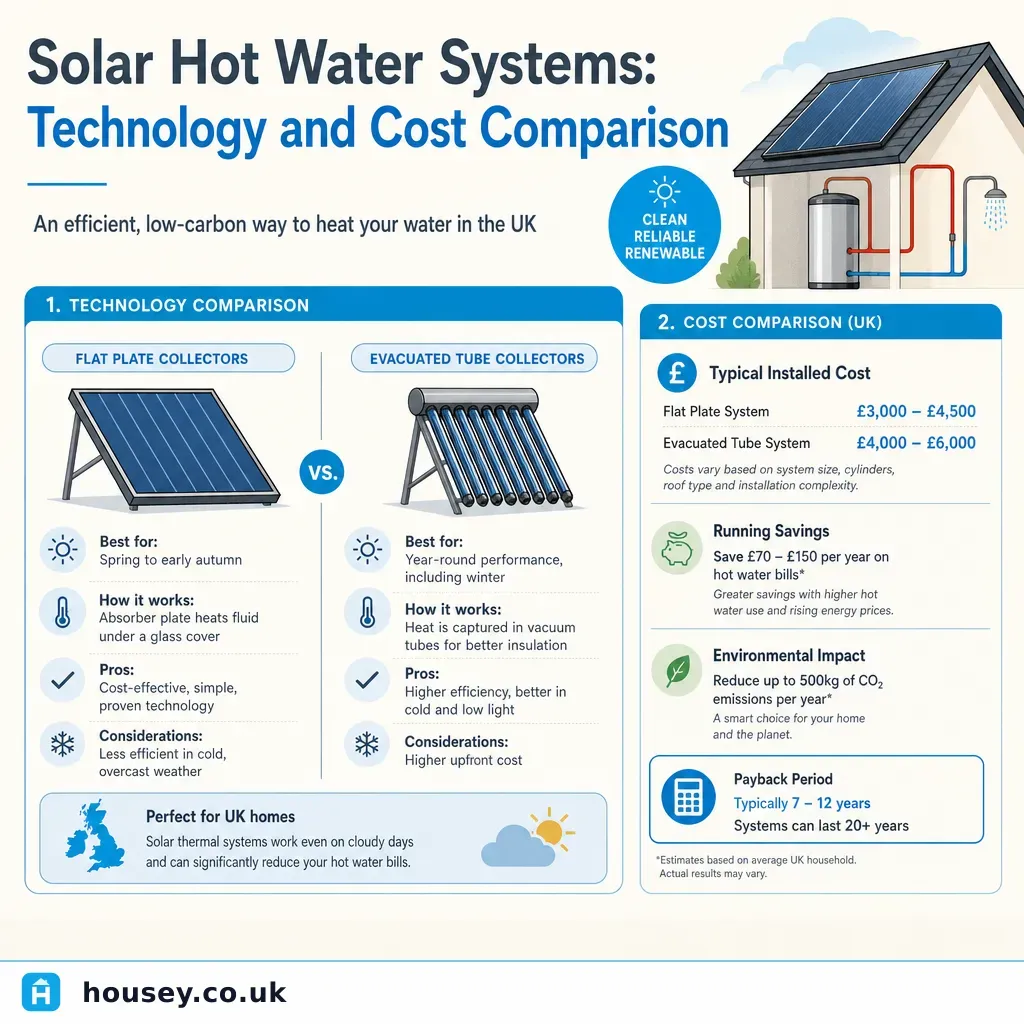
Solar Hot Water Systems: Technology and Cost Comparison
Solar thermal systems use roof-mounted collectors to heat domestic hot water via a glycol circuit and twin-coil cylinder.