Prefabricated Insulated Wall Forms: Permanent Insulation Solutions
By Housey · Last reviewed 24th of May 2026
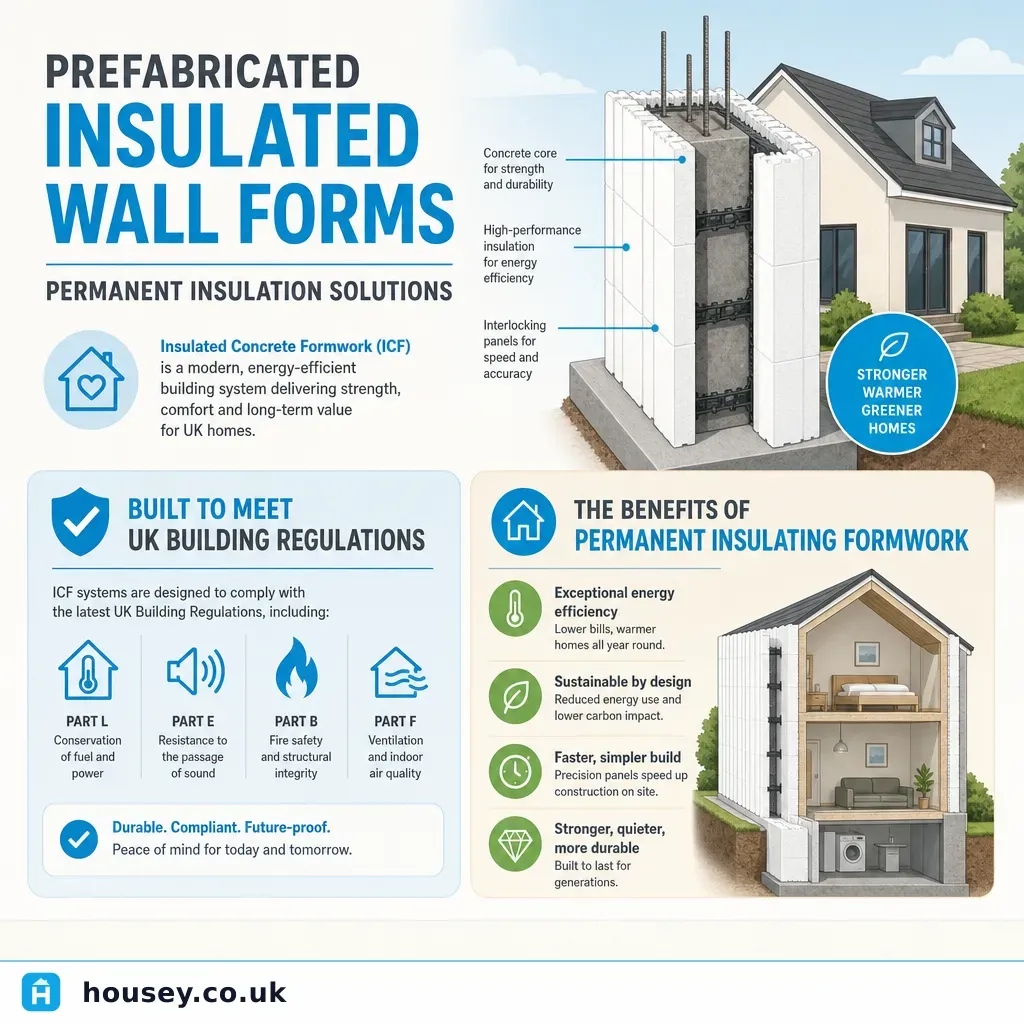
Prefabricated Insulated Wall Forms: Permanent Insulation Solutions
Prefabricated insulated wall forms — most commonly known as Insulated Concrete Formwork (ICF) or Permanent Insulating Formwork (PIF) — combine structural and thermal functions in a single wall system. They are used in new-build construction and, increasingly, as part of retrofit strategies for upgrading the thermal envelope of existing UK homes. The decision to specify them carries implications for Building Regulations compliance, moisture management, and long-term energy performance that homeowners and their builders need to understand carefully before committing to a system.
Key points
- ICF systems typically achieve wall U-values of 0.15–0.25 W/m²K depending on insulation thickness, meeting or exceeding the Building Regulations Part L1A target of 0.18 W/m²K for external walls in new dwellings in England (2021 edition).
- Retrofit external wall insulation systems must comply with PAS 2035:2019+A1:2023 when installed under publicly funded schemes such as ECO4 or the Great British Insulation Scheme (GBIS) — this requires a TrustMark-registered Retrofit Coordinator.
- Moisture risk in solid-wall retrofit is one of the leading causes of premature insulation failure — adding insulation to a wall with existing damp, without a hygrothermal assessment, can trap moisture and cause structural damage.
- ICF systems produce a highly airtight building envelope; without adequate mechanical ventilation (MVHR or MEV), indoor air quality can deteriorate and interstitial condensation risk increases significantly.
- Some ICF and PIW systems carry British Board of Agrément (BBA) certificates — specifying a certificated system is important for building control approval and mortgage or structural warranty purposes.
Important limitations
This article provides general information about insulated wall form systems and the regulatory framework. It does not constitute structural, thermal, or retrofit design advice. Moisture risk is highly property-specific — a system that performs well in one building may cause damage in another depending on orientation, exposure, occupancy, and existing wall construction. Always engage a qualified Retrofit Coordinator (PAS 2035), structural engineer, or suitably qualified building designer before specifying or installing any permanent insulation system.
When this becomes urgent
- If an existing wall insulation system is showing signs of damp penetration, cold spots on thermal imaging, or internal mould growth, seek professional assessment immediately — do not simply add more insulation over the existing system.
- If a contractor proposes installing any wall insulation on a solid-wall property without a prior moisture risk assessment, treat this as a red flag and seek a second opinion before proceeding.
- If building control has queried the thermal or structural specification of an ICF scheme, obtain qualified professional advice before continuing work.
What are prefabricated insulated wall forms?
ICF systems consist of interlocking hollow blocks or panels made from expanded polystyrene (EPS) or similar rigid foam insulation. The blocks are stacked to form the wall geometry, steel reinforcement is placed inside, and concrete is poured to fill the cavity and form a solid, insulated, reinforced wall. Once cured, the insulation remains permanently in place as the wall's thermal envelope — unlike traditional formwork, which is stripped and removed after the concrete sets.
Prefabricated insulated wall (PIW) is a broader term encompassing factory-manufactured wall panels with insulation already incorporated — such as structural insulated panels (SIPs), insulated timber frames, or composite systems with an insulated core. These are delivered to site ready to erect, reducing on-site labour and programme time compared with in-situ methods.
Both systems share the aim of delivering a continuous, thermally efficient wall envelope with minimal cold bridging — a key weakness of traditional UK cavity wall construction where insulation batts can be poorly fitted or compressed during installation.
Comparison: insulated wall form systems
System | Best for | Typical U-value (W/m²K) | Build speed | Main risk | BBA or ETA certification |
|---|---|---|---|---|---|
ICF (EPS blocks, poured concrete) | New build, basement walls, extensions | 0.15–0.25 | Moderate | Moisture if inadequately ventilated; requires concrete pour | Many systems — check manufacturer |
SIPs (Structural Insulated Panels) | New build, extensions, loft conversions | 0.18–0.28 | Fast (factory-made) | Airtightness requires careful jointing; moisture at panel junctions | Available — check system certificate |
Insulated timber frame (PIW) | New build, off-site manufacture | 0.18–0.30 | Fast | Fire performance of cavity barriers; timber shrinkage | NHBC or BBA accepted |
External Wall Insulation (EWI) retrofit | Solid-wall retrofit, cavity wall top-up | 0.30 or better depending on existing wall | Slower — requires render or cladding finish | Moisture trapping in existing wall; PAS 2035 required for funded schemes | BBA certificates for specific systems |
Indicative data, last reviewed 2026-05-24. U-values depend on insulation thickness and system configuration. Obtain manufacturer data and building control confirmation for your specific scheme.
Building Regulations and compliance
Any new-build using ICF or PIW systems in England must comply with Building Regulations, including:
- Part A (Structure): the structural capacity of the concrete core must be demonstrated, usually via manufacturer structural calculations submitted to building control.
- Part L (Conservation of fuel and power): Part L1A (new dwellings) requires SAP (Standard Assessment Procedure) calculations; the notional U-value for external walls should not exceed 0.18 W/m²K. ICF systems routinely meet this target.
- Part F (Ventilation): a high-performance airtight envelope — a common feature of ICF construction — requires mechanical ventilation. Part F1 applies to new dwellings and must be designed before the specification is finalised.
- Part B (Fire safety): EPS insulation within wall forms must meet fire performance requirements; cavity barriers must be correctly specified and installed throughout.
For retrofit EWI projects under publicly funded schemes (ECO4, GBIS), PAS 2035:2019+A1:2023 compliance is mandatory. This requires a whole-house retrofit assessment, a TrustMark-registered Retrofit Coordinator, and a TrustMark-registered Retrofit Installer.
Moisture risk and hygrothermal assessment
Moisture is the most significant risk with any insulation system applied to an existing wall. ICF and PIW systems create a highly airtight, low-vapour-diffusion construction. For new build, this is generally managed by design — controlled ventilation, vapour control layers, and carefully detailed junctions. For retrofit applications, the existing wall's moisture profile must be fully assessed before insulation is added.
In solid-wall properties — typically pre-1920 brick or stone construction — adding impermeable insulation can shift the dew point within the wall and cause interstitial condensation, leading to timber decay, mould growth, and premature insulation failure. A hygrothermal risk assessment (WUFI modelling or Glaser method calculations) should be carried out by a suitably qualified person before specifying any solid-wall insulation system. This is not an optional step on older properties.
Decision tree: which insulated wall system?
- Choose ICF if you are building a new structure — an extension, basement, or new dwelling — and want maximum thermal mass combined with excellent U-values in a single operation.
- Choose SIPs or insulated timber frame if build speed is critical and you have a contractor experienced in airtightness detailing and junction sealing.
- Choose EWI with a BBA-certificated system for retrofit to a solid-wall property, subject to a hygrothermal assessment and — if publicly funded — PAS 2035 compliance.
- Ask a Retrofit Coordinator if your property has existing damp problems, is a hard-to-treat solid wall, or if you are applying for ECO4 or GBIS funding.
- Check with building control if the structural design of the ICF concrete core is non-standard, or if Part B (fire) or Part F (ventilation) compliance is uncertain for your specific configuration.
What to ask a qualified professional
Before instructing a contractor to install any prefabricated insulated wall form or retrofit insulation system, ask:
- Are you TrustMark-registered and experienced with PAS 2035 requirements for funded retrofit schemes?
- Has a whole-house Retrofit Assessment been carried out, and who will act as Retrofit Coordinator for this project?
- What is the hygrothermal risk profile of the existing wall, and what moisture risk assessment method will you use?
- Which specific ICF or PIW system are you proposing, and does it hold a BBA certificate or equivalent European Technical Assessment?
- How will you ensure insulation continuity at all junctions — floor-wall, wall-roof, and around openings — to avoid thermal bridging?
- What ventilation strategy is proposed to maintain indoor air quality in a more airtight envelope?
- Will a SAP calculation or Part L compliance assessment be produced for building control sign-off?
When to get professional help
Prefabricated insulated wall systems are not suitable for self-specification without specialist input. The interaction between airtightness, moisture, ventilation, and structural performance requires qualified assessment at the design stage. Seek professional help if:
- You are unsure whether a proposed system is structurally adequate or Building Regulations-compliant.
- The existing wall shows any signs of dampness or mould before insulation is added.
- A contractor has not mentioned PAS 2035 or a hygrothermal assessment for retrofit work on a solid-wall property.
- The building is of unusual construction — listed, pre-1919, or solid stone — where standard insulation details and U-value calculations may not apply without modification.
How Housey can help
Choosing and installing the right insulated wall system involves navigating building regulations, moisture risk, and grant eligibility simultaneously. Housey connects homeowners with qualified insulation installers, PAS 2035-compliant retrofit assessors, and energy-efficiency consultants who can advise on the best approach for your property type and budget.
Frequently asked questions
Is ICF suitable for a home extension in England?
Yes — ICF is used for extensions in England and is well-suited to meeting Building Regulations Part L thermal performance requirements. You will need building control approval; ensure the chosen system holds a BBA certificate or equivalent, and that structural calculations are submitted to the building control inspector before work begins.
Do prefabricated insulated wall forms qualify for government grants?
Under ECO4 and the Great British Insulation Scheme (GBIS), external wall insulation systems may qualify for funding, subject to property eligibility criteria and PAS 2035 compliance. ICF for new-build is generally not covered by current retrofit grant schemes. Check eligibility via the Energy Saving Trust or your energy supplier.
How long do ICF walls last?
The concrete core of an ICF wall is expected to last the lifetime of the building. The EPS insulation faces are durable but must be protected from UV exposure — they should be finished with render, cladding, or another approved covering. Manufacturer guidance typically specifies finish requirements as a condition of the BBA certificate.
Can ICF be used for internal partitions?
ICF is primarily used for external load-bearing walls. Internal partitions are usually formed using conventional timber stud or blockwork. Some ICF manufacturers offer internal panel systems, but these are less common. Consult the manufacturer's technical guidance and your structural engineer before specifying ICF for internal partition applications.
Sources and further reading
- Building Regulations Approved Document L (Conservation of fuel and power) — GOV.UK
- PAS 2035 — Retrofitting dwellings for improved energy efficiency — BSI Group
- Energy Saving Trust: Solid Wall Insulation — Energy Saving Trust
- British Board of Agrément (BBA) certificates — BBA
- NHBC Technical Standards — NHBC
- ECO4 scheme: Energy Company Obligation — Ofgem
Useful next reads
 Energy & Retrofit
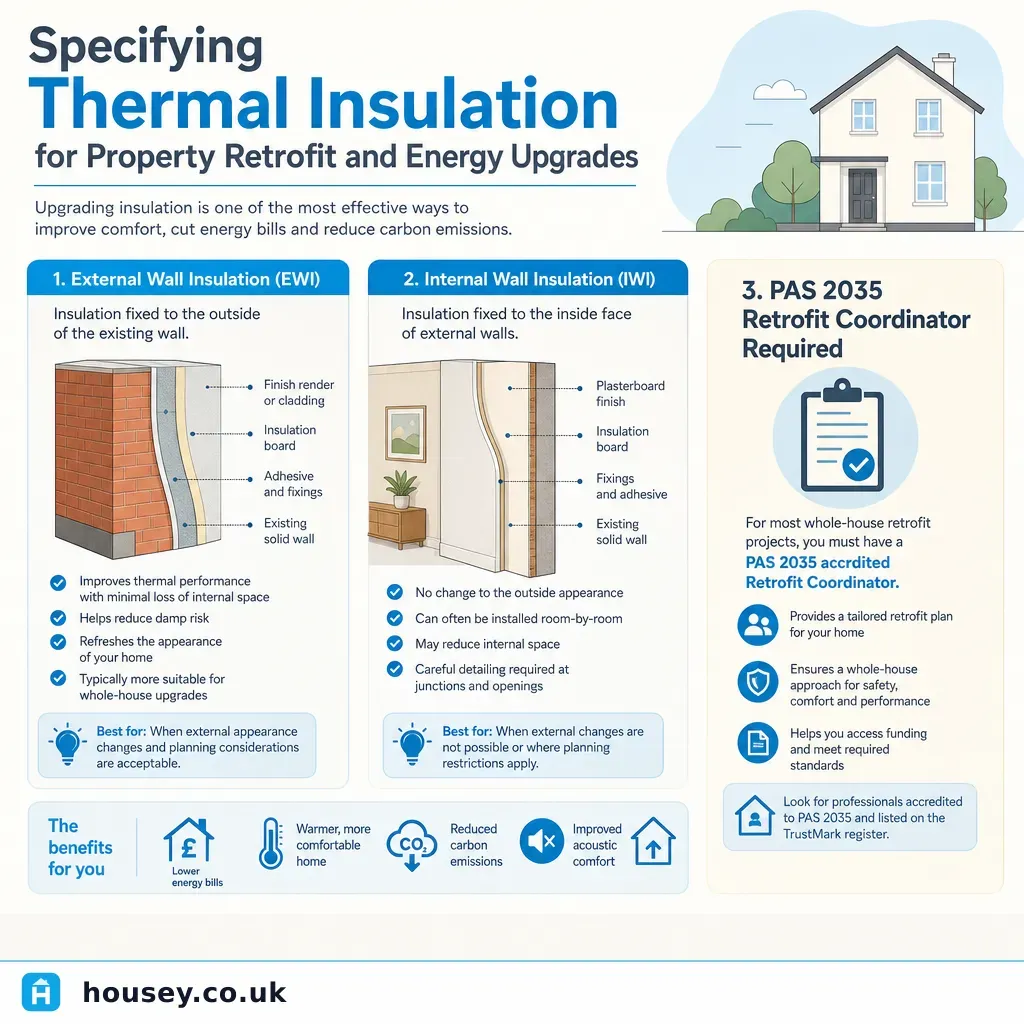
Specifying Thermal Insulation for Property Retrofit and Energy Upgrades
Specifying thermal insulation for UK retrofit requires matching the product to your property's construction, moisture conditions, and heating system.
 Energy & Retrofit
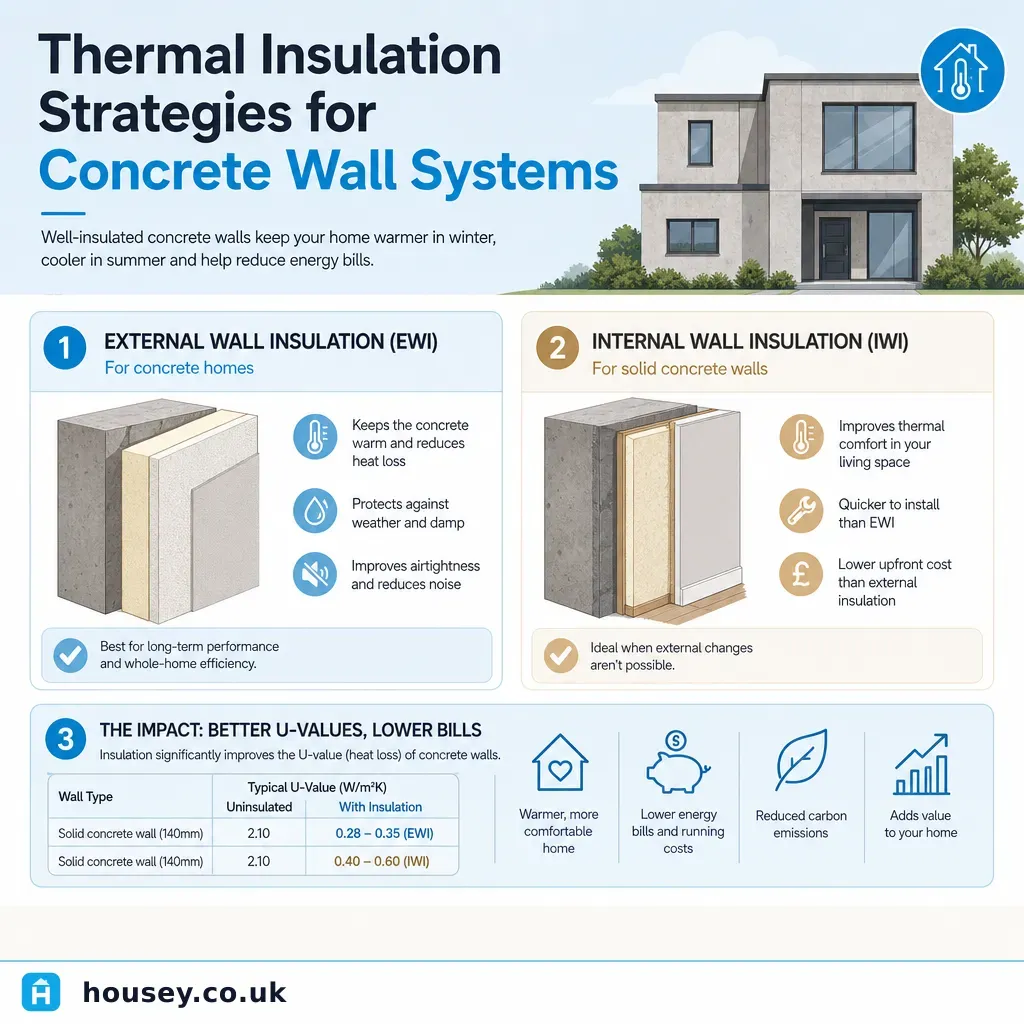
Thermal Insulation Strategies for Concrete Wall Systems
Concrete walls can be insulated using three main approaches: external wall insulation (EWI), internal wall insulation (IWI), or — where a cavity exists — cavity fill.
 Energy & Retrofit
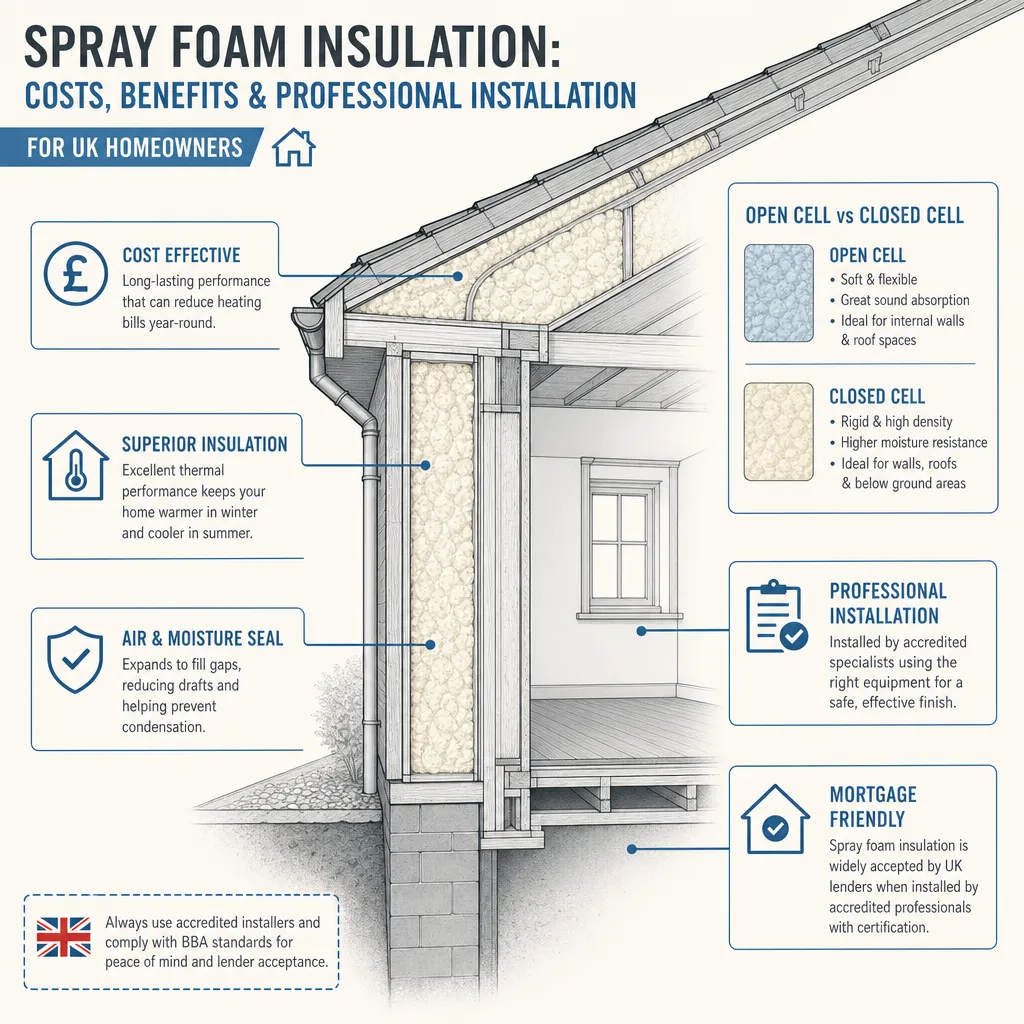
Spray foam insulation: costs, benefits and professional installation
Spray foam insulation costs between £15 and £60 per square metre installed in the UK, depending on whether open-cell or closed-cell foam is used.
 Energy & Retrofit
Improving Home Energy Efficiency through Secondary Glazing Solutions
Secondary glazing fits an additional pane inside your existing window reveal, reducing heat loss and noise without replacing the original frame.
 Energy & Retrofit
Solar window film: enhancing thermal performance and energy efficiency
Solar window film is a thin laminate applied to glass that reduces solar heat gain by 30–80% depending on specification.