Cost-Saving Strategies for House Building Projects
By Housey · Last reviewed 10th of May 2026
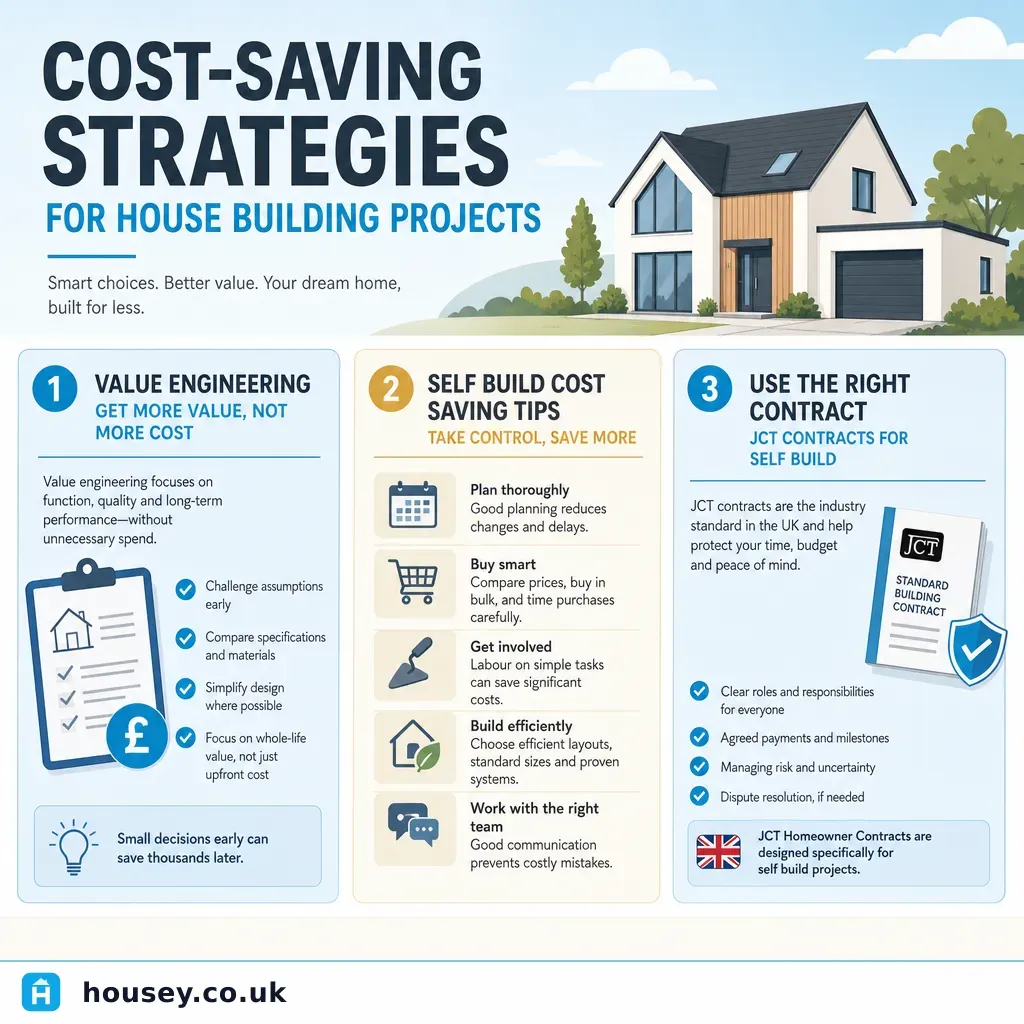
Cost-Saving Strategies for House Building Projects
Building a new home or undertaking a major extension is one of the largest financial commitments most UK homeowners make — and costs frequently exceed initial estimates. Whether you are managing a self-build on a rural plot, commissioning an architect-designed family home, or overseeing a substantial rear extension, knowing where money is commonly wasted and where it can legitimately be saved can make a five- or six-figure difference to the final bill.
Key points
- A contingency of 10–15% of total build cost is standard practice for self-builds and major works; omitting it is one of the most common causes of project financial distress.
- HMRC's DIY Housebuilder Scheme (form VAT431NB) allows self-builders to reclaim VAT on most eligible building materials for new homes intended for personal occupation; claims must be submitted within three months of the completion certificate.
- Selecting a fixed-price JCT (Joint Contracts Tribunal) contract transfers cost risk to the contractor, but only works reliably when drawings and specifications are fully resolved before the tender goes out.
- Value engineering — reviewing the specification for cost reductions that do not compromise structural integrity or building regulation compliance — is most effective before the tender stage, not after construction begins.
- A main contractor typically adds 15–25% to subcontractor costs for coordination, management, and risk; this is the margin that self-managing subcontractors or appointing a project manager can reduce.
Why building projects go over budget
Most UK building projects overrun on cost for a cluster of predictable reasons:
- Incomplete design at tender stage: when drawings are not fully resolved before contractors price the work, provisional sums and variations during construction inflate the final cost.
- Specification creep: individual upgrades to kitchens, bathrooms, and finishes are easy to approve one at a time but cumulatively expensive.
- Underestimated groundworks: foundations, drainage, and ground conditions are difficult to predict without a ground investigation; unexpected rock, high water tables, or contaminated ground are common cost shocks.
- No contingency: a project without a financial buffer has no room to absorb unforeseen conditions without genuine distress.
- Procurement delays: materials or subcontractors arriving late extend the programme and increase site-running costs.
Understanding these failure points is the first step to building a realistic budget and protecting it throughout the project.
Value engineering: where to look first
Value engineering is the systematic review of a building design to find cost reductions that maintain function and quality. It should happen before construction, at the detailed design stage, before a specification goes to tender.
Building element | Common cost-saving approach | Watch-out |
|---|---|---|
Roof form | Simpler pitch with fewer valleys and hips reduces structural cost and future leak risk | Flat or mono-pitch roofs may carry higher long-term maintenance costs |
Foundation type | Strip foundations are cheaper than piled or raft where ground conditions allow | A ground investigation report is needed before assuming strip foundations are viable |
External wall | Masonry cavity wall is often cheaper than structural insulated panels (SIPs) at standard spans | SIPs can reduce programme time, which may offset cost differences |
Window specification | Standard sizes from a manufacturer's range cost less than bespoke | Heritage or conservation area constraints may limit flexibility |
Internal layout | Fewer internal load-bearing walls reduces steelwork requirements | Check structural implications with a structural engineer before removing walls from the design |
Drainage | Connecting to existing drainage rather than laying a new run is cheaper | Subject to building control approval and water company requirements |
Procurement decisions that affect cost
How you procure the build — the contract type, tendering process, and relationship with the main contractor — significantly affects your exposure to cost risk.
Which procurement route suits your project?
- Choose a fixed-price JCT contract if your design is fully resolved and specified before going to tender. This transfers cost risk to the contractor but requires complete drawings and specifications. Any gaps become variations that cost extra.
- Choose a cost-plus or management contract if your design will evolve during construction. You absorb the cost risk but have more flexibility. Suitable for complex or phased projects.
- Consider design and build if you want a single point of responsibility for design and construction. Often reduces programme cost and administrative overhead, but you relinquish detailed design control.
- Self-manage subcontractors if you have the time and construction knowledge to coordinate trades directly. Can reduce the main contractor's on-costs, but requires full-time management commitment and construction knowledge.
- Appoint a project manager if you want professional oversight without a main contractor's margin. A project manager can tender work packages, manage the programme, and control variations on your behalf.
Tendering and getting competitive quotes
Open-book tendering — asking at least three contractors to price the same fully specified brief — is the most reliable way to ensure competitive pricing.
- Issue identical documentation to all tenderers so quotes are directly comparable.
- Require tenderers to break their price into work packages so you can scrutinise individual elements.
- Ask for a programme alongside the price — a lower price with a longer programme may not represent a saving once finance and site-running costs are factored in.
- Check contractor references and recent comparable projects before appointing.
- Avoid appointing on lowest price alone; consider the quality of the submission, communication, and references.
A build cost estimating professional can prepare a pre-tender cost plan that tells you whether contractor quotes are realistic before you commit to any appointment.
Worked UK project scenario: 70 m² single-storey rear extension
Situation: A homeowner in the East Midlands is planning a 70 m² kitchen-dining extension to a 1970s semi-detached house. Two initial contractor quotes range from £132,000 to £178,000 — a £46,000 spread.
Value engineering review with architect and cost consultant:
- Switching from a flat roof with a glazed lantern to a simple mono-pitch with rooflights reduced structural steel requirements and roofing cost: saving of approximately £8,000.
- Specifying a standard bifolding door width (2.4 m) rather than a bespoke 3.6 m run reduced the glazing cost: saving of approximately £4,500.
- Retaining the existing concrete floor slab with a screed overlay rather than full removal and replacement: saving of approximately £6,000 (ground investigation confirmed suitability).
Adjusted lower quote after value engineering: approximately £113,500 before contingency.
Contingency added (12%): £13,620.
Working budget: approximately £127,120.
This scenario is illustrative. Actual costs depend on specification, location, ground conditions, and market conditions at the time of tender.
What not to assume
- Do not assume the cheapest tender is the best value. Contractors who significantly underprice work often recover their margin through variations once on site.
- Do not assume planning drawings are sufficient for building control or tender. Planning drawings show massing and appearance; building regulation drawings and structural calculations are a separate and necessary step.
- Do not assume VAT will not apply. Most extension and renovation work is standard-rated at 20%. Self-build new homes may benefit from zero-rating or the HMRC VAT431NB reclaim scheme; always seek specialist tax advice.
- Do not assume groundwork costs are fully covered in a fixed-price contract. Many contracts exclude unexpected groundwork, drainage diversions, and ground remediation as risk items.
- Do not assume a verbal agreement is binding. Always use a written contract — a JCT Minor Works contract is widely used for smaller projects and provides clear protections for both parties.
When to get professional help
A qualified quantity surveyor (QS) or cost consultant adds genuine value at two key points: before design is finalised (to establish a realistic budget) and before going to tender (to prepare a bill of quantities or specification that contractors price accurately).
Consider professional cost advice if:
- Your estimated build cost exceeds £100,000.
- You are managing multiple subcontractors without a main contractor.
- Contractor quotes vary by more than 20%.
- You are unsure whether your design is fully resolved enough to support a fixed-price tender.
- You are a first-time self-builder without construction procurement experience.
How Housey can help
Housey connects you with build cost estimating professionals who can prepare pre-tender cost plans and review contractor quotes, as well as experienced project managers who can run your tender process and manage construction on your behalf. Compare quotes from vetted specialists before committing to any procurement approach.
Frequently asked questions
How much contingency should I allow for a house building project?
Most construction professionals recommend 10–15% of the total build cost as contingency. For projects with significant unknowns — ground conditions, structural alterations, or heritage constraints — 15–20% is more appropriate. Omitting contingency entirely is one of the most reliably costly mistakes in self-build and major renovation projects.
Can I save money by acting as my own project manager?
Yes, but the saving comes with significant time and knowledge requirements. A main contractor typically charges 15–25% on top of subcontractor costs for coordination and risk management. Self-managing eliminates that margin but requires full-time availability, construction knowledge, and experience managing contractual relationships with individual trades.
Is it cheaper to build in winter?
Demand for contractors is often lower in winter, which may improve your negotiating position. However, cold, wet weather slows external work and may require temporary protective measures, potentially offsetting savings. The net benefit depends on your project type, location, and programme flexibility.
What is a JCT contract and do I need one?
A JCT (Joint Contracts Tribunal) contract is a standard-form building contract widely used in the UK for residential projects. It sets out the rights and obligations of the client and contractor clearly, covering variations, disputes, and delays. For any project above approximately £10,000–£20,000, using a written contract such as JCT Minor Works is strongly recommended.
Sources and further reading
- VAT refunds for DIY housebuilders (Notice 431NB) — HMRC
- JCT standard forms of contract — Joint Contracts Tribunal
- Building regulations — GOV.UK
- RICS quantity surveying and construction standards — RICS
- Planning Portal: extensions — Planning Portal
Useful next reads
 Improvement & Build
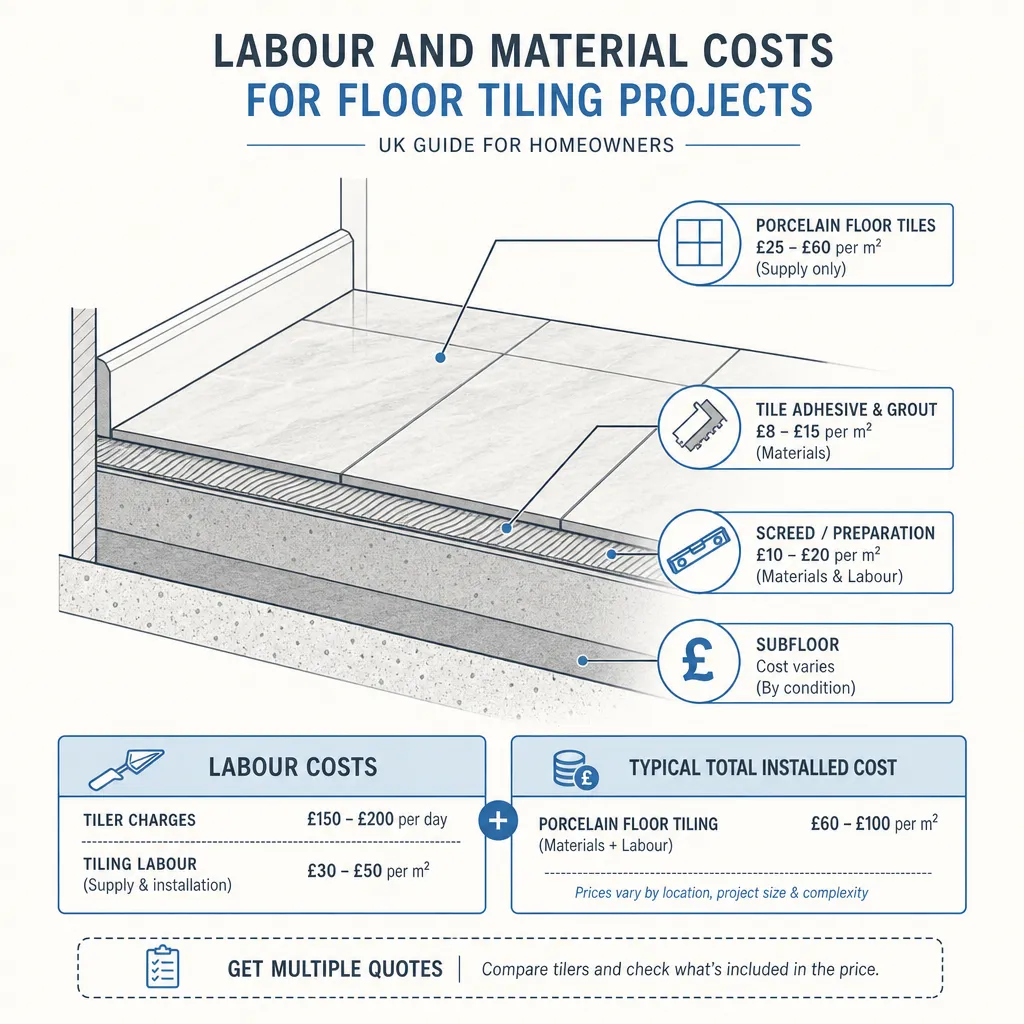
Labour and material costs for floor tiling projects
Floor tiling in the UK typically costs £30–£60 per m² in labour, plus materials ranging from £10–£40/m² for ceramic to £50–£150+/m² for natural stone.
 Improvement & Build
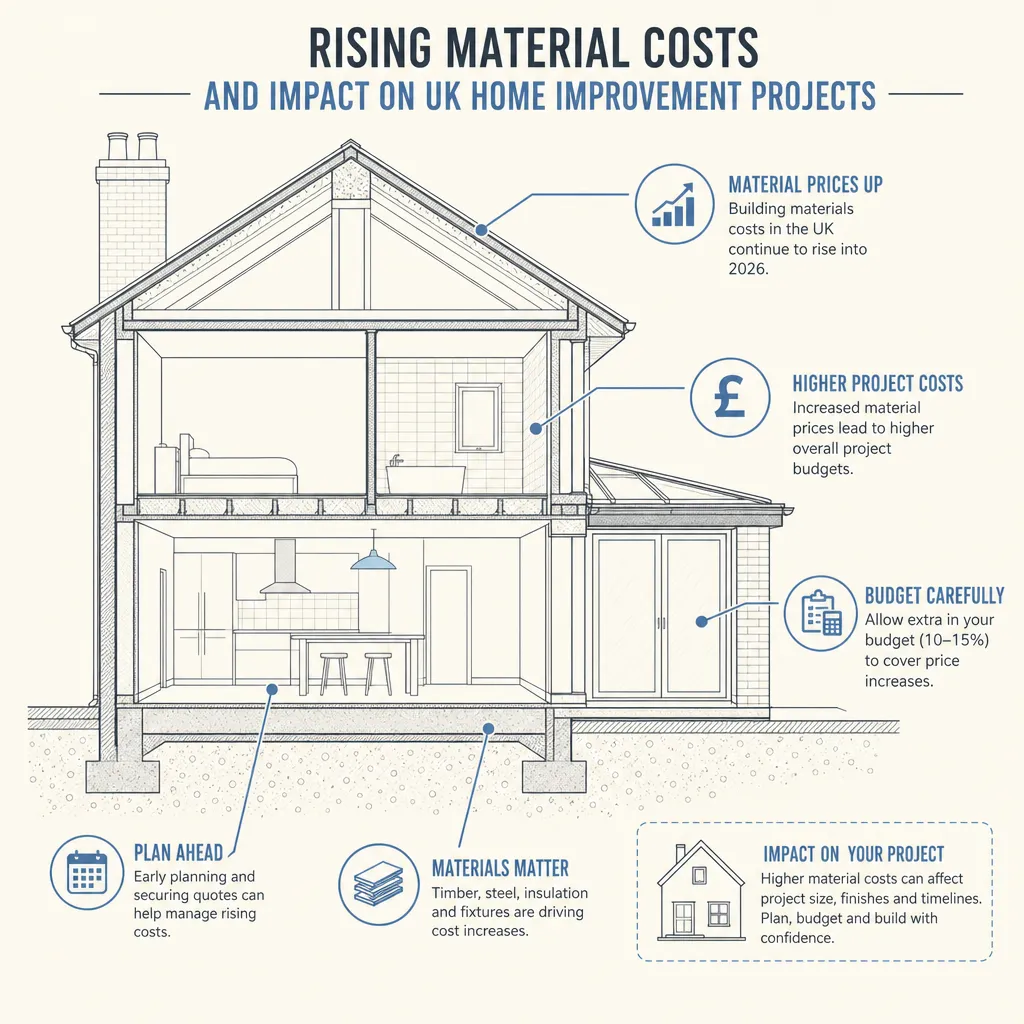
Rising Material Costs and Impact on UK Home Improvement Projects
UK construction material prices remain above pre-2020 levels despite some easing from peak inflation.
 Improvement & Build
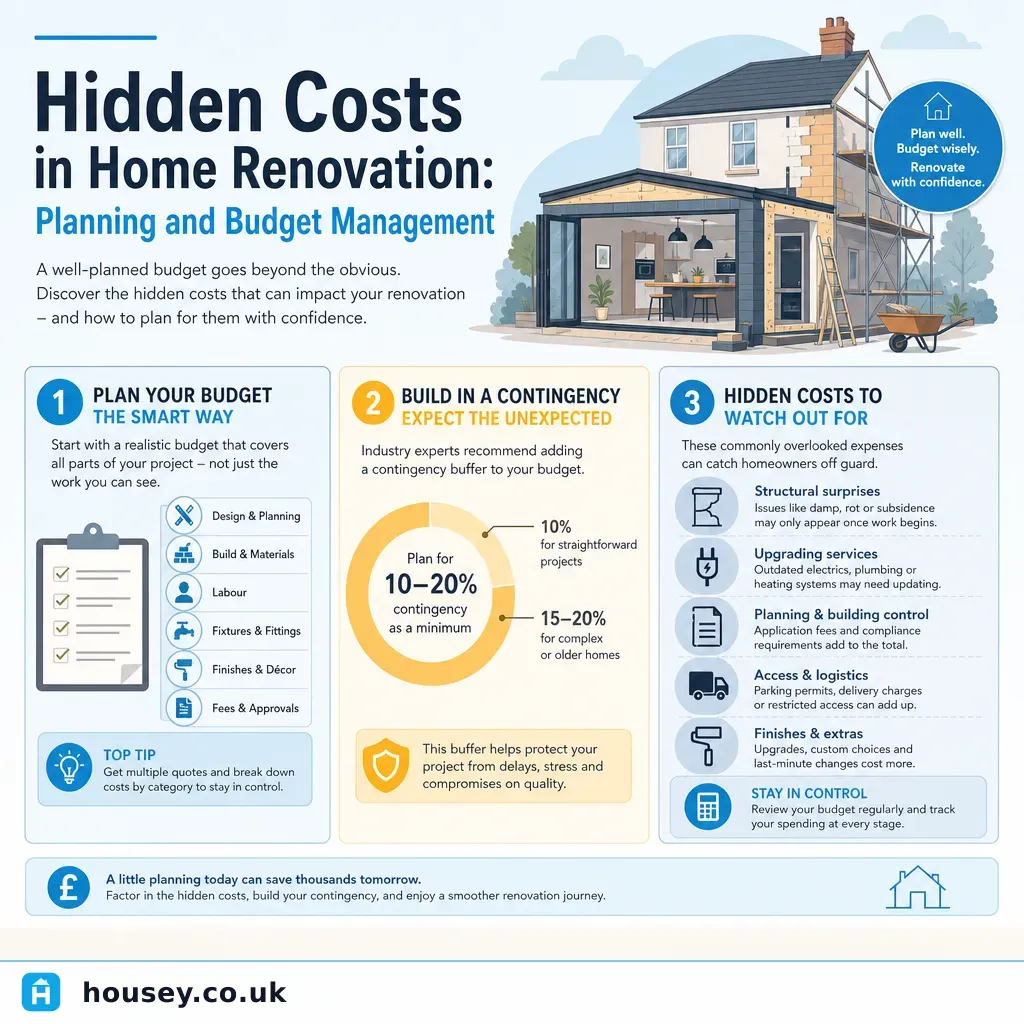
Hidden Costs in Home Renovation: Planning and Budget Management
Most UK renovation projects run 10–20% over the initial builder quote because professional fees, VAT, statutory fees, and party wall costs are routinely excluded from early estimates.
 Improvement & Build
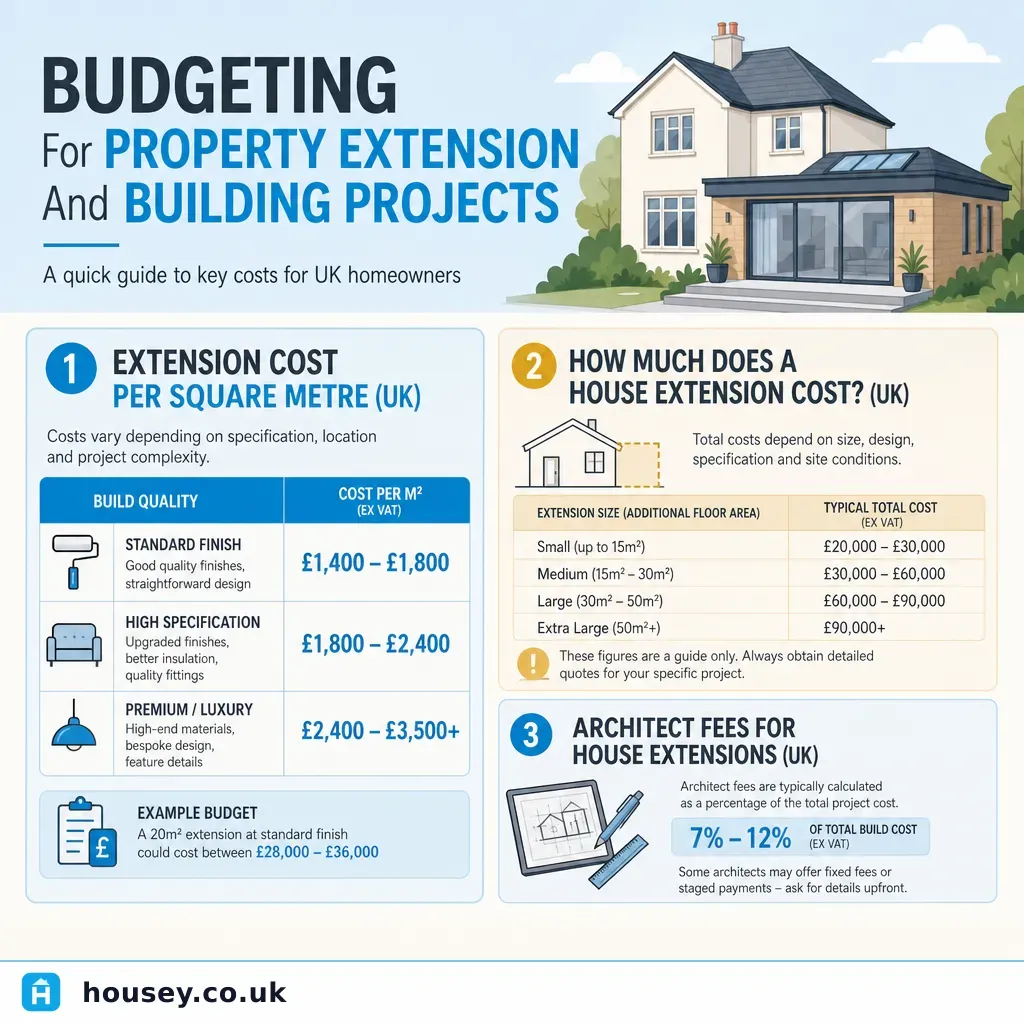
Budgeting For Property Extension And Building Projects
A typical UK single-storey rear extension costs roughly £1,500–£2,500 per square metre to build, before professional fees, planning costs, and VAT.
 Improvement & Build
Understanding Service Provider Invoicing and Payment Terms
Most builders and tradespeople in the UK use stage payments tied to milestones — deposit on contract signing, interim payments at agreed build stages, and a final balance on practical completion.