Rising Material Costs and Impact on UK Home Improvement Projects
By Housey · Last reviewed 19th of May 2026
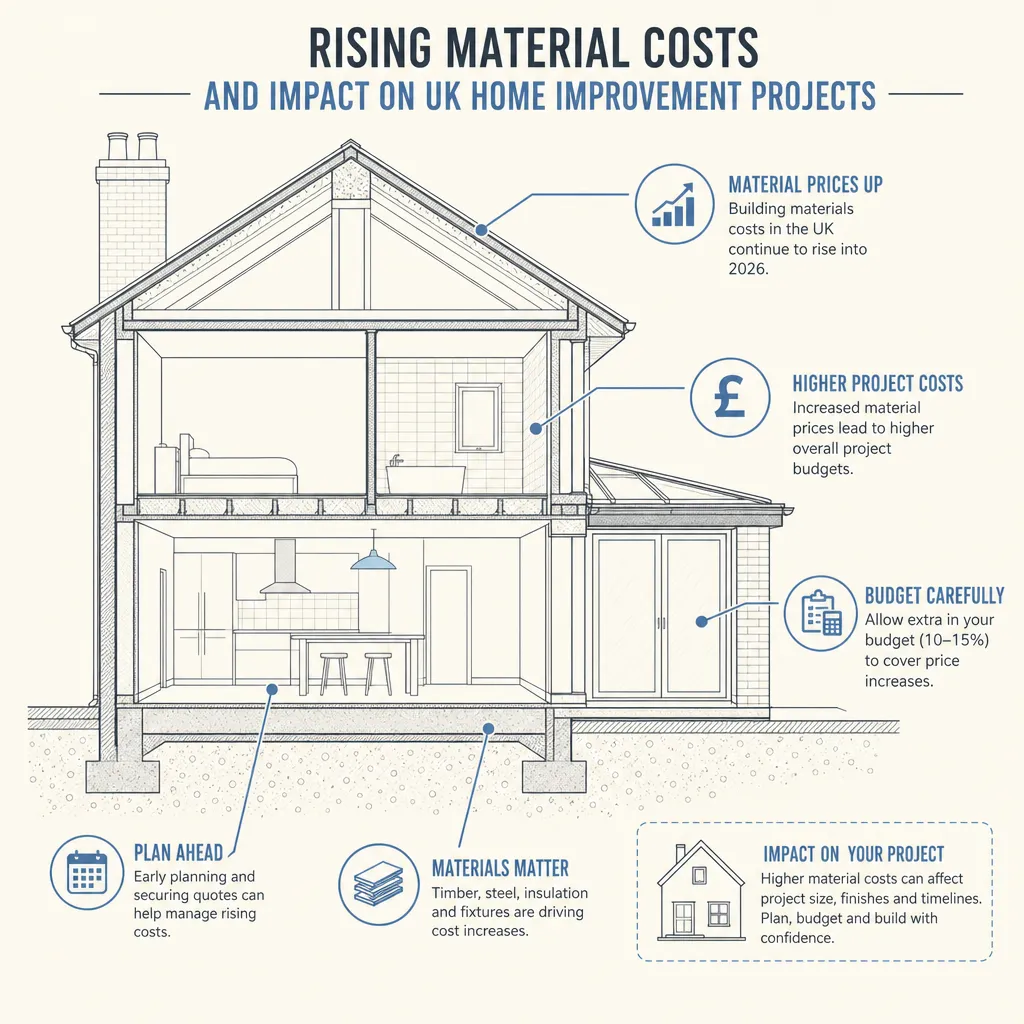
Rising Material Costs and Impact on UK Home Improvement Projects
For anyone planning a home improvement project in 2025–26, the question of whether to build now — and how to budget reliably — is more complex than it was a few years ago. Construction material prices in the UK experienced significant volatility from 2020 onwards, and while inflationary pressure has eased from its peak, costs remain structurally higher than pre-pandemic levels, reshaping how homeowners, builders, and project managers approach budgeting for everything from a rear extension to a full retrofit.
Key points
- ONS Producer Price Indices show that UK construction materials prices rose by over 30% cumulatively between 2020 and 2023, with structural steel, plasterboard, and copper wiring among the categories experiencing the sharpest increases.
- BCIS (Building Cost Information Service, operated by RICS) publishes quarterly construction cost indices widely used by quantity surveyors to benchmark residential project budgets against current market conditions.
- The Federation of Master Builders' State of Trade Survey regularly tracks materials availability and price concerns among UK builders, with energy-intensive products (bricks, glass, cement) among the most persistently cited pressures.
- Price rises are not uniform: timber and structural steel saw early acute increases; insulation materials, plasterboard, and copper pipe followed later; labour costs have risen persistently due to skilled-trade shortages flagged by the CITB.
- Building in a contingency of 10–15% of project cost remains standard professional advice for residential projects, with 15–20% recommended where significant opening-up work is involved.
What has driven construction cost inflation in the UK?
Several interconnected factors have pushed UK construction costs higher since 2020.
Energy prices and industrial production costs. Many building materials — cement, bricks, glass, plasterboard, steel — are energy-intensive to manufacture. The energy price spike of 2021–22 fed directly into manufacturing costs, with some UK brick kilns temporarily curtailing production. While wholesale energy prices have since moderated, not all of these cost increases have reversed through the supply chain.
Supply chain disruption. Post-Brexit changes to haulage and customs procedures, combined with pandemic-era factory closures and shipping container shortages, created intermittent shortages of materials ranging from roof tiles to electrical components. The effects on lead times and pricing persisted well into 2023–24.
Skilled-labour shortages. Construction faces a chronic skills gap that pre-dates the pandemic. The CITB has repeatedly highlighted the gap between projected demand for skilled tradespeople and available supply. Labour cost inflation has run alongside — and often ahead of — materials inflation for certain trades.
Post-pandemic demand surge. The home improvement surge of 2020–21, driven partly by furlough, restricted travel, and increased remote working, created a demand spike that strained supply chains across materials and tradespeople simultaneously, with effects that took years to fully unwind.
Materials cost tracker: which categories have been most affected?
Based on ONS Producer Price Index data and BCIS reporting. Indicative UK trends, last reviewed 2026-05-19.
Material category | Peak pressure period | Current trend (2025–26) | Implications for projects |
|---|---|---|---|
Structural timber | 2020–22 | Stabilised, above pre-2020 levels | Timber-frame and joist work more expensive; compare steel beam alternatives |
Bricks and blocks | 2021–23 | Broadly stable; some easing | Masonry extension allowances should remain above 2019 benchmarks |
Plasterboard | 2021–22 | Largely normalised | Re-plastering and first-fix costs more predictable |
Copper pipe and cable | 2021–ongoing | Elevated; global commodity-linked | Rewires and plumbing overhauls remain sensitive to copper price volatility |
Insulation materials | 2021–23 | Easing but above pre-2020 levels | Retrofit and Part L compliance costs benefit from some relief |
Structural steel | 2021–22 | Broadly stabilised | Beam and lintol costs relatively predictable in 2025–26 |
Roof tiles and slates | 2021–23 | Easing; some import-route effects | Natural slate from Wales and Spain; fibre-cement alternatives cost-competitive |
MVHR and heat pump components | Ongoing | Still elevated; supply improving | Longer lead times for some models; order early and confirm availability |
What not to assume when budgeting for a home improvement project
Do not assume last year's quote still applies. Even a 12-month-old quote may underestimate current costs, particularly for projects involving significant materials. Always request fresh quotes before committing to a project budget.
Do not assume all cost pressures are resolved. While headline inflation has eased, BCIS data indicates that residential building costs remain meaningfully above 2019 levels. Labour costs in particular have not declined and show no near-term signs of doing so.
Do not treat online cost estimates as tender prices. Published cost guides — including indicative ranges — are useful for orientation and sanity-checking, not for committing a budget. A quantity surveyor or experienced builder can provide a more project-specific assessment once the scope is defined.
Do not forget the regulatory cost layer. Building Regulations fees, structural engineer calculations, planning application fees, and specialist certification (MCS for heat pumps, Gas Safe for boiler installations) add cost that is often absent from headline estimates. The GOV.UK planning application fee schedule was revised in late 2023, with household application fees increasing.
Do not overlook the VAT position. Standard domestic building work attracts VAT at 20%. The 0% VAT rate for energy-saving materials — insulation, heat pumps, solar panels — remains in place until at least March 2027, representing a meaningful saving on qualifying retrofit projects.
How to protect your project budget against cost uncertainty
Agree a fixed-price contract where possible. For well-specified, limited-scope work, fixed-price contracts transfer the materials risk to the contractor. For large or complex projects, a combination of fixed and provisional rates is more realistic.
Use a quantity surveyor for projects over £50,000. A QS can provide an independent cost plan, benchmark contractor quotes against BCIS data, and manage variations through the project. RICS members offering QS services can be found via the RICS Find a Surveyor tool.
Build a contingency into your budget. For straightforward projects: 10%. For projects involving opening up older properties or unknown ground conditions: 15–20%. Treat contingency as a buffer against discoveries, not as money available to spend on upgrades.
Agree a materials procurement strategy. On larger projects, discuss whether materials should be supplied by the client or contractor. Client-supply can reduce contractor margin but increases your coordination risk. Get the arrangement in writing before work starts.
Phase the project if cash flow is a concern. Breaking a large project into phases allows better cost control and lets you pause if materials or labour costs move adversely between phases.
Red flags that suggest a quote may be underpriced
Be cautious if:
- A quote is significantly lower than the other two — ask for a detailed breakdown to understand what is excluded
- The contractor does not include a materials specification in the quote
- No contingency or provisional sum is referenced for a complex or open-up project
- Full payment is requested upfront before work begins
- The contractor cannot provide a written contract and verifiable references
- VAT is not mentioned or the contractor is unable to confirm their VAT registration number
When to get professional help
Consider instructing a RICS-accredited cost consultant or quantity surveyor when:
- Your project budget exceeds £50,000 or involves multiple trades working in sequence
- Quotes received are significantly divergent and you cannot identify the reason from the paperwork
- You are procuring work on a phased basis and need cash-flow forecasting across the programme
- Your project involves an older property with significant unknowns about existing structure, services, or fabric
- You want independent scrutiny of a main contractor's interim payment applications during a larger build
How Housey can help
Housey helps UK homeowners compare quotes from vetted local professionals and understand what to expect from the market before committing to a project. Getting structured, comparable quotes through Housey's platform means you can benchmark against current market rates rather than relying on outdated cost guides.
Frequently asked questions
Have UK construction material prices started to fall?
Some categories have eased from peak levels — notably structural timber, plasterboard, and most imported materials affected by post-2020 supply disruption. However, BCIS data indicates that overall residential building costs in 2025–26 remain meaningfully higher than 2019 levels. Labour costs, in particular, have not reversed. The picture varies by material and by trade.
How should I account for cost inflation in a phased project?
Build an inflation assumption into your project cost plan. The BCIS publishes quarterly cost forecasts that quantity surveyors use to model multi-year project budgets. For DIY budgeting, adding 5–8% per annum to labour and materials for future phases is a conservative starting point — but check BCIS data or ask a QS for a current forecast rather than treating this as a fixed rule.
Does rising material cost affect the value of my home?
Extension and improvement costs have risen faster than value gains in many regions. RICS valuers assess added value on comparable evidence, not cost incurred — so a more expensive build does not automatically increase the surveyed value proportionally. Discuss expected value impact with a RICS Registered Valuer before committing to a major project.
Are there materials shortages in 2025–26?
The acute shortages of 2021–22 have largely resolved. Some categories — specialist glazing, MVHR units, and certain heat pump models — still carry longer lead times than standard. For projects dependent on specific materials or imported components, allow extra procurement time and confirm availability before finalising your programme.
Sources and further reading
- ONS Producer Price Indices: construction materials — ONS
- BCIS Building Cost Information Service — RICS
- FMB State of Trade Survey — Federation of Master Builders
- CITB Construction Skills Network: workforce forecasts — CITB
- Planning application fees: GOV.UK guidance — GOV.UK
- VAT on energy-saving materials (Notice 708/6) — HMRC
Useful next reads
 Improvement & Build
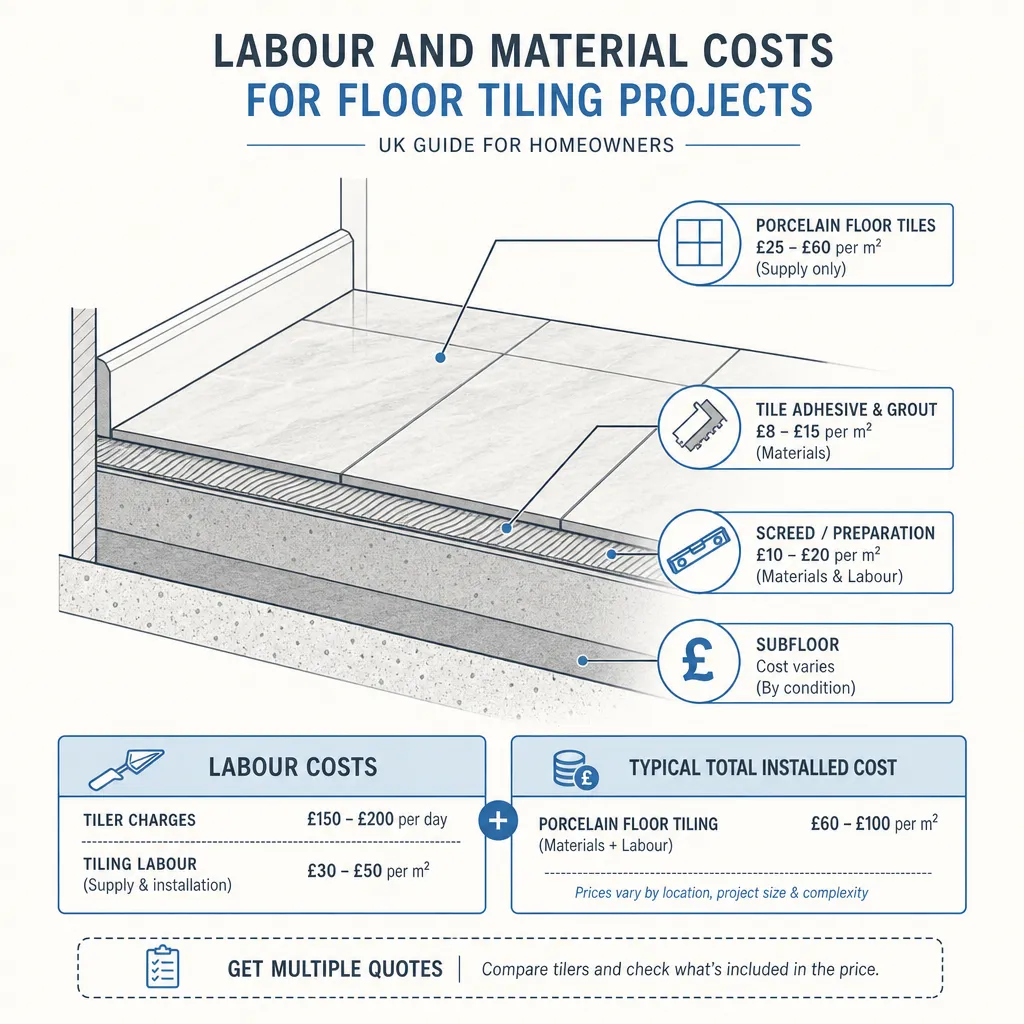
Labour and material costs for floor tiling projects
Floor tiling in the UK typically costs £30–£60 per m² in labour, plus materials ranging from £10–£40/m² for ceramic to £50–£150+/m² for natural stone.
 Improvement & Build
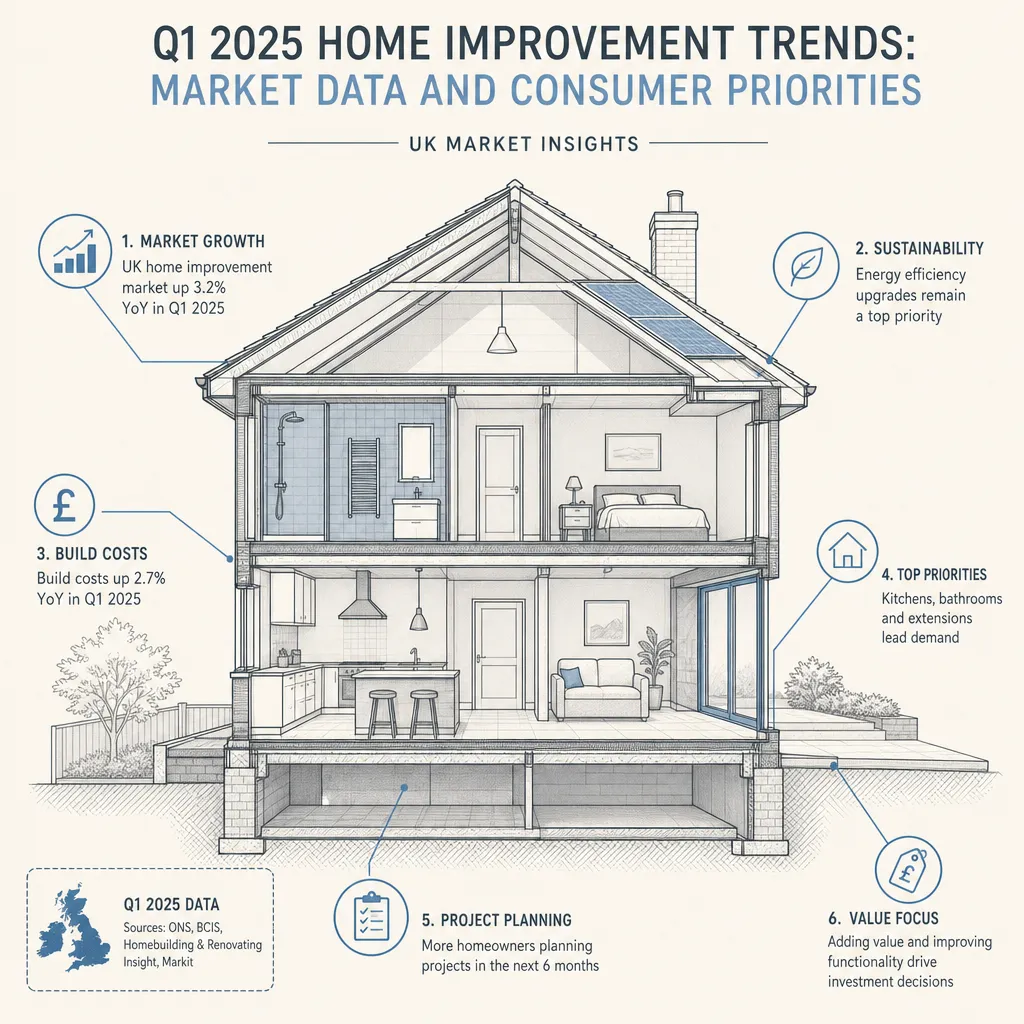
Q1 2025 Home Improvement Trends: Market Data and Consumer Priorities
Q1 2025 saw UK homeowners prioritise loft conversions, energy efficiency upgrades, and kitchen extensions as build costs stabilised following the 2022–2023 peak and mortgage rates began to ease.
 Improvement & Build
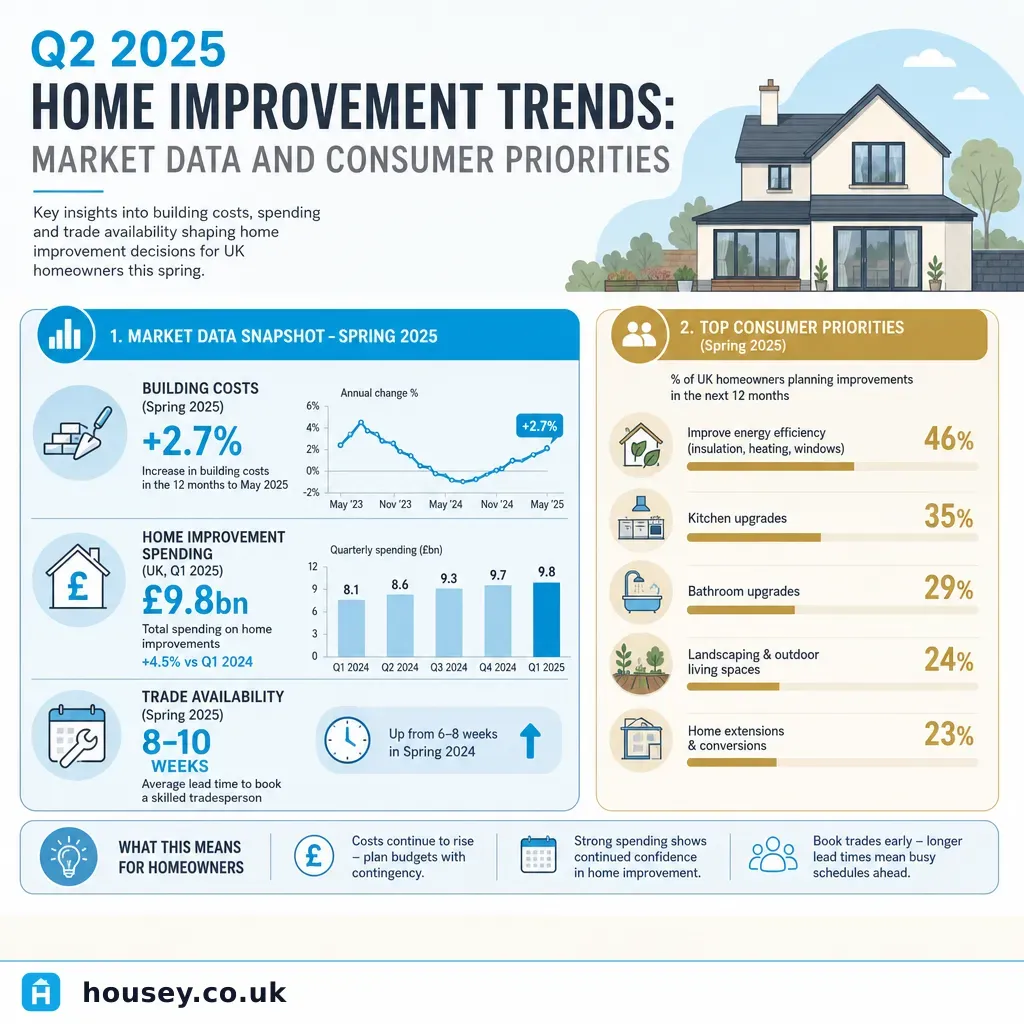
Q2 2025 Home Improvement Trends: Market Data and Consumer Priorities
In Q2 2025, kitchen refurbishments and bathroom renovations led UK consumer home improvement demand, followed by single-storey extensions and garden offices.
 Improvement & Build
Q4 2025 Home Improvement Trends: Market Data and Consumer Priorities
In Q4 2025, UK homeowners prioritised heating upgrades, insulation, and kitchen refurbishments as temperatures fell.
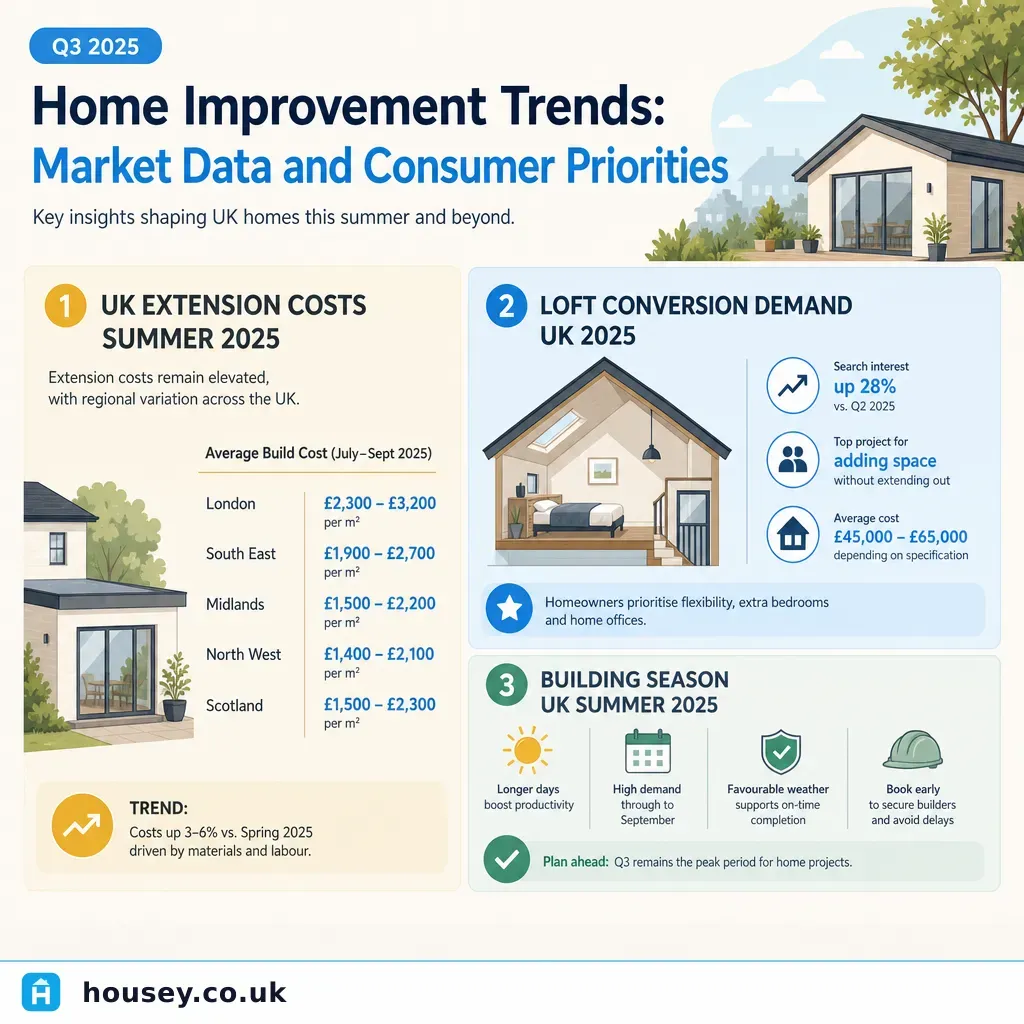 Improvement & Build
Q3 2025 Home Improvement Trends: Market Data and Consumer Priorities
Q3 2025 was the UK's peak building season, with single-storey extensions, loft conversions, and outdoor living projects at their highest quarterly demand.