Costs for Repainting Pebbledash Exterior Finish
By Housey · Last reviewed 6th of May 2026
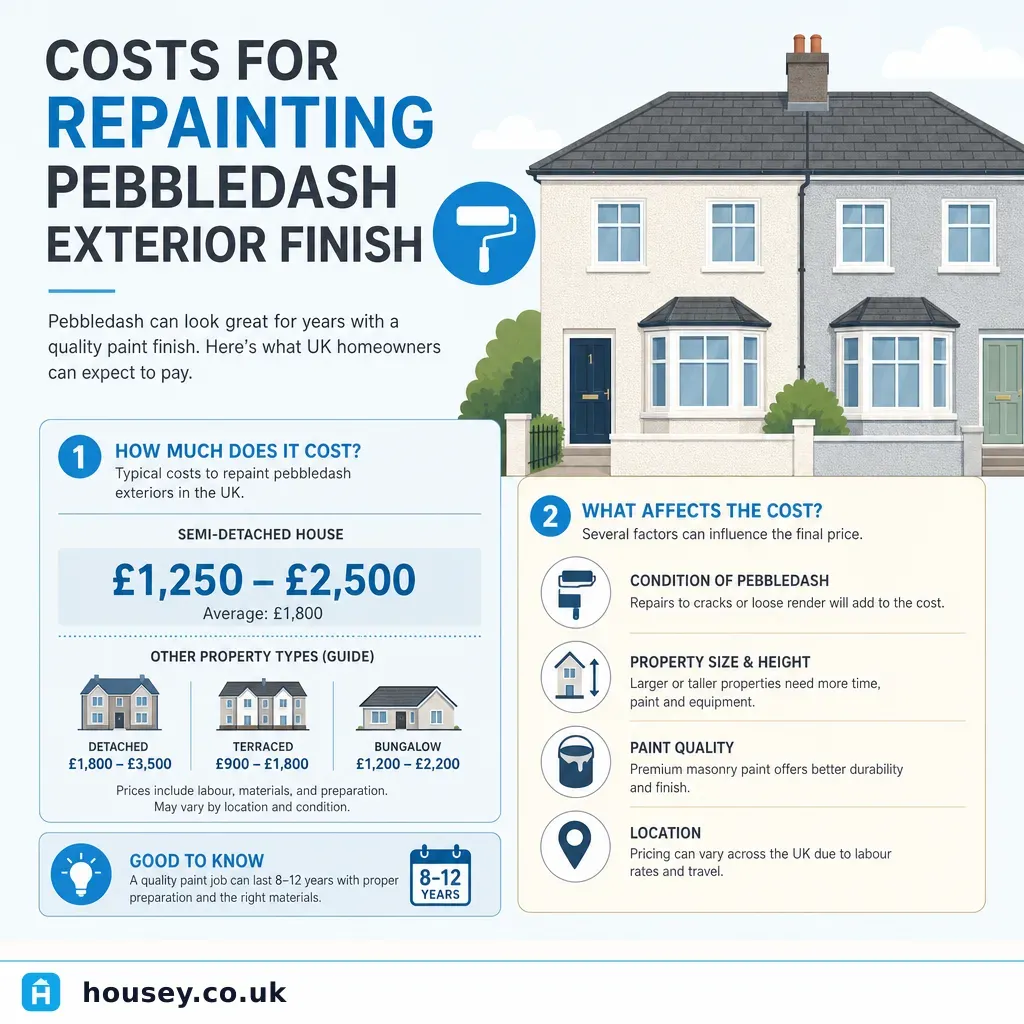
Costs for Repainting Pebbledash Exterior Finish
Pebbledash is one of the most widespread exterior finishes on British homes built between the 1920s and 1970s, and many owners eventually face the question of whether and how to repaint it. The decision involves more than choosing a colour — the condition of the underlying render, the paint specification, the need for scaffolding, and the extent of preparation work all affect both cost and outcome significantly.
Key points
- Repainting pebbledash on a two-storey semi-detached home in the UK typically costs £1,200–£2,500 in total, including scaffolding and materials. Indicative UK costs, last reviewed 2026-05-06.
- Pebbledash must be painted with a breathable, flexible masonry paint — non-breathable coatings can trap moisture within the wall and accelerate render failure.
- Scaffolding is required for most two-storey homes and typically adds £500–£1,200 to the overall cost for a standard semi-detached property. Indicative cost, last reviewed 2026-05-06.
- Preparation — including pressure washing, fungicidal treatment, crack repairs, and a stabilising solution — is the most critical stage and should not be omitted from any contractor's scope.
- Conservation area designations and listed building status can restrict exterior paint colours; always check with your local planning authority before proceeding.
What is pebbledash and why does it need repainting?
Pebbledash is a wet-dash render finish in which small pebbles or stone chippings are pressed into a freshly applied mortar coat. It was widely used on UK housing estates in the interwar and postwar decades because it was cost-effective and relatively weather-resistant. Over time, the render becomes increasingly porous, accumulating dirt, algae, and moisture. Repainting can restore weatherproofing, improve appearance, and extend the life of the render — but only when the correct paint and preparation are used.
Painting pebbledash also introduces an ongoing maintenance commitment: once painted, the surface will generally need recoating every 8–15 years, and reverting to an unpainted finish is not straightforward.
What affects the cost of repainting pebbledash?
Cost factor | Lower end of range | Higher end of range |
|---|---|---|
House size | Terraced house or bungalow | Large detached or three-storey |
Render condition | Sound, clean, minimal repairs | Cracked, loose sections, heavy organic growth |
Scaffolding | Ground-floor or single-storey only | Full scaffolding for two or three storeys |
Number of coats | Two topcoats of masonry paint | Stabiliser + primer + two topcoats |
Paint specification | Standard masonry paint | Premium breathable or elastomeric coating |
Location | Rural or lower-cost region | London, South East, or major cities |
Typical costs by house size
The following ranges cover professional labour, scaffolding, and a standard two-coat masonry paint specification for repainting existing pebbledash in fair to good condition.
Indicative UK costs, last reviewed 2026-05-06. Obtain at least three quotes for your specific property.
Property type | Approx. wall area | Estimated total cost |
|---|---|---|
Terraced house (two-storey) | 60–80 m² | £800–£1,800 |
Semi-detached house (two-storey) | 80–120 m² | £1,200–£2,500 |
Detached house (two-storey) | 120–180 m² | £1,800–£3,500 |
Bungalow | 50–100 m² | £700–£1,600 |
Large detached or three-storey | 200 m²+ | £3,000–£6,000+ |
Costs are illustrative and will vary significantly by render condition, location, specification, and contractor.
Preparation: the most critical stage
Inadequate preparation is the most common cause of early paint failure on pebbledash. A professional job should include:
- Pressure washing to remove surface dirt, algae, moss, and loose material.
- Fungicidal wash or biocide treatment if organic growth is present — allow several days drying time before painting.
- Crack repair using a flexible exterior filler or mortar repair product, depending on the severity of the damage.
- Stabilising solution applied to friable or heavily porous areas to bind the surface before painting.
- Masking of windows, doors, soffits, and fascias to protect adjacent surfaces.
- Two topcoats of breathable masonry paint, applied by brush, roller, or spray.
Always ask a contractor specifically which preparation steps are included in their quote — some lower-cost quotes omit the stabilising solution or fungicidal treatment stage, which can significantly shorten the life of the finish.
Choosing the right paint for pebbledash
Not all masonry paints are appropriate for pebbledash. The most important properties to look for:
- Vapour permeability (breathability): The coating must allow moisture vapour to escape from the wall. Non-breathable coatings can trap damp and accelerate render failure and internal dampness.
- Flexibility: Pebbledash expands and contracts with temperature changes. Rigid coatings can crack and allow water ingress behind the paint film.
- UV resistance: Particularly important for south- and west-facing elevations with high sun exposure.
Products commonly used by UK contractors include Sandtex Masonry Paint, Dulux Weathershield, K Rend Silicone Paint, and elastomeric coatings for problem walls or historic render. Elastomeric products are more expensive but bridge hairline cracks and tend to last longer before recoating is needed.
DIY vs hiring a professional for pebbledash repainting
Consideration | DIY | Professional contractor |
|---|---|---|
Safe access | Scaffolding or tower still required — hire cost still applies | Scaffolding arranged and typically included in quote |
Surface preparation | Risk of skipping or inadequate preparation stages | Experienced contractor prepares correctly |
Paint application | Feasible at ground level; high risk above one storey | All elevations covered with correct specification |
Realistic saving | Materials only: approx. £200–£600 for paint | Full cost £800–£3,500+ |
Best for | Ground-floor areas of a bungalow or single-storey extension | All two-storey properties and above |
For two-storey homes, the saving from DIY is modest once scaffolding hire is factored in, and the risks of inadequate preparation and working at height make professional contractors the safer and more cost-effective choice in most cases.
What to ask before accepting a quote
- What preparation steps are included, and which specific products will be used at each stage?
- Is scaffolding included in the quoted price, or charged separately?
- How many coats of paint are specified, and what brand or product?
- Is a stabilising solution or primer included?
- What is the expected lifespan of the finish under normal weathering conditions?
- Is VAT included in the quoted price?
- What guarantee or warranty applies to the workmanship?
- Will windows, doors, soffits, and fittings be protected during the job and cleaned after completion?
When to get professional help
Repainting pebbledash on a two-storey property is almost always a job for a professional contractor. Watch for these red flags that require professional assessment before any painting work begins:
- Hollow-sounding render: Tap the wall — a hollow sound indicates delamination between the render and the substrate. Painting over hollow render is likely to fail, and a contractor should advise whether repair or re-rendering is needed first.
- Efflorescence (white crystalline salt deposits appearing on the surface): This indicates active moisture movement within the wall that should be investigated before the exterior is sealed.
- Cracks wider than approximately 3 mm, or cracks that follow a diagonal or stepped pattern through the masonry — these may indicate structural movement requiring assessment by a chartered surveyor or structural engineer before any surface work is carried out.
- Conservation area or listed building status: Consult your local planning authority before changing the appearance of the exterior finish — colour and material restrictions may apply.
How Housey can help
Housey helps UK homeowners compare quotes from vetted local exterior decorators and render contractors. Describe your property and the scope of work on Housey, and receive quotes from experienced professionals who can assess your pebbledash in person before pricing the job.
Frequently asked questions
How long does painted pebbledash last before repainting?
With good preparation and a quality breathable masonry paint, a professionally applied finish on pebbledash typically lasts 8–15 years, depending on product quality, weather exposure, and the condition of the underlying render. Poor preparation or an unsuitable paint can reduce this to as little as 3–5 years.
Can I paint over existing painted pebbledash?
In most cases yes, provided the existing paint is well adhered and not peeling. The surface should be thoroughly cleaned, any organic growth treated with a fungicidal wash, and a stabilising solution applied to friable areas before recoating. A contractor should assess the adhesion of the existing coating before proceeding.
Does painting pebbledash cause damp problems?
It can, if the wrong paint is used. Non-breathable coatings can trap moisture vapour within the wall, leading to internal dampness and render failure. Always use a breathable, vapour-permeable masonry paint — silicone-based products are a reliable choice for pebbledash and other rendered surfaces.
Do I need planning permission to repaint pebbledash?
In most cases, repainting an existing exterior finish does not require planning permission. However, if your property is in a conservation area or is listed, there may be restrictions on colours or the type of works permitted. Check with your local planning authority before proceeding.
How much does it cost to remove pebbledash instead of repainting it?
Pebbledash removal is a significant construction project. Indicative costs for a typical two-storey semi-detached are £2,000–£8,000 or more, depending on size and the re-rendering specification chosen. Indicative UK costs, last reviewed 2026-05-06. Many contractors recommend over-rendering with a new smooth coat as an alternative if appearance is the primary concern.
Sources and further reading
- Practical Building Conservation — Renders, Plasters and Masonry — Historic England
- Work at Height Regulations 2005 — Health and Safety Executive
- Planning permission — GOV.UK
- Solid wall insulation — Energy Saving Trust
- Masonry coatings guidance — British Coatings Federation
Useful next reads
 General property advice
What to do when your boiler stops working
When your boiler stops working, check the pressure gauge (should read 1–1.
 General property advice
Property Market Trends: Activity Growth and Price Movements
UK property market activity is measured through completed sale registrations (HM Land Registry), lender mortgage data, and transaction volumes from HMRC.
 General property advice
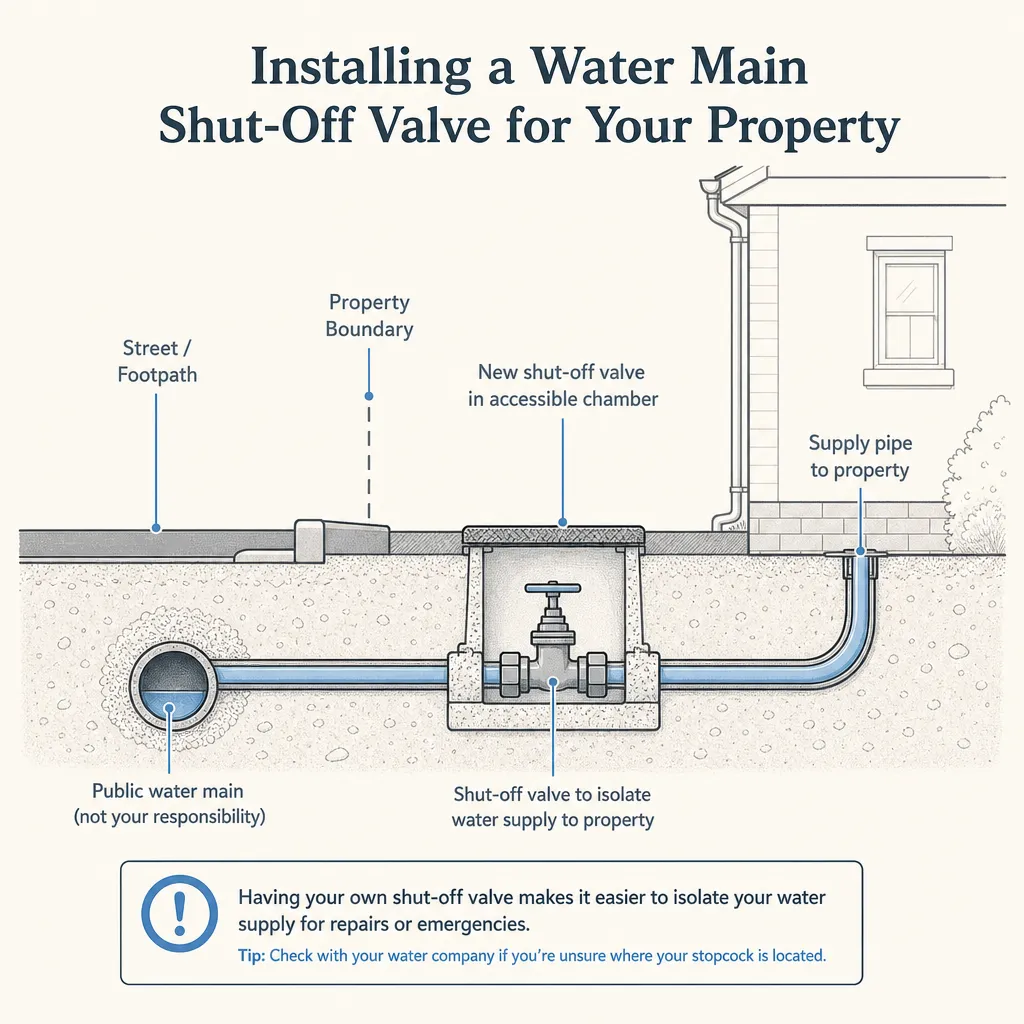
Installing a water main shut-off valve for your property
A water main shut-off valve — commonly called a stopcock — controls all water entering your home from the mains.
 General property advice
Monthly House Price Index: August Market Report and Analysis
The UK House Price Index is published monthly using completed Land Registry transaction data, meaning August figures typically reflect sales agreed months earlier.
 General property advice
Scottish Property Market: Activity and Regional Trends
Scotland's property market operates under distinct legal rules: sellers must provide a Home Report before marketing, transactions become legally binding at conclusion of missives rather than exchange of contracts, and Land and Buildings Transaction Tax replaces Stamp Duty.