Cost vs Value in Home Improvements: What Upgrades Deliver ROI
By Housey · Last reviewed 24th of May 2026
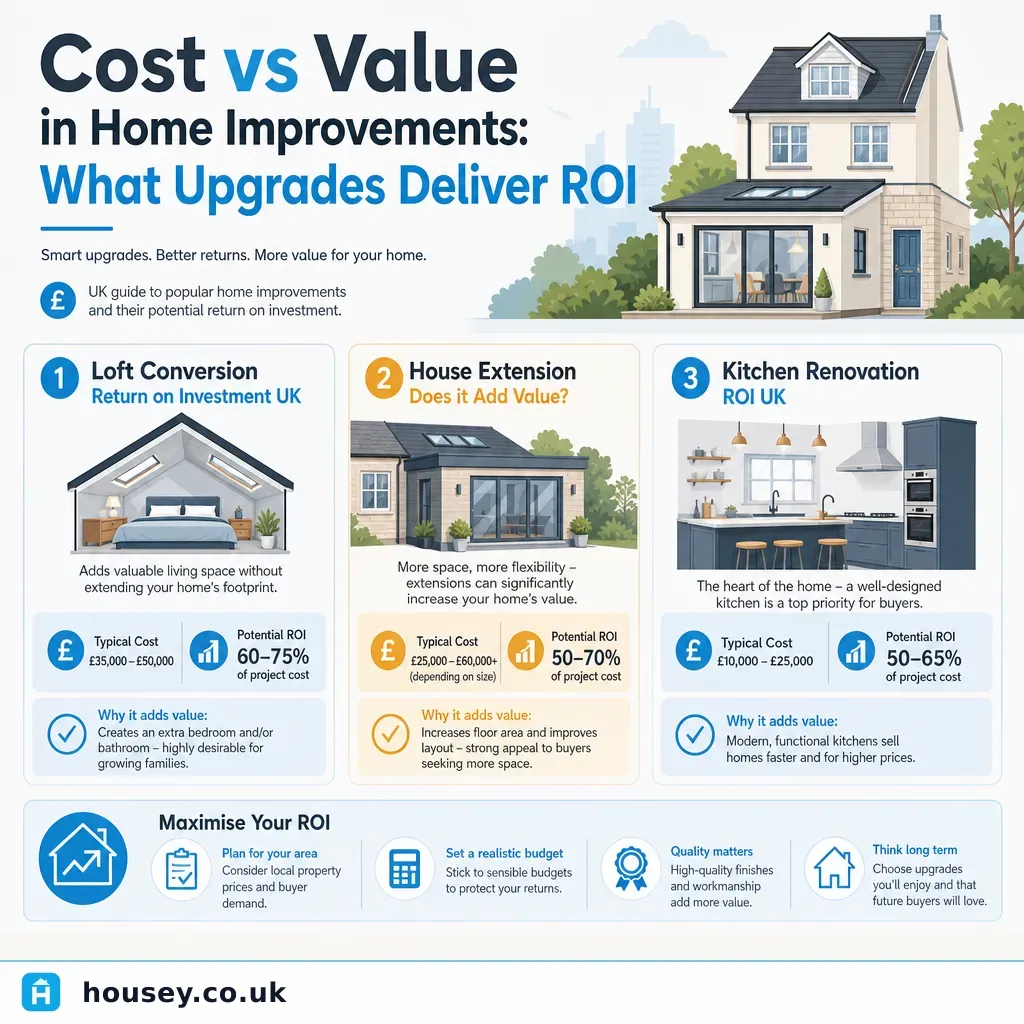
Cost vs Value in Home Improvements: What Upgrades Deliver ROI
Whether you are renovating to sell, to improve how you live, or both, the question of which improvements recover their cost matters. In the UK, the relationship between what you spend on a home and what you get back at sale is shaped by local property values, buyer expectations, the quality of execution, and whether you are adding genuinely usable space or simply refreshing finishes. Homeowners regularly overestimate the financial return of cosmetic work and underestimate how much location influences whether any improvement pays back.
Key points
- Loft conversions are consistently cited by estate agents and property analysts as among the highest-value UK home improvements, with potential value uplift of 10–20% in many locations where an additional bedroom and bathroom are created.
- Single-storey rear extensions typically add 5–8% to property value in areas where local price-per-square-metre supports the cost of works.
- Replacement windows in existing dwellings in England must meet a maximum U-value of 1.4 W/m²K under Approved Document L; installers registered with FENSA (the glazing self-certification scheme) can self-certify compliance with Building Regulations.
- Kitchen renovations rarely deliver a full pound-for-pound cost recovery at sale, but a dated kitchen can suppress buyer offers and prolong time on the market.
- Under permitted development rights, single-storey rear extensions of up to 4m (detached houses) or 3m (other house types) may not require a planning application, subject to conditions and the prior approval neighbour consultation scheme for larger extensions.
Which improvements add the most value in the UK?
The table below compares common home improvements by typical cost, estimated value uplift, and key conditions. All figures are indicative and vary considerably by location, property type, specification, and execution quality.
Indicative UK costs and value uplift, last reviewed 2026-05-24. Obtain professional valuations and contractor quotes before making investment decisions.
Improvement | Typical cost range | Indicative value uplift | Best conditions | Key notes |
|---|---|---|---|---|
Loft conversion (dormer) | £35,000–£65,000+ | 10–20% of property value | Houses with usable roof void; strong local values | Adds bedroom and bathroom; planning needed for most dormers |
Single-storey rear extension | £25,000–£60,000+ | 5–8% | Houses where rear space permits | Permitted development may apply for smaller extensions |
Double-storey extension | £50,000–£110,000+ | 8–15% | High-value postcodes; adequate garden depth | Planning permission usually required |
Kitchen renovation | £8,000–£30,000+ | Variable; primarily saleability | All property types | Full cost recovery unusual; dated kitchen suppresses offers |
Additional bathroom | £5,000–£20,000+ | Higher for a second bathroom | Properties with only one bathroom | Adding a second bathroom often more impactful than renovating one |
New roof | £6,000–£18,000+ | Minimal direct uplift | Homes with failing or end-of-life roof | Prevents value loss; may be required by mortgage lender |
Replacement windows and doors | £5,000–£18,000+ | Low direct uplift; EPC benefit | Single-glazed or failing frames | FENSA certification confirms Building Regulations compliance |
Garden landscaping | £3,000–£20,000+ | Modest; kerb appeal factor | Properties with neglected outdoor space | Highly location-dependent |
Sources: estate agent surveys, RICS guidance, Nationwide House Price data. Costs are indicative and vary by location, specification, and contractor.
Loft conversions: the UK's highest-return improvement
A loft conversion that creates an additional bedroom — particularly one with an en-suite bathroom — is one of the clearest value-adding projects available to UK homeowners. Residential valuation in the UK is largely driven by bedroom count, and moving from three to four bedrooms can open a property to a significantly wider pool of buyers and comparables.
Not all loft conversions require planning permission. Rear dormers and hip-to-gable conversions may fall within permitted development rights, provided the total additional roof volume does not exceed 40 cubic metres for terraced houses or 50 cubic metres for detached and semi-detached homes. Building regulations approval is always required, regardless of whether a planning application is needed.
For complex rooflines, poor roof access, or properties in conservation areas, engage a specialist loft conversion company to assess feasibility before commissioning drawings.
Extensions: space that sells
A well-designed rear extension creating an open-plan kitchen and living area has become one of the most sought-after features in UK family homes, particularly in cities and commuter towns where buyers trade garden depth for internal space. The value added depends on:
- The price per square metre in your postcode — higher-value areas generate more absolute uplift per added square metre.
- Whether the design integrates well with the existing property and meets buyers' expectations for the neighbourhood.
- The planning history of nearby properties — if most in the street have already extended, the marginal uplift is smaller because buyers already expect the feature.
For larger single-storey extensions (4–8m for detached houses, 3–6m for others), the prior approval neighbour consultation scheme applies under permitted development. Consult your local planning authority or an experienced extension builder before proceeding.
Energy efficiency: the growing value driver
Energy Performance Certificate (EPC) ratings are increasingly factoring into buyer decisions, lender products, and landlord legal obligations. Several major lenders offer green mortgage products at preferential rates for homes rated EPC A or B. For landlords, a minimum EPC E rating is required for new tenancies in England and Wales under the Minimum Energy Efficiency Standards regulations, with further tightening proposed for the future.
For owner-occupiers, the most cost-effective EPC improvements are typically:
- Loft insulation where absent or below current standards (GOV.UK and the Energy Saving Trust publish updated guidance on thresholds and available grant schemes).
- Cavity wall insulation where applicable to the construction type.
- Replacement of single-glazed windows with double or triple glazing via a FENSA-registered window and door installer.
- Heating system upgrades where economically viable.
The Energy Saving Trust provides regularly updated guidance on typical costs, savings, and available grant schemes for these measures.
Does a new roof add value?
A new roof rarely delivers a measurable positive uplift in isolation. Its primary function is defensive — it prevents value erosion. Surveyors regularly flag roofing defects in RICS Level 2 and Level 3 pre-purchase surveys, and mortgage lenders may retain funds or decline to lend until roofing works are addressed. If you are selling a property with an ageing or failing roof, addressing it with a vetted roofing contractor before listing removes a common negotiation pressure point and reduces the risk of a sale falling through after survey.
Before you commit: what to consider
Homeowner checklist: evaluating a home improvement investment
Red flags that a project may not deliver the return you expect
- You are in a lower-value postcode and the planned works cost more than the achievable price-per-square-metre uplift supports.
- You are already the highest-priced property on the street and cannot draw value from higher-priced comparables.
- The improvement is driven by very personal taste unlikely to be shared by mainstream buyers in your area.
- You plan to sell within twelve months but the works involve significant disruption over eight or more months.
- The contractor cannot confirm planning history, building regulations sign-off status, or provide references for comparable completed projects nearby.
When to get professional help
The value of a specific improvement in your property and location is best assessed by a local RICS-registered valuer or an experienced estate agent. Seek professional input if:
- You are making an investment decision primarily on the basis of expected sale price uplift.
- The project involves structural alterations — removing load-bearing walls, altering foundations, or adding a storey.
- You are uncertain whether planning permission or building regulations approval applies.
- A survey has flagged defects and you are unsure which repairs to prioritise before selling.
How Housey can help
Housey connects homeowners with vetted professionals across improvement and build services. Whether you are considering a loft conversion, a rear or side extension, new or repaired roofing, or replacement windows and doors, Housey helps you request quotes, compare proposals, and find professionals with relevant local experience.
Frequently asked questions
Which home improvement adds the most value in the UK?
For most homeowners, a loft conversion creating an additional bedroom and en-suite bathroom delivers the strongest percentage value uplift — typically 10–20% in locations where the property type and local comparables support it. Extensions that add open-plan kitchen and living space are a close second. Returns are heavily location-dependent; consult a local estate agent or RICS-registered valuer for guidance specific to your property.
Do I always need planning permission for an extension?
Not always. Under permitted development rights, a single-storey rear extension of up to 4m (detached houses) or 3m (other house types) may not require a full planning application. Larger extensions require prior approval via the neighbour consultation scheme. Conservation area designations, Article 4 Directions, and previous extensions on the property can restrict or remove permitted development rights. Check with your local planning authority before starting.
Does a new roof add value to a house?
A new roof rarely adds measurable positive value on its own, but it protects against value loss. Surveyors regularly flag roofing defects in pre-purchase surveys, and lenders may decline to lend or retain funds until the work is completed. Replacing an ageing roof before selling removes a common negotiation pressure point and reduces the risk of a buyer seeking a price reduction or withdrawing after survey.
How does an EPC rating affect house prices?
Research from sources including Rightmove has identified associations between higher EPC ratings and sale price premiums, particularly in urban markets. The effect is not uniform across all property types and regions, but EPC ratings are becoming more visible as energy costs feature more prominently in household finances and green mortgage products become more widely available from major lenders.
Sources and further reading
- Permitted development rights for householders: technical guidance — GOV.UK
- Energy Saving Trust: home insulation and energy efficiency — Energy Saving Trust
- RICS: residential property guidance — Royal Institution of Chartered Surveyors
- FENSA: replacement glazing self-certification scheme — FENSA
- Approved Document L: conservation of fuel and power in existing dwellings — GOV.UK
- Planning Portal: householder planning guidance — Planning Portal
Useful next reads
 Improvement & Build
Home Improvement Projects That Add Value to Your Property
Loft conversions, rear extensions, and kitchen refurbishments typically offer the strongest return on investment for UK homeowners.
 Improvement & Build
Maximising Value Through Strategic Home Improvement Projects
In the UK, loft conversions and kitchen extensions tend to deliver the strongest return on investment, with loft conversions potentially adding around 20% to property value according to Nationwide data.
 Improvement & Build
Home Renovation Priorities: Where to Spend for the Best Return in the UK
UK professionals consistently prioritise structural and damp repairs first, followed by energy efficiency improvements that raise EPC ratings, then proportionate kitchen and bathroom updates.
 Improvement & Build
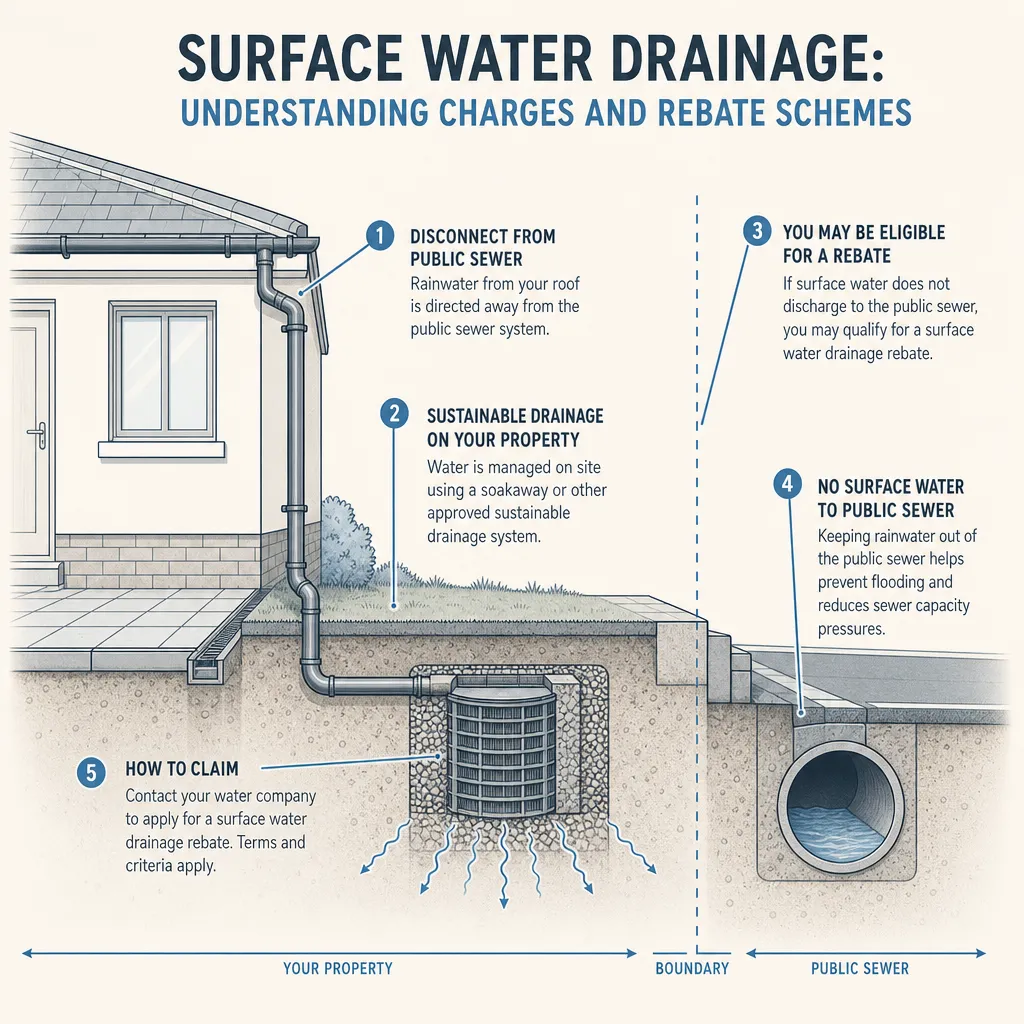
Surface Water Drainage: Understanding Charges and Rebate Schemes
Surface water drainage charges appear on UK household water bills to cover the cost of managing rainwater run-off through the public sewer network.
 Improvement & Build
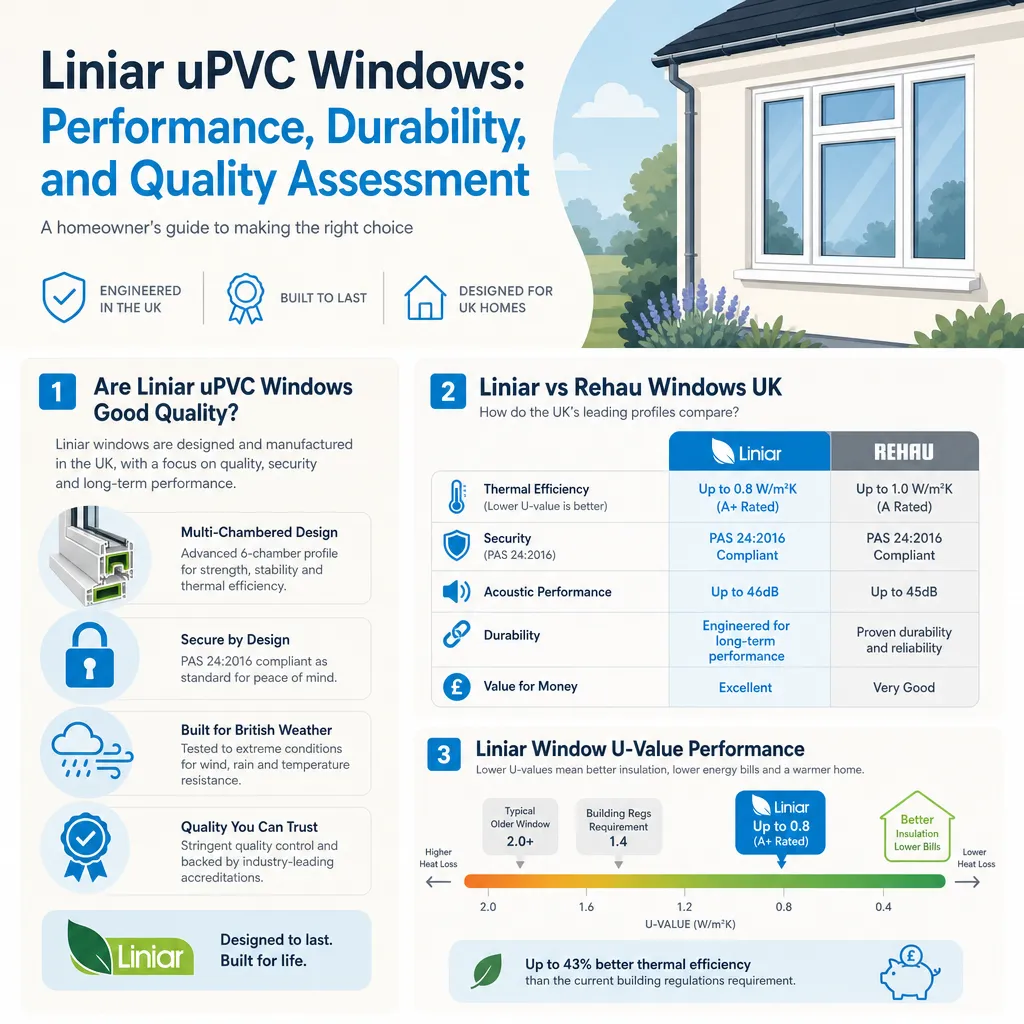
Liniar uPVC Windows: Performance, Durability, and Quality Assessment
Liniar uPVC window profiles are manufactured in the UK using multi-chambered, foamed frames.