Costs for installing livestock fencing or electric boundaries
By Housey · Last reviewed 6th of May 2026
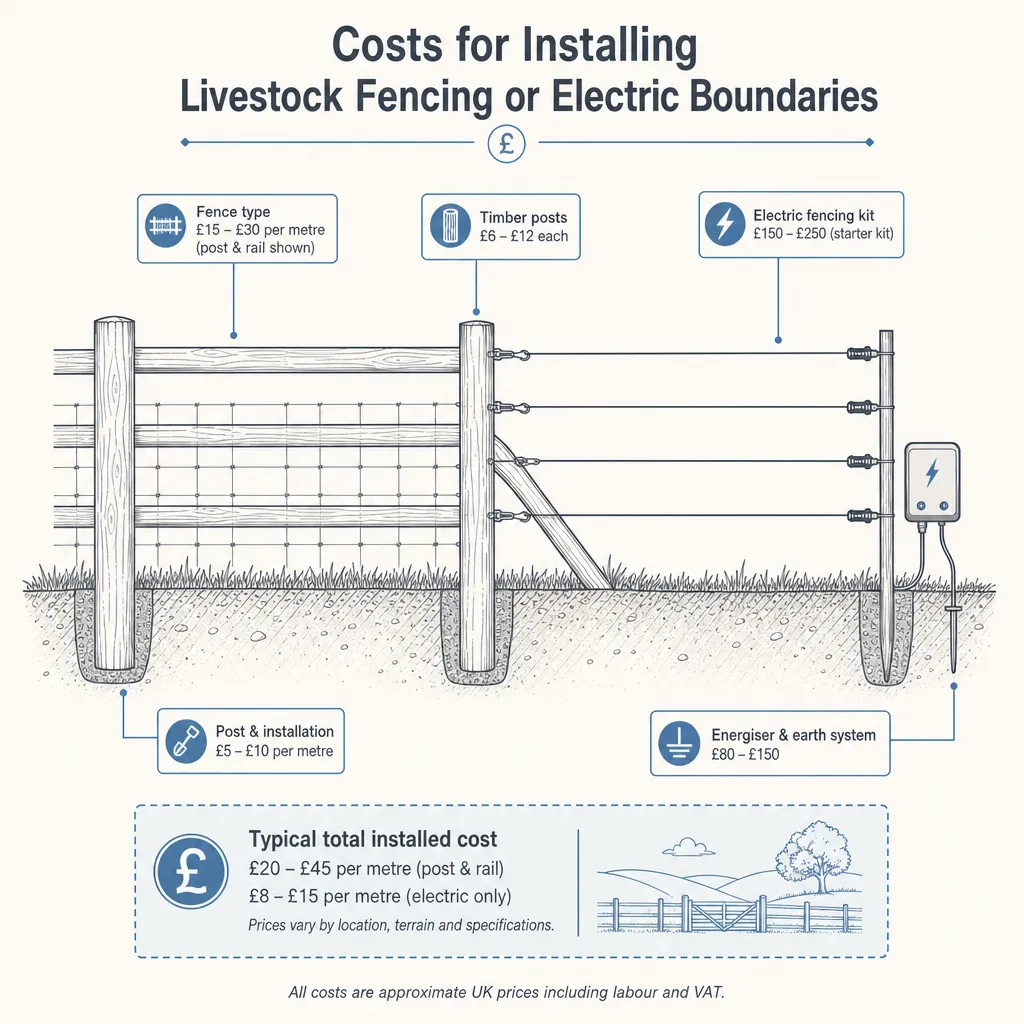
Costs for installing livestock fencing or electric boundaries
Fencing is one of the most significant recurring infrastructure costs on UK smallholdings, farms, and rural residential properties. Whether you are containing sheep, cattle, or horses, or establishing electric boundaries to manage rotational grazing, the materials, labour, and ground conditions all affect what you pay. Getting accurate quotes requires knowing the right questions to ask and understanding why cost-per-metre figures can vary so widely across different sites and contractors.
Key points
- Post-and-wire stock fencing (C8 or L8 pattern) typically costs £8–£18 per linear metre installed, including posts and wire (indicative UK costs, last reviewed 2026-05-06).
- Post-and-rail timber fencing typically costs £20–£45 per metre installed; the range reflects differences in rail count, post centres, and timber specification.
- Under BS EN 60335-2-76, electric fences must not exceed 10,000 volts peak, and appropriate warning signs are required near public rights of way under the Countryside and Rights of Way Act 2000.
- Agricultural fencing on working farmland in England generally qualifies as permitted development under Schedule 2, Part 6 of the Town and Country Planning (General Permitted Development) (England) Order 2015, but this right is restricted in National Parks, AONBs, and Sites of Special Scientific Interest.
- Electric fence energiser units cost £50–£400 depending on joule output; mains-powered units generally offer the lowest cost per joule for permanent installations near farm buildings.
Types of fencing and typical costs
Different livestock and different terrain require different fencing solutions. The table below summarises the main types, their indicative installed costs, and their typical applications.
Fencing type | Indicative cost per metre installed | Best for | Typical lifespan |
|---|---|---|---|
Post-and-wire stock fencing (C8/L8) | £8–£18 | Cattle, sheep, mixed grazing | 20–30 years with maintenance |
Post-and-rail timber (3-rail) | £20–£35 | Horses, paddocks, field boundaries | 15–25 years |
Post-and-rail timber (4-rail) | £28–£45 | Horses, boundary prestige, road frontage | 15–25 years |
High-tensile electric wire (permanent) | £5–£12 | Rotational grazing, deer management | 10–20 years |
Electric tape or polywire (temporary) | £1–£4 | Strip grazing, seasonal paddock division | Seasonal |
Pig netting or weld mesh | £12–£22 | Pigs, goats, small livestock | 15–25 years |
Deer fencing (1.8m high tensile) | £18–£35 | Deer management, woodland protection | 20–30 years |
Indicative UK costs, last reviewed 2026-05-06. Prices vary by region, ground conditions, and supplier. Always obtain at least three quotes from local contractors.
Labour costs for fencing contractors
Fencing contractors in the UK typically charge by the linear metre, with labour built into a per-metre rate. Where ground conditions are unusually difficult — rocky ground, heavy clay, or persistently waterlogged land — contractors may quote day rates instead.
Typical day rates for experienced fencing contractors range from £150 to £300 per person per day (indicative UK costs, last reviewed 2026-05-06). Corner posts, gate hangings, straining posts, and changes of direction attract additional costs because they are more labour-intensive than straight runs.
What affects the labour rate?
- Terrain and ground hardness. Rocky or waterlogged ground slows post driving and may require a tractor-mounted post driver rather than a manual or petrol driver, affecting both speed and day rate.
- Access. Fields requiring gate removal or traversal over narrow farm tracks can slow setup significantly and may mean a mobilisation surcharge.
- Distance from the contractor's base. Rural locations far from the contractor's yard may attract a travel or mobilisation charge, particularly for smaller jobs.
- Time of year. Ground conditions in winter months often increase labour time for post driving and may affect ground settlement after installation.
Electric boundary fencing: costs and components
Electric fencing is the most cost-effective way to manage rotational grazing and to reinforce or subdivide existing fixed boundaries. The main cost components are:
Energiser unit. This is the power source for the fence. Mains-powered energisers are generally the cheapest per joule of output. A suitable energiser for a two-hectare grazing block typically costs £80–£200; larger acreages or more animals require higher output models.
Energiser type | Typical cost range | Best for |
|---|---|---|
Mains-powered | £50–£200 | Permanent installations near farm buildings with mains supply |
Battery-powered (12V) | £80–£300 | Remote fields without mains electricity |
Solar-powered | £120–£400 | Remote fields with good southern aspect |
Wire, tape, or polywire. High-tensile galvanised wire for permanent installations costs approximately £30–£60 per 250-metre roll. Polywire or electric tape for temporary fencing costs approximately £15–£40 per 200-metre roll (indicative UK costs, last reviewed 2026-05-06).
Posts and insulators. Step-in plastic posts cost approximately £0.50–£1.50 each. Permanent wooden posts with screw insulators cost more depending on post spacing and timber specification.
Earthing rods. Proper earthing is critical — poor earthing is the most common cause of weak fence voltage. Earth stakes typically cost £5–£15 each, and most systems require at least two stakes driven at least 500mm apart and well away from each other.
Which fencing solution should you choose?
- Choose post-and-wire stock fencing if you need a permanent, low-maintenance boundary for cattle or sheep on relatively straightforward terrain.
- Choose post-and-rail timber if you are managing horses, want a visually prominent boundary adjacent to a road or residential area, or are fencing a paddock close to a dwelling.
- Choose permanent electric wire if you are setting up a rotational grazing system and need to subdivide larger fields cost-effectively over many years.
- Choose temporary electric tape or polywire for strip grazing, seasonal paddock division, or trialling a layout before committing to permanent fencing infrastructure.
- Ask a fencing contractor to visit the site if your ground conditions are unusual, the run is longer than 500 metres, or you need to meet specific grant scheme specifications for post diameters and wire gauges.
- Check with your local planning authority before starting if the land is in a National Park, an Area of Outstanding Natural Beauty, or a Site of Special Scientific Interest, or if the fencing is adjacent to a listed building curtilage.
What to ask a fencing contractor before accepting a quote
- Does the quote include all materials: posts, wire or rail, staples, straining wire, end posts, and corner posts?
- How will posts be driven — manual driver, petrol driver, or tractor-mounted post banger? Does difficult ground change the price?
- Are gates, gate posts, and hinges included or separately priced?
- What is the post spacing, and what diameter and timber specification are the posts?
- What happens if ground conditions differ from what was seen at the site visit — will the quote be revised?
- Is VAT included in the quoted price?
- Is there a defects period? What is covered if posts shift or wire sags within twelve months of installation?
- Do you hold public liability insurance, and what is the limit?
Planning permission and regulations
Agricultural fencing on working farmland in England and Wales is generally considered permitted development, meaning formal planning permission is not usually required. This is set out under Schedule 2, Part 6 of the Town and Country Planning (General Permitted Development) (England) Order 2015. However, permitted development rights are removed or restricted in several situations:
- National Parks and Areas of Outstanding Natural Beauty. Some fencing types may require prior approval or full planning permission depending on local development orders.
- Sites of Special Scientific Interest (SSSIs). Any fencing or ground disturbance requires consent from Natural England before starting work — this applies even to apparently routine post driving.
- Listed building curtilages. Fencing that could affect the character of a listed building or its curtilage may require listed building consent.
- Conservation areas. Local planning authority guidance should be sought before making significant boundary changes in or adjacent to a conservation area.
For electric fencing near public rights of way, appropriate warning signs are required under the Countryside and Rights of Way Act 2000, and the fence must not obstruct or narrow the right of way. The fence must comply with the voltage limits set in BS EN 60335-2-76, which caps electric fence output at 10,000 volts peak.
When to get professional help
Most agricultural fencing is within the capability of an experienced fencing contractor and does not require a regulated professional. Seek specialist advice if:
- Your site is a Site of Special Scientific Interest (SSSI), where Natural England consent is required before any fencing or ground disturbance takes place.
- You are applying for a Countryside Stewardship capital grant or a Sustainable Farming Incentive action, which may specify post diameters, wire gauges, staple counts, or installation methods that must be evidenced and photographed.
- The fencing borders a public road and the height or opacity could affect highway visibility splays — contact the relevant highways authority before starting.
- You are uncertain whether electric fencing is appropriate near a public right of way frequently used by unsupervised children or vulnerable adults, particularly if signage placement is not straightforward.
How Housey can help
Housey helps UK property owners connect with vetted local contractors for a wide range of property improvement and rural infrastructure work. If you are planning a livestock fencing or electric boundary project and want to compare quotes from experienced contractors in your area, Housey can help you describe your requirements and receive comparable quotes — making it straightforward to assess cost, specification, and credentials before committing.
Frequently asked questions
Do I need planning permission for livestock fencing?
In most cases in England and Wales, agricultural fencing on working farmland is permitted development and does not require planning permission. Exceptions apply in National Parks, Areas of Outstanding Natural Beauty, Sites of Special Scientific Interest, and listed building curtilages. If in doubt, contact your local planning authority for pre-application advice before starting any work.
How long does agricultural fencing last?
Post-and-wire stock fencing lasts 20–30 years with reasonable maintenance, including periodic re-straining of wire and replacement of rotted posts. Timber post-and-rail fencing lasts 15–25 years depending on timber species and whether pressure-treated posts were used. Electric polywire for temporary use is typically replaced seasonally; permanent high-tensile wire may last 15–20 years.
Can I install electric fencing myself?
Electric fencing for agricultural use is commonly installed by landowners themselves, particularly for temporary or rotational grazing systems. The key requirements are correct energiser output for your acreage, proper earthing with at least two earth stakes, and appropriate warning signs near any public access points. Follow the manufacturer's installation guidance and ensure compliance with BS EN 60335-2-76 for safe voltage limits.
What grants are available for agricultural fencing in the UK?
The Countryside Stewardship scheme and the Sustainable Farming Incentive (SFI) can contribute towards boundary fencing costs for qualifying farms in England. Grant rates and eligible works change periodically — check the current GOV.UK Countryside Stewardship guidance or contact the Farming Advice Service (FAS) for up-to-date information. In Wales, equivalent support is available through the Sustainable Farming Scheme.
Sources and further reading
- Town and Country Planning (General Permitted Development) (England) Order 2015 — Schedule 2, Part 6 — legislation.gov.uk
- Countryside Stewardship: capital grants — GOV.UK
- Sites of Special Scientific Interest — operations requiring consent — Natural England / GOV.UK
- Environmental Land Management schemes overview — GOV.UK
- Electric fences — safety guidance — Electrical Safety First
Useful next reads
 General property advice
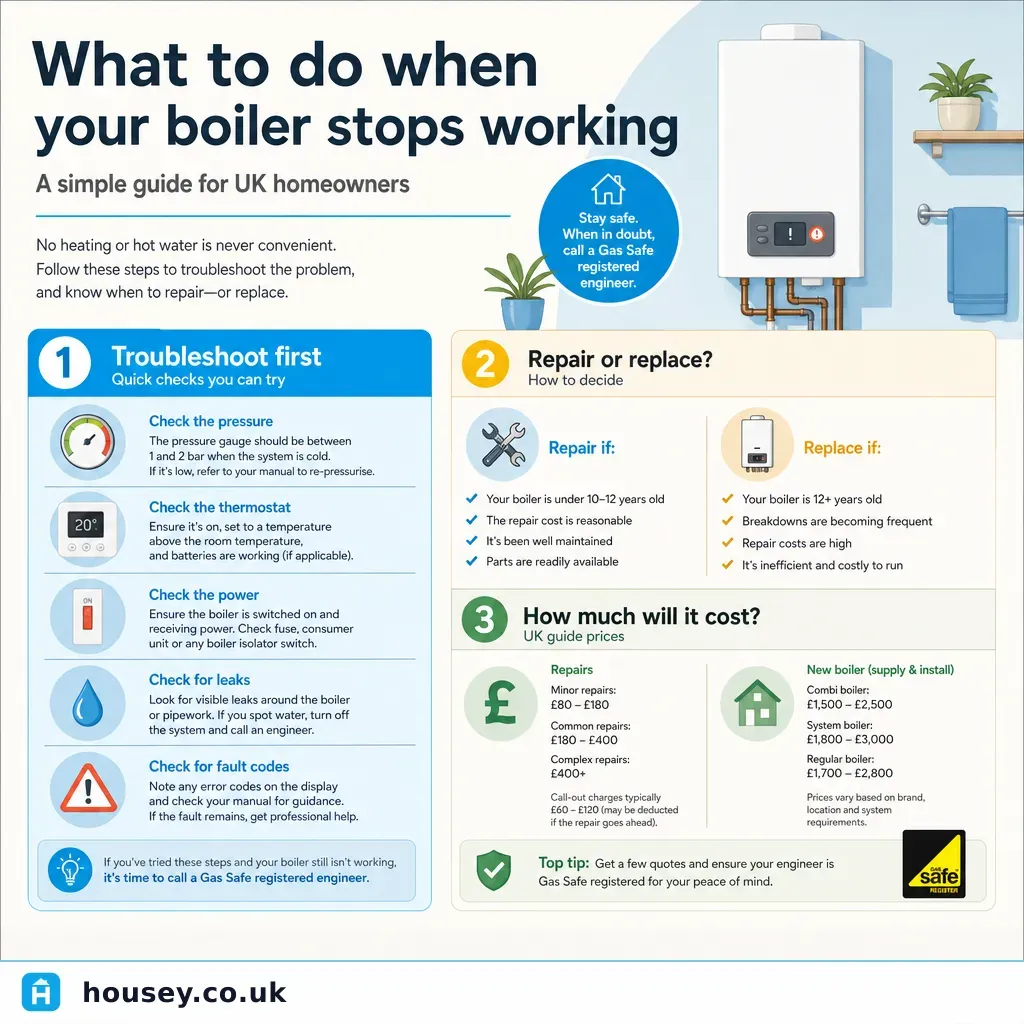
What to do when your boiler stops working
When your boiler stops working, check the pressure gauge (should read 1–1.
 General property advice
Property Market Trends: Activity Growth and Price Movements
UK property market activity is measured through completed sale registrations (HM Land Registry), lender mortgage data, and transaction volumes from HMRC.
 General property advice
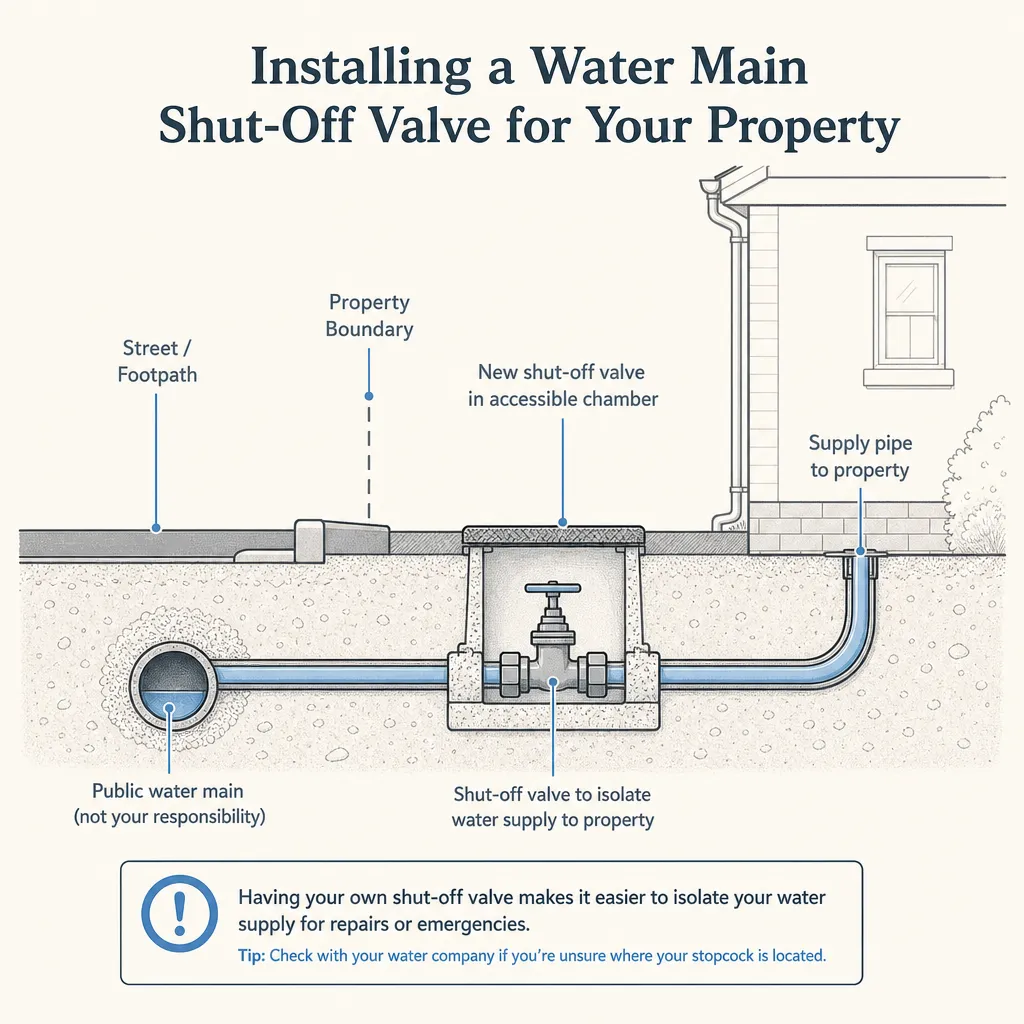
Installing a water main shut-off valve for your property
A water main shut-off valve — commonly called a stopcock — controls all water entering your home from the mains.
 General property advice
Monthly House Price Index: August Market Report and Analysis
The UK House Price Index is published monthly using completed Land Registry transaction data, meaning August figures typically reflect sales agreed months earlier.
 General property advice
Scottish Property Market: Activity and Regional Trends
Scotland's property market operates under distinct legal rules: sellers must provide a Home Report before marketing, transactions become legally binding at conclusion of missives rather than exchange of contracts, and Land and Buildings Transaction Tax replaces Stamp Duty.