Country Properties and Rural Estate Surveys and Inspections
By Housey · Last reviewed 30th of May 2026
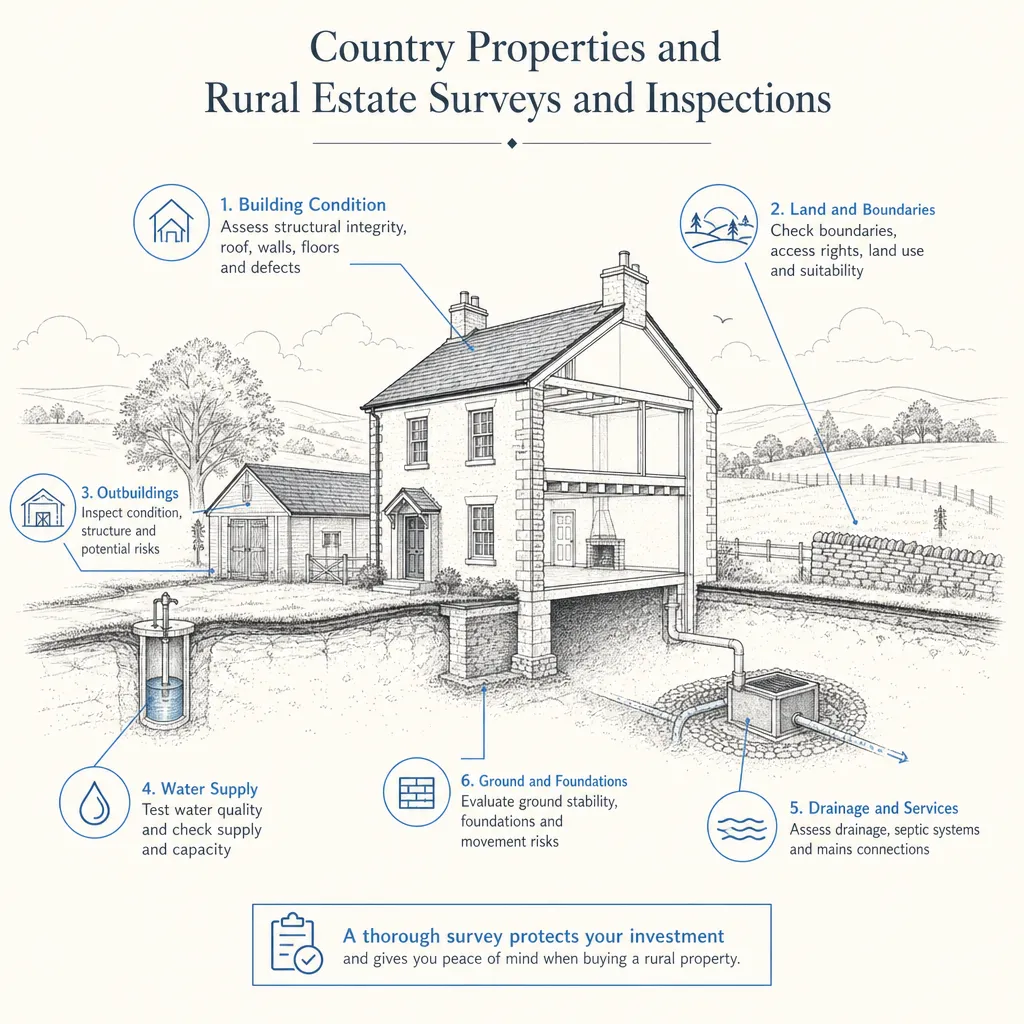
Country Properties and Rural Estate Surveys and Inspections
Rural and country property purchases in England, Scotland, and Wales carry a distinct set of survey and inspection requirements that rarely apply to a standard urban terrace or new-build flat. From unregistered land boundaries and Tree Preservation Orders to private septic tanks and listed farmhouse outbuildings, the number of specialist reports a prudent buyer should commission can be significantly greater — and the legal and financial consequences of missing a problem significantly higher.
Key points
- Many rural properties have unregistered land or boundaries defined by hedges, ditches, or historic estate maps — a boundary survey may be essential before relying on the title plan from HM Land Registry.
- Properties connected to a private sewage treatment system or septic tank must comply with the General Binding Rules (England, revised 2020) or face Environment Agency enforcement.
- Tree Preservation Orders (TPOs) and ancient woodland constraints can restrict what you do with land; an arboricultural survey identifies protected trees, their structural condition, and root constraints.
- A RICS Level 3 Building Survey is the appropriate starting point for most rural dwellings, but specialist reports — drainage, ecology, asbestos, boundary — are often also required.
- Listed building consent is required for almost any alteration to a listed farmhouse, cottage, or estate building, internal or external.
Why country properties need specialist surveys
An urban semi-detached in a 1990s estate has a relatively predictable set of survey risks: roof condition, cavity wall insulation, FENSA-compliant windows, and a connection to mains services. A rural farmhouse, converted barn, or country estate introduces a far wider range of variables:
- Private drainage: Properties not connected to mains sewer rely on a septic tank or sewage treatment plant. The condition, age, capacity, and compliance of these systems varies widely and directly affects habitability and Environment Agency compliance.
- Private water supply: Some rural properties draw water from a borehole, spring, or well. The Drinking Water Inspectorate and local authorities regulate private water supplies; buyers need a water quality test and ideally a survey of the extraction system.
- Unregistered or unclear boundaries: Rural land boundaries are often defined by hedges, ditches, or estate maps that do not translate clearly to the Ordnance Survey-based title plans used by HM Land Registry. Disputes over boundaries can be prolonged and expensive.
- Trees and ecology: Large estates and rural properties commonly have veteran or protected trees, ancient woodland, or habitat for protected species — great crested newts, bats, barn owls. Ignoring these constraints can lead to enforcement action or planning refusals for later works.
- Building condition: Older rural buildings — stone barns, flint cottages, cob-walled farmhouses — were built with materials and techniques outside the scope of a standard domestic survey. A RICS Level 3 surveyor with rural property experience is important here.
Which professional do you need?
Survey or inspection | What it covers | Typical professional | When to commission |
|---|---|---|---|
RICS Level 3 Building Survey | Structural condition, roof, damp, defects, services overview | RICS-accredited building surveyor | Before exchange — all rural properties |
Boundary survey | Boundary positions, encroachments, discrepancies with title plan | Chartered land surveyor | Where title plan is unclear or disputes are suspected |
Measured building survey | Accurate floor plans, elevations, and cross-sections | Surveying practice or architect | Conversion, extension, or planning projects |
Arboricultural survey | Tree species, condition, TPO status, safety, root constraints | Registered Consultant Arboriculturist | Where trees are significant or development is planned |
Ecological survey | Protected species, habitats, ecological constraints | Chartered ecologist | Before planning applications or conversion works |
Private drainage survey | Septic tank or treatment plant condition, capacity, compliance | Drainage engineer | All properties on private drainage |
Private water supply test | Water quality, extraction system condition | Accredited laboratory | All properties on a private water supply |
Asbestos survey | Presence and condition of asbestos-containing materials | Licensed asbestos surveyor | Before intrusive works on pre-2000 buildings |
Boundary and land issues
Rural land boundaries are among the most common sources of dispute in English property law. Title plans from HM Land Registry are drawn from Ordnance Survey maps and are accurate to approximately 1–2 metres — insufficient to resolve disputes over hedge lines, ditches, or strips of land between properties.
Before buying a rural property with significant acreage, check:
- Whether all the land is registered at HM Land Registry (unregistered land remains common in rural England and Wales).
- Whether the title deeds include historic estate maps, conveyances, or plans that describe boundaries in detail.
- Whether boundary structures — walls, fences, hedges, ditches — are the responsibility of the buyer or a neighbour, sometimes specified in the title register.
- Whether any rights of way, footpaths, bridleways, or access rights cross the land (check the Definitive Map at your local highway authority).
A boundary surveyor can produce a report comparing the physical features on the ground against the paper title, identifying discrepancies before you are legally committed.
Tree and ecological considerations
Rural properties often include mature trees, ancient hedgerows, or habitats of ecological significance. These are assets — but they carry legal responsibilities.
Tree Preservation Orders (TPOs) protect specific trees or groups identified by the local planning authority as having amenity value. Pruning, felling, or carrying out works to a protected tree without consent is a criminal offence carrying unlimited fines.
Ancient woodland cannot be converted to other uses without exceptional justification. If the property includes or is adjacent to ancient woodland, check the Natural England Ancient Woodland Inventory before making an offer.
Protected species surveys may be required before planning permission is granted for conversion or extension works. Barn conversions frequently require bat surveys — conducted during specific seasons — and sometimes barn owl surveys.
An arboricultural survey from a Registered Consultant Arboriculturist identifies which trees are protected, assesses structural condition and safety, and provides a plan that satisfies local planning authority requirements.
Measured building surveys for rural structures
Many rural properties include outbuildings, barns, or ancillary structures in various states of repair or conversion potential. A measured building survey produces accurate architectural drawings — floor plans, elevations, cross-sections — required for:
- Listed building consent applications.
- Planning applications for change of use, for example barn to dwelling.
- Architectural feasibility work ahead of renovation or extension.
- Insurance valuations where the property is unusual, listed, or very large.
Standard estate agent floor plans are not accurate enough for building regulation or planning submissions.
Pre-purchase checklist for country property buyers
Before exchanging contracts on a rural or country property:
Important limitations
This article provides general information about the types of surveys commonly needed for rural and country property purchases in England and Wales. Rules and requirements vary by property type, local authority, location, tenure, and the specific physical characteristics of the land and buildings. This article does not constitute legal, structural, or planning advice. A qualified professional should assess your specific property before you commit to purchase or undertake any works.
What to ask a qualified professional
Before instructing any surveyor or specialist for a country property purchase, ask:
- Do you have specific experience with rural properties, historic buildings, or this type of construction?
- Will the survey cover all outbuildings and structures, or only the main dwelling?
- How will you access the roof space, drainage system, and land boundary during the inspection?
- Will the report identify areas where specialist follow-up reports are recommended?
- Are you a RICS member, a Registered Consultant Arboriculturist, or a Chartered Ecologist, as appropriate to the scope of instruction?
- What is the reporting timeline, and will you discuss findings with me before the report is finalised?
When to get professional help
Rural property purchases almost always warrant multiple professional surveys. Seek specialist input immediately if:
- The title plan does not clearly match the physical boundaries visible on the ground.
- The property includes trees that appear mature, veteran, or within a conservation area.
- Any barn, stable, or outbuilding is described as having conversion potential — ecological and planning constraints must be assessed first.
- The seller cannot provide evidence of private drainage compliance, such as a valid inspection certificate or recent emptying records.
- The building surveyor's report flags cracks, settlement, or damp as requiring further specialist investigation.
How Housey can help
Housey connects rural buyers with accredited specialists who understand the particular demands of country property purchases. Commission an arboricultural survey to understand tree constraints before you exchange, instruct boundary surveyors where land extent is unclear, or arrange measured building surveys for outbuildings and barns you plan to convert or extend. Submit a single request and receive quotes from up to four vetted professionals.
Frequently asked questions
Do I need an arboricultural survey when buying a rural property?
Not always, but it is strongly recommended where the property has significant trees, is in a conservation area, or where development or conversion works are planned. An arboricultural survey identifies Tree Preservation Orders, assesses structural safety, and flags constraints that could affect future planning applications. Without one, you risk committing to works that require consent you have not yet secured — and may not obtain.
What is a measured building survey and do I need one?
A measured building survey produces accurate scaled drawings — floor plans, elevations, and sections — used for planning applications, listed building consent, architectural design, or insurance valuations. For rural properties with complex layouts, listed farmhouses, or conversion projects, a measured building survey is usually essential before any design work begins. Standard estate agent floor plans are not accurate enough for these purposes.
How do I check if a rural property has a registered boundary?
Search HM Land Registry online to check registration status. The title register includes a title plan, but note this is indicative rather than definitive for precise boundary positions. For detailed accuracy, instruct a chartered land surveyor to compare the title plan with physical features on the ground. Your solicitor should also review the title deeds and any historic conveyancing documents for boundary descriptions.
What drainage checks should I do for a country property?
Ask the seller whether the property connects to mains sewer, a septic tank, or a sewage treatment plant. For private systems, request the last inspection report, emptying records, and any Environment Agency correspondence. Commission an independent drainage survey before exchange to assess condition and compliance with the General Binding Rules (England) or equivalent. A failing or non-compliant system can be costly to upgrade or replace.
Sources and further reading
- General Binding Rules for Small Sewage Discharges — GOV.UK
- Search the Land Register — HM Land Registry
- Ancient Woodland Inventory — Natural England
- Home Surveys — RICS
- Find an Arborist — Arboricultural Association
- Listed Buildings — Planning Portal
- Private Water Supplies — Drinking Water Inspectorate
Useful next reads
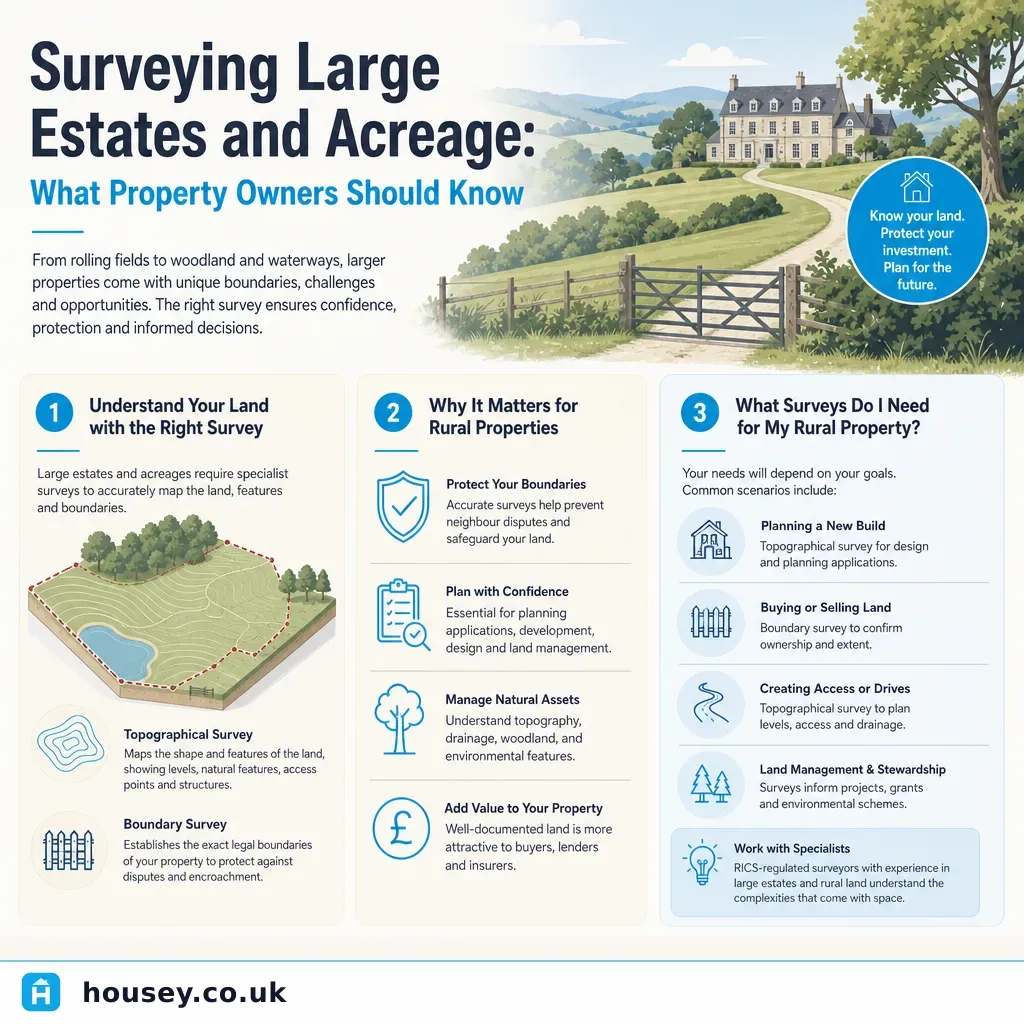 Surveys & Inspections
Surveying Large Estates and Acreage: What Property Owners Should Know
Large estates and acreage typically require a combination of surveys: a topographical survey to map contours and features, a boundary survey to confirm legal extents, and often an ecological or environmental assessment.
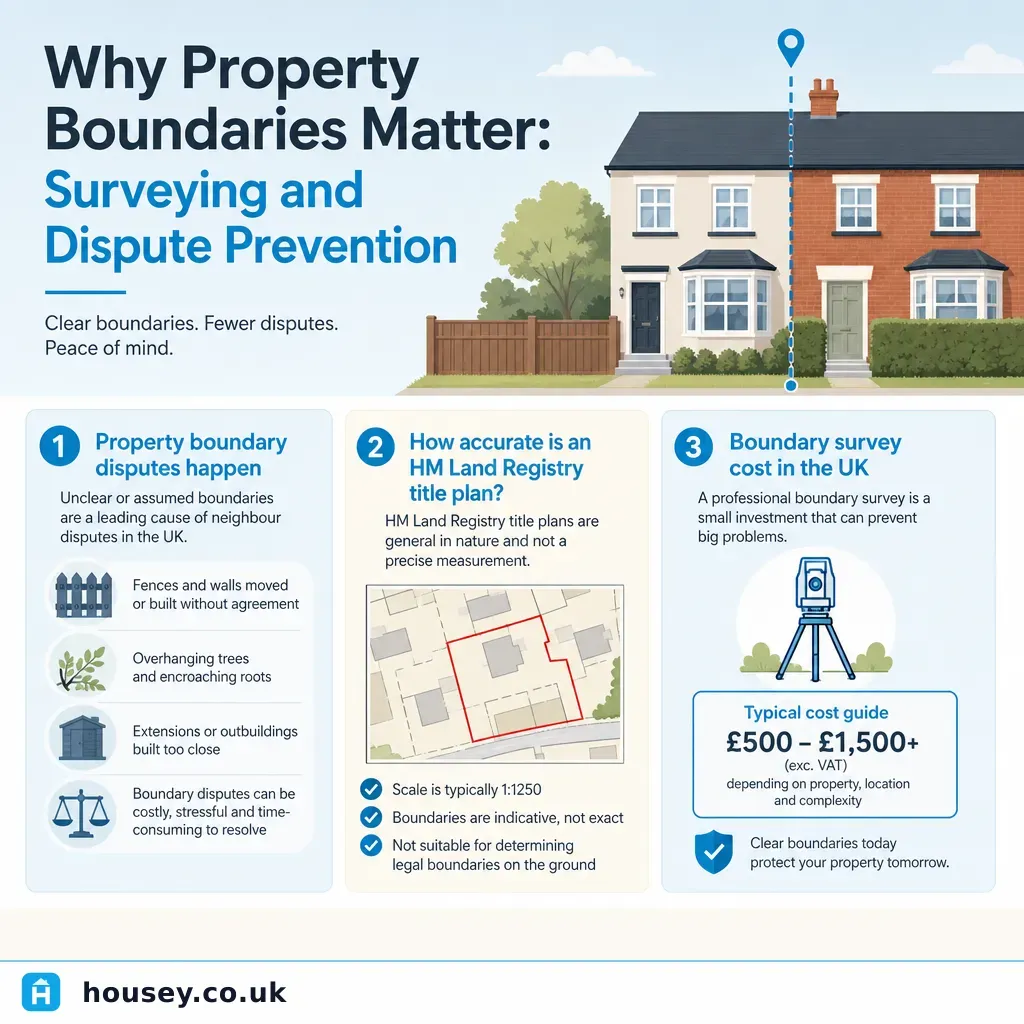 Surveys & Inspections
Why Property Boundaries Matter: Surveying and Dispute Prevention
Property boundaries in England and Wales are recorded as general boundaries by HM Land Registry — not precise measurements.
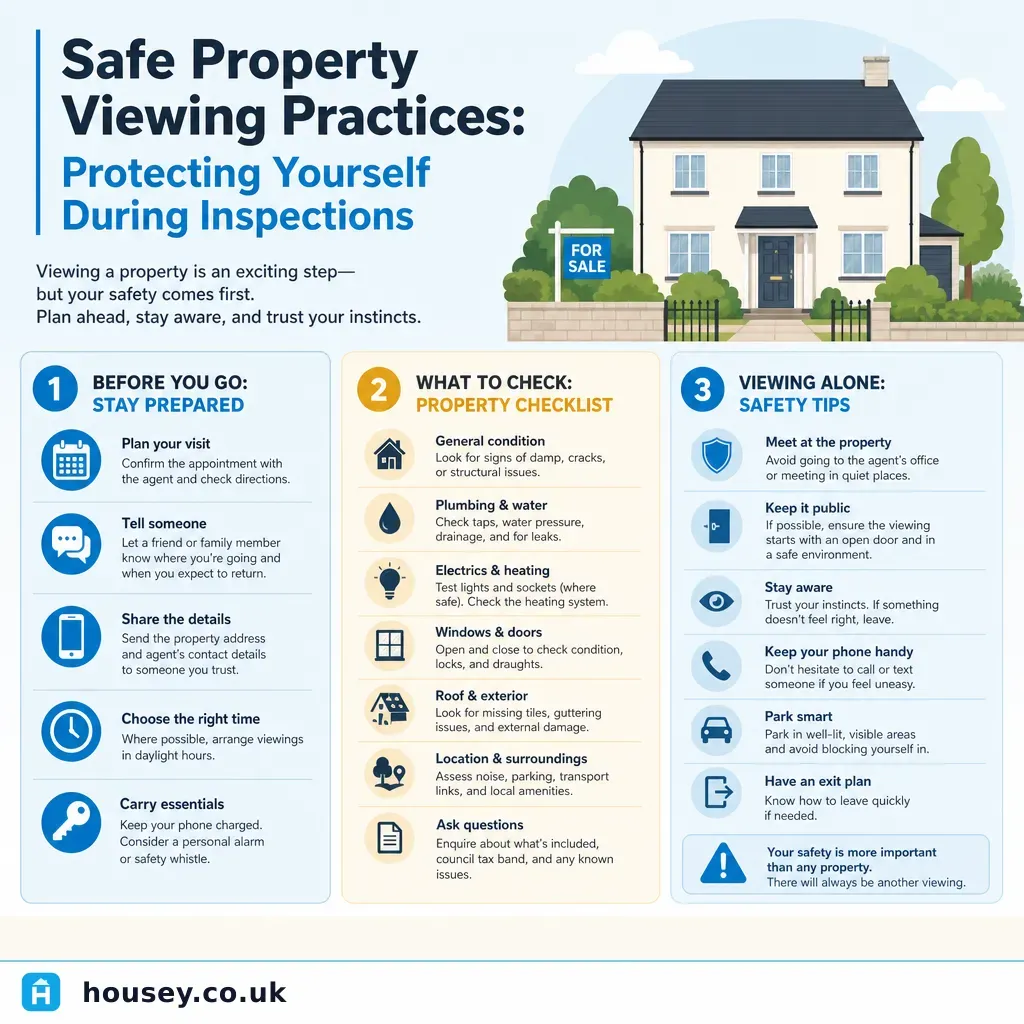 Surveys & Inspections
Safe Property Viewing Practices: Protecting Yourself During Inspections
When viewing a property in the UK, always tell someone where you are going and share the full address before you leave.
 Surveys & Inspections
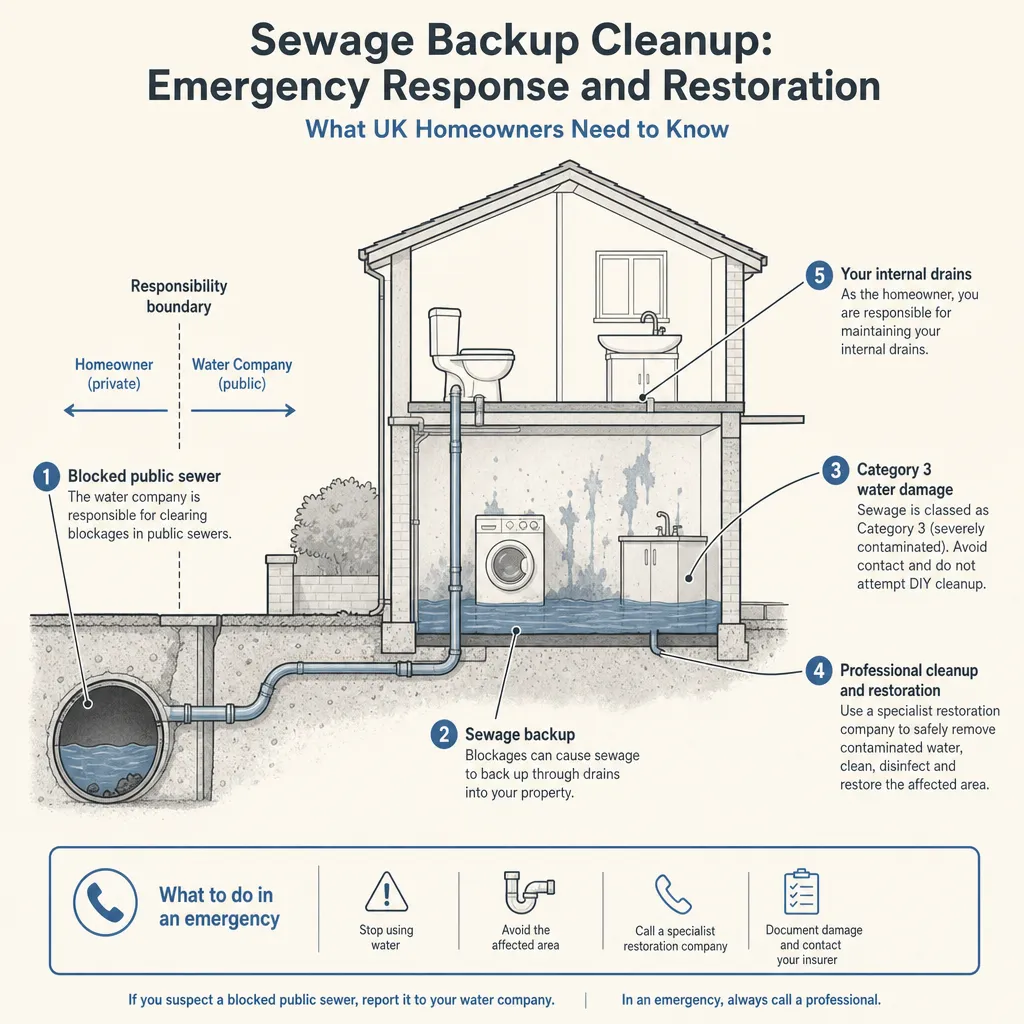
Sewage Backup Cleanup: Emergency Response and Restoration
A sewage backup should be treated as a Category 3 contamination event.
 Surveys & Inspections
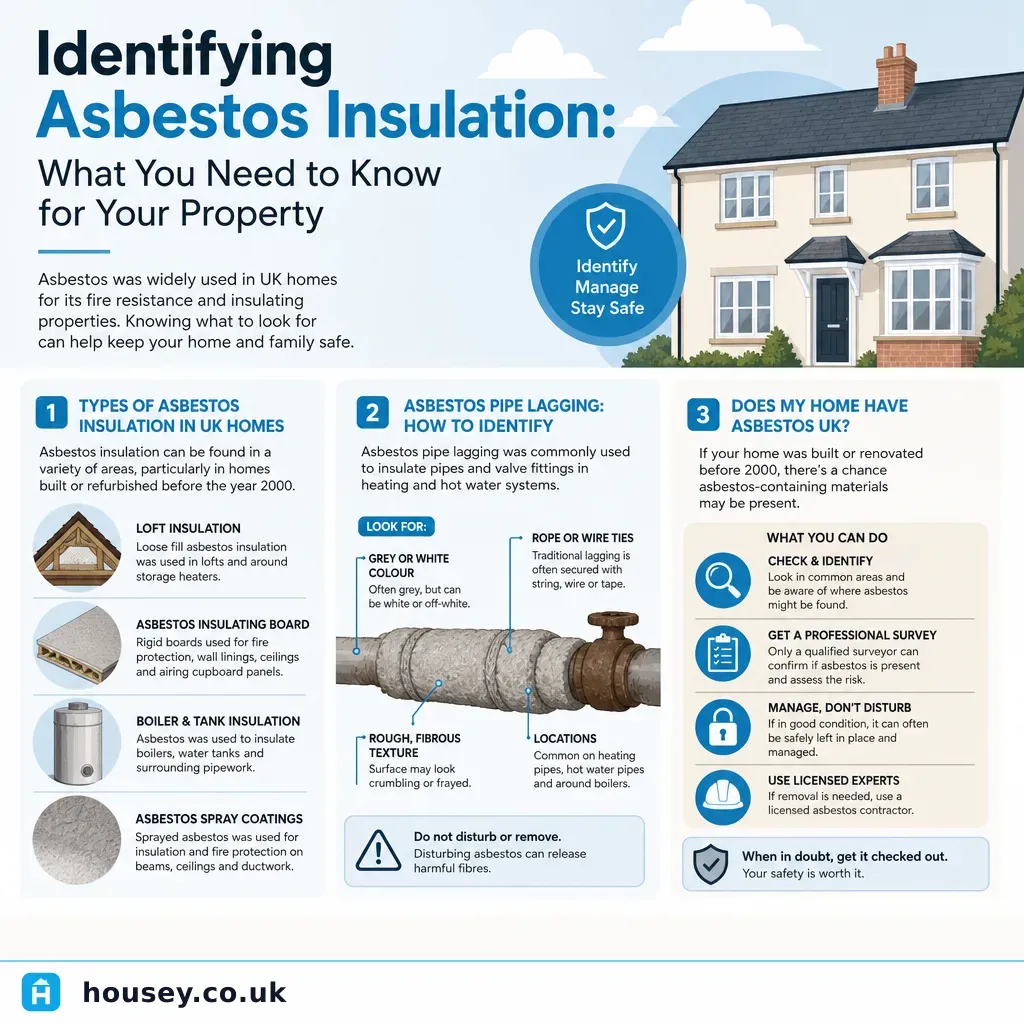
Identifying Asbestos Insulation: What You Need to Know for Your Property
Asbestos insulation was widely used in UK properties built before 2000, commonly found in pipe lagging, ceiling tiles, loose-fill loft insulation, and around boilers.