Covered Outdoor Kitchen and Dining Spaces: Design and Installation
By Housey · Last reviewed 1st of June 2026
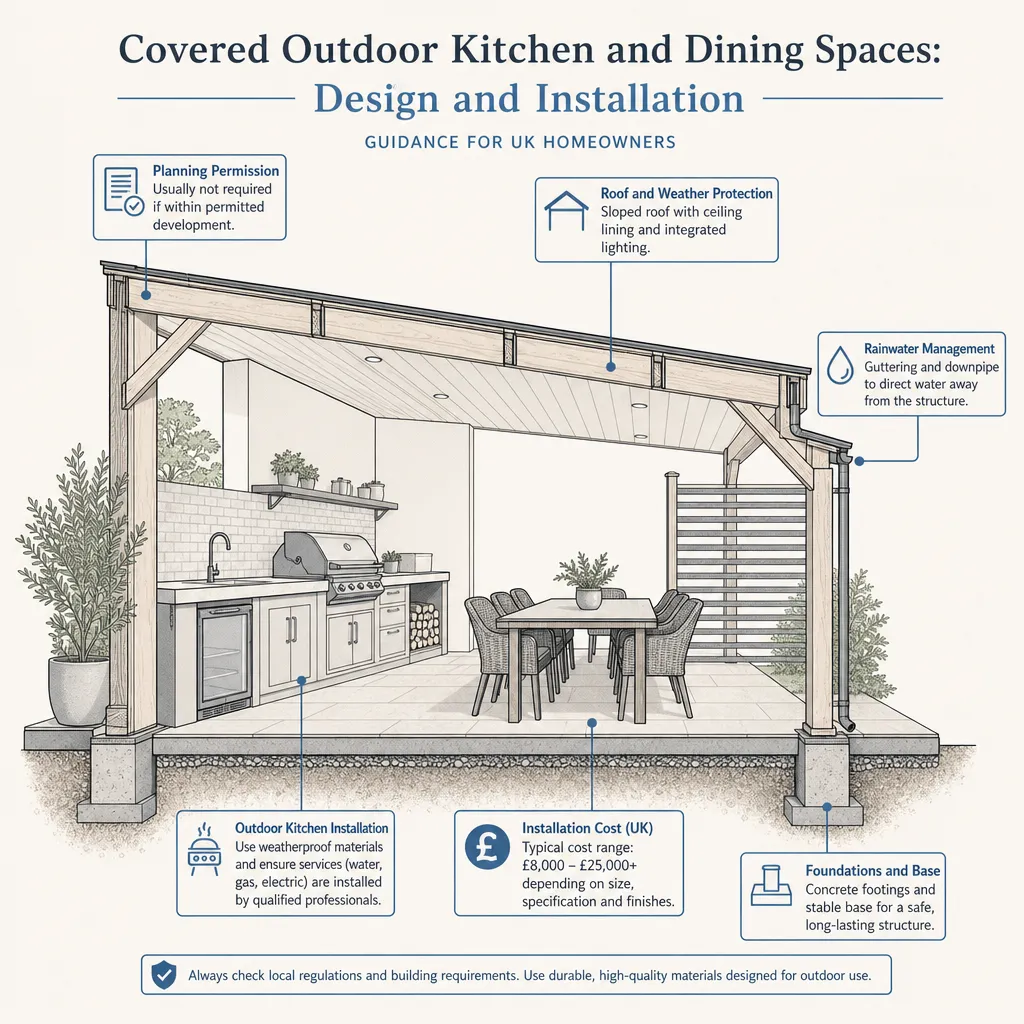
Covered Outdoor Kitchen and Dining Spaces: Design and Installation
A covered outdoor kitchen is one of the more significant garden improvements a UK homeowner can undertake — it extends usable living space, adds an attractive focal point, and, when well designed, functions year-round in our changeable climate. Whether you are planning a simple pergola with a built-in BBQ or a fully equipped kitchen pavilion, the project involves planning rules, building regulations, utility connections, and design decisions that can quickly become complex if not approached in the right order.
Key points
- Under Schedule 2, Part 1, Class E of the Town and Country Planning (General Permitted Development) (England) Order 2015, most rear-garden outbuildings are permitted development (PD) provided the eaves height does not exceed 2.5m and the overall height does not exceed 4m (dual-pitched roof) or 3m (any other roof form).
- If any part of the structure falls within 2m of a boundary, the maximum permitted overall height drops to 2.5m — a threshold easy to breach with a substantial covered structure.
- Permitted development rights under Class E do not apply to listed buildings, or to properties on Article 2(3) land, which includes National Parks, Areas of Outstanding Natural Beauty, conservation areas, and World Heritage Sites.
- Any gas appliances — outdoor hobs, pizza ovens with a piped gas supply, or gas-fuelled infrared heaters — must be installed by a Gas Safe registered engineer under the Gas Safety (Installation and Use) Regulations 1998.
- Outdoor electrical installations must comply with BS 7671 (18th Edition Wiring Regulations) and, where notifiable, be certified under Part P of the Building Regulations.
Does a covered outdoor kitchen need planning permission?
Most covered outdoor kitchen structures in rear gardens qualify as permitted development (PD) under Class E of the GPDO 2015, meaning no planning application is needed provided the conditions are met. Several thresholds are, however, easy to breach — particularly height limits and the 50% curtilage coverage rule that restricts the combined footprint of all outbuildings and extensions on the plot.
Decision tree: do you need planning permission?
- Proceed under PD if: the structure is in the rear garden, eaves height is under 2.5m, overall roof height is under 4m (dual-pitched) or 3m (any other form), and combined outbuilding coverage remains under 50% of the original garden area.
- Check the boundary carefully if: any part of the structure comes within 2m of a boundary — the maximum permitted overall height in that zone is 2.5m.
- Apply for full planning permission if: the structure is in the front or side garden (Class E covers rear gardens only in England); or the height or footprint conditions cannot be met within the desired design.
- Seek specialist advice before proceeding if: the property is listed, in a conservation area, AONB, or National Park; or if a previous planning condition has removed PD rights.
- Check with your local planning authority (LPA) if: you are unsure about Article 2(3) designations or any relevant planning history attached to the property.
Applying for a Lawful Development Certificate (LDC) is not mandatory when PD applies, but it provides formal written confirmation from the LPA that the works are lawful. This can be valuable when selling or remortgaging. Applications currently cost approximately £103 in England — verify the current fee at GOV.UK planning fees guidance.
Rules differ in Scotland, Wales, and Northern Ireland; consult the relevant national Planning Portal for guidance specific to your location. For structures attached to the house, Class A (extensions) rather than Class E applies, and different height and size limits govern what is permitted.
Choosing the right structure
The type of cover affects planning compliance, build cost, weatherproofing, and whether building regulations apply.
Structure type | Typical eaves height | PD compatible? | Building regs usually required? | Best for |
|---|---|---|---|---|
Open pergola | 2–3m | Usually yes (rear garden) | No — open structure | Summer use, low budget, flexible |
Freestanding gazebo or pavilion | 2.5–4m | Usually yes under Class E | Possibly, depends on utilities | Four-season use, enclosed feel |
Lean-to attached to house | 2.5–3m | Class A rules apply, not Class E | Possibly — check size and attachment method | Year-round use, weatherproof |
Tensile sail or fabric canopy | Variable | Unlikely to require permission if temporary | No | Budget, flexibility, easily removed |
Premium detached garden room | 2.5–4m | Class E if detached | Yes if includes notifiable gas or electrical | Full year-round use |
Design considerations
A well-functioning covered outdoor kitchen balances aesthetics, practicality, and the realities of British weather.
Layout checklist:
- Position the cooking station so prevailing winds carry smoke away from the seating area — in most parts of England the prevailing wind is south-westerly.
- Allow at least 900mm clearance between the cooking surface and any adjacent combustible cladding, walls, or fixed seating.
- Plan drainage from the outset — a sloped concrete or paving base with a channel drain is far cheaper to install during groundworks than to retrofit later.
- Confirm the routes for gas, water, and electrical supplies before finalising the structure's footprint and foundation layout.
- Use materials rated for outdoor exposure: marine-grade stainless steel appliances, powder-coated aluminium frames, and porcelain or natural stone worktops outperform standard kitchen-grade products in a UK outdoor environment.
Key appliances and fittings:
- Built-in BBQ or grill: allow for ventilation clearance above the cooking surface in line with the manufacturer's instructions; this affects canopy height.
- Pizza oven: wood-fired models need a flue and minimum clearance distances as set out in Approved Document J; gas models require a Gas Safe installation.
- Outdoor sink: needs a cold-water supply and waste drainage connection; a hot-water feed may require significant additional pipework.
- Refrigeration: specify units with an outdoor ambient temperature rating of at least -5°C for year-round UK reliability.
- Lighting: outdoor-rated fittings are required to comply with BS 7671 — minimum IP44 for covered areas, IP65 for fully exposed positions.
Utility connections and building regulations
All utility work in an outdoor kitchen must be carried out by registered competent persons:
- Gas supply: involve a Gas Safe registered engineer from the design stage. Outdoor gas pipework must be buried or protected and terminated at an approved isolation valve. Permanent connections must not use indoor-rated flexible hoses.
- Electricity: circuits, sockets, and the supply cable must be designed and tested by a Part P registered electrician. All outdoor circuits require RCD (residual current device) protection. Sockets and fittings must carry the appropriate weatherproof IP rating.
- Water: a qualified plumber should install supply and waste connections, including an isolating stop-valve for the outdoor run.
- Building regulations: a freestanding outbuilding without sleeping accommodation and under 15m² internal floor area does not usually require a full building regulations application in England. However, gas and electrical installations within any structure are always notifiable under Approved Document J (combustion appliances) and Approved Document P (electrical safety) respectively.
Indicative costs
Indicative UK costs, last reviewed 2026-06-01. Costs vary significantly by specification, materials, region, and site access — always obtain multiple itemised quotes.
Scope | Indicative range |
|---|---|
Pergola with basic BBQ and paving base | £4,000–£12,000 |
Freestanding pavilion with outdoor kitchen fit-out | £15,000–£35,000 |
Premium garden room or fully weatherproofed kitchen pavilion | £30,000–£70,000+ |
Gas and electrical connections (utility work only) | £1,500–£4,000 |
Lawful Development Certificate application fee (England) | ~£103 |
VAT at 20% applies to labour and materials on new garden structures. Request itemised quotes separating groundworks, structure, roofing, cladding, utilities, appliances, and finishing.
Important limitations
This article provides general information about planning policy and building regulations for covered outdoor kitchen structures in England. Rules in Scotland, Wales, and Northern Ireland differ in important respects. Planning and permitted development outcomes depend on your specific property's history, location, and any conditions attached to previous planning consents. This article does not constitute planning, building control, or legal advice. Consult your local planning authority and appropriately qualified professionals before committing to a design or commencing any work.
When this becomes urgent
Seek professional advice before or as soon as possible after works begin if:
- You have started construction without confirming the planning position — voluntary regularisation is significantly cheaper than responding to a planning enforcement notice, which can require demolition at your expense.
- Your property is listed or in a conservation area — unauthorised works to or within the curtilage of a listed building are a criminal offence under the Planning (Listed Buildings and Conservation Areas) Act 1990.
- A neighbour has raised a complaint or your council has issued a pre-enforcement letter.
- You have connected gas without a Gas Safe registered engineer — this is a criminal offence under the Gas Safety (Installation and Use) Regulations 1998 and creates serious risk to life.
What to ask a qualified professional
Before appointing a designer, contractor, or tradesperson:
- Does this structure require planning permission, or is it permitted development — and would you recommend applying for a Lawful Development Certificate?
- What building regulations approvals or competent person notifications are required for this project?
- Who will design and certify the gas installation, and are they Gas Safe registered?
- Who will design and certify the electrical installation, and are they Part P registered?
- What does the contract include for groundworks and drainage?
- How will water runoff from the roof be managed and where will it discharge?
- What warranties and guarantees apply to the structure, appliances, and utility work?
- Is VAT included in your quote, and what circumstances could change the final price or programme?
When to get professional help
A covered outdoor kitchen with gas, electrical, or water connections is not a DIY project for those installations. Specific work that requires qualified professionals:
- All gas connection and appliance installation: Gas Safe registered engineer (legally required)
- All outdoor electrical design, installation, and testing: Part P registered electrician
- Structural elements — footings, load-bearing posts, roof members — particularly where the structure attaches to the house
- Planning applications and LDC submissions: many homeowners self-submit via the Planning Portal, but a planning consultant adds value for borderline or complex cases
How Housey can help
Housey can connect you with experienced design-and-build firms that manage covered outdoor kitchen and garden structure projects from initial planning advice through to completed installation, as well as extension builders for larger or attached structures that bring additional planning and building regulations considerations.
Frequently asked questions
Do I need planning permission for an outdoor kitchen in my garden?
Most covered outdoor kitchen structures in rear gardens are permitted development under Class E of the GPDO 2015, provided height and footprint conditions are met. You are likely to need planning permission if the property is listed, in a conservation area or AONB, or if the structure exceeds relevant height thresholds. Check with your local planning authority or apply for a Lawful Development Certificate to confirm your position.
Can I connect gas to an outdoor kitchen myself?
No. Gas installation work in the UK must be carried out by a Gas Safe registered engineer. It is a criminal offence to undertake gas work without appropriate Gas Safe registration under the Gas Safety (Installation and Use) Regulations 1998. Always check an engineer's registration number on the Gas Safe Register website before instructing any gas work.
What roofing material works best for a UK outdoor kitchen?
Polycarbonate, solid aluminium, powder-coated steel, and artificial or natural thatch are all used in UK outdoor kitchen projects. Polycarbonate is cost-effective but can be noisy in heavy rain, which is a practical consideration given the UK climate. Aluminium and steel systems offer the best weather resistance and longevity. Solid timber requires regular maintenance to prevent rot, particularly in wetter regions.
How long does it take to build a covered outdoor kitchen?
A straightforward pergola with paving and a basic BBQ typically takes one to two weeks on site. A full outdoor kitchen pavilion with utility connections may take four to eight weeks from groundbreaking to commissioning, depending on structure complexity and lead times for bespoke elements. Allow several additional weeks if planning permission is required.
Sources and further reading
- Town and Country Planning (General Permitted Development) (England) Order 2015, Schedule 2, Part 1 — legislation.gov.uk
- Planning Portal: outbuildings guidance — Planning Portal
- Gas Safe Register: find a registered engineer — Gas Safe Register
- Building Regulations Approved Document J: combustion appliances — GOV.UK
- Building Regulations Approved Document P: electrical safety — GOV.UK
- Planning (Listed Buildings and Conservation Areas) Act 1990 — legislation.gov.uk
Useful next reads
 Improvement & Build
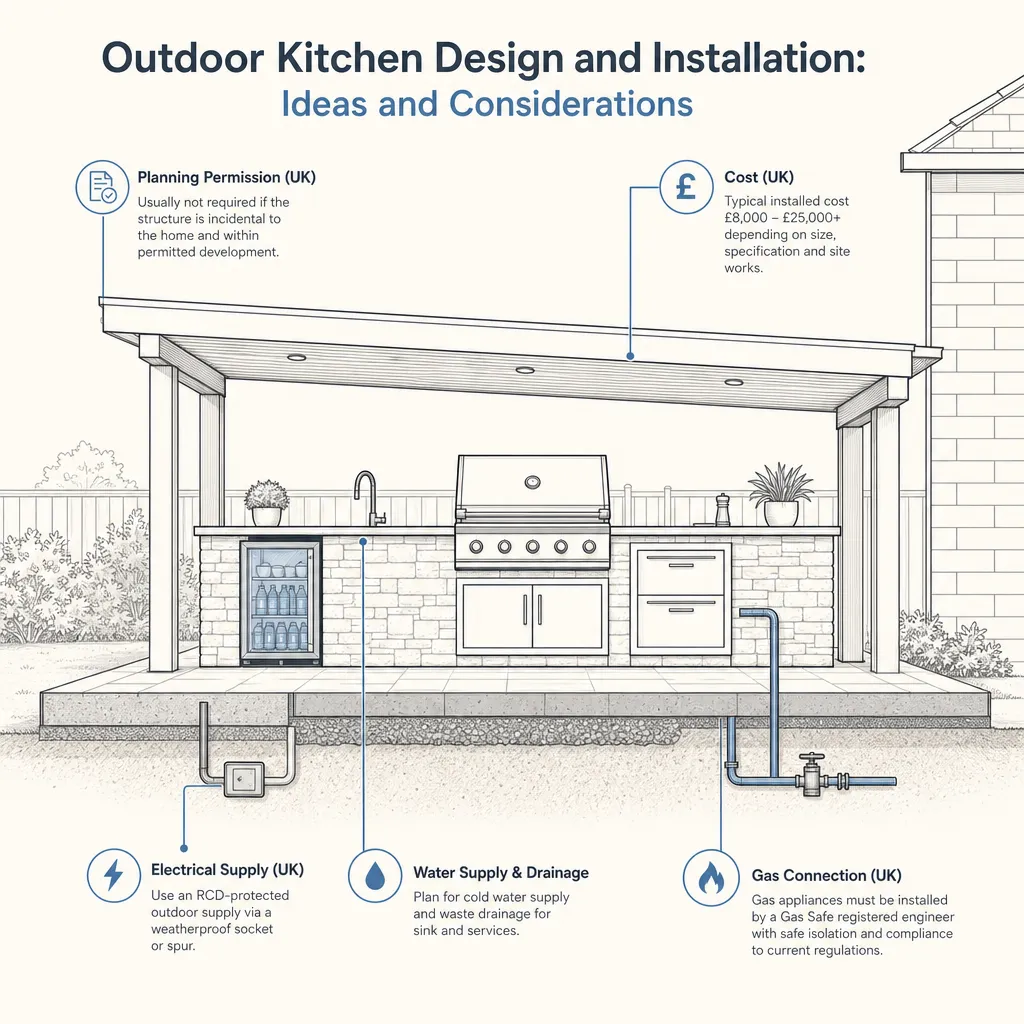
Outdoor Kitchen Design and Installation: Ideas and Considerations
An outdoor kitchen in the UK typically costs £3,000–50,000 depending on size and specification.
 Improvement & Build
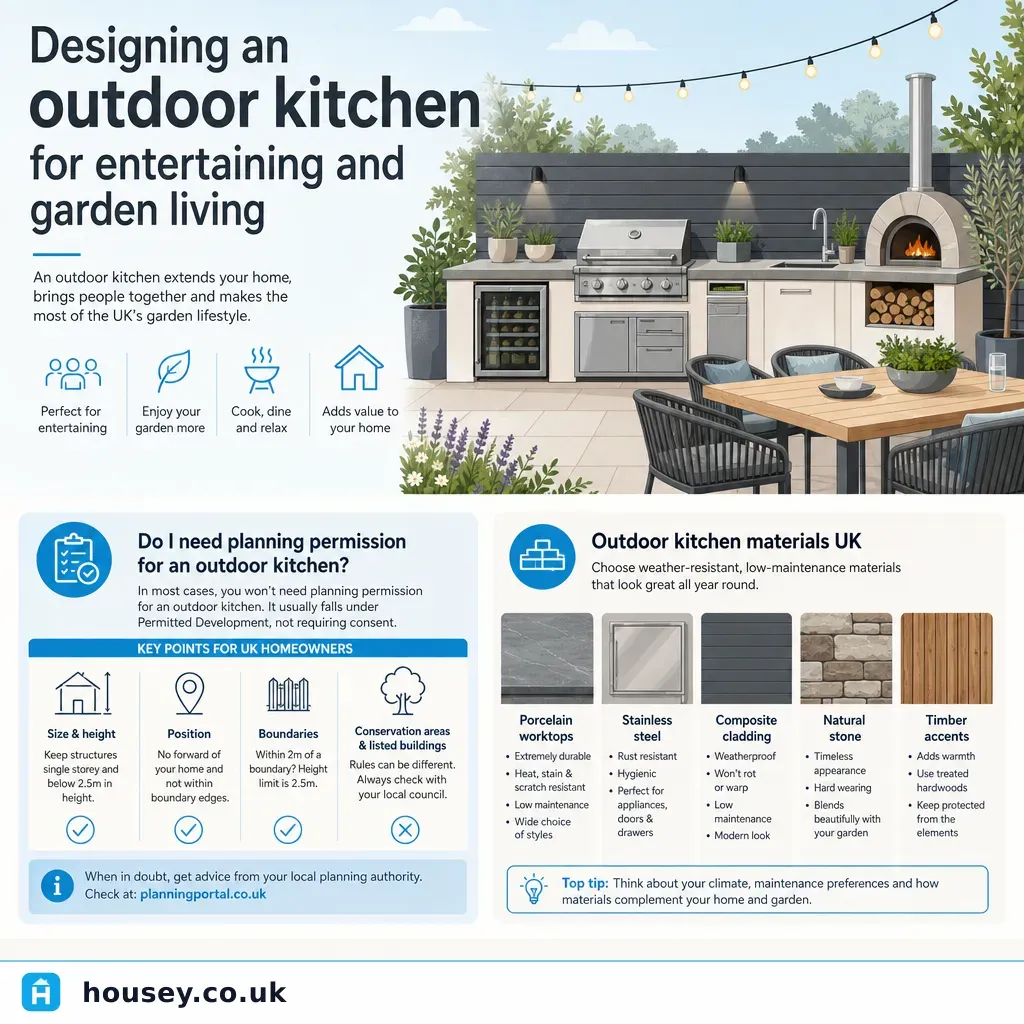
Designing an outdoor kitchen for entertaining and garden living
An outdoor kitchen in a UK garden needs a stable, level base — typically a concrete slab or quality paving — with weather-rated materials such as stainless steel grade 316 or frost-rated porcelain.
 Improvement & Build
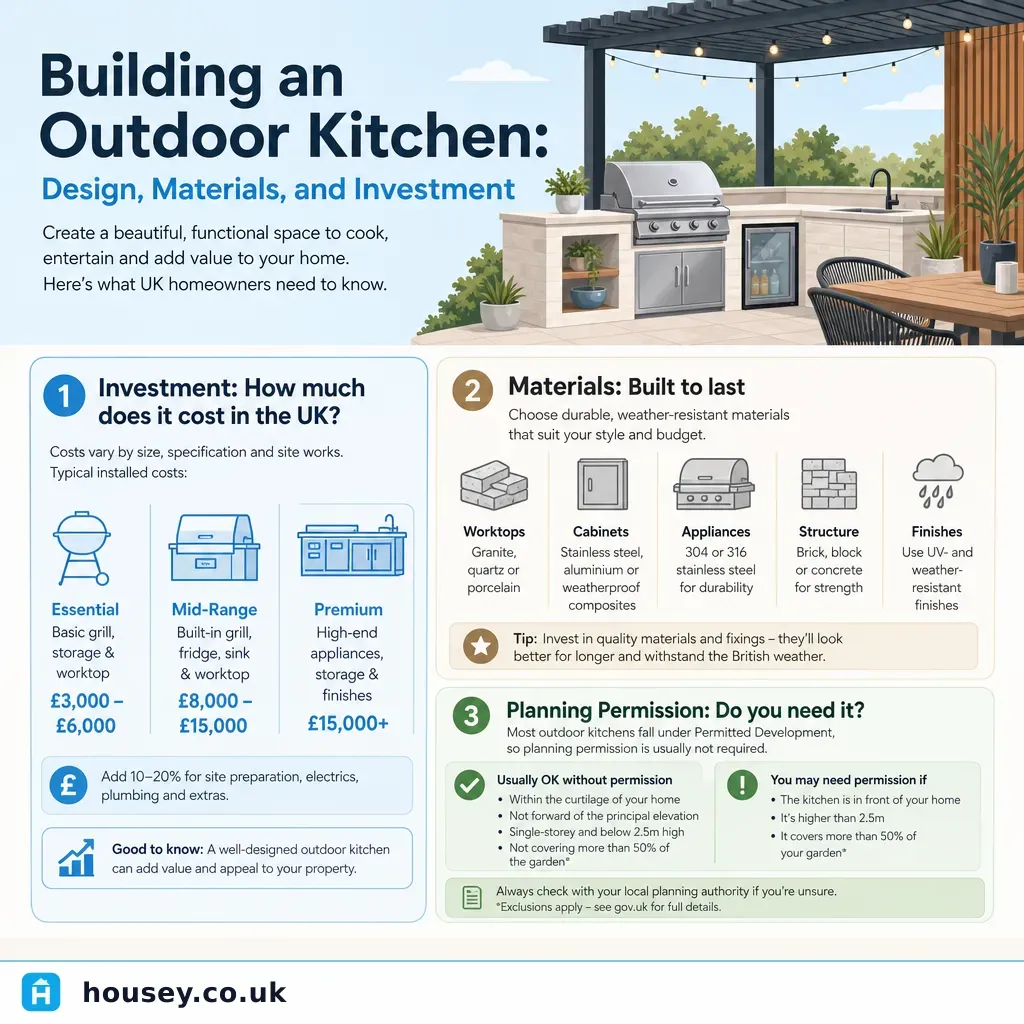
Building an Outdoor Kitchen: Design, Materials, and Investment
Building an outdoor kitchen in the UK costs roughly £3,000–£25,000 depending on size and materials.
 Improvement & Build
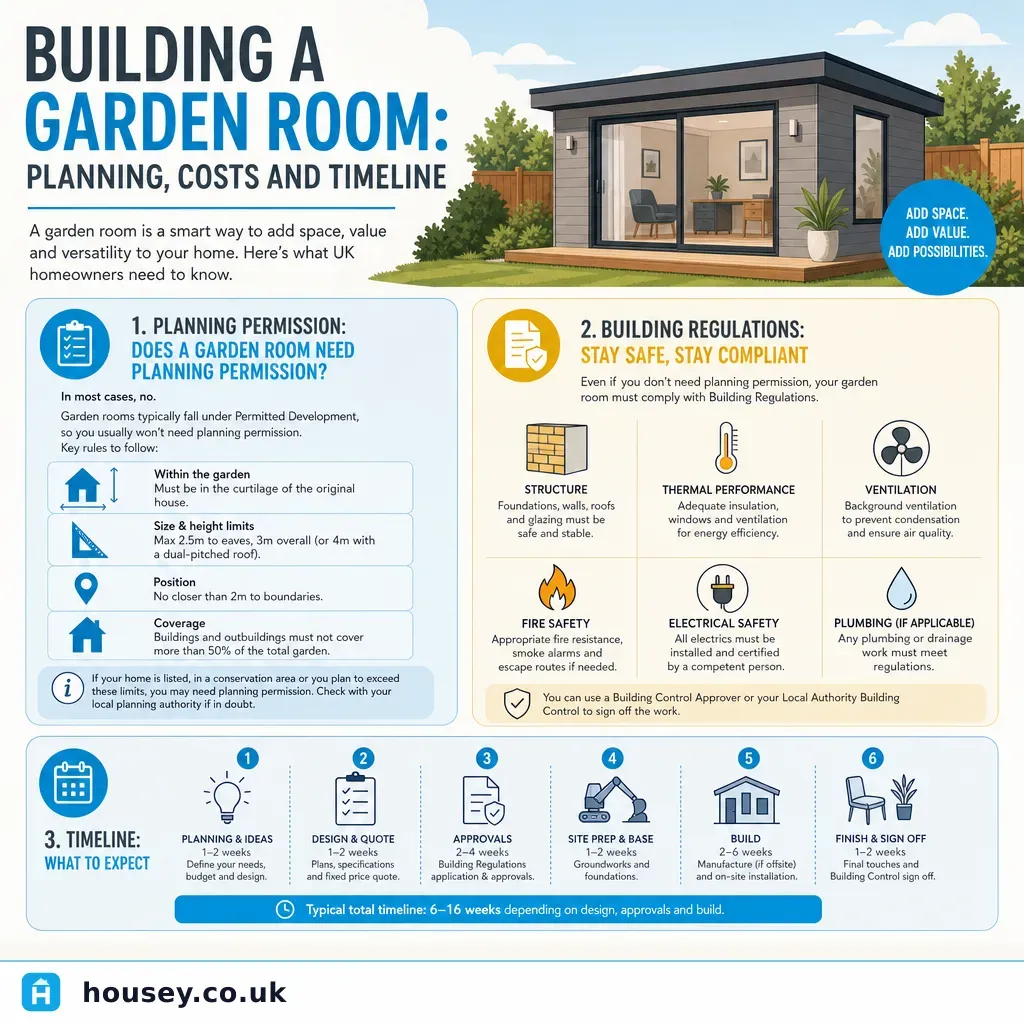
Building a Garden Room: Planning, Costs and Timeline
Most garden rooms in England fall under permitted development and don't need planning permission, provided the structure meets height, coverage, and boundary conditions.
 Improvement & Build
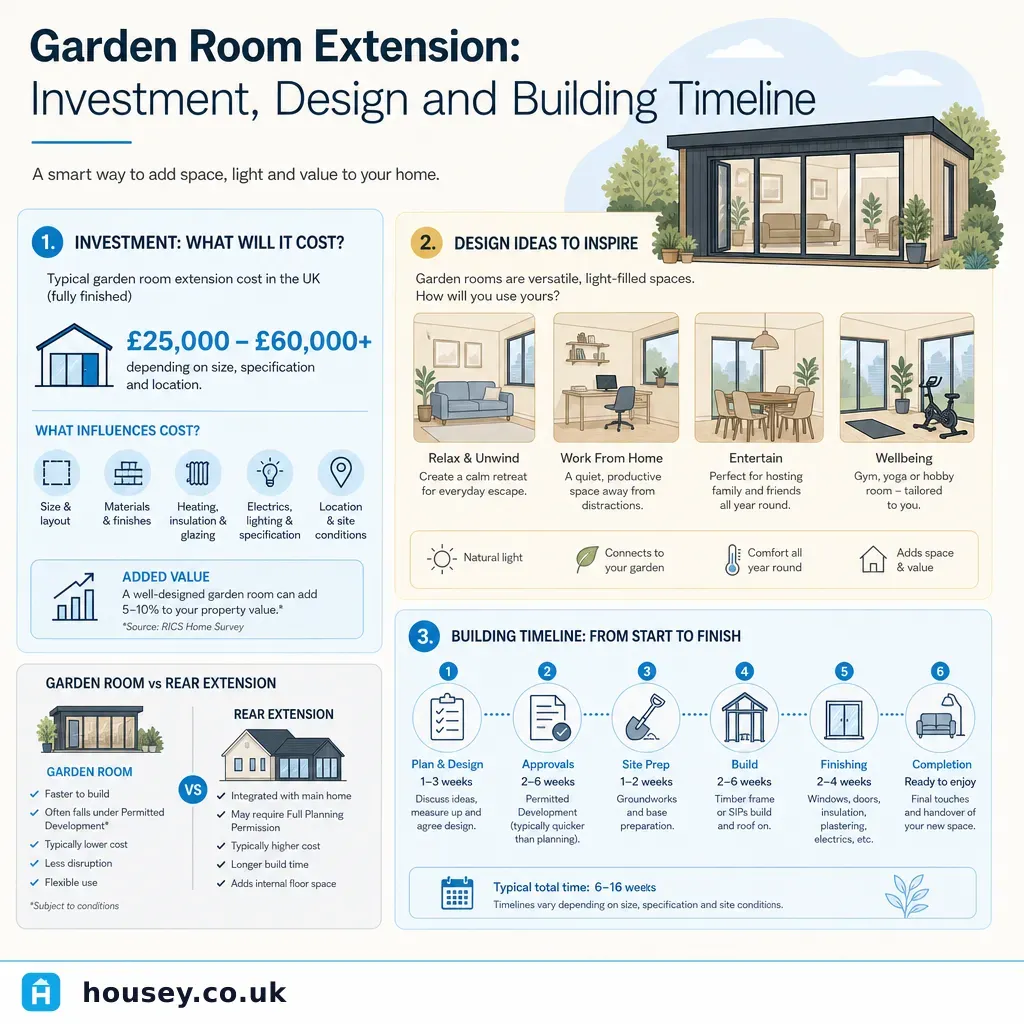
Garden Room Extension: Investment, Design and Building Timeline
A garden room or garden extension can add usable year-round space without always requiring planning permission.