Outdoor Kitchen Design and Installation: Ideas and Considerations
By Housey · Last reviewed 1st of June 2026
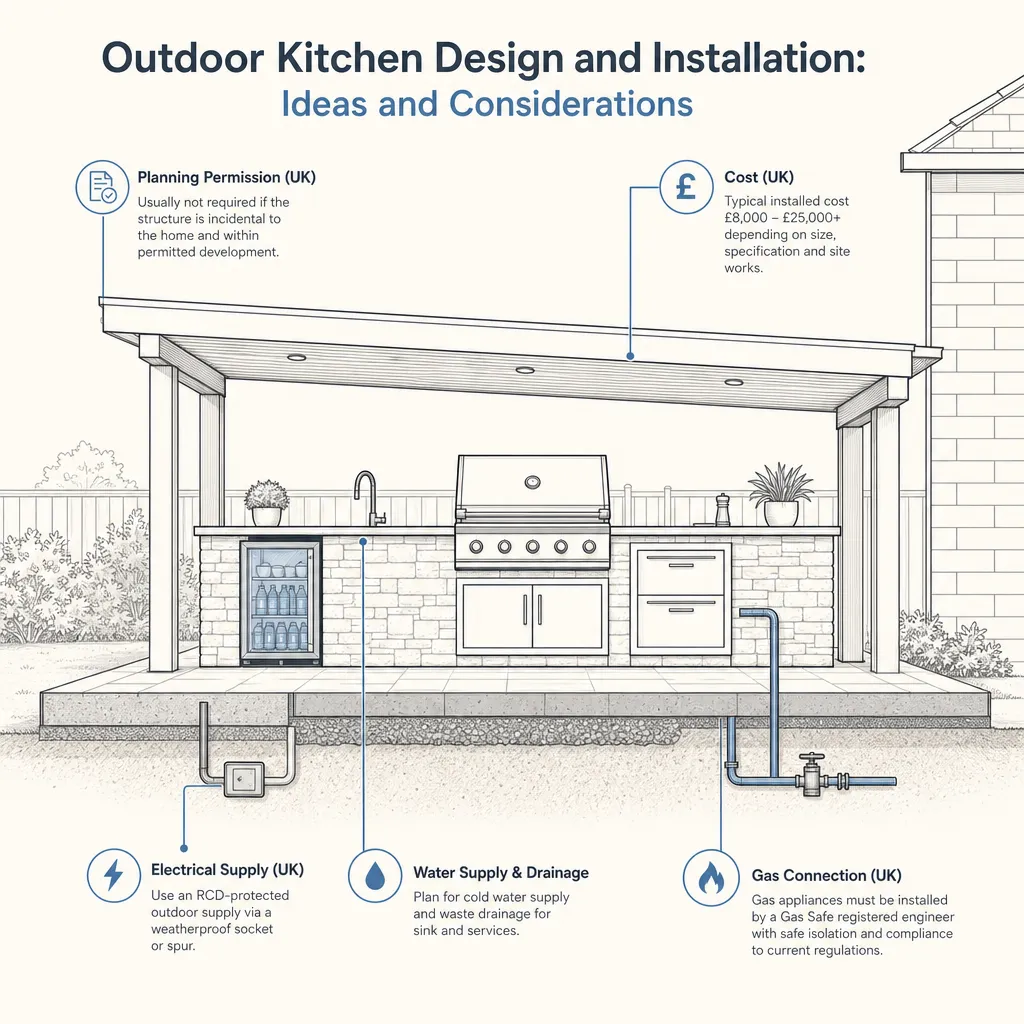
Outdoor Kitchen Design and Installation: Ideas and Considerations
Outdoor kitchens have moved from a niche aspiration to a practical garden upgrade for many UK homeowners, driven by larger garden renovations and a growing appetite for al fresco entertaining. The decision is rarely straightforward — UK weather, planning constraints, and legal requirements around gas and electrical connections all need careful consideration before money is committed. Whether you are planning a simple built-in barbecue station or a fully fitted outdoor kitchen with a hob, refrigerator, and sink, the scope, cost, and regulatory exposure differ substantially depending on specification.
Key points
- Most outdoor kitchen structures fall within permitted development rights under Class E of the Town and Country Planning (General Permitted Development) (England) Order 2015, but height, footprint, and proximity-to-boundary limits apply — always check with your local planning authority before building.
- Gas connections must be carried out by a Gas Safe registered engineer — a legal requirement under the Gas Safety (Installation and Use) Regulations 1998; this is non-negotiable for any fixed outdoor gas installation.
- Outdoor electrical installations must comply with BS 7671 (18th Edition Wiring Regulations); new circuits from the consumer unit are notifiable under Building Regulations Part P and must be installed by a registered electrician.
- Drainage for an outdoor sink must connect to an approved drainage system — discharging directly to the open garden surface is not permitted and may require consent from your water authority.
- Structures closer than 1 metre to a boundary may require planning permission regardless of overall size, and listed buildings or conservation area properties face additional restrictions beyond the standard permitted development rules.
Does an outdoor kitchen need planning permission?
In most cases, no — but the answer depends on the size and siting of the structure. In England, outbuildings fall under permitted development rights as Class E of the Town and Country Planning (General Permitted Development) (England) Order 2015, provided:
- The total area of all outbuildings does not exceed 50% of the garden (curtilage) of the property.
- The structure is no more than 2.5 m high if it is within 2 m of a boundary (or up to 4 m for a dual-pitch roof elsewhere in the garden).
- The building is not forward of the principal elevation of the house.
- The property is not listed, and permitted development rights have not been removed by an Article 4 direction.
Decision tree — do you need planning permission?
- No permission likely needed: freestanding structure in the rear garden, height under 2.5 m, more than 2 m from any boundary, non-listed property outside a designated area, combined outbuilding footprint below 50% of the garden.
- Check with your local planning authority first: structure within 2 m of a boundary; property in a conservation area, National Park, or Area of Outstanding Natural Beauty; Article 4 direction in place; combined outbuilding footprint approaching 50% of the garden.
- Planning permission likely required: listed building; structure forward of the principal elevation; property in a designated area where permitted development rights have been withdrawn.
Wales, Scotland, and Northern Ireland operate separate permitted development regimes — check your devolved government's planning guidance before starting work.
Choosing materials for the UK climate
UK weather is the single most important factor driving material selection for an outdoor kitchen. Rain, frost, and variable temperatures rule out many materials that perform well in warmer climates.
Material | UK weather durability | Maintenance | Relative cost | Best for |
|---|---|---|---|---|
Marine-grade stainless steel (grade 316) | Excellent — rust and frost resistant | Low — wipe-down only | High | Worktops, sinks, appliance housings |
Rendered blockwork | Excellent structural base | Low — repaint every 5–7 years | Moderate | Permanent base structures |
Powder-coated aluminium | Very good | Very low | Moderate to high | Frames, cabinetry |
Hardwood (teak or iroko) | Good — requires treatment | Medium — annual oiling | Moderate to high | Worktop accents, shelving |
Frost-rated porcelain or natural stone | Very good (frost rating essential) | Low | Moderate to high | Worktops, cladding |
Composite decking | Good | Very low | Moderate | Surrounding platform or patio |
Untreated softwood or exterior MDF | Poor — prone to rot and warping | High | Low | Not recommended for permanent outdoor structures |
For built-in installations in the UK, the most durable and widely used combination is a rendered blockwork base with a frost-rated porcelain or stone worktop and marine-grade stainless steel appliances.
Utilities: gas, water, and electrical connections
Gas connections
Many outdoor kitchens include a gas hob, pizza oven burner, or patio heater. All gas pipework and connections must be installed by a Gas Safe registered engineer — this covers running a new supply branch from the house, fitting isolation valves, and pressure-testing the installation. You can verify an engineer's registration at gassaferegister.co.uk. For fixed outdoor kitchens, permanent underground gas pipework is preferable to long flexible hoses.
Outdoor electrical circuits
Outdoor circuits must comply with BS 7671 and be run in steel wire armoured (SWA) cable or appropriately rated conduit. All outdoor socket circuits must be protected by a 30 mA residual current device (RCD). New circuits from the consumer unit are notifiable work under Building Regulations Part P and must be installed by a Part P-registered electrician, who will issue a Building Regulations Compliance Certificate — important for insurance purposes and for disclosure during a property sale.
Water supply and drainage
A supply pipe to an outdoor sink should be trace-heated or fully drainable before winter to prevent frost damage. Drainage must connect to an approved system rather than discharging to the open garden surface. Your water supplier or a plumber can advise on the requirements for connecting to the drainage system and whether consent from the water authority is needed.
Outdoor kitchen layouts and design ideas
The best layout depends on available space, intended use, and budget. Common configurations for UK gardens:
Single-run kitchen: the simplest and most cost-effective option — one straight run of units against a wall or fence. Works well in smaller or terraced gardens. Typically includes a built-in barbecue or hob, a worktop, and a sink.
L-shaped kitchen: provides separate prep and cooking zones in a compact footprint. Suits gardens of around 5 m × 4 m or larger. Often includes a gas hob, undercounter fridge, sink, and additional worktop space.
Island layout: suited to larger gardens and entertaining-focused designs. An island with bar seating on one side creates a sociable arrangement but requires more extensive groundwork and drainage planning.
Worked example: 1960s semi-detached rear garden (approx. 8 m × 5 m)
A homeowner in a 1960s semi in the East Midlands installs an L-shaped outdoor kitchen in the rear corner of their garden, approximately 3 m from the boundary and 6 m from the house:
- Rendered blockwork base with frost-rated porcelain worktop and marine-grade stainless steel appliances
- Gas hob, with a Gas Safe registered engineer running a new supply branch from the house kitchen
- Undercounter compact fridge, with a Part P-registered electrician running armoured cable from the house consumer unit
- Cold-water outdoor sink with frost-protected supply pipe and connection to the garden drainage run
- Timber pergola with corrugated polycarbonate roof panels for weather protection
No planning permission required: structure under 2.5 m high, more than 2 m from any boundary, rear garden, non-listed property in an undesignated area. Estimated total project cost: approximately £14,000–18,000 including groundwork, utilities, and fitted appliances. Indicative UK costs, last reviewed 2026-06-01.
What does an outdoor kitchen cost in the UK?
Indicative UK costs, last reviewed 2026-06-01. Costs vary significantly by size, specification, and region — obtain multiple written quotes before committing:
Specification | Typical installed cost | What is usually included |
|---|---|---|
Basic / modular | £3,000–6,000 | Pre-made modular units, no fixed gas, single outdoor socket |
Mid-range / custom-built | £8,000–18,000 | Blockwork base, gas hob, sink, undercounter fridge, tiled worktop |
Premium / full kitchen | £20,000–50,000+ | Full kitchen suite, pizza oven, integrated lighting, pergola, landscaping |
VAT at 20% applies. Groundwork — levelling and laying a concrete base or paving — typically adds £1,500–5,000 depending on the existing surface and site access. Gas and electrical work are usually priced separately by the respective specialist trades.
What to ask before accepting a quote
- Is groundwork and a concrete or paving base included in the price, or quoted separately?
- Will gas work be carried out by a Gas Safe registered engineer, and will they provide the Gas Safe certificate on completion?
- Will electrical work be carried out by a Part P-registered electrician who will issue a Building Regulations Compliance Certificate?
- How will drainage from the outdoor sink be handled, and is this included in the quoted price?
- What weatherproofing provisions are made for appliances and worktops over winter?
- What warranty is offered on materials, appliances, and workmanship, and for how long?
- Is VAT included in the quoted price?
- What is the payment schedule, and is a retention held on final payment until snagging is fully resolved?
When to get professional help
An outdoor kitchen involves several trades where unlicensed or amateur work creates genuine safety or legal exposure:
- Gas connections: must always be carried out by a Gas Safe registered engineer. Do not attempt to connect or extend gas pipework yourself.
- Fixed outdoor electrical circuits: notifiable under Part P; must be installed by a registered electrician who can self-certify the work and issue the compliance certificate.
- Structural groundwork: significant excavation or permanent base construction — especially on sloping or clay-heavy ground — should be managed by a qualified groundworker.
- Planning queries: if your property is listed, in a conservation area, or has unusual boundary conditions, consult your local planning authority before starting work.
Red flags to watch for:
- A contractor who offers to connect the gas supply without mentioning Gas Safe registration.
- A quote that does not separate gas and electrical work from general building work.
- No mention of drainage for the outdoor sink.
- No provision for planning checks before work begins on or near boundaries.
How Housey can help
Housey connects homeowners with vetted design-and-build firms who can manage outdoor kitchen projects end-to-end, as well as specialist groundworkers for base preparation, drainage, and hard landscaping. Compare quotes, verify trade credentials, and find professionals who understand UK planning requirements, Gas Safe obligations, and Part P electrical compliance for outdoor kitchen installations.
Frequently asked questions
Do I need planning permission for an outdoor kitchen in the UK?
In most cases, no. Outdoor kitchen structures typically fall within permitted development rights for outbuildings under Class E of the GPDO 2015. However, if your property is listed, in a conservation area, if the structure is within 2 m of a boundary and taller than 2.5 m, or if an Article 4 direction applies, check with your local planning authority before starting work.
Can I connect gas to an outdoor kitchen myself?
No. All gas pipework and connections must be carried out by a Gas Safe registered engineer under the Gas Safety (Installation and Use) Regulations 1998. Working on gas supply pipework yourself is illegal and dangerous. Ask to see the engineer's Gas Safe ID card before work starts and obtain the Gas Safe certificate once the installation is complete.
How do I protect an outdoor kitchen over winter in the UK?
Marine-grade stainless steel and frost-rated stone worktops are inherently resistant to frost. Drain and isolate water supply pipes before the first frost. Disconnect or store compact fridges unless rated for cold ambient temperatures — standard mini-fridges often stop working correctly below 10°C. Cover appliances with weatherproof covers and ensure gas isolation valves are closed when the kitchen is not in use.
Does an outdoor kitchen add value to a UK home?
Evidence for the UK market is anecdotal rather than systematic, but a well-constructed permanent outdoor kitchen with quality materials may appeal to buyers who entertain. A poorly specified or incomplete installation can be a detractor. Estate agents generally advise prioritising quality of finish over scale, and ensuring all gas and electrical work has the correct certificates available for disclosure during a property sale.
Sources and further reading
- Town and Country Planning (General Permitted Development) (England) Order 2015 — legislation.gov.uk
- Gas Safety (Installation and Use) Regulations 1998 — legislation.gov.uk
- Gas Safe Register: find a registered engineer — Gas Safe Register
- Building Regulations Approved Document P: Electrical Safety in Dwellings — GOV.UK
- Planning Portal: permitted development for outbuildings — Planning Portal
Useful next reads
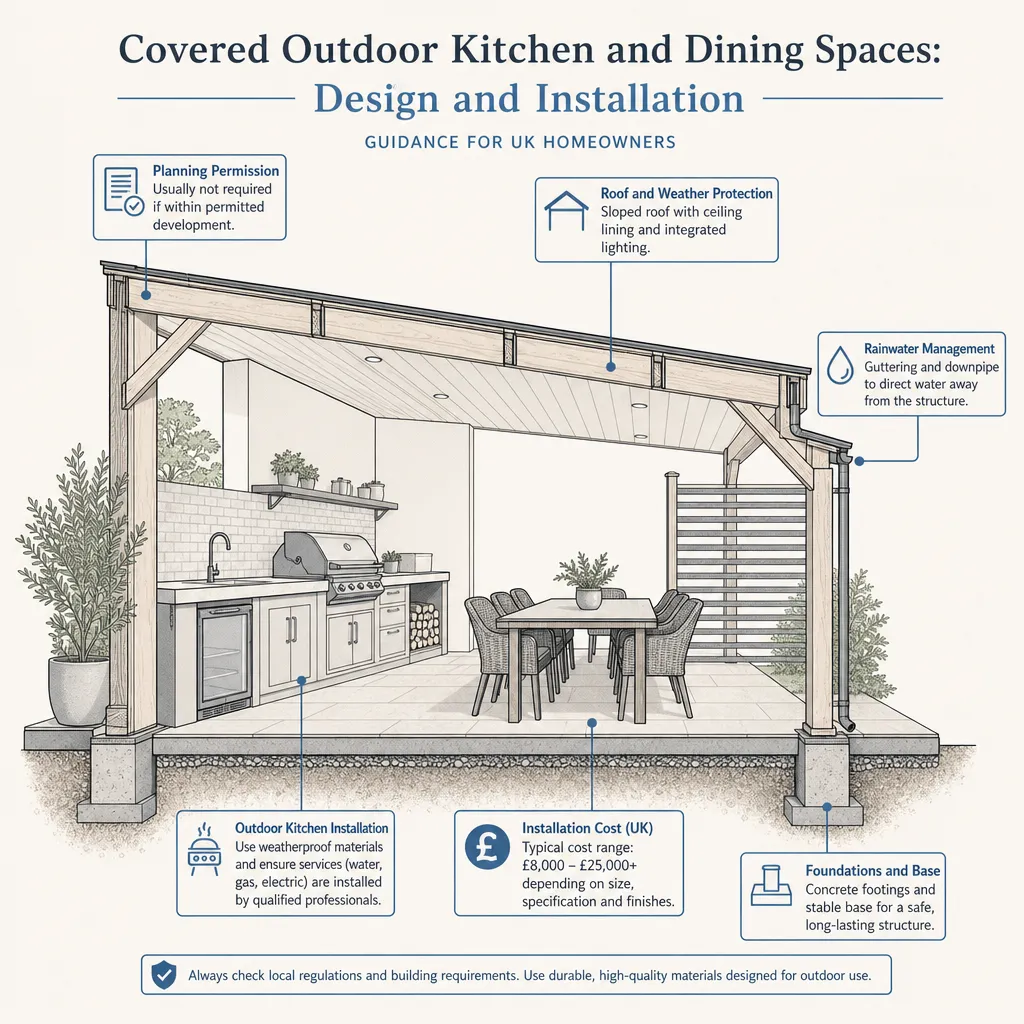 Improvement & Build
Covered Outdoor Kitchen and Dining Spaces: Design and Installation
A covered outdoor kitchen in a UK rear garden is usually permitted development under the GPDO 2015, provided the structure stays within height and footprint limits.
 Improvement & Build
Designing an outdoor kitchen for entertaining and garden living
An outdoor kitchen in a UK garden needs a stable, level base — typically a concrete slab or quality paving — with weather-rated materials such as stainless steel grade 316 or frost-rated porcelain.
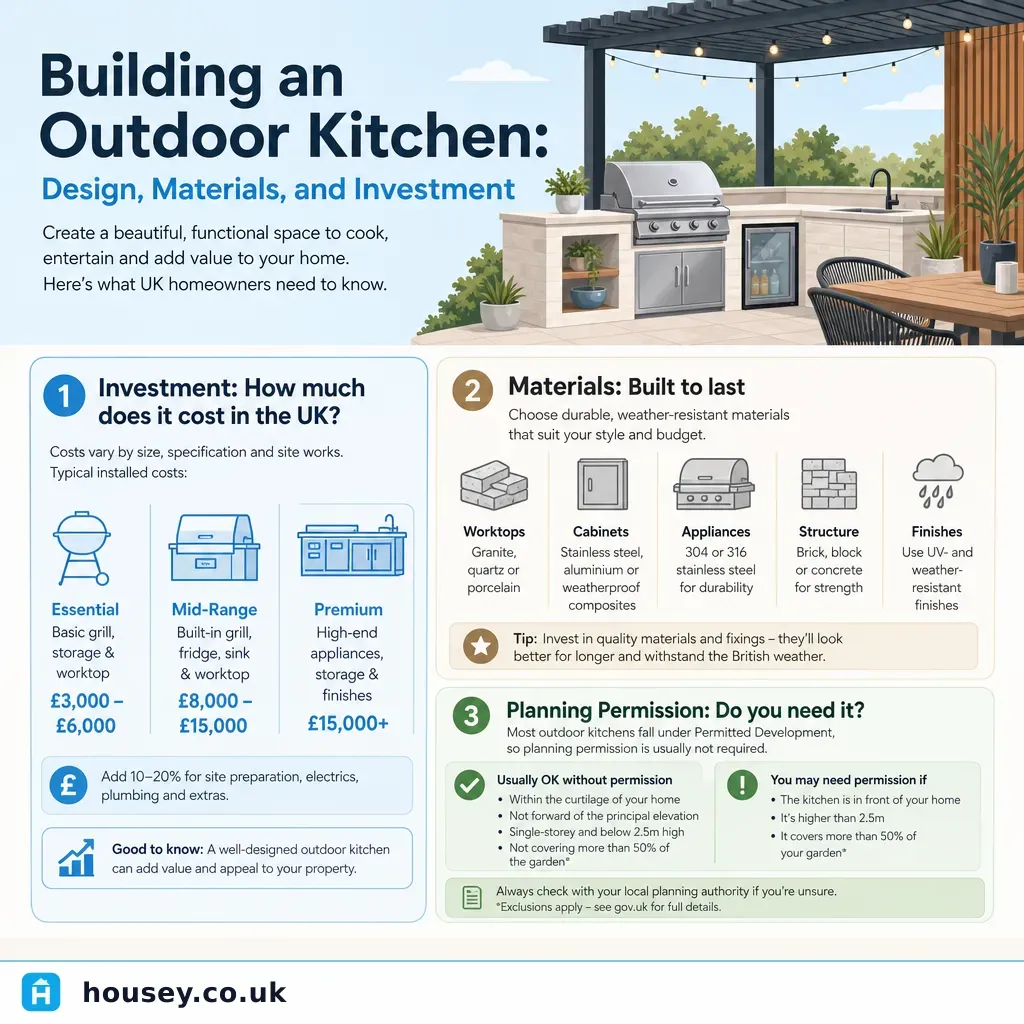 Improvement & Build
Building an Outdoor Kitchen: Design, Materials, and Investment
Building an outdoor kitchen in the UK costs roughly £3,000–£25,000 depending on size and materials.
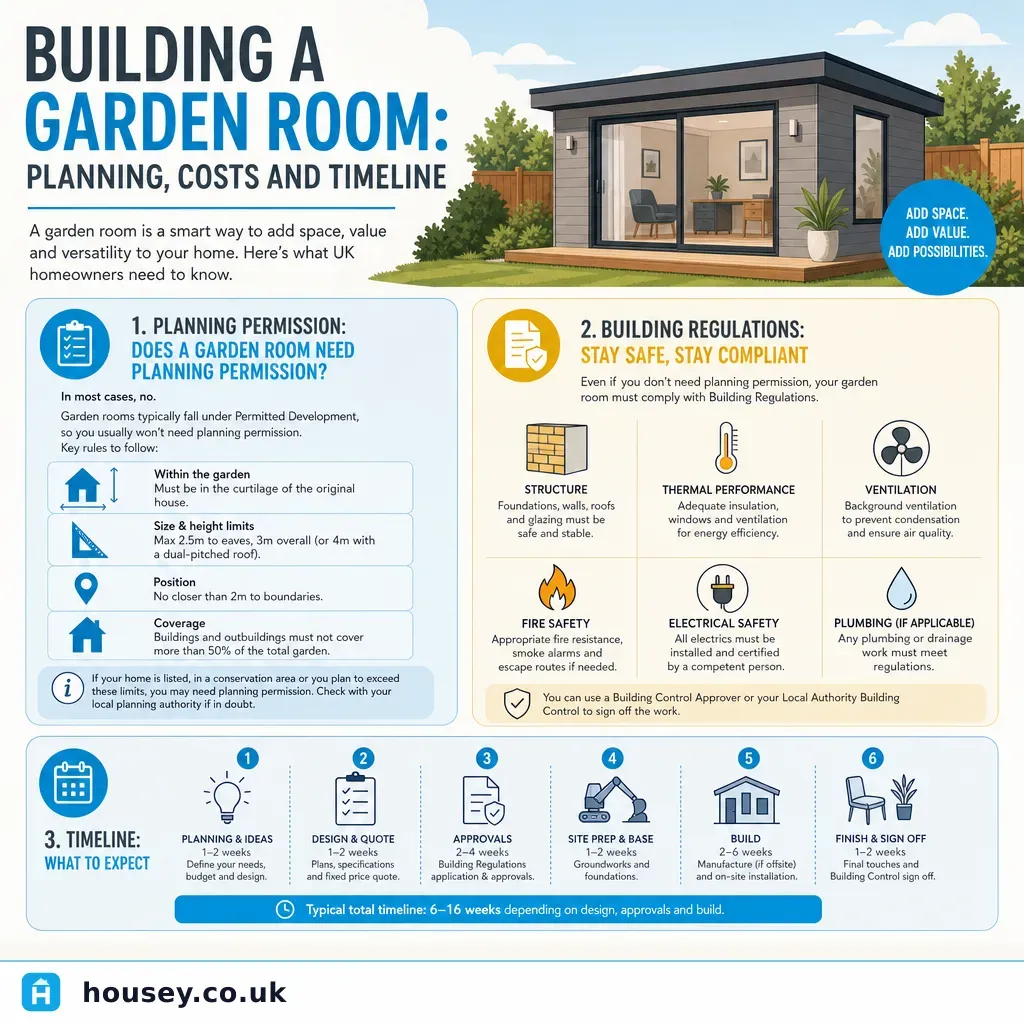 Improvement & Build
Building a Garden Room: Planning, Costs and Timeline
Most garden rooms in England fall under permitted development and don't need planning permission, provided the structure meets height, coverage, and boundary conditions.
 Improvement & Build
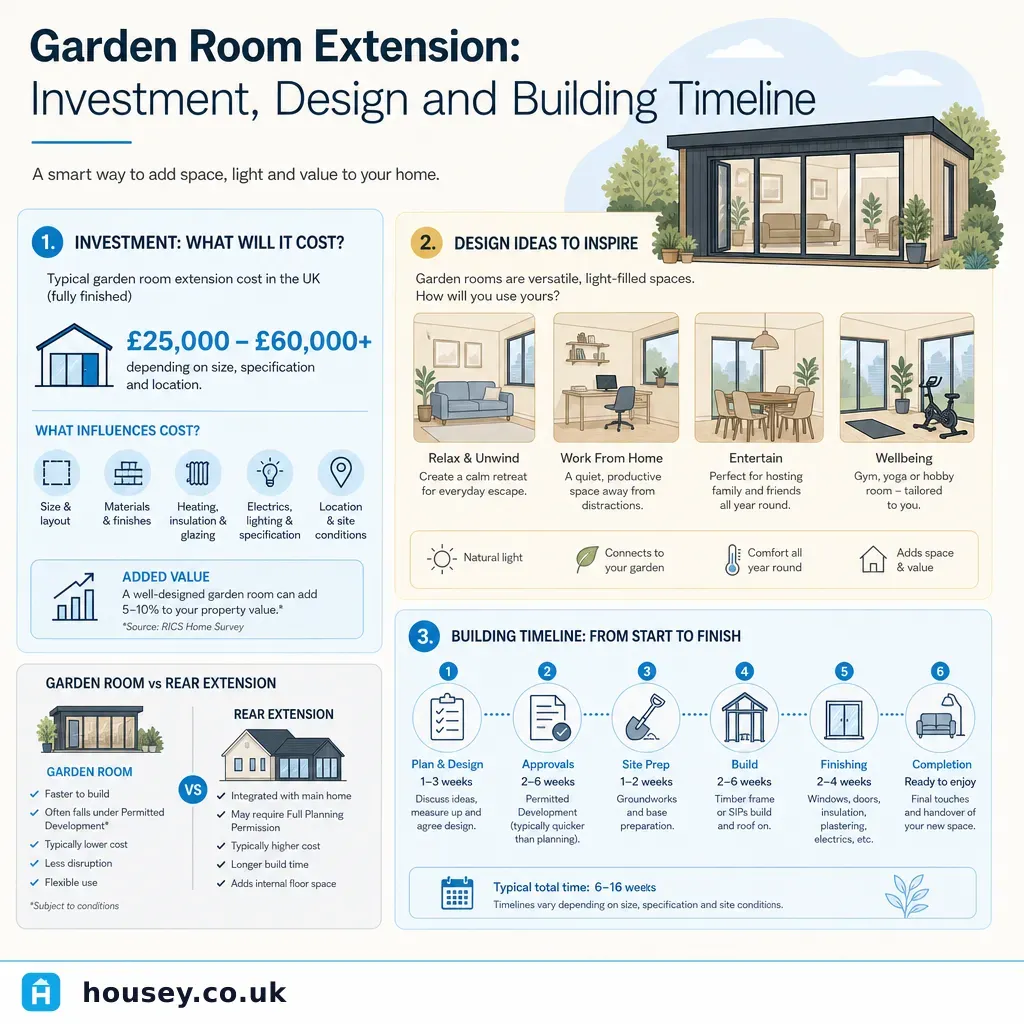
Garden Room Extension: Investment, Design and Building Timeline
A garden room or garden extension can add usable year-round space without always requiring planning permission.