Coving Installation and Cornice Fitting Costs
By Housey · Last reviewed 6th of May 2026
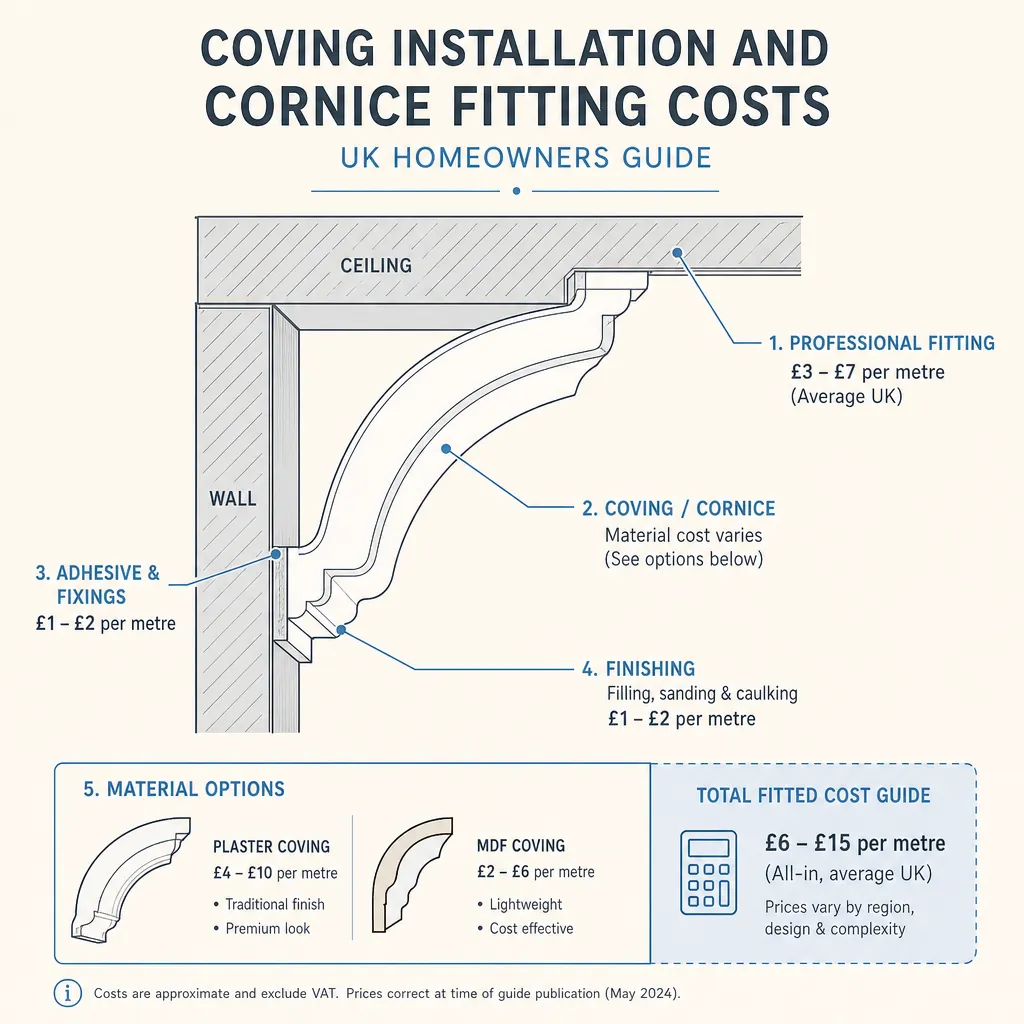
Coving Installation and Cornice Fitting Costs
Coving and cornice installation is one of the more popular decorative finishing touches in UK homes, particularly during renovation projects or when restoring period properties to their original character. Whether you are adding simple foam coving to a new-build extension or reinstating ornate Victorian cornicing after a ceiling replacement, cost and complexity vary considerably by material, profile size, and the condition of existing walls and ceilings. Understanding what affects the price helps you compare quotes accurately and avoid surprises once work begins.
Key points
- Coving installation in the UK typically costs £15–£50 per linear metre for supply and fitting, depending on material and profile complexity (indicative UK costs, last reviewed 2026-05-06).
- A standard living room of around 5 m × 4 m has roughly 18 m of perimeter — total fitted cost ranges from approximately £270 to £900 for a basic profile, rising significantly for ornate plaster cornicing.
- Plaster and fibrous plaster (GRC) coving requires a qualified plasterer; polyurethane foam and MDF profiles can be fitted by an experienced decorator.
- In listed buildings or conservation areas, the local authority may require replacement cornicing to match the original profile — sourcing a specialist caster adds considerably to the cost.
- VAT at 20% applies to coving installation in most circumstances; always confirm whether a quote is inclusive or exclusive of VAT before accepting it.
Types of coving and cornice: a comparison
The material you choose affects cost, durability, workability, and visual authenticity — particularly important in period homes.
Material | Typical supply cost per metre | Trade required | Best for | Not ideal for |
|---|---|---|---|---|
Plaster (run in situ) | £8–£30+ | Plasterer | Authentic period restoration, bespoke profiles | Speed, tight budgets |
GRC / fibrous plaster (pre-cast) | £15–£60+ | Plasterer or joiner | Listed buildings, heritage profile matching | Budget renovations, small rooms |
MDF (routed profile) | £3–£12 | Decorator or joiner | Modern homes, painted finishes, cost-conscious jobs | Damp areas, period authenticity |
Polyurethane / foam | £2–£8 | Decorator | Budget refurbs, rental properties, quick finishes | Period homes, damp rooms |
Indicative UK material costs, last reviewed 2026-05-06.
What affects the installation cost
Room perimeter. Larger rooms require more material and labour. Rates per metre often reduce slightly for longer runs once the trade professional is set up on site.
Profile size and complexity. A simple 90 mm ogee takes less time to cut and mitre than an ornate 200 mm classical cornice with multiple elements. Elaborate mouldings require slower, more precise work at every junction.
Number and type of corners. Internal and external corners — for bay windows, alcoves, or chimney breasts — each require precise mitring or scribing. More corners increase labour time and the risk of waste from miscut sections.
Surface condition. Uneven, cracked, or lath-and-plaster ceilings need preparation or repair before coving can be fixed successfully. This is often priced separately.
Removal of existing coving. Stripping old solid plaster profiles that have been overpainted many times adds labour time and may reveal damage requiring filling underneath.
Ceiling height. Properties with ceilings of 3.0 m or more require taller hop-ups or scaffold boards, adding time and cost.
Matching period profiles. Sourcing a specialist plaster moulder to cast a matching fibrous plaster section for a listed building can add hundreds to thousands of pounds depending on the profile's complexity.
Indicative total costs for common scenarios
All figures are indicative UK costs, last reviewed 2026-05-06. Request at least three quotes before committing.
Small bedroom (~13 m perimeter), simple polyurethane cove: Materials £40–£80 + fitting £100–£180 = £140–£260
Average living room (~18 m perimeter), mid-range MDF profile: Materials £80–£180 + fitting £180–£350 = £260–£530
Victorian hallway (~14 m perimeter), ornate GRC cornice, specialist plasterer: Materials £400–£700 + fitting £350–£600 = £750–£1,300
Full ground floor of a 1930s semi (~65 m total run), mid-range plaster: Materials £300–£600 + fitting £650–£1,200 = £950–£1,800
What to ask before accepting a quote
Before instructing a decorator or plasterer, confirm the following:
- Does the quote include the cost of the coving itself, or are materials priced separately?
- What adhesive will be used, and is it appropriate for the wall surface and coving material?
- How will internal and external corners be finished — mitred, coped, or scribed?
- Is preparation work (filling, sanding, priming) included, or charged as an extra?
- If old coving is being removed, is that included, and how will any ceiling damage be handled?
- Does the quote include a primer coat to make the surface paint-ready?
- Is VAT included in the price?
- Do you have experience with this specific material (for example, GRC or fibrous plaster)?
DIY coving: when it is and is not appropriate
Polyurethane and foam coving from DIY retailers can be fitted by a confident DIYer using proprietary adhesive in a straightforward room with standard corners. A professional is recommended when:
- Any plaster or GRC coving is involved — correct bonding agents and plastering skills are essential.
- The room has irregular walls, out-of-square corners, or variable ceiling heights.
- Period authenticity matters — poorly mitred classical profiles are more noticeable than no coving at all.
- The ceiling height exceeds approximately 2.5 m, where safe working requires proper hop-ups or scaffold boards.
When to get professional help
A skilled decorator is sufficient for foam or MDF profiles; a qualified plasterer is needed for plaster and GRC work. Seek specialist advice if:
- The building is listed or in a conservation area and profile matching is required by the local authority.
- The ceiling or wall requires structural or plastering repairs before coving can be fitted.
- The property was built before 1985 and you plan to disturb an existing Artex or textured ceiling — arrange a professional asbestos survey first, as pre-1985 Artex may contain chrysotile asbestos fibres.
How Housey can help
Housey helps UK homeowners compare quotes from local decorators and plasterers for coving and cornice installation across a wide range of profiles and property types. Describe your project to receive quotes from verified professionals in your area.
Frequently asked questions
How long does coving installation take?
A single average room typically takes a professional half a day to a full day, depending on perimeter length, profile complexity, and the number of corners. A whole-house project across several rooms may take two to three days. Allow additional time if old coving needs removing or the ceiling surface requires repair or preparation before new sections can be fixed.
Can coving be fitted to a textured ceiling such as Artex?
Yes, but additional preparation is needed. The Artex surface must be clean and sound. Many plasterers apply a band of fresh bonding compound along the ceiling-wall junction to create a stable substrate. Important: if the property was built before 1985, Artex may contain asbestos. Do not sand, score, or disturb it before arranging a professional asbestos survey.
Does coving add value to a property?
In period properties, well-matched cornicing can support saleability by restoring original character, which buyers in the Victorian and Edwardian terrace market often value. In modern homes, simple coving is unlikely to add measurable financial value on its own, but it can improve the overall presentation and finish of a room ahead of a sale or valuation.
What is the difference between coving and cornice?
Coving refers to the concave or curved moulding at the wall-ceiling junction, typically in a simple ogee or cove profile. Cornice is the broader term for more elaborate mouldings with multiple components — bed mould, fascia, cove — associated with Georgian, Victorian, and Edwardian properties. In practice, trade suppliers and most builders use the terms interchangeably.
Do I need to redecorate after coving installation?
Yes. Newly fitted coving requires at least one mist coat (diluted emulsion) to seal the surface, followed by a finish coat. GRC and plaster coving must be fully dry — typically two to four weeks — before painting, to prevent cracking caused by moisture movement as the material cures. Your plasterer should advise on the recommended drying period for the specific product used.
Sources and further reading
- Traditional Plasterwork — Historic England
- Working at height: the basics — Health and Safety Executive
- Asbestos: the hidden killer — Health and Safety Executive
- Conserving and enhancing the historic environment — GOV.UK
Useful next reads
 Improvement & Build
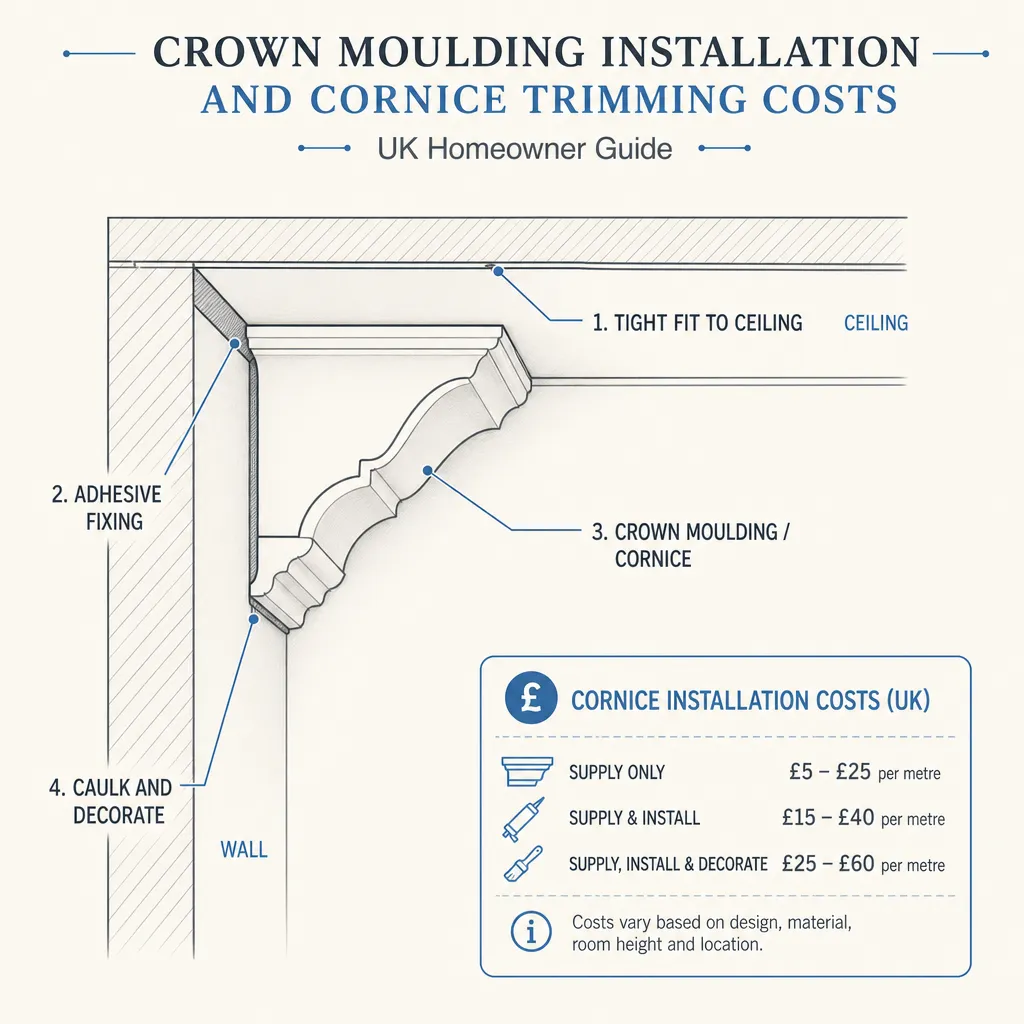
Crown Moulding Installation and Cornice Trimming Costs
Coving and cornice installation in the UK typically costs £15–£45 per linear metre for supply and fit, depending on the material, profile complexity, and whether existing cornice needs removing.
 Improvement & Build
Removing Wallpaper Adhesive Residue Before Redecorating
After stripping wallpaper, a thin layer of dried paste or adhesive often remains on the wall surface.
 Improvement & Build
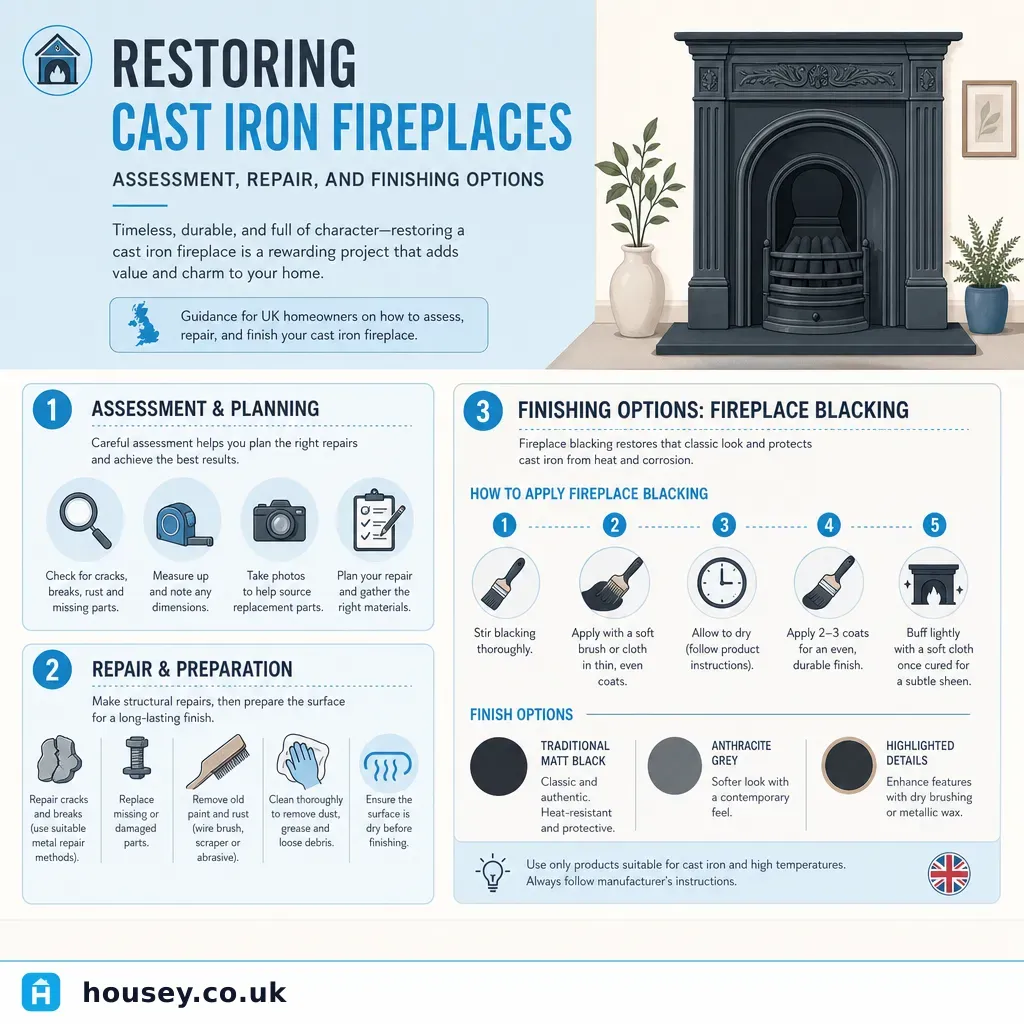
Restoring Cast Iron Fireplaces: Assessment, Repair, and Finishing Options
Restoring a cast iron fireplace involves assessing for cracks, corrosion, and missing components, treating rust, repairing joints and the fireback with fire cement, and applying specialist blacking or heat-resistant paint.
 Improvement & Build
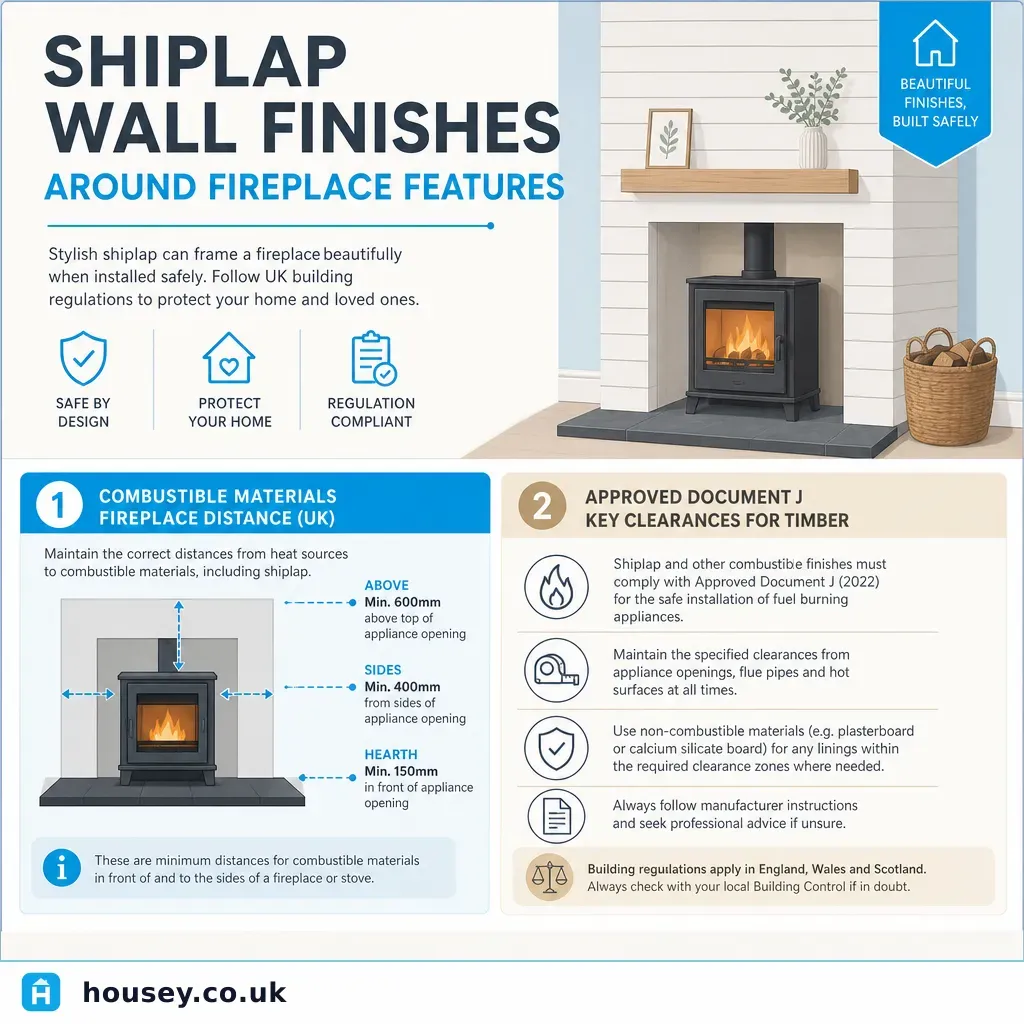
Shiplap Wall Finishes Around Fireplace Features
Shiplap cladding can be used around a fireplace, but combustible timber must respect minimum clearance distances from the heat source as set out in Approved Document J of the Building Regulations.
 Improvement & Build
Interior Painting Costs for Four-Bedroom Properties
Professionally painting the interior of a four-bedroom UK house typically costs £2,500–£6,000, covering walls, ceilings, and woodwork.