Shiplap Wall Finishes Around Fireplace Features
By Housey · Last reviewed 18th of May 2026
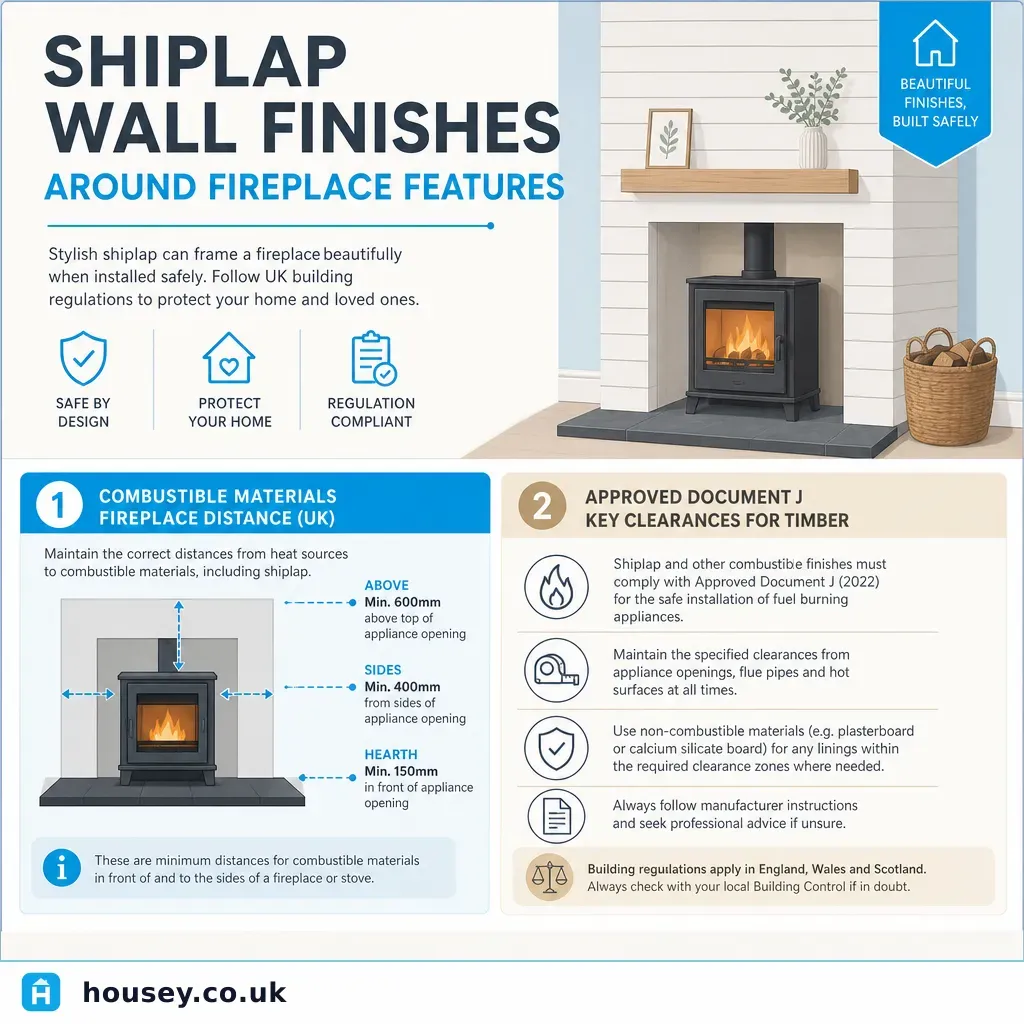
Shiplap Wall Finishes Around Fireplace Features
Shiplap cladding has become one of the more popular choices for fireplace feature walls in UK homes — the combination of horizontal boards and shadow lines works well against a chimney breast, whether the hearth contains a working open fire, a modern solid fuel stove, a gas insert, or a contemporary electric feature. The question that homeowners and interior designers face is where a decorative choice becomes a Building Regulations matter, and the answer depends heavily on the type of appliance involved and the distances between the proposed timber and the heat source.
Key points
- Approved Document J of the Building Regulations (England) requires combustible materials including timber shiplap to be kept a minimum distance from fireplace openings and combustion appliance surfaces — the exact distance depends on the appliance type and configuration.
- For open fires and solid fuel stoves, combustible materials must generally be positioned at least 150 mm horizontally from the inside face of the fireplace opening; combustible mantel shelves must typically be at least 300 mm above the top of the opening.
- Gas fires and gas fireplace inserts carry manufacturer-specified clearance distances that may be more restrictive than the Approved Document J minimums — deviating from these distances can invalidate the appliance warranty and breach Building Regulations.
- HETAS-registered engineers must commission solid fuel stove and biomass appliance installations; Gas Safe registered engineers are legally required for all gas appliance work in the UK.
- Where a chimney breast has been fully or partially removed, a structural engineer should assess the remaining structure before any cladding is fixed to or adjacent to it.
Can you put shiplap around a fireplace?
Shiplap can be used around a fireplace, but the installation must respect the minimum clearance distances from the heat source set out in Approved Document J and in the appliance manufacturer's installation instructions. The critical variable is the type of appliance:
Decorative electric fires with no real flame — LED or visual-flame features with a low-surface-temperature heating element — present the lowest risk. Standard timber shiplap can typically be fitted close to the surround, subject to the manufacturer's own installation guide, which should state a minimum clearance distance.
Gas fires, gas stoves, and gas inserts require Gas Safe registered installation. The appliance manufacturer specifies clearance distances to combustible surfaces; these must be followed precisely. Approved Document J also applies.
Solid fuel and wood-burning stoves require HETAS-registered installation and commissioning. Clearance distances to combustible surfaces are typically specified in the stove installation manual and must meet or exceed the Approved Document J requirements — whichever is more restrictive applies.
Open fires in existing fireplace recesses are governed directly by Approved Document J requirements for the hearth and surround construction.
UK Building Regulations and fire safety distances
Approved Document J of the Building Regulations (England) is the key reference document. The following principles are relevant to shiplap installation around a fireplace:
Constructional hearth: must extend at least 150 mm in front of and to each side of the fireplace opening and be at least 125 mm thick of non-combustible material. Shiplap flooring or wall boards must not encroach on or reduce this hearth dimension.
Combustible material clearance from the opening: combustible materials must generally be at least 150 mm from the inside face of the fireplace opening, measured horizontally from the outermost point of the opening jambs. Some appliances require greater clearances — always check the appliance installation manual.
Mantel and overmantel clearance: a combustible mantel shelf must not have any part within 300 mm vertically above the top of the fireplace opening, unless the projection from the wall at that height is no more than 150 mm — and even then, specific dimensional rules apply. Consult Approved Document J directly for the table relevant to your opening size.
Fireplace recess jambs and lintel: the recess construction must be non-combustible. Shiplap used to dress the chimney breast face must not project into or reduce the required recess dimensions.
For solid fuel stoves installed within a fireplace recess or on a hearth, the stove installation manual will specify additional minimum clearances to combustible surfaces on the sides, rear, and ceiling above — often 150–300 mm or more depending on the appliance and output. These are in addition to, not instead of, the Approved Document J requirements.
Choosing the right shiplap material for a fireplace wall
Not all shiplap profiles carry the same fire performance. The material you choose for panels closest to the heat source matters.
Material | Fire classification | Suitable adjacent to a fireplace | Notes |
|---|---|---|---|
Untreated softwood (pine, spruce) | Euroclass D or E | Only at fully compliant clearance distances | Most widely available; all clearances must be observed |
Hardwood (oak, ash) | Euroclass D | Only at fully compliant clearance distances | Slightly better charring resistance but still combustible |
Fire-retardant treated timber | Euroclass B or C (treated to BS 8216) | Reduces — but does not eliminate — risk at clearance margins | Treatment certificate should be retained |
Standard MDF shiplap profile | Euroclass E | Not advisable close to a heat source | Poor performance at elevated temperatures; can off-gas |
PVC or composite shiplap | Varies by product | Low-heat and electric-only situations | Check manufacturer's maximum temperature rating |
Calcium silicate board | Euroclass A1 (non-combustible) | Yes — suitable at all compliant clearance distances | Can be used as a non-combustible substrate behind or instead of timber panels close to the opening |
For panels immediately adjacent to the fireplace opening — side pilasters, panels flanking a stove — consider using calcium silicate board or a similar non-combustible substrate in place of or behind timber, transitioning to timber shiplap at the point where compliant clearances are maintained.
How to integrate shiplap with different fireplace styles
Shiplap works well in several configurations around a fireplace, provided clearances are maintained:
Full chimney breast treatment: boards applied to the full chimney breast face from skirting to ceiling. Use a non-combustible surround — stone, brick slips, ceramic tiles, or a proprietary fire surround — for the zone around the opening, transitioning to timber shiplap at the compliant clearance distance. This is the most common arrangement.
Overmantel panel: shiplap fitted above an existing mantel shelf, with the bottom edge of the boards at least 300 mm above the top of the fireplace opening (or the distance required by Approved Document J for your configuration). Often paired with a painted or lime-washed finish for a Scandinavian or coastal aesthetic.
Recessed insert with shiplap surround: where a gas or electric fire is set flush into a flat wall with no chimney breast, shiplap on the adjacent wall panels frames the recess cleanly. Confirm clearances to the appliance with the engineer before fixing.
In all cases, confirm the finalised design with a HETAS engineer (solid fuel) or Gas Safe registered engineer (gas) before any timber is fixed.
Important limitations
This article is general guidance only. Approved Document J requirements depend on the specific appliance type, rated output, and installation configuration. Clearance distances differ between appliances, and local building control bodies may apply additional requirements. For any fireplace involving a combustion appliance — gas, solid fuel, oil, or biomass — consult a registered engineer and, where required, notify building control before fitting shiplap or any combustible material in the vicinity. This article does not constitute building control approval or a formal fire safety assessment, and compliance is the responsibility of the installer and the homeowner.
When this becomes urgent
Stop work and seek professional advice immediately if:
- You find that existing timber, combustible insulation, or other combustible material is already closer to the fireplace opening than Approved Document J distances permit — the situation should be assessed before the appliance is used again.
- The chimney breast has been partially or fully removed and the remaining structure shows cracking, movement, or is bearing on materials that appear inadequate.
- The existing gas or solid fuel appliance has not been commissioned by a registered engineer (Gas Safe or HETAS) — do not use the appliance until it has been properly inspected and, where required, certificated.
- You can smell gas or combustion gases in the room — evacuate immediately and call the National Gas Emergency Service on 0800 111 999.
What to ask a qualified professional
Before committing to a shiplap design around a fireplace, ask the relevant registered engineer the following:
- What are the exact minimum clearance distances from this specific appliance and fireplace opening to combustible materials — on the sides, above, and in front?
- Does the proposed shiplap layout require building control notification or inspection?
- Is the existing hearth construction compliant, and does it need to be extended or modified before any decorative work proceeds?
- Should I use a non-combustible substrate behind the timber boards on the panels closest to the opening?
- Does the chimney or flue need inspection, lining, or repair before I redecorate around it?
- If the chimney breast has been altered or removed in the past, was this signed off by building control, and is there documentation?
When to get professional help
Even where the fireplace is decorative or low-risk (electric, LED flame effect only), consider consulting a professional when:
- You are unsure whether the chimney breast is structural — cladding over existing plaster can obscure cracks or movement that indicate a problem.
- The property is listed or in a conservation area — altering the appearance of a chimney breast surround may require Listed Building Consent.
- You want shiplap to run continuously up to and around the opening — a HETAS or Gas Safe engineer should review the design before fixing begins.
- The existing fire surround, hearth, or appliance has not been inspected recently and you do not know whether it was installed to current standards.
Housey can help you find vetted professionals for associated building work.
How Housey can help
If you are planning a fireplace feature wall as part of a broader room renovation or home extension, Housey connects you with experienced extension builders who understand Building Regulations requirements and can carry out construction work to a compliant specification.
Frequently asked questions
How close can timber shiplap be to a fireplace opening in the UK?
Under Approved Document J, combustible materials including timber should generally be at least 150 mm from the inside face of a fireplace opening, measured horizontally. For a combustible mantel above the opening, the minimum vertical clearance is typically 300 mm above the top of the opening — though the specific rule depends on the projection of the mantel. Always check Approved Document J and the appliance installer's instructions for your configuration.
Does fitting shiplap around a fireplace need building control approval?
Fitting decorative shiplap to walls around a fireplace is not in itself notifiable building work. However, any modification to the hearth, installation or alteration of a combustion appliance, or lining or alteration of a flue may require building control notification. HETAS-registered installers can self-certify solid fuel stove installations; Gas Safe engineers can self-certify gas work. Check with your local building control authority if in doubt.
Can I use MDF shiplap boards around a fireplace?
Standard MDF is not advisable close to a heat source. It performs poorly when repeatedly exposed to elevated temperatures, can off-gas at high heat, and swells with moisture in humid rooms. For panels within the recommended clearance zone near a fireplace, use solid timber with a fire-retardant treatment, or a non-combustible substrate such as calcium silicate board.
What is shiplap cladding?
Shiplap is a type of wall cladding where each board has a rebated or angled edge so boards overlap or nest together horizontally, creating a flat but textured surface with defined shadow lines between each course. It is used both externally on outbuildings and coastal homes, and internally as a decorative wall finish — increasingly popular around fireplace chimney breasts in UK living rooms and kitchen-diners.
Sources and further reading
- Approved Document J: Combustion appliances and fuel storage systems — GOV.UK
- HETAS — official list of registered engineers and solid fuel installation guidance — HETAS
- Gas Safe Register — find a registered gas engineer — Gas Safe Register
- Historic England — listed building guidance for home improvements — Historic England
- National Gas Emergency Service — National Grid
Useful next reads
 Improvement & Build
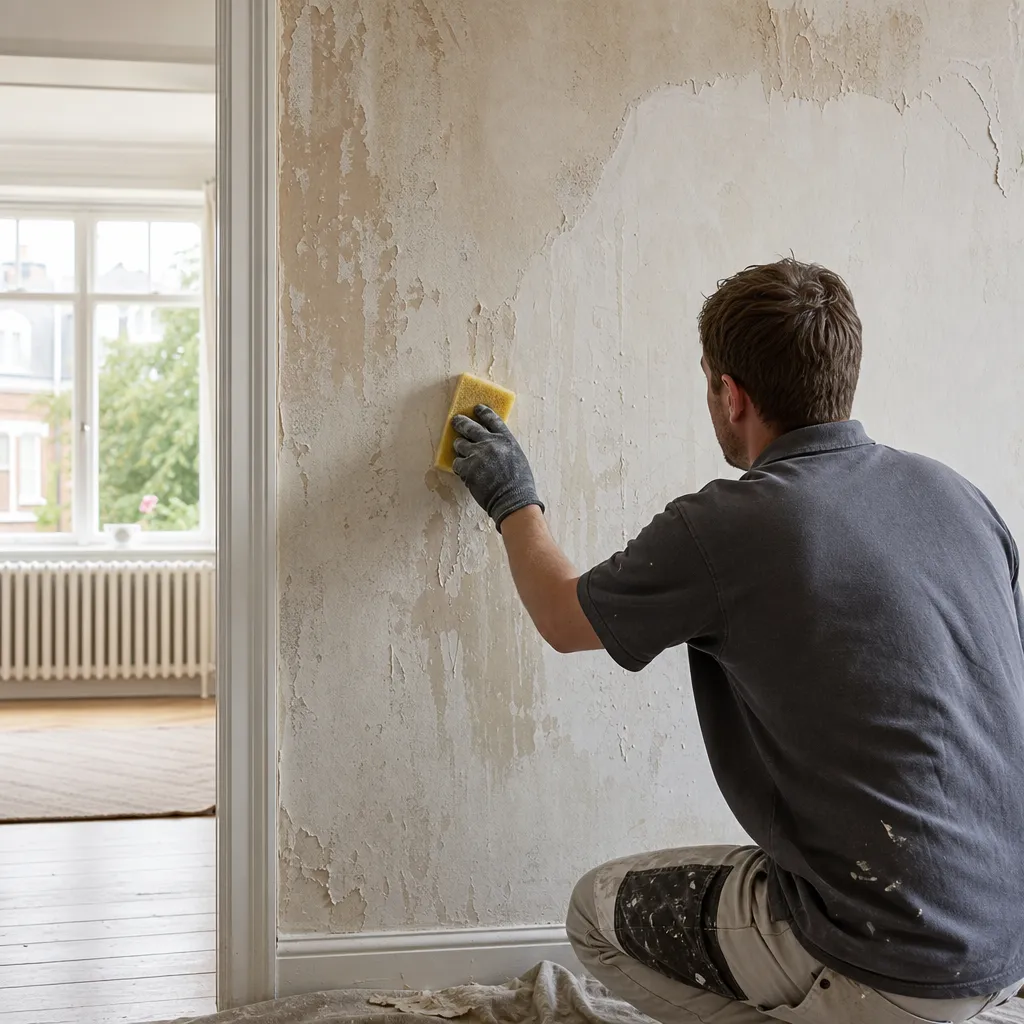
Removing Wallpaper Adhesive Residue Before Redecorating
After stripping wallpaper, a thin layer of dried paste or adhesive often remains on the wall surface.
 Improvement & Build
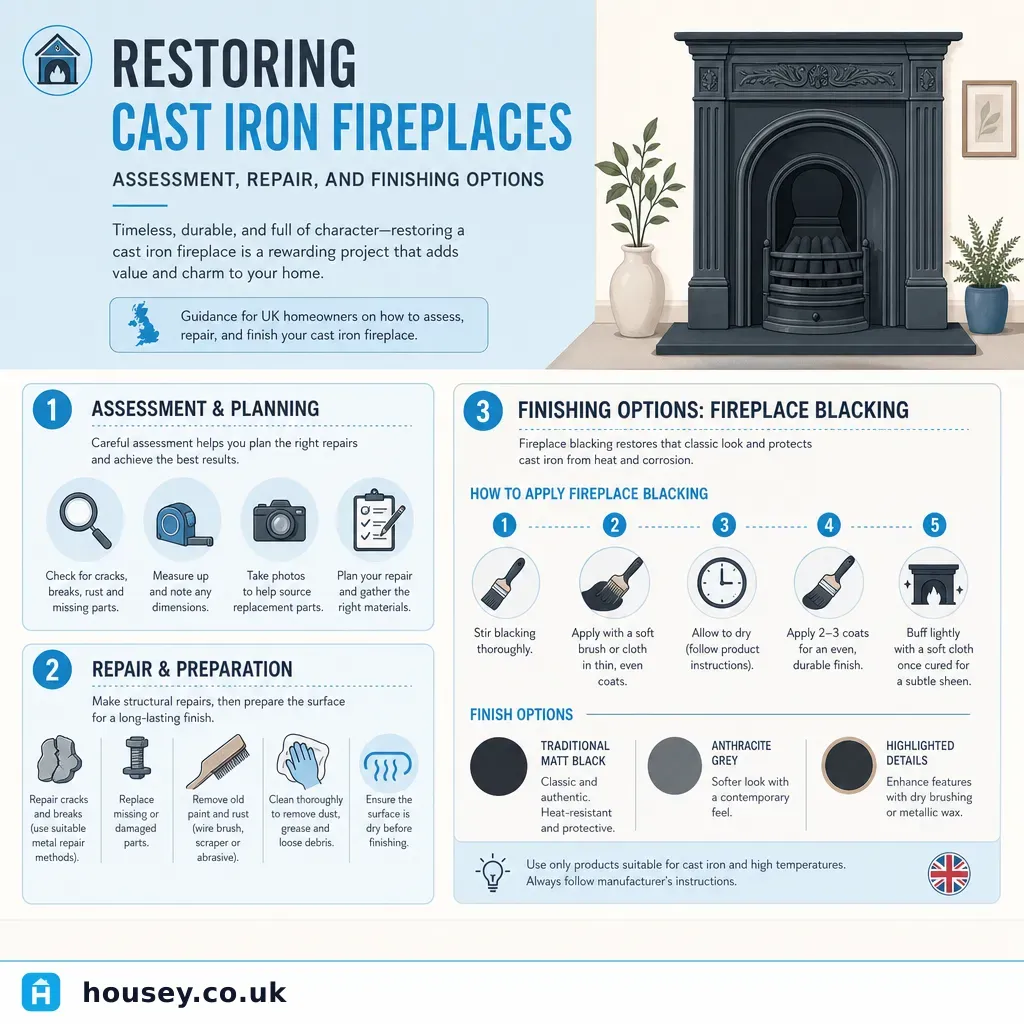
Restoring Cast Iron Fireplaces: Assessment, Repair, and Finishing Options
Restoring a cast iron fireplace involves assessing for cracks, corrosion, and missing components, treating rust, repairing joints and the fireback with fire cement, and applying specialist blacking or heat-resistant paint.
 Improvement & Build
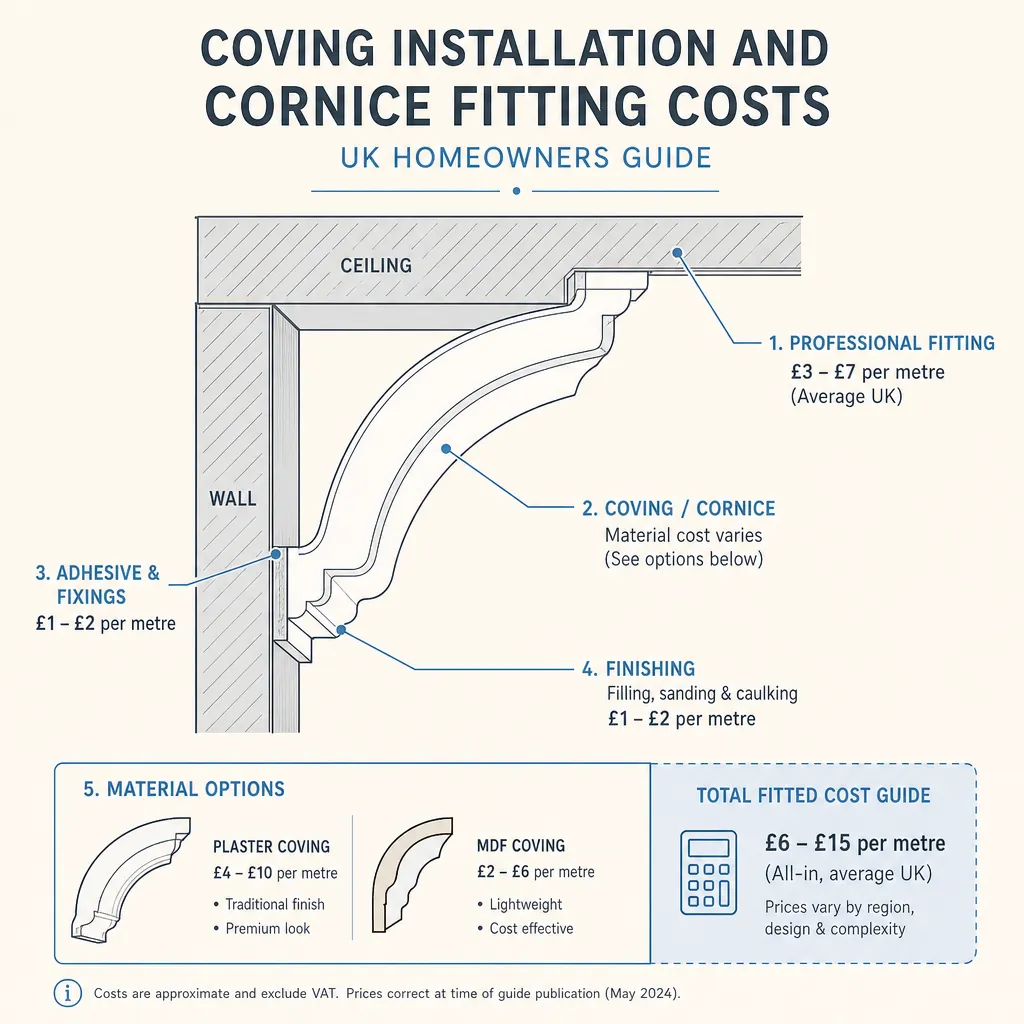
Coving Installation and Cornice Fitting Costs
Coving installation in the UK typically costs £15–£50 per linear metre for supply and fitting.
 Improvement & Build
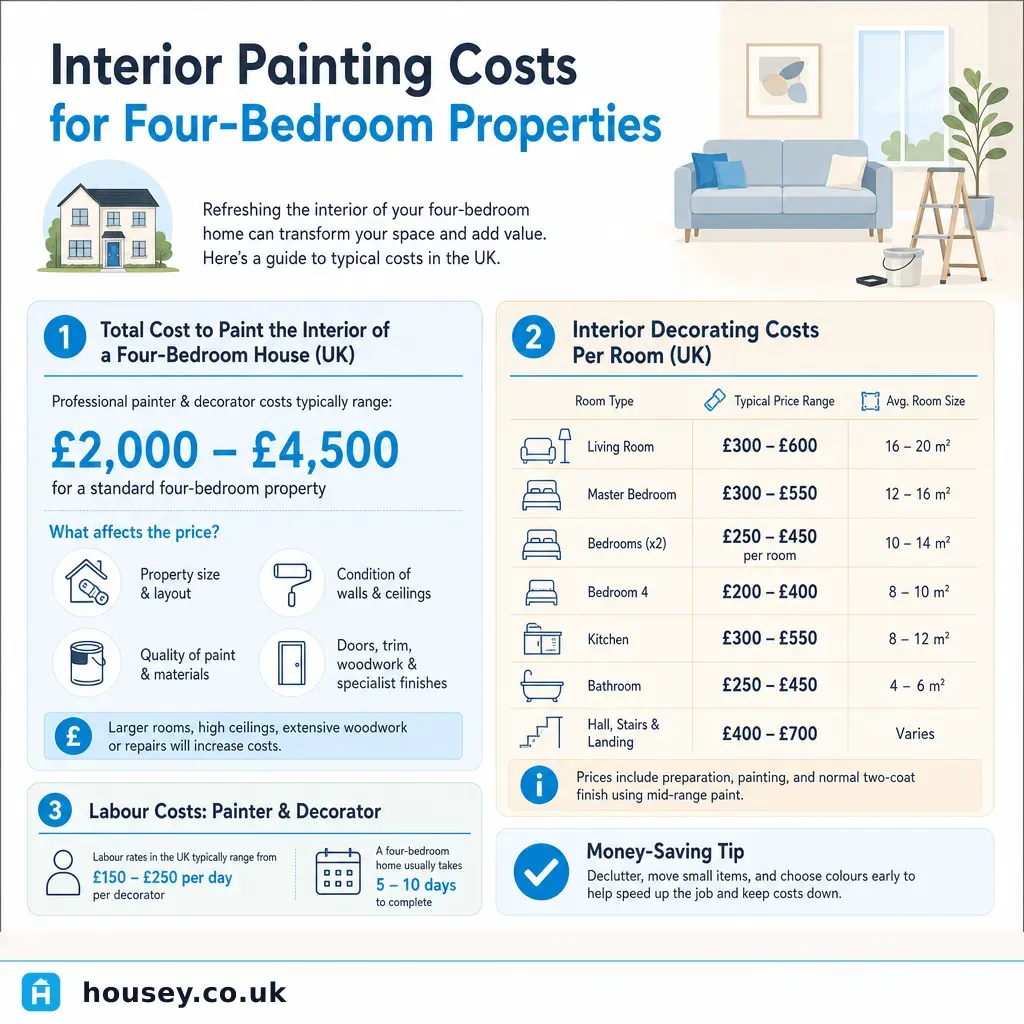
Interior Painting Costs for Four-Bedroom Properties
Professionally painting the interior of a four-bedroom UK house typically costs £2,500–£6,000, covering walls, ceilings, and woodwork.
 Improvement & Build
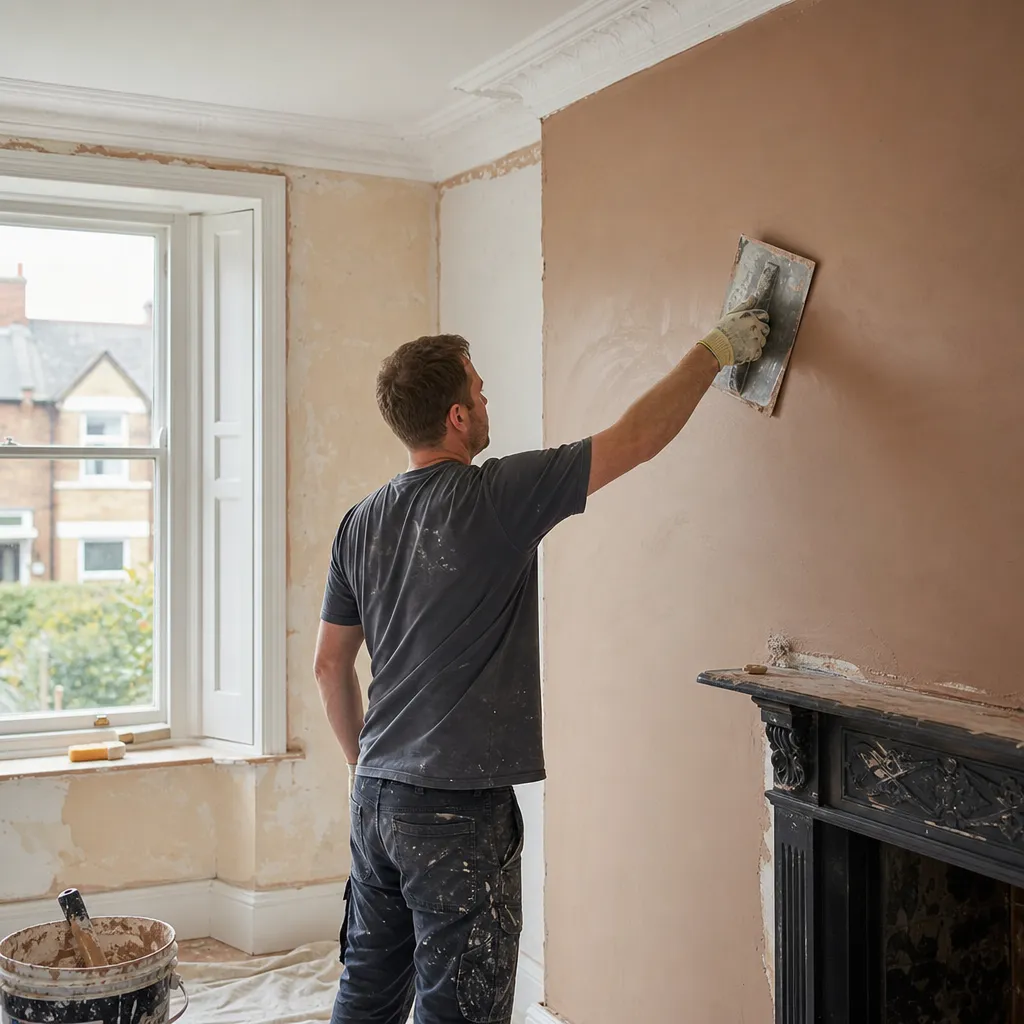
Replastering Interior Walls: Techniques for Smooth Finishes and Problem Solving
Replastering interior walls involves removing all loose or damaged plaster, preparing the substrate, and applying coats suited to the wall type.