Crawlspace Repair and Remediation Costs
By Housey · Last reviewed 6th of May 2026
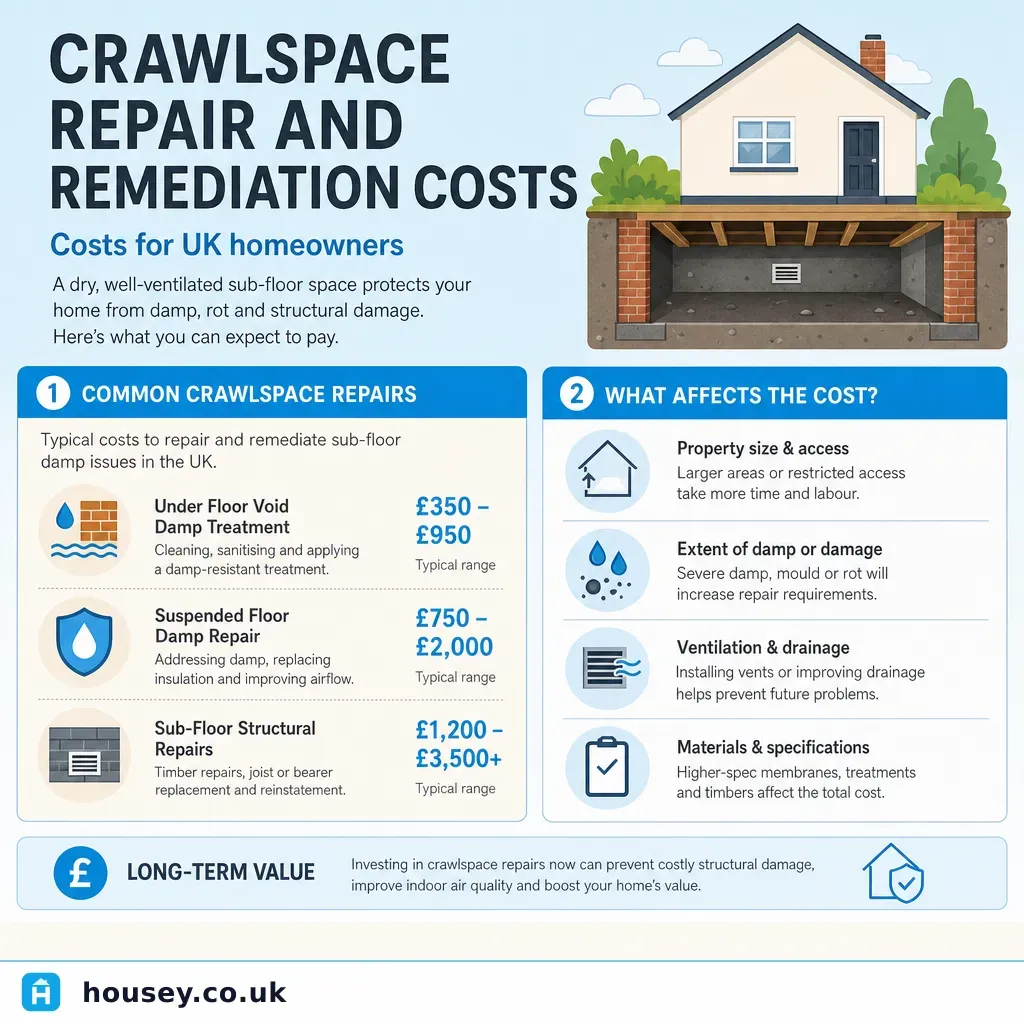
Crawlspace Repair and Remediation Costs
For UK homeowners with older properties — particularly Victorian, Edwardian, and inter-war houses built with suspended timber ground floors — the crawl space (the sub-floor void between the ground and the floor deck) is one of the areas most commonly overlooked until something goes wrong. A RICS surveyor's report, a springy floor, or a persistent musty smell often brings this space into focus, and at that point understanding what repair involves and what it costs becomes urgent.
Key points
- Sub-floor voids are most common in UK properties built before the 1950s with suspended timber floors; post-war homes typically have solid concrete ground floors and no crawlspace.
- Building Regulations Approved Document C (Site preparation and resistance to contaminants and moisture) sets requirements for sub-floor ventilation in new build and certain renovation works.
- RICS Level 2 and Level 3 Home Surveys routinely flag crawlspace issues including inadequate ventilation, rising damp, and timber decay — often the first formal notification a homeowner receives.
- Indicative remediation costs range from around £500 for minor airbrick clearance to £15,000 or more for extensive structural timber replacement combined with dry rot treatment.
- The Property Care Association (PCA) maintains a register of qualified damp and timber specialists; a PCA-registered contractor is advisable for any significant sub-floor works.
What is a crawlspace and why does it matter in a UK home?
In UK property, a crawlspace or sub-floor void is the unoccupied space beneath a suspended timber ground floor, typically between 150 mm and 600 mm in height. Its purpose is to allow air to circulate beneath the floor joists, keeping timber dry and preventing decay.
When ventilation is blocked, insufficient, or has never been adequate, moisture accumulates. This leads to:
- Wet rot in joists and floorboards, caused by persistent dampness.
- Dry rot (Serpula lacrymans), which spreads aggressively through masonry as well as timber.
- Rising damp affecting ground-floor walls and floor structures.
- Pest infestation — rodents and woodworm favour damp, dark sub-floor voids.
- Structural weakening of the ground floor, sometimes to the point of floor failure.
In most UK properties, crawlspace problems come to light during a home purchase survey, when planning a ground-floor renovation, or when occupants notice floor movement or persistent odours.
Common crawlspace problems and indicative repair costs
Problem | Typical remediation | Indicative cost range | Specialist needed |
|---|---|---|---|
Blocked or missing airbricks | Clear blockages or reinstate airbricks | £150–£600 | General builder |
Inadequate ventilation | Install additional airbricks or mechanical ventilation | £300–£1,500 | Builder or damp specialist |
Condensation and surface mould | Damp treatment and ventilation upgrade | £800–£3,500 | PCA-registered damp specialist |
Localised wet rot to joists | Splice or replace affected sections | £600–£3,000 | Structural carpenter |
Widespread wet rot | Full joist and floorboard replacement | £4,000–£12,000+ | Structural engineer and contractor |
Dry rot outbreak | Specialist eradication and structural repair | £2,000–£15,000+ | PCA-registered dry rot specialist |
Rodent infestation and entry points | Pest control and masonry sealing | £200–£800 | Pest controller and builder |
Sub-floor membrane encapsulation | Install vapour-control membrane across void | £1,500–£5,000 | Remediation specialist |
Indicative UK costs, last reviewed 2026-05-06. Actual costs depend on access, extent of damage, regional labour rates, and the contractor's specification. Obtain at least three written quotes before instructing any work.
Decision tree: which professional do you need?
- Choose a PCA-registered damp and timber specialist if the issue is moisture, condensation, mould, or suspected fungal decay — they can diagnose both wet rot and dry rot and specify appropriate treatment.
- Choose a structural engineer if joists appear deflected or fractured, or if the floor feels dangerously unstable and load-bearing capacity is in question.
- Ask a RICS surveyor first if you have not had a survey and are unsure of the cause — a surveyor identifies the root problem and recommends the right specialist, avoiding costly misdiagnosis.
- Consult building control if works involve replacing a significant portion of the structural floor or altering sub-floor ventilation in a way that affects the building fabric.
- Contact a pest controller before starting any timber work if rodent activity is suspected, to avoid disturbing nesting areas without prior control measures in place.
What drives crawlspace repair costs?
Extent of damage Localised rot in one or two joists costs far less than widespread decay across an entire ground floor. Extent is confirmed by a specialist damp and timber report — not just a visual check through airbrick openings.
Type of fungal attack Dry rot is significantly more expensive to treat than wet rot. Because Serpula lacrymans can spread through masonry and mortar, treatment often involves removing and chemically treating adjacent brickwork, greatly increasing the scope of works.
Access constraints Shallow sub-floor voids (under 200 mm) are difficult to work in and increase labour time. Properties where floorboards are bonded through tiles or other finishes involve additional stripping and reinstatement costs.
Specification of treatment Some contractors propose full membrane encapsulation; others favour improved ventilation and targeted chemical treatment. Both can be appropriate depending on the site — always ask for a written specification with a clear rationale, and seek a second opinion if uncertain.
Whether building regulations approval is required Works involving structural floor replacement or changes to external walls (such as new airbrick positions) may require building control notification. Your local authority or an approved inspector can clarify requirements.
Red flags: signs the problem may be more serious
The following indicate that the issue goes beyond routine maintenance and requires urgent professional assessment:
- Floors feel significantly springy, bouncy, or show visible deflection towards the centre of a room.
- A persistent musty or earthy smell that does not improve with ventilation.
- Grey or white fluffy or cushion-like growth on timbers or walls at floor level — may indicate dry rot fruiting bodies.
- Structural cracks appearing in ground-floor walls adjacent to the affected area.
- Previous damp proofing treatments that appear to have failed or caused new problems elsewhere.
- The property is leasehold and the sub-floor forms part of a communal structure — lease obligations and landlord responsibilities may apply.
Important limitations
This article provides general guidance for UK homeowners on crawlspace and sub-floor repair costs. The figures given are indicative only, based on published industry ranges as of 2026. Sub-floor conditions vary considerably between properties of different ages, construction types, and locations. The cause of damp or structural problems in a sub-floor void should always be confirmed by a qualified specialist before work is instructed. This article is not a substitute for a professional damp survey, structural assessment, or advice specific to your property. Building regulations requirements vary — check with your local authority building control department.
What to ask a qualified professional
Before instructing any crawlspace remediation, ask:
- Are you PCA-registered, and can you provide your membership details?
- Have you identified the root cause of the problem, rather than just treating symptoms?
- What does the written specification include, and what is excluded?
- Will the works require building regulations notification or approval?
- What guarantee do you provide, and is it backed by insurance or a recognised warranty scheme?
- Is VAT included in the quotation, and are there likely to be additional costs once access is gained?
- Have you worked on similar properties of this age and construction type in this area?
When to get professional help
Seek professional advice without delay if:
- A RICS Level 2 or Level 3 Home Survey has flagged crawlspace or sub-floor concerns.
- There is any sign of dry rot — do not disturb or treat this without a qualified specialist.
- The floor structure shows visible movement or deflection, or feels unsafe underfoot.
- You are planning a ground-floor renovation, extension, or underfloor heating installation that will involve the existing floor structure.
- You are buying a property and have not yet had a survey — sub-floor voids are rarely visible without lifting boards or specialist inspection.
How Housey can help
If a survey or inspection has flagged damp, rot, or structural concerns in your sub-floor void, Housey can connect you with qualified damp proofing specialists who can assess the extent of the problem, prepare a written specification, and provide competitive quotes for remediation works.
Frequently asked questions
Are crawlspaces common in UK homes?
Suspended timber ground floors with sub-floor voids are most common in UK properties built before around 1950, including Victorian, Edwardian, and many inter-war homes. Post-war properties typically have solid concrete ground floors and no crawlspace. If you are unsure what type of floor your property has, a builder or RICS surveyor can advise.
Does crawlspace repair add value to a house?
Remedying crawlspace defects removes a problem rather than adding a premium feature, but it can be essential for a sale to proceed. Mortgage lenders may require evidence of repair before releasing funds, and unresolved sub-floor issues identified in a survey can lead to renegotiated purchase prices or collapsed sales transactions.
Will my home insurance cover crawlspace repair?
Standard UK home insurance typically covers sudden, unforeseen damage — such as floor timbers damaged by a burst pipe — but not gradual deterioration, rot, or maintenance failures. Check your policy wording and contact your insurer before instructing repairs if you believe the damage has an insured cause.
Is crawlspace encapsulation worth it in UK conditions?
Encapsulation — sealing the sub-floor void with a vapour-control membrane — can be effective where the moisture source is ground water vapour. However, it is not always the most appropriate solution and can mask rather than resolve underlying causes. A PCA-registered specialist should assess whether it suits your specific property and ground conditions.
Do I need building regulations approval for crawlspace repairs?
Routine maintenance and like-for-like timber repairs generally do not require building regulations approval. However, if you are replacing a significant portion of the structural floor or altering sub-floor ventilation in a way that affects the building fabric, check with your local authority building control department or a registered approved inspector.
Sources and further reading
Useful next reads
 Planning & Pre-Build
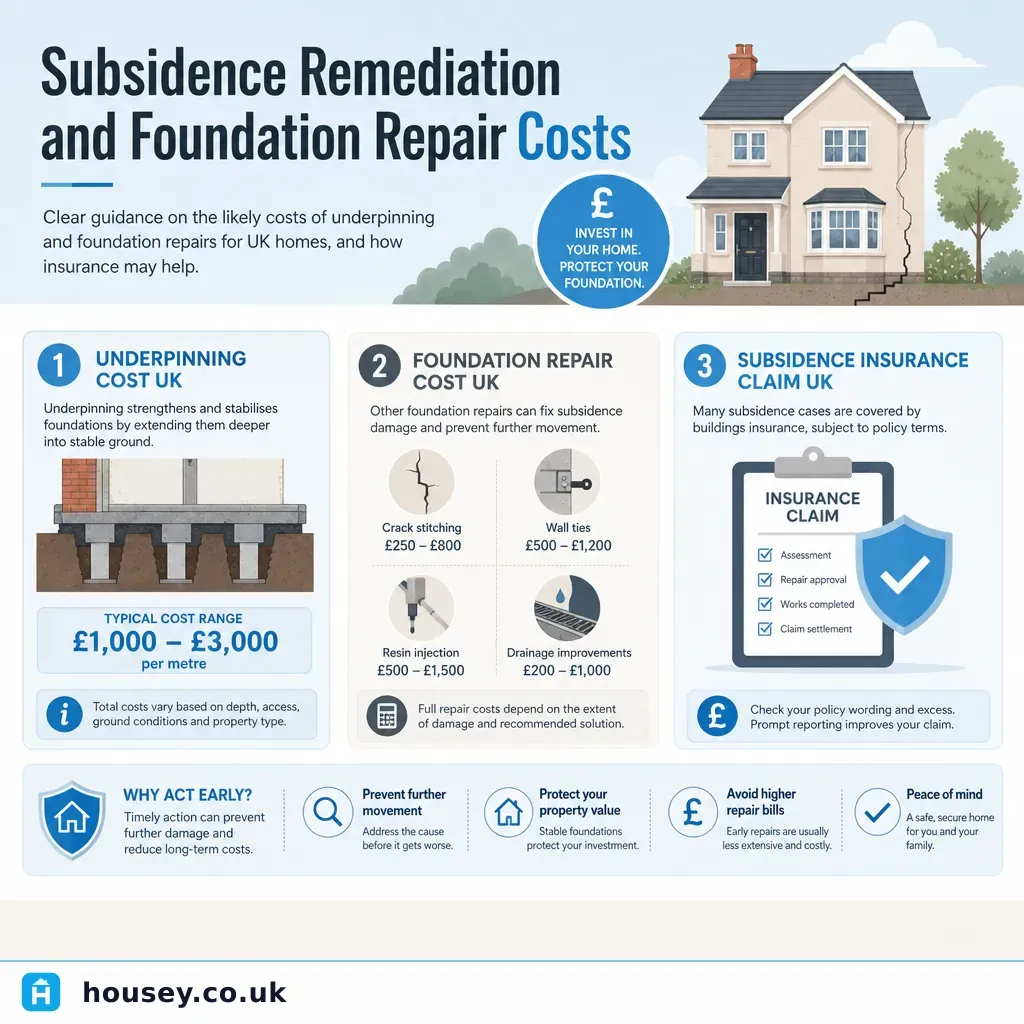
Subsidence Remediation and Foundation Repair Costs
Subsidence remediation in the UK typically costs £5,000–£50,000+ depending on cause and method.
 Planning & Pre-Build
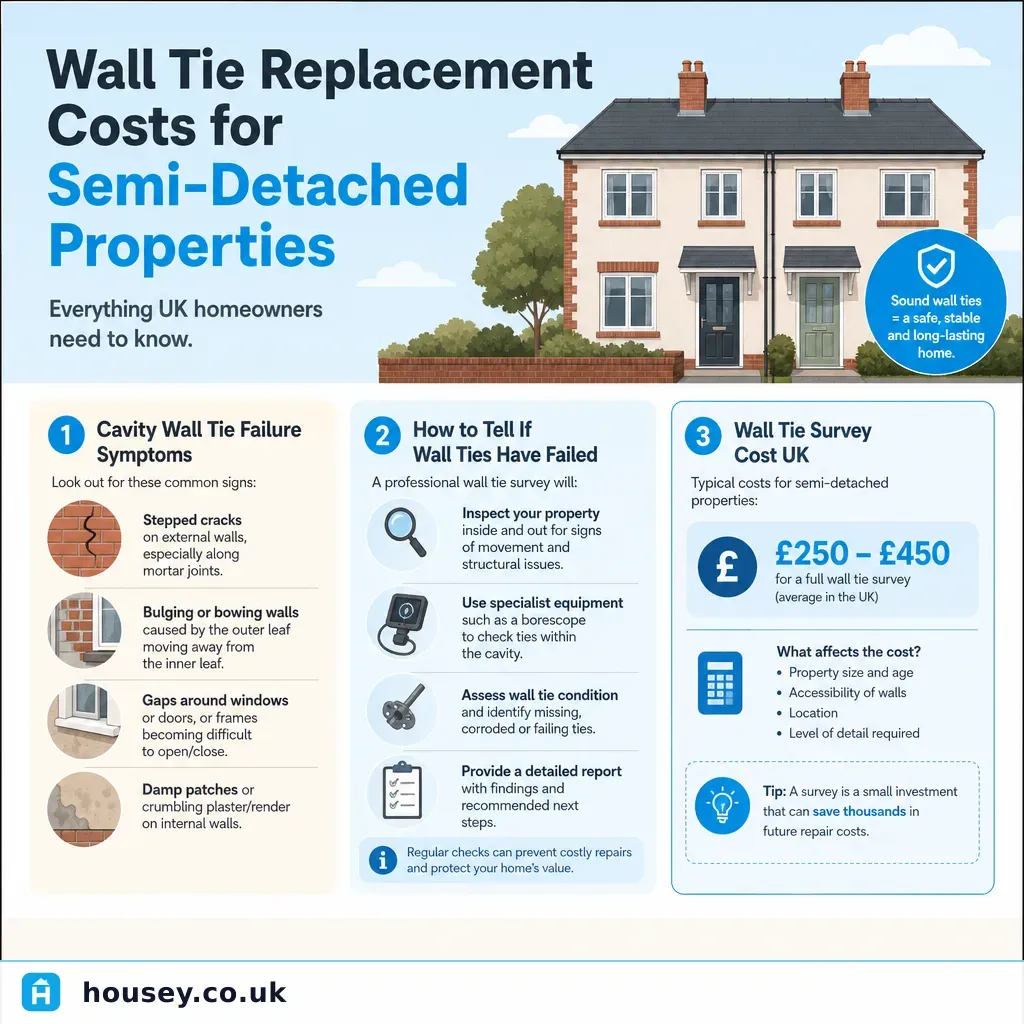
Wall Tie Replacement Costs for Semi-Detached Properties
Wall tie replacement in a UK semi-detached house typically costs £2,500–7,000 for a full two-elevation repair, plus £200–450 for a borescope survey.
 Planning & Pre-Build
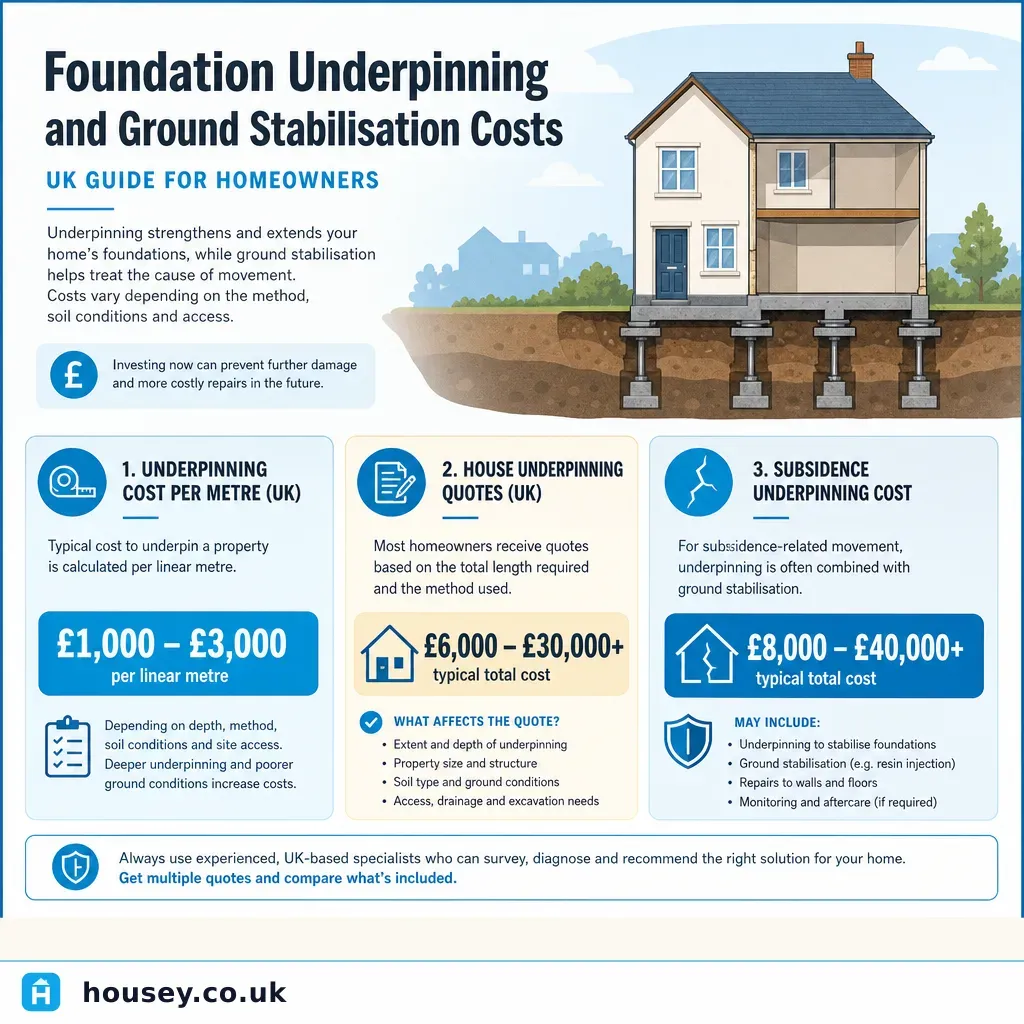
Foundation Underpinning and Ground Stabilisation Costs
Foundation underpinning in the UK typically costs £10,000–£50,000 or more for a whole property, with partial wall-section treatment running £5,000–£15,000.
 Planning & Pre-Build
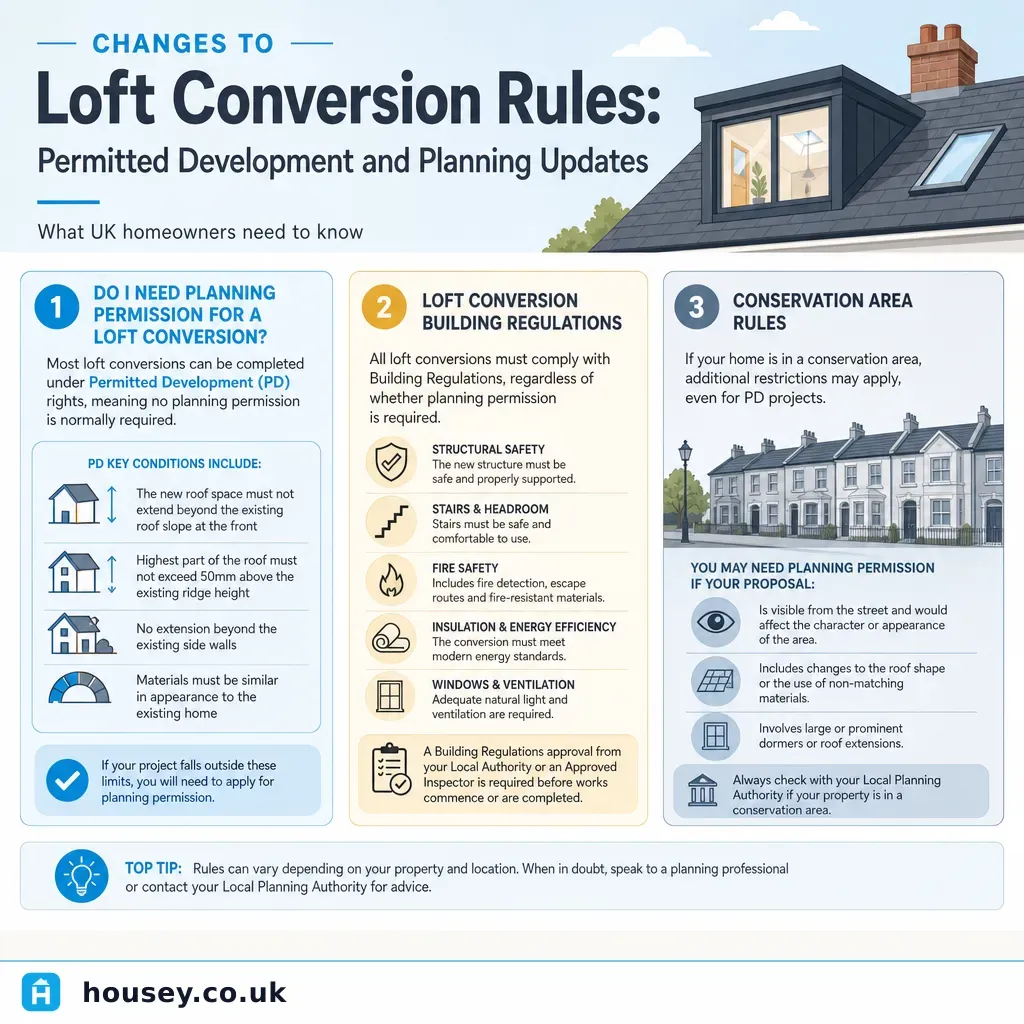
Changes to Loft Conversion Rules: Permitted Development and Planning Updates
In England, most loft conversions on standard houses qualify as Permitted Development under Class B of the GPDO 2015, allowing up to 40 cubic metres (terraced) or 50 cubic metres (detached or semi-detached) without a planning application — if conditions are met.
 Planning & Pre-Build
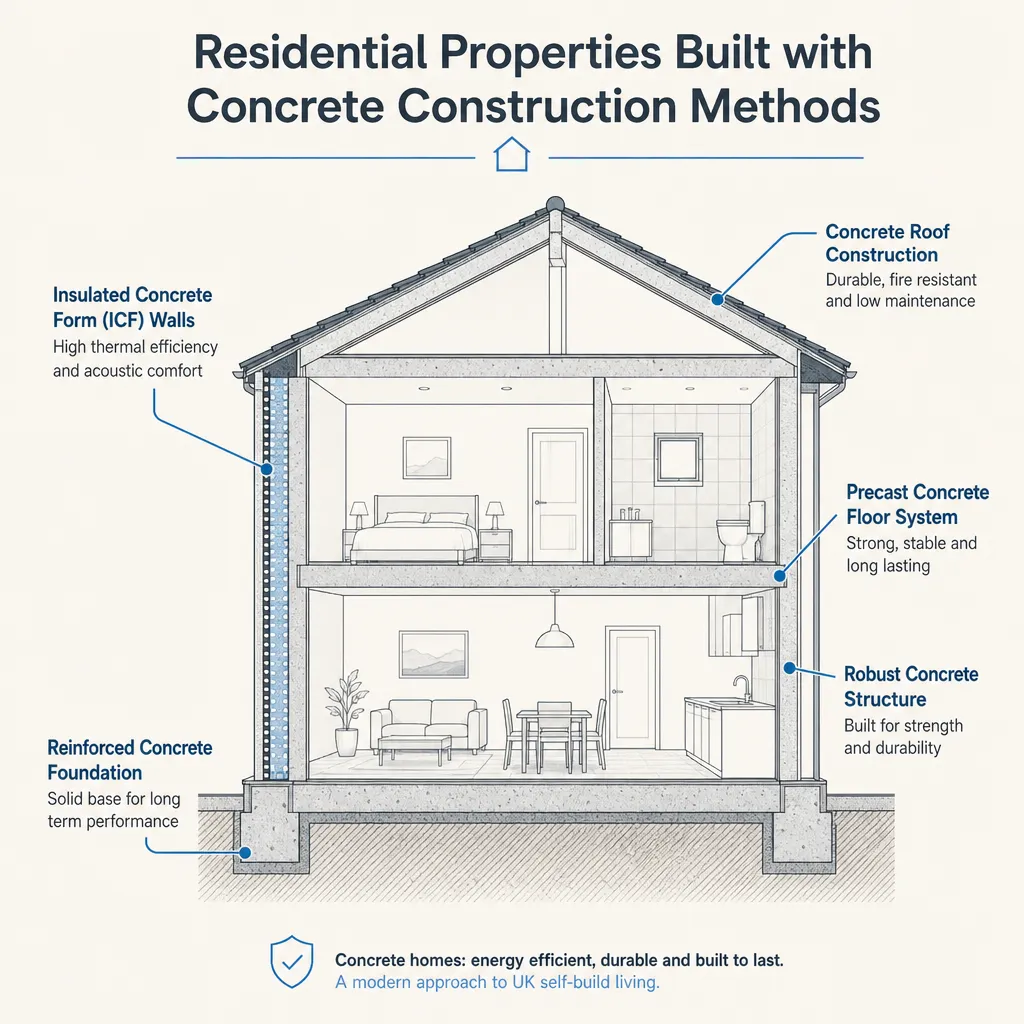
Residential Properties Built with Concrete Construction Methods
UK homes are built using several concrete methods: in-situ cast concrete, precast panel systems, insulating concrete formwork (ICF), and older non-traditional types such as Wimpey No-Fines and Laing Easiform.