Foundation Underpinning and Ground Stabilisation Costs
By Housey · Last reviewed 11th of May 2026
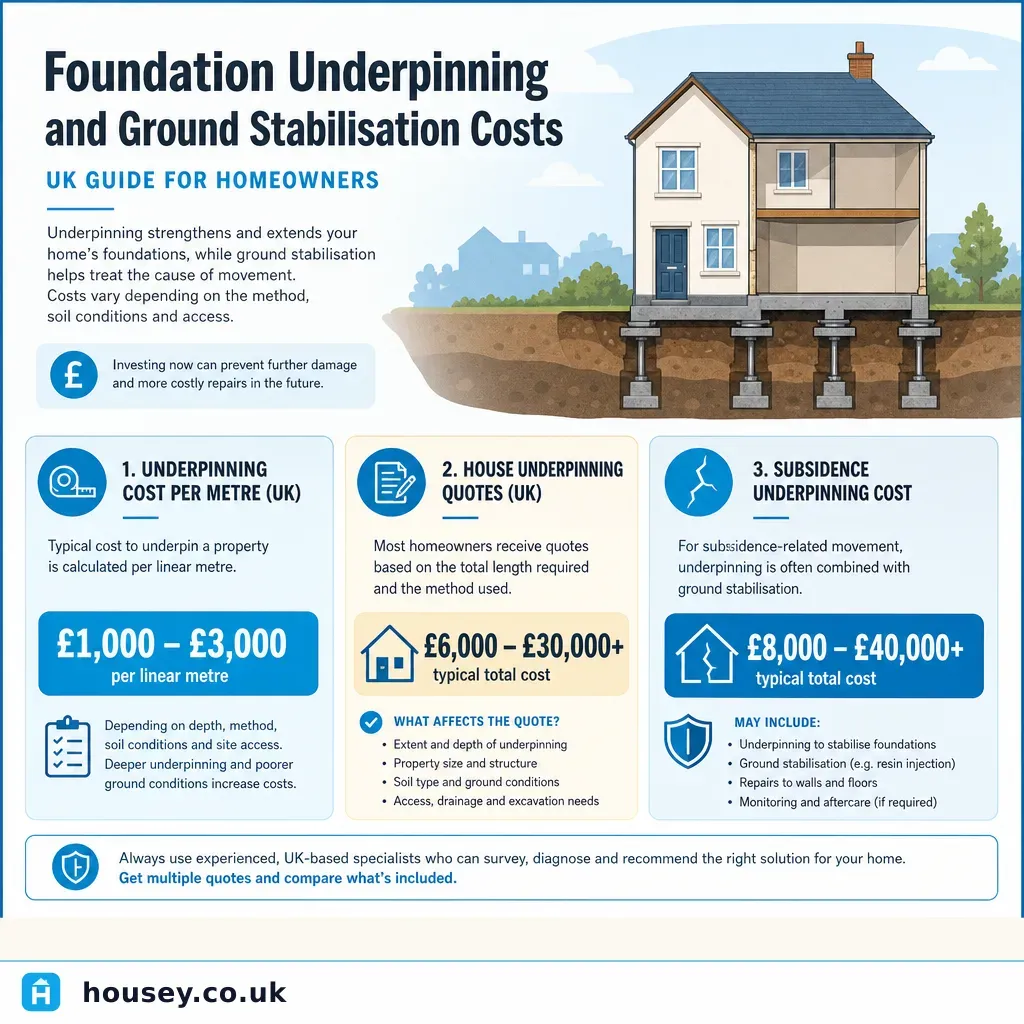
Foundation Underpinning and Ground Stabilisation Costs
Foundation underpinning is one of the most significant remedial works a UK homeowner may face. It typically becomes relevant after a surveyor, structural engineer, or insurer identifies evidence of subsidence, heave, or inadequate original foundation depth — common in Victorian and Edwardian properties and in homes built on shrinkable clay soils across much of southern England. Understanding the cost landscape and what drives variation in specialist quotes helps homeowners engage with professionals from a well-informed position.
Key points
- Foundation underpinning in the UK typically costs £10,000–£50,000 or more for a whole property; partial underpinning of a single wall section may cost £5,000–£15,000. Indicative UK costs, last reviewed 2026-05-11.
- A structural engineer's assessment and calculations are always required before any underpinning method is specified — no reputable contractor should quote for work without them.
- The three most common methods are mass concrete (traditional), mini-piling, and resin injection; the correct choice depends on soil type, foundation depth, load, and the underlying cause of movement.
- Buildings insurance may cover underpinning costs where the cause is a recognised insured peril such as subsidence or tree root damage, but the insurer's engineers will direct the method and contractor choice.
- Underpinning is notifiable structural work: a completion certificate from building control must be issued before the property can be remortgaged or sold with a clean structural record.
Underpinning methods and typical costs
Different ground conditions and degrees of foundation failure require different approaches. The table below summarises the main methods used by UK structural engineers.
Method | How it works | Typical cost range | Best for | Limitations |
|---|---|---|---|---|
Mass concrete (traditional) | Sequential excavation and concrete filling beneath the existing foundation | £1,000–£2,000/m run | Shallow foundations on stable subsoil; standard residential properties | Disruptive; labour-intensive; unsuited to deep or waterlogged ground |
Mini-piling | Driven or drilled piles to load-bearing strata; new beam ties to piles | £15,000–£40,000+ | Deep soil movement; shrinkable clay; tree root damage | Higher cost; specialist equipment required |
Resin injection (geopolymer) | Expanding resin injected into voids to stabilise and lift the ground | £5,000–£20,000 | Voids, loose fill, or localised settlement on suitable soils | Not suitable for all soil types; may not be accepted by all insurers |
Beam and base | Reinforced concrete beams transfer loads to new foundation pads | £10,000–£30,000 | Mixed foundation conditions; load redistribution needed | Significant excavation required; slower programme |
Screw pile (helical pile) | Steel piles screwed into load-bearing strata with minimal vibration | £15,000–£35,000 | Restricted access; near existing services; vibration-sensitive sites | Requires specialist plant and geotechnical input |
Indicative UK costs, last reviewed 2026-05-11. Costs depend on soil conditions, site access, foundation depth, and contractor. Always obtain quotes alongside a structural engineer's specification.
What drives the cost of underpinning?
Extent of movement: Partial underpinning of one wall section costs significantly less than whole-property treatment. However, partial work may not resolve the root cause, and an engineer may specify a wider scope following investigation.
Cause of movement: The underlying cause — shrinkable clay, tree root desiccation, leaking drains, inadequate original foundations, or mining subsidence — determines the correct remedy. Treating the cause (removing or root-barrier-treating an offending tree; repairing a drain) may reduce or eliminate the need for full underpinning.
Foundation depth and soil conditions: Deep foundations or difficult soils (running sand, made ground, high water table) require more complex and costly methods.
Site access and party walls: Narrow access for plant, proximity to neighbouring properties, and shared walls all affect programme, method selection, and cost. Party wall matters require compliance with the Party Wall etc. Act 1996.
Structural engineer and building control fees: A structural engineer typically charges £1,000–£3,000 for initial assessment, specification, and site inspections. Building control fees for notifiable structural works vary by local authority but may add £500–£2,000.
Neighbouring properties: If ground movement affects adjacent properties, coordinated or sequential treatment may be necessary — substantially increasing total cost.
Which professional do you need?
Professional | Role | When to instruct |
|---|---|---|
RICS-registered building surveyor | Initial inspection, defect diagnosis, condition reporting | First step when cracks or movement are noticed |
Chartered structural engineer | Structural assessment, cause analysis, specification of remedial works | Before any underpinning is quoted or started |
Geotechnical engineer | Soil investigation, ground conditions report (boreholes, trial pits) | Required for complex cases; often instructed by the structural engineer |
Specialist underpinning contractor | Carries out the agreed remedial scheme under the engineer's specification | After the structural engineer has issued a specification |
Party wall surveyor | Manages Party Wall etc. Act 1996 notices and awards | If the affected wall is shared with a neighbour |
Red flags that require urgent professional attention
The following signs suggest active or progressing structural movement and warrant immediate professional assessment — not a DIY investigation:
- Cracks wider than 5 mm, or any crack stepped through mortar courses and brickwork
- Cracks that are visibly widening over days or weeks
- Doors or windows that have recently started sticking or no longer close properly
- Floors that have become noticeably uneven or that bounce underfoot
- Gaps opening between walls and ceiling or cornice
- Bulging or leaning external walls
- Ground that has visibly subsided near the property perimeter
Important limitations
This article provides general cost information about underpinning for UK homeowners. Underpinning is a complex structural intervention: the correct method, extent, and specification can only be determined by a qualified structural engineer following a site investigation and, typically, a geotechnical ground investigation. Nothing here should substitute for professional assessment. Rules and requirements vary by soil type, property tenure, local authority, and insurer. If you suspect foundation movement, do not carry out any structural or renovation works until a qualified professional has inspected the property.
When this becomes urgent
Stop relying on online guidance and seek immediate professional help if:
- Cracks are visibly growing or widening
- There are sudden changes in how doors or windows operate
- You notice visible subsidence in the ground surface near the property
- Your buildings insurer has been notified and is directing the investigation
- You are under offer to sell or purchase the property and a survey has flagged structural movement
- Your mortgage lender has been made aware of structural concerns
What to ask a qualified professional
Before instructing a structural engineer or underpinning contractor, ask:
- What is the likely cause of the movement, and has it stabilised or is it still active?
- What investigations (boreholes, trial pits, drain CCTV survey) are needed before a specification can be issued?
- Which underpinning method do you recommend, and why is it appropriate for this property and soil type?
- What assumptions is the initial estimate based on — and what factors could change the scope or cost?
- Do you hold professional indemnity insurance, and what is the claims limit?
- Will the works be subject to building control notification and inspection?
- How will the works affect the Party Wall Act position with neighbouring properties?
- Will a structural warranty or completion certificate be issued on completion?
When to get professional help
If you have not already done so, instruct a RICS-registered building surveyor or chartered structural engineer before taking any further action. If a surveyor or conveyancer has flagged foundation movement in a report, seek a specialist structural engineer's opinion before exchange of contracts. Do not instruct an underpinning contractor directly without an independent structural engineer's specification.
How Housey can help
Housey can connect you with vetted structural engineers and structural surveyors across the UK who can assess foundation movement, issue a formal specification, and oversee underpinning works on your behalf. Use the Housey quote request tool to receive assessments from qualified local professionals.
Frequently asked questions
Does underpinning devalue a property?
A property with a history of underpinning can be harder to sell or remortgage, particularly if the work was recent or not formally signed off. However, a property where movement has been correctly treated and signed off by a structural engineer and building control is often in a better structural position than one with unaddressed movement. Disclosure is legally required in the TA6 property information form when selling.
How long does underpinning take?
Traditional mass concrete underpinning for a semi-detached house typically takes four to eight weeks on site, plus time for investigation and specification beforehand. Mini-piling and resin injection are often faster — one to three weeks on site — but the full programme from initial instruction to building control sign-off usually runs several months.
Will my insurer cover underpinning costs?
If foundation movement is caused by an insured peril such as subsidence, heave, or landslip, your buildings insurer may cover the cost, subject to your excess — typically £1,000 or more for subsidence claims. The insurer will appoint their own loss adjuster and usually their own engineer. Check your policy carefully and notify your insurer as soon as movement is first suspected.
Does underpinning require planning permission?
Underpinning itself does not normally require planning permission. However, it is notifiable structural work: you must notify your local authority's building control department or an approved inspector before work begins, and a completion certificate must be issued on completion. This record is important for any future sale or remortgage.
Sources and further reading
- Building Regulations Approved Document A: Structure — GOV.UK
- Party Wall etc. Act 1996: explanatory booklet — GOV.UK
- RICS building surveying standards and guidance — RICS
- Building regulations approval — GOV.UK
- HSE: Structural safety in construction — Health and Safety Executive
Useful next reads
 Planning & Pre-Build
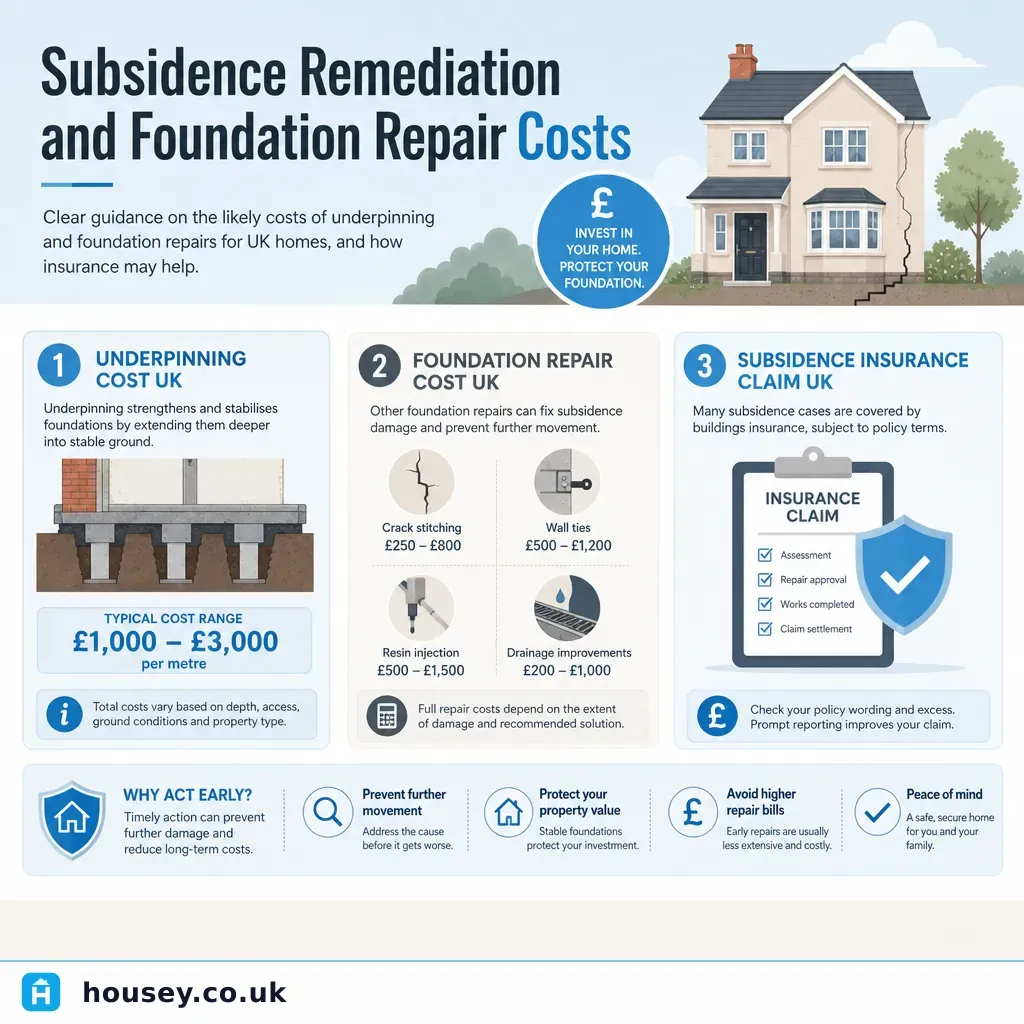
Subsidence Remediation and Foundation Repair Costs
Subsidence remediation in the UK typically costs £5,000–£50,000+ depending on cause and method.
 Planning & Pre-Build
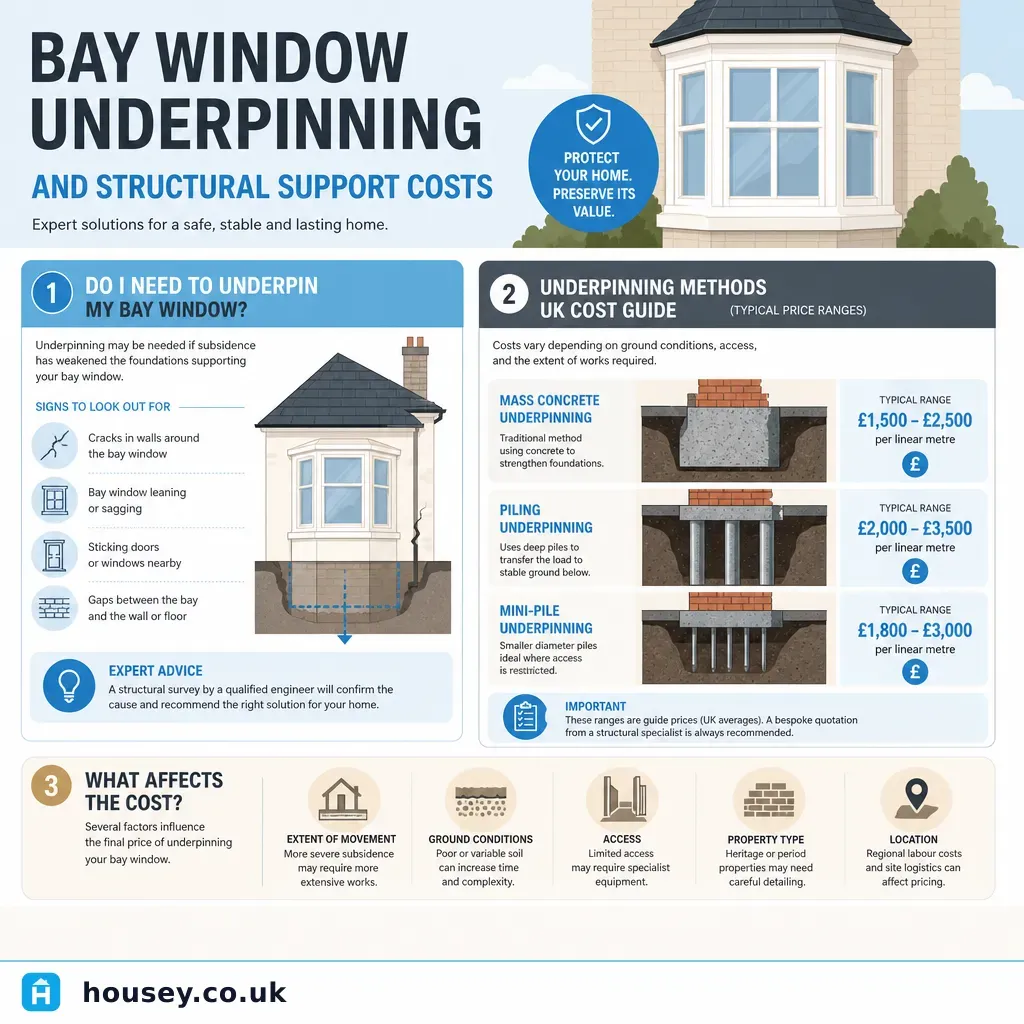
Bay Window Underpinning and Structural Support Costs
Bay window underpinning in the UK typically costs £3,000–£10,000 per bay for traditional mass concrete methods, with resin injection and mini-piling in a similar range depending on depth and site conditions.
 Planning & Pre-Build
Wall Tie Replacement Costs for Semi-Detached Properties
Wall tie replacement in a UK semi-detached house typically costs £2,500–7,000 for a full two-elevation repair, plus £200–450 for a borescope survey.
 Planning & Pre-Build
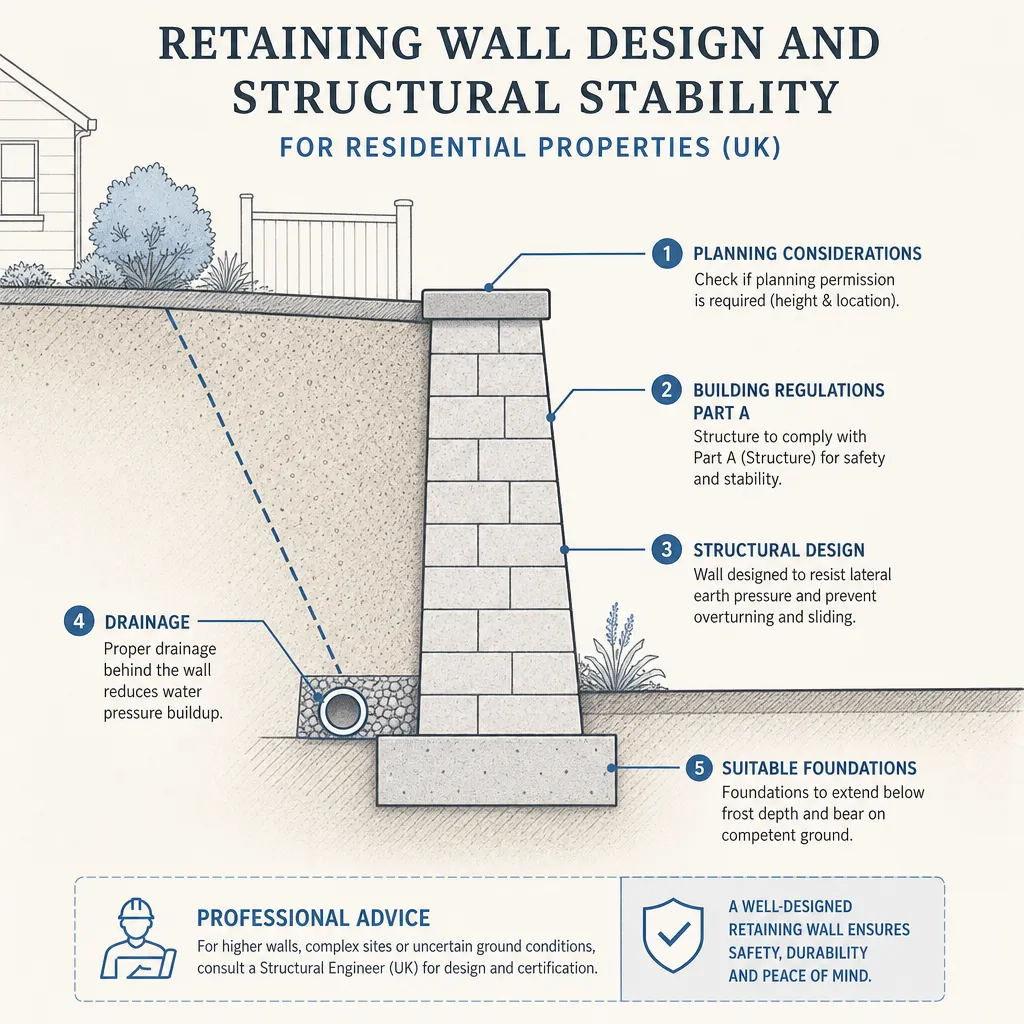
Retaining Wall Design and Structural Stability for Residential Properties
Retaining walls over around 1 m in height usually need structural engineer assessment; walls over 2 m almost always require a formal structural design and building control approval.
 Planning & Pre-Build
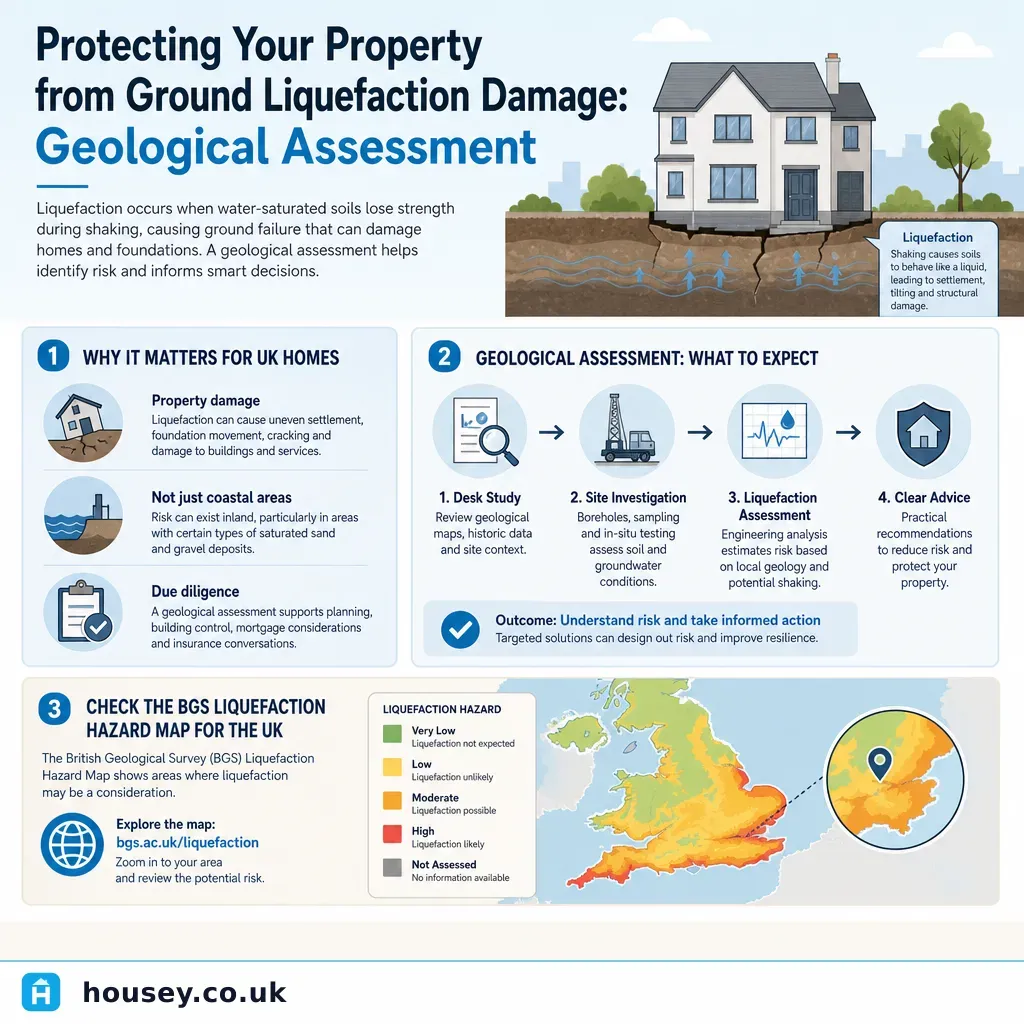
Protecting Your Property from Ground Liquefaction Damage: Geological Assessment
Ground liquefaction occurs when saturated, loose granular soils temporarily lose bearing capacity under vibration or shaking.