Subsidence Remediation and Foundation Repair Costs
By Housey · Last reviewed 11th of May 2026
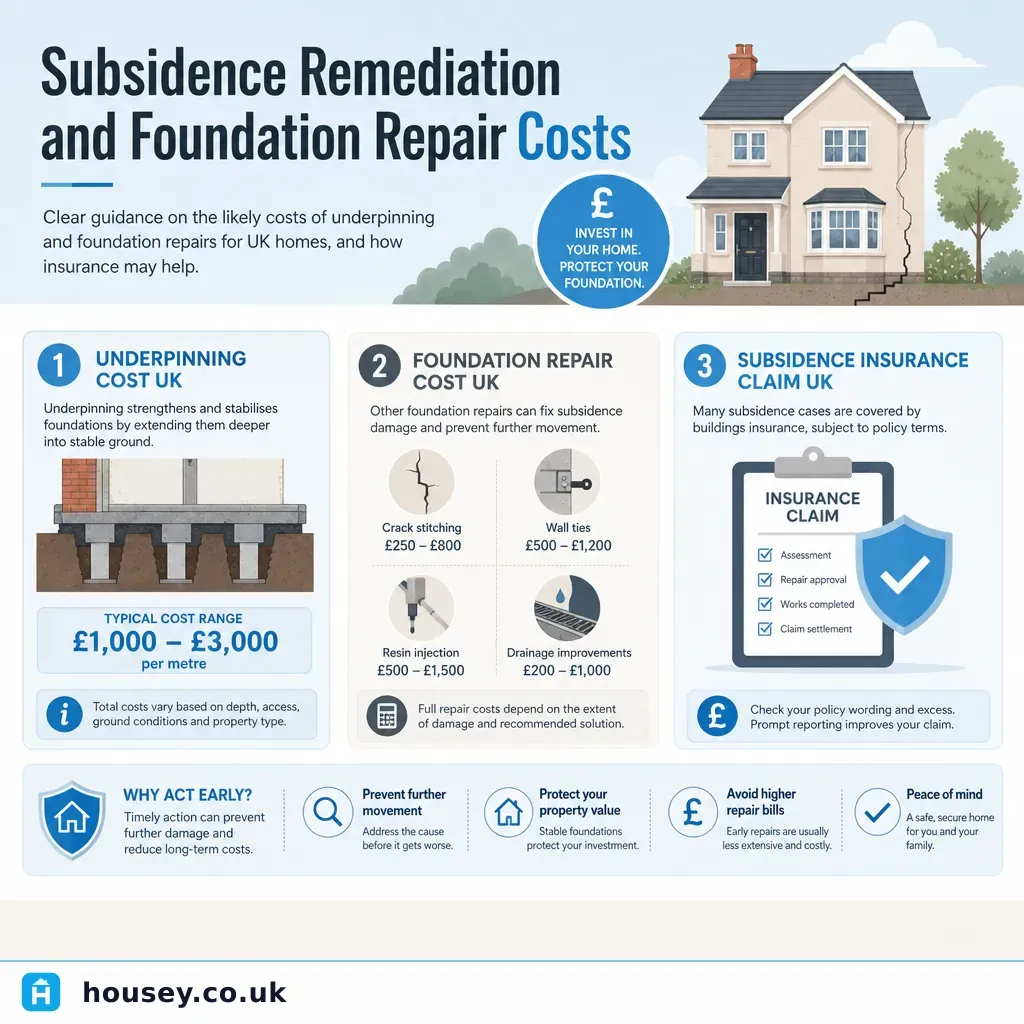
Subsidence Remediation and Foundation Repair Costs
For UK homeowners, discovering signs of subsidence — widening wall cracks, sticking doors, or uneven floors — triggers urgent questions about structural safety, insurance, and repair costs. Properties on London clay, Midlands boulder clays, and other shrinkable soils are particularly vulnerable, and the remediation route chosen can make the difference between a manageable insurance claim and a very large unexpected bill. Getting the diagnosis right before committing to any works is essential: the wrong fix can be expensive and ineffective.
Key points
- The Building Research Establishment (BRE) classifies subsidence damage in six categories (0–5); categories 3–5, involving cracks wider than 5mm, typically require formal structural assessment and possible engineering intervention.
- Traditional mass concrete underpinning costs approximately £1,500–£3,000 per bay (around 1–1.5 linear metres of wall), with whole-property underpinning typically reaching £30,000–£50,000 or more (Indicative UK costs, last reviewed 2026-05-11).
- Most standard buildings insurance policies include subsidence cover, but policy excesses are commonly £1,000–£5,000, and most insurers require a structural engineer's investigation report before authorising repairs.
- Resin injection (geopolymer injection) is an increasingly common alternative to traditional underpinning, often costing £10,000–£25,000 for a partial treatment with significantly less disruption to the property.
- Oak, willow, poplar, and elm trees on shrinkable clay soils are the most frequently cited cause of UK subsidence insurance claims; tree removal or root barriers may resolve the problem without structural intervention.
What causes subsidence in UK homes
Subsidence occurs when the ground beneath a building's foundations moves downward unevenly, causing the structure above to settle or crack. In the UK, the most common causes are:
- Shrinkable clay soils drying out, often due to drought or tree-root water extraction. Clay soils across London, the Home Counties, the East Midlands, and parts of the North West are particularly susceptible.
- Tree roots, particularly from oaks, willows, poplars, and elms, which extract large volumes of moisture from clay soils and can cause differential settlement over many years.
- Leaking or fractured drains washing away subsoil beneath shallow foundations — a common cause in Victorian and Edwardian terraces where clay drain pipes have cracked or displaced over time.
- Mining legacy in parts of the North East, Midlands, South Wales, and Yorkshire, where historical mine workings can trigger unpredictable ground movement.
- Made ground or fill beneath foundations that was poorly compacted at the time of construction.
Understanding the cause is not merely academic: it dictates the remedy. A leaking drain requires drain repair first; clay shrinkage may be addressed by tree management. Only when the cause is confirmed and addressed should structural remediation proceed.
How subsidence damage is classified
The BRE's classification system, set out in Digest 251: Assessment of Damage in Low-Rise Buildings, is widely used by structural engineers and insurers to categorise crack severity:
Category | Crack width | Typical description | Likely action |
|---|---|---|---|
0 | Hairline (<0.1mm) | Negligible | Monitor only |
1 | Up to 1mm | Fine; easily filled | Monitor |
2 | 1–5mm | Moderate; may need repointing | Monitor; minor repairs |
3 | 5–15mm | Notable; requires investigation | Structural engineer assessment |
4 | 15–25mm | Severe; structural concern | Engineering intervention likely |
5 | >25mm | Very severe | Urgent engineering intervention |
Categories 0–2 are often caused by thermal movement, moisture change, or normal settlement and may not require structural works. Categories 3–5 almost always require a qualified structural engineer's assessment.
Subsidence remediation options and costs
There is no single standard fix for subsidence. The appropriate method depends on the cause, foundation type, soil conditions, extent of movement, and property type.
Method | How it works | Best for | Typical installed cost | Main limitation |
|---|---|---|---|---|
Traditional mass concrete underpinning | Concrete poured in sequential bays beneath existing foundations to reach stable strata | Most soil types; long proven record | £1,500–£3,000 per bay; £30,000–£50,000 whole house | Disruptive; slow; not suited to all ground conditions |
Mini-pile underpinning | Steel or concrete piles driven or bored to stable depth | Deep fill, mining areas, restricted access | £20,000–£50,000+ | Specialist plant required; higher cost |
Resin (geopolymer) injection | Expanding resin injected to compact and stabilise soil beneath foundations | Clay shrinkage subsidence with limited movement | £10,000–£25,000 | Not suitable for all causes or ground types |
Raft foundation repair | Slab reinforced or jacked back to level | Large footprints, slab extensions | Varies widely by size | Complex engineering required |
Drain repair and regrouting | Leaking drains repaired to stop subsoil erosion | Drain-caused subsidence | £2,000–£8,000 | Must be confirmed as the primary cause |
Tree management or removal | Tree removed or root barriers installed | Clay-soil tree-root subsidence | £500–£5,000 depending on tree | Soil may swell on re-wetting, causing heave |
Indicative UK costs, last reviewed 2026-05-11. Costs vary significantly by location, site conditions, and contractor. Always obtain at least three quotes.
Which remediation method should you choose?
- Choose tree management or drain repair first if investigation confirms either as the primary cause — avoid structural works until the underlying problem is resolved.
- Choose resin injection if the cause is confirmed as clay shrinkage with limited movement and a specialist has assessed the ground as suitable.
- Choose traditional mass concrete underpinning if ground investigation confirms that foundations need extending to stable strata, particularly for older Victorian or Edwardian properties with shallow foundations.
- Choose mini-pile underpinning if access is restricted, the building is sensitive to vibration, or fill or mining ground conditions are present.
- Ask a structural engineer if you are unsure — the investigation report should specify the appropriate method before any contractor is engaged.
- Check with your insurer before commissioning any works; undertaking repairs without prior insurer agreement may invalidate a claim.
Does buildings insurance cover subsidence?
Most standard UK buildings insurance policies include subsidence as a named peril. Key considerations:
- Policy excesses for subsidence claims are typically £1,000–£5,000 — significantly higher than standard property excesses.
- Insurers usually appoint a loss adjuster and require a structural engineer's investigation report (typically costing £500–£2,000) before authorising remediation.
- Pre-existing subsidence disclosed at purchase may affect cover or premiums; some insurers will not offer new cover for properties with an active subsidence history.
- If subsidence was identified in a pre-purchase survey but you proceeded, your surveyor's professional indemnity coverage may be relevant if the risk was not adequately flagged.
- The Association of British Insurers publishes guidance on subsidence claims and what policyholders can expect.
Important limitations
This article provides general information about subsidence causes, remediation methods, and indicative costs in the UK. It is not structural, legal, or insurance advice. Causes, remediation options, and costs vary considerably depending on ground conditions, property type, foundation depth, building age, tree proximity and species, drainage, and local geology. Indicative costs are ranges only.
A qualified structural engineer must assess your specific property before any remediation method is selected or structural works commence. If you are making a buildings insurance claim, follow your insurer's claims procedure and do not commission works without their agreement.
When this becomes urgent
Seek professional help immediately if:
- A crack is widening visibly over days or weeks
- Cracks are stepped diagonally through brickwork, following the mortar joints
- Doors or windows have recently become difficult to open or close
- Floors feel noticeably uneven or springy underfoot
- Gaps are appearing between walls and ceilings or skirting boards
- A surveyor or structural engineer has classified damage as Category 3 or above
What to ask a qualified professional
Before instructing a structural engineer to investigate suspected subsidence:
- What does the investigation involve, and will you produce a written report suitable for submission to an insurer?
- What ground investigation work do you recommend — trial pits, borehole samples, or a drain CCTV survey?
- Are you a chartered member of the Institution of Structural Engineers (IStructE) or a chartered engineer with relevant subsidence experience?
- What experience do you have with properties on this soil type and in this area?
- If remediation is needed, will you specify the works, oversee contractors, and certify completion?
- What are the risks of the proposed remediation method for this property type and construction?
- Is post-remediation monitoring included in your scope, and for how long?
When to get professional help
Consult a structural engineer or chartered surveyor if any BRE Category 3 cracking is present, if movement appears ongoing, or if a pre-purchase survey has flagged subsidence risk. Notify your buildings insurer as soon as you suspect active subsidence movement.
Red flags requiring prompt professional attention:
- Cracks wider than 5mm appearing suddenly or widening noticeably
- Diagonal or stepped cracking through brickwork following mortar joints
- Sticking doors or windows that have changed suddenly
- A visible lean or bulge in an external wall
- Floor tiles or boards cracking in a consistent diagonal or curved line
How Housey can help
If you are dealing with suspected subsidence, Housey can connect you with qualified structural engineers who can carry out ground investigations, produce the reports that insurers require, and oversee remediation works. You can also find professionals offering structural surveys who can provide an initial assessment of crack patterns and advise on whether a full engineering investigation is warranted.
Frequently asked questions
How can I tell whether cracks are caused by subsidence or something else?
Subsidence cracks are typically diagonal or stepped through mortar joints in brickwork, wider at the top than the bottom. Vertical shrinkage cracks around window frames or in new plasterwork are usually caused by thermal or moisture movement. Horizontal cracks in a single mortar course can indicate wall tie failure or lateral pressure. A structural engineer is the right professional to distinguish between these causes.
Does subsidence devalue a property?
A property with a history of subsidence can be harder to sell and insure, even after successful remediation. Buyers and mortgage lenders will want engineering certificates confirming the cause has been resolved and monitoring shows movement has stopped. With clear documentation and an insurance-backed guarantee from the contractor, sales at normal market value are achievable — though some buyers will remain cautious.
Can I sell a house with active or historic subsidence?
You must disclose known subsidence to a buyer — failure to do so could constitute misrepresentation. Active, unresolved subsidence makes a property very difficult to mortgage or sell. Once fully remediated and the cause confirmed as resolved, many properties sell successfully, though specialist mortgage products or high-excess insurance may be needed depending on the property's history.
How long does subsidence remediation take?
Drain repairs typically take a few days; tree management can be completed within a week. Traditional mass concrete underpinning takes several weeks to months depending on extent, as concrete cures between sequential bays. Resin injection can often be completed in one to three days. Post-remediation monitoring with crack gauges typically continues for at least 12 months before a final engineer's certificate is issued.
Sources and further reading
- BRE Digest 251: Assessment of Damage in Low-Rise Buildings — Building Research Establishment
- Subsidence and your home insurance — Association of British Insurers
- Find a structural engineer — Institution of Structural Engineers
- Home surveys and structural defects guidance — Royal Institution of Chartered Surveyors
Useful next reads
 Planning & Pre-Build
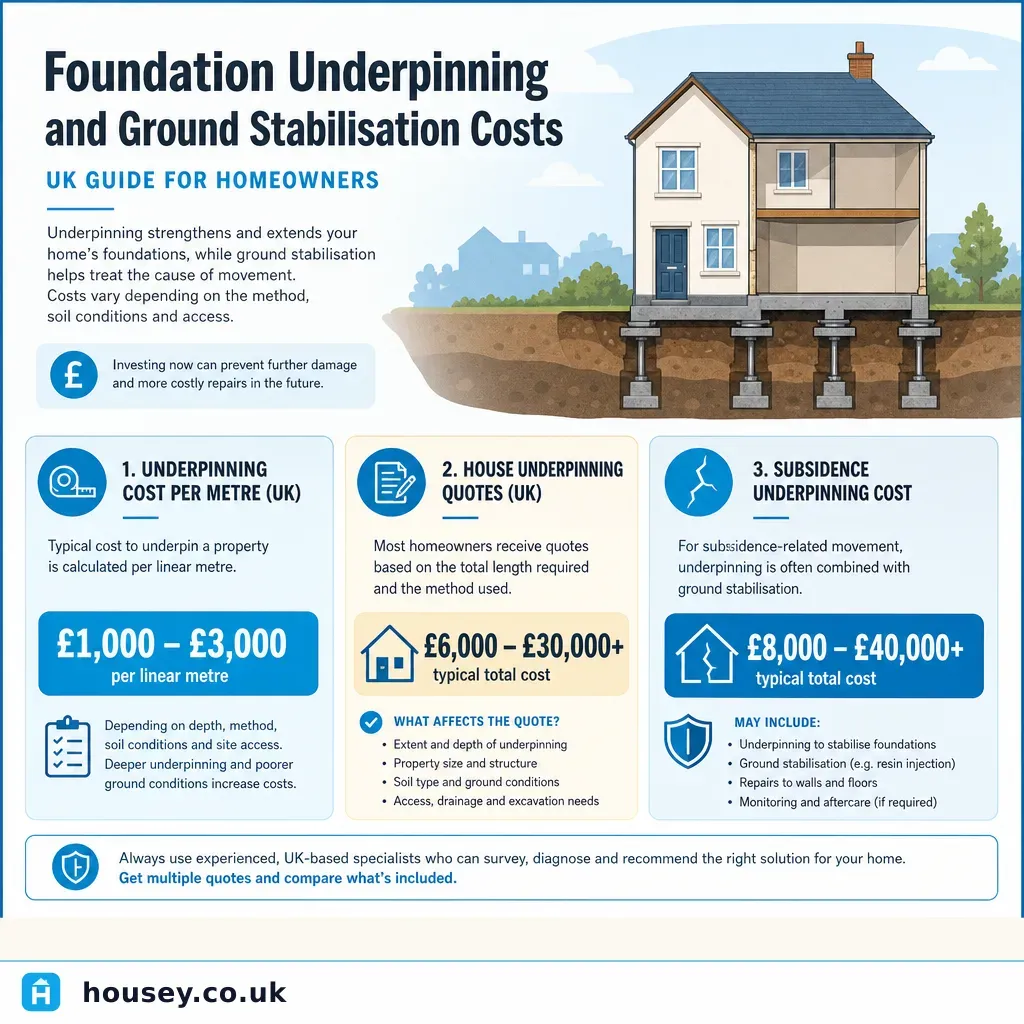
Foundation Underpinning and Ground Stabilisation Costs
Foundation underpinning in the UK typically costs £10,000–£50,000 or more for a whole property, with partial wall-section treatment running £5,000–£15,000.
 Planning & Pre-Build
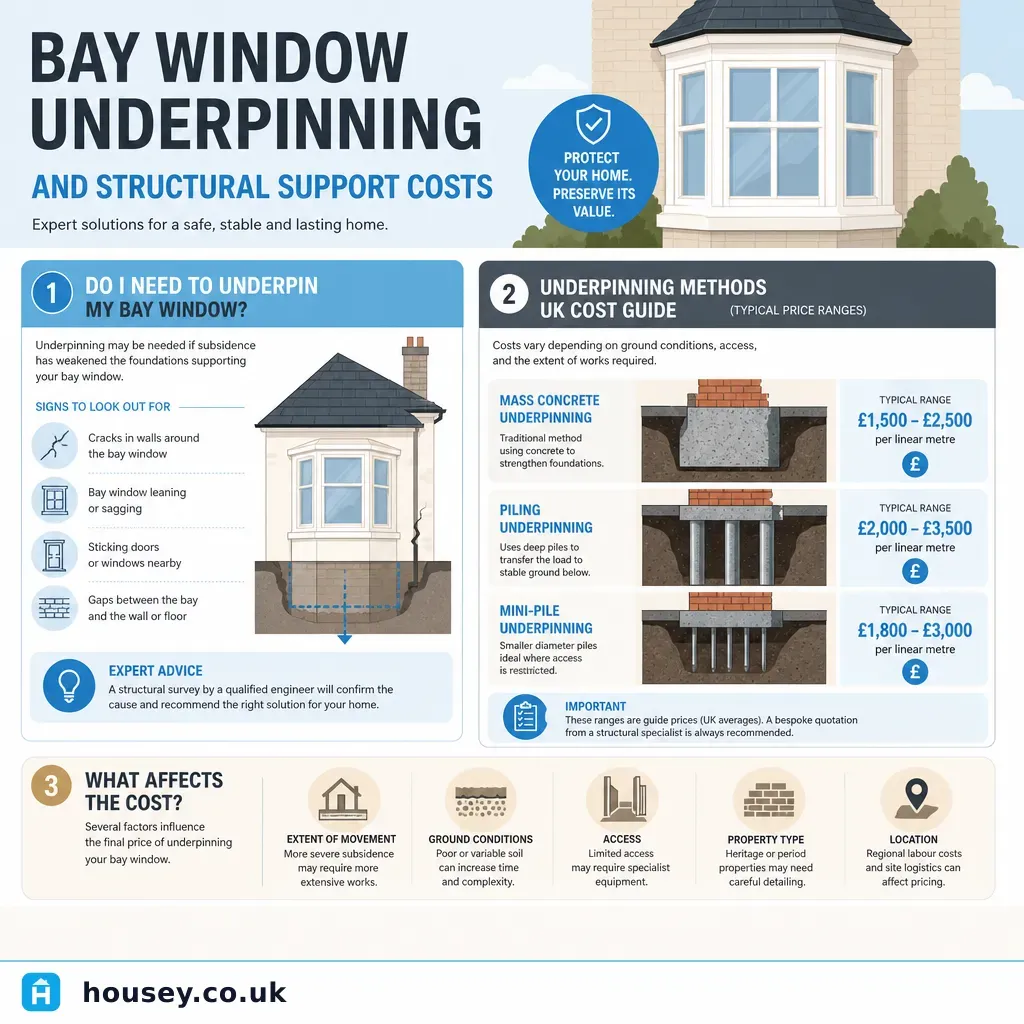
Bay Window Underpinning and Structural Support Costs
Bay window underpinning in the UK typically costs £3,000–£10,000 per bay for traditional mass concrete methods, with resin injection and mini-piling in a similar range depending on depth and site conditions.
 Planning & Pre-Build
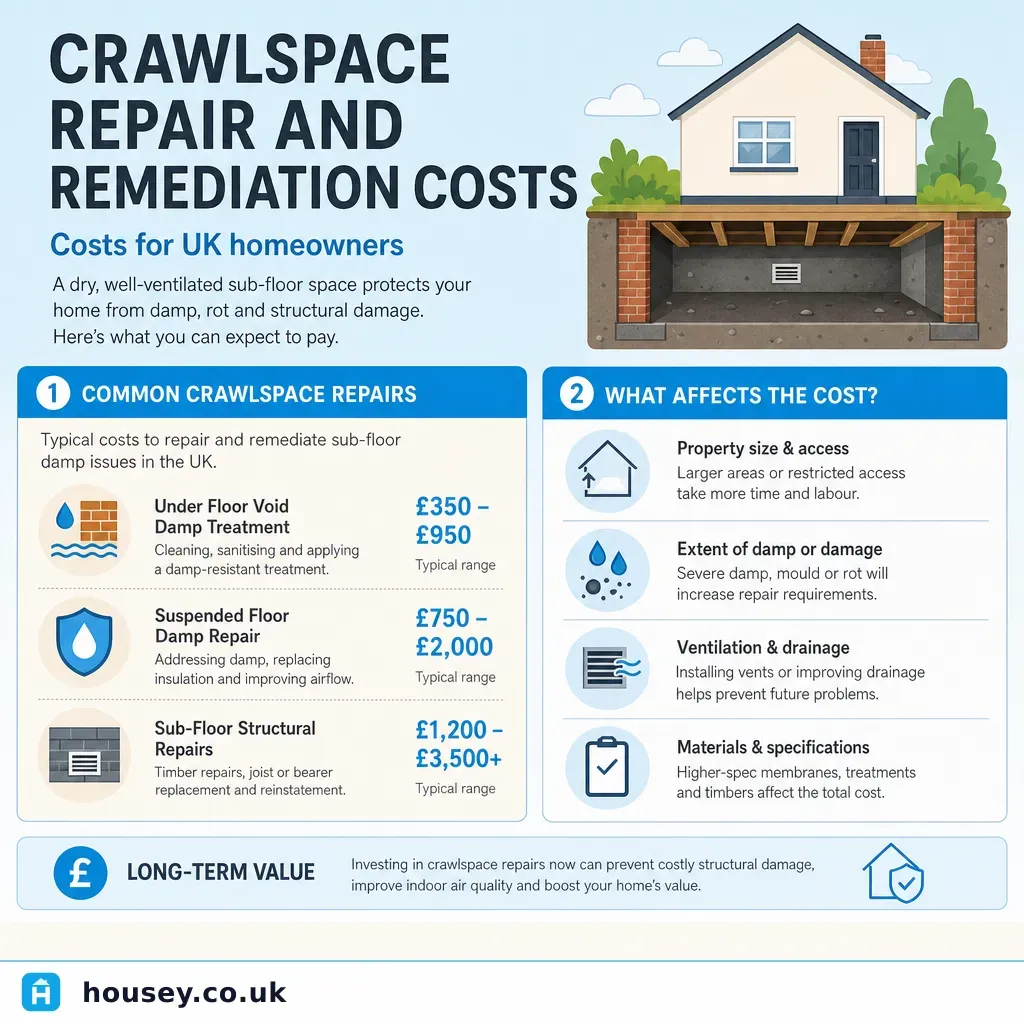
Crawlspace Repair and Remediation Costs
Crawlspace and sub-floor repair in the UK typically costs between £500 for minor ventilation work and £15,000 or more for extensive structural timber replacement or dry rot treatment.
 Planning & Pre-Build
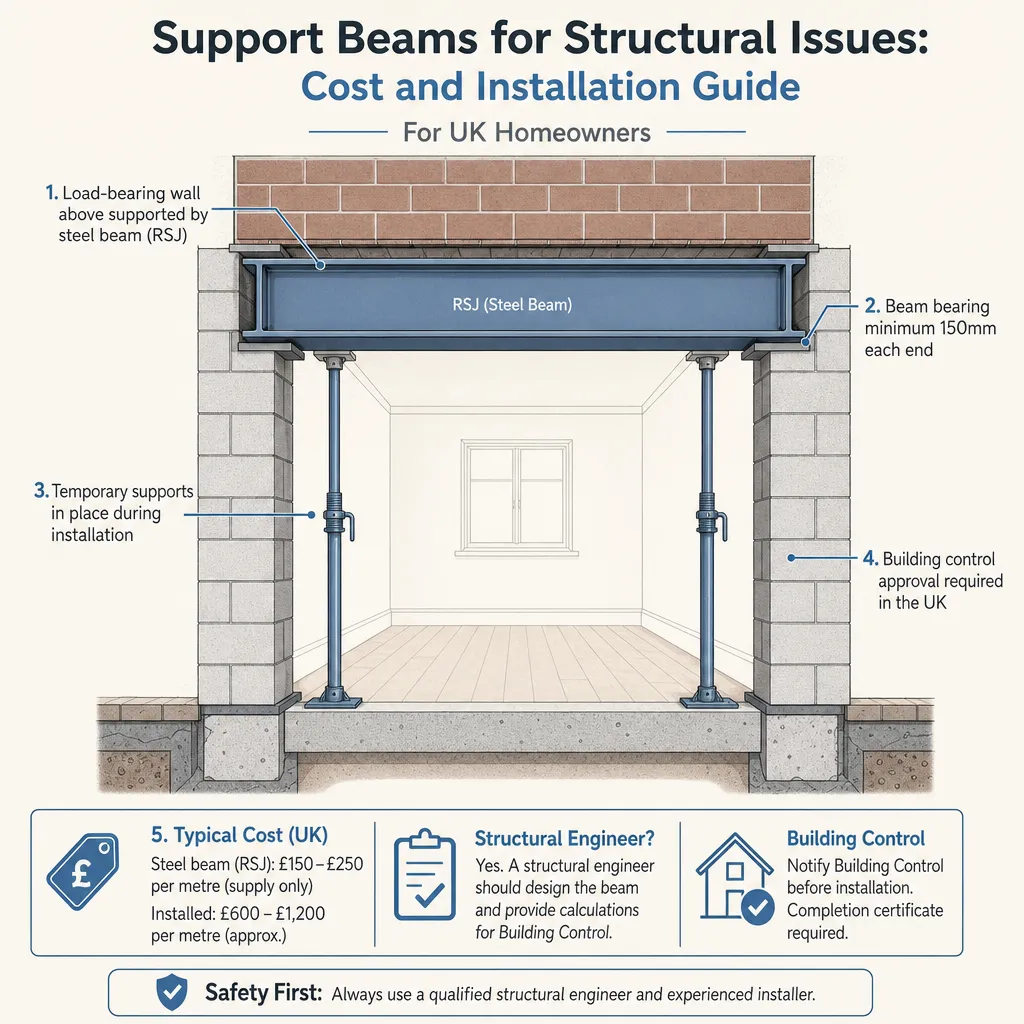
Support Beams for Structural Issues: Cost and Installation Guide
Installing a structural support beam in a UK property typically involves a structural engineer's calculations, temporary propping, and building control sign-off.
 Planning & Pre-Build
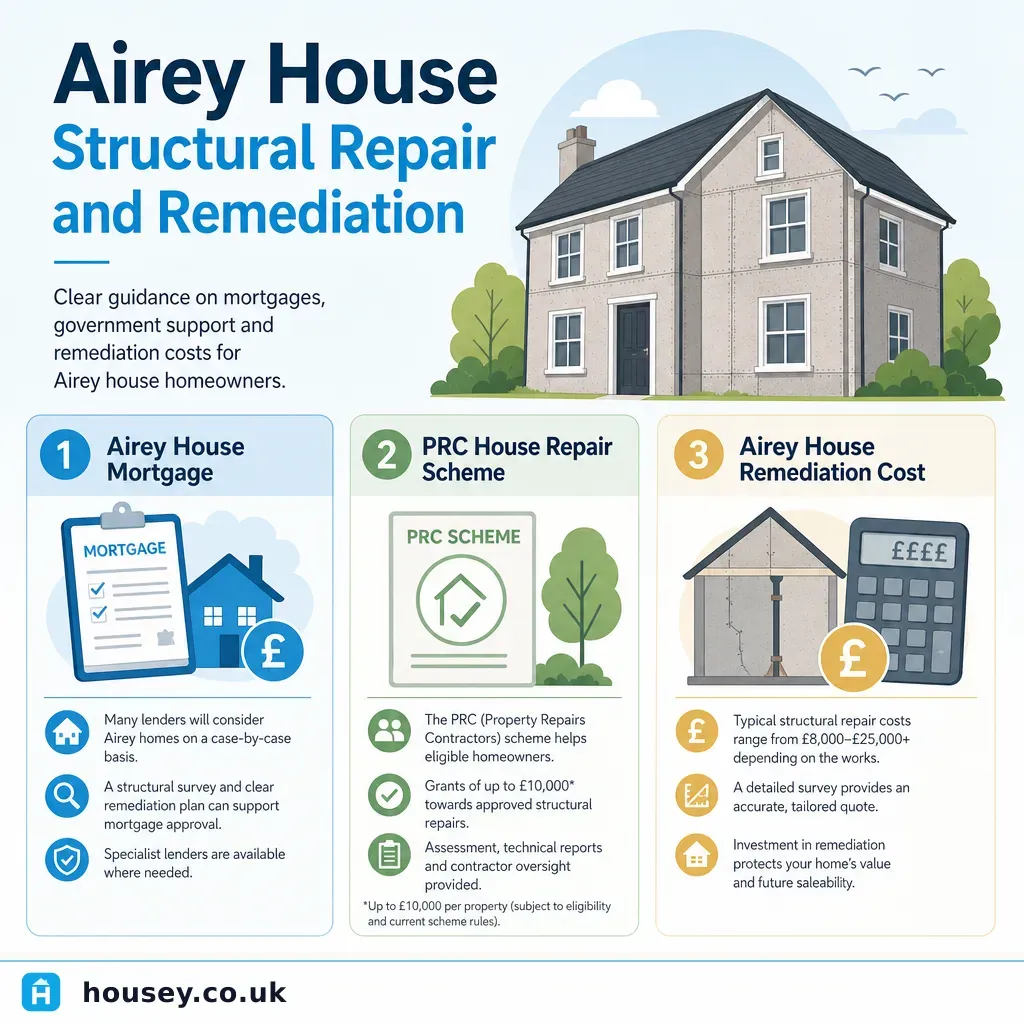
Airey House Structural Repair and Remediation
Unremediated Airey houses are generally unmortgageable.