What to Budget for Installing Crazy Paving or a Stone Patio
By Housey · Last reviewed 6th of May 2026
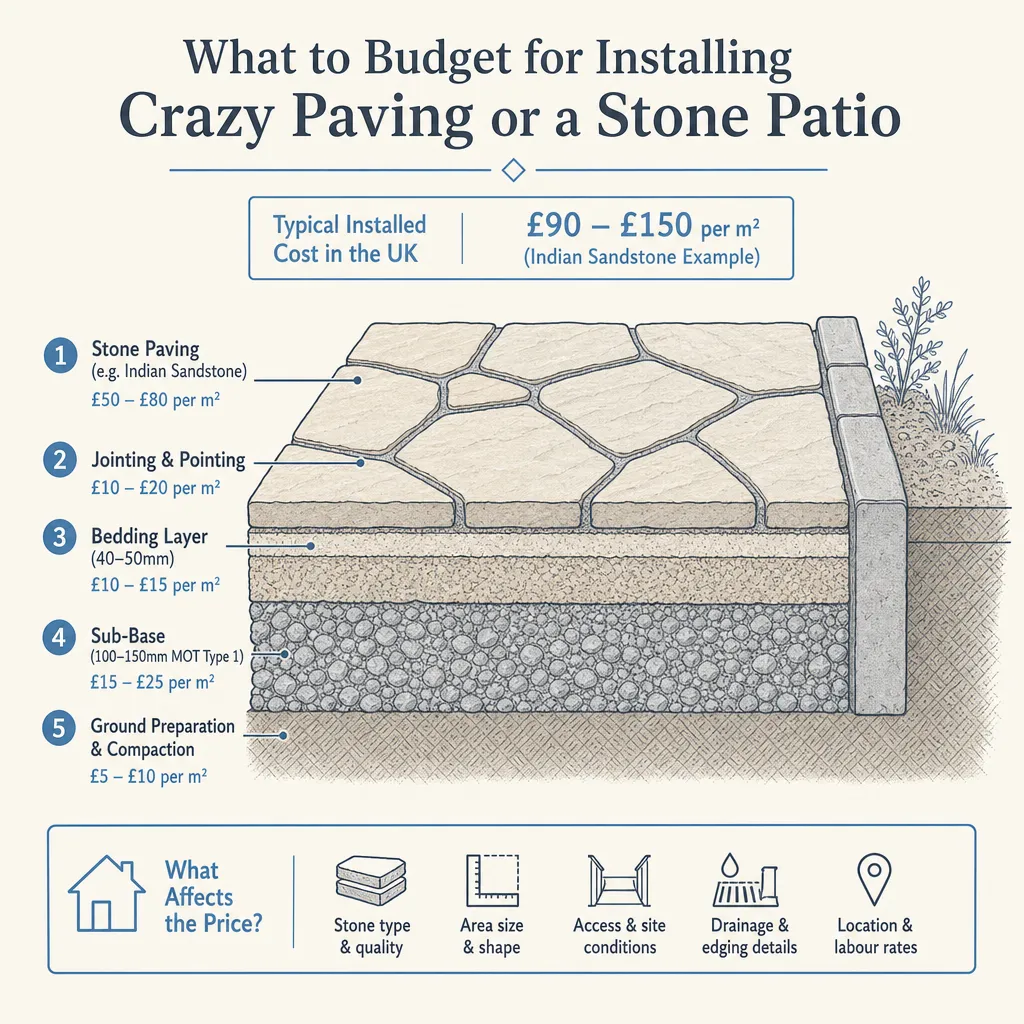
What to Budget for Installing Crazy Paving or a Stone Patio
Patio and paving projects are among the most popular garden improvements in the UK, arising most often when homeowners want to create an outdoor dining area, replace a tired concrete slab, or add a winding informal path through a cottage garden. Material and labour costs can vary by a factor of three or more depending on the stone chosen, the depth of excavation required, site access, and the complexity of the finish. Understanding the cost components before inviting contractors to quote helps you budget realistically, spot low-quality tenders, and compare like for like.
Key points
- Crazy paving uses irregular stone fragments — typically reclaimed or offcut natural stone — and is generally cheaper in materials than cut slabs but more labour-intensive to lay, often making the installed cost similar overall.
- Indicative fully installed costs for natural stone patios in the UK range from approximately £80 to £220+ per square metre, with Indian sandstone at the lower end and Yorkstone or granite at the upper end.
- A correctly specified sub-base — typically 100–150 mm of compacted MOT Type 1 hardcore followed by a sharp-sand-and-cement or adhesive-mortar bed — is essential and must be included in any reputable quote.
- Under Building Regulations Approved Document H and planning rules introduced in 2008, any hard-standing exceeding 5 m² that drains to a surface-water drain or soakaway may require permeable paving or a drainage diversion plan.
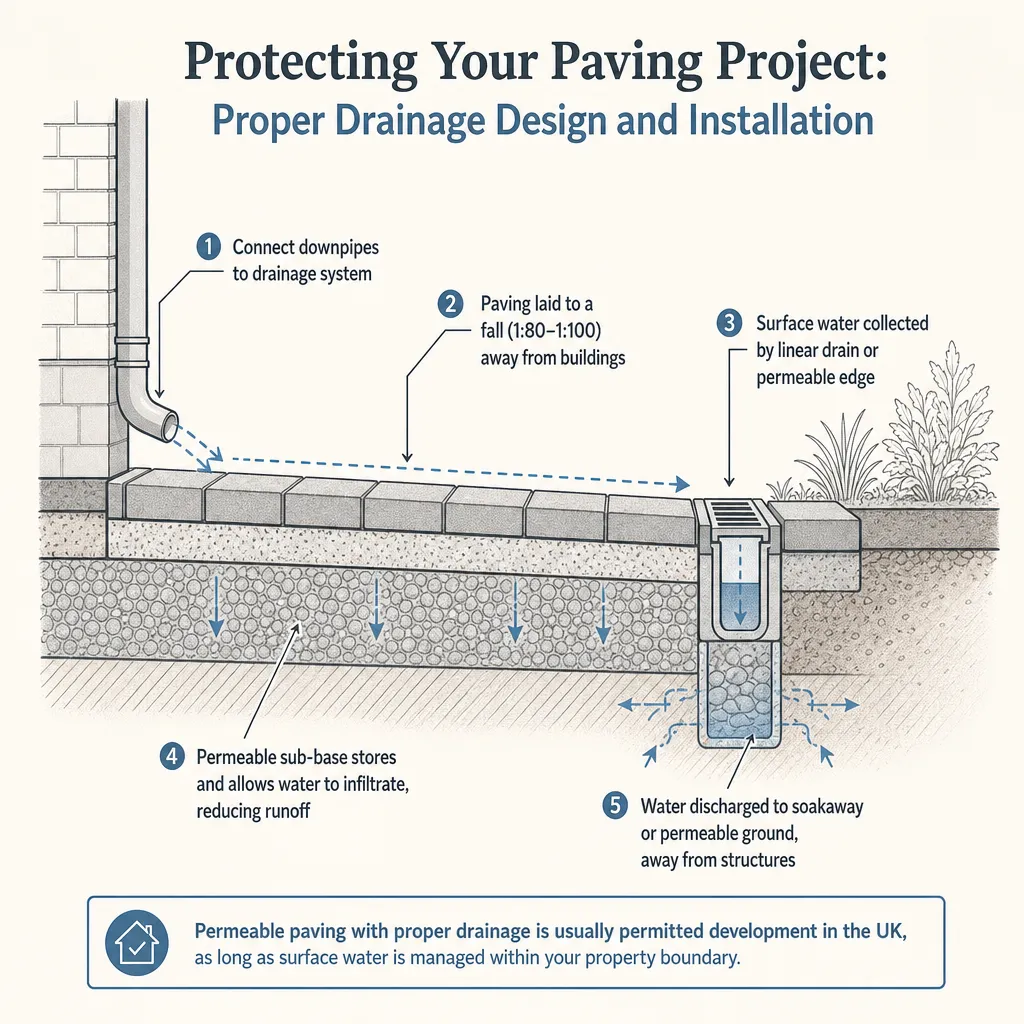
- Patios laid adjacent to a house must be installed to a minimum 1:60 fall away from the wall and below the damp-proof course (DPC) level to prevent rising damp entering the building.
How much does a stone patio or crazy paving cost in the UK?
Indicative UK costs, last reviewed 2026-05-06. The ranges below cover supply and installation by a contractor. Costs vary by region, site access, existing ground conditions, sub-base depth, and chosen stone. Always obtain at least three quotes before proceeding.
Paving type | Approx. material cost (per m²) | Approx. installed cost (per m²) | Notes |
|---|---|---|---|
Concrete paving slabs (budget) | £10–£25 | £40–£70 | Lowest cost; less premium appearance |
Indian sandstone | £20–£45 | £80–£130 | Most popular mid-range choice in UK; benefits from sealing |
Porcelain patio tiles | £35–£80 | £100–£175 | Very durable and low maintenance; requires adhesive mortar bed |
Natural limestone | £35–£70 | £110–£180 | Softer and more porous than sandstone; sealing essential |
Slate paving | £30–£60 | £100–£160 | Suits contemporary and coastal gardens |
Granite setts or slabs | £40–£90 | £120–£200+ | Extremely durable; often used for both patios and driveways |
Crazy paving (reclaimed or random natural stone) | £15–£40 | £80–£140 | Labour-intensive irregular jointing increases time on site |
Yorkstone or reclaimed British sandstone | £50–£120+ | £130–£220+ | Premium British stone; reclaimed material commands a significant premium |
For a typical 20 m² patio in Indian sandstone, an indicative installed cost including sub-base, bedding, jointing, edging, and spoil disposal is £1,600–£2,600. The same area in Yorkstone or granite setts could reach £4,000–£5,000+.
Source: indicative ranges informed by BCIS (Building Cost Information Service) guidance and published trade data. Verify all figures with independent contractor quotes.
What drives the cost up or down?
Knowing the main cost drivers lets you assess whether a quote reflects genuine conditions or whether scope is being omitted to win the work.
Factors that increase cost:
- Irregular shapes, curved edges, or many cuts required in the stone.
- Deep excavation — heavy clay soils, large tree roots, or an existing concrete slab to break out and remove.
- Steps, raised areas, retaining edges, or level changes.
- Premium or imported stone (Yorkstone, limestone, granite).
- Limited vehicle or machinery access to the site.
- Disposal of large volumes of excavated material or existing paving.
Factors that reduce cost:
- A simple rectangular area with no steps or curves.
- An existing solid sub-base that can be re-used or requires only minor top-up.
- Good site access for a mini-digger and bulk material deliveries.
- Budget materials such as concrete slabs or entry-level Indian sandstone.
Is crazy paving cheaper than cut stone?
Crazy paving typically uses irregular fragments of natural stone, slate, or reclaimed material. Material costs are often 20–40% lower per square metre than calibrated (uniform-thickness) cut slabs of equivalent stone type. However, laying time is significantly higher — each piece must be individually selected, fitted, and pointed around irregular joints — which typically adds 20–30% to the labour element per square metre.
The net effect is that a crazy-paved patio often ends up costing a similar amount to an Indian sandstone slab patio of the same area, with the saving in materials largely absorbed by extra labour. Crazy paving suits informal cottage or country gardens, winding paths, and areas where a naturalistic aesthetic is preferred. It is generally less suited to formal dining terraces where table and chair legs need a flat, stable surface.
What a proper patio installation should include
A responsibly installed patio involves more than placing stones on prepared ground. Use this checklist to verify that any quote covers the full scope.
Homeowner checklist: what a complete patio installation should cover
If a quote does not specify the sub-base depth or drainage fall, ask before accepting — these are the most common omissions that lead to premature sinking, cracking, or water pooling.
What to ask before accepting a patio quote
Use these questions when comparing quotes from landscapers for patio and paving work or other contractors.
- What depth of excavation and sub-base thickness is included, and what material will be used?
- What bedding system will be used — sharp-sand-and-cement, hydraulic lime, or adhesive mortar?
- What fall is specified, and where will the surface water drain to?
- Is spoil and waste disposal included in the price?
- Who supplies the stone — contractor or homeowner — and can you see a physical sample before it is ordered?
- Is the price for supply-and-fix or labour only?
- What is the payment schedule, and what deposit is required?
- Is there a workmanship guarantee, and for how long does it apply?
- Is VAT included in the quoted price?
- What assumptions is the quote based on, and what could change the final cost?
Drainage rules to be aware of
Any new hard-standing of more than 5 m² in front of a dwelling in England that drains to the highway drainage system requires permeable paving or a drainage management solution under planning rules introduced in 2008. This is less commonly a concern for rear garden patios, but drainage from any patio that connects to a public sewer or soakaway should comply with Building Regulations Approved Document H.
More practically for most homeowners: ensure the patio is graded to drain away from the house at a minimum 1:60 fall, and that the finished surface level sits at least 150 mm below the damp-proof course. If water is directed towards planted beds or a lawn, this is usually acceptable; if it drains to a gully connected to the sewer, verify this is correctly set up to avoid surcharging.
When to get professional help
Most domestic patio installations are standard work carried out competently by experienced landscapers for patio and paving work or driveway installers. Seek additional professional input when:
- The patio is adjacent to a retaining wall or sits near a significant change in level — structural advice may be needed.
- You are working near protected trees (a Tree Preservation Order or conservation area may restrict root-zone excavation).
- Excavation will pass close to existing drainage runs, foundations, or buried services — contact your utility providers before digging.
- The area is on a slope steeper than approximately 1:10 or near a drop — retaining edges or structural advice may be needed.
- The property is a listed building — listed building consent may be required even for external garden works.
For projects involving substantial groundworks, drainage connections, or level changes, groundworkers for excavation and drainage can advise on the sub-structure before a landscaper lays the finished surface.
How Housey can help
Housey makes it straightforward to request quotes from vetted landscapers for patio and paving work and driveway installers across the UK. For projects that involve significant excavation, drainage connections, or retaining structures, you can also request quotes from experienced groundworkers for excavation and drainage to ensure the sub-structure is sound before the finishing layer goes down.
Frequently asked questions
Do I need planning permission to lay a stone patio in my garden?
Not usually. In most cases, laying a patio in a rear or side garden is permitted development for a dwelling house. However, if you are in a conservation area or the curtilage of a listed building, additional consent may be required. Front garden hard-standings exceeding 5 m² that do not use permeable paving may also require permission. Check the Planning Portal or your local authority if in any doubt.
How long does it take to lay a stone patio?
A typical 20–30 m² patio takes 3–5 days for a two-person team, assuming no significant groundwork complications such as existing concrete or heavy clay. Larger areas, steps, curved edges, or difficult access extend the programme. Allow additional time if drainage connections need altering or if the existing ground level requires substantial excavation.
What is the difference between Indian sandstone and Yorkstone?
Indian sandstone is quarried mainly in Rajasthan and is the most widely used natural stone for UK patios. It is available in a broad colour range, relatively affordable, and durable when sealed. Yorkstone is a British millstone grit quarried mainly in Yorkshire, prized for its durability and characteristic grey-buff tones. Reclaimed Yorkstone is highly valued but significantly more expensive — often £130–£220 per m² installed.
Does a stone patio add value to my home?
A well-laid natural stone patio generally improves a property's usability and kerb appeal. Estate agents tend to describe good outdoor entertaining space positively, particularly for family homes. However, the increase in market value rarely equals the installation cost directly; the return depends on the local market, garden size, and the quality of the finish relative to comparable properties in the area.
How do I maintain a natural stone patio?
Most natural stone patios benefit from an annual clean using a pressure washer on a low setting or a specialist stone cleaner, and re-sealing every two to four years for porous stones such as sandstone and limestone. Re-pointing of mortar joints may be needed every five to ten years. Porcelain tiles require very little maintenance and are highly resistant to staining and frost damage.
Sources and further reading
Useful next reads
 Improvement & Build
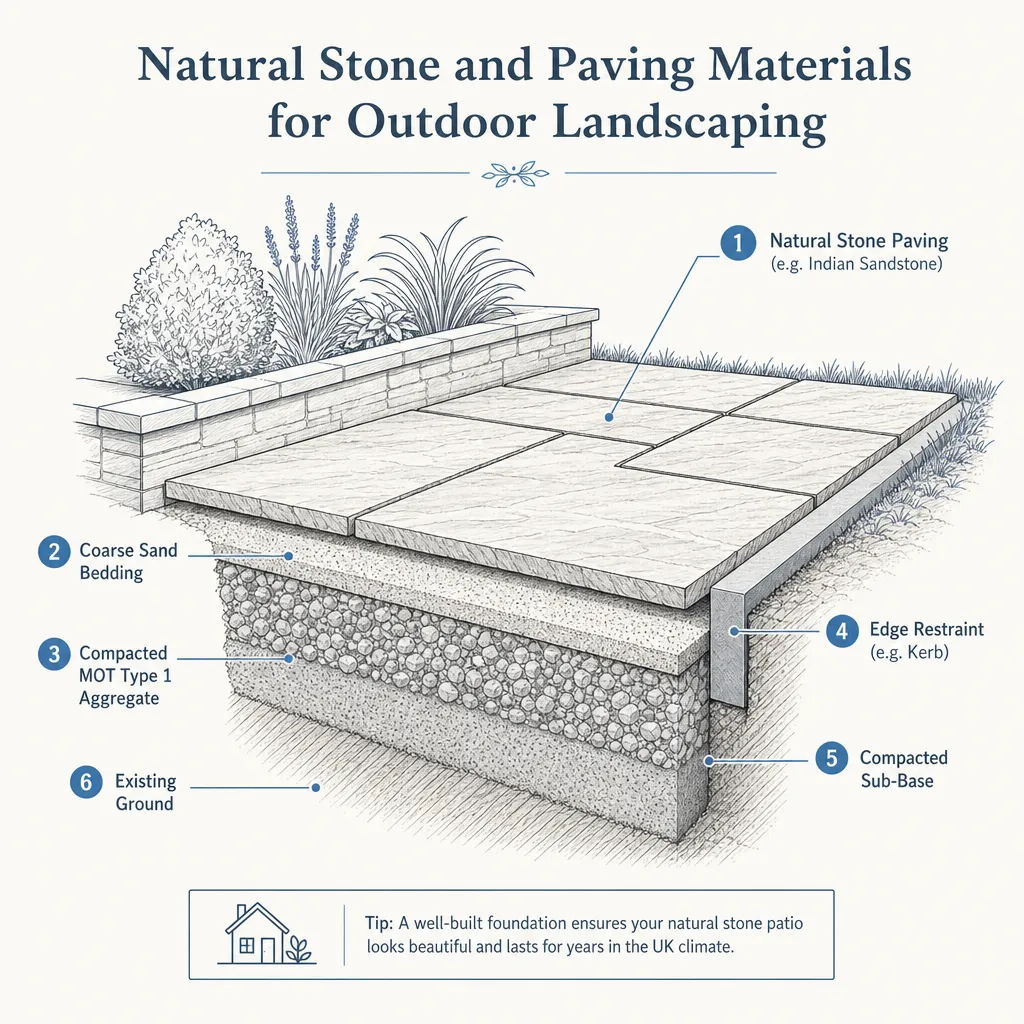
Natural Stone and Paving Materials for Outdoor Landscaping
Natural stone paving choices for UK gardens include Indian sandstone, limestone, granite, slate, basalt, and reclaimed York stone.
 Improvement & Build
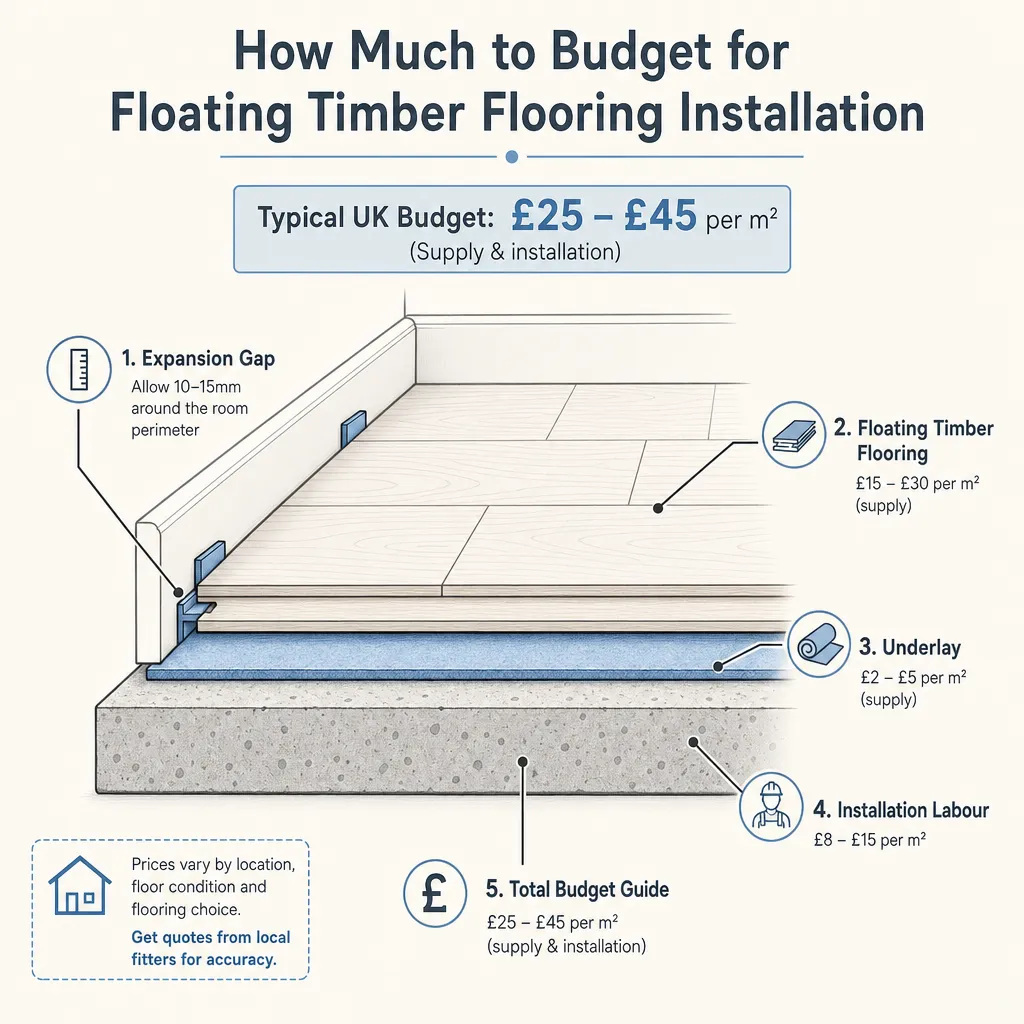
How Much to Budget for Floating Timber Flooring Installation
Floating timber flooring installation in the UK typically costs £8–£20 per m² for labour alone, with materials adding £8–£80+ per m² depending on whether you choose laminate, engineered oak, or solid wood.
 Improvement & Build
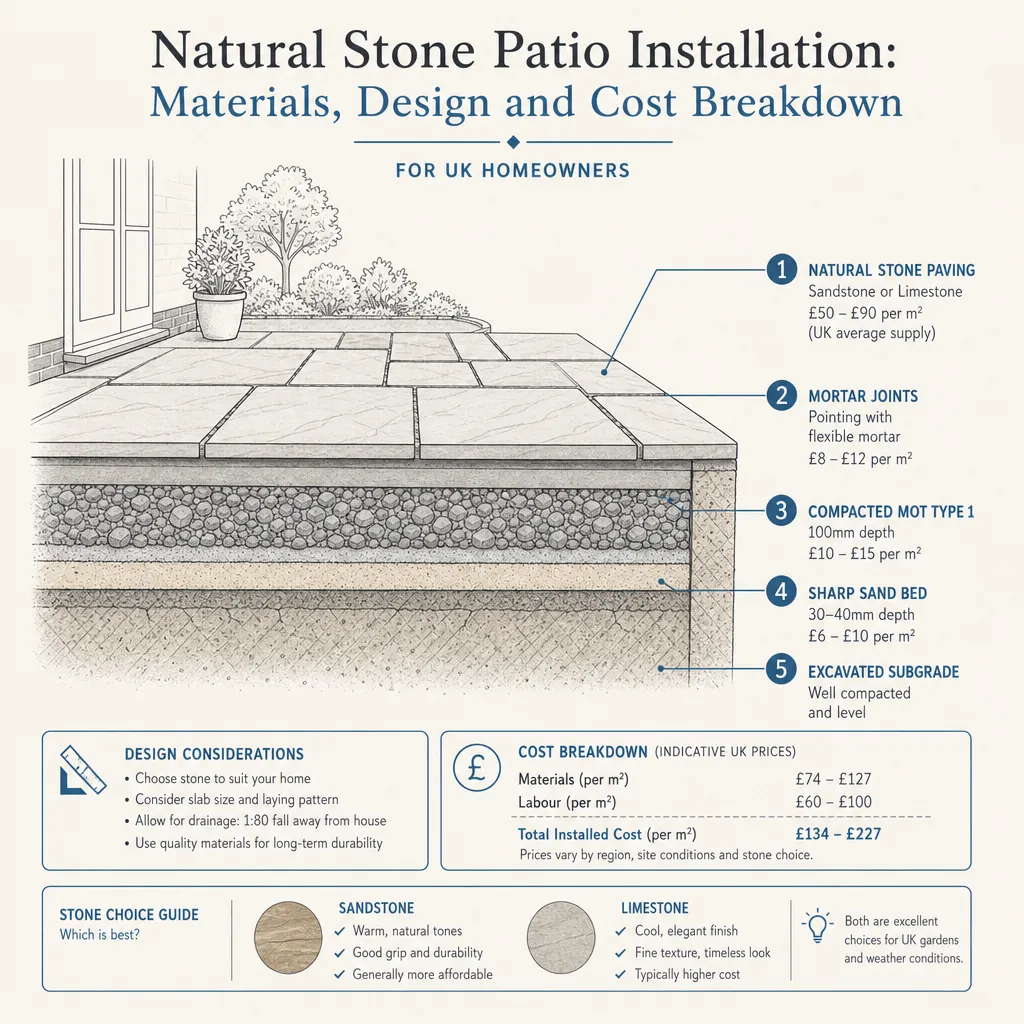
Natural Stone Patio Installation: Materials, Design and Cost Breakdown
A natural stone patio typically costs £100–£200 per square metre installed in the UK, depending on stone type, subbase preparation, and site access.
 Improvement & Build
Designing an outdoor kitchen for entertaining and garden living
An outdoor kitchen in a UK garden needs a stable, level base — typically a concrete slab or quality paving — with weather-rated materials such as stainless steel grade 316 or frost-rated porcelain.
 Improvement & Build
Protecting Your Paving Project: Proper Drainage Design and Installation
Good paving drainage starts with a minimum fall of 1:60 to 1:80 away from buildings, a correctly specified sub-base, and a clear outlet for surface water.