How Much to Budget for Floating Timber Flooring Installation
By Housey · Last reviewed 6th of May 2026
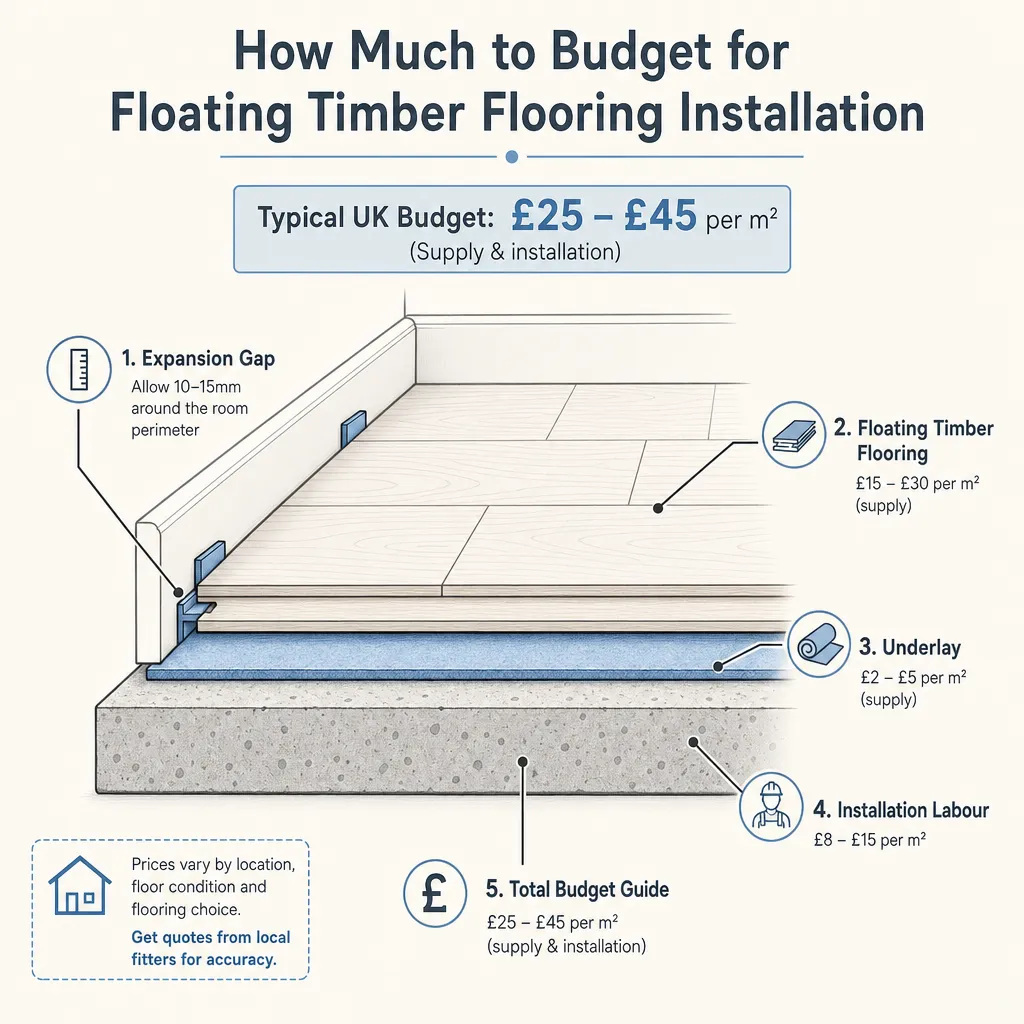
How Much to Budget for Floating Timber Flooring Installation
Floating timber flooring comes up as a cost question at several points in the homeowner journey — before a renovation begins, when a builder mentions it as a project stage, or when replacing tired carpet finally moves from wish-list to active plan. Choosing between laminate, engineered timber, and solid wood affects not just material cost but longevity, compatibility with underfloor heating, and whether the floor can be refinished years later. Getting an accurate cost picture before approaching fitters means understanding subfloor condition, room complexity, and how the three main product types differ in price and suitability.
Key points
- Labour for floating timber flooring in the UK typically costs £8–£20 per m², with higher rates in London and the South East (Indicative UK costs, last reviewed 2026-05-06).
- Laminate flooring material costs from approximately £8–£25 per m²; engineered timber from £20–£80+ per m² depending on wood species and wear layer thickness.
- BS 8201, the code of practice for installation of flooring, recommends expansion gaps of at least 10–15mm around the full perimeter of a floating floor, concealed with beading or skirting.
- Subfloor levelling to the commonly cited 3mm-over-1.8m tolerance adds £5–£20 per m² where significant preparation is needed.
- Underlay and a damp-proof membrane (DPM) are typically required even on concrete subfloors, adding £3–£8 per m² to the overall cost.
What does floating timber flooring installation cost?
The total project cost has three main components: flooring material, installation labour, and subfloor preparation. Pricing these separately in quotes makes it much easier to compare fitters and suppliers accurately.
Indicative UK cost breakdown per m² (last reviewed 2026-05-06)
Cost component | Laminate | Engineered timber | Solid wood (floating) |
|---|---|---|---|
Material per m² | £8–£25 | £20–£80+ | £40–£120+ |
Underlay and DPM per m² | £3–£6 | £3–£8 | £3–£8 |
Fitting labour per m² | £8–£14 | £10–£18 | £12–£20 |
Subfloor preparation (if needed) | £5–£15 | £5–£20 | £5–£20 |
Typical all-in range per m² | £24–£60 | £38–£126 | £60–£168 |
Indicative UK costs, last reviewed 2026-05-06. Excludes skirting removal, disposal of old flooring, and furniture moving. Quotes vary by region and room complexity.
Worked example: 1930s semi-detached living room (22m²)
A homeowner fitting mid-range engineered oak floating flooring in a 22m² living room:
- Engineered oak at £35 per m²: £770 in materials
- Underlay and DPM: approximately £130
- Labour at £13 per m²: approximately £285
- Subfloor levelling (minor cracks in existing concrete slab): approximately £150
- Skirting removal and beading: approximately £120
- Estimated project total: approximately £1,455
Using laminate at £15 per m² instead reduces materials to roughly £330, bringing the total closer to £900–£1,000. A premium wide-plank engineered oak at £65 per m² would push materials alone to around £1,430.
Laminate, engineered, or solid wood: which is right?
All three can be installed as floating floors but differ considerably in cost, durability, and suitability for UK homes.
Comparison table
Factor | Laminate | Engineered timber | Solid wood (floating) |
|---|---|---|---|
Core material | HDF board with printed layer | Real wood veneer on plywood or HDF core | Solid timber throughout |
Material cost | Lowest | Mid to high | High |
Durability | AC3–AC5 rated; susceptible to moisture at edges | High; dimensionally stable | Very high; can be sanded multiple times |
Underfloor heating suitability | Many ranges compatible up to 27°C — check spec | Most ranges compatible — confirm data sheet | Generally not recommended for floating |
Typical lifespan | 10–25 years | 25–50 years | 50–100+ years |
Suitability for kitchens and bathrooms | Generally no; use waterproof-rated variants | Some ranges suitable — check warranty | Not recommended |
Best for | Budget refurbishments, rentals, bedrooms | Main living spaces, family homes | Period restorations, premium schemes |
Decision guide
- Choose laminate if budget is the priority, the room has moderate traffic, or it is a rental property where cost efficiency matters more than longevity.
- Choose engineered timber if you want real wood appearance, plan to stay long-term, or need underfloor heating compatibility — always confirm with the manufacturer's technical data sheet.
- Choose solid wood (floating) with caution: many solid wood manufacturers now recommend glue-down rather than floating installation, and floating solid wood is more prone to gapping in centrally heated UK homes. Confirm the product is rated for floating use before purchasing.
- Ask a specialist fitter if the room has underfloor heating, is above a basement with uncertain moisture levels, or the subfloor shows any visible damp or soft areas.
What affects the price beyond materials?
Subfloor condition is the biggest variable. A flat, well-levelled concrete screed needs minimal work; a suspended timber floor with squeaks, soft spots, or localised damage may need board replacement first. Ask the fitter to inspect the subfloor before finalising a price.
Room complexity adds labour time. Alcoves, bay windows, hearths, radiator pipes, and doorframes requiring undercutting all slow installation. Rooms with complex shapes can add 20–30% to fitting time compared with a simple rectangle of the same area.
Skirting and beading are often overlooked in early budgets. Options include new timber beading at approximately £1–£3 per linear metre, removing and refitting existing skirting at £4–£10 per linear metre for labour, or replacing skirting entirely at £8–£20+ per linear metre including MDF and fitting.
Staircase nosings where the floor meets a stair head typically cost £20–£60 per step for a matching timber nosing, plus fitting.
Furniture moving and disposal are sometimes charged as extras — confirm in writing what is included before work starts.
Subfloor preparation: what is involved?
For concrete screeds, the surface must be level to within 3mm over 1.8m. Low spots are filled with self-levelling compound; high spots are ground down. A bag of compound covers roughly 5m² at 3mm depth and costs approximately £20–£35. Professional application typically adds £5–£15 per m² depending on the extent of the work.
For suspended timber subfloors, individual boards may need securing with screws or adhesive to eliminate movement — essential before laying any floating floor. Badly deteriorated sections need replacing. Check for evidence of damp beneath the floor; a moisture reading above approximately 75% relative humidity at the surface may require a DPM even under a floating system.
Homeowner checklist before getting quotes
What to ask before accepting a quote
- Have you inspected the subfloor, and is subfloor preparation included in the price?
- Is underlay and a DPM included, or priced separately?
- Does the quote include skirting removal and beading or skirting refitting?
- Is disposal of the old flooring covered?
- What brand and specification of underlay will you use?
- What expansion gap will you leave, and how will it be concealed?
- Are you a member of the National Institute of Carpet and Floorlay (NICF)?
- Is VAT included?
When to get professional help
For a straightforward room, a competent sole-trader fitter with good references and a clear written quote is usually sufficient. Seek additional advice or a specialist if:
- The subfloor shows visible damp, staining, or soft areas — arrange a damp assessment before any flooring goes down
- You are fitting over underfloor heating — use a fitter with specific UFH experience and verify the product spec
- You are in a listed building or conservation area where original floor coverings may have heritage significance — check with the local authority conservation officer
- The flooring is part of a larger extension or renovation — coordinate with the builder so flooring is laid after plastering and decorating, not before
- You need to match an existing floor in adjacent rooms — colour and texture matching engineered timber requires a specialist supplier
How Housey can help
If your flooring project is part of a larger home improvement — such as a rear extension, whole-house renovation, or reconfiguration — Housey can help you find and compare qualified local builders. Find extension builders near you through Housey to get quotes from vetted providers, ensuring flooring is properly sequenced within the wider build programme.
Frequently asked questions
Is floating timber flooring compatible with underfloor heating?
Many engineered timber and laminate ranges are certified for use over underfloor heating, but you must confirm with the specific product's technical data sheet. Surface temperatures should generally not exceed 27°C and subfloor moisture content must be within the manufacturer's tolerance. Solid wood is generally not recommended for floating installation over underfloor heating due to the risk of movement and gapping.
Can I install floating timber flooring myself?
Floating floor installation is accessible to competent DIY homeowners, particularly for straightforward laminate in a rectangular room. Subfloor levelling, undercutting doorframes, and managing expansion gaps require care. Mistakes such as inadequate expansion gaps or poor subfloor preparation can cause boards to buckle over time. For engineered timber in complex rooms or over underfloor heating, professional fitting is advisable.
How long does engineered timber floating flooring last?
A quality engineered timber floor with a 3–6mm wear layer can typically last 25–50 years, and the wear layer can usually be lightly sanded one to three times to refresh it. Laminate cannot be sanded and has a typical lifespan of 10–25 years depending on the AC wear rating. Solid wood floating floors can last considerably longer but require careful indoor humidity management in centrally heated UK homes.
Does floating timber flooring add value to a property?
Replacing worn carpet or dated vinyl with quality engineered timber flooring can improve buyer perception and saleability, though specific value uplift figures are not reliably documented in published UK research. Estate agents often note that quality flooring contributes to positive first impressions. The actual impact depends on overall property condition, local buyer preferences, and the standard of installation.
What are AC ratings in laminate flooring?
AC (Abrasion Class) ratings from AC1 to AC5 describe laminate's resistance to wear. AC3 is generally suitable for moderate domestic use; AC4 is appropriate for busy domestic areas or light commercial settings. Most quality laminate sold in UK retailers is AC3 or AC4. Avoid AC1 or AC2 for floors that will receive regular everyday footfall from a family household.
Sources and further reading
- BS 8201: Code of practice for installation of flooring — BSI Group
- National Institute of Carpet and Floorlay: find a member — NICF
- Underfloor heating and flooring guidance — Underfloor Heating Manufacturers Association
- Consumer Rights Act 2015 — legislation.gov.uk
Useful next reads
 Improvement & Build
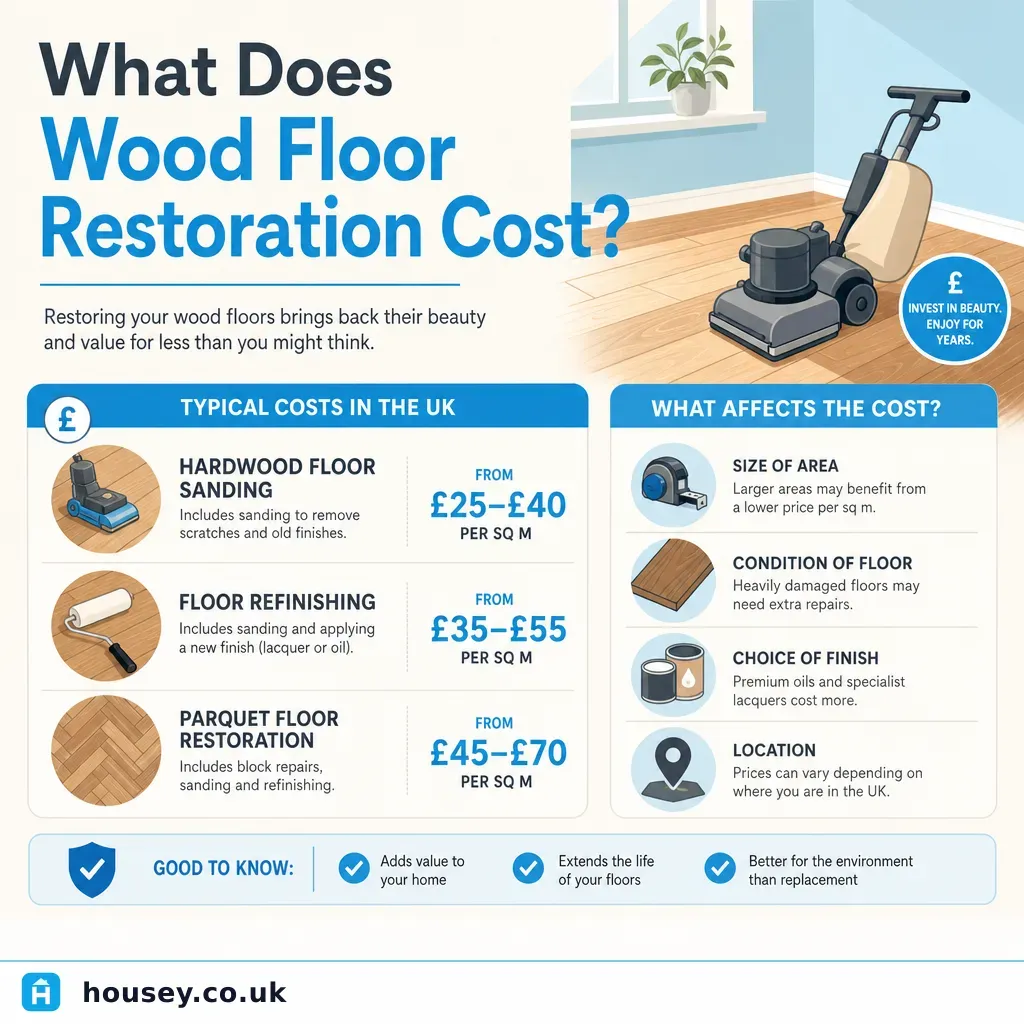
What Does Wood Floor Restoration Cost?
Wood floor restoration in the UK typically costs £15–£40 per square metre for sanding and finishing, depending on floor type, condition, and finish chosen.
 Improvement & Build
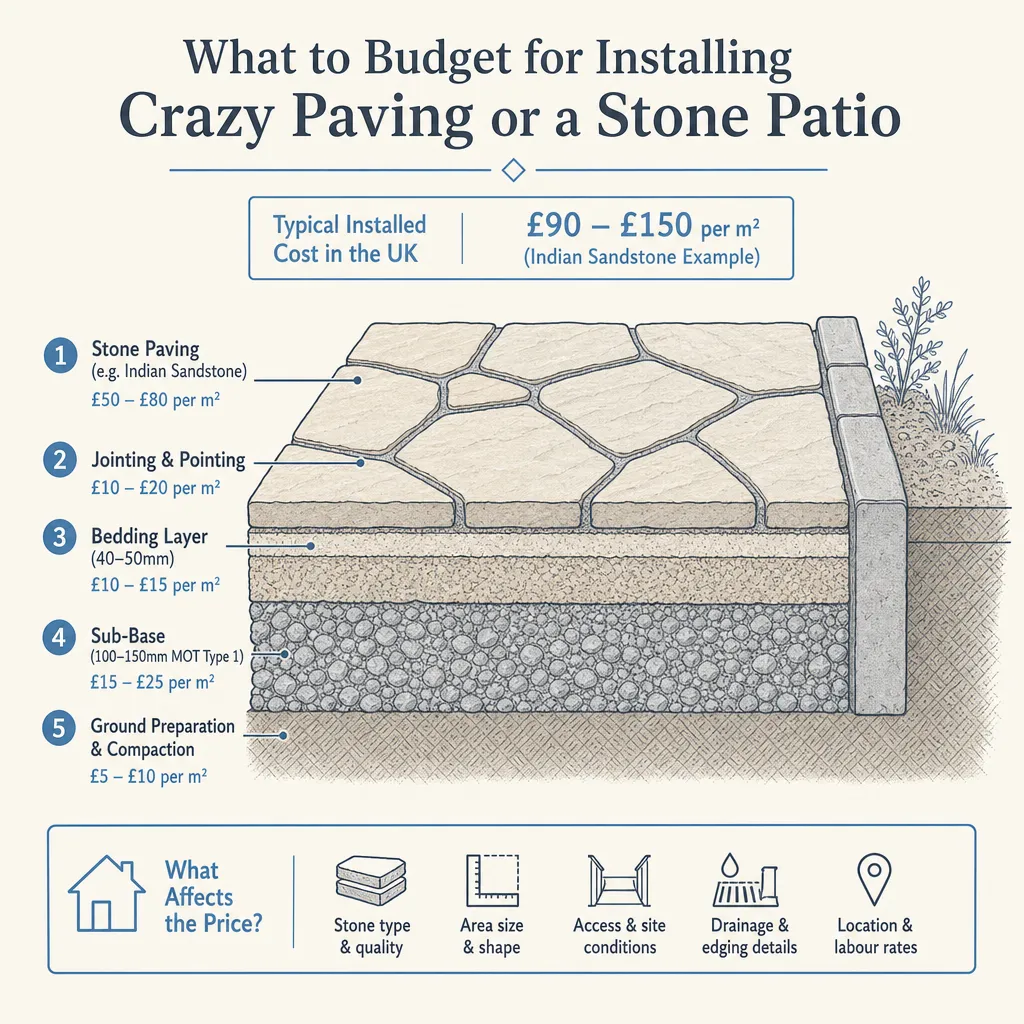
What to Budget for Installing Crazy Paving or a Stone Patio
Installing a stone patio in the UK typically costs £80–£200 per square metre fully installed, depending on stone type, sub-base depth, and site conditions.
 Improvement & Build
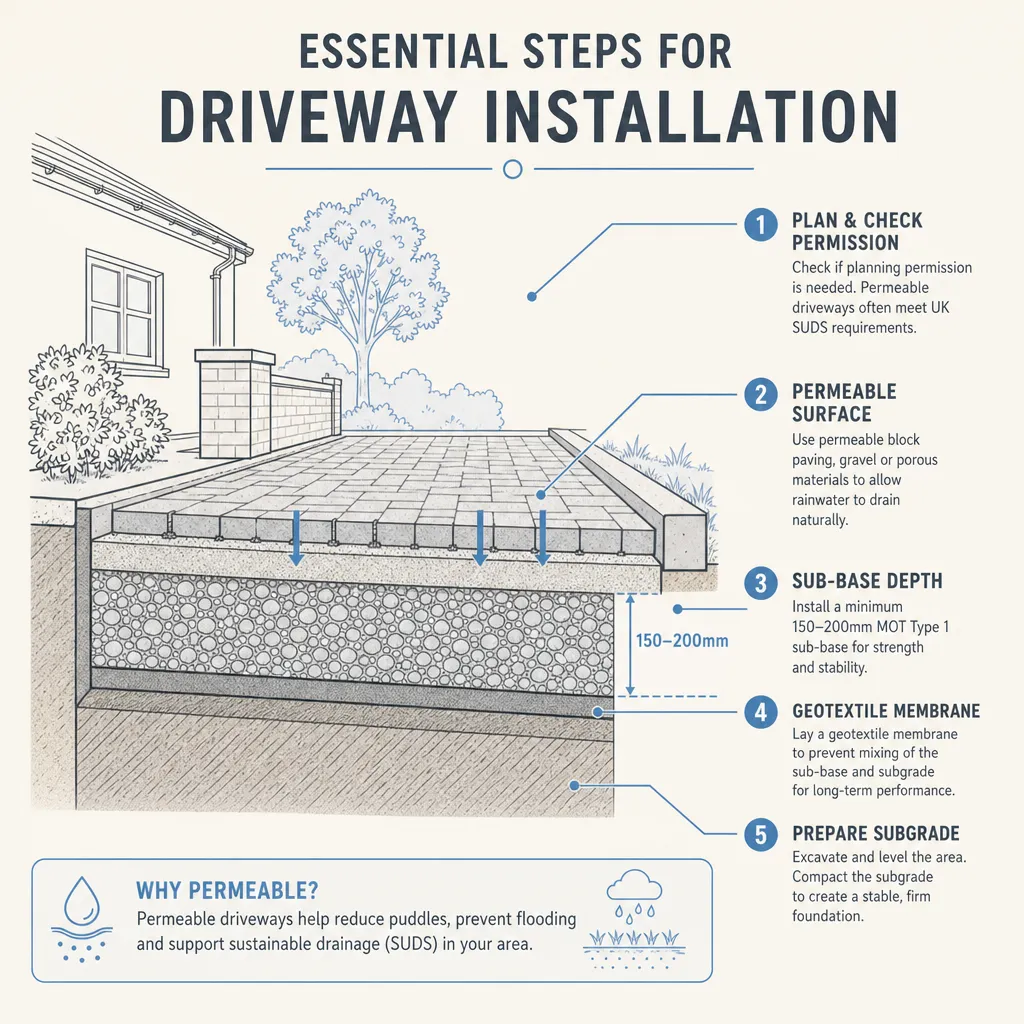
Essential Steps for Driveway Installation
Installing a driveway in England requires planning permission only when using an impermeable surface (standard tarmac, concrete, or block paving) on a front garden area over 5 m².
 Improvement & Build
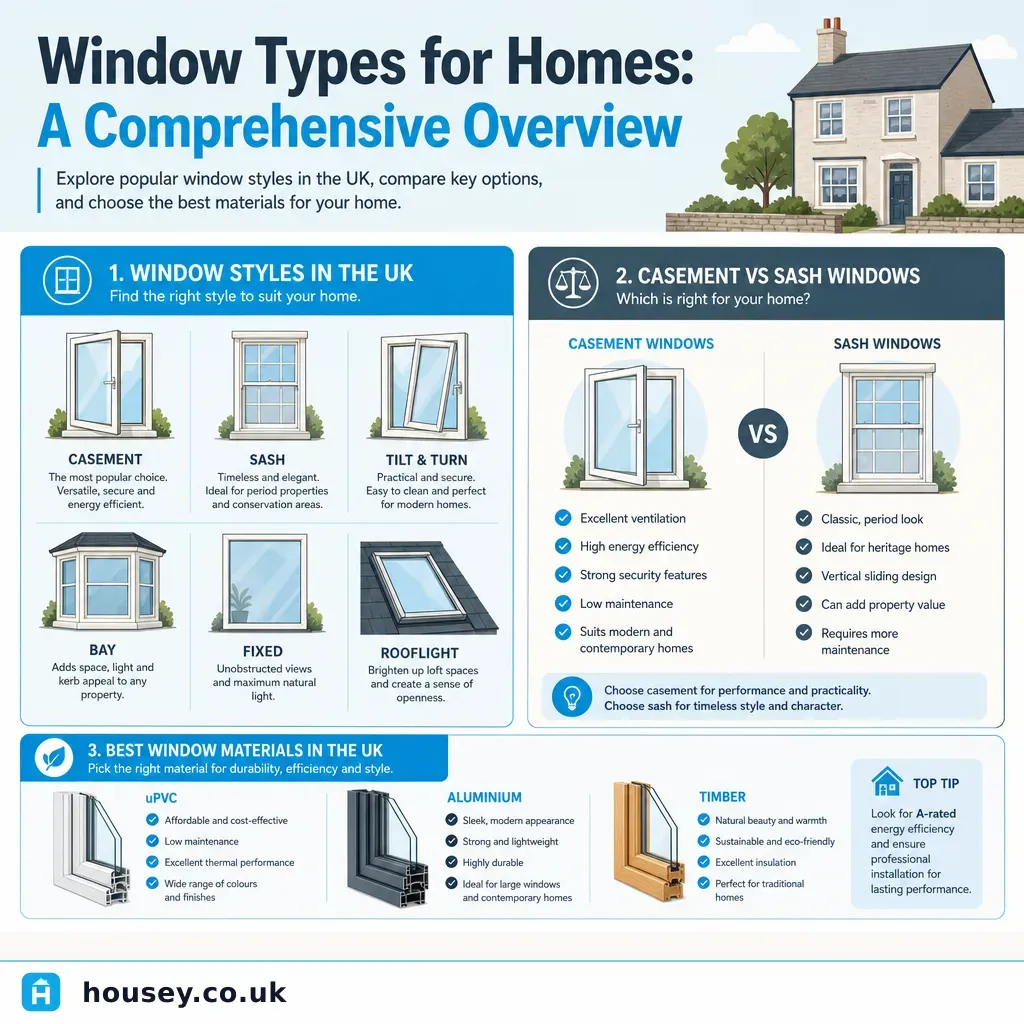
Window Types for Homes: A Comprehensive Overview
UK homes use several main window styles: casement (outward-swinging), sash (vertically sliding), tilt-and-turn, fixed light, and bay or bow.
 Improvement & Build
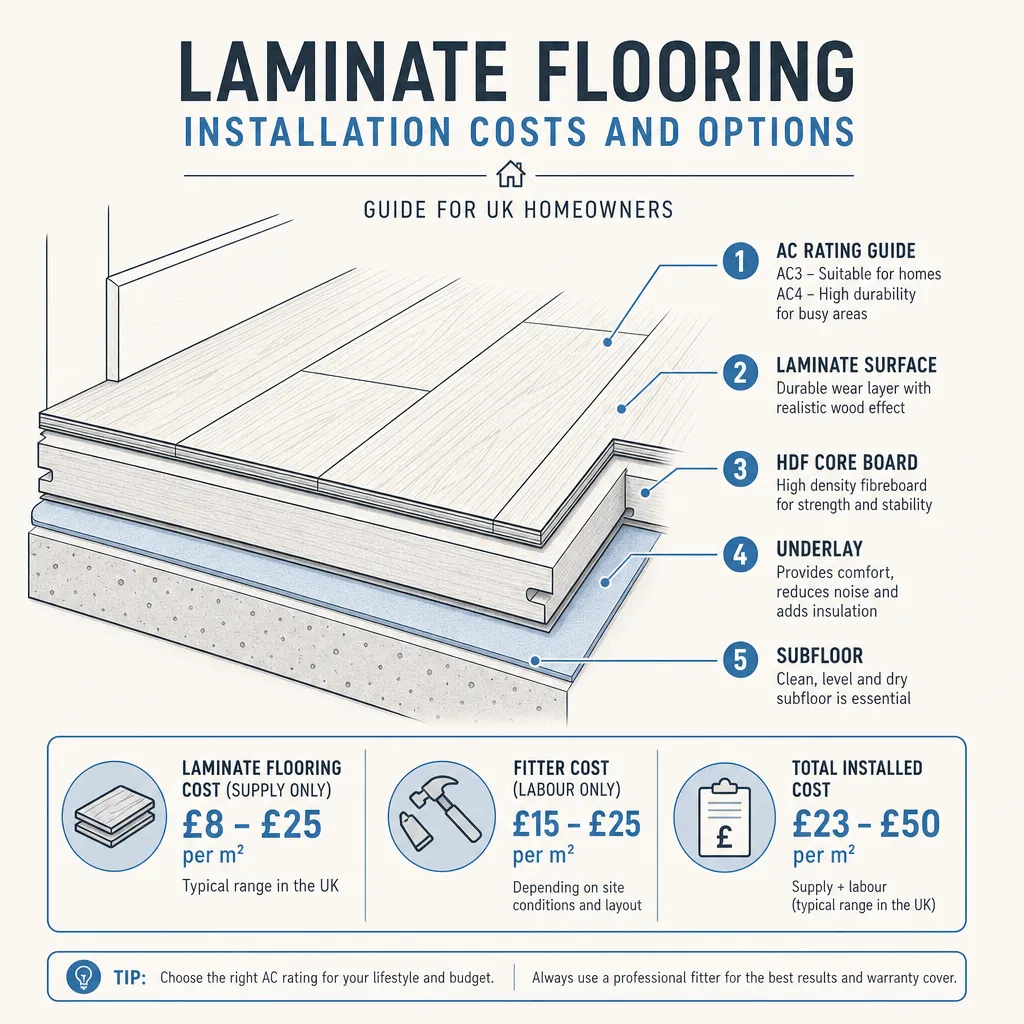
Laminate Flooring Installation Costs and Options
Laminate flooring typically costs £20–55 per square metre fully installed in the UK, including materials, underlay, and professional fitting.