Natural Stone Patio Installation: Materials, Design and Cost Breakdown
By Housey · Last reviewed 24th of May 2026
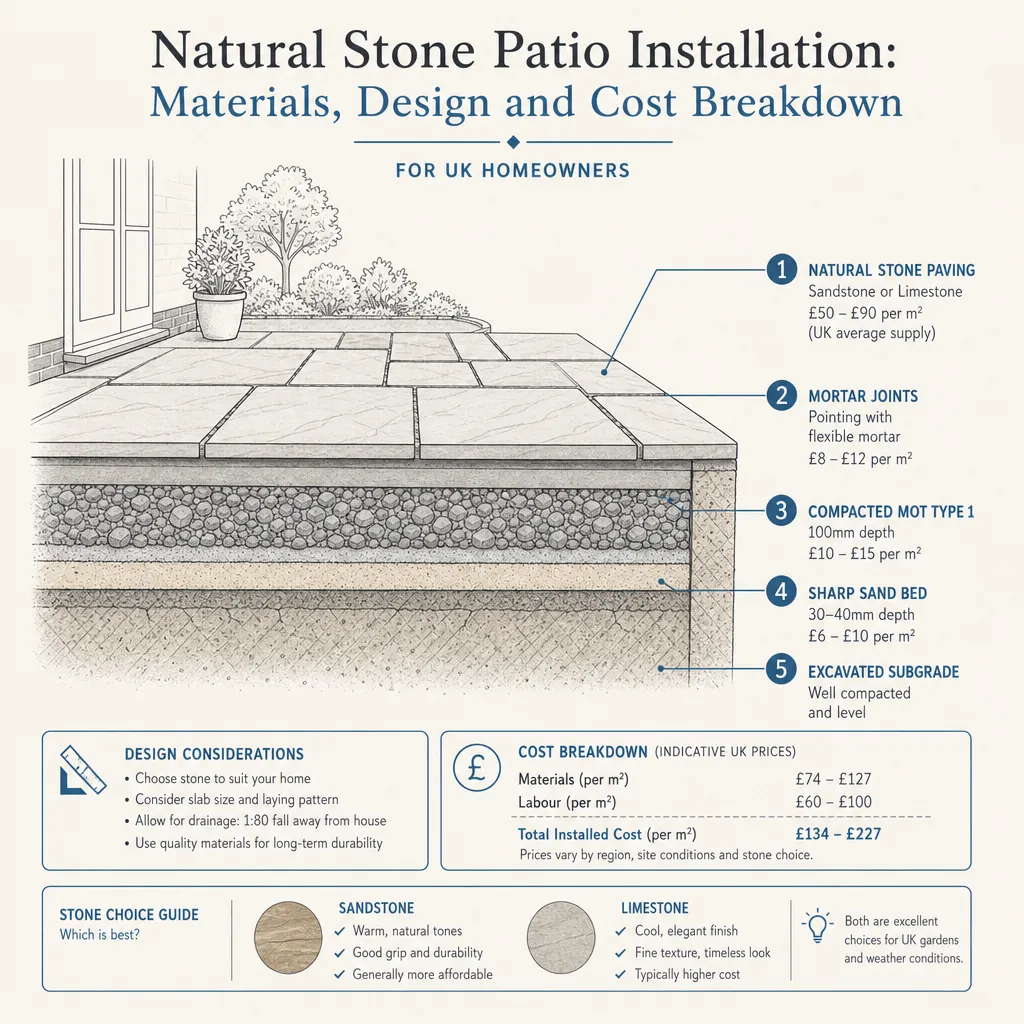
Natural Stone Patio Installation: Materials, Design and Cost Breakdown
Choosing a natural stone patio is one of the more consequential decisions in a garden improvement project — the finish will last decades if installed correctly and look increasingly tired if it is not. The question typically arises when homeowners are redesigning an outdoor space, replacing a cracked concrete or tired paving slab surface, or adding usable outdoor living area ahead of a sale. Getting the stone type, subbase, and drainage right from the outset is far cheaper than relaying a failed patio after one hard winter.
Key points
- Natural stone patio installation in the UK typically costs £100–£200 per square metre (supply and lay), with stone alone ranging from £30–£120 per m² depending on origin and finish. Indicative UK costs, last reviewed 2026-05-24.
- A minimum 100 mm compacted hardcore subbase plus a mortar or dry-mix bed is required for most natural stone installations to prevent movement, sinkage, and cracking.
- Paving within 5 metres of a highway must comply with Sustainable Drainage Systems (SuDS) requirements under Schedule 2 of the Town and Country Planning (General Permitted Development) (England) Order 2015 — permeable jointing or drainage channels may be required.
- Natural stone varies significantly in slip resistance: sandstone and riven slate typically outperform polished granite or limestone when wet, which matters in shaded or frequently damp UK gardens.
- Jointing compound choice (pointing mortar, resin, or polymeric sand) affects long-term weed control and water ingress — a common oversight that leads to premature failure.
Choosing the right natural stone for a UK garden
The UK's climate — frequent rain, frost, and temperature swings — places particular demands on paving. Not all natural stone performs equally outdoors.
Stone type | Best for | Less ideal for | Typical cost (supply only) | Key property |
|---|---|---|---|---|
Sandstone | Cottage gardens, period terraces, informal spaces | Shaded areas prone to algae | £30–£55/m² | Warm tones, riven texture, moderate slip resistance |
Limestone | Contemporary and traditional gardens alike | Very shaded or north-facing sites | £35–£65/m² | Smooth or riven finish; weathers attractively |
Granite | High-traffic areas, driveways, hard edges | Budget projects | £55–£120/m² | Extremely hard-wearing, very low porosity |
Slate | Modern gardens, water features nearby | Areas where frost heave is likely | £40–£75/m² | Rich colour, naturally riven, good grip |
York Stone (reclaimed) | Period properties, authentic character | Projects requiring consistent sizing | £60–£120/m² | Authentic, very hard-wearing; thickness varies |
Indicative UK material costs, last reviewed 2026-05-24. Prices vary by supplier, origin (Indian vs. European quarried), and size.
Indian sandstone and limestone are significantly cheaper than European-quarried equivalents. If sustainability or provenance matters to you, ask suppliers for their origin certification.
What a proper installation involves
A long-lasting patio requires more preparation below ground than most homeowners expect.
Subbase preparation
Strip topsoil to at least 150–200 mm depth (deeper on clay-heavy or soft ground). Compact a minimum 100 mm layer of Type 1 MOT (crushed limestone) hardcore using a plate compactor. Allow for drainage falls — a standard 1:80 gradient away from the house is widely used.
Mortar bed
Natural stone is typically laid on a semi-dry mortar mix or full mortar bed at 30–50 mm depth. Dry-fix systems exist but are more common for porcelain than natural stone.
Jointing
Joints should be filled once the stone has bedded, using a pointing mortar or resin jointing compound. Resin joints offer better weed resistance; traditional mortar suits period aesthetics but requires occasional repointing.
Drainage near the house
Where the patio adjoins the house, a fall away from the structure is essential to prevent damp ingress at the damp proof course (DPC). A gap of at least 150 mm between the patio surface and the DPC is standard practice.
Planning and permitted development rules for patios
For most residential patios at ground level to the rear of a property, no planning permission is required under permitted development rights in England. However, there are exceptions:
- If the property is a listed building, consent may be required for any alteration to the grounds.
- In a conservation area, front garden paving over 5 m² with non-permeable material requires planning permission.
- SuDS rules apply when paving exceeds 5 m² and drains towards the highway — permeable paving or a soakaway drainage plan may be required.
Always check with your local planning authority (LPA) before starting work if you are in any doubt.
How to compare quotes effectively
What to ask before accepting a quote
- Is the price for supply and lay, or supply only?
- What subbase depth and specification is included?
- What drainage fall will be achieved, and how is this measured?
- What jointing material is included, and will it be warranted?
- Who removes spoil, and is skip hire included in the price?
- What happens if poor ground conditions are found on excavation?
- Is VAT included?
- What guarantee (if any) is offered on workmanship?
Getting at least three quotes is advisable. Itemised quotes — separating stone, subbase, labour, waste disposal, and VAT — allow genuine comparison.
When to get professional help
Most homeowners hire a landscaper or groundworker for natural stone patio installation. Stone cutting requires an angle grinder or disc cutter and carries significant risk without training, and achieving consistent drainage falls requires site experience.
Red flags to watch for:
- A quote with no subbase specification or depth — a skimped subbase is the most common cause of early patio failure.
- No plan for spoil removal, or unlicensed skip hire.
- No consideration of drainage falls or DPC clearance near the house.
- Pressure to use cheap stone with no provenance or origin information.
How Housey can help
Housey connects you with vetted landscapers and groundworkers who can assess your site, recommend the right stone for your garden conditions, and provide itemised, comparable quotes for the full installation.
Frequently asked questions
How long does a natural stone patio take to install?
A typical 30–50 m² patio takes two to four days for a professional team, including excavation, subbase compaction, laying, and jointing. Larger or more complex projects with steps or edging may take a week or more. Allow additional time for the mortar to cure — usually 24–48 hours — before foot traffic.
Does natural stone need sealing?
Sealing is optional but often recommended for porous stones like sandstone and limestone. A penetrating sealer repels oil, wine, and moss while preserving the natural appearance. Granite and slate are less porous and may not need sealing. Re-seal every 3–5 years depending on use and exposure.
Will a natural stone patio add value to my property?
A well-installed natural stone patio generally adds to kerb appeal and usable outdoor living space, which estate agents consider a positive feature. However, overspending on premium stone for a garden disproportionate to the house may not achieve a proportionate return. RICS valuers assess the whole property, not individual features in isolation.
Can I lay natural stone myself?
Experienced DIYers can lay natural stone, but achieving the correct subbase depth, consistent drainage falls, and tight jointing is harder than it looks. Errors in the subbase often only become apparent after the first winter. Professional installation is advisable for anything over 10 m² or where the patio adjoins the house.
Sources and further reading
- Paving your front garden — GOV.UK
- Hard surfaces in your garden — Planning Portal
- Town and Country Planning (General Permitted Development) (England) Order 2015, Schedule 2 — legislation.gov.uk
- Sustainable drainage systems guidance — Energy Saving Trust
Useful next reads
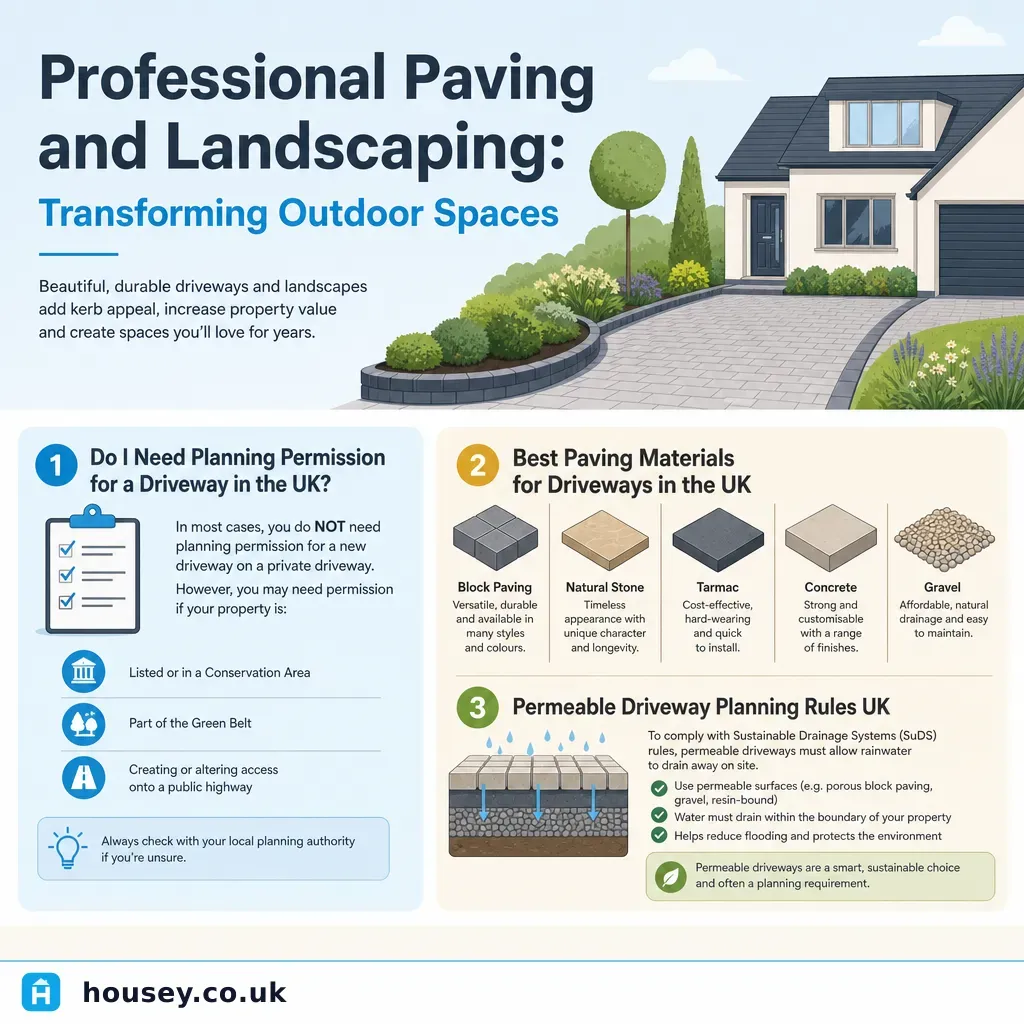 Improvement & Build
Professional Paving and Landscaping: Transforming Outdoor Spaces
Professional paving and landscaping can transform a garden or driveway, improving kerb appeal and adding usable outdoor space.
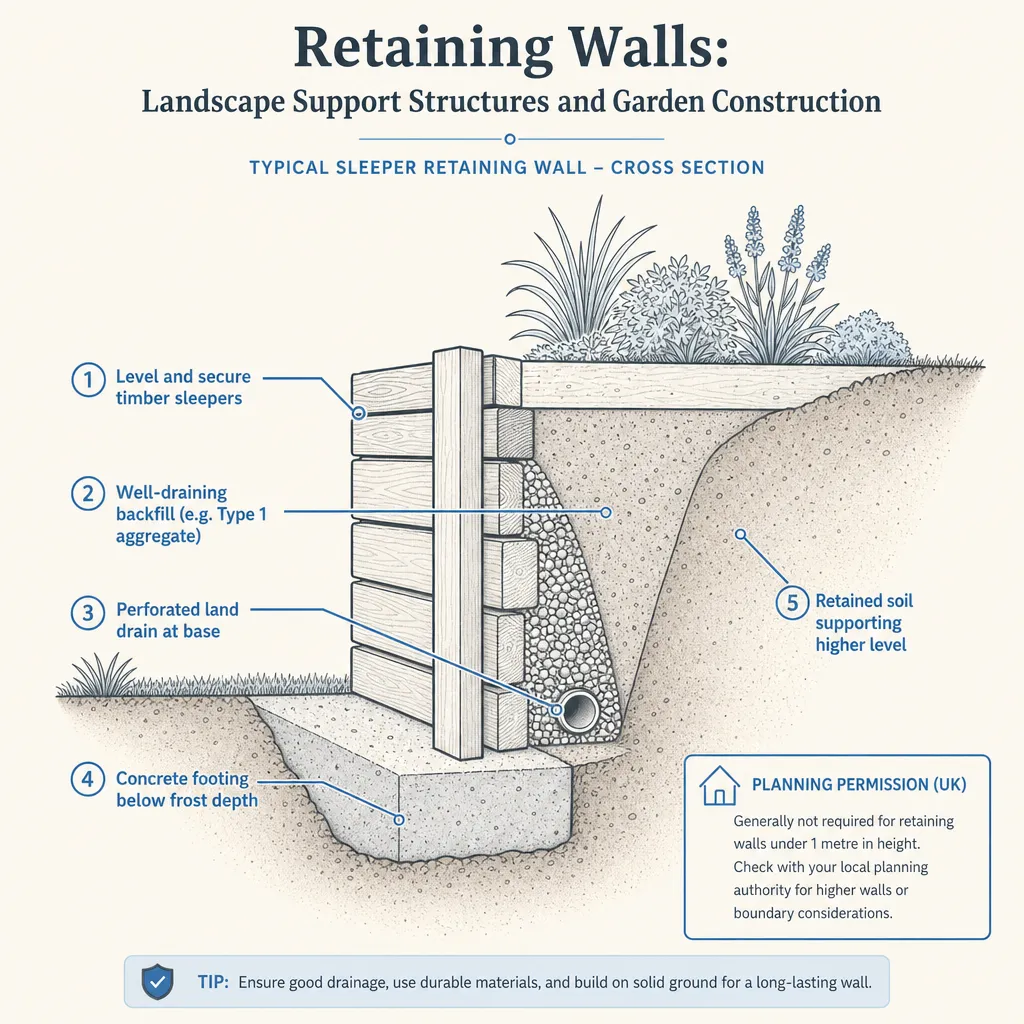 Improvement & Build
Retaining Walls: Landscape Support Structures and Garden Construction
A domestic retaining wall under 1 metre in height, away from buildings and boundaries, can usually be built by a landscaper or groundworker without structural calculations.
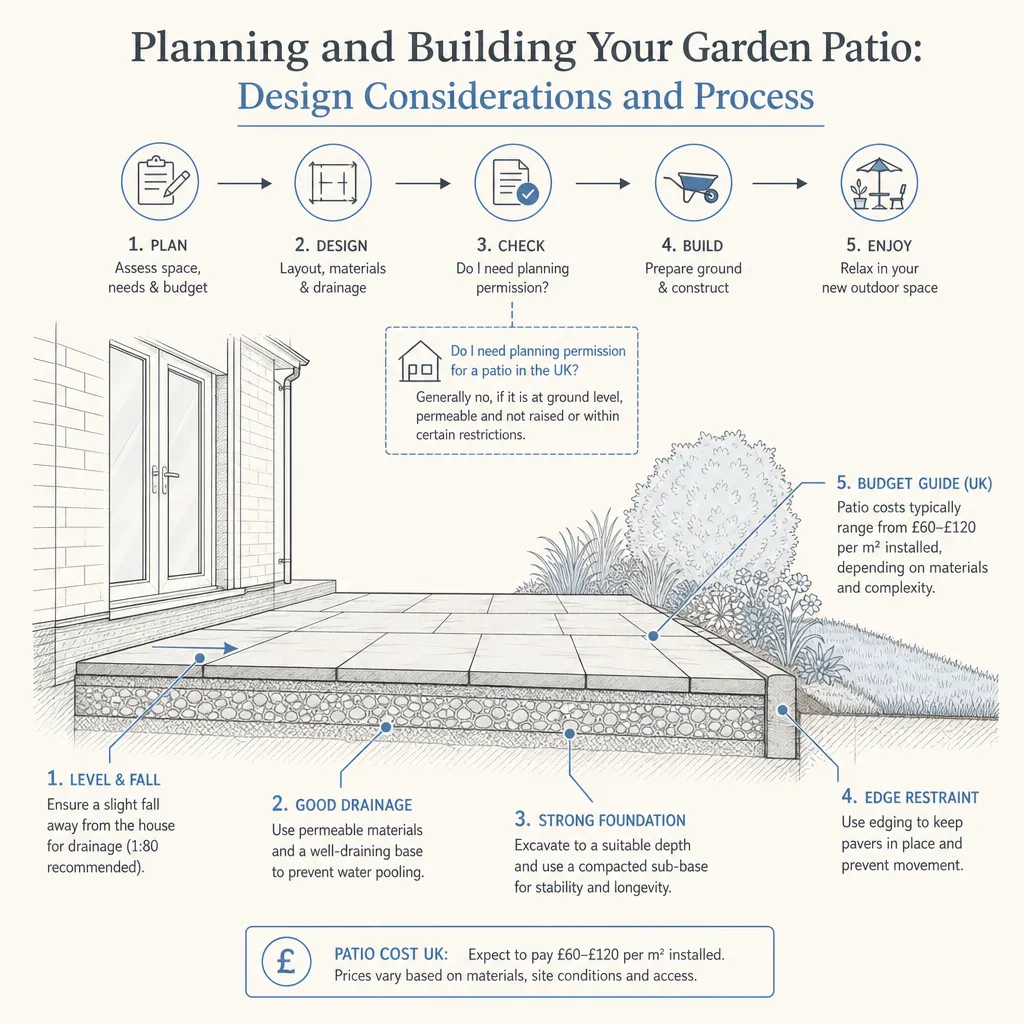 Improvement & Build
Planning and Building Your Garden Patio: Design Considerations and Process
Most rear garden patios in England and Wales don't need planning permission under Permitted Development rights.
 Improvement & Build
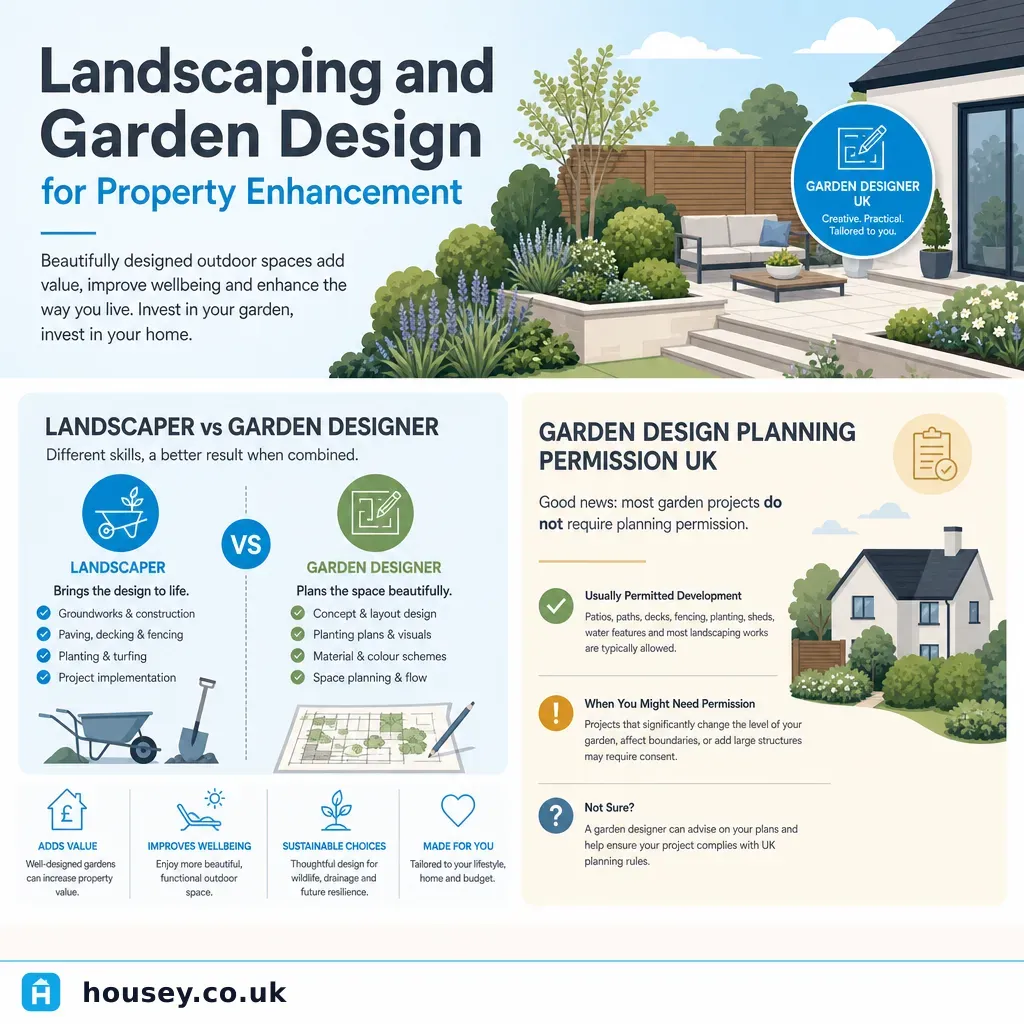
Landscaping and Garden Design for Property Enhancement
Landscaping and garden design involve planning and building outdoor spaces — from patios and raised beds to planting schemes and drainage.
 Improvement & Build
Garden Design Alternatives to Traditional Lawns
Popular alternatives to a traditional grass lawn in UK gardens include gravel, wildflower meadow planting, permeable paving, and ground-cover plants.