Protecting Your Paving Project: Proper Drainage Design and Installation
By Housey · Last reviewed 7th of May 2026
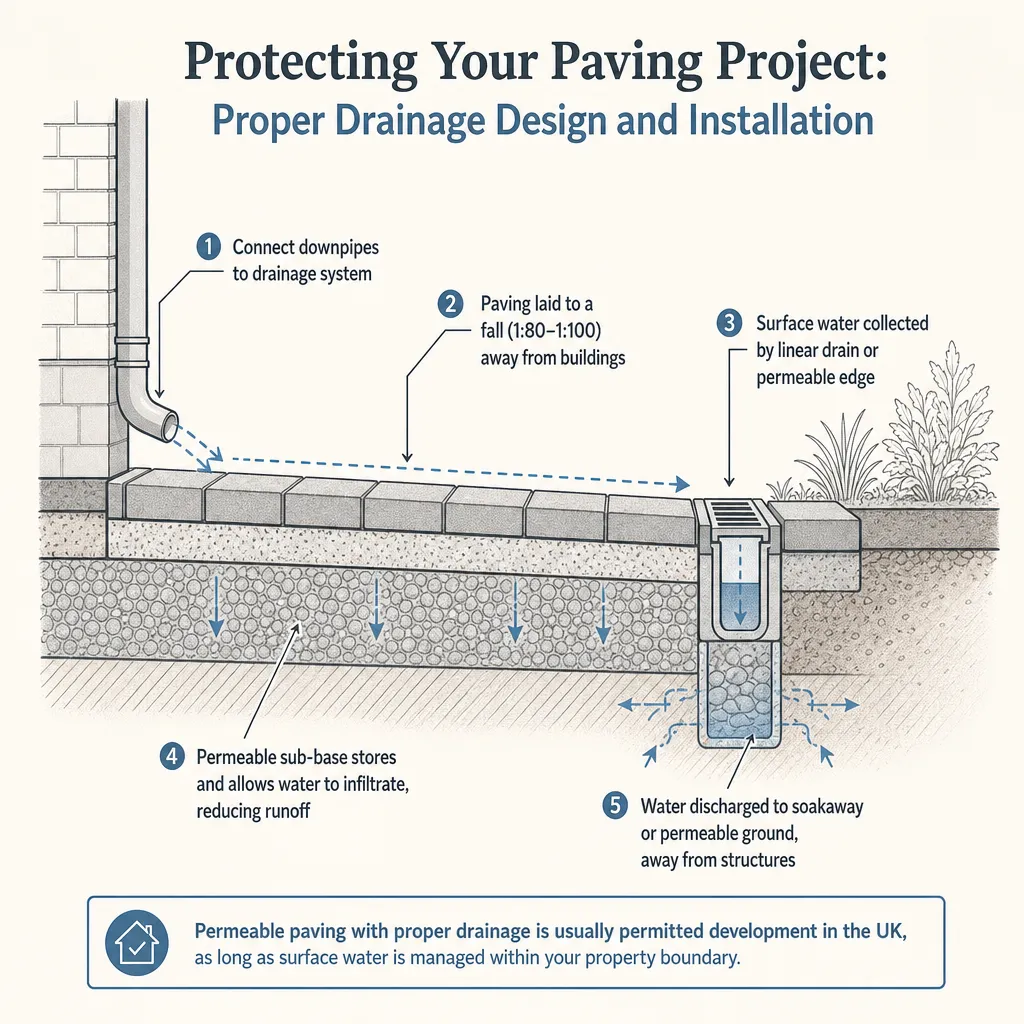
Protecting Your Paving Project: Proper Drainage Design and Installation
Poor drainage is the most common reason paved surfaces fail prematurely — whether that is a driveway that pools water after every downpour, a patio where run-off flows toward the house, or a path that lifts and cracks after the first hard winter. Getting drainage right is not just about surface performance: in England it also determines whether your project qualifies as Permitted Development or requires a planning application, and it has direct implications under Building Regulations Approved Document H.
Key points
- Since October 2008, front driveways over 5 m² in England must use permeable surfacing or direct run-off to a permeable area (lawn or soakaway) to qualify as Permitted Development; impermeable surfaces draining to the highway require a planning application.
- A minimum fall of 1:60 to 1:80 (approximately 1.25–1.7%) away from buildings and boundaries is the standard for residential paving.
- A typical residential driveway carrying private cars requires 100–150 mm of compacted MOT Type 1 aggregate as a sub-base; permeable block paving requires Type 3 or open-graded clean gravel to preserve drainage voids.
- Surface water must never be connected to a foul (sewage) sewer; connection to a public surface water sewer requires consent from the sewerage undertaker.
- Sustainable Drainage Systems (SuDS) became a mandatory approval requirement in Wales in January 2019 under Schedule 3 of the Flood and Water Management Act 2010; in England, SuDS are increasingly expected by local planning authorities, particularly on larger projects.
Why drainage design matters before excavation begins
Surface water has to go somewhere. When paving increases the impermeable area of a plot, rainfall that previously soaked into the ground is redirected. Without a considered drainage design:
- Water pools on the surface, creating trip hazards and accelerating freeze-thaw erosion of jointing and surface material.
- Run-off directed toward a house foundation can cause damp, subsidence, or flood ingress at ground-floor level.
- Excess water discharging to the highway may attract enforcement action from the local authority under the Highways Act 1980.
- Poorly drained sub-bases become saturated, lose load-bearing capacity, and cause uneven settlement and surface cracking.
Designing drainage before excavation is considerably cheaper than retrofitting a drain or channel under finished paving.
Planning permission and the 5 m² rule
Since October 2008, Permitted Development rights for new front driveways in England have been conditional on surface water management. A new or enlarged front driveway does not require a planning application if:
- The surface is permeable — such as gravel, block paving with open joints, permeable concrete, or reinforced grass systems — or
- Run-off from an impermeable surface is directed to a permeable area of the property (lawn, planted border, or soakaway), not to the highway or a surface water drain.
If neither condition is met and the area exceeds 5 m², a householder planning application is required. In Scotland and Wales, rules differ and you should check with your local planning authority. Listed buildings and conservation area properties may face additional restrictions regardless of size.
Rear and side patios are generally not affected by this rule, but discharging surface water to the highway remains unlawful under the Highways Act 1980 regardless of the paving location.
Choosing the right drainage approach
Which drainage approach should you choose?
- Choose permeable paving if the soil drains freely (sandy or loamy ground) and the area exceeds 5 m² at the front of a property in England.
- Choose a soakaway if a percolation test confirms the soil absorbs water adequately and an impermeable surface is preferred.
- Choose a linear channel drain if the surface falls toward a highway or building and redirecting the fall is not practical.
- Choose a surface water sewer connection only if permitted by the sewerage undertaker and no other viable option exists.
- Ask a drainage contractor if the site is in a flood zone, has a high water table, or existing drainage may be affected by the works.
Drainage method | Best suited to | Not ideal for | Key consideration |
|---|---|---|---|
Permeable paving (gravel, open-jointed block, porous concrete) | Front driveways; free-draining soils | Heavy clay or high water-table sites | Avoids planning permission; requires periodic maintenance to keep joints clear |
Soakaway + impermeable surface | Most soils where percolation test passes | Clay-heavy soils with percolation below 1:10 mm/s | Must be at least 5 m from building foundations |
Linear / channel drain to soakaway | Drives with fall toward highway or building | Sites with consistently poor percolation | Intercepts run-off at the boundary; flexible outlet options |
Surface water sewer connection | Where public sewer is available and consented | Foul sewer — connection is never permitted for surface water | Requires sewerage undertaker consent; may need Building Regs notification |
Rain garden / swale | Large areas; SuDS requirement from local authority | Small plots or areas of poor infiltration | Most sustainable option; benefits biodiversity and biodiversity net gain |
Sub-base requirements and correct falls
Correct falls
A correctly graded fall is fundamental to every paving project. Standard guidance for residential work:
- Minimum fall: 1:80 (1.25%) for block paving and slabs; 1:60 (1.7%) for areas prone to leaf debris or likely blockage.
- Direction: always away from the building, boundary walls, and any area that could flood.
- Cross-fall: for wider driveways, a slight cross-fall toward a central or side channel prevents water tracking along the edges.
Errors in fall are expensive to correct without re-laying the surface course and re-grading the sub-base — getting this right before the first course is laid saves considerable cost.
Sub-base materials and depth
Surface and loading | Sub-base material | Minimum depth | Notes |
|---|---|---|---|
Pedestrian patio or path | MOT Type 1 | 75–100 mm | Light load bearing only |
Residential driveway (private cars) | MOT Type 1 | 100–150 mm | Increase to 200 mm on soft or made-up ground |
Driveway with van or light commercial access | MOT Type 1 | 150–200 mm | Seek contractor or engineer guidance |
Permeable block paving | Type 3 or open-graded clean gravel | 100–150 mm | Avoid Type 1 — fines clog drainage voids |
Indicative guidance for standard residential loading. Consult a contractor or engineer for unusual sites, soft ground, or heavy vehicle access. Indicative UK practice, last reviewed 2026-05-07.
Homeowner checklist before laying paving
Before any excavation begins, work through the following:
Red flags: signs of poor drainage planning
Watch for these warning signs when reviewing a contractor's quote or inspecting finished work:
- No mention of drainage in the written quote — surface water management must be explicitly addressed for any project over 5 m².
- Sub-base depth not specified — a contractor unable to state the intended sub-base depth is unlikely to lay it correctly.
- Falls not checked with a spirit level or laser — estimating falls by eye results in low spots and pooling after the first rain.
- Soakaway proposed without a percolation test — a soakaway in clay soil will fail within the first wet winter.
- Manhole covers to be paved over or sealed — these must remain accessible at finished paving level; raising or relocating covers requires appropriate proprietary fittings.
- No gully or channel at the foot of a drive where the surface meets the public pavement — run-off to the highway is a highways offence.
When to get professional help
Most residential paving projects can be completed by a competent contractor. Involve a specialist drainage contractor or civil engineer if:
- The site falls within Flood Zone 2 or 3 (check via the Environment Agency Flood Map for Planning).
- You are paving a large area over 200 m² where total run-off volume is significant.
- There is no clear outlet for surface water and soakaway percolation is poor.
- Existing drainage shows signs of surcharging or blockage before works begin.
- Building Regulations approval is required — for example, where work includes new connections to a public sewer.
How Housey can help
If you are planning a driveway or patio and want drainage designed correctly from the outset, Housey can connect you with experienced driveway installers who understand sub-base and fall requirements, and specialist drainage contractors who can design and install surface water management suited to your site and soil conditions.
Frequently asked questions
Do I need planning permission for a new driveway in England?
In England, a new front driveway over 5 m² using an impermeable surface that drains to the highway requires a householder planning application. Permeable surfaces, or impermeable surfaces that drain to a lawn or soakaway, qualify as Permitted Development. Rules differ in Scotland, Wales, and Northern Ireland — check with your local planning authority before starting.
What is the correct fall for a patio or driveway?
A minimum fall of 1:80 (approximately 1.25%) away from buildings and boundaries is standard for block paving and slabs. In areas prone to heavy leaf fall or blockage, 1:60 (1.7%) provides a safer margin. Falls directed toward a house are a common installation error that can cause damp and flood ingress at ground-floor level.
Can I connect a new drain to the sewer?
Surface water drains must never be connected to a foul (sewage) sewer. Connection to a public surface water sewer requires consent from your sewerage undertaker and may require Building Regulations notification. For most domestic paving projects, a soakaway or permeable surface is the simpler, lower-cost solution.
How deep should the sub-base be for a driveway?
For a typical residential driveway carrying private cars, 100–150 mm of compacted MOT Type 1 aggregate is standard. On soft or made-up ground, 200 mm or more may be needed. For permeable block paving, use Type 3 or an open-graded clean aggregate — Type 1 contains fines that clog the drainage voids and defeat the purpose.
What is SuDS and does it affect domestic paving projects?
Sustainable Drainage Systems (SuDS) manage surface water close to where it falls, using permeable paving, soakaways, and rain gardens rather than directing run-off straight to a drain. SuDS approval became mandatory in Wales in January 2019 and is increasingly referenced in England. For most domestic projects, permeable paving or a well-designed soakaway already satisfies the underlying principle.
Sources and further reading
- When is permission required — householder permitted development — GOV.UK
- Sustainable drainage systems: approval guidance — GOV.UK
- Approved Document H: Drainage and waste disposal — GOV.UK Building Regulations
- Flood Map for Planning — Environment Agency
- Block paving design and installation guidance — Interpave (Precast Concrete Paving and Kerb Association)
Useful next reads
 Improvement & Build
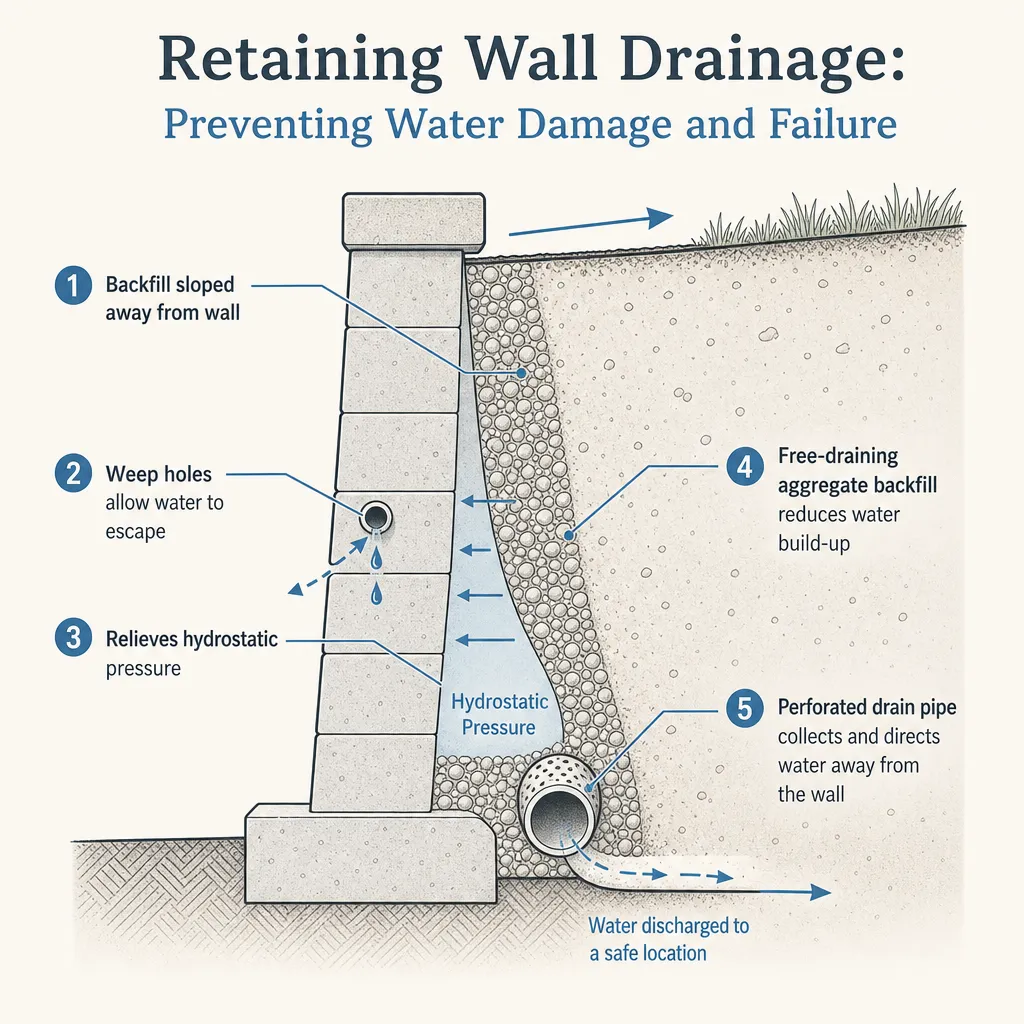
Retaining Wall Drainage: Preventing Water Damage and Failure
Retaining wall drainage fails when hydrostatic pressure builds behind the structure due to poor drainage layers, blocked weep holes, or impermeable backfill.
 Improvement & Build
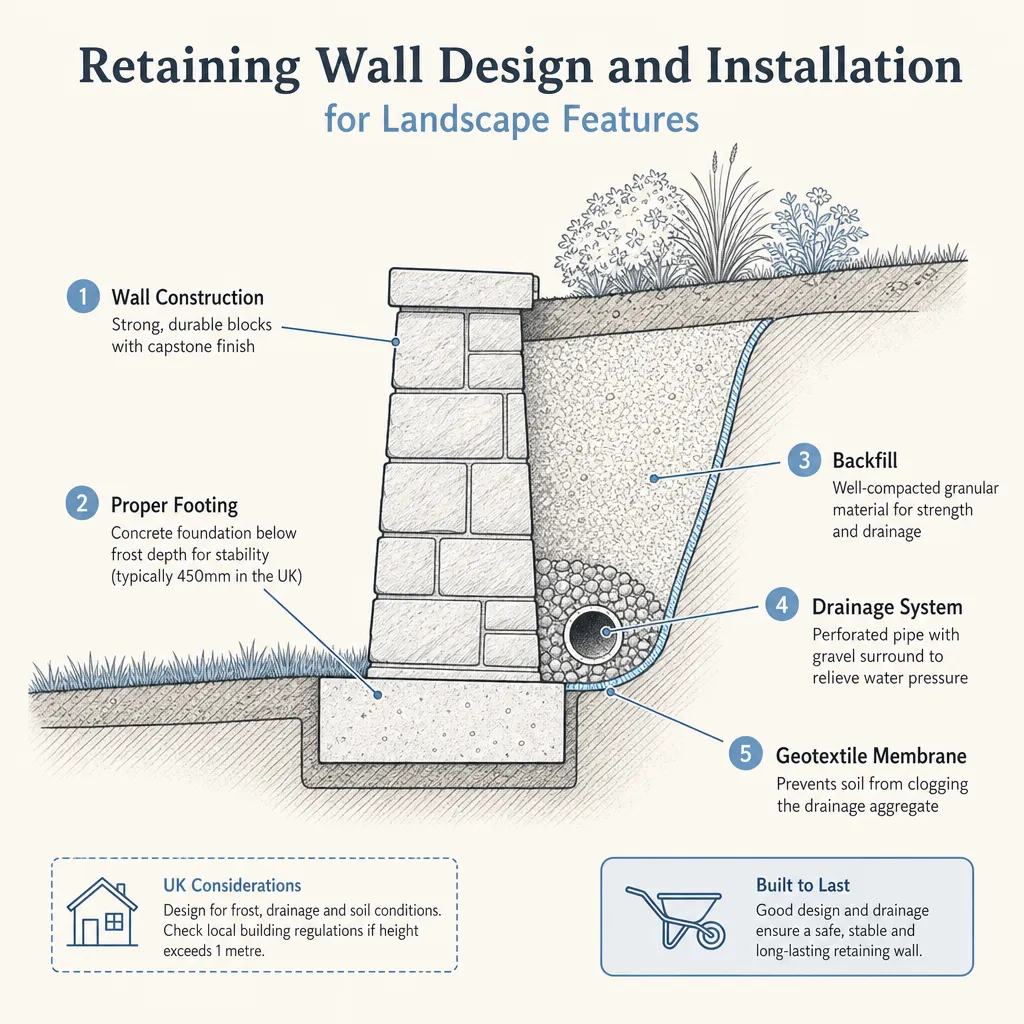
Retaining Wall Design and Installation for Landscape Features
A garden retaining wall holds back soil on a sloped plot using concrete blocks, stone, or timber.
 Improvement & Build
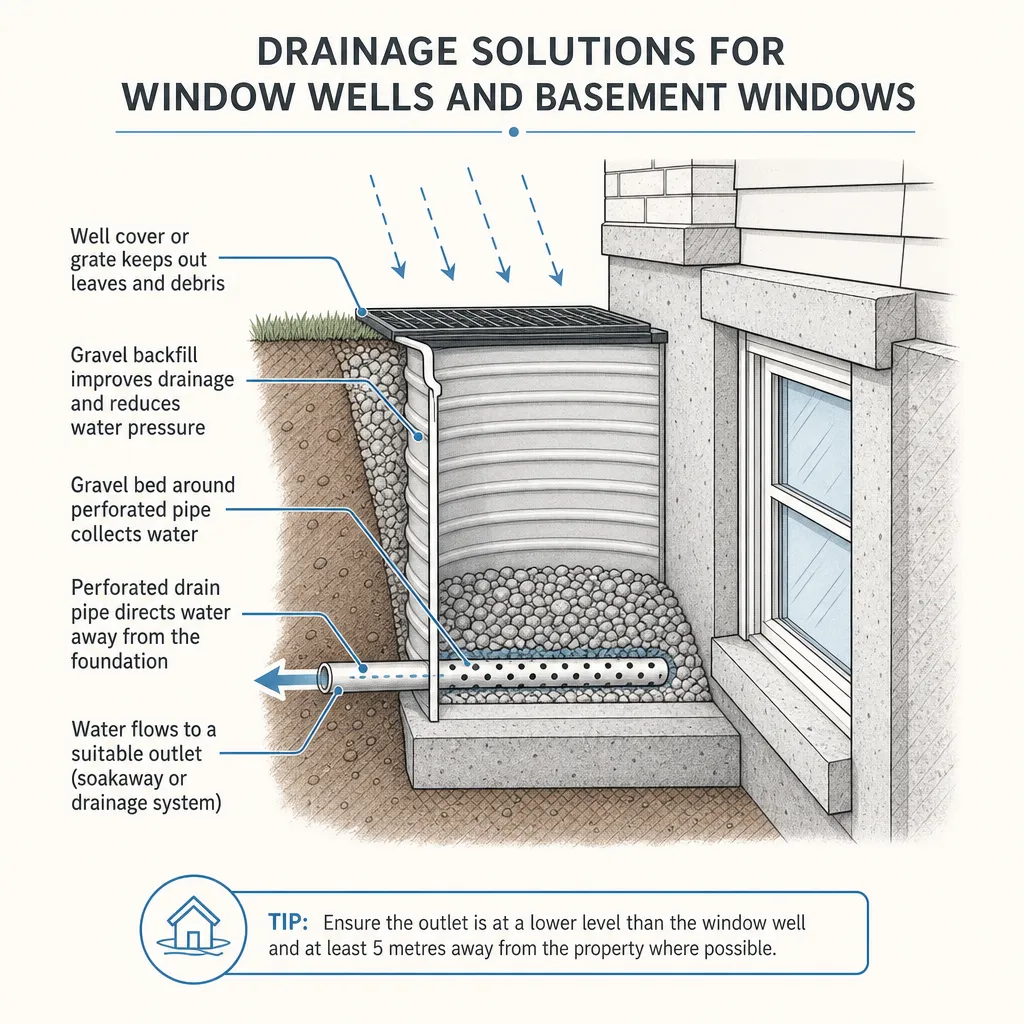
Drainage solutions for window wells and basement windows
Most UK window wells manage water through a gravel-filled sump at least 200 mm deep or a plastic liner fitted with a drain outlet connected to a soakaway or drainage system.
 Improvement & Build
French Drain Installation: Drainage Solutions and Costs
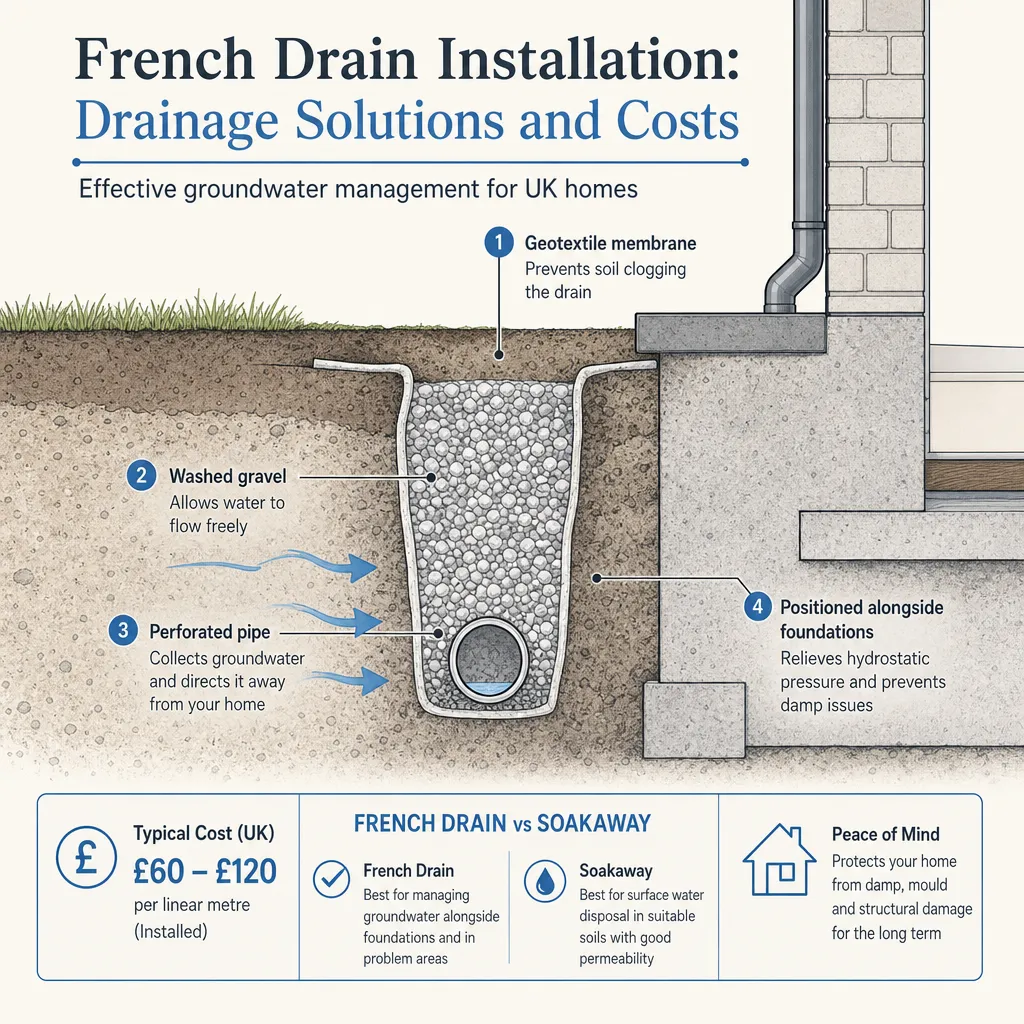
A French drain is a gravel-filled trench containing a perforated pipe that channels subsurface water away from problem areas.
 Improvement & Build
Finding Local Contractors for Patio Installation and Design
For most residential patios, a local landscaper or paving specialist manages the project from design to laying.