Cream-Coloured uPVC Windows for Period Properties
By Housey · Last reviewed 11th of May 2026
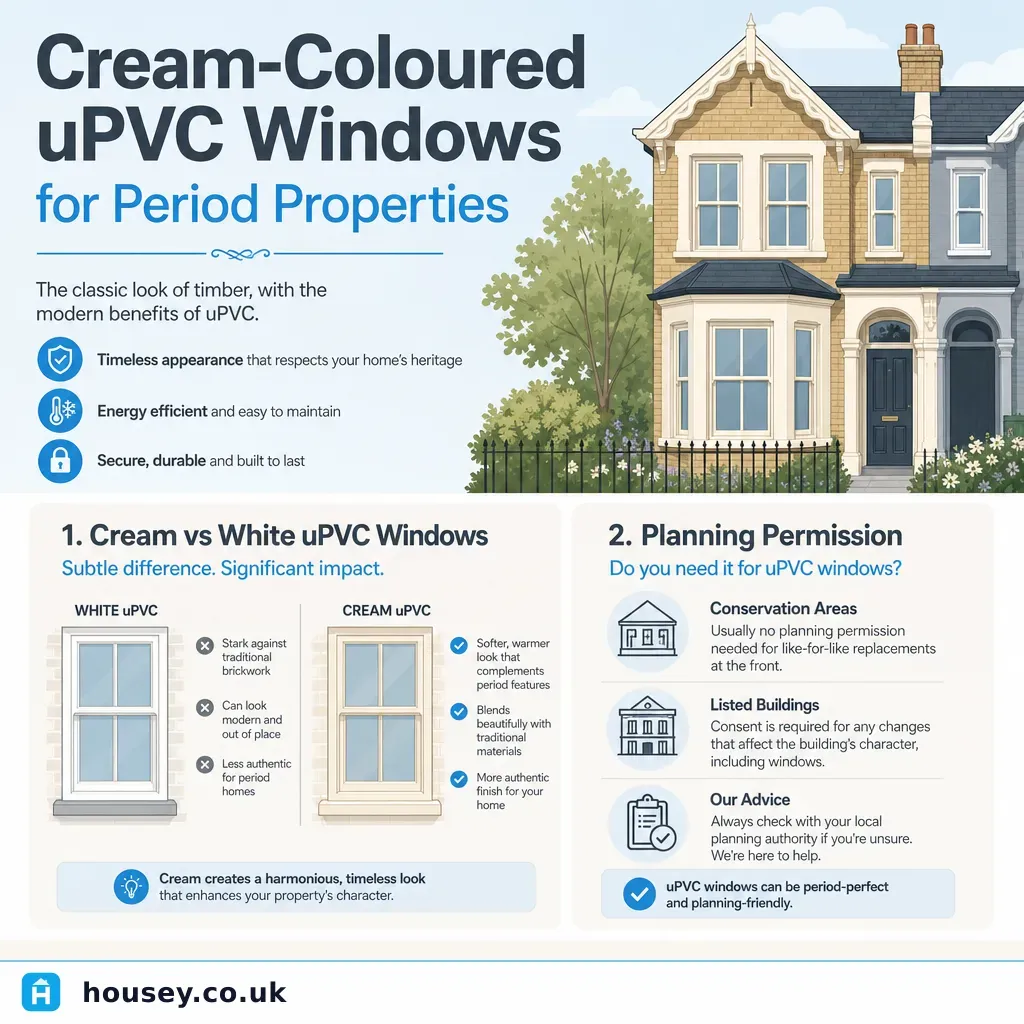
Cream-Coloured uPVC Windows for Period Properties
Choosing window colours for a Victorian terrace, Edwardian semi, or interwar property is more than an aesthetic preference — it touches on planning rules, energy performance, and how sympathetically the home sits within its streetscape. Stark white uPVC became the default throughout the 1990s and 2000s when double glazing was fitted wholesale across the UK's period housing stock, often with little regard for the character of the building. Cream and other heritage tones have since become a popular choice for homeowners who want a finish that reads more naturally against aged brick, stone, and original timber detailing.
Key points
- Window replacement in standard residential properties is permitted development in England and does not require planning permission; however, replacement windows must comply with Building Regulations Approved Document L (minimum whole-window U-value of 1.4 W/m²K) and Approved Document N (safety glazing in critical locations).
- FENSA (Fenestration Self-Assessment Scheme) registered installers can self-certify compliance with Building Regulations, removing the need for a separate local authority Building Control application for most straightforward window replacements.
- Cream uPVC is available as a foiled finish over a white PVC substrate or as a through-colour profile; quality varies significantly between manufacturers — always ask for a written colour-fade warranty of at least 10 years.
- Conservation areas and Article 4 Directions may restrict or prohibit uPVC installation entirely, regardless of colour — check with your local planning authority before ordering any windows.
- Listed buildings require Listed Building Consent for any window replacement; uPVC is rarely considered an acceptable material in listed building applications.
Cream vs white uPVC: making the right colour choice
Feature | Standard white uPVC | Cream uPVC |
|---|---|---|
Appearance against period brick | Cool contrast; can look clinical on warm-toned brick | Warmer tone, sits closer to natural or painted timber |
Typical cost premium | Baseline | Approximately 5–15% more (indicative, 2026) |
Colour fade risk | UV-stable for 25+ years in most mainstream profiles | As above — check the specific product warranty |
Profile availability | Maximum choice across all suppliers | Slightly fewer profiles; most major ranges include cream |
Lead times | Standard | May be special order with some manufacturers |
Conservation area suitability | Subject to local Article 4 restrictions | Subject to the same restrictions; uPVC itself may be prohibited |
Indicative cost difference, last reviewed 2026-05-11. Actual quotes vary by window size, specification, and installer.
Why cream often suits period properties
Cream sits closer to the aged off-white, stone, and putty tones of traditional timber window frames. On Victorian and Edwardian brick — particularly London stock brick, yellow Leicester brick, or warm red Staffordshire brick — a cream uPVC frame tends to read as more sympathetic to the original character than stark bright white. The softer tone also works well alongside original or reclaimed timber doors, sandstone surrounds, and clay roof tiles.
That said, the right choice depends on the specific property. On homes with white-painted render or pale limestone, bright white uPVC may actually be more appropriate. Look at neighbouring properties that retain original joinery, or at any surviving painted timber on the building itself, before finalising a colour.
Planning permission and conservation rules
Standard residential properties (England)
Window replacement on most homes in England is permitted development — no planning permission is required. However, replacement windows must still comply with Building Regulations:
- Thermal performance: minimum whole-window U-value of 1.4 W/m²K (Approved Document L, 2021 edition).
- Safety glazing: toughened or laminated glass in critical locations such as low-level panels and beside doors (Approved Document N).
- Ventilation: trickle vents are required in replacement windows for habitable rooms (Approved Document F).
- Means of escape: first-floor bedroom windows must allow fire escape — any replacement must maintain at least the same openable area.
Conservation areas
In many conservation areas, permitted development rights for windows are restricted by Article 4 Directions. uPVC windows may be prohibited entirely, with the local planning authority requiring timber, aluminium, or a specific profile that matches the street's historic character. Installing uPVC without the necessary consent can result in an enforcement notice requiring removal and reinstatement at the homeowner's cost.
Contact your local planning authority before ordering any windows if your property is in a conservation area.
Listed buildings
Any window replacement in a listed building requires Listed Building Consent, regardless of material or colour. uPVC is generally considered inappropriate for listed buildings, and consent is rarely granted. Slimline double-glazed timber sash replacements or secondary glazing are the more commonly approved routes for improving thermal performance in listed properties.
Which professional do I need?
Situation | Professional to contact |
|---|---|
Standard window replacement, not listed, not in conservation area | FENSA or CERTASS registered window installer |
Conservation area — checking whether replacement is permitted | Local planning authority first; then an approved installer |
Listed building | Conservation officer at the local authority before any work begins |
New window opening or enlargement of an existing opening | Structural engineer plus Building Regulations application |
Draught-proofing original timber frames without replacing them | Specialist joiner or draught-proofing contractor |
Energy performance: what to look for
Under Building Regulations Approved Document L (2021 edition), replacement windows in England must achieve a minimum U-value of 1.4 W/m²K for the whole window unit — frame and glazing combined. Most modern A-rated double-glazed uPVC windows comfortably meet or exceed this.
The BFRC (British Fenestration Rating Council) Window Energy Rating system labels windows from A++ to G. Look for A or A+ rated windows as a minimum. For period properties on solid-wall construction — typical of Victorian and Edwardian homes — windows are one of the few areas where meaningful thermal improvement is achievable without major structural intervention.
Triple glazing achieves U-values of around 0.8–1.0 W/m²K but at higher cost and with a marginal reduction in visible light transmission. It is worth considering for north-facing rooms or in areas with particularly cold winters.
What to ask before accepting a quote
Before committing to a window installer:
- What FENSA or CERTASS registration number does your company hold, and is it currently valid?
- Is the cream finish a through-colour profile or a foiled finish — and what is the colour-fade warranty period?
- What is the whole-window U-value and BFRC energy rating for the specified product?
- Are trickle vents included? (Required under Approved Document F for habitable rooms.)
- Will I receive a FENSA Competent Person certificate on completion, and within what timeframe after installation?
- What is your process if windows arrive in the wrong colour or with a manufacturing defect?
- Does the quote include removal and disposal of the existing frames, and making good around the reveals?
- Is VAT included in the quoted price?
Decision tree: do I need consent for cream uPVC windows?
- Standard residential property, no conservation area, not listed: Permitted development applies. No planning permission needed. Use a FENSA-registered installer who will self-certify Building Regulations compliance.
- Conservation area: Contact the local planning authority before ordering. uPVC may not be permitted; if it is, a specific profile or colour may be required.
- Listed building: Apply for Listed Building Consent before any work. uPVC is usually unacceptable — seek advice from the local conservation officer.
- New or enlarged window opening: A Building Regulations application is needed regardless of property type, in addition to any planning requirement.
When to get professional help
Most uPVC window replacement is straightforward for a competent FENSA-registered installer. Seek additional professional input when:
- The property is listed or in a conservation area.
- You want to enlarge or create a new window opening (structural and Building Regulations implications apply).
- Existing frames show signs of rot, failed lintels, or persistent damp around the reveals.
- You are replacing windows in a leasehold flat or a building with shared walls where management company or freeholder consent may be required.
How Housey can help
Housey connects homeowners with vetted FENSA-registered window and door installers experienced with cream and heritage uPVC profiles for period properties across the UK. If your project involves new openings or requires formal Building Regulations drawings, our building regulations drawings service can help you find the right professional.
Frequently asked questions
Do I need planning permission to install cream uPVC windows?
In most cases, no. Window replacement is permitted development for standard residential properties in England. The main exceptions are listed buildings, which require Listed Building Consent, and properties in conservation areas where Article 4 Directions may restrict or prohibit uPVC windows. Always check with your local planning authority before ordering if your property is in a designated area.
Are cream uPVC windows more expensive than white?
Cream uPVC typically costs 5–15% more than equivalent white uPVC windows, though this varies by manufacturer, profile, and whether cream is a standard or special-order option. The cost difference is usually modest relative to the total installation cost. Some manufacturers offer a wider range of profiles in white, so cream may also involve slightly longer lead times.
Will cream uPVC windows fade over time?
Quality cream uPVC profiles with UV-resistant foil finishes or through-colour formulations are designed to resist fading for 10–25 years. Ask for the manufacturer's colour warranty in writing before agreeing to installation. Cheaper foil-finish profiles may show fading or peeling sooner, particularly on south-facing elevations with prolonged UV exposure.
Sources and further reading
- Planning Portal: Windows — Planning Portal
- Approved Document L: Conservation of fuel and power — GOV.UK
- FENSA: What is FENSA? — FENSA
- Energy Saving Trust: Windows — Energy Saving Trust
Useful next reads
 Improvement & Build
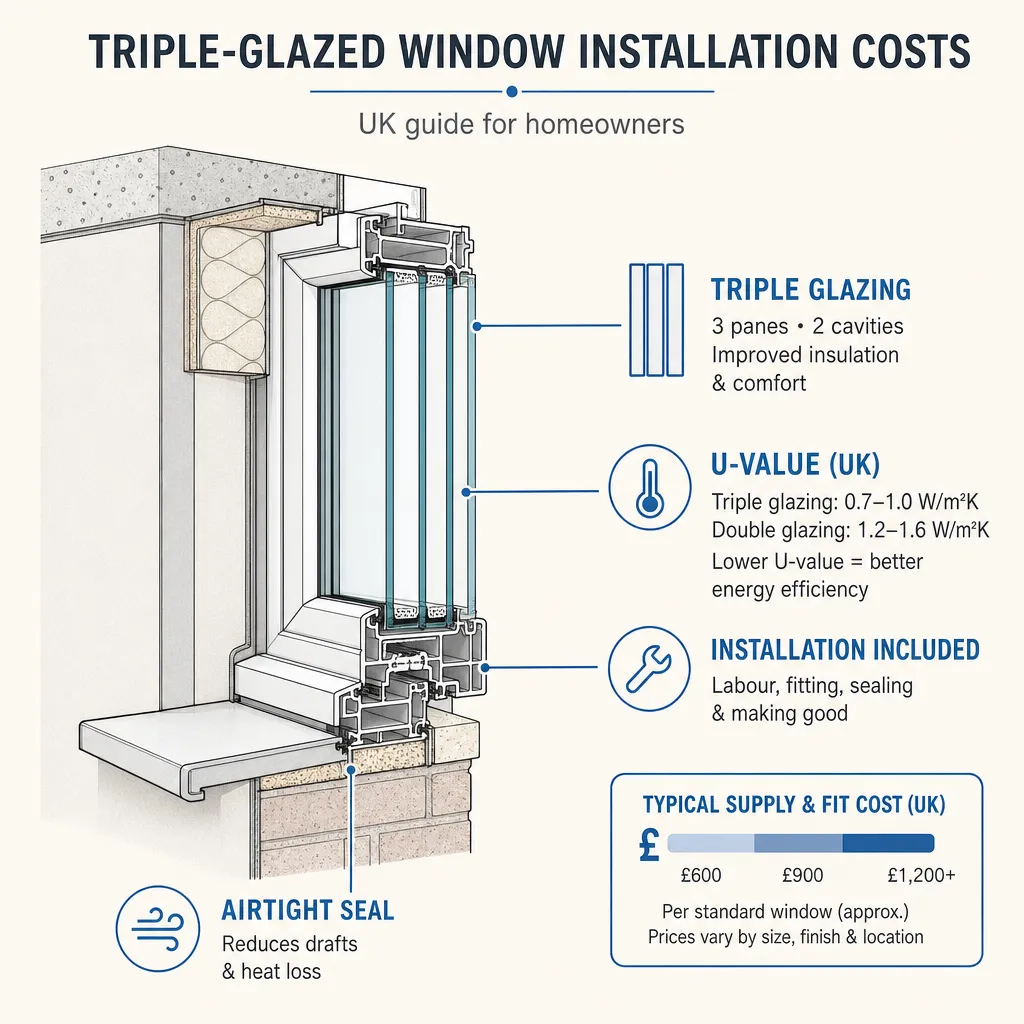
Triple-Glazed Window Installation Costs
Triple-glazed window installation in the UK typically costs £800–£1,800 per window, depending on size, frame material, and glazing specification.
 Improvement & Build
Guide to Replacing Timber Sash Windows with Authentic Restoration
Restoring a timber sash window typically costs £150–£400 per window; full replacement costs £800–£2,500.
 Improvement & Build
Window Replacement Planning: What to Discuss With Your Installer
Most window replacements in England fall under permitted development rights and do not require planning permission, but they must comply with Building Regulations Part L and Part K.
 Improvement & Build
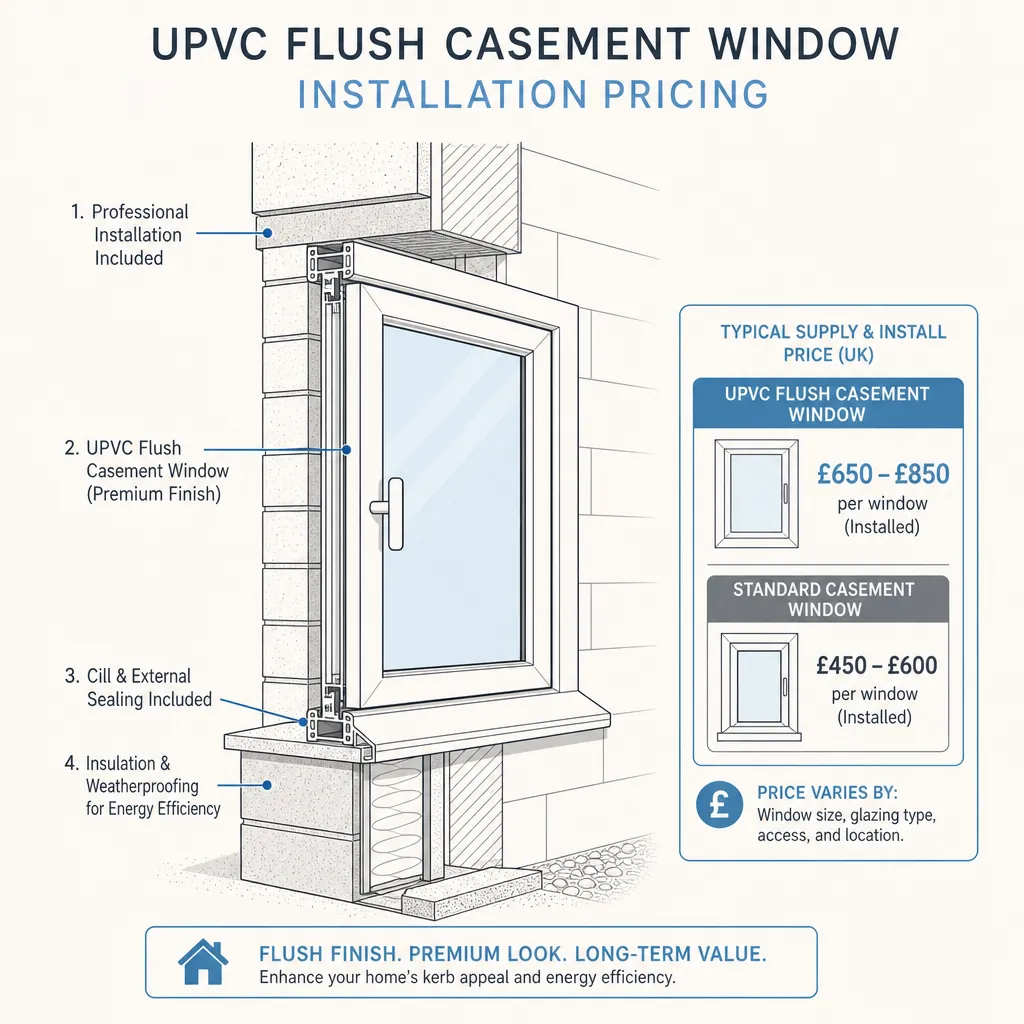
UPVC Flush Casement Window Installation Pricing
UPVC flush casement windows typically cost £400–£900 per window supplied and fitted in the UK, depending on size, glazing specification, and finish.
 Improvement & Build
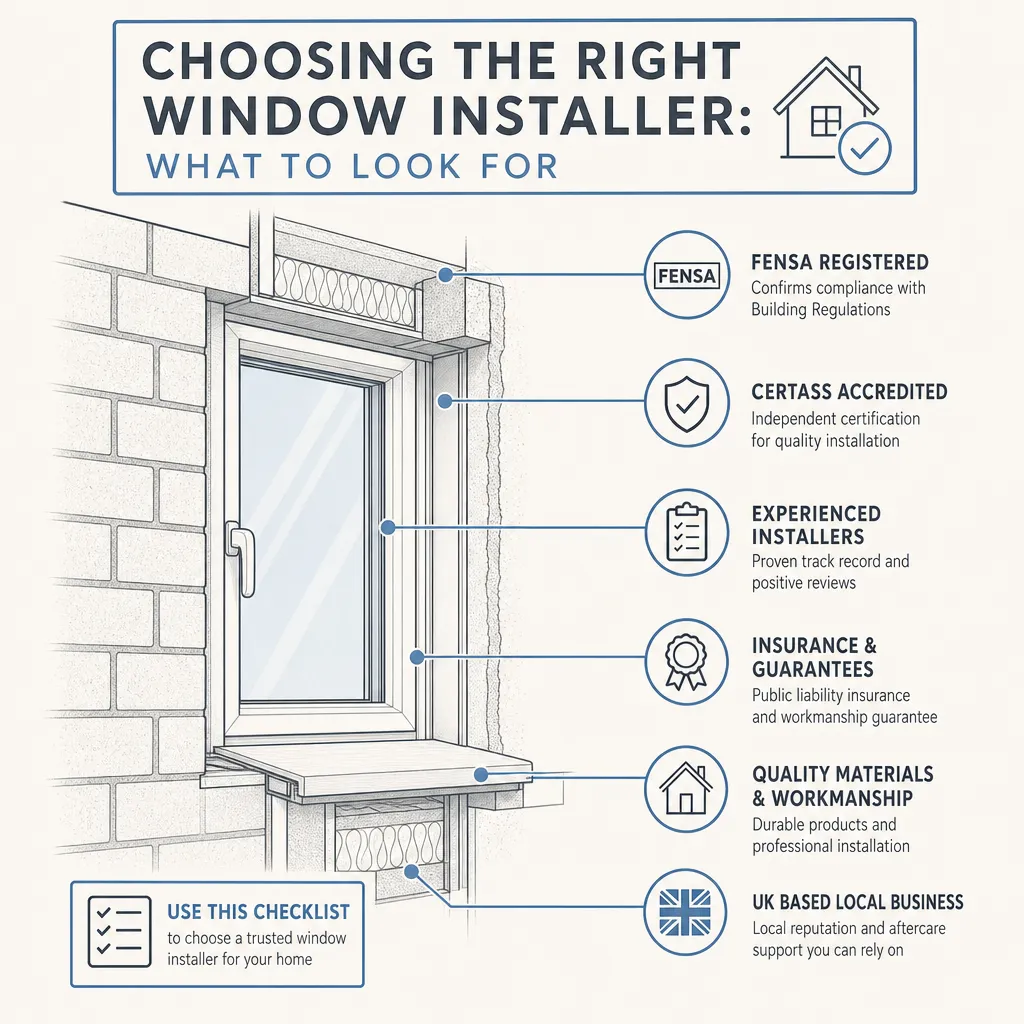
Choosing the Right Window Installer: What to Look For
When choosing a window installer in the UK, verify FENSA or CERTASS registration first — these schemes allow installers to self-certify Building Regulations compliance and issue the completion certificate you will need at resale.