Creating a Healthy Home: Ventilation, Moisture, and Air Quality
By Housey · Last reviewed 1st of June 2026
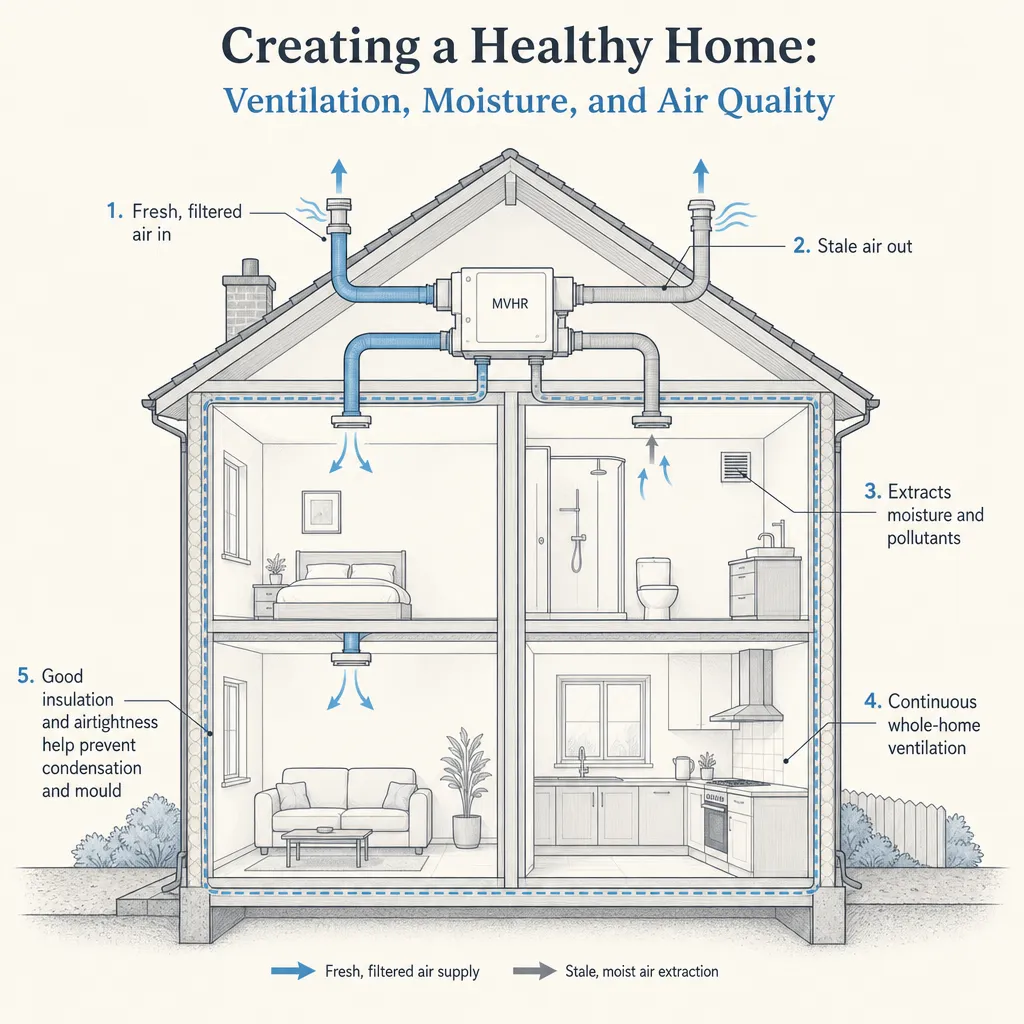
Creating a Healthy Home: Ventilation, Moisture, and Air Quality
Poor indoor air quality and uncontrolled moisture are among the most underestimated factors affecting health and comfort in UK homes. Whether you have recently insulated a 1930s semi, replaced windows in a Victorian terrace, or moved into a tightly sealed new-build flat, the way air moves through your home — and where it gets trapped — has direct consequences for respiratory health, condensation, and mould growth. The question typically becomes urgent after energy-efficiency improvements or after a change in how a property is occupied and heated.
Key points
- Approved Document F (Ventilation) of the Building Regulations sets minimum ventilation rates for new dwellings and applies when windows or ventilation systems are replaced as a material alteration.
- PAS 2035:2023 requires a Retrofit Assessor and Coordinator to assess and manage moisture and ventilation risks before and after insulation or airtightness improvements are made to an existing home.
- Sustained indoor relative humidity above 70% creates conditions that accelerate mould growth, including Aspergillus and Cladosporium species associated with respiratory health effects.
- Mechanical Ventilation with Heat Recovery (MVHR) is the recommended whole-house solution for highly insulated new builds and deep retrofits, recovering up to 90% of heat from extracted air while supplying fresh filtered air.
- The UK Health Security Agency (UKHSA) sets a radon action level of 200 Bq/m³ for existing homes; properties in higher-risk areas — notably the South West, parts of the East Midlands, and Grampian — should be tested using UKHSA-approved measurement services.
Why ventilation, moisture, and air quality are connected
These three topics are often treated separately, but in any building they form a single interacting system. When a home is made more airtight — whether through cavity or solid-wall insulation, draught-proofing, or new double-glazing — the natural air change rate drops. Without adequate mechanical or passive ventilation to compensate, moisture from cooking, bathing, breathing, and drying clothes accumulates in the internal air.
That moisture migrates to cold surfaces — external walls, window reveals, roof junctions, and unheated rooms — and condenses, creating conditions for mould growth, dust mite proliferation, and structural damage. At the same time, airtight homes retain pollutants that would previously have dispersed through draughts: volatile organic compounds (VOCs) from paints, adhesives, and flooring; combustion products from gas appliances; particulate matter from cooking; and biological contaminants including dust mites and pet dander.
Understanding this interaction is essential before undertaking retrofit works. PAS 2035:2023, the standard underpinning the UK's ECO4 and Great British Insulation Scheme funding, makes a pre-works moisture and ventilation assessment mandatory.
Types of ventilation and when each applies
Background (passive) ventilation
Trickle vents in windows and purpose-provided vents in external walls provide a low level of continuous background ventilation by pressure difference and wind. Approved Document F requires trickle vents to be retained or installed when replacement windows are fitted. They are unreliable in calm conditions and insufficient on their own in well-sealed homes.
Intermittent extract ventilation
Extract fans in kitchens and bathrooms remove moisture and pollutants at source. The 2021 edition of Approved Document F sets minimum intermittent extract rates of 30 l/s for kitchens (adjacent to the hob) and 15 l/s for bathrooms with a bath or shower. Fans linked to humidity sensors or occupancy detectors perform significantly better than manual or timer-only operation.
Continuous mechanical extract (dMEV)
Decentralised mechanical extract ventilation (dMEV) runs continuously at a low background rate and boosts automatically on detection of occupancy or elevated humidity. It is suited to moderate retrofit situations where full ductwork installation is not feasible.
Whole-house mechanical ventilation with heat recovery (MVHR)
MVHR supplies fresh filtered air to living spaces and extracts stale air from wet rooms via a central heat-exchanger unit. It is most effective in highly insulated, airtight homes (typically air permeability below 3 m³/h·m² at 50 Pa). MVHR requires ductwork installation, making it most practical in new builds or comprehensive refurbishments rather than occupied period homes.
Which ventilation system suits your situation?
- Choose background ventilation with intermittent extract if your home retains natural air leakage, you are replacing windows only, or works are otherwise minor.
- Choose dMEV if you are insulating or draught-proofing and cannot install ductwork for a full MVHR system.
- Choose MVHR if you are building new, undertaking a deep retrofit to Passivhaus or EnerPHit standard, or refurbishing to a high airtightness specification.
- Ask a ventilation specialist or Retrofit Coordinator if you are applying for ECO4, the Great British Insulation Scheme, or other government-funded insulation works — a pre-works PAS 2035 assessment is required.
- Check Approved Document F and consult your building control body if replacement windows are part of your project — omitting trickle vents is a common compliance failure.
Controlling moisture: a homeowner checklist
Effective moisture management begins with occupancy habits and simple maintenance before moving on to fabric and mechanical interventions.
Daily habits
Fabric and maintenance checks
Sources of indoor air pollutants and how to manage them
Pollutant | Common sources in UK homes | Management approach |
|---|---|---|
Nitrogen dioxide (NO₂) | Gas hobs and boilers | Fit a cooker hood ducted to outside; service boiler annually; consider switching to induction |
VOCs | Paints, adhesives, new flooring, flat-pack furniture | Ventilate thoroughly after installation; specify low-VOC or zero-VOC products |
Radon | Ground ingress — higher risk in SW England, E Midlands, Grampian | Test via UKHSA measurement service; install sub-floor ventilation or radon sump if above 200 Bq/m³ |
PM2.5 | Cooking, open fires, candles, incense | Use extract ventilation; limit solid fuel burning; choose DEFRA-exempt appliances |
Carbon monoxide (CO) | Faulty gas appliances, wood-burning stoves | Install audible CO alarms on every floor; service combustion appliances annually via Gas Safe or HETAS-registered engineers |
Mould spores | Condensation on cold surfaces, water ingress | Address the moisture source first; clean affected surfaces; improve ventilation |
Important limitations
This article provides general information about ventilation, moisture control, and indoor air quality in UK homes. Individual properties vary significantly in construction type, airtightness, occupancy, and existing moisture load. Guidance appropriate for one property type may not suit another. Nothing in this article constitutes professional advice or substitutes for an assessment of your specific home by a qualified professional. If you are applying for government-funded retrofit works under ECO4 or the Great British Insulation Scheme, PAS 2035:2023 requires a formal pre-works assessment by a registered Retrofit Assessor and Coordinator; this article cannot replace that process.
When this becomes urgent
Stop relying on general guidance and seek professional assessment without delay if:
- Visible black mould is spreading or recurring after cleaning, particularly on external walls or inside roof spaces — this may indicate interstitial condensation within the building fabric, not just surface moisture.
- Occupants are experiencing unexplained or worsening respiratory symptoms, persistent coughs, or allergic reactions that improve when away from the home.
- You are planning insulation, draught-proofing, or window replacement works — moisture and ventilation risks must be assessed before works begin, not after.
- A radon test result exceeds 200 Bq/m³ — the UKHSA action level for existing homes.
- A CO alarm activates or carbon monoxide poisoning is suspected — leave the building immediately, call 999, and do not re-enter until cleared by a Gas Safe registered engineer.
- Condensation or dampness appears within a newly insulated wall or roof construction — this may indicate a vapour control layer failure requiring specialist investigation.
What to ask a qualified professional
Before instructing a ventilation specialist, Retrofit Coordinator, or energy assessor, ask:
- Are you registered with TrustMark and, if the work is publicly funded, qualified to act as a PAS 2035 Retrofit Assessor and Coordinator?
- Will you carry out a pre-works ventilation and moisture risk assessment as required under PAS 2035:2023, and will that assessment be formally documented?
- What ventilation strategy do you recommend given my home's construction type, occupancy pattern, and approximate airtightness — and what are the alternatives?
- If MVHR is recommended, what air permeability level does my home need to achieve for it to work effectively, and how will that be measured?
- How will interstitial condensation risk be assessed in the retrofit design?
- What post-installation checks or performance monitoring do you include as standard?
When to get professional help
Beyond the urgent situations above, professional input is valuable for:
- Any insulation or airtightness works, however modest — a ventilation assessment should precede them rather than follow.
- Persistent condensation on windows or walls that does not resolve with improved behaviour and extract ventilation.
- Installing a wood-burning stove or open fire — combustion appliances in draught-proofed homes require a calculated air supply as set out in Approved Document J.
- New build or major refurbishment — a ventilation design by a CIBSE-qualified engineer ensures Approved Document F compliance and measurable performance.
How Housey can help
Getting ventilation and moisture management right is one of the most technically demanding aspects of home improvement, particularly following insulation or airtightness works. A ventilation and condensation assessment can identify the specific risks in your home before you commit to any works. For a whole-house view of energy performance, thermal comfort, and air quality, an energy-efficiency consultant can coordinate ventilation, moisture, and heat-loss considerations as an integrated package.
Frequently asked questions
Do I need planning permission to install MVHR?
In most cases, no — MVHR installation in a domestic property is typically permitted development. However, if your home is in a conservation area or is listed, external duct terminals may require consent. Check with your local planning authority before specifying external grilles or louvres in a visible location on the building's exterior.
How do I know if my home has a ventilation problem?
Common signs include persistent condensation on cold windows and external walls, recurrent mould growth in room corners and on north-facing surfaces, musty or stale odours that do not clear with opening windows, and occupants experiencing more respiratory symptoms indoors than outdoors.
What does a ventilation assessment involve?
A qualified assessor typically inspects all wet rooms, checks existing fans and vents for function and compliance, estimates or measures the home's air change rate, and assesses moisture risk based on construction type, occupancy, and any recent fabric works. Where PAS 2035 applies, a formal Moisture and Ventilation Risk Assessment document must be produced.
Is condensation damage covered by buildings insurance?
Buildings insurance does not typically cover condensation damage caused by inadequate ventilation — insurers treat it as a maintenance issue rather than an insured event. A new-build home with a defective or non-compliant ventilation system may have a claim under the NHBC Buildmark warranty or equivalent. Sudden water ingress from a burst pipe or storm damage is treated differently.
Sources and further reading
- Approved Document F: Ventilation (2021 edition) — GOV.UK
- PAS 2035:2023 — Retrofitting dwellings for improved energy efficiency — BSI Group
- Radon: guidance on protective measures — UK Health Security Agency / GOV.UK
- Ventilation advice for the home — Energy Saving Trust
- Approved Document J: Combustion appliances and fuel storage systems — GOV.UK
Useful next reads
 Energy & Retrofit
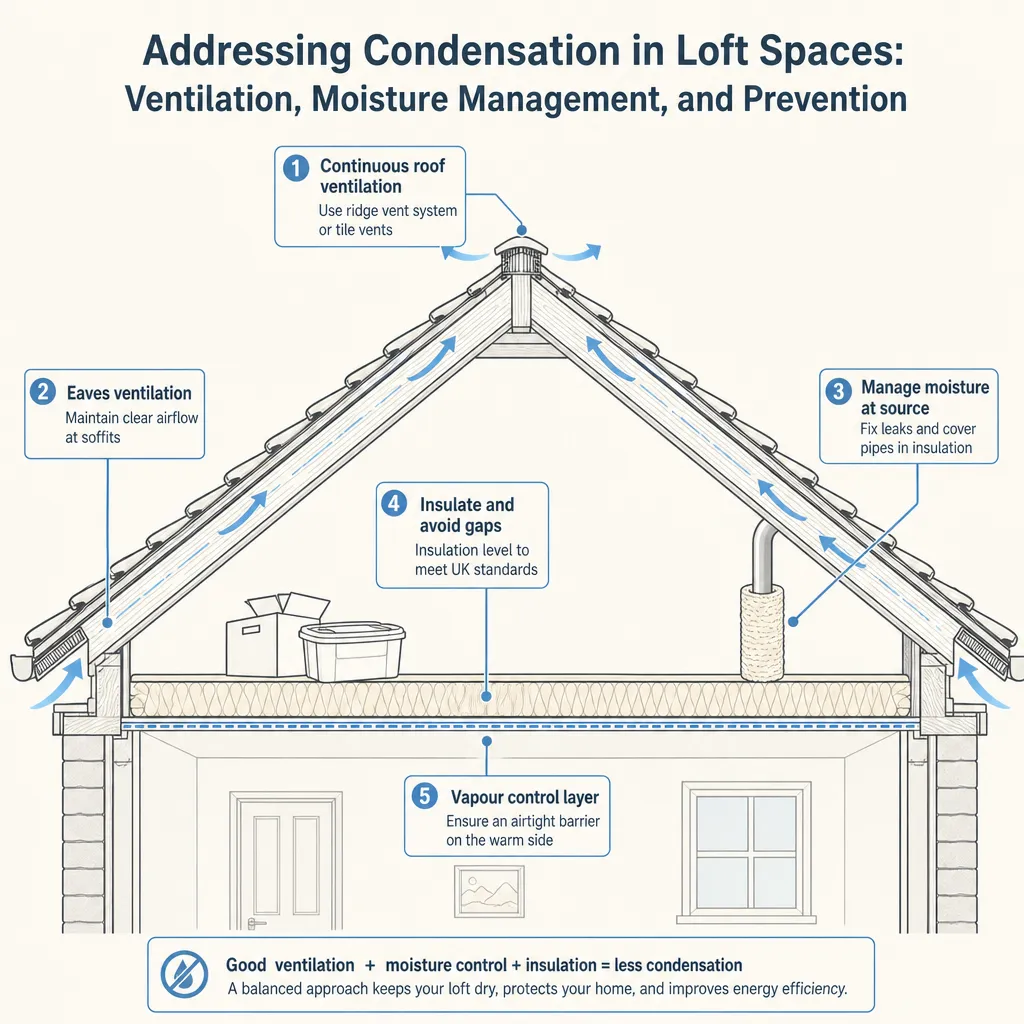
Addressing Condensation in Loft Spaces: Ventilation, Moisture Management, and Prevention
Loft condensation forms when warm, moist air from living spaces passes through ceiling gaps and deposits moisture on cold roof timbers or underfelt.
 Energy & Retrofit
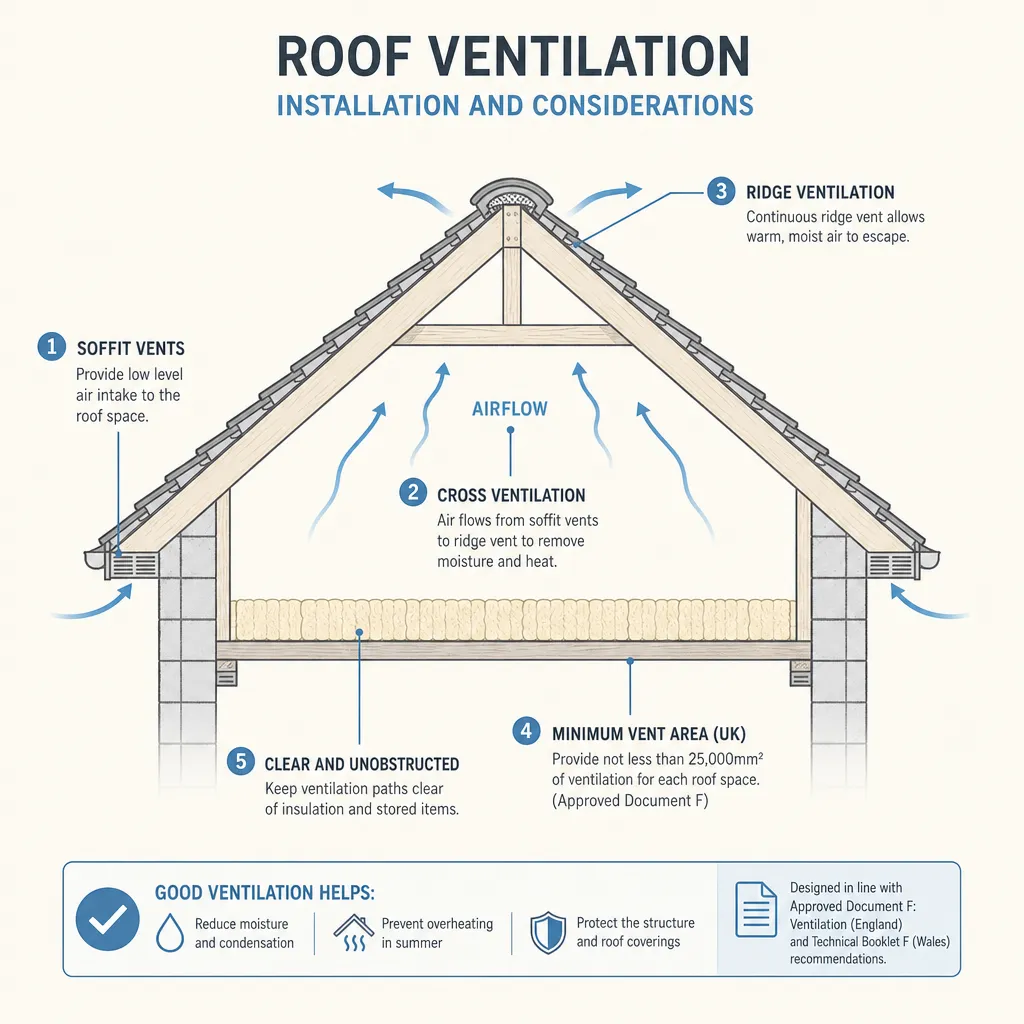
Roof Ventilation Installation and Considerations
Roof ventilation prevents condensation, rot, and structural damage in UK roof spaces by maintaining airflow above insulation.
 Energy & Retrofit
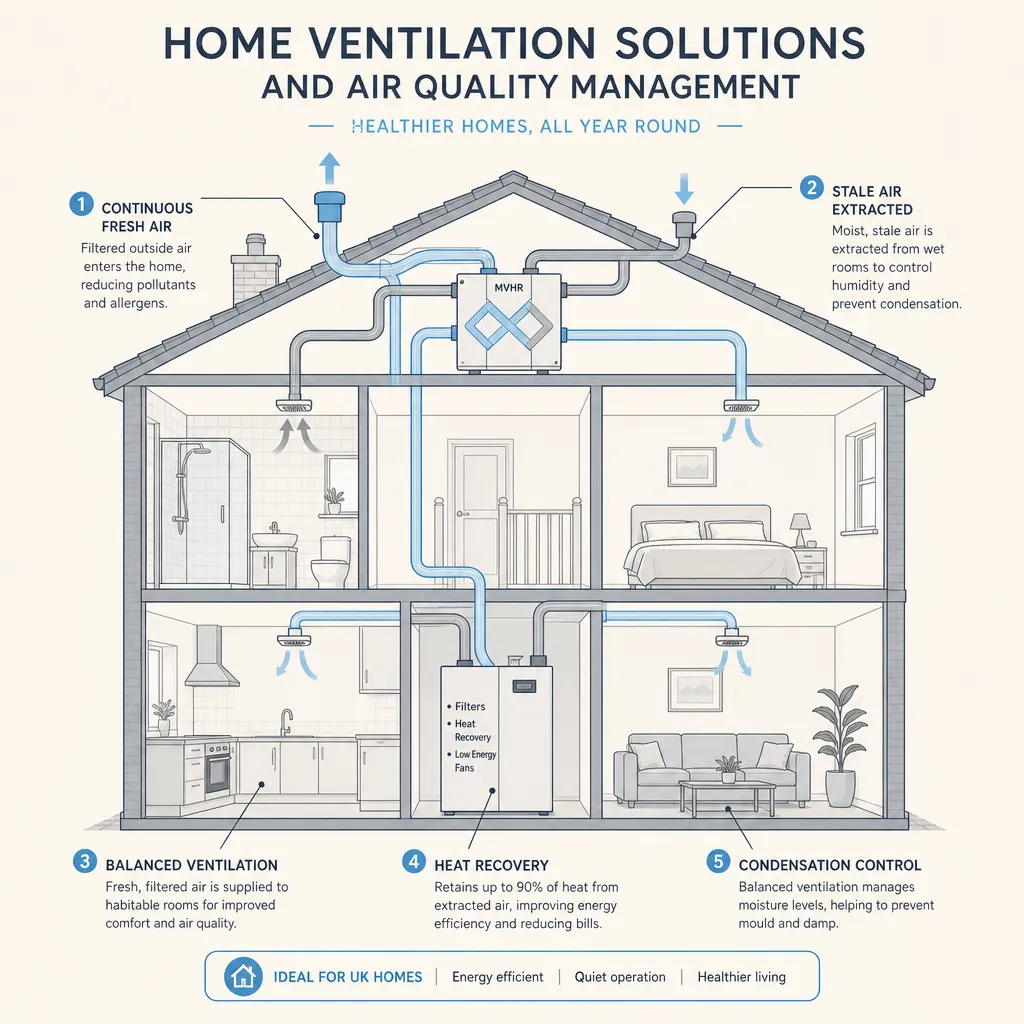
Home Ventilation Solutions and Air Quality Management
The right home ventilation solution depends on how airtight and well-insulated your property is.
 Energy & Retrofit
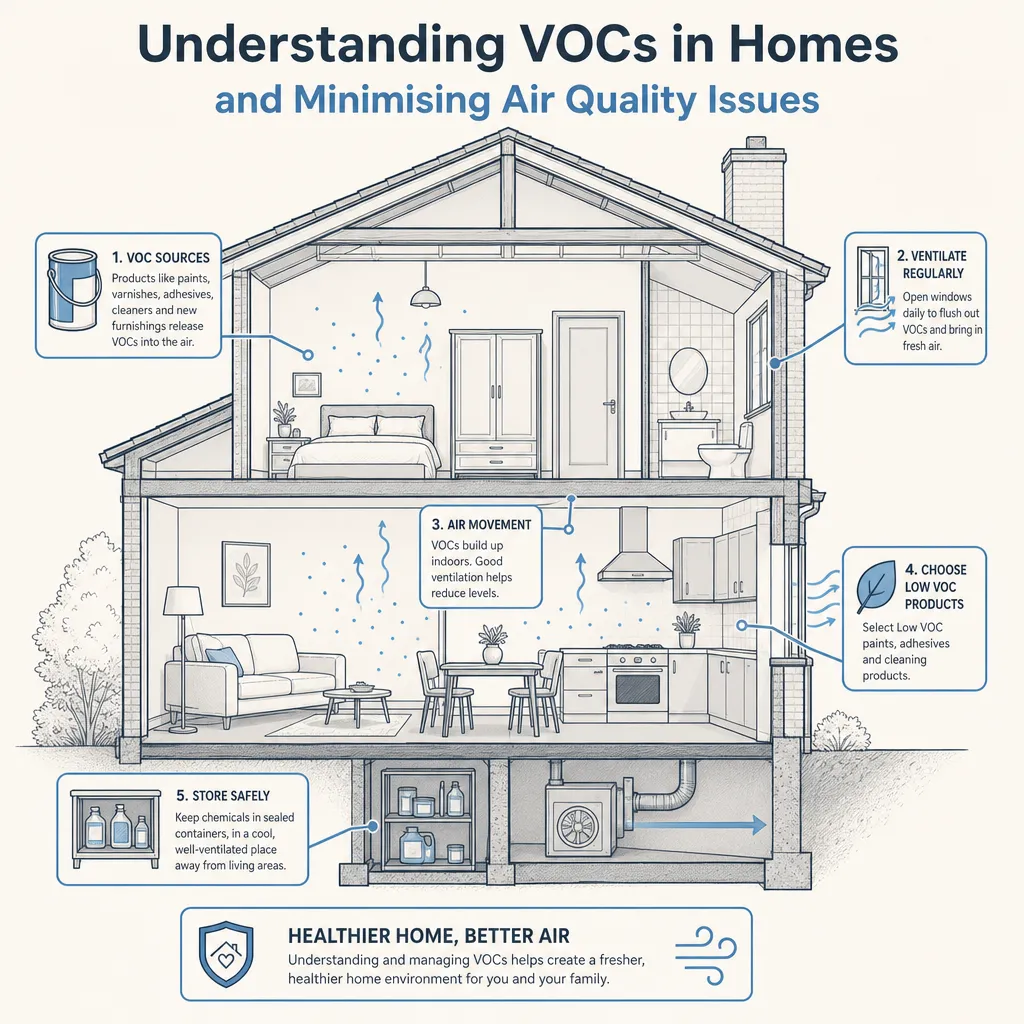
Understanding VOCs in Homes and Minimising Air Quality Issues
Volatile organic compounds (VOCs) are gases emitted by paints, adhesives, flooring, and furnishings found in most UK homes.
 Energy & Retrofit
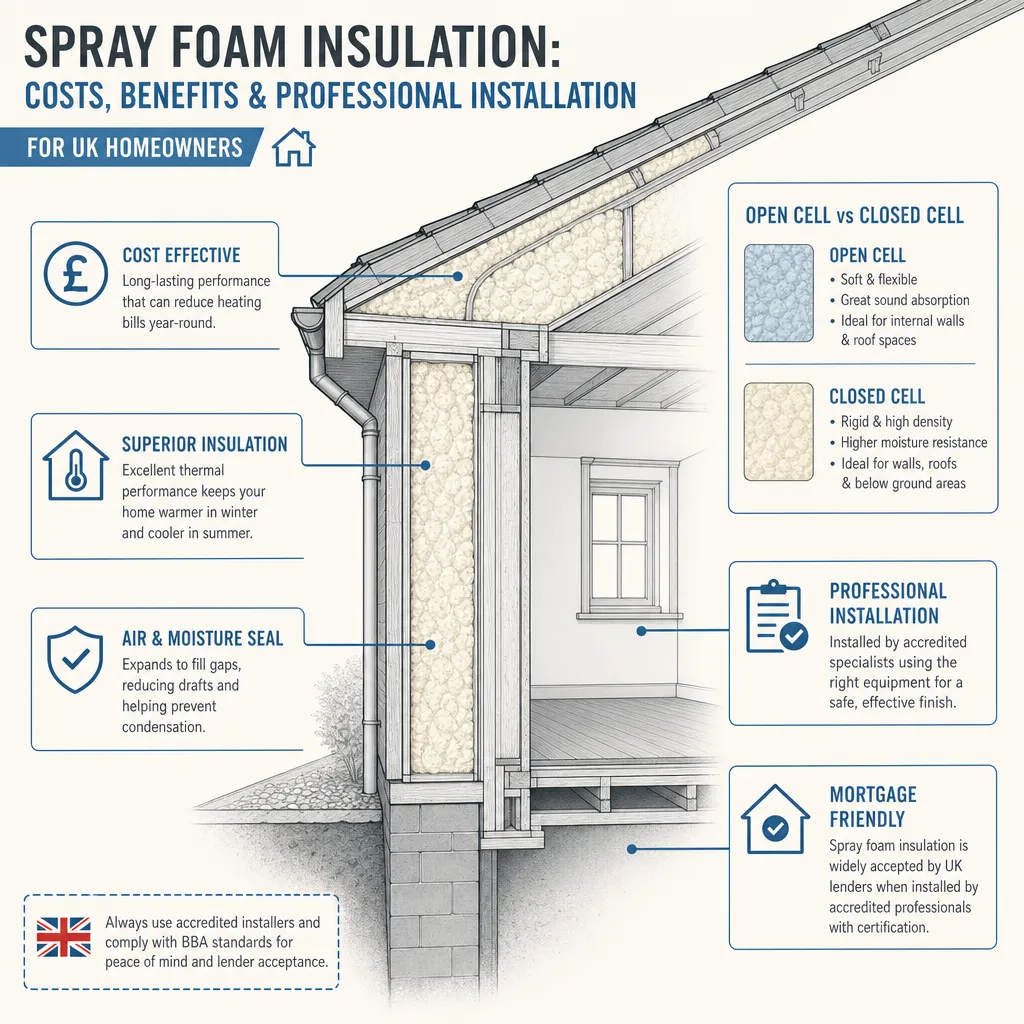
Spray foam insulation: costs, benefits and professional installation
Spray foam insulation costs between £15 and £60 per square metre installed in the UK, depending on whether open-cell or closed-cell foam is used.