Home Ventilation Solutions and Air Quality Management
By Housey · Last reviewed 11th of May 2026
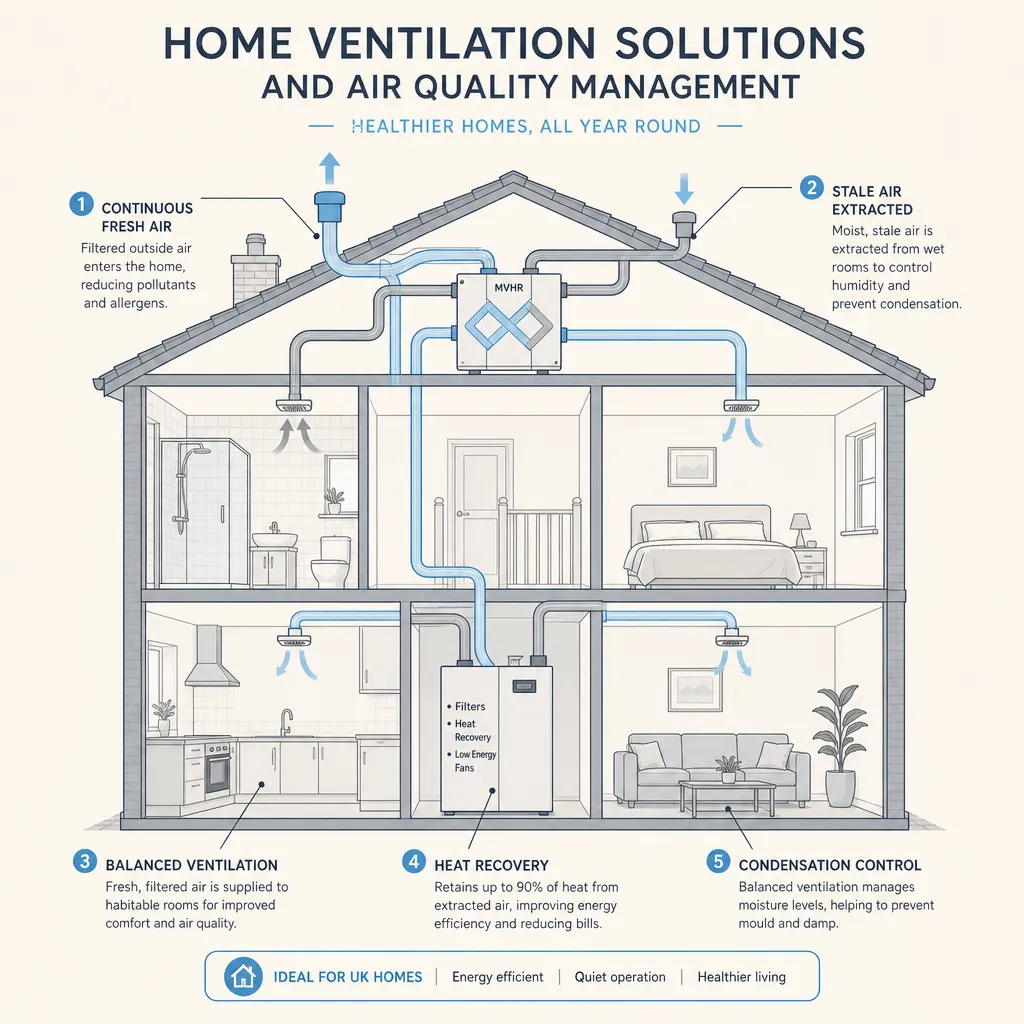
Home Ventilation Solutions and Air Quality Management
Poor ventilation is one of the most common and least visible problems in UK homes. It sits behind persistent condensation, recurring mould, elevated CO₂ levels, and — particularly after insulation upgrades — the moisture-related defects that retrofit specifications such as PAS 2035 are designed to prevent. Whether you are dealing with steamed-up windows each winter, a musty smell that will not shift, or damp patches that reappear despite redecoration, the cause and the correct remedy depend on the type, age, airtightness, and heating pattern of your home.
Key points
- Building Regulations Approved Document F (2021 edition) sets minimum ventilation rates for new and substantially refurbished dwellings in England and Wales, including specific requirements for kitchens, bathrooms, and habitable rooms.
- PAS 2035:2023, the specification governing publicly funded retrofit works including ECO4 and the Great British Insulation Scheme, requires a ventilation assessment before insulation or airtightness measures are installed.
- Mechanical Ventilation with Heat Recovery (MVHR) systems can recover up to 90% of the heat from extracted air, but perform efficiently only in airtight, well-insulated homes — fitting MVHR in a draughty property delivers little thermal benefit.
- Condensation on cold surfaces is a ventilation and heating problem; rising damp and penetrating damp have entirely different causes and different remedies — a proper assessment is needed to tell them apart.
- Background ventilators (trickle vents) are required in replacement windows under Approved Document F; blocking or removing them reduces whole-building ventilation below the regulated minimum.
Understanding ventilation types
System | How it works | Best for | Not ideal for | Indicative installed cost* |
|---|---|---|---|---|
Natural ventilation (trickle vents + opening windows) | Air moves through openings by pressure and temperature difference | Pre-retrofit homes, low airtightness | Highly insulated airtight properties | Minimal (trickle vent replacement £10–£30 each) |
Intermittent extract fans (IEF) | Fan in kitchen or bathroom extracts air on demand or timer | Spot moisture control in individual rooms | Whole-home air quality management | £50–£200 per fan installed |
Continuous mechanical extract ventilation (MEV) | Central unit extracts from wet rooms continuously at a low rate | Whole-home moisture control, moderate insulation levels | Very leaky older properties (risk of over-extraction in winter) | £600–£1,500 installed |
Decentralised MVHR (dMVHR) | Room-by-room units extract and supply fresh air with heat recovery | Retrofit where whole-house ducting is impractical | Properties with very high moisture loads | £200–£500 per unit |
Whole-house MVHR | Central unit with duct network extracts and supplies throughout | New builds, deep retrofits, airtight homes | Poorly insulated homes (condensation risk on cold ducts) | £3,000–£6,000 installed |
Positive Input Ventilation (PIV) | Fan in loft pushes filtered air down into the home | Solid-wall homes, whole-home condensation problems | Homes without a usable loft or with roof insulation issues | £300–£800 installed |
*Indicative UK costs, last reviewed 2026-05-11. Costs vary significantly by property size, existing infrastructure, and installer rates. Obtain at least three quotes before proceeding.
Which ventilation solution suits your home?
Decision tree: choosing a ventilation approach
- Is condensation limited to one or two rooms? → Start by confirming existing trickle vents are open and unobstructed, and that intermittent extract fans are working and ducted to outside. Replace or upgrade fans if needed before investing in a whole-home system.
- Is condensation whole-home, or has it worsened since insulation was installed? → Commission a ventilation assessment calculated in accordance with Approved Document F to establish the whole-building ventilation rate before specifying a solution.
- Is your home highly insulated and airtight, or will it be after planned retrofit works? → Whole-house MVHR is likely the correct long-term solution; engage an MVHR designer to model heat load and duct layout before purchasing equipment.
- Do you have a usable loft and solid or hard-to-insulate walls? → Positive Input Ventilation may offer a cost-effective route to reducing condensation, though a professional assessment should confirm suitability for your construction type.
- Has insulation been installed under ECO4 or the Great British Insulation Scheme? → PAS 2035 requires a Retrofit Coordinator to assess and specify ventilation as part of the retrofit plan; check with your installer or TrustMark that this step was completed.
- Are rooms frequently stuffy, or does a CO₂ monitor regularly exceed 1,000 ppm in occupied spaces? → Extract-only systems do not supply fresh air; whole-home mechanical ventilation with a supply-air element is more effective for CO₂ management than extract-only approaches.
Condensation, mould, and structural damp: what is the difference?
Condensation occurs when warm, moisture-laden air meets a cold surface — typically windows, external walls, or cold bridges. It is a ventilation and heating problem. Black mould (commonly Cladosporium or Aspergillus niger) follows where condensation persists on a surface without adequate air movement or heat.
Structural damp — rising damp or penetrating damp — has entirely different causes: defective or absent damp-proof courses, failed pointing, blocked gutters, or damaged roof flashings. A ventilation upgrade will not resolve structural water ingress.
Before investing in a ventilation system, check:
- Gutters, downpipes, and external drainage are clear and undamaged
- Windows, doors, and roof flashings are weathertight
- The external ground level is not bridging the damp-proof course
- Plumbing leaks have been ruled out
A professional ventilation and condensation assessment will identify whether the problem is airborne moisture, cold bridging, or structural water ingress — and recommend the appropriate remedy for each cause.
Indoor air quality beyond moisture
Ventilation affects more than moisture control. Poor indoor air quality in UK homes is also linked to elevated CO₂ from occupants and combustion appliances, volatile organic compounds (VOCs) from paints, adhesives, and furnishings, and fine particulate matter from cooking and solid-fuel burning.
In homes with solid-fuel stoves or open fireplaces, Approved Document J requires sufficient combustion air supply. Sealing a home without accounting for combustion appliance requirements creates a carbon monoxide risk — a Gas Safe registered engineer (gas appliances) or a HETAS-registered professional (solid-fuel appliances) should check appliance performance after any significant airtightness work.
Where indoor air quality — rather than moisture alone — is the primary concern, an energy-efficiency consultant can assess ventilation, airtightness, and combustion safety together as part of a joined-up whole-home strategy.
Important limitations
This article provides general information about domestic ventilation principles and options for UK homeowners. The correct ventilation strategy for any specific property depends on its construction type, airtightness level, occupancy pattern, heating system, and any existing or planned insulation measures. Ventilation specifications for retrofit projects should be produced by a qualified ventilation designer or TrustMark-registered Retrofit Coordinator. Requirements can differ between England, Wales, Scotland, and Northern Ireland — check the applicable version of the Building Regulations. Nothing in this guide constitutes professional advice or replaces a site-specific assessment.
When this becomes urgent
Seek professional advice promptly if:
- Black mould covers more than 1 m² in any room — this presents a health risk, particularly for children, elderly occupants, and those with respiratory or immune conditions
- Mould is appearing inside wall cavities, on structural timbers, or in the floor void
- CO₂ readings regularly exceed 1,000 ppm in occupied rooms during the heating season
- A combustion appliance is showing signs of incomplete combustion, or a CO alarm has activated
- Condensation or internal damp has appeared or significantly worsened within 12 months of insulation being installed under any funded scheme
What to ask a qualified professional
Before instructing a ventilation installer, assessor, or Retrofit Coordinator, ask:
- Are you TrustMark-registered and qualified to carry out PAS 2035 ventilation assessments for domestic retrofit?
- Will the ventilation specification be calculated in accordance with Approved Document F (2021 edition)?
- If MVHR is proposed, who will design the duct layout and heat recovery sizing, and can you provide CIBSE-compliant calculations?
- Will the system be commissioned and balanced after installation, and is commissioning included in the quoted price?
- How does the specification account for combustion appliances currently in the property?
- What ongoing maintenance does the chosen system require, and who should carry it out?
- If insulation has been installed under a funded scheme, can you confirm a PAS 2035 ventilation assessment was completed before those works proceeded?
When to get professional help
A qualified ventilation assessor should be involved whenever insulation or airtightness measures are planned — PAS 2035 requires this for all publicly funded retrofit schemes. A specialist should also be consulted when condensation and mould persist after basic remedial measures, or when a whole-house MVHR system is being considered. Design errors in MVHR installations can cause duct condensation, inadequate fresh-air supply, or excessive noise, and are far more costly to correct after installation.
How Housey can help
Housey can connect you with qualified professionals for ventilation and condensation assessments and insulation assessments, as well as energy-efficiency consultants who can advise on a whole-home approach covering airtightness, insulation, and ventilation together. Submit your details to receive up to four quotes from local specialists.
Frequently asked questions
Do I need planning permission for a home ventilation system?
Most domestic ventilation installations — extract fans, trickle vents, PIV units, and MVHR — do not require planning permission. However, external grilles or ducts visible from a highway may need consent in conservation areas or for listed buildings. Check with your local planning authority if your property is in a sensitive location before installation begins.
Will an MVHR system save money on energy bills?
MVHR can reduce heating demand by recovering heat from extracted air, with quality systems achieving heat recovery rates of around 85–92%. However, savings depend heavily on how airtight the building is — in a leaky property, much heat loss bypasses the system entirely. An energy consultant can model expected savings for your specific home and construction type.
Is condensation damage covered by home insurance?
Standard home insurance policies do not typically cover condensation damage, as it is generally treated as a maintenance issue rather than an insurable event. If persistent condensation has caused secondary damage — such as rotting window frames or structural timbers — the underlying ventilation problem must be resolved before any repairs will be durable.
Do new-build homes need mechanical ventilation?
Post-2021 Building Regulations (Part F and Part L together) push new builds toward much higher airtightness targets, which in most cases makes mechanical ventilation necessary. From 2025 the Future Homes Standard will tighten requirements further. Developers must confirm the ventilation strategy in the home's documentation pack at handover.
Sources and further reading
Useful next reads
 Energy & Retrofit
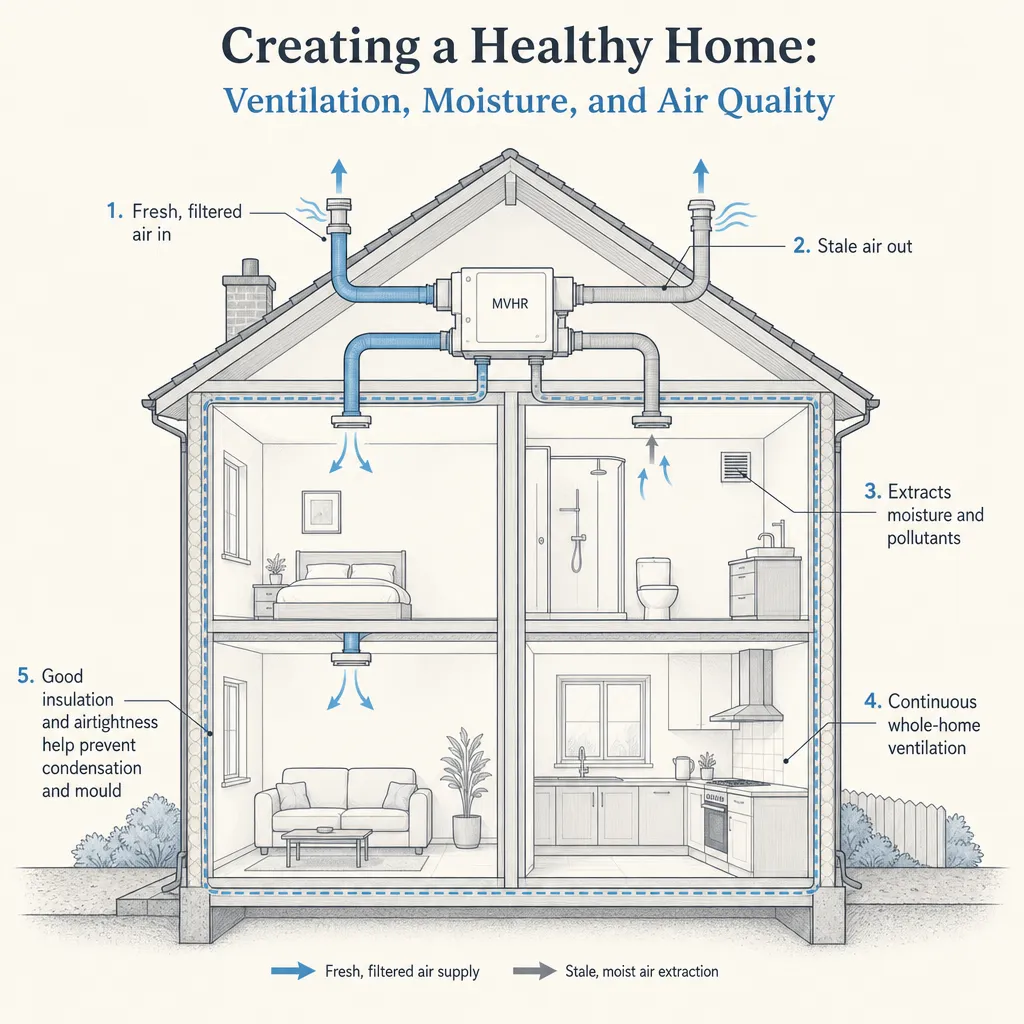
Creating a Healthy Home: Ventilation, Moisture, and Air Quality
Healthy indoor air quality depends on balancing airtightness with adequate ventilation, managing moisture from everyday activities, and removing pollutants at source.
 Energy & Retrofit
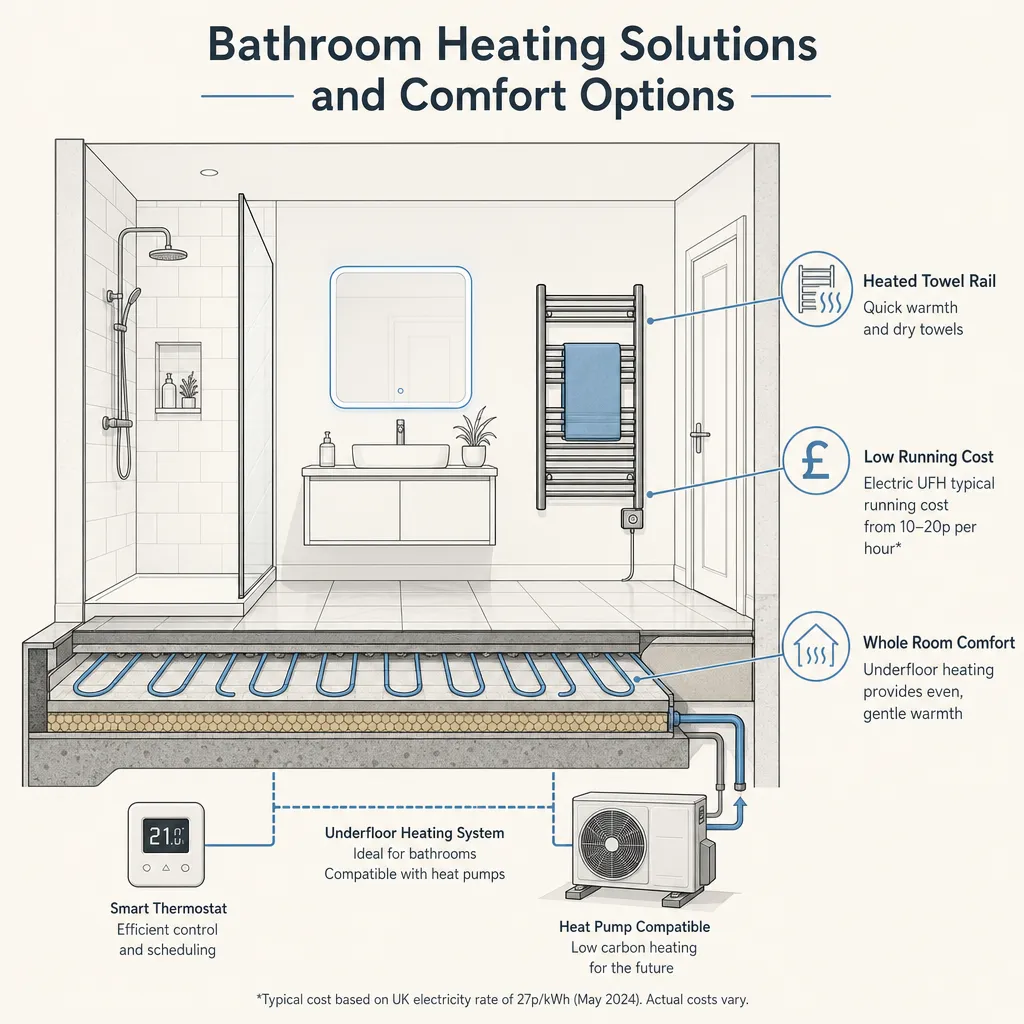
Bathroom Heating Solutions and Comfort Options
UK bathrooms can be heated using electric towel rails, wet radiators on the central heating circuit, electric or wet underfloor heating, or infrared panels.
 Energy & Retrofit
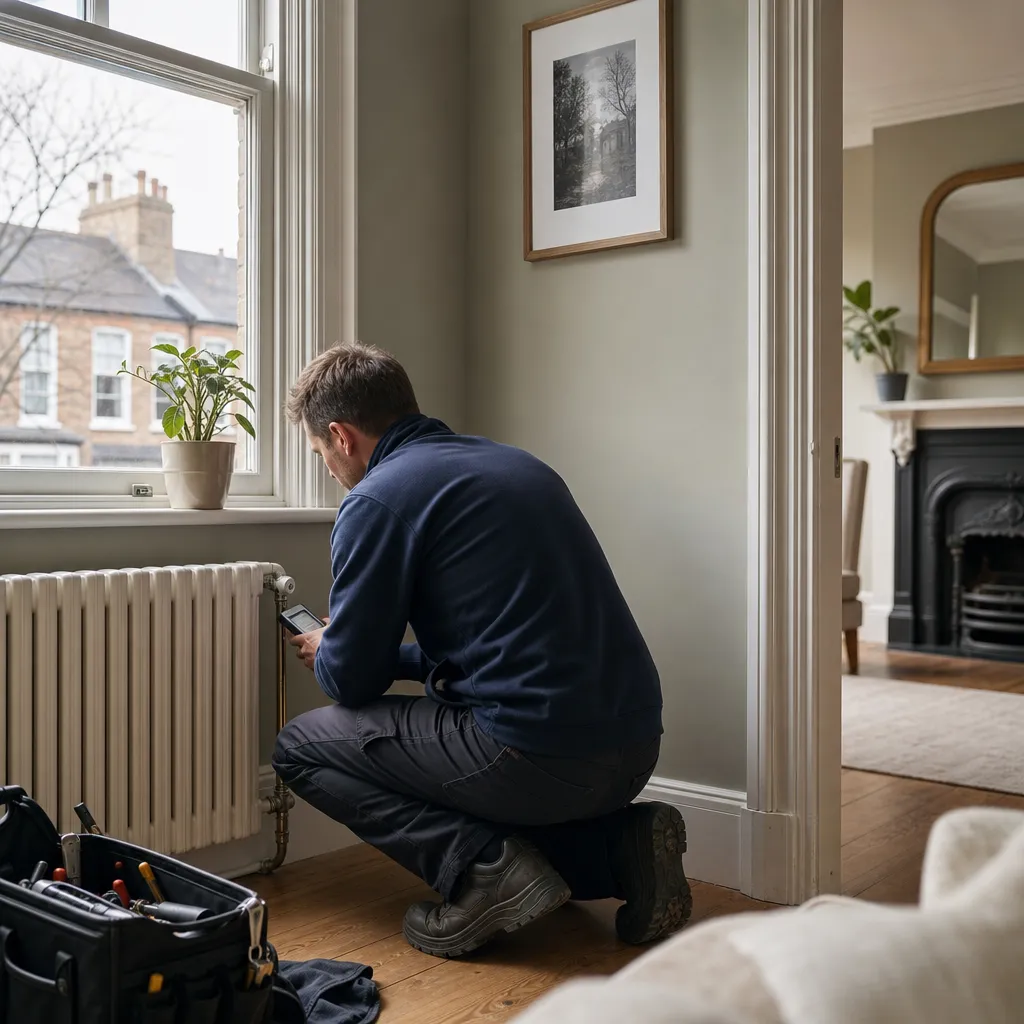
Diagnosing and Fixing Temperature Imbalances in Your Home
Temperature imbalances in UK homes usually stem from hydraulic imbalance in the central heating system, cold bridging at poorly insulated walls or junctions, air infiltration through gaps and draughts, or problems with thermostat placement.
 Energy & Retrofit
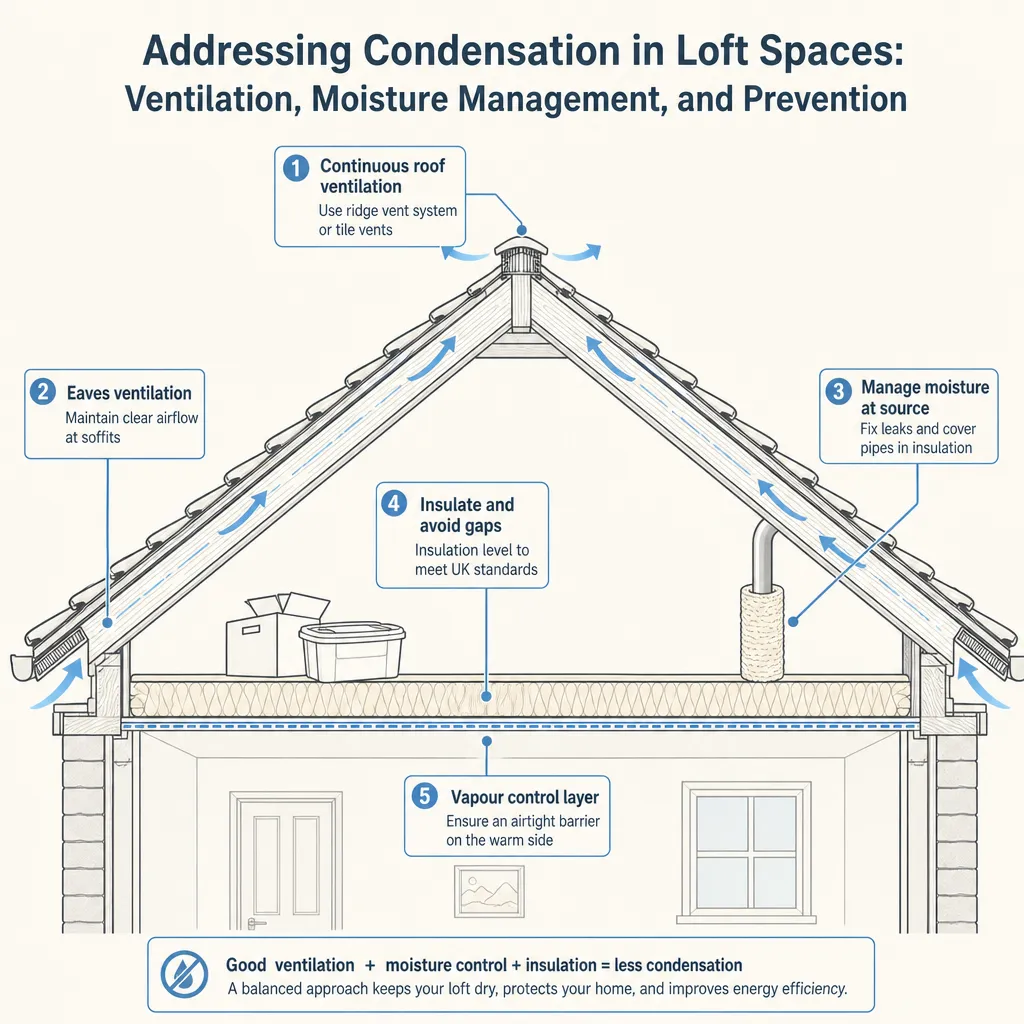
Addressing Condensation in Loft Spaces: Ventilation, Moisture Management, and Prevention
Loft condensation forms when warm, moist air from living spaces passes through ceiling gaps and deposits moisture on cold roof timbers or underfelt.
 Energy & Retrofit
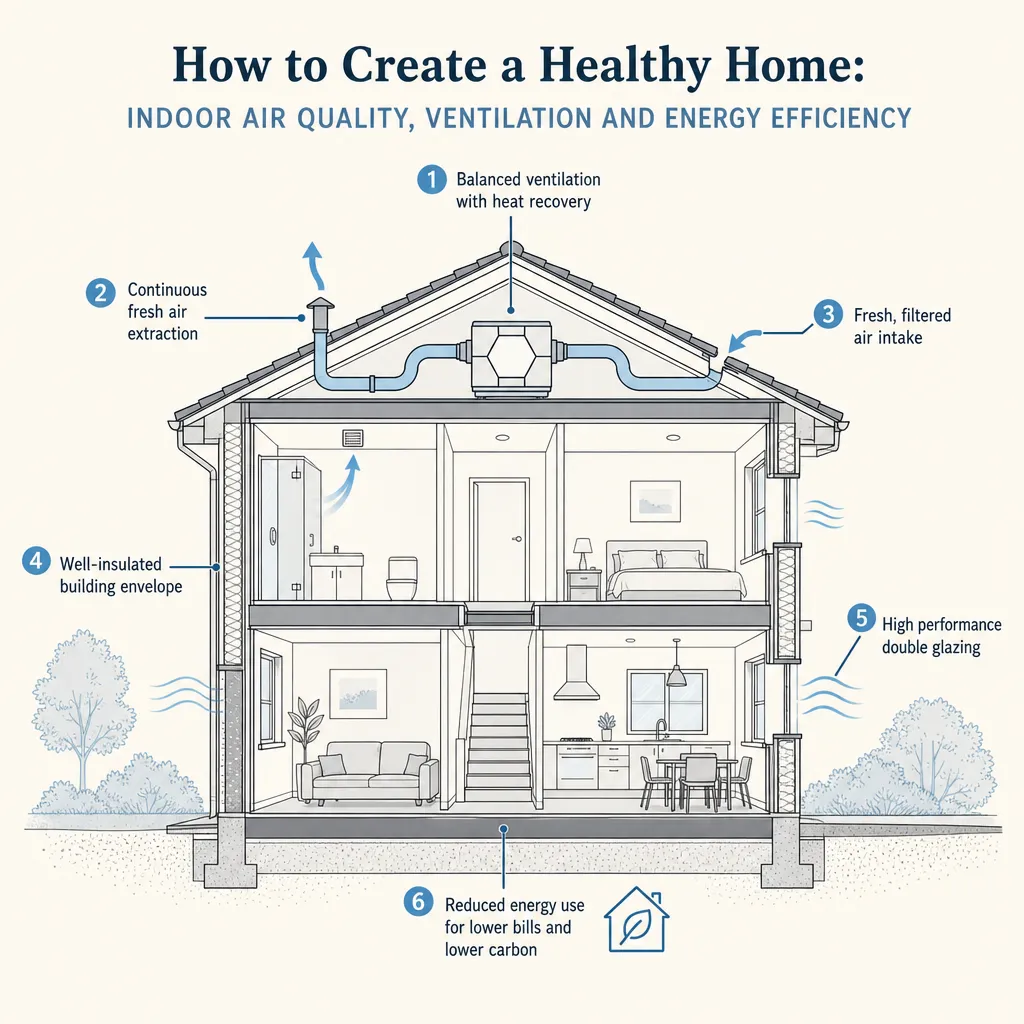
How to Create a Healthy Home: Indoor Air Quality, Ventilation and Energy Efficiency
A healthy home in the UK maintains good indoor air quality through adequate ventilation, controls moisture to prevent damp and mould, and uses insulation to keep temperatures stable without trapping pollutants.