UK Markets with Strongest Renovation Spending Among Homeowners with Accessibility Needs
By Housey · Last reviewed 24th of May 2026
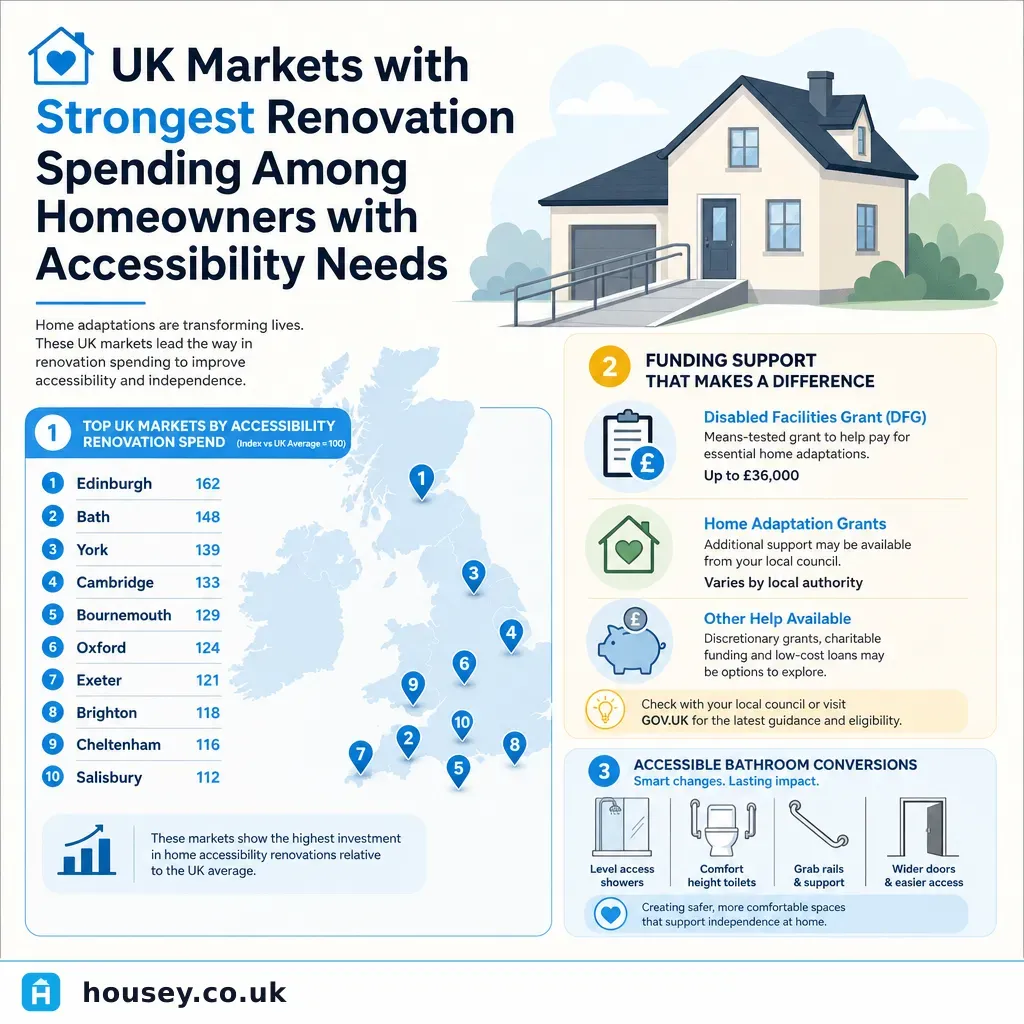
UK Markets with Strongest Renovation Spending Among Homeowners with Accessibility Needs
Accessibility adaptations are one of the most practical forms of home improvement: they directly affect quality of life, reduce hospital admissions, and often increase a property's long-term usability across generations. Demand is concentrated in areas with older housing stock and ageing populations — factors that create particular pressure in parts of the South West, Yorkshire and the Humber, and the East Midlands. For homeowners navigating an adaptation project, understanding local grant availability and the right sequence of professionals makes a significant difference to cost and outcome.
Key points
- The Disabled Facilities Grant (DFG) provides up to £30,000 in England, up to £36,000 in Wales, and up to £25,000 in Scotland towards essential adaptations; it is means-tested in England and Wales.
- An occupational therapist (OT) assessment is almost always required before a local authority processes a DFG application — the OT's recommendation defines what adaptations are "necessary and appropriate."
- Building Regulations Approved Document M (Access to and Use of Buildings) sets minimum standards for adaptations requiring building control approval, including door clear openings of at least 775 mm for wheelchair access in new or significantly altered circulation routes.
- Home Improvement Agencies (HIAs), co-ordinated nationally through Foundations, offer free or low-cost support to help older and disabled homeowners organise quotes, manage contractors, and apply for grants.
- Adaptation spending is driven by areas with high proportions of over-65 residents and older pre-1919 housing stock, which is less likely to have accessible layouts or level access at entry.
Where accessibility renovation demand is strongest in the UK
Renovation spending on accessibility adaptations broadly tracks two variables: the proportion of the local population aged 65 and over, and the proportion of homes built before 1945 — which were rarely designed with step-free access, accessible bathrooms, or wide internal doorways.
Local authority DFG allocations (published annually by the Ministry of Housing, Communities and Local Government) reflect this geography. Rural and coastal areas in the South West — including parts of Devon, Cornwall, and Dorset — alongside urban areas in Yorkshire and the East Midlands tend to show higher DFG utilisation relative to population. Wales has a higher DFG maximum (£36,000) partly reflecting the older average age of Welsh housing stock.
That said, high demand is not unique to any single region. An ageing population is a national trend: ONS projections indicate that by 2043 roughly one in four people in the UK will be aged 65 or over. For homeowners and families planning ahead, this makes accessibility adaptations a near-universal consideration for any property likely to be occupied over the next 20 years.
What accessibility adaptations typically involve
The scope of an accessibility adaptation can range from a single grab rail to a whole-room remodel or a purpose-built ground-floor extension. Common projects include:
Adaptation type | Typical scope | Relevant building regulation | Funding eligibility |
|---|---|---|---|
Level-access shower / wet room | Full bathroom remodel, waterproofing, drainage alteration | Part G (sanitation), Part M (access) | Often DFG-eligible |
Stairlift or through-floor lift | Structural opening or mechanical installation | Part K (protection from falling) | Often DFG-eligible |
Widened doorways | Door frame removal, lintel check, redecoration | Part M (775 mm clear opening) | Sometimes DFG-eligible |
Ramped or level entrance | External groundwork, DPC considerations | Part M, Part C (moisture) | Often DFG-eligible |
Ground-floor extension (bedroom/bathroom) | Full building works including foundations | Part A (structure), Part M, Part L (energy) | Potentially DFG for essential elements |
Handrails and grab rails | Fixing into solid wall substrate | Part K | Minor adaptations grant or DFG |
Costs and DFG eligibility depend on individual assessment and local authority allocation. Indicative UK costs, last reviewed 2026-05-24 — always obtain multiple quotes.
Ground-floor extensions built to enable a disabled person to remain in their home are among the more expensive projects, but they also qualify most clearly for DFG support. A single-storey rear extension providing a bedroom and accessible wet room is a recognised DFG application type.
Funding routes: Disabled Facilities Grants and beyond
The DFG is the primary publicly funded route for essential adaptations. In England, applications go through the local housing authority; the process usually takes 6–18 months from initial enquiry to works completion, depending on OT waiting lists and contractor availability.
Beyond DFG, funding routes include:
- Local authority discretionary grants — many councils hold additional funds for adaptations that fall outside DFG scope, such as garden works or larger extensions. Availability varies significantly by area.
- Social Care direct payments — under the Care Act 2014, adults assessed as having eligible care needs may receive direct payments that can contribute towards adaptation costs.
- Equity release / remortgage — for homeowners with property equity who need to move faster than the DFG timeline allows. Seek independent financial advice before proceeding.
- Charity funding — organisations including Foundations' member HIAs can identify charitable grants for specific circumstances.
- VAT relief — adaptations for disabled people are often zero-rated for VAT under HMRC Group 12 relief, which can reduce costs meaningfully on larger projects.
Always check current eligibility directly with your local authority and Home Improvement Agency, as grant thresholds and local policies change.
Building regulations and planning considerations
Most internal adaptations — grab rails, stairlifts, wet rooms — require building regulations approval but not planning permission. However, the position changes for:
- Extensions: a single-storey rear or side extension will typically require either a full planning application or confirmation it falls within permitted development rights. Permitted development limits vary by property type, local conservation area status, and prior extension history.
- Through-floor lifts: may require a structural opening; building control approval is needed. In a leasehold property, written consent from the freeholder is usually required.
- Listed buildings: any adaptation to a listed building requires Listed Building Consent in addition to any planning or building control approvals. Contact your local planning authority's heritage officer early in the process.
For permitted development queries, check with your local planning authority before starting work — permitted development rights can be removed by Article 4 Directions in some areas.
Which professional do you need?
Professional | When you need them | Qualification to look for |
|---|---|---|
Occupational therapist (OT) | DFG application; access needs assessment | HCPC-registered occupational therapist |
Architect or architectural technologist | Ground-floor extension; listed building works | RIBA (architect), CIAT (technologist) |
Structural engineer | Loadbearing wall removal; through-floor lift opening | CEng, MIStructE or MICE |
Builder / extension specialist | Construction works, wet rooms, groundwork | FMB membership or TrustMark registration |
Stairlift / lift installer | Stairlift or through-floor lift supply and fit | LEIA (Lift and Escalator Industry Association) member |
Home Improvement Agency advisor | Grant navigation, contractor tendering support | Foundations member HIA |
When to get professional help
Contact a qualified professional — not just a contractor — if:
- Your adaptation project involves removing or altering a loadbearing wall or introducing a new structural opening.
- The property is leasehold and written consent from the freeholder or management company is required.
- The building is listed or in a conservation area, where standard permitted development rules do not apply.
- You are unsure whether your planned works fall within permitted development or require a full planning application.
- An OT assessment has recommended adaptations beyond minor aids and equipment — a full DFG application requires professional oversight throughout.
How Housey can help
If your accessibility project includes structural work, a ground-floor extension, or significant internal remodelling, connecting with the right contractor early is essential. Housey can match you with vetted extension builders and window and door installers who have experience with accessible design requirements, saving you time on research and quotes.
Frequently asked questions
Do I need planning permission for a home adaptation?
Most internal adaptations — wet rooms, stairlifts, widened doors — require building regulations approval but not planning permission. External works such as ramps and extensions usually fall under permitted development if within size limits, but rules vary by property type and location. Always verify with your local planning authority before starting external works.
How long does a Disabled Facilities Grant take?
In England, the statutory time limit from application to decision is 6 months; works are expected to be completed within 12 months. In practice, delays at the OT assessment stage can extend the overall timeline to 12–18 months. Local Home Improvement Agencies can often help expedite the process.
Can I adapt a leasehold flat for accessibility?
Yes, but leasehold tenants usually need written consent from the freeholder or management company before making structural alterations. The Equality Act 2010 provides some protections — landlords cannot unreasonably withhold consent for reasonable adjustments — but this is a legal area where advice from a solicitor familiar with leasehold law is advisable.
Is VAT charged on disability adaptation work?
Many adaptations for disabled people are zero-rated for VAT under HMRC's relief for qualifying works (Group 12, Schedule 8, Value Added Tax Act 1994). This can provide a meaningful cost saving on larger projects. Ask your contractor and confirm eligibility with HMRC or a tax adviser for your specific works.
Sources and further reading
- Disabled Facilities Grant — GOV.UK
- Approved Document M: Access to and use of buildings — GOV.UK / MHCLG
- Foundations — national body for Home Improvement Agencies — Foundations
- Care Act 2014 statutory guidance — GOV.UK
- VAT relief for disabled people — GOV.UK / HMRC
Useful next reads
 Improvement & Build
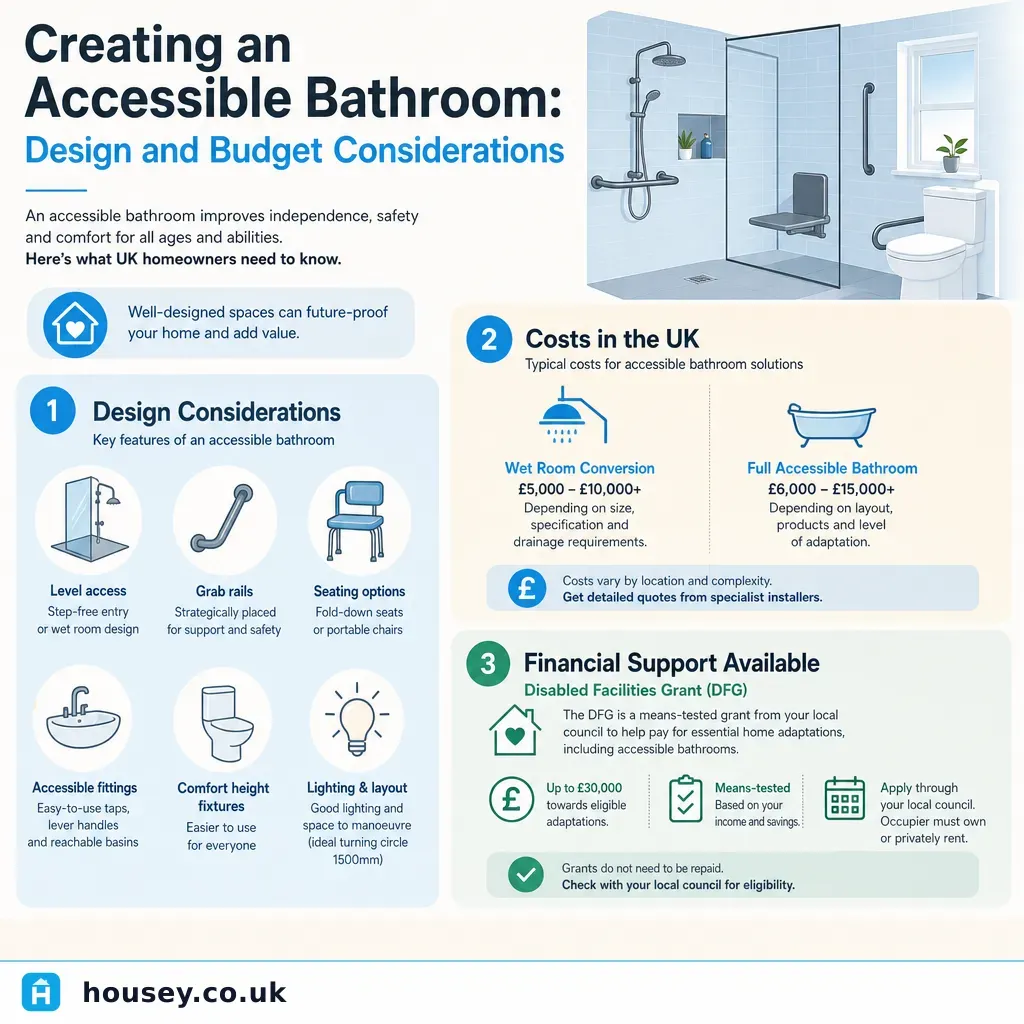
Creating an Accessible Bathroom: Design and Budget Considerations
An accessible bathroom typically combines a level-access or wet-room shower, grab rails, a comfort-height WC, and non-slip flooring.
 Improvement & Build
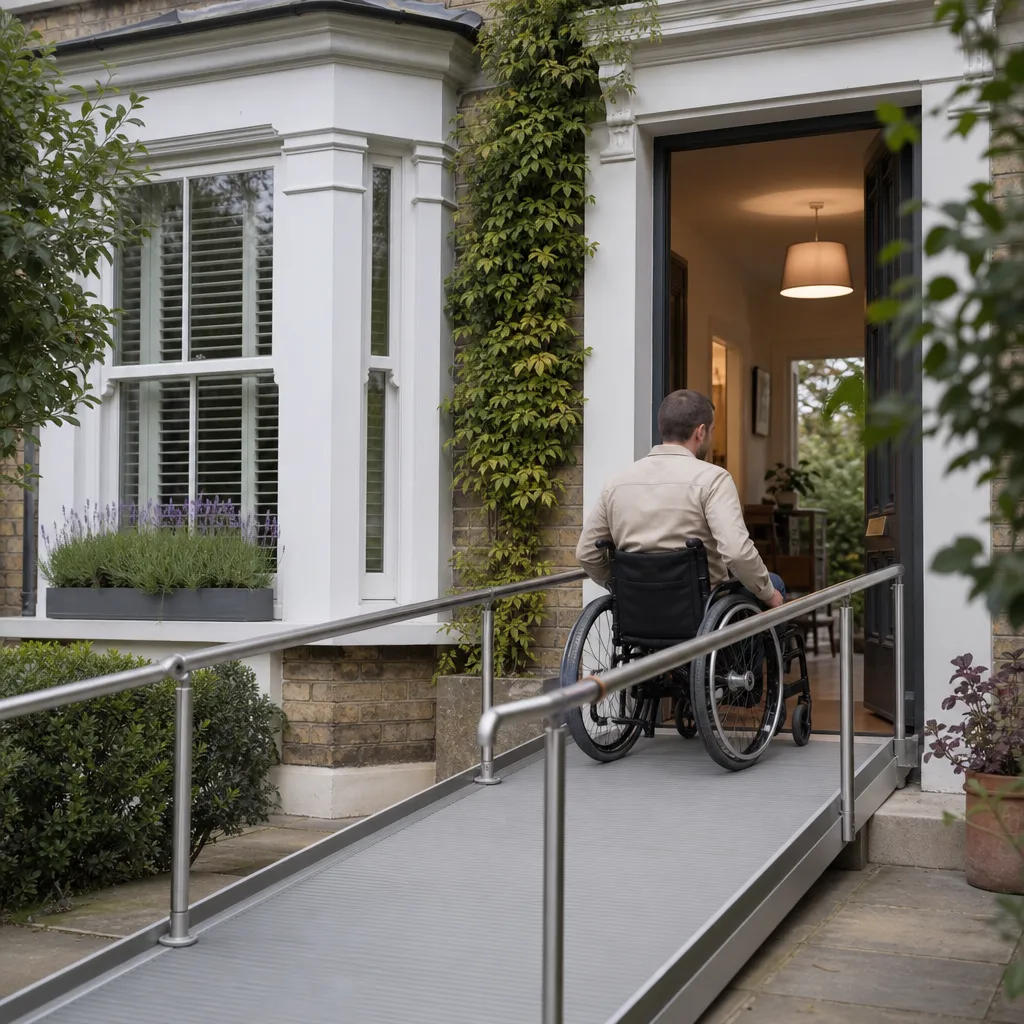
Universal Design Principles: Adding Value and Accessibility to Your Home
Universal design creates homes that work for the widest range of people without requiring costly retrofitting later.
 Improvement & Build
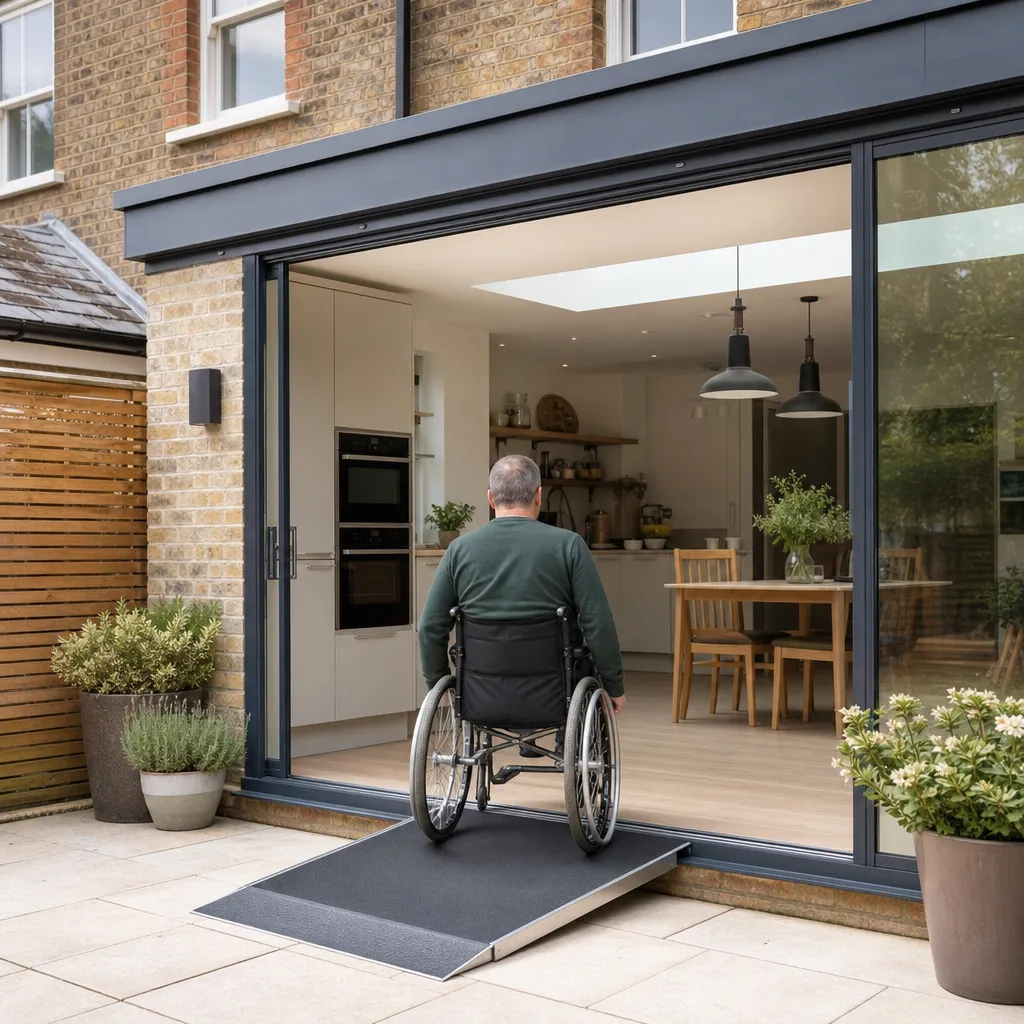
Accessible Home Renovation: Combining Style With Inclusive Design
Accessible home renovation incorporates level thresholds, wider doorways, lever handles, and wet rooms into quality design from the outset.
 Improvement & Build
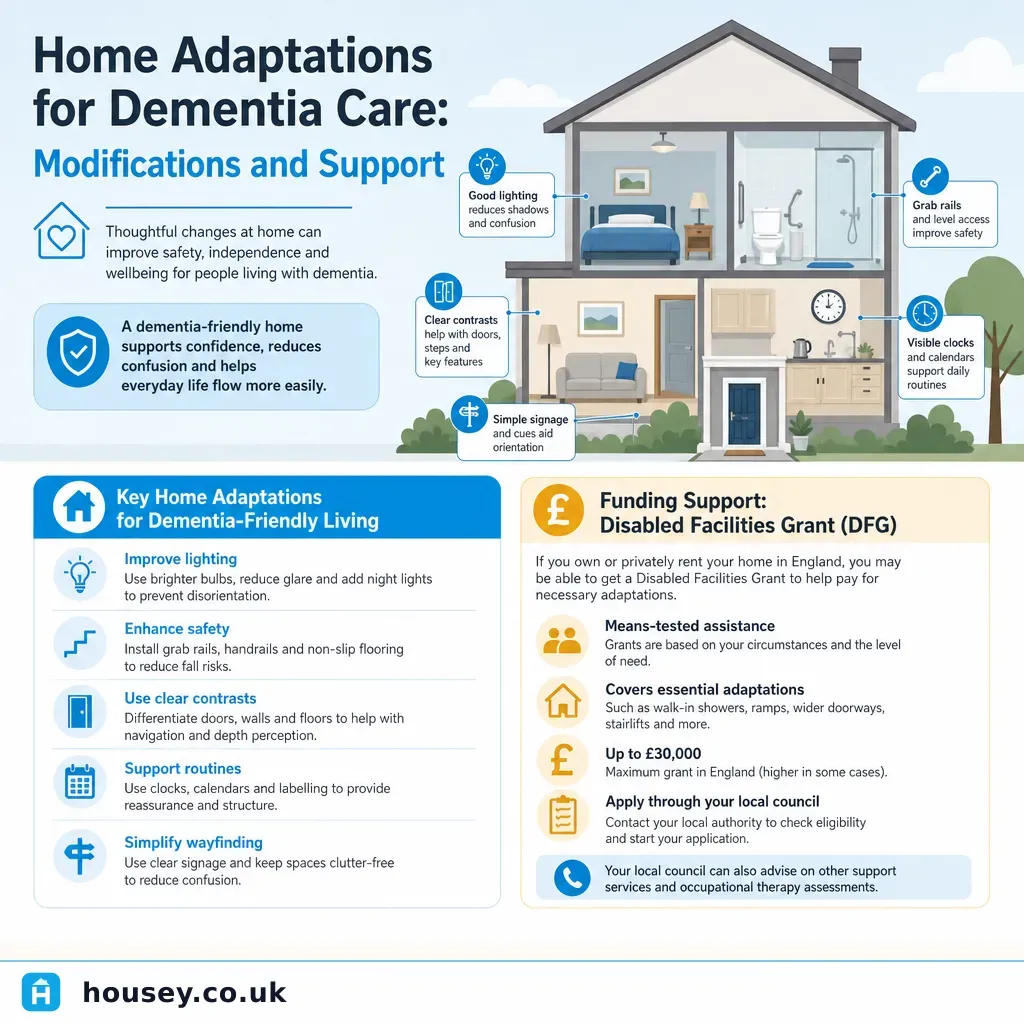
Home Adaptations for Dementia Care: Modifications and Support
Home adaptations for dementia typically include improved lighting, contrasting colours, clear signage, grab rails, and level-access wet rooms.
 Improvement & Build
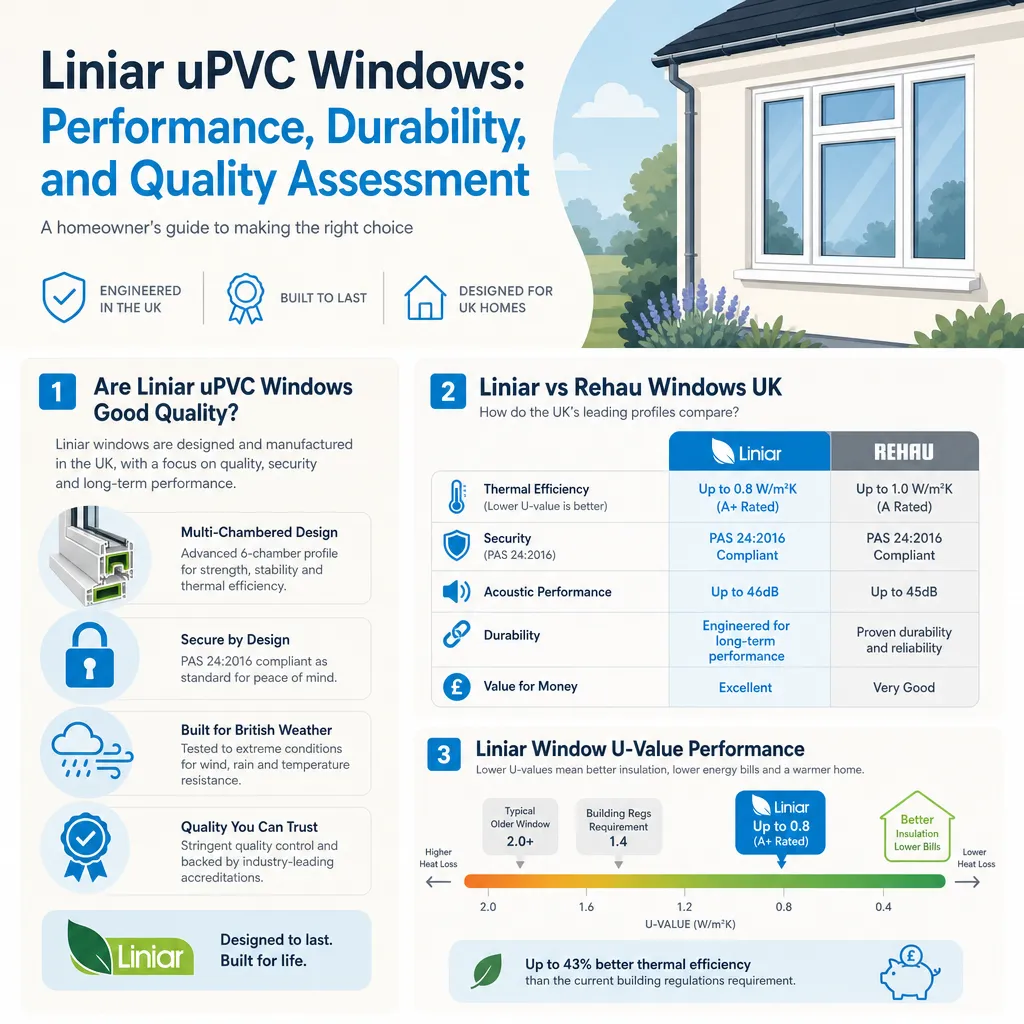
Liniar uPVC Windows: Performance, Durability, and Quality Assessment
Liniar uPVC window profiles are manufactured in the UK using multi-chambered, foamed frames.