Creating Valuable Outdoor Living Spaces: Design and Installation
By Housey · Last reviewed 8th of May 2026
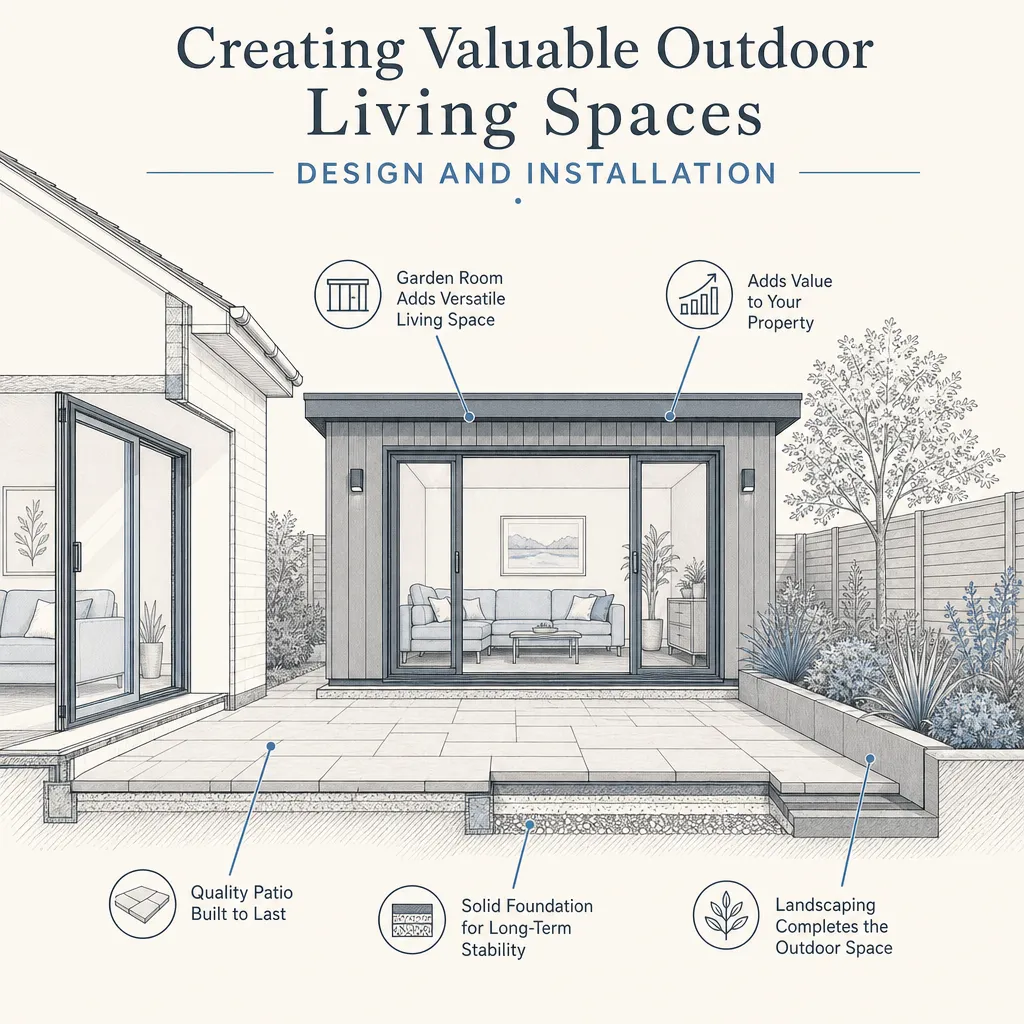
Creating Valuable Outdoor Living Spaces: Design and Installation
Most UK homeowners begin thinking seriously about outdoor living after a disappointing summer on a cramped patio — or when a neighbour's new garden room prompts a rethink. The question is rarely whether to improve the space and more often what will actually work for the property, what consents are needed, and whether the investment is worthwhile. Whether you are planning a simple paved terrace or a fully fitted garden room, the decisions made at the design stage determine whether the result adds genuine, lasting value.
Key points
- Permitted development rights allow most patios and ground-level decks under 300mm high without a planning application, but restrictions apply in conservation areas and to listed buildings.
- Garden rooms (outbuildings) over 2.5m in height, or those covering more than 50% of the original garden area, require planning permission under the Town and Country Planning (General Permitted Development) (England) Order 2015.
- Building regulations approval is required for garden rooms intended as habitable space — insulated, heated, and used as a home office or bedroom — and for any structural groundworks.
- Indicative UK costs range from approximately £2,000 for a basic patio to £50,000+ for a bespoke garden room with groundworks, electrics, and heating (Indicative UK costs, last reviewed 2026-05-08).
- Resale value uplift from outdoor improvements is not guaranteed; general industry guidance suggests a well-designed garden may add 5–15% to perceived value, but this varies considerably by location, property type, and market conditions.
What counts as an outdoor living space?
Outdoor living spaces cover a broad range of home improvements, from a simple paved patio to a fully glazed garden pavilion. The most common types in UK residential projects are:
- Patios and terraces: hard-landscaped areas directly adjoining the house, typically in stone, porcelain, brick, or concrete.
- Decking: raised or ground-level timber or composite platforms, popular in rear gardens with changes in level.
- Garden rooms and studios: insulated outbuildings used as home offices, gyms, playrooms, or leisure spaces.
- Outdoor kitchens and dining areas: often combined with pergolas, canopies, or bi-fold doors opening from the kitchen.
- Integrated landscaping: planting, levels, boundary treatment, lighting, and drainage combined with hard surfaces.
The category matters because planning and building regulations requirements differ significantly between a patio (generally no consents needed) and a garden room with electrics and heating (may require both).
Do you need planning permission?
For most patio and decking projects, planning permission is not required in England under permitted development. The rules depend on several factors.
Patios and ground-level decks are generally permitted development if:
- The deck or patio is no more than 300mm above natural ground level.
- The total area of decking plus other outbuildings does not exceed 50% of the original garden area.
Garden rooms and outbuildings are permitted development if:
- The building is no more than 2.5m high (or up to 4m for a dual-pitched roof, 3m otherwise, if it is more than 2m from any boundary).
- The total footprint of all outbuildings does not exceed 50% of the curtilage.
- The outbuilding is not forward of the principal elevation and is not used as a separate dwelling.
Exceptions: These rules do not apply in conservation areas, Areas of Outstanding Natural Beauty, or to listed buildings, where planning permission or listed building consent may be required even for minor works. In Wales and Scotland, different permitted development rules apply — check with your local planning authority or the Planning Portal before starting work.
Choosing the right outdoor living space for your property
The best choice depends on your garden's size, orientation, existing layout, and intended use.
Space type | Best for | Not ideal for | Typical professional | Main consideration |
|---|---|---|---|---|
Patio or terrace | Most gardens, year-round use, low maintenance | Very small north-facing plots | Landscaper or groundworker | Drainage falls, material selection |
Decking | Gardens with level changes, informal aesthetic | Shaded or damp sites (higher maintenance risk) | Landscaper or carpenter | Timber decay, composite alternatives |
Garden room | Home office, gym, year-round usable room | Very small gardens (under 5m depth to boundary) | Extension builder or specialist supplier | Planning, building regs, insulation spec |
Outdoor kitchen | Open-plan kitchen-dining homes | North-facing gardens, frequent heavy rain | Landscaper plus kitchen fitter | Gas or electrical connections, weather cover |
Integrated landscaping | All gardens — complements any hard feature | No equivalent | Garden designer plus landscaper | Drainage, planting scheme, lighting |
Decision tree
- Choose a patio or terrace if your main goal is a low-maintenance, durable outdoor area for dining and relaxing.
- Choose decking if your garden has significant changes in level or you prefer an informal, timber aesthetic.
- Choose a garden room if you need a year-round usable space with insulation, heating, and electrics.
- Choose integrated landscaping alongside any hard feature to make the space feel considered rather than purely functional.
- Consult a garden designer if you are unsure how all elements should relate to each other and to the house.
- Check with your local planning authority if the property is listed, in a conservation area, or if the proposed outbuilding is larger than a single room.
Materials and design options
Material choice affects durability, maintenance requirements, cost, and planning implications.
Paving materials: Natural sandstone and slate offer a premium look but vary in porosity and slip resistance. Porcelain is increasingly popular for its durability and low maintenance. Concrete and block paving are cost-effective alternatives. Hard surfaces over 5 square metres positioned directly in front of the principal elevation must use permeable materials or drain to a soakaway under Schedule 2, Part 1, Class F of the GPDO.
Decking materials: Softwood timber is the cheapest option but requires regular treatment to prevent decay. Hardwood species such as Bangkirai or Iroko are more durable but carry sustainability considerations — look for FSC-certified timber. Composite decking (recycled plastic and wood fibre) has higher upfront costs but significantly lower ongoing maintenance requirements.
Garden room construction: Timber-frame is the most common approach for residential garden buildings. Structural insulated panels (SIPs) offer better thermal performance. Insulation specification and glazing quality determine year-round usability and energy running costs — a poorly insulated garden room will be uncomfortable in winter regardless of its size.
How much does an outdoor living space cost?
Costs vary significantly by size, materials, site conditions, and specification. The figures below are indicative only.
Indicative UK costs, last reviewed 2026-05-08. Always obtain at least three quotes from qualified contractors.
Project type | Indicative cost range | Key cost drivers |
|---|---|---|
Basic patio (40–60 m²) | £2,000–£5,000 | Materials, drainage, access |
Premium stone terrace (40–60 m²) | £5,000–£12,000 | Natural stone, bespoke design, level changes |
Composite decking (30 m²) | £3,500–£8,000 | Subframe, size, access, fixing method |
Garden room (12–20 m²) | £15,000–£40,000 | Insulation, glazing, electrics, foundation type |
Outdoor kitchen with canopy | £8,000–£25,000 | Appliances, gas or electrical connections, weatherproofing |
Integrated landscape design and build | £10,000–£50,000+ | Size, complexity, planting scheme, drainage |
VAT at 20% applies to most garden and landscape work. Always confirm whether quotes are inclusive of VAT.
What to ask before accepting a quote
- What is included and excluded from the scope — specifically drainage, groundworks, and waste removal?
- Who will carry out the work, and what qualifications or accreditations do they hold?
- What planning checks have been made, and who is responsible if consent is subsequently required?
- What warranties are provided for materials and workmanship?
- What assumptions is the quote based on — for example, ground conditions and existing drainage capacity?
- Is VAT included?
- What are the payment terms, and is a stage-payment schedule available for larger projects?
When to get professional help
For a standard patio, an experienced landscaper or groundworker can usually deliver a good result. You should involve a qualified professional when:
- The project includes structural elements such as retaining walls, changes of more than 300mm in ground level, or foundations for a garden room.
- Drainage from hard surfaces needs to connect to an existing soakaway or drainage system — poorly designed drainage can cause flooding and may breach planning conditions.
- Electrical work is needed for a garden room, outdoor lighting, or socket circuits — this must be completed by a Part P-registered electrician under Building Regulations Part P.
- Gas connections are required for an outdoor kitchen — only a Gas Safe registered engineer may work on gas installations.
- The property is listed or in a conservation area — seek formal planning advice before committing to a design.
- You are making a substantial investment and want independent design oversight to reduce the risk of costly mistakes.
How Housey can help
Housey connects you with qualified garden designers to help develop a design brief, as well as landscapers and groundworkers to carry out the work. For larger projects involving structural elements or garden room foundations, you can also request quotes from extension builders experienced in outbuilding and outdoor projects.
Frequently asked questions
Does a garden room add value to my home?
A well-designed, insulated garden room used as a home office or leisure space can add perceived value and make a property more attractive to buyers. However, uplift is not guaranteed and varies by location, market conditions, and how well the structure is integrated with the rest of the property. Ask a valuer specifically whether the feature supports the asking price before listing.
Do I need planning permission for a patio?
Most patios and ground-level hard surfaces in rear gardens do not require planning permission under permitted development. Front garden paving over 5 square metres must use permeable materials or drain to a soakaway. If your home is listed or in a conservation area, different rules apply — always check with your local planning authority before starting work.
What is the difference between a garden room and a conservatory?
A garden room is a free-standing or attached outbuilding separated from the main house. A conservatory is attached to the dwelling with a roof that is at least 75% translucent, placing it outside certain building regulations requirements — though energy-efficiency rules still apply to extensions. Planning and building regulations requirements differ between the two types.
How long does it take to install a patio?
A standard patio of 40–60 square metres typically takes 3–7 days depending on site preparation requirements, material delivery, and weather. Projects involving drainage works or bespoke stonework can take 2–4 weeks. Garden rooms typically take 4–10 weeks from order to completion, including foundation works and any electrical fit-out.
Can I build a garden room right up to my boundary?
Under permitted development in England, a garden room must be at least 2m from any boundary if it is taller than 2.5m. You may build up to the boundary for structures under 2.5m. Always confirm with your local planning authority — particularly if prior extensions may have reduced your permitted development allowance.
Sources and further reading
- Planning Portal: Outbuildings — Planning Portal
- GOV.UK: Planning permission — GOV.UK
- The Town and Country Planning (General Permitted Development) (England) Order 2015 — legislation.gov.uk
- LABC: Building Regulations guidance for homeowners — Local Authority Building Control
- Energy Saving Trust: Insulating your home — Energy Saving Trust
Useful next reads
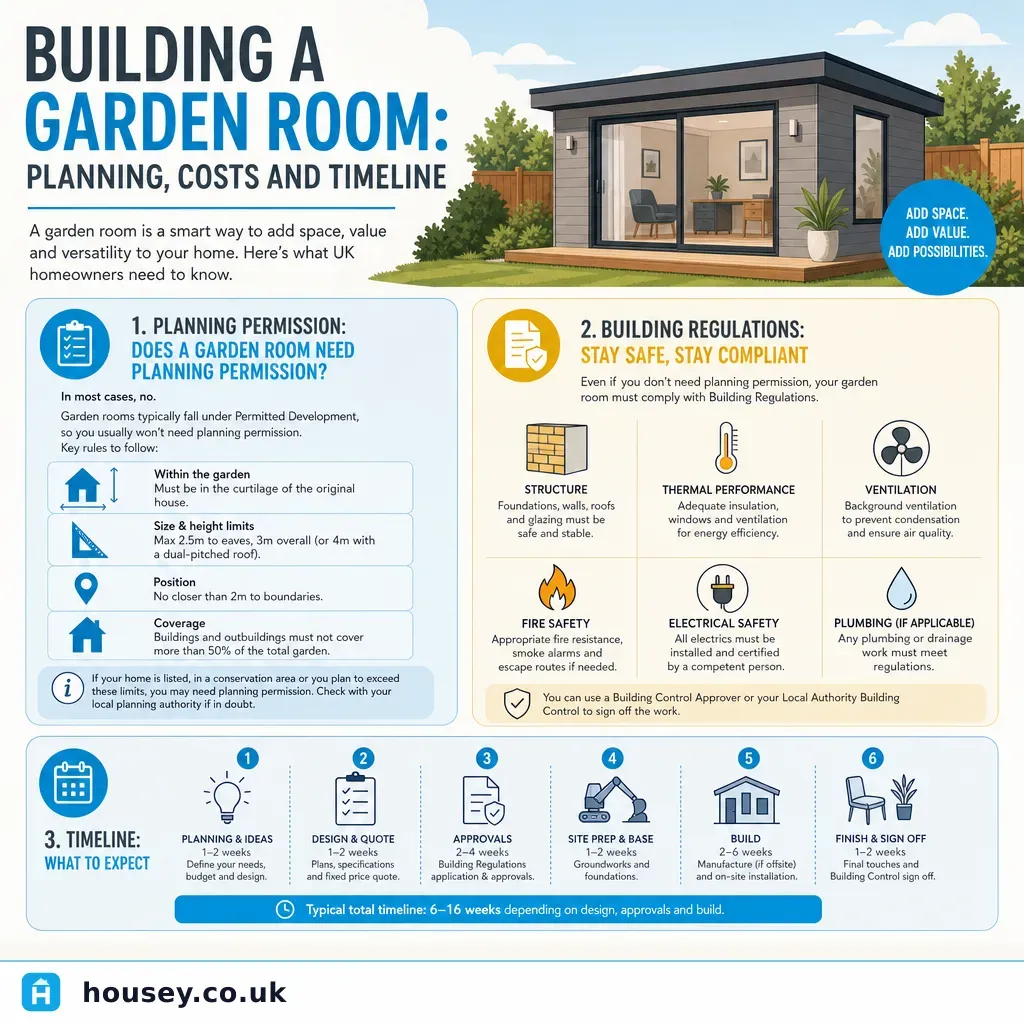 Improvement & Build
Building a Garden Room: Planning, Costs and Timeline
Most garden rooms in England fall under permitted development and don't need planning permission, provided the structure meets height, coverage, and boundary conditions.
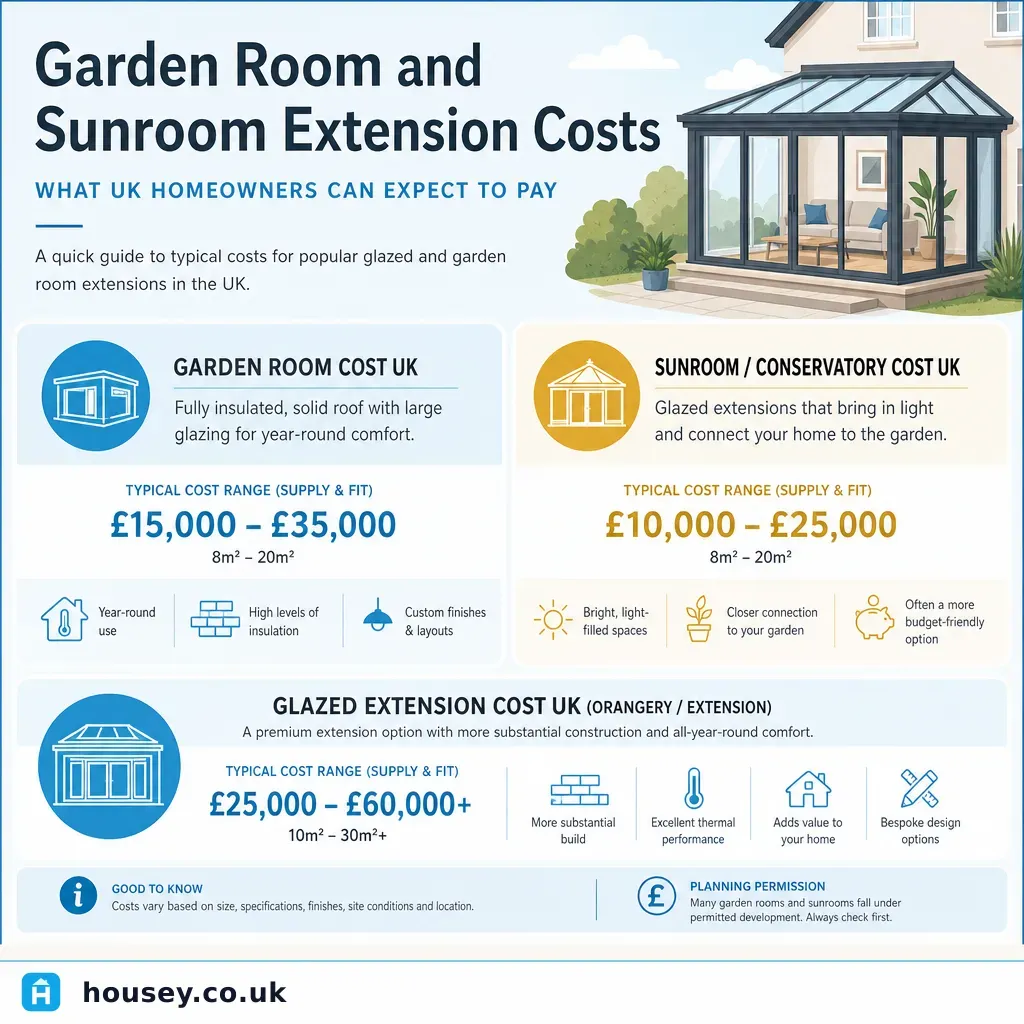 Improvement & Build
Garden Room and Sunroom Extension Costs
Garden rooms and sunroom extensions cost roughly £10,000–£80,000 installed in the UK depending on type, size, and glazing specification.
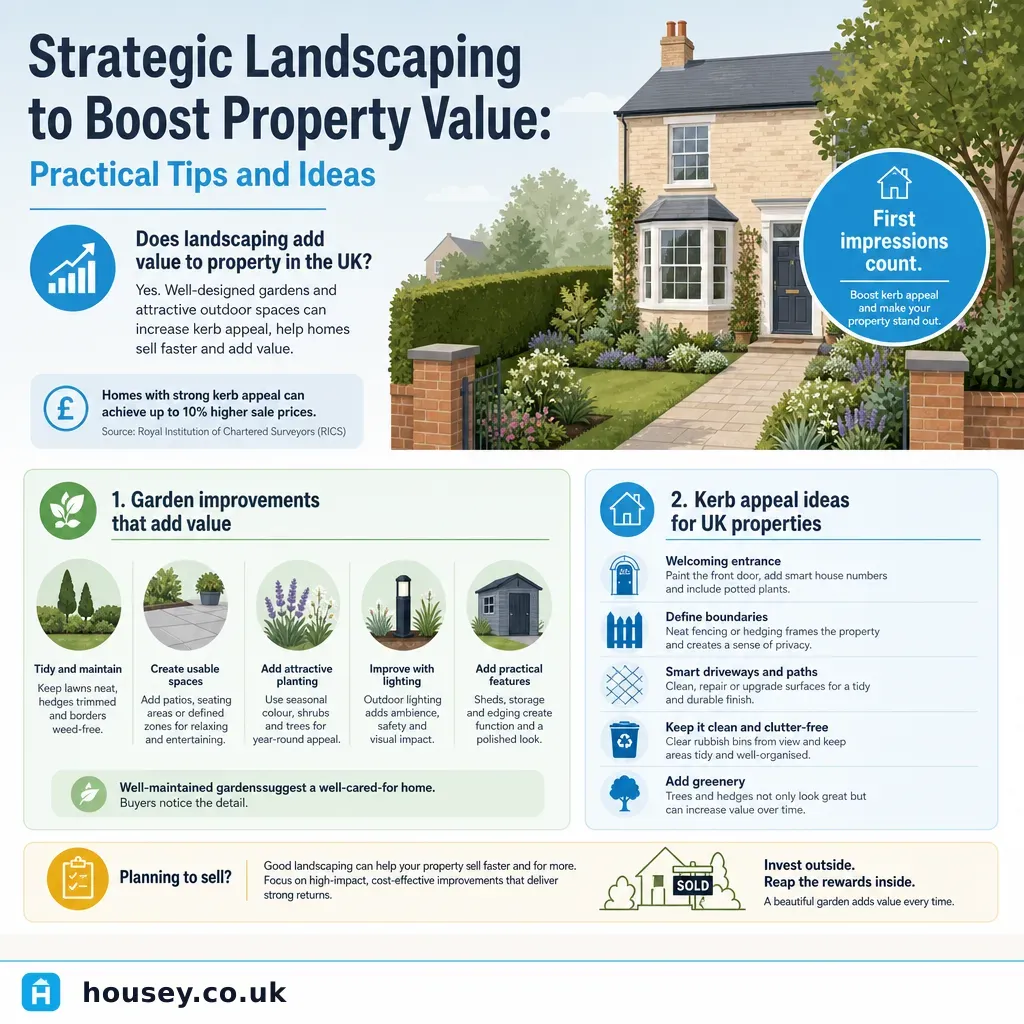 Improvement & Build
Strategic Landscaping to Boost Property Value: Practical Tips and Ideas
Landscaping can add 5–15% to a UK property's perceived value, though the return varies by improvement type.
 Improvement & Build
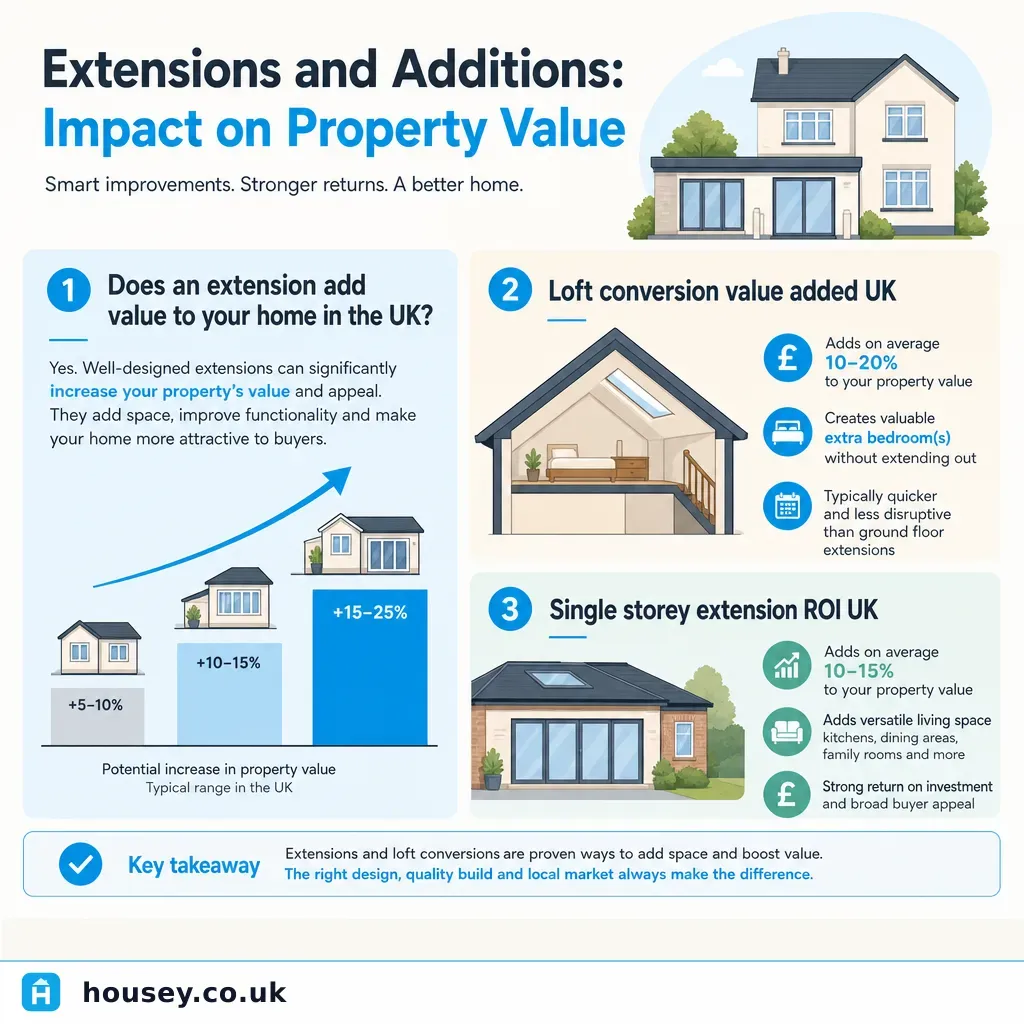
Extensions and Additions: Impact on Property Value
Extensions typically add 5–20% to UK property values depending on type, quality, and local market conditions.
 Improvement & Build
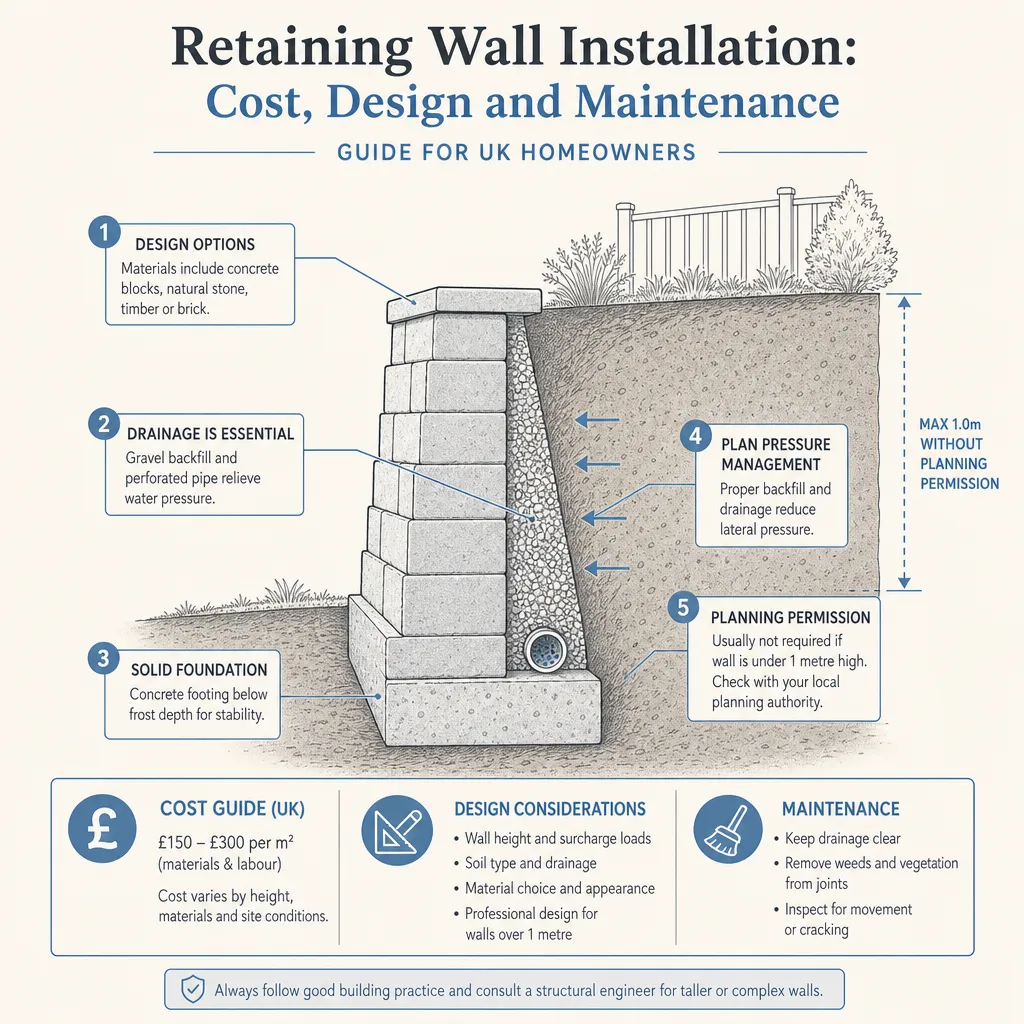
Retaining Wall Installation: Cost, Design and Maintenance
A retaining wall holds back soil on a sloped or banked site.