Critical Evaluation and Due Diligence for Investment Properties
By Housey · Last reviewed 30th of May 2026
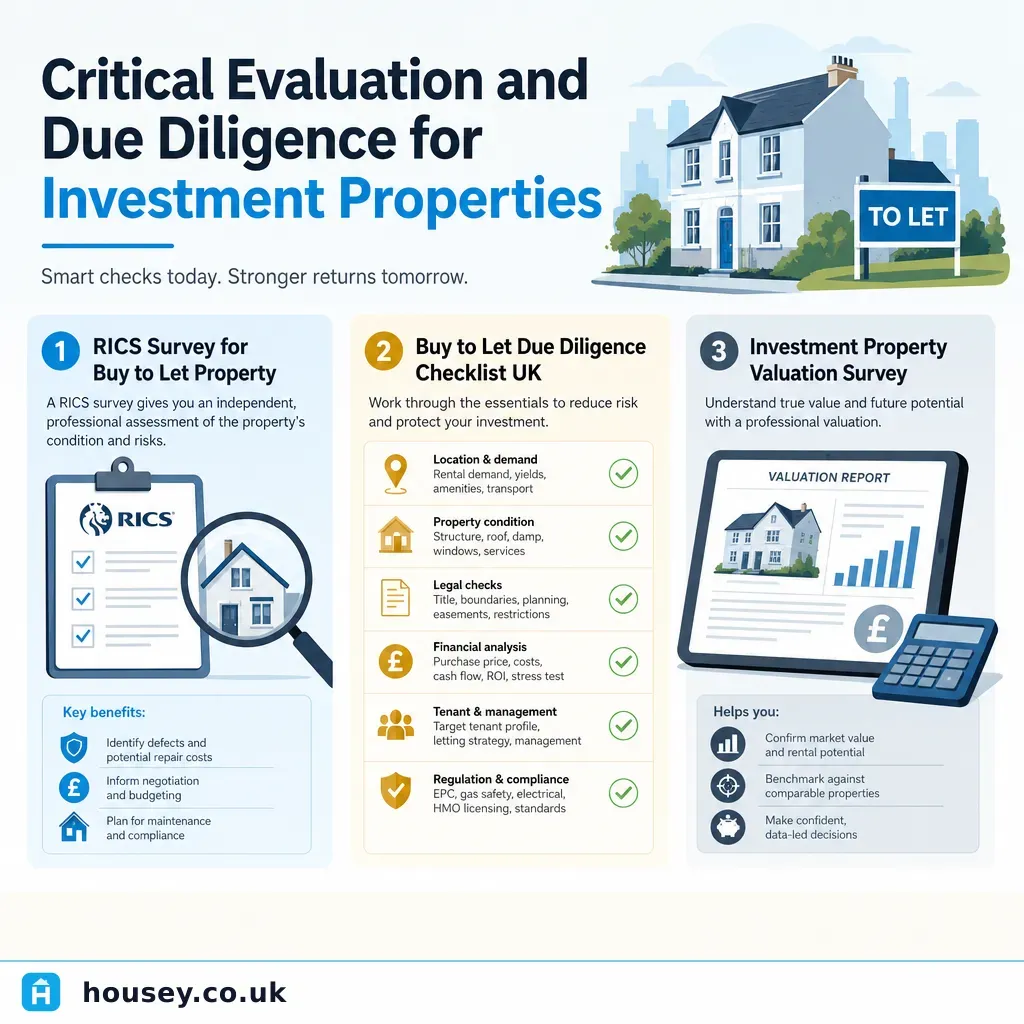
Critical Evaluation and Due Diligence for Investment Properties
Purchasing a residential investment property — whether a single buy-to-let flat, a terraced house for rental, or a house in multiple occupation (HMO) — carries financial, legal, and regulatory risks that are distinct from those facing an owner-occupier. Investors typically face tighter margins, more complex compliance obligations, and a harder exit if a property underperforms. A structured due diligence process, carried out before exchange of contracts, reduces the chance of an expensive surprise once the deal has completed.
Key points
- A RICS Valuation (Red Book compliant) and a RICS condition survey are separate products with different purposes: the valuation assesses market worth, the survey assesses physical condition.
- The Minimum Energy Efficiency Standards (MEES) currently require a minimum EPC rating of E for private rented properties in England and Wales; failure to comply can result in a fine of up to £30,000 per property.
- The Stamp Duty Land Tax (SDLT) surcharge on additional residential properties in England and Northern Ireland increased to 5% from 31 October 2024, significantly affecting acquisition costs.
- HMO licensing requirements vary by local authority; properties occupied by five or more people forming two or more households require a mandatory licence under the Housing Act 2004.
- A RICS Level 3 Building Survey is generally more appropriate than a Level 2 for older stock, converted properties, or buildings showing visible defects.
What due diligence covers for an investment purchase
Due diligence for a residential investment property typically falls into four overlapping areas: physical condition, regulatory compliance, financial viability, and legal title.
Physical condition involves commissioning a RICS Home Survey (Level 2 or Level 3 depending on the property) to identify defects, maintenance liabilities, and risks that could affect yield or capital value. For older stock — particularly pre-1919 terraced housing, converted Victorian warehouses, or 1960s and 1970s purpose-built flats — a Level 3 survey will usually give more actionable detail than a Level 2.
Regulatory compliance means checking EPC ratings, fire safety obligations (especially for HMOs), electrical installation condition (EICR), gas safety certificates, and any local licensing schemes. Selective licensing schemes operate in many English local authorities and impose additional obligations on landlords.
Financial viability involves stress-testing the rental yield against the purchase price, financing costs, voids, maintenance reserves, and management fees. An independent RICS Valuation can be important if you are financing through a lender or if the asking price appears above comparable evidence.
Legal title covers searches, tenancy agreements on occupied properties, service charge and ground rent history for leaseholds, and any covenants that could restrict use.
Which survey is right for an investment property?
Survey type | Best for | Not ideal for | Typical output | Main risk if wrong |
|---|---|---|---|---|
RICS Level 2 Home Survey | Conventional post-1900 properties in reasonable condition | Older, altered, or visibly defective stock | Condition ratings, maintenance advice | Missed hidden defects in complex buildings |
RICS Level 3 Building Survey | Pre-1919 homes, conversions, HMOs, visible defects | New-builds where an NHBC warranty exists | Detailed defect analysis and repair advice | Higher cost — but more protection on complex stock |
RICS Valuation (Red Book) | Mortgage purposes, purchase price verification, reinvestment analysis | Assessing physical condition | Market value opinion | Overpaying; lending shortfall |
Insurance valuation | Calculating correct reinstatement cost for buildings insurance | Market pricing | Reinstatement cost figure | Under-insurance if rebuild costs underestimated |
For most investment purchases, instructing both a condition survey and a standalone valuation is prudent — one tells you what the building is worth, the other tells you what condition it is in.
Financial and yield assessment
Gross rental yield is calculated as annual rent divided by purchase price, expressed as a percentage. Net yield deducts void periods, maintenance, agent fees, and insurance before dividing by the purchase price. Experienced investors usually target net yields of at least 5–7% in most UK regions, though this varies significantly by location and property type.
Key cost inputs to model before purchase:
- SDLT: the 5% surcharge on additional properties (England and Northern Ireland) applies on top of standard rates. For a £200,000 property, this adds £10,000 compared to a primary residence purchase. Check the GOV.UK Stamp Duty calculator for your specific transaction.
- EPC upgrade costs: if the property sits at F or G, upgrading to E — or the proposed C rating if that policy is enacted — could require significant insulation and heating works.
- HMO conversion costs: if you plan to convert to an HMO, additional fire doors, means of escape, kitchen and bathroom provision, and licencing fees will apply.
- Indicative survey and valuation costs: a RICS Level 3 survey for a mid-sized property typically costs £600–£1,500+; a standalone RICS Valuation typically £250–£600+. These are indicative UK costs, last reviewed 2026-05-30 — actual quotes will vary by location, property size, and surveyor.
Red flags that should prompt further investigation
- EPC rating of F or G: significant upgrade costs and potential non-compliance with MEES.
- Damp, mould, or condensation staining: could indicate structural damp, inadequate ventilation, or thermal bridging — all costly to remediate in tenanted stock.
- Absence of an EICR or gas safety certificate: legal obligations for landlords; remedial works can be extensive in older wiring.
- Short remaining lease (under 80 years for a leasehold flat): lease extension costs increase sharply as the lease falls below 80 years due to marriage value provisions.
- Service charge arrears or major works notices: for leasehold flats, check the last three years of service charge accounts and any Section 20 notices under the Landlord and Tenant Act 1985.
- Selective or additional HMO licensing in the target area: check with the local authority before purchasing; some London boroughs and city councils operate borough-wide selective licensing schemes.
- Asbestos in pre-2000 properties: properties built or refurbished before 2000 may contain asbestos-containing materials (ACMs). Do not disturb any suspected ACM — instruct a qualified asbestos surveyor for an asbestos management or refurbishment/demolition survey before any renovation works.
Investment property due diligence checklist
Use this checklist before committing to purchase:
Important limitations
This article provides general guidance only. Rental regulation, licensing requirements, EPC obligations, and SDLT rates can change and vary by jurisdiction — England, Wales, Scotland, and Northern Ireland each have different regimes. Always instruct a qualified solicitor, RICS-registered surveyor, and a financial adviser familiar with investment property before committing to a purchase. Nothing in this article constitutes legal, financial, or valuation advice.
When this becomes urgent
- You are exchanging contracts imminently and have not yet commissioned a survey.
- The property has visible signs of structural movement, damp, or roof failure.
- The EPC rating is F or G and you plan to let the property immediately.
- The property requires HMO licensing and you are not yet familiar with the conditions.
- You suspect asbestos-containing materials are present and renovation is planned.
What to ask a qualified professional
When commissioning a RICS survey:
- Is a Level 2 or Level 3 survey more appropriate for this specific property?
- Will the report give repair priority ratings and indicative cost guidance?
- Are there any areas the surveyor cannot access that should be inspected?
When instructing a conveyancing solicitor:
- Are there any covenants that restrict rental or HMO use?
- What does the local authority search reveal about licensing schemes?
- Are there any Section 20 major works consultations outstanding?
When seeking a RICS Valuation:
- Is the valuation based on comparable market evidence from the subject postcode?
- What rental income has been used in any investment valuation?
- Are there any assumptions about condition or tenure that would change the figure?
When to get professional help
Investment property purchase involves several professionals working in parallel. You should always instruct a RICS-registered surveyor for a condition report and, where financing is involved, a separate RICS Valuation. A solicitor or licensed conveyancer should handle all legal title work.
Seek specialist advice if:
- The property is listed or in a conservation area.
- You are considering converting to an HMO and are unsure about planning or licensing requirements.
- Asbestos or Japanese knotweed is identified during inspection.
- The lease has fewer than 85 years remaining.
- The electrical installation appears to predate 2000 or is unregistered.
How Housey can help
Housey connects investors with qualified, vetted professionals for every stage of the due diligence process. Whether you need a RICS Level 2 survey for a post-war flat, a full RICS Home Survey for a complex Victorian property, or an independent valuation survey to confirm your offer is sound, you can compare quotes from local specialists through our platform. We also connect investors who need an insurance valuation to ensure the correct reinstatement cost is in place from day one.
Frequently asked questions
Do I need a survey if I am buying a property at auction?
Yes — arguably more so than in a conventional sale. Properties sold at auction are typically sold with limited recourse after the fall of the gavel. Commission a survey and legal pack review before the auction date, not after. Most auctioneers make the legal pack available in advance.
What is the difference between a mortgage valuation and a RICS survey?
A mortgage valuation is carried out for the lender's benefit, not yours. It confirms the property provides adequate security for the loan — it is not a condition report. You should commission a separate RICS Level 2 or Level 3 survey to understand the building's physical condition.
What EPC rating do I need to legally let a property in England?
Currently, private rented properties in England and Wales must have a minimum EPC rating of E to be lawfully let, under the Minimum Energy Efficiency Standards (MEES). The Government has consulted on raising this to C by 2030 for existing tenancies, but this has not yet been enacted. Check GOV.UK for the current position.
When does a property need a mandatory HMO licence?
Under the Housing Act 2004, a property requires a mandatory HMO licence if it is occupied by five or more people from two or more separate households and it is at least three storeys high. Many local authorities also operate additional or selective licensing schemes that apply to smaller HMOs or entire neighbourhoods. Always check with the relevant local authority.
Sources and further reading
- Renting out your property: landlord responsibilities — GOV.UK
- Minimum energy efficiency standards for private rented sector — GOV.UK
- RICS HomeSurvey Standard — RICS
- Houses in multiple occupation and licensing — GOV.UK
- Stamp Duty Land Tax rates and thresholds — GOV.UK
- Asbestos: the survey guide (HSG264) — Health and Safety Executive
Useful next reads
 Surveys & Inspections
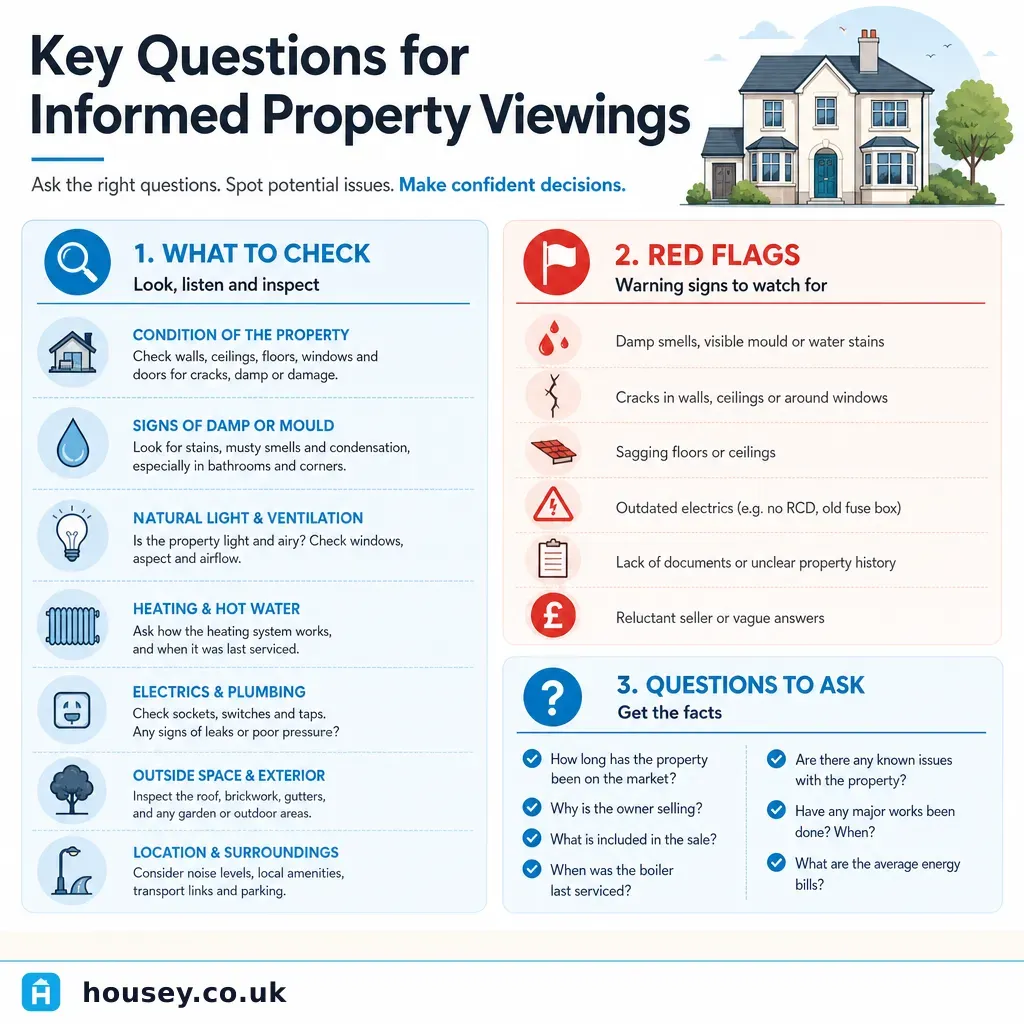
Key Questions for Informed Property Viewings
At a property viewing, ask specifically about structural movement, damp or water ingress, the age and service history of the boiler and electrics, whether any extensions obtained building regulations sign-off, and the seller's chain position.
 Surveys & Inspections
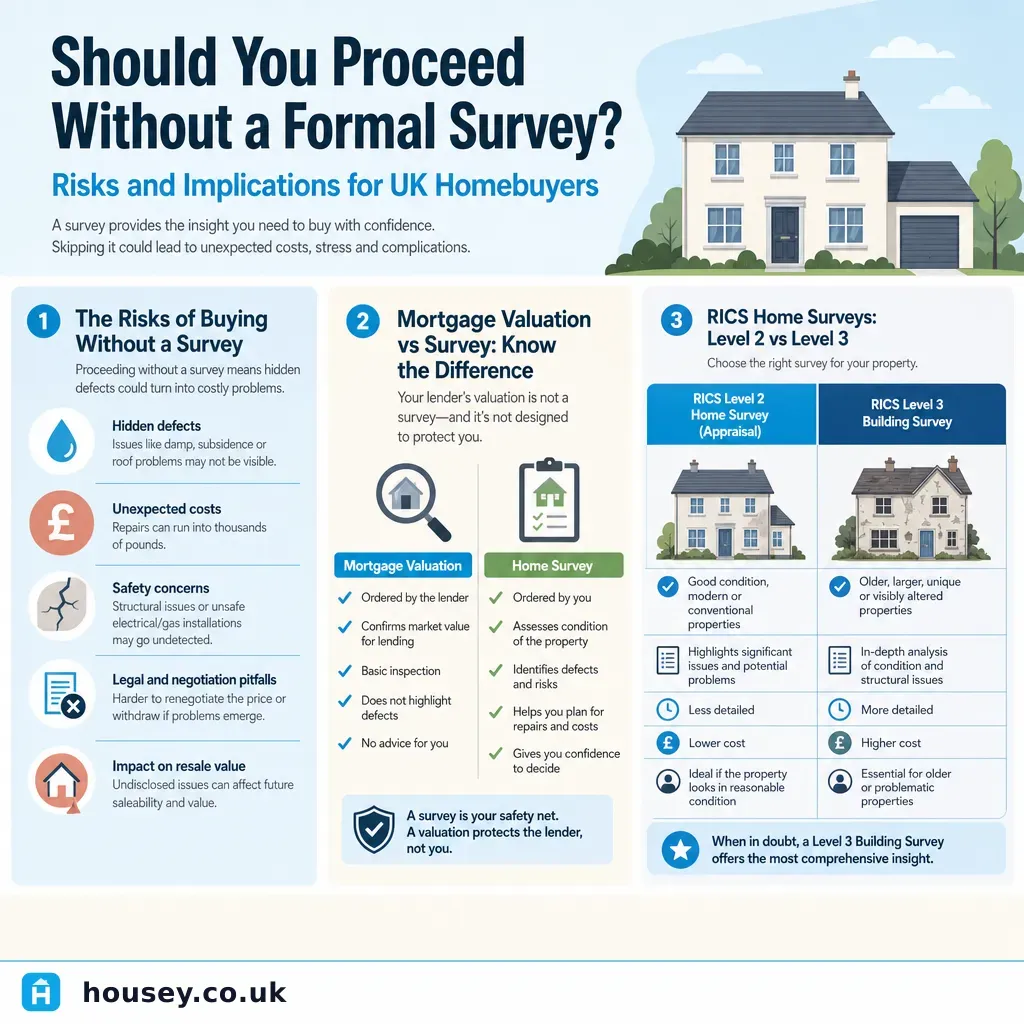
Should You Proceed Without a Formal Survey? Risks and Implications
In England and Wales there is no legal requirement to obtain a survey before exchange, but caveat emptor means any undisclosed defects become your problem the moment contracts are exchanged.
 Surveys & Inspections
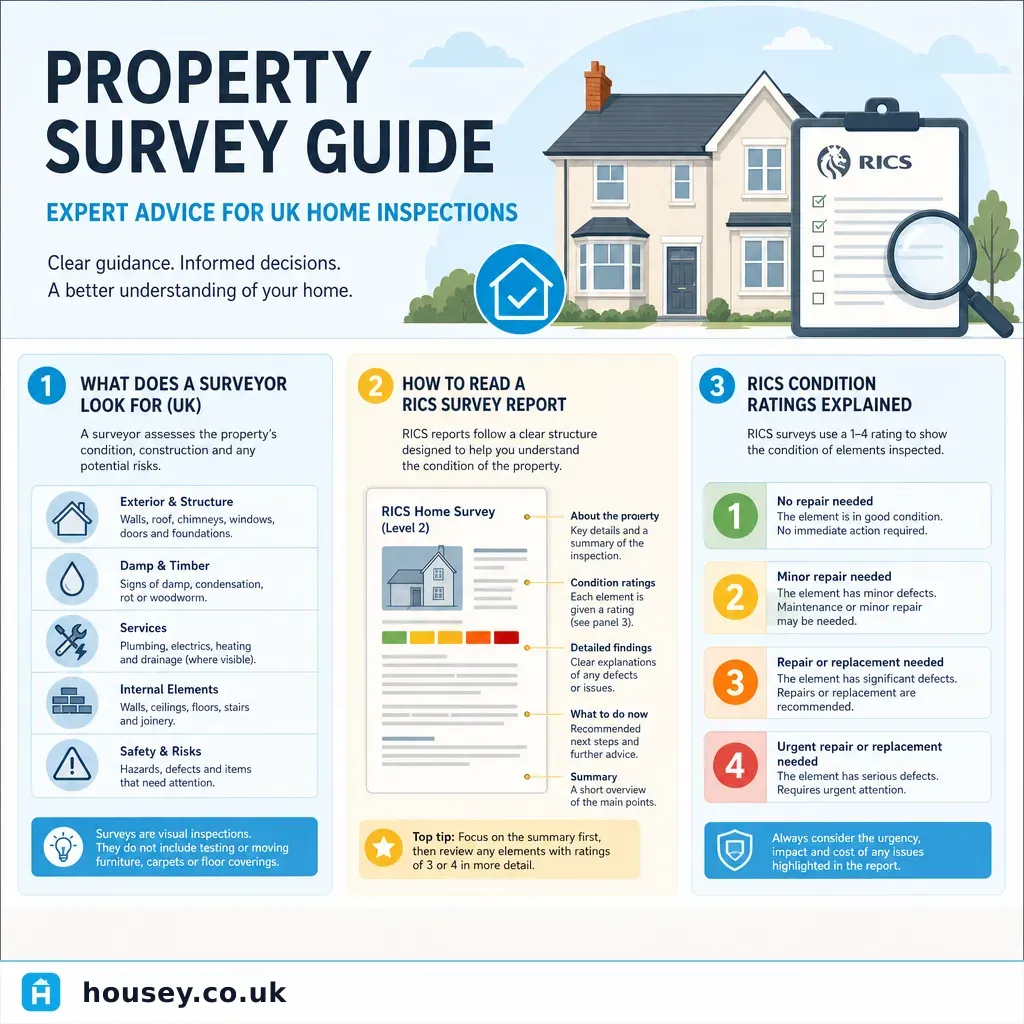
Property Survey Guide: Expert Advice for UK Home Inspections
Getting the most from a property survey means preparing the property and key documents before the inspection, understanding what a surveyor can and cannot access, and knowing how to respond when the report flags defects.
 Surveys & Inspections
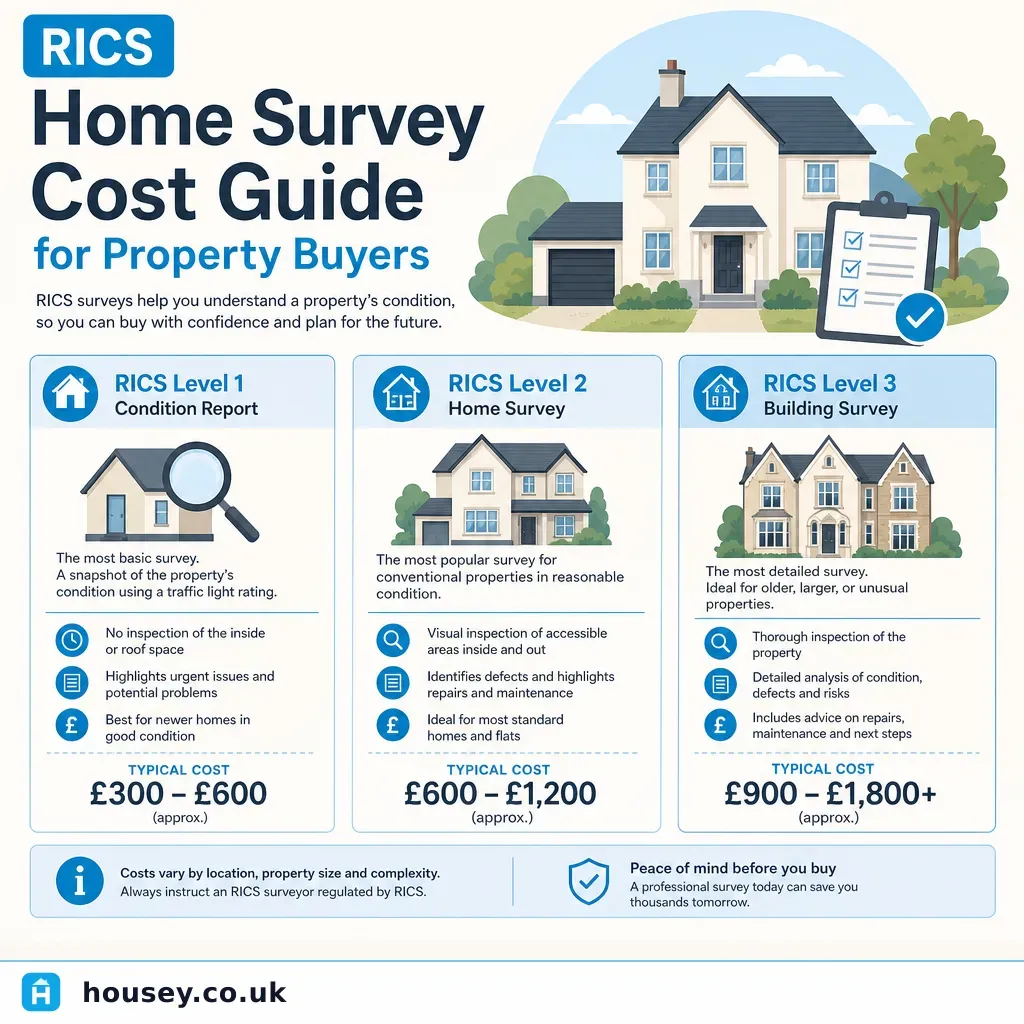
RICS Home Survey Cost Guide for Property Buyers
A RICS Level 2 Home Survey typically costs £400–£700 in the UK, while a Level 3 Building Survey ranges from £600 to £1,500 or more.
 Surveys & Inspections
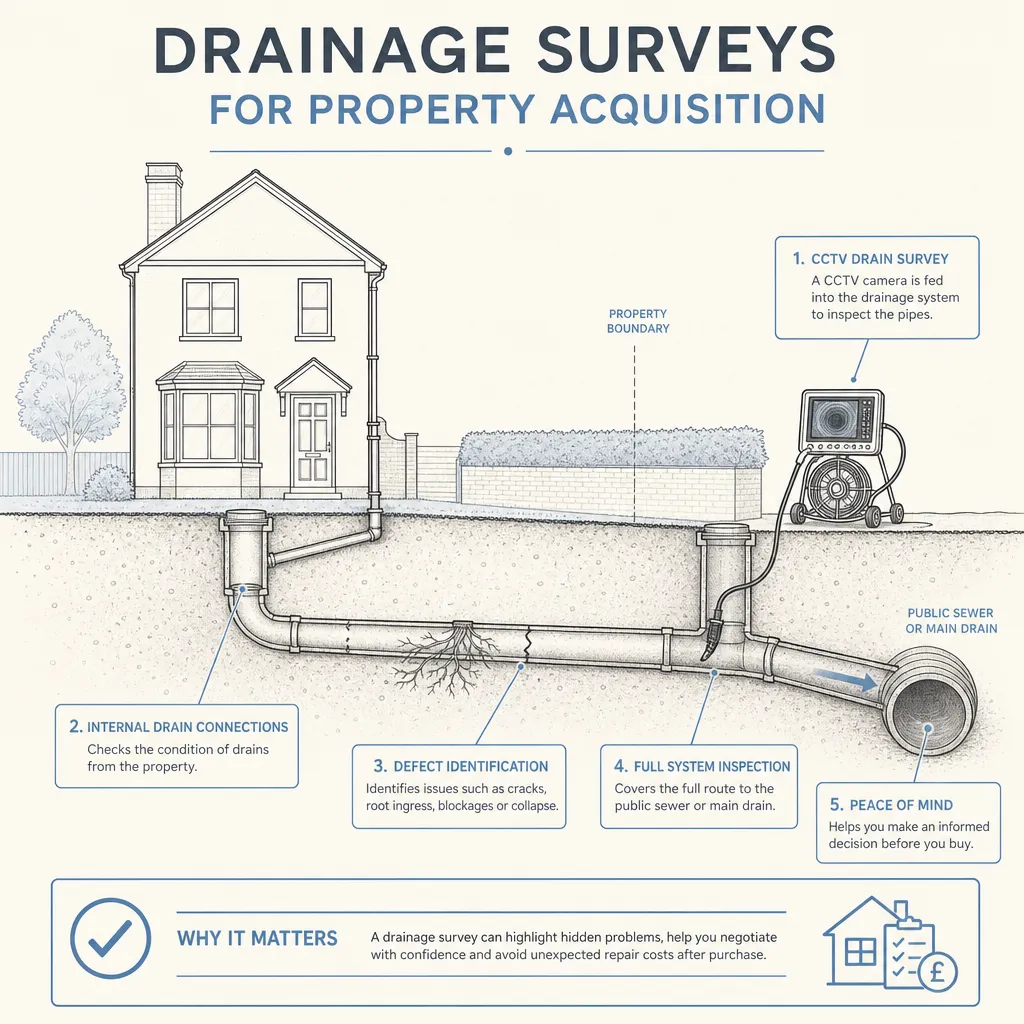
Drainage Surveys for Property Acquisition
A drainage survey — typically a CCTV camera inspection of underground drain runs — helps identify blockages, collapsed sections, root ingress, and misconnections that would not be visible in a standard property survey.