Property Survey Guide: Expert Advice for UK Home Inspections
By Housey · Last reviewed 30th of May 2026
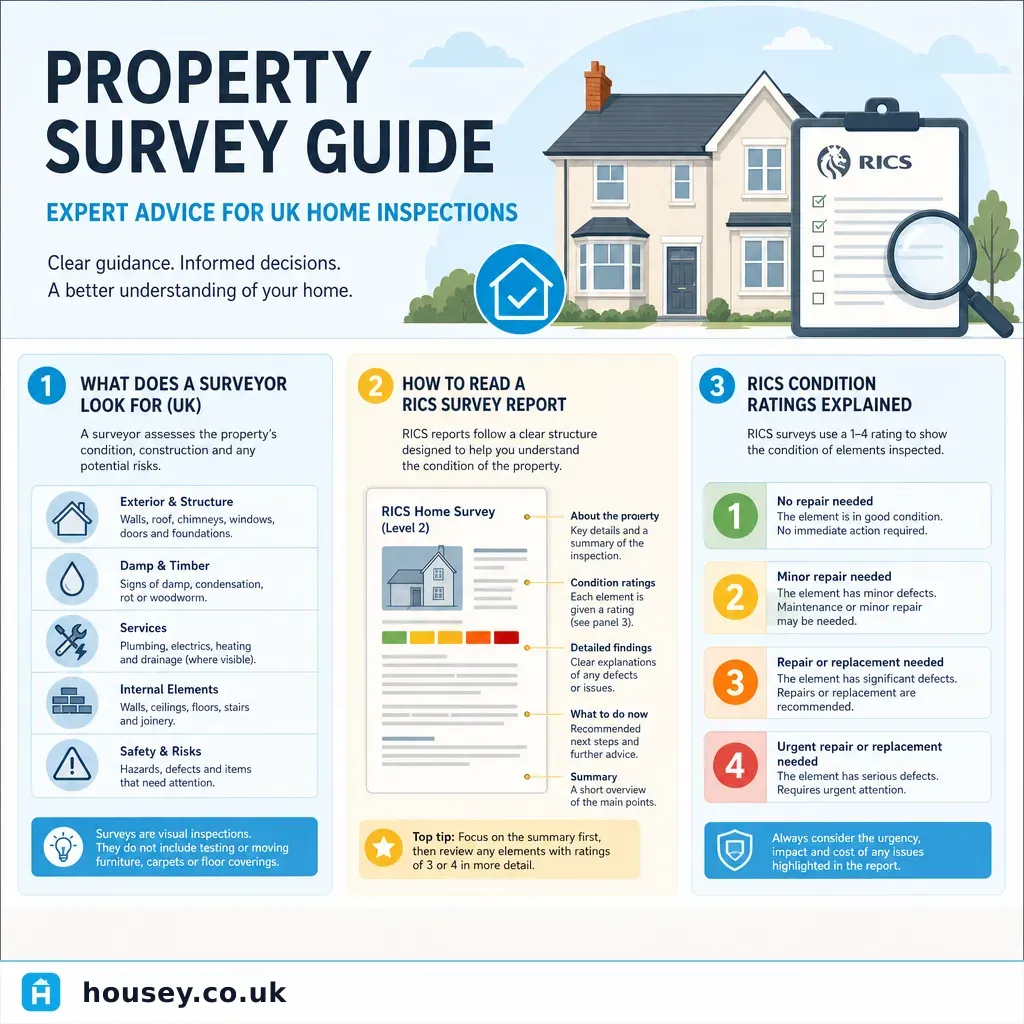
Property Survey Guide: Expert Advice for UK Home Inspections
Commissioning a property survey is straightforward in principle, but many buyers arrive at exchange without fully understanding what their surveyor inspected, what the condition ratings mean, or what to do when the report flags significant defects. Getting the most from a survey means preparing thoroughly before the inspection, understanding the scope of what a visual assessment can and cannot cover, and knowing how to respond to findings — particularly when they affect your negotiating position or require specialist follow-up.
Key points
- RICS surveyors carry out a non-invasive inspection — they cannot lift fitted carpets, remove panelling, or access areas that are sealed or obstructed without a separate, specific instruction.
- Condition rating 3 in a RICS Level 2 or Level 3 report means the surveyor has identified a defect requiring urgent repair or further investigation — it does not automatically mean the property is unmortgageable.
- Buyers typically have two to four weeks between receipt of the survey and exchange of contracts in which to act on findings, obtain specialist quotes, and renegotiate if necessary.
- In Scotland, the seller's Home Report (including a Single Survey) must be made available to prospective buyers before or at the point of offer — buyers may also commission their own independent survey.
- A surveyor's report does not guarantee that all defects have been found — a non-invasive inspection cannot detect defects hidden behind fixed finishes, below floor coverings, or within sealed voids.
Preparing for the survey: document and access checklist
Providing clear access and relevant documents helps the surveyor carry out a thorough inspection and reduces the risk of areas being recorded as not inspected in the final report.
Access to prepare before survey day:
- All rooms including loft space, cellar, and outbuildings
- Electricity, gas, and water meter cupboards
- Consumer unit (fusebox) location
- Roof space hatch (clear enough for safe entry where applicable)
- Under-stairs cupboard and any service access hatches
Documents to have available (if you are the seller, or request these from the seller's solicitor):
- Planning permissions and building regulations completion certificates for any alterations (extensions, loft conversions, garage conversions)
- FENSA or CERTASS certificates for replacement windows and doors installed after April 2002
- Gas Safe service and installation records
- EICR (Electrical Installation Condition Report) if available
- Any previous survey reports or specialist investigation reports
- Guarantees for damp-proofing, timber treatment, or underpinning work
Missing documents do not necessarily indicate a problem, but gaps are worth raising with the seller's solicitor before exchange.
What surveyors inspect — and what they cannot
RICS Home Surveys are non-invasive. The surveyor visually inspects all accessible parts of the property using a damp meter, torch, and binoculars where necessary. The inspection cannot:
- Lift or remove fixed floor coverings, fitted furniture, panelling, or insulation
- Access sealed roof voids or areas below concrete ground floors
- Test drains, gas appliances, or electrical installations in operational detail
- Assess concealed structural elements
As a result, reports may include phrases such as 'not inspected due to limited access' or 'further investigation recommended.' These are honest acknowledgements of the inspection's scope limits, not oversights. Drainage CCTV surveys, Electrical Installation Condition Reports (EICR), and gas safety checks are separate commissions that address what a visual survey cannot reach.
How to read a RICS survey report
RICS Level 2 and Level 3 reports use a condition rating system to classify elements of the property:
Rating | Meaning | Typical action |
|---|---|---|
1 — No repair currently needed | Element is in satisfactory condition | Monitor; routine maintenance only |
2 — Repairs or maintenance needed | Defect present but not urgent | Obtain quotes; budget for repair |
3 — Urgent or significant repair needed | Immediate attention or specialist investigation required | Act before exchange; seek specialist advice |
NI — Not inspected | Area was inaccessible on the day | Request further investigation or seller clarification |
When reviewing your report:
- Read the executive summary first to identify all condition 3 items.
- Read the full description of each condition 3 element before drawing conclusions about severity.
- Note any 'further investigation recommended' caveats — these are material and should be followed up.
- Do not assume a condition 2 item is minor; some represent significant ongoing maintenance liabilities.
A Level 3 Building Survey provides detailed written commentary rather than a traffic-light grid, and typically includes indicative repair cost guidance.
Red flags to take seriously
Not every survey finding carries equal weight. The following warrant immediate specialist follow-up or solicitor involvement before exchange:
- Active structural movement — cracking described as 'active' or 'progressive', stepped cracking through brickwork, or differential settlement. A chartered structural engineer should assess before exchange.
- Rising damp or penetrating damp rated condition 3 — requires independent investigation by a qualified specialist, ideally one with no commercial interest in remedial treatment.
- Roof covering at or near end of life on a large or complex property — indicative re-roofing costs can be substantial; obtain a contractor's quote before exchange.
- Evidence of past underpinning — a material fact affecting insurability and mortgage availability; verify with the seller and check with your insurer and lender.
- Multiple 'not inspected' areas — particularly if the roof void, cellar, or a significant outbuilding is inaccessible; consider carefully whether the sale should proceed without that information.
What to do after receiving the report
Step 1 — Identify all condition 3 items and 'further investigation' recommendations. List them in priority order by likely cost and safety implication.
Step 2 — Obtain specialist quotes or reports for significant items. Contact a chartered structural engineer, independent damp specialist, or drainage contractor as appropriate. Allow seven to fourteen days for quotes and written reports.
Step 3 — Decide whether to renegotiate. A survey finding does not automatically entitle you to a price reduction, but significant unexpected defects typically provide grounds for negotiation. Your solicitor can advise on approach and timing.
Step 4 — Confirm your position before exchange. Do not exchange contracts until you have the information you need to proceed with confidence, or until any price adjustment has been formally agreed.
Important limitations
Survey reports are professional opinions based on a non-invasive visual inspection carried out on a specific day. They cannot guarantee that all defects have been identified. Rules on survey obligations, seller disclosure duties, and legal remedies vary across England, Wales, and Scotland. This article provides general guidance only; always take qualified advice for your specific property and circumstances.
What to ask a qualified professional
Before commissioning a survey:
- What survey level do you recommend for this property type, age, and apparent condition?
- Will your report include indicative repair costs for condition 3 items?
- How long will the inspection take and when will I receive the written report?
- If you identify something requiring specialist investigation, will you state this explicitly in the report?
- Are you MRICS or FRICS qualified, and do you have experience with this property type?
- Is VAT included in the fee, and what is your cancellation policy?
When to get professional help
Do not delay seeking specialist advice if your report:
- Identifies active structural movement or suspected subsidence
- Flags suspected asbestos-containing materials (do not disturb them)
- Rates multiple elements as condition 3 (urgent repair needed)
- Recommends a structural engineer's report or drainage investigation
Contact your solicitor promptly if the report reveals information that materially changes your view of the property — you may need legal advice on your position before exchange.
How Housey can help
Housey makes it straightforward to find and compare RICS-qualified surveyors. Whether you need a RICS Level 2 Home Survey for a standard family home or a thorough RICS Level 3 Building Survey for a period property or one with visible concerns, you can request quotes from local surveyors through the platform. For newer properties, a RICS Level 1 Condition Report provides a lower-cost condition overview.
Frequently asked questions
Can the seller be present during the survey?
Surveyors generally prefer to carry out the inspection without the seller present, as it allows them to note observations freely. Sellers have no legal obligation to vacate, however. If access to areas is refused or restricted, the surveyor should record this in the report and the affected elements will be marked as not inspected.
What happens if a survey reveals undisclosed defects after exchange?
Once contracts are exchanged you are legally committed to the purchase. Legal remedies for undisclosed defects depend on whether the seller made a material misrepresentation or breach of contract — both require solicitor advice. This is one of the principal reasons to ensure all significant survey findings are understood and acted on before exchange, not after.
Should I commission my own survey if the seller already has one?
A seller's survey is produced for the seller's benefit, not yours. You cannot rely on it legally, and you have no right to bring a professional negligence claim if the report later proves deficient. Commissioning your own independent survey ensures the report is addressed to you and gives you the legal standing you need.
How is a property survey different from a building control sign-off?
Building control approval confirms that building work met the required standards at the time of construction — it is not an ongoing assessment of condition. A survey assesses the current state of the building, which may have changed significantly since any building control sign-off. The two serve entirely different purposes.
Sources and further reading
- RICS Home Survey Standard — Royal Institution of Chartered Surveyors
- Buying or selling your home — GOV.UK
- Surveys and valuations — Citizens Advice
- FENSA: glazing installation compliance — FENSA
Useful next reads
 Surveys & Inspections
How Professional Home Surveys Deliver Real Value For Buyers
A professional home survey by a RICS-registered surveyor can identify defects, legal compliance gaps, and cost liabilities before exchange of contracts, giving buyers an evidence base for negotiation or withdrawal.
 Surveys & Inspections
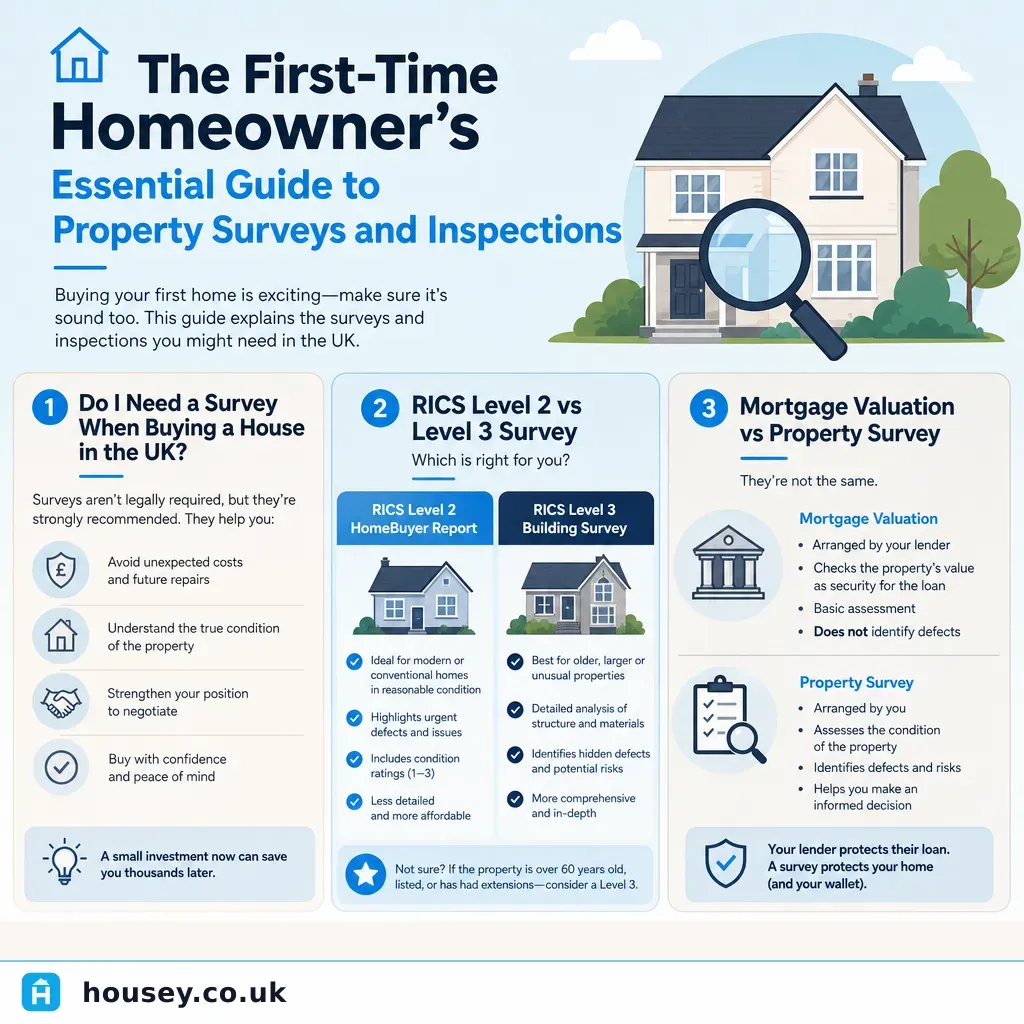
The First-Time Homeowner's Essential Guide to Property Surveys and Inspections
First-time buyers in the UK need more than the mortgage valuation — that report protects the lender, not you.
 Surveys & Inspections
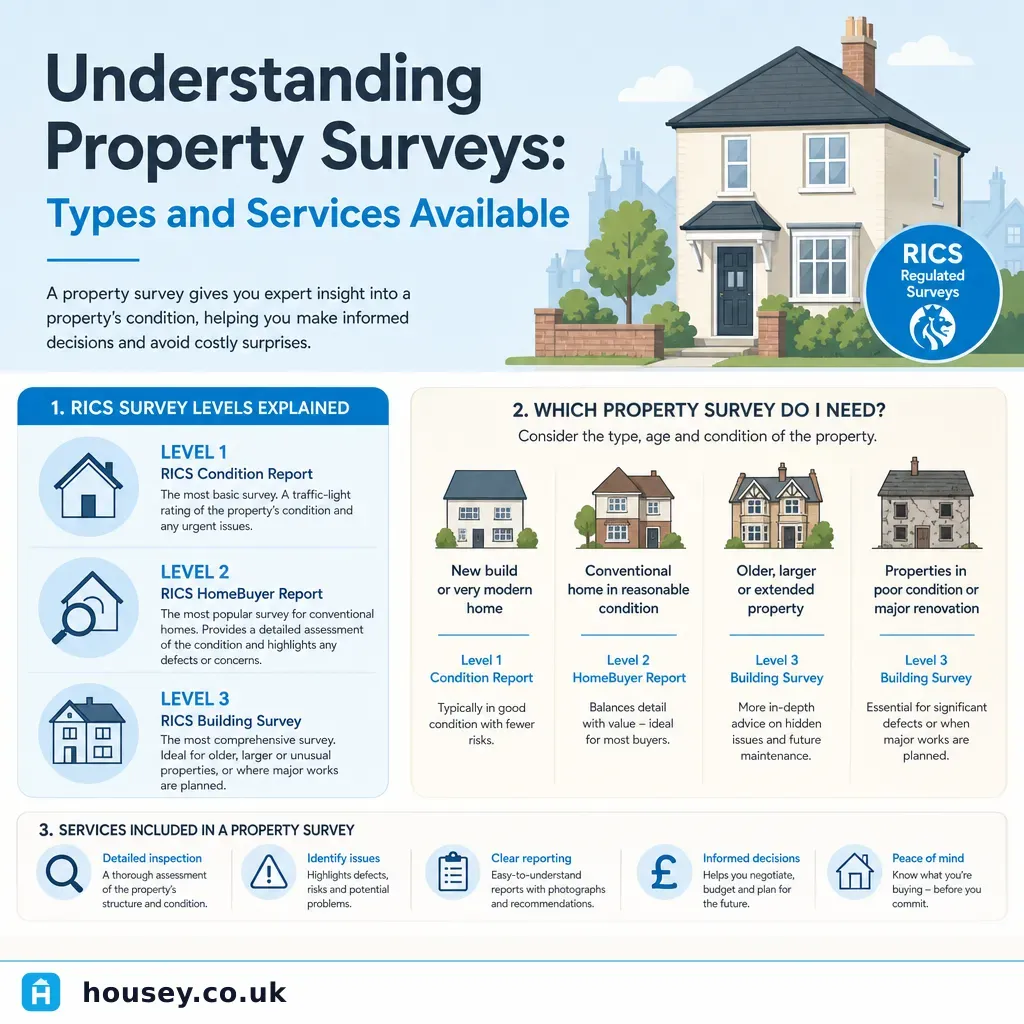
Understanding Property Surveys: Types and Services Available
UK property surveys follow three RICS-defined levels: Level 1 (Condition Report), Level 2 (Home Survey), and Level 3 (Building Survey).
 Surveys & Inspections
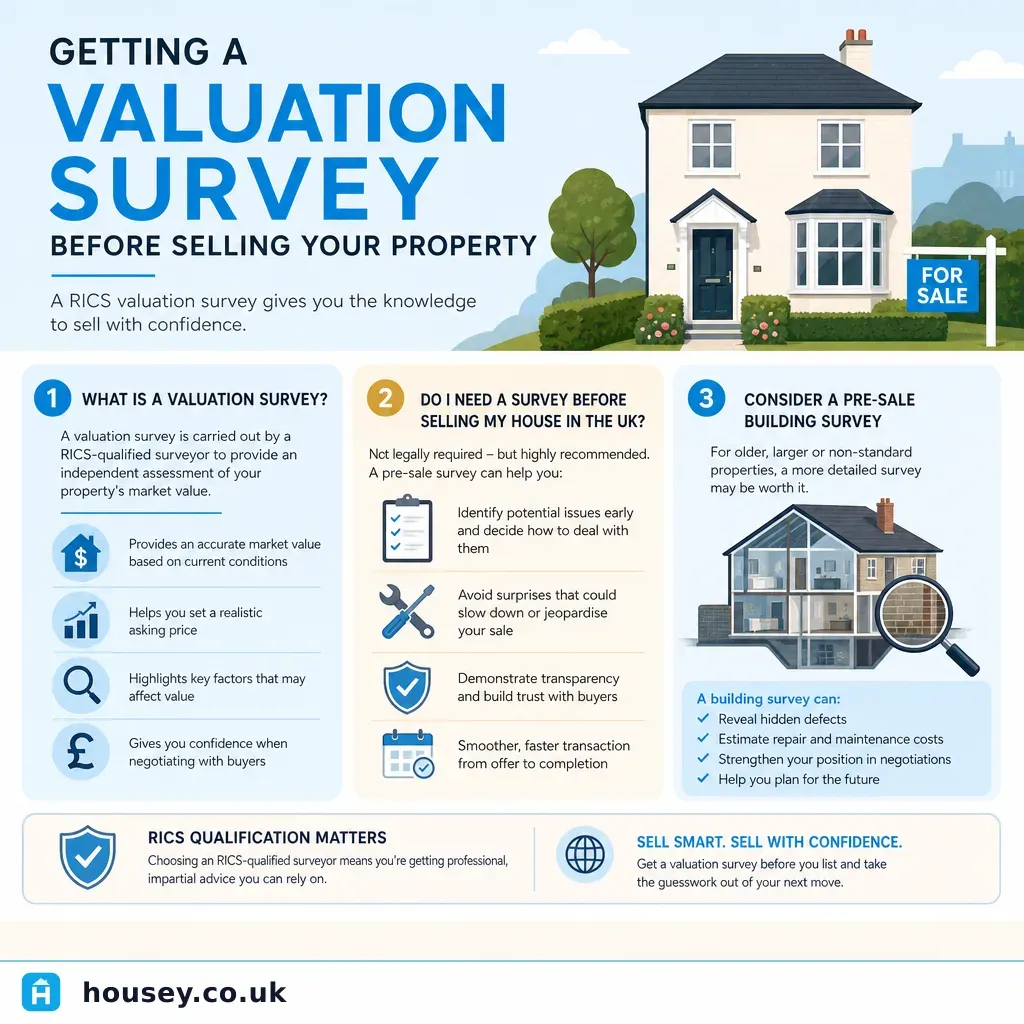
Getting a Valuation Survey Before Selling Your Property
Before selling, a free estate agent appraisal gives a market price guide, but only a RICS Red Book valuation carries formal professional standards and legal weight.
 Surveys & Inspections
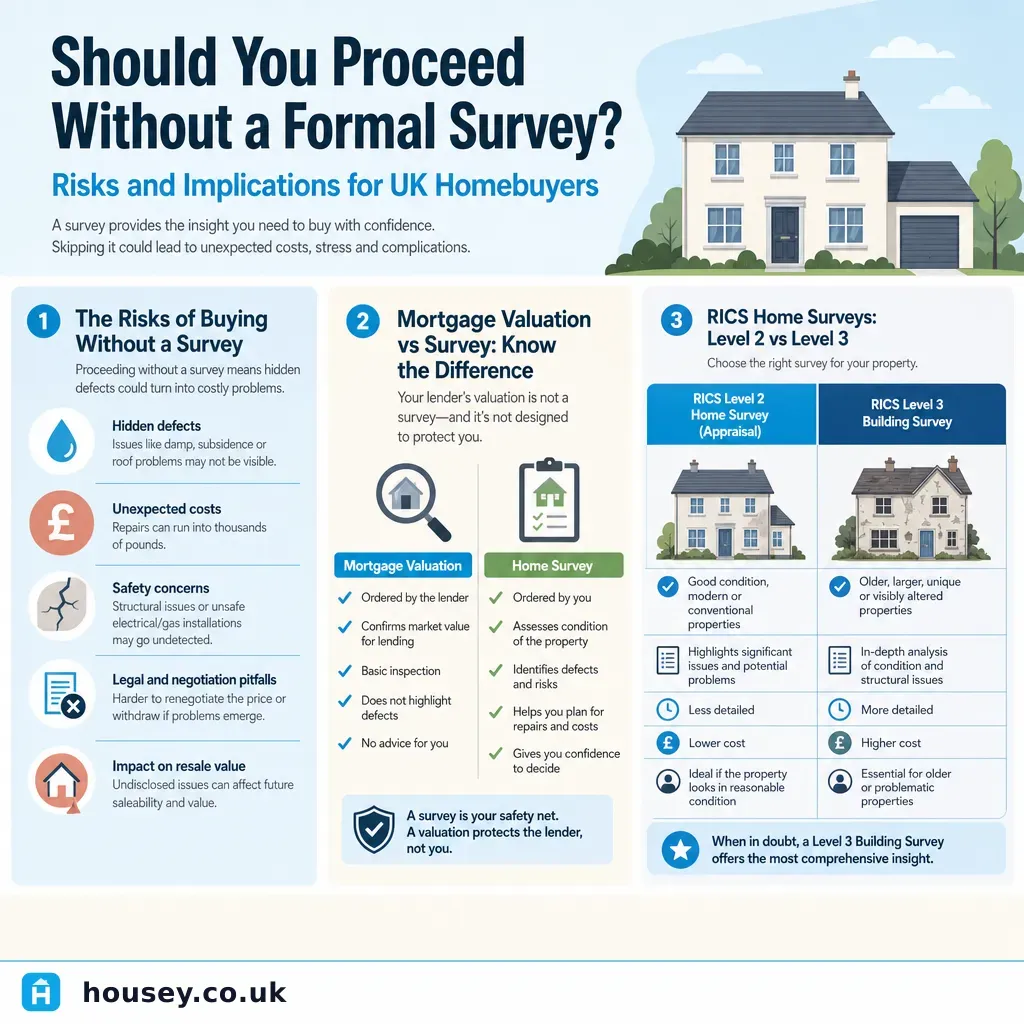
Should You Proceed Without a Formal Survey? Risks and Implications
In England and Wales there is no legal requirement to obtain a survey before exchange, but caveat emptor means any undisclosed defects become your problem the moment contracts are exchanged.