RICS Home Survey Cost Guide for Property Buyers
By Housey · Last reviewed 7th of May 2026
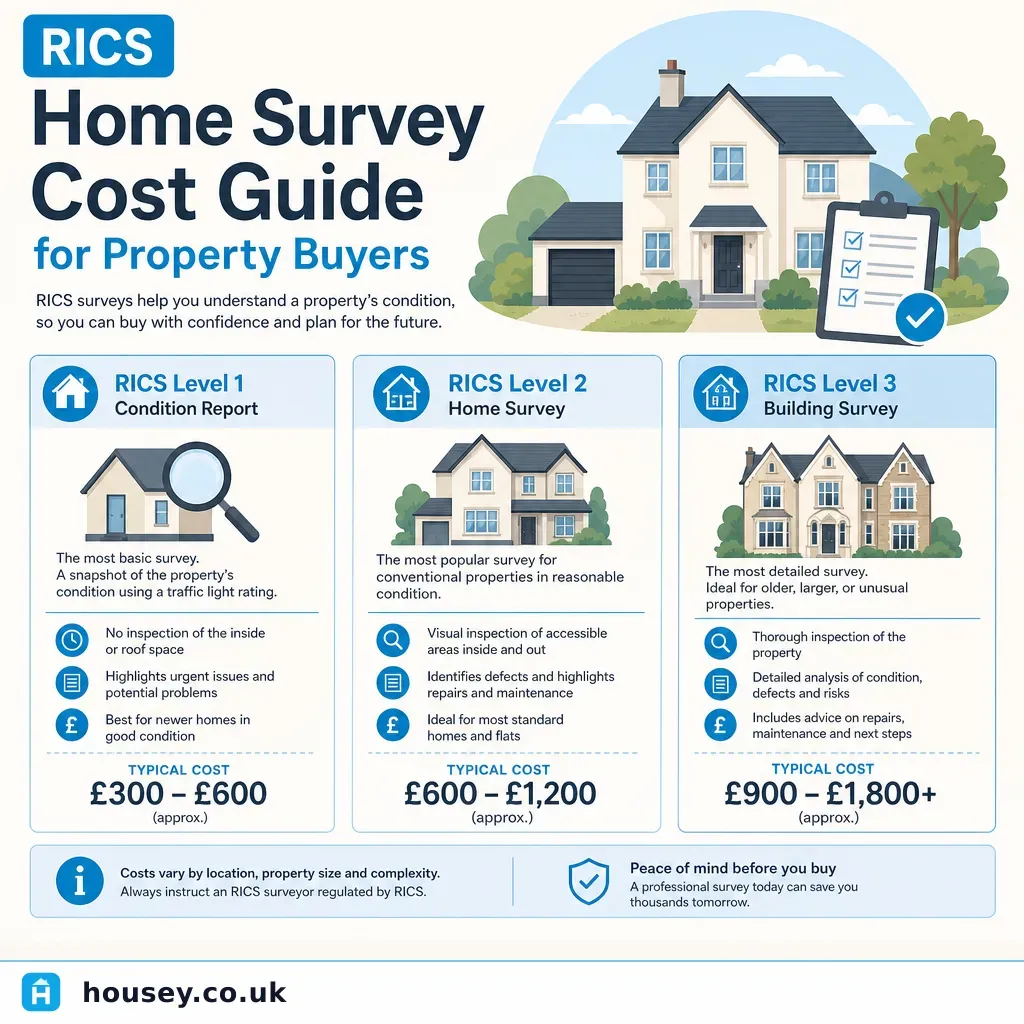
RICS Home Survey Cost Guide for Property Buyers
Most buyers encounter RICS survey fees at a stressful point in the conveyancing process — after an offer has been accepted but before contracts are exchanged. The cost can feel like yet another outgoing on top of solicitor fees, stamp duty, and removal costs, but understanding what drives surveyor pricing helps you choose the right level of inspection without overspending or underprotecting yourself.
Key points
- A RICS Level 2 Home Survey typically costs £400–£700, and a Level 3 Building Survey £600–£1,500+, depending on property size, age, and location (indicative UK costs, last reviewed 2026-05-07).
- A mortgage lender's valuation is not a structural or condition survey — it is carried out for the lender's benefit and will not identify most defects.
- All RICS surveyors must comply with the RICS Home Survey Standard (published 2019, effective 2021), which defines exactly what each level must include.
- Survey fees usually exclude specialist follow-up reports such as those from a structural engineer or damp specialist — budget for additional investigations if the surveyor flags concerns.
- Some surveyors offer a combined Home Survey and Valuation at Level 2 or Level 3, which costs more but removes the need to pay for a separate RICS Valuation Report.
What does a RICS home survey cost?
The three RICS Home Survey levels each have a different scope, and price typically reflects that difference. The table below shows indicative UK price ranges based on a conventionally built property of average size. Prices at the lower end tend to apply to smaller, newer properties in lower-cost regions; higher-end figures reflect larger, older, or more complex homes in London and the South East.
Survey level | What it covers | Typical UK cost range | Best for |
|---|---|---|---|
Level 1 — Condition Report | Traffic-light condition ratings; no advice on defects or repairs | £250–£400 | New-builds or homes under 10 years old in good condition |
Level 2 — Home Survey | Condition ratings plus surveyor advice; market valuation available if requested | £400–£700 | Conventional homes in reasonable condition built after 1920 |
Level 3 — Building Survey | Detailed inspection, description of defects, repair options and cost implications | £600–£1,500+ | Pre-1920 homes, unusual construction, extensions, visible defects |
Indicative UK costs, last reviewed 2026-05-07. Prices vary by property size, region, and surveyor. Always request a written quote and confirm whether VAT is included.
What affects the price of a RICS survey?
Several factors influence what a surveyor will charge, and understanding them helps you assess whether a quote is fair.
Property size and complexity. Most surveyors price by floor area or number of bedrooms. A two-bedroom flat will almost always cost less to survey than a five-bedroom Victorian detached house, even at the same survey level.
Property age and construction type. Older properties — particularly those built before 1919 — require more time and expertise. Non-standard construction such as timber frame, thatched roofs, stone walls, or prefabricated concrete typically attracts a higher fee.
Geographic location. Surveyor day rates in London and the South East tend to be higher than in the North, Wales, or Scotland, reflecting local market rates and travel time.
Survey level chosen. A Level 3 Building Survey involves a more thorough inspection and a longer written report, so it commands a higher fee than a Level 1 or Level 2.
Add-ons. A valuation included within the survey report, thermal imaging, a drain survey, or a written reinstatement cost assessment for buildings insurance purposes can all increase the total fee.
Worked UK property scenario
A buyer is purchasing a 1930s semi-detached house in the East Midlands, asking price £240,000. The property has had a loft conversion and a rear extension, and the estate agent's photos show a crack above the rear door.
In this scenario, a Level 2 Home Survey alone may not provide enough detail, given the visible crack and the structural changes made to the property. A Level 3 Building Survey — likely costing £700–£900 for a property of this age and complexity — would provide a fuller assessment of the crack, the integrity of the loft conversion, and any movement-related concerns. If the Level 3 surveyor then flags suspected structural movement, the buyer might additionally need a structural engineer's report, typically costing £400–£800 (indicative, 2026-05-07).
This scenario illustrates why choosing the wrong survey level can be a false economy: a less detailed survey may miss issues that cost far more to resolve after completion.
Is the lender's mortgage valuation enough?
No. A mortgage lender's valuation is carried out to confirm the property is worth roughly what you are borrowing against it — it is a financial assessment for the lender's benefit, not yours. It is not a structural or condition survey and will not identify damp, roof defects, wiring issues, or subsidence unless they are severe enough to affect mortgage eligibility.
Some lenders no longer send a physical valuer at all, relying instead on automated valuation models (AVMs). You should always commission your own RICS Home Survey independently of whatever the lender arranges.
What to ask before accepting a surveyor's quote
Use this checklist when comparing quotes from surveyors:
- Is VAT included? Some quotes are listed exclusive of VAT — add 20% if not clearly stated.
- Which RICS Home Survey level is being quoted? Confirm Level 1, 2, or 3 and what the report will cover.
- Does the quote include a market valuation? Clarify if you also need a reinstatement cost or valuation figure.
- How long will the inspection take, and when will the report be delivered? Delays can affect your exchange timeline.
- Will the surveyor visit the property in person? Confirm a physical inspection, not a desktop review.
- What happens if defects require specialist investigation? Ask whether follow-up calls to discuss the findings are included.
- What qualifications does the surveyor hold? Look for MRICS or FRICS designation; verify via the RICS Find a Surveyor directory.
- What could cause the price to change? Some surveyors reserve the right to revise fees if access is restricted or the property is more complex than initially described.
When to get professional help
A RICS Home Survey is itself a professional service — the key decision is choosing the right level rather than relying on informal opinions or a lender's valuation.
Consider upgrading to a Level 3 Building Survey — or requesting additional specialist reports — if:
- The property was built before 1919 or uses non-standard construction.
- You can see visible cracks, damp staining, sagging floors or ceilings, or signs of past alterations.
- The property has had extensions, loft conversions, or other significant structural changes.
- The property is listed or in a conservation area.
- Your Level 2 surveyor recommends further investigation of any element in their report.
Acting on a surveyor's recommendations before exchange — rather than after completion — gives you the strongest negotiating position with the seller.
How Housey can help
Housey makes it straightforward to request quotes from qualified RICS surveyors for the level of inspection your property warrants. Whether you are comparing a RICS Level 2 Home Survey for a conventional semi or need a more thorough RICS Level 3 Building Survey for an older or altered property, you can submit a single request and receive quotes from local surveyors. Browse all available RICS Home Survey options to find the right starting point, or explore a RICS Level 1 Condition Report if you are buying a newer, straightforward home.
Frequently asked questions
Can I negotiate the cost of a RICS survey?
In some cases, yes. Surveyors may have flexibility on pricing, particularly in a slower market or if they have availability. However, choosing purely on price risks instructing a less experienced surveyor. Always check RICS credentials — look for MRICS or FRICS designation — and read any available reviews before prioritising the lowest quote over quality.
How long does a RICS survey take?
A Level 2 inspection typically takes two to four hours on site, while a Level 3 Building Survey may take four to eight hours for a larger or more complex property. Written reports are usually delivered within three to five working days of the inspection, though individual surveyors' timescales vary. Ask at the point of booking if exchange deadlines are pressing.
Does a RICS survey cover the drains?
Standard RICS Home Surveys do not include a CCTV drain survey. Surveyors may note visible drainage concerns and recommend further investigation, but a separate drain inspection must be instructed independently. If the property has older clay or pitch-fibre drainage, or you are buying a Victorian or Edwardian terrace, a drain survey is worth considering before exchange.
What is the difference between a homebuyer report and a building survey?
These are older terms largely replaced by RICS Level 2 Home Survey and Level 3 Building Survey since the RICS Home Survey Standard came into effect in 2021. If a surveyor uses older terminology, confirm which current RICS level it corresponds to, as the scope of each level is now standardised across all RICS-registered surveyors.
Can I use a RICS survey to renegotiate the purchase price?
Yes. If the survey reveals significant defects or estimated repair costs, it is reasonable to return to the seller with a revised offer or to request remediation before completion. The surveyor's written report provides documented evidence to support that negotiation. Acting promptly after receiving the report gives you the strongest position before exchange.
Sources and further reading
- RICS Home Survey Standard — Royal Institution of Chartered Surveyors
- Buying a home: surveys and valuations — GOV.UK
- Property surveys — Citizens Advice
- Find a RICS surveyor — RICS Firm Search
Useful next reads
 Surveys & Inspections
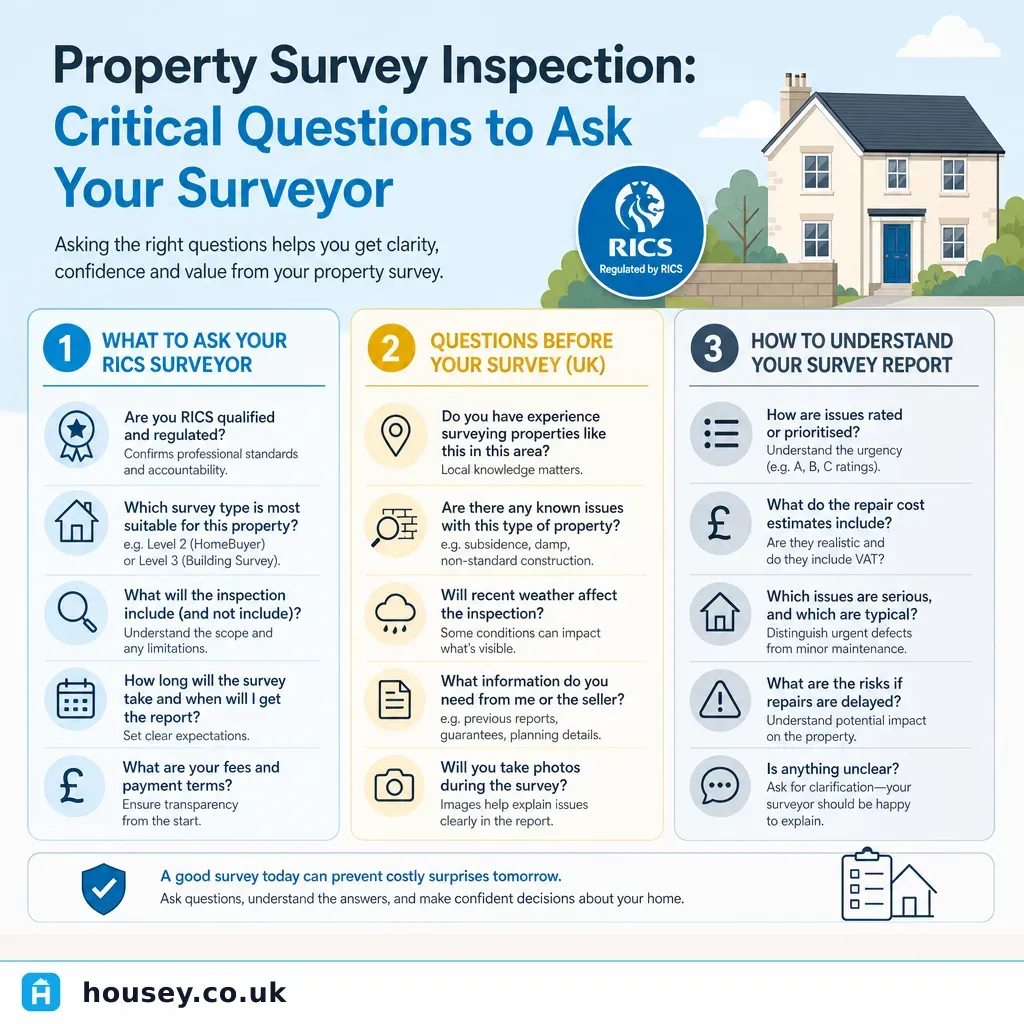
Property Survey Inspection: Critical Questions to Ask Your Surveyor
Before instructing a surveyor, ask which RICS level suits your property and what the report will and will not cover.
 Surveys & Inspections
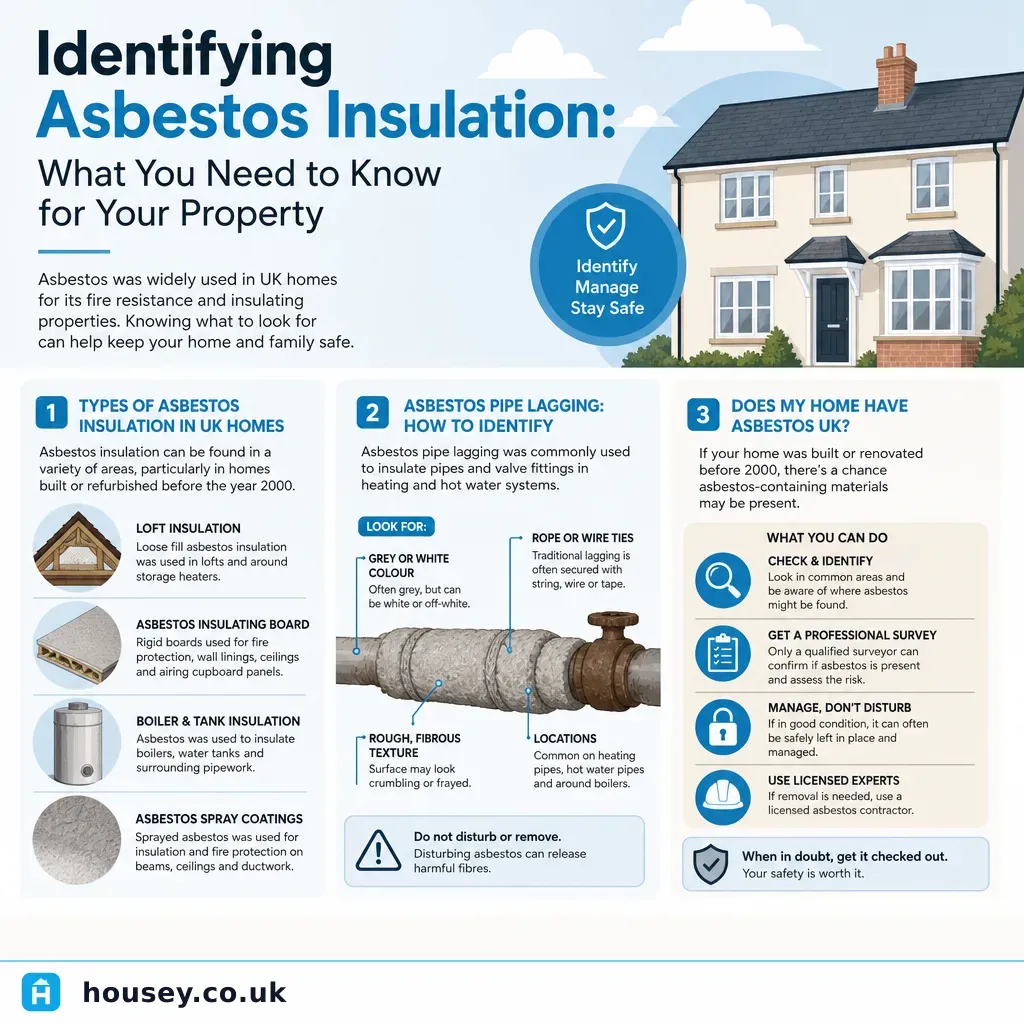
Identifying Asbestos Insulation: What You Need to Know for Your Property
Asbestos insulation was widely used in UK properties built before 2000, commonly found in pipe lagging, ceiling tiles, loose-fill loft insulation, and around boilers.
 Surveys & Inspections
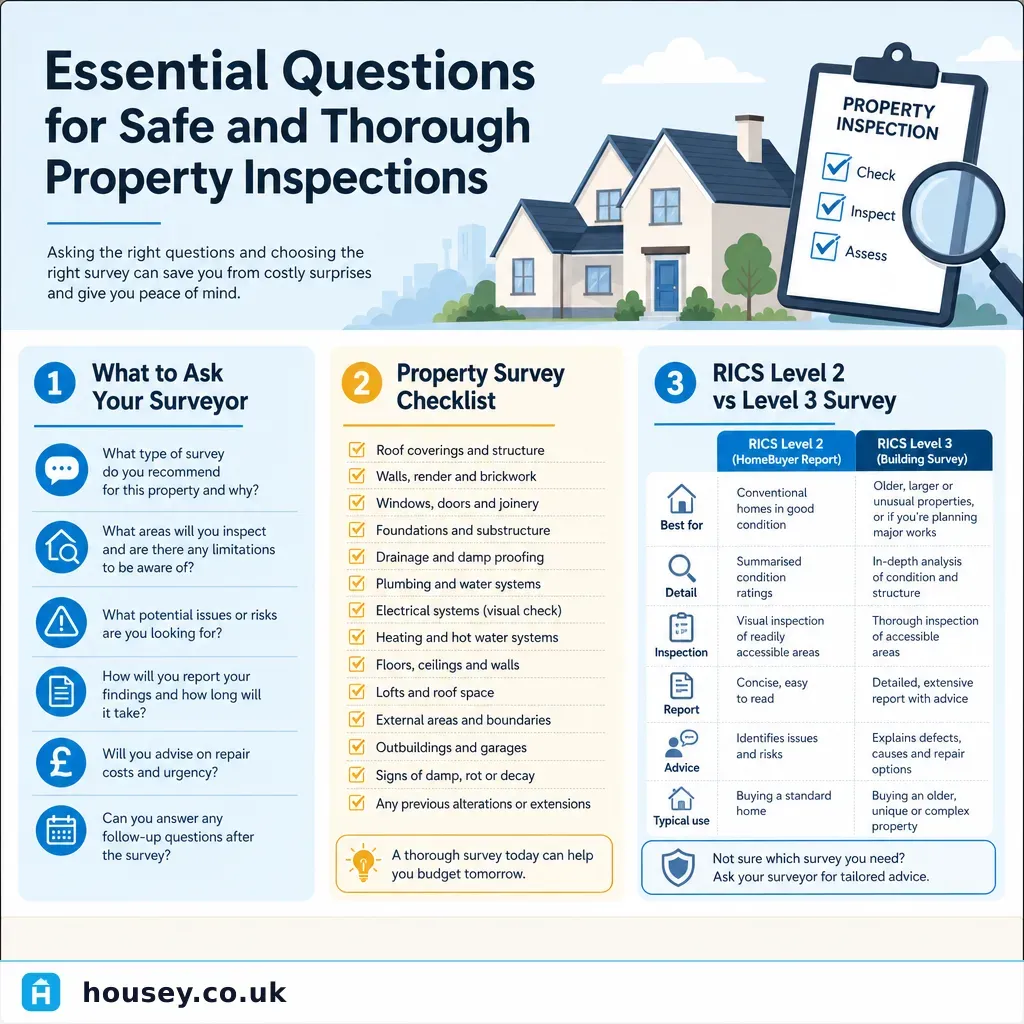
Essential Questions for Safe and Thorough Property Inspections
Before commissioning a property survey, confirm what type of inspection suits your property's age and condition, ask the surveyor what defects they will and will not assess, and understand what the report will recommend.
 Surveys & Inspections
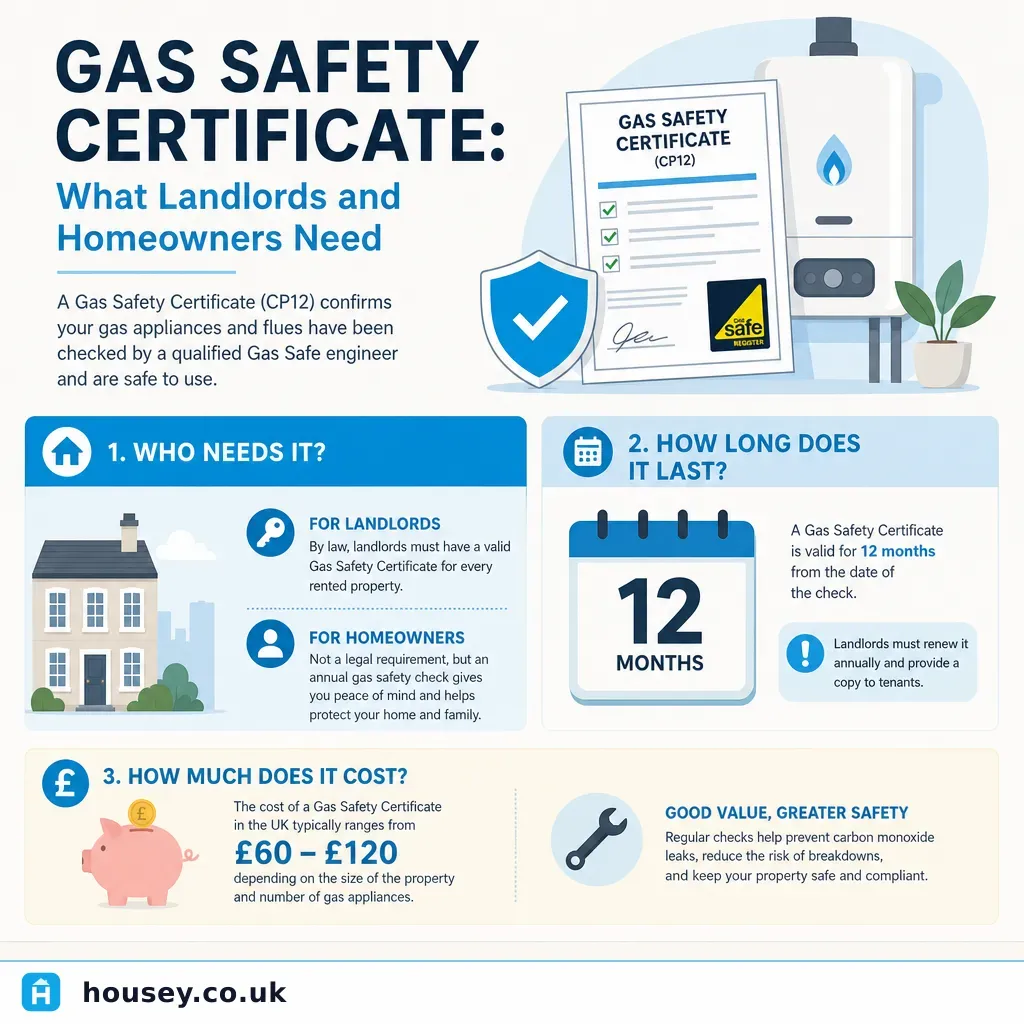
Gas Safety Certificate: What Landlords and Homeowners Need
Landlords in England, Scotland, and Wales must arrange a gas safety check every 12 months by a Gas Safe registered engineer under the Gas Safety (Installation and Use) Regulations 1998.
 Surveys & Inspections
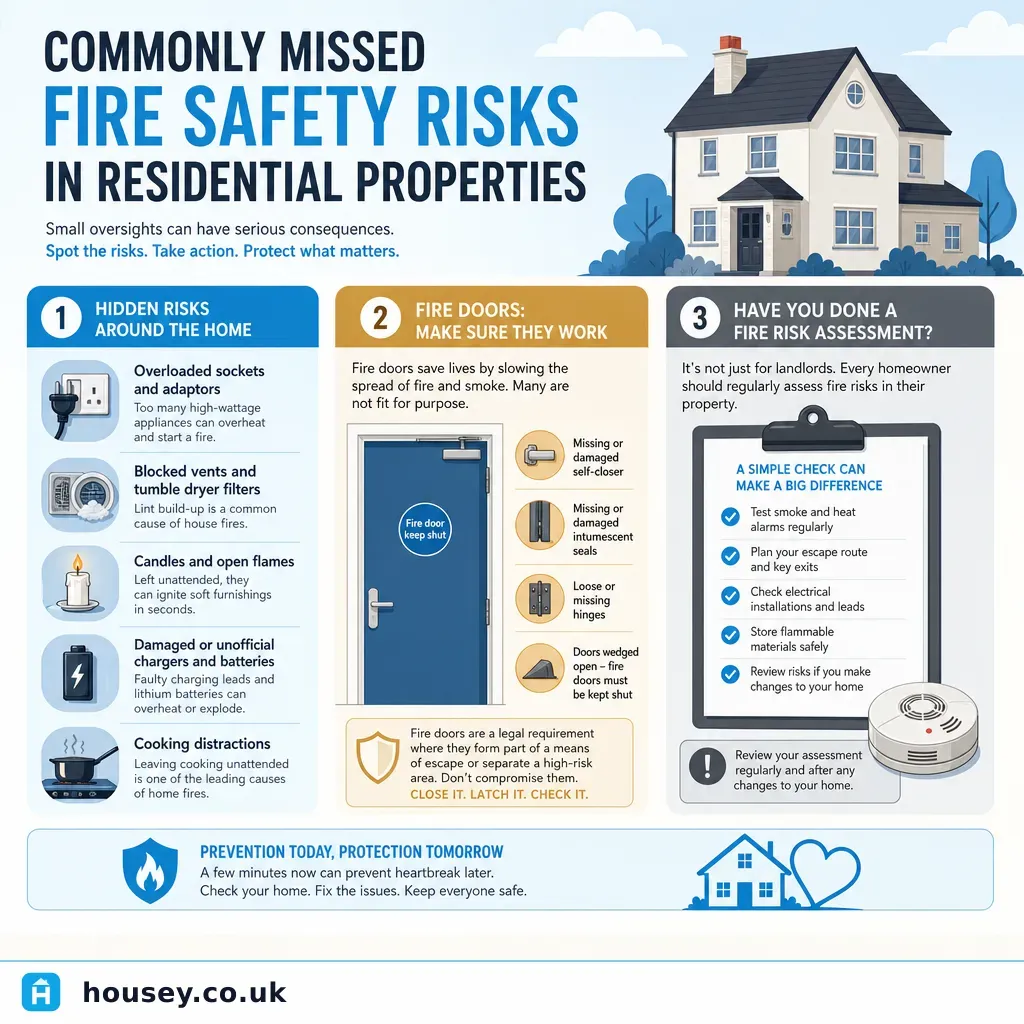
Commonly Missed Fire Safety Risks in Residential Properties
Commonly missed fire safety risks in UK homes include damaged fire doors without intumescent strips, breached compartmentation in roof spaces and floor voids, daisy-chained extension leads, and recessed downlighters without fire-rated covers.