Drainage Surveys for Property Acquisition
By Housey · Last reviewed 11th of May 2026
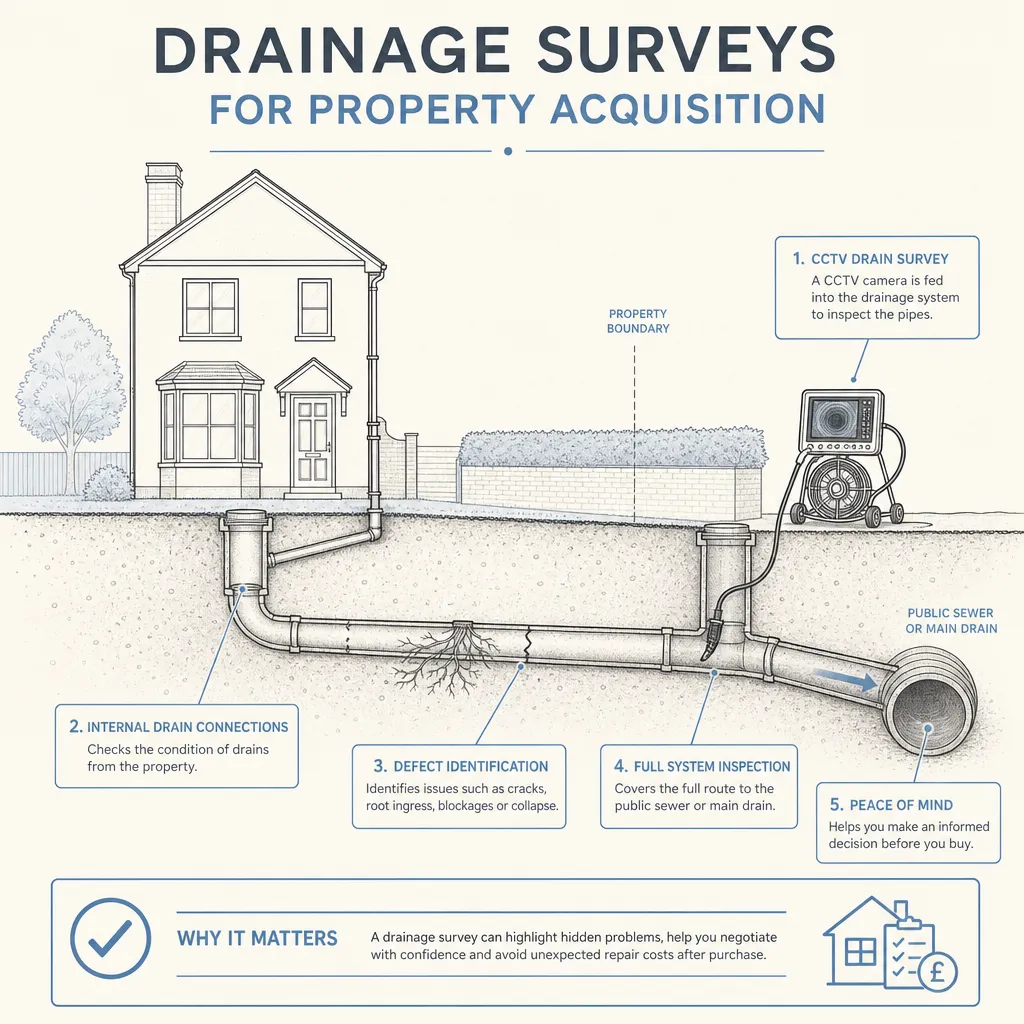
Drainage Surveys for Property Acquisition
Drainage problems are among the most consistently underestimated risks in residential property purchases across the UK. A RICS Level 2 or Level 3 Home Survey rarely includes a detailed inspection of underground drainage — meaning buyers can complete on a property harbouring collapsed drain runs, root ingress, or illegal misconnections, only discovering the problem when drains back up months after moving in. Commissioning a dedicated drainage survey before exchange is one of the most cost-effective forms of due diligence available.
Key points
- A CCTV drainage survey involves a camera passed through underground drain runs to record their condition; a full survey covers all accessible inspection chambers, soil stacks, and lateral connections within the property boundary.
- The Water Industry Act 2011 transferred most shared private drains to water company ownership, but private lateral drains within the property curtilage remain the homeowner's responsibility to maintain and repair.
- Drain collapses, root ingress, and displaced joints are the most common findings; remediation costs can range from a few hundred pounds for a localised repair to several thousand pounds for re-lining or excavation.
- Drainage survey reports typically use a defect severity grading system, with Grade 1 being minor and Grade 4–5 representing serious structural failure, giving buyers a basis for negotiation.
- Drainage surveys are particularly important for Victorian and Edwardian terraces, where shared combined (foul and surface water) drainage is common and pipes may be original clayware more than 100 years old.
What a drainage survey covers
A residential drainage survey for property acquisition typically includes:
Scope | What is inspected | Typical deliverable |
|---|---|---|
CCTV survey of drain runs | Underground lateral drains and sewer connections within the boundary | Recorded video and written condition report |
Inspection chamber survey | All accessible manholes and rodding eyes within the curtilage | Photographs and structural condition notes |
Soil stack and SVP check | Above-ground soil vent pipes and connections | Visual inspection notes |
Flow test | Water passed through the system to confirm flow rate and absence of blockages | Pass/fail observation |
Drain tracing (if commissioned) | Dye or smoke introduced to identify misconnections | Separate report section or addendum |
Not all surveys include every element — confirm the scope in writing before instructing. Drain tracing is often charged separately but is worth commissioning on extended, converted, or older properties.
Do I actually need a drainage survey?
- Choose a CCTV drainage survey if the property is Victorian or Edwardian, shows signs of slow drainage or historic low-level damp, has mature trees near the boundary, or is on a plot with known shared drainage.
- Choose a combined RICS Level 3 Home Survey and drainage survey if the property is generally older or shows multiple areas of concern — a structural surveyor and a drainage specialist working together avoids missed interactions between drainage defects and foundation or cellar issues.
- Commission drain tracing specifically if you suspect misconnections — for example, if the property has been extended, converted, or had unrecorded drainage works by previous owners.
- Consider omitting a drainage survey only if the property is a modern new-build (within approximately ten years) with active developer warranties, NHBC cover, and no visible drainage concerns — though even then, a survey may surface problems.
Common defects found in residential drainage surveys
Red flags to watch for in a drainage survey report:
- Displaced or open joints: sections of pipe that have separated, allowing groundwater ingress and soil migration into the drain. Commonly caused by ground movement, settlement, or tree root activity.
- Root ingress: tree roots entering cracked or joint-failed pipes; progressive if untreated and a common cause of repeated blockages in older properties.
- Collapsed sections: partial or complete structural failure of the pipe run; usually requires excavation or patch lining.
- Deformed pipe: significant ovality in the pipe cross-section indicates structural failure is likely in the near term.
- Misconnections: surface water connected to foul sewers, or vice versa — a regulatory breach under the Water Industry Act and Environmental Permitting Regulations that can carry enforcement consequences.
- Deposits and build-up: grease, scale, or debris pointing to poor maintenance or chronic slow drainage.
- Groundwater infiltration: water visible in the drain run when no flow is present, suggesting the drain may be acting as an unintended land drain.
How defect severity grades work
Drainage survey reports commonly use a severity grading to help buyers and their advisers understand urgency. The following reflects standard practice across UK CCTV survey contractors:
Severity grade | Typical description | Suggested buyer response |
|---|---|---|
Grade 1 | Minor defect; no immediate action required | Monitor; budget for future maintenance |
Grade 2 | Moderate defect; maintenance recommended | Negotiate a sum in lieu or request maintenance record |
Grade 3 | Serious defect; early intervention required | Negotiate repair or price reduction before exchange |
Grade 4 | Severe defect; immediate action needed | Re-negotiate strongly; obtain specialist remediation quote |
Grade 5 | Collapse or impassable section | Potentially deal-breaking; seek structural advice |
A drainage contractor or specialist can advise on realistic remediation costs for each grade of defect identified in the report.
What a drainage survey does not cover
A drainage survey gives a snapshot of accessible drain runs on the day of inspection. It does not:
- Inspect drains that are backfilled or inaccessible without excavation.
- Confirm the drain's position relative to building foundations — a structural engineer or drainage contractor can advise if proximity is a concern.
- Replace the CON29DW (Drainage and Water Enquiries) search that your solicitor should commission separately — this confirms whether the property is connected to the public sewer and identifies any public sewers crossing the plot (which affects build-over rights).
- Assess septic tanks or private sewage treatment plants — these require a separate specialist inspection.
Important limitations
This article provides general guidance only. Drainage and sewer responsibilities, shared drain arrangements, and water company boundaries vary by property, tenure, and location. Legal responsibility for drainage is a matter for your solicitor to confirm through a CON29DW search and the title documents. Drainage survey reports should be interpreted by a qualified drainage specialist, not used as the sole basis for legal or financial decisions without professional advice. Rules in Scotland, Wales, and Northern Ireland may differ from those applying in England under the Water Industry Act 1991 (as amended).
When this becomes urgent
Seek professional advice without delay if:
- The drainage survey reveals a Grade 4 or Grade 5 defect anywhere on the system.
- The report identifies a misconnection — these can carry regulatory consequences and affect the property's insurability.
- Mature trees are positioned within 3 m of drain runs and the survey shows root ingress at multiple points.
- The property has a septic tank or private treatment plant and no recent inspection or emptying records are available.
- Your solicitor's CON29DW search reveals the property is not connected to the public sewer as assumed, or that a public sewer runs beneath the property footprint.
What to ask a qualified professional
Before instructing a drainage surveyor or CCTV drain survey contractor, ask:
- What is the full scope of the survey — which drain runs, chambers, and connections are included, and what is explicitly excluded?
- What camera system is used, and will footage be provided in a standard playback format (MP4 or similar) that I can share with other professionals?
- Will the report use a recognised defect grading system, and will each defect be described with its location within the run?
- Are you insured, and do you hold relevant accreditations or qualifications for CCTV drain surveys?
- If defects are found, can you provide indicative remediation costs or refer me to a drainage repair specialist?
- Is drain tracing included in the quoted fee, or is it an additional charge — and do you recommend it for this property type?
- How quickly will I receive the written report? Given exchange timescales, turnaround time is critical.
How Housey can help
Housey connects buyers with experienced professionals offering drainage surveys and CCTV drain surveys across the UK, with fast turnaround to fit pre-exchange timescales. If drainage findings raise concerns about structural integrity or the proximity of drain runs to foundations, Housey can also connect you with specialists offering structural surveys to give you a complete picture before committing to a purchase.
Frequently asked questions
How much does a residential drainage survey cost in the UK?
A residential CCTV drainage survey typically costs between £150 and £400 depending on property size, the number of drain runs, access conditions, and whether drain tracing or a detailed written report is included. Indicative UK costs, last reviewed 2026-05-11. Always obtain at least two or three quotes specifying the same scope of works.
Can my solicitor arrange a drainage survey?
Your solicitor will arrange a CON29DW (Drainage and Water Enquiries) search, which confirms public sewer connections and responsibilities — but this is desk-based and does not physically inspect the drains. A CCTV drainage survey is a separate service, usually arranged by the buyer or their surveyor, not through the conveyancing solicitor.
What happens if a drainage problem is found before exchange?
If a survey reveals significant defects, you have several options: negotiate a price reduction reflecting estimated repair costs, ask the seller to carry out and evidence repairs before exchange, or withdraw from the purchase. Your solicitor can help formalise any agreed conditions in the exchange contract.
Are shared drains my responsibility as a UK homeowner?
Under the Water Industry Act 2011, most shared private drains connecting two or more properties to the public sewer were transferred to water company ownership. However, the private lateral drain within your property boundary remains your responsibility. Your solicitor's CON29DW search will clarify the position for your specific property.
Sources and further reading
- Ofwat — drains and sewers — Ofwat
- Water Industry Act 1991 — legislation.gov.uk
- RICS Home Survey Standard — RICS
- GOV.UK — buying a property: property searches — GOV.UK
- WaterSafe — guidance for homeowners on drainage — WaterSafe
Useful next reads
 Surveys & Inspections
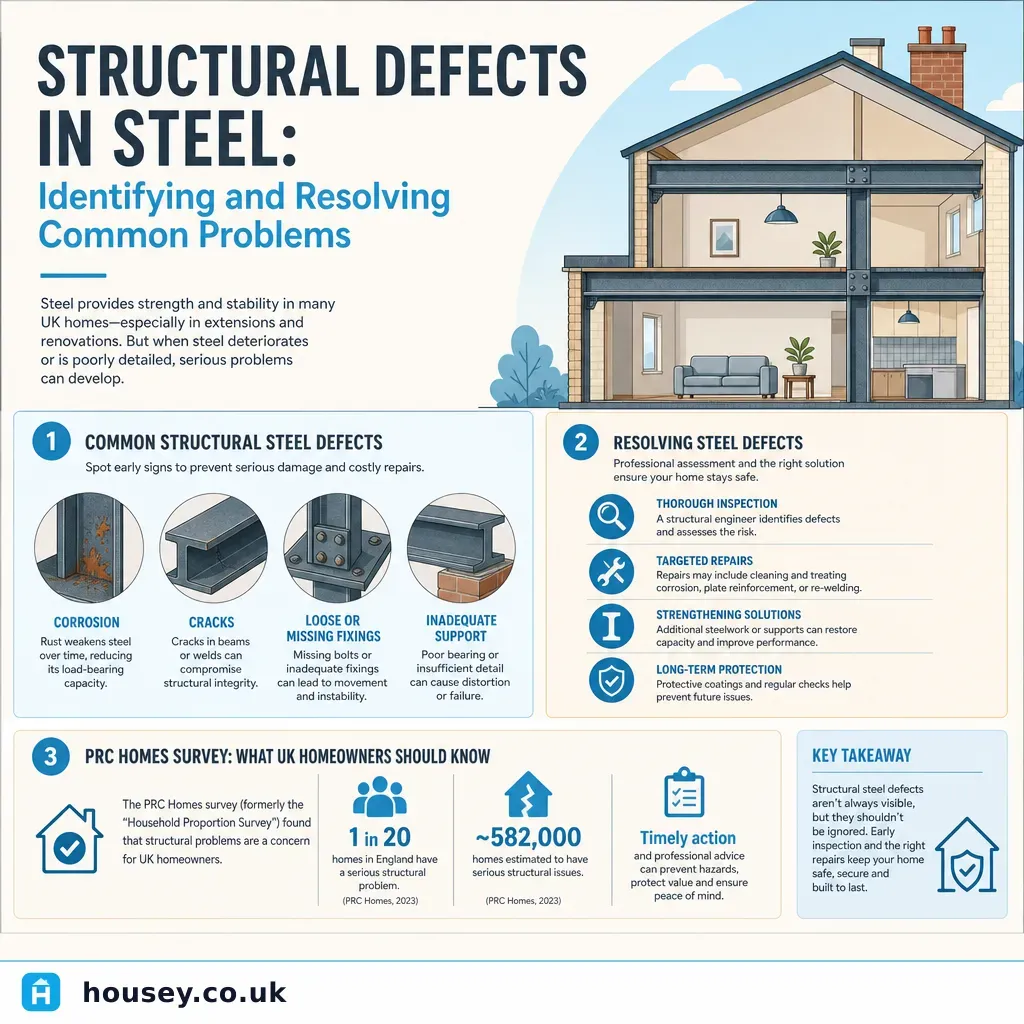
Structural Defects in Steel: Identifying and Resolving Common Problems
Common structural steel defects in UK buildings include corrosion with section loss, weld failures, buckling, and connection problems.
 Surveys & Inspections
House Survey Guide: Types and What to Expect
UK house surveys come in three RICS-standardised levels: Level 1 (Condition Report) for new or near-new homes, Level 2 (Home Survey) for conventional post-war properties, and Level 3 (Building Survey) for older, altered, or defective properties.
 Surveys & Inspections
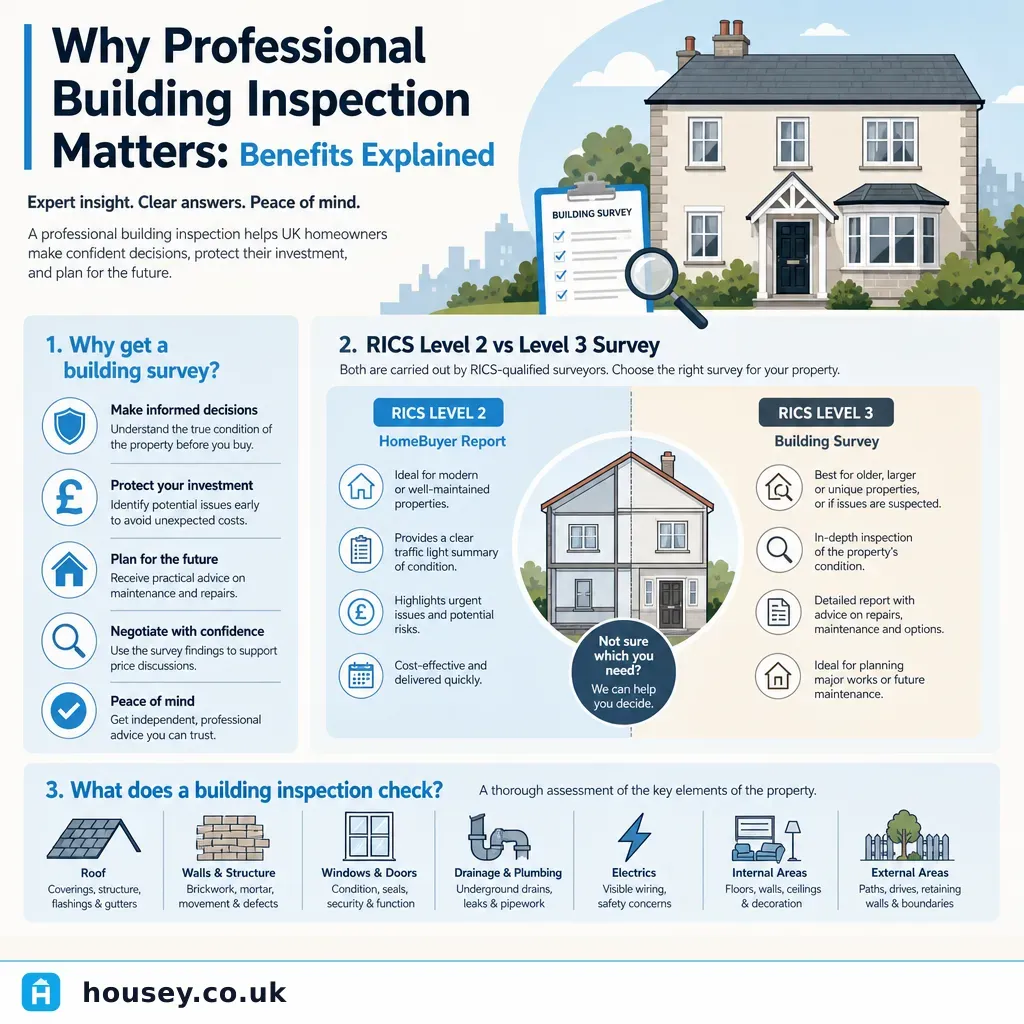
Why Professional Building Inspection Matters: Benefits Explained
Professional building inspection gives UK homeowners an independent, expert view of a property's condition and regulatory compliance.
 Surveys & Inspections
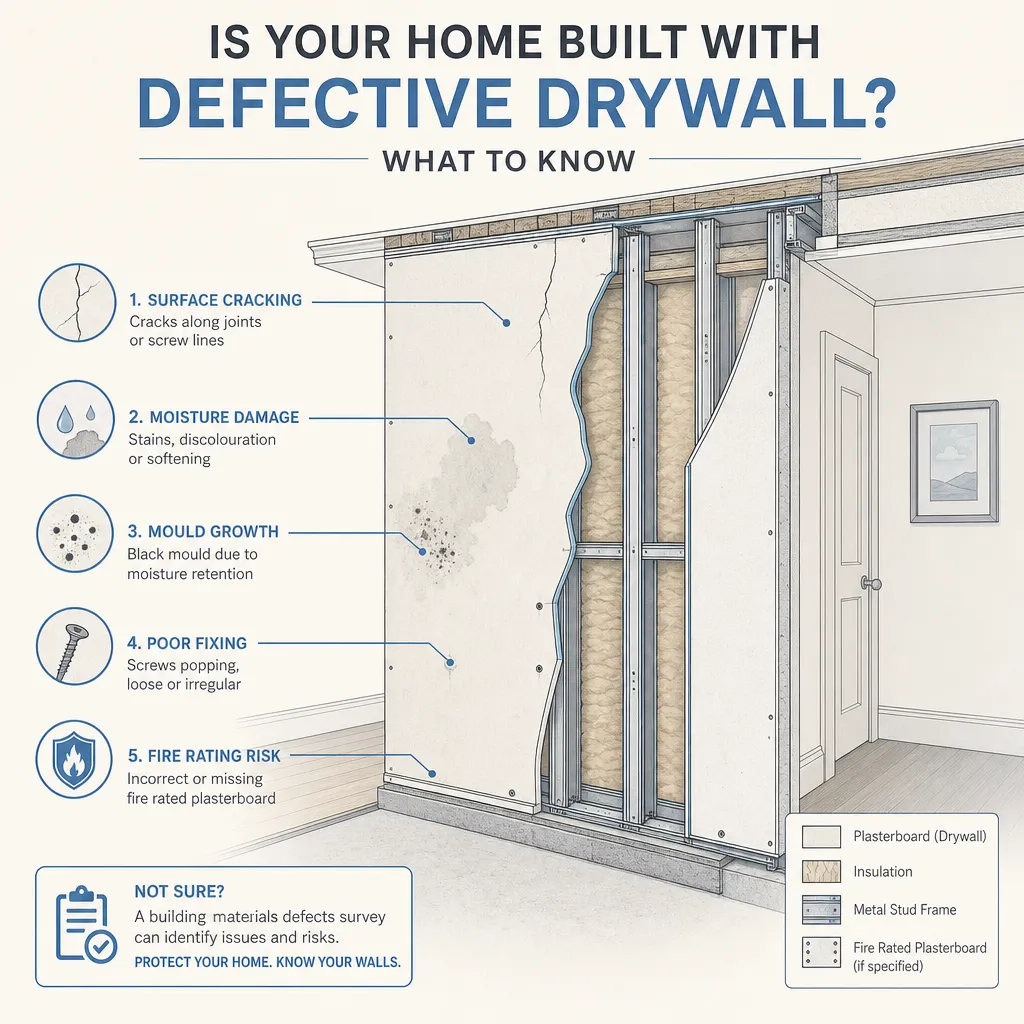
Is Your Home Built with Defective Drywall? What to Know
Contaminated Chinese drywall — as seen in US homes built 2001 to 2009 — is not a documented widespread problem in UK properties, where plasterboard is manufactured primarily to European standards.
 Surveys & Inspections
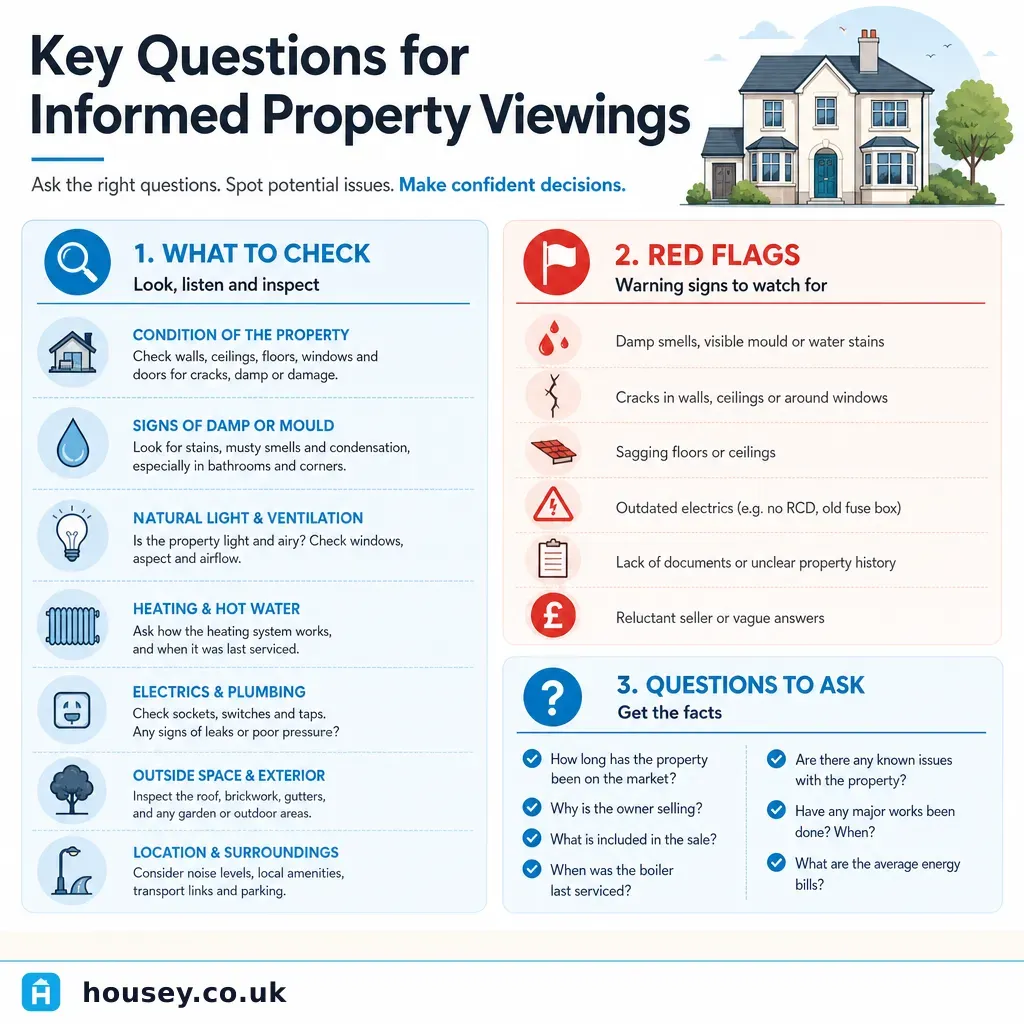
Key Questions for Informed Property Viewings
At a property viewing, ask specifically about structural movement, damp or water ingress, the age and service history of the boiler and electrics, whether any extensions obtained building regulations sign-off, and the seller's chain position.