Damp and Mould on Walls: Causes, Diagnosis, and Solutions
By Housey · Last reviewed 10th of May 2026
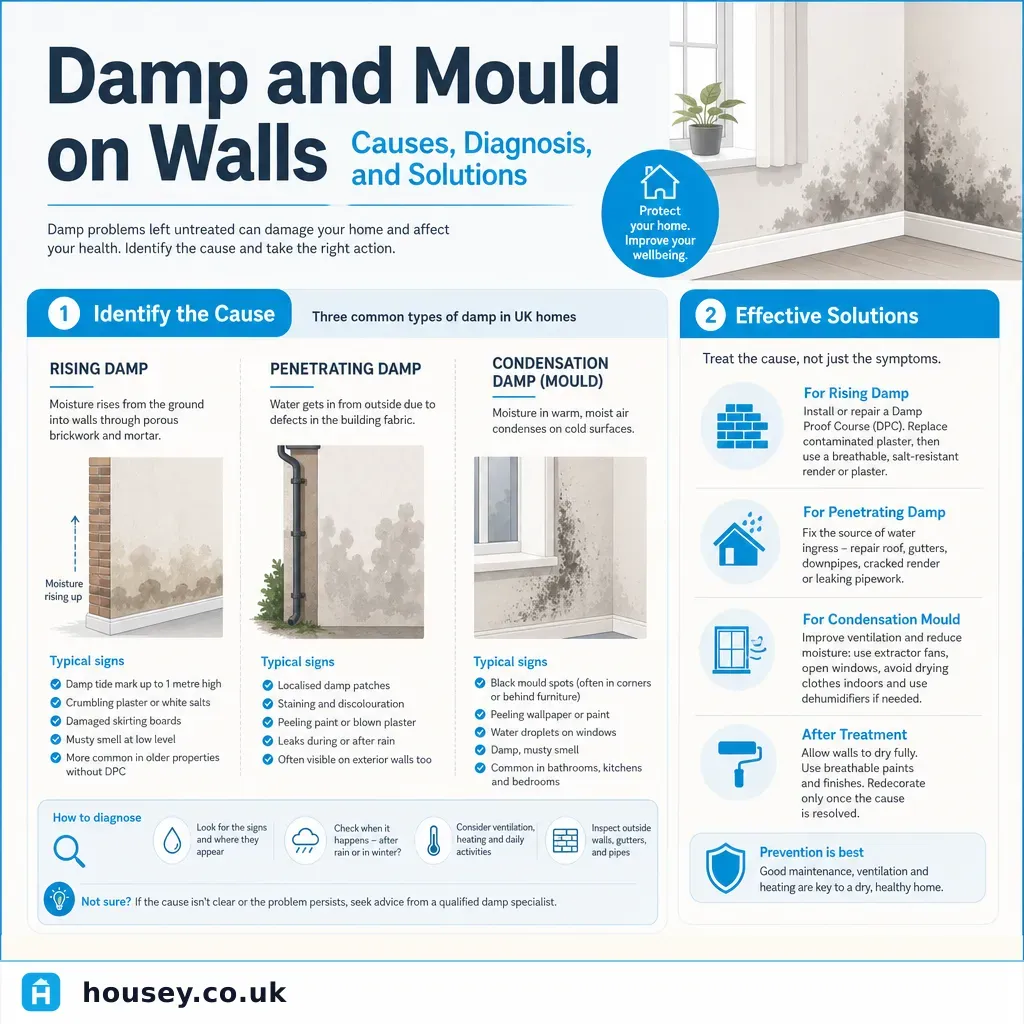
Damp and Mould on Walls: Causes, Diagnosis, and Solutions
Understanding the source of damp or mould in a UK home matters because the wrong treatment — however well-intentioned — can mask the problem or make it considerably worse. The question usually surfaces when a homeowner notices a tide mark on a ground-floor wall, black spots forming near a window, or a persistently musty smell in a bedroom. The pattern of the staining, where it appears on the wall, and whether it worsens after rainfall or in cold weather are all diagnostic clues that point to very different underlying causes.
Key points
- There are three main categories of damp in UK homes: rising damp, penetrating damp, and condensation — each requiring a different remedy and a different professional.
- The Property Care Association (PCA) recommends a full diagnostic survey before any chemical damp-proofing is applied, as condensation is frequently misdiagnosed as rising damp by sales-driven remediation companies.
- Under the Homes (Fitness for Human Habitation) Act 2018, landlords in England and Wales have a legal duty to keep rental properties free from damp and mould that makes the home unfit to live in.
- Black mould species can cause respiratory problems; NHS guidance identifies it as a risk factor for asthma, allergies, and lung infections, particularly in children and people with weakened immune systems.
- A RICS-qualified surveyor or PCA-registered specialist can issue a damp and timber report — mortgage lenders sometimes require this before approving a loan on an affected property.
What causes damp on walls?
Damp on walls in UK homes typically falls into one of three categories. Getting the diagnosis right before committing to a treatment is critical, because each type has a different origin and a different remedy.
Type of damp | Where it appears | Key signs | Common cause | Usual remedy |
|---|---|---|---|---|
Rising damp | Ground-floor walls, typically up to ~1 m high | Tide marks, white salt deposits (efflorescence), wallpaper peeling at the base | Failed or absent damp-proof course (DPC) | DPC injection or replacement, replastering |
Penetrating damp | Any external wall, often upper floors or below a flat roof | Damp patches after rain, localised staining that may dry out in dry spells | Leaking roof, defective pointing, blocked gutters, failed window seals | Repair the water ingress route first |
Condensation | Corners, behind furniture, around cold bridges, north-facing walls | Black mould spots, furring on surfaces, musty smell; worse in winter | Warm moist air meeting cold surfaces; inadequate ventilation or heating | Improve ventilation, insulate cold bridges, adjust heating pattern |
Rising damp is frequently overstated by sales-driven remediation contractors. Independent surveys carried out by PCA members and RICS surveyors often find condensation or penetrating damp where rising damp has been assumed, meaning expensive injection works may be proposed unnecessarily.
How to diagnose the type of damp
A systematic check can narrow down the cause before you instruct any professional:
- Check the timing. Does the damp appear or worsen after heavy rain (suggests penetrating damp), in cold winter mornings (suggests condensation), or does it persist regardless of weather (may suggest rising damp or a slow structural leak)?
- Look at the height. Rising damp rarely travels above 1–1.2 m from the floor. Any staining above that level is more likely penetrating damp or condensation.
- Inspect the outside. Walk around the property and check for missing or cracked pointing, overflowing or blocked gutters, flat-roof junctions, or windows without adequate drip mouldings.
- Look behind furniture. Condensation mould often grows where air circulation is restricted — behind wardrobes, on external walls, in built-in cupboards.
- Use a moisture meter. A basic pin-type moisture meter can confirm whether wall material itself is wet, though it cannot indicate why. Readings that are consistent across an entire wall face at low level may support a rising damp hypothesis, but professional assessment is still needed.
What a professional damp survey involves
A damp and timber survey carried out by a PCA-registered specialist or RICS-qualified building surveyor typically includes:
- Visual inspection of internal and external wall surfaces
- Moisture meter readings taken at multiple heights across affected areas
- Examination of the existing DPC level and condition (if one is present)
- Assessment of gutters, roof, pointing, and other potential water ingress routes
- Identification of structural timbers — floor joists, lintels, window frames — at risk from rot or woodworm associated with persistent dampness
- A written report setting out the causes identified and remediation options in order of priority
A RICS Level 3 Building Survey also covers damp as part of a broader structural inspection and may be more appropriate if the property has multiple defects, is a Victorian or Edwardian terrace, or is a solid-wall construction built before 1919.
Indicative costs for a standalone damp and timber survey range from approximately £200 to £600 depending on property size and location; last reviewed 2026-05-10. Quotes vary significantly by region and scope — always obtain at least two written quotes before instructing.
Red flags: when damp becomes urgent
Not all damp is immediately serious, but certain combinations of symptoms warrant urgent professional assessment rather than a wait-and-see approach:
- Structural timbers (floor joists, lintels, roof rafters) showing signs of wet rot or dry rot alongside persistent dampness
- Damp accompanied by visible cracking, settlement, or failed structural junctions suggesting water ingress is reaching load-bearing elements
- Black mould visible in a bedroom, nursery, or any room used by someone with asthma, a respiratory condition, or a compromised immune system
- A damp-proof course injected within the last 10–20 years that appears to have failed — this may indicate an incorrect original diagnosis
- A lender's mortgage valuation or buyer's RICS survey report that specifically flags damp, requiring a specialist report before the mortgage offer can proceed
Important limitations
This article provides general information about the common types of damp found in UK homes. The appropriate diagnosis and remedy for any specific property depend on its age, construction method, DPC type, exposure, ventilation, heating patterns, and external condition. A general guide cannot replace a professional survey. Chemical damp-proofing applied without a correct diagnosis may mask symptoms while leaving the underlying cause unaddressed, potentially allowing further structural or timber damage to develop.
What to ask a qualified professional
Before instructing a damp specialist or commissioning a survey, ask:
- Are you registered with the Property Care Association (PCA) or a RICS-qualified building surveyor?
- Will you produce a written report identifying the cause of dampness before recommending any treatment?
- Does your diagnosis involve moisture meter readings at multiple heights and inspection of external as well as internal wall surfaces?
- If you are recommending a chemical DPC injection, what is the evidence that rising damp is the cause rather than condensation or penetrating damp?
- Does the quoted price include replastering? (Chemical DPC work usually requires salt-resistant replastering after injection — this is often a significant additional cost not included in the initial quote.)
- Is any guarantee backed by insurance, and by whom?
When to get professional help
Damp rarely resolves on its own, and delayed treatment often allows secondary problems — timber decay, mould spread, damage to plasterwork and finishes — to develop. Seek a professional damp and timber survey if:
- Damp patches or mould return within a few weeks of cleaning
- You cannot identify a clear external cause (blocked gutter, failed pointing) and fix it yourself
- The damp is affecting structural timbers or appears consistently at the base of ground-floor walls
- A buyer's surveyor or mortgage lender has raised damp as a formal concern
How Housey can help
Housey connects you with PCA-registered and RICS-qualified specialists who carry out damp and timber surveys across the UK. Rather than instructing whoever shows up first, you can compare quotes from vetted local professionals and read reviews from other homeowners before deciding who to trust with your property.
Frequently asked questions
How do I tell if I have rising damp or condensation?
Rising damp typically produces a tide mark at a consistent height below 1 m from floor level, often with white salt deposits and peeling wallpaper at the base. Condensation mould appears as black spots, clusters in corners and behind furniture, and worsens in winter. A moisture meter and external inspection can help narrow it down, but a professional survey provides the most reliable diagnosis.
Do I need a professional damp survey before treating the problem?
A professional survey is strongly advisable before any remediation work, particularly before chemical DPC injection or replastering. Independent surveys frequently find a different cause to the one initially assumed. If a lender or mortgage valuer has flagged damp, a report from a PCA-registered specialist or RICS-qualified surveyor is likely required before your mortgage offer can proceed.
Can I treat damp myself?
Condensation can often be reduced significantly by improving ventilation — trickle vents, extractor fans, or positive input ventilation — and adjusting heating patterns. Clearing a blocked gutter or repointing a small area of defective mortar is within DIY reach for a competent homeowner. Chemical DPC injection and structural replastering should be left to qualified professionals.
Is mould on walls a health risk in a UK home?
NHS guidance identifies damp and mould as a health risk, particularly for people with asthma, allergies, weakened immune systems, or respiratory conditions, and for children and the elderly. Under the Homes (Fitness for Human Habitation) Act 2018, landlords in England and Wales must address damp and mould in rental properties. Citizens Advice can advise tenants on next steps if a landlord does not respond to written notice.
Sources and further reading
- Damp and mould in the home — NHS
- Homes (Fitness for Human Habitation) Act 2018 — GOV.UK
- Damp investigation and remediation guidance — Property Care Association
- RICS Home Survey Standard — RICS
Useful next reads
 Surveys & Inspections
House Survey Guide: Types and What to Expect
UK house surveys come in three RICS-standardised levels: Level 1 (Condition Report) for new or near-new homes, Level 2 (Home Survey) for conventional post-war properties, and Level 3 (Building Survey) for older, altered, or defective properties.
 Surveys & Inspections
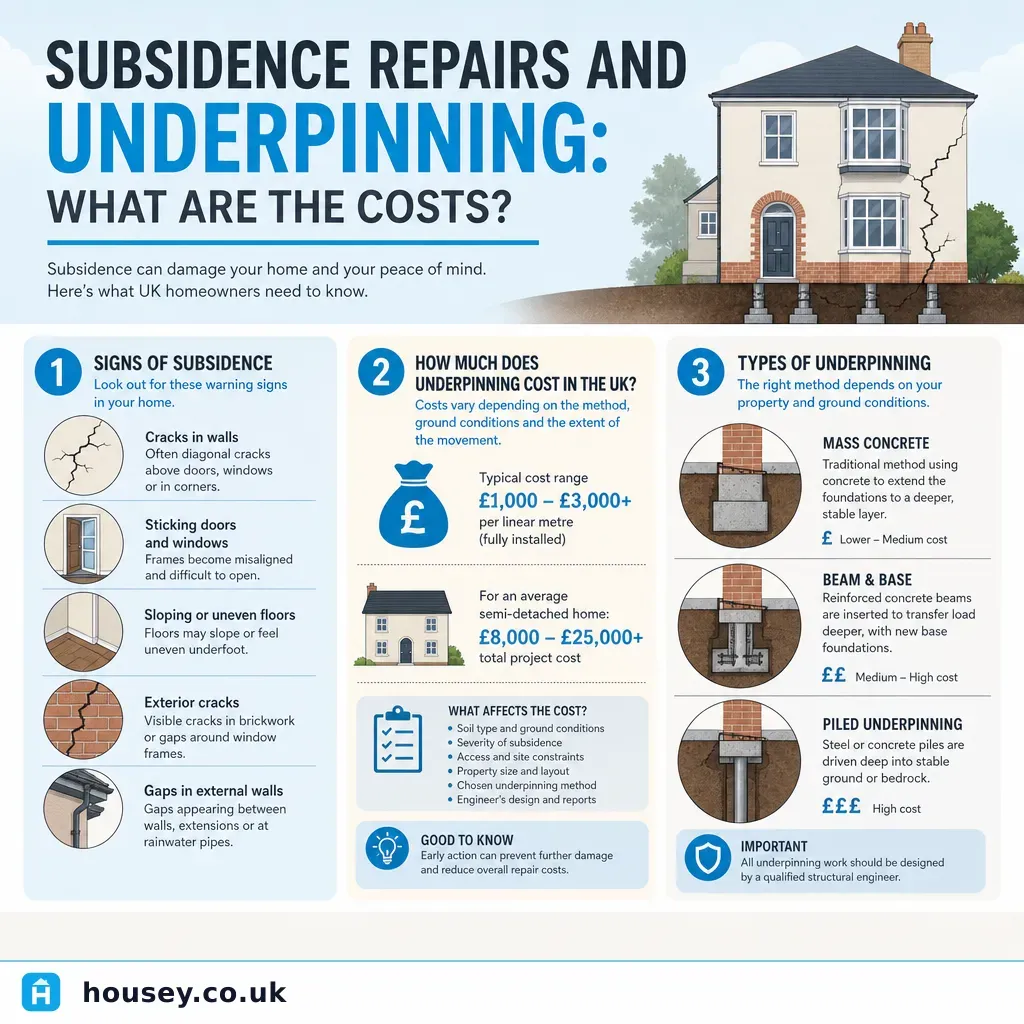
Subsidence Repairs and Underpinning: What Are the Costs?
Underpinning costs in the UK typically range from £1,000 to £3,000 per linear metre, with whole-house projects often totalling £10,000–£50,000 depending on method, property size, and ground conditions.
 Surveys & Inspections
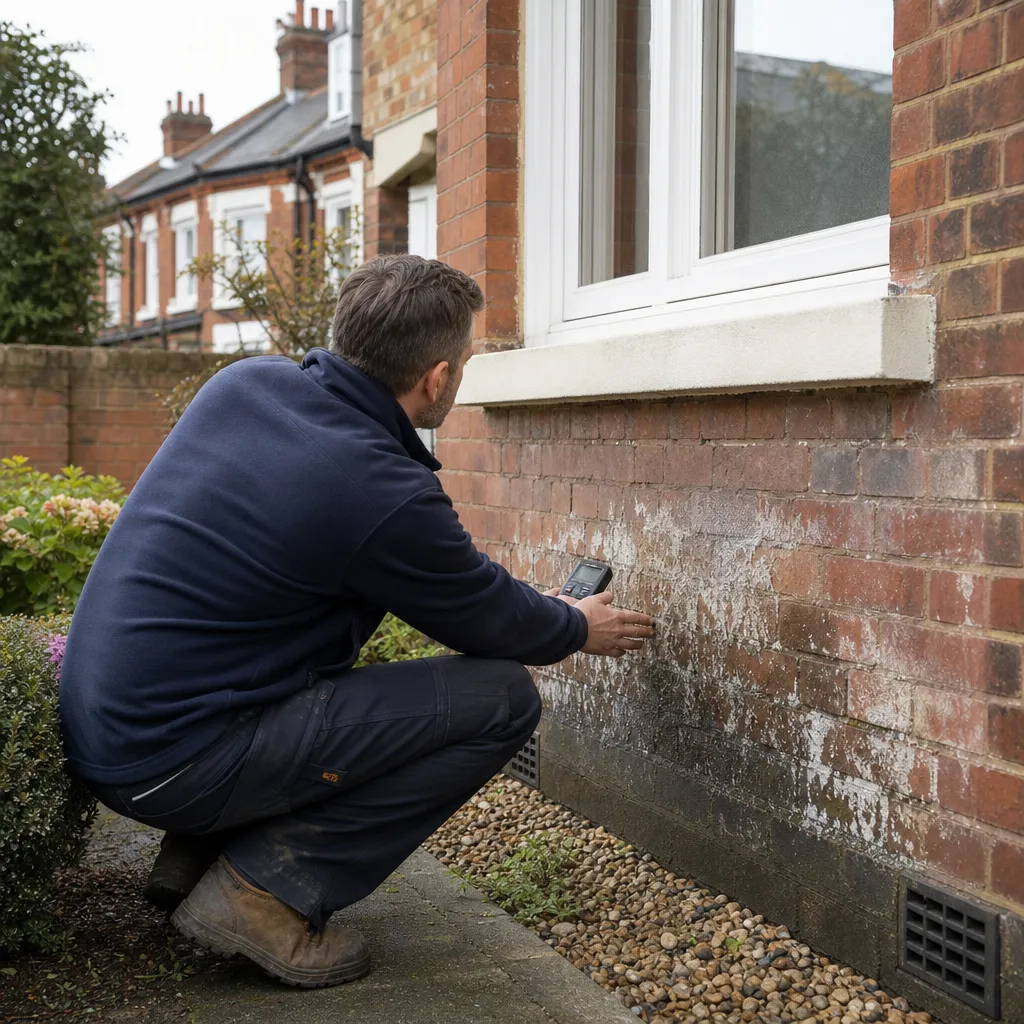
Treatment and Prevention of Damp Problems in Homes
Damp in UK homes usually falls into three categories: rising damp (moisture drawn up through walls), penetrating damp (water entering through building defects), and condensation — the most common cause, particularly in post-war housing.
 Surveys & Inspections
Essential Factors for Property Buyers to Consider Before Exchange
Before exchanging contracts on a UK property, buyers should commission an appropriate RICS survey, review the property's legal title and search results, check the planning history, assess structural condition, and confirm the EPC rating.
 Surveys & Inspections
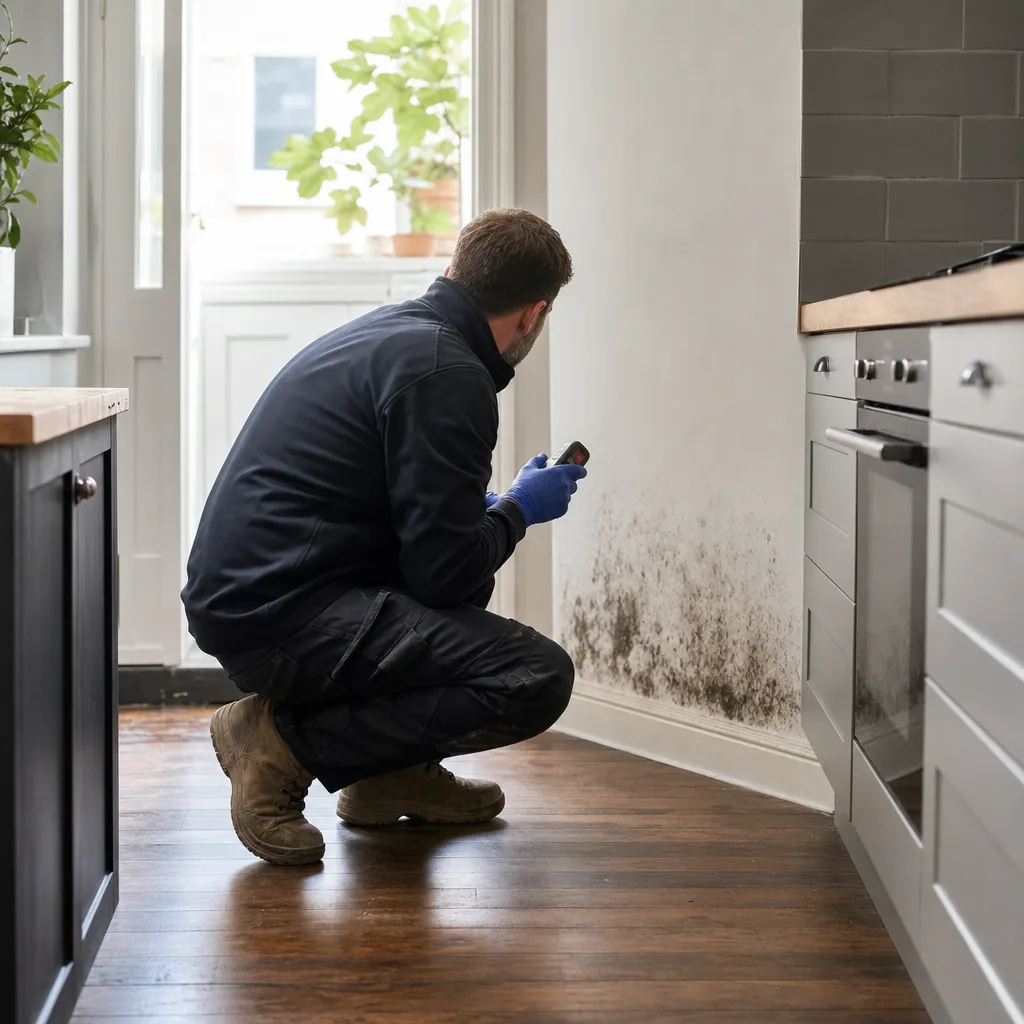
Investigating and Diagnosing Unexpected Odours in Your Property
Unexpected odours in a UK property usually indicate drainage faults, rising or penetrating damp, decaying timber, or mould growth.