Essential Factors for Property Buyers to Consider Before Exchange
By Housey · Last reviewed 30th of May 2026
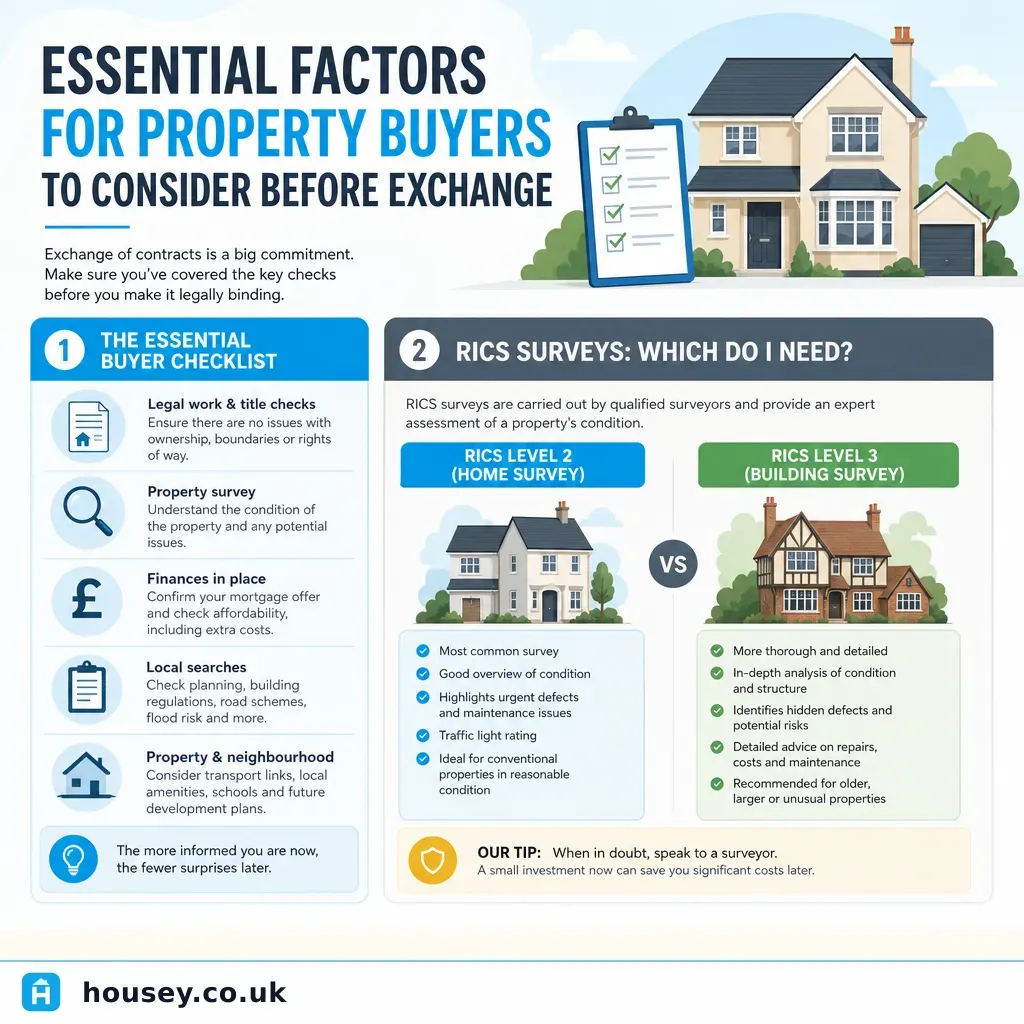
Essential Factors for Property Buyers to Consider Before Exchange
Purchasing a property in the UK involves a sequence of legal, physical, and financial checks that must be completed before contracts are exchanged and the transaction becomes legally binding. Many buyers focus primarily on price and location, but the structural condition of the property and the legal status of its title carry equal weight when assessing value and risk. Incomplete due diligence before exchange leaves buyers with limited legal recourse for problems discovered afterwards — understanding which checks matter, and when to commission them, is one of the most consequential parts of the buying process.
Key points
- In England and Wales, exchange of contracts is the point at which the purchase becomes legally binding; defects discovered after exchange are generally the buyer's responsibility unless specifically negotiated beforehand.
- A RICS Level 2 Home Survey suits standard homes in reasonable condition built roughly post-1930; a RICS Level 3 Building Survey is recommended for older, larger, altered, unusual, or visibly defective properties — the choice should be driven by the property, not cost alone.
- Local authority searches, drainage searches, and environmental searches are ordered by your conveyancer and can take 2–10 weeks depending on the local authority; results can reveal planning constraints, flood risk, and infrastructure proposals that materially affect value.
- An Energy Performance Certificate (EPC) is legally required for most properties being sold; an F or G rating signals that the buyer should budget for retrofit improvements.
- Damp, timber decay, and structural movement are among the most common significant defects found in UK residential surveys — each can escalate substantially in remediation cost if undetected.
Choosing the right survey
Choosing the right survey level depends on the age, construction, and condition of the specific property — not on cost or convenience alone. The RICS (Royal Institution of Chartered Surveyors) defines three main residential survey levels:
Survey type | Best for | What it covers | Main limitation |
|---|---|---|---|
RICS Level 1 Condition Report | New builds or near-new homes in excellent condition | Traffic-light condition ratings; limited commentary | Rarely recommended for older or altered homes |
RICS Level 2 Home Survey | Conventional homes post-1930, unaltered, sound condition | Condition ratings, defect commentary, damp readings, visible structure | Does not open floors, lift carpets, or access concealed voids |
RICS Level 3 Building Survey | Older, larger, altered, unusual, or visibly defective properties | Detailed assessment of construction, condition, defects, and maintenance requirements | More expensive and time-consuming than Level 2 |
Structural engineer report | Specific concern such as cracking, movement, or non-standard structure | Engineering diagnosis of a named structural issue | Not a whole-house condition survey |
For a Victorian terrace, a 1930s semi with past extensions, or any listed building, a RICS Level 3 Building Survey typically provides significantly more actionable information.
Decision tree: which survey do you need?
- Choose a RICS Level 2 Home Survey if the property is conventional post-1930 construction, appears to be in reasonable condition, and has not been significantly extended or altered.
- Choose a RICS Level 3 Building Survey if the property is pre-1930, is of unusual or non-standard construction (timber frame, thatched, concrete panel), shows visible cracks, damp staining, or evidence of significant alterations, or is large and complex.
- Commission a specialist structural engineer if the survey or your visual inspection identifies movement, subsidence risk, or a structural element the surveyor recommends investigating further.
- Commission a damp and timber survey if a Level 2 or Level 3 survey identifies damp penetration, rising damp, or timber decay — a specialist report provides a treatment specification and cost estimate.
- Ask your conveyancer about additional searches if the property is in a known flood-prone area, a former mining region, or a location with potential ground contamination.
- Check lease terms carefully with your conveyancer if buying a leasehold flat — a term below 80 years carries specific risks for mortgage eligibility and future saleability.
Legal and conveyancing checks
Your conveyancer or solicitor carries out legal due diligence in parallel with your survey. Key checks include:
- Official copies of the title register from HM Land Registry, confirming the seller's ownership and any charges, restrictions, or covenants affecting the property.
- Local authority search, which reveals planning history, enforcement notices, road proposals, and whether the property is in a conservation area or subject to a Tree Preservation Order.
- Water and drainage search, confirming mains water and drainage connections and whether any public sewers cross the land.
- Environmental search, flagging flood risk, ground contamination, and proximity to landfill sites.
- Chancel repair liability search, relevant for properties near medieval churches in England.
- Property information forms (TA6 and TA10), the seller's disclosures about disputes, alterations, warranties, and fixtures — review these carefully alongside your solicitor.
For leasehold flats and maisonettes, your conveyancer should also review the lease itself, service charge history, ground rent terms, and any planned major works that may result in a significant service charge demand after completion.
Red flags to watch for
The following issues warrant careful consideration, further investigation, or professional advice before proceeding:
- Cracks in external masonry — particularly stepped diagonal cracks, horizontal cracks in brick courses, or cracks near door and window openings, which may indicate movement or subsidence.
- Damp patches, tide marks, or white salt deposits (efflorescence) on internal walls at low level (possible rising damp) or on chimney breasts (penetrating damp).
- Flat roof areas — these have shorter lifespans than pitched roofs and can be costly to replace; ask about age and maintenance history.
- Older or non-standard electrical wiring — ask when the installation was last tested; an Electrical Installation Condition Report (EICR) should be less than 10 years old for most dwellings.
- Missing planning permission or building regulations approval for extensions, loft conversions, or structural alterations — your conveyancer should raise the absence of documentation with the seller.
- Short lease on a leasehold flat — a remaining term below 80 years can affect mortgage eligibility and future saleability; lease extension costs increase as the term falls.
- Properties in flood zones 2 or 3 — check the Environment Agency's flood risk maps and factor in higher buildings insurance premiums.
- No boiler service history — ask the seller for documentation; an unmaintained boiler in an older property may require early replacement.
Important limitations
This article provides general guidance only. Property condition, legal title, survey requirements, and applicable regulations vary significantly between properties, tenures, locations, and individual circumstances. Nothing here constitutes legal, structural, or financial advice. Always instruct a RICS-registered surveyor for condition assessments, a regulated solicitor or licensed conveyancer for legal work, and other qualified specialists as appropriate for your specific property and situation.
When this becomes urgent
Seek professional advice promptly — and before exchange — if:
- A crack is visibly widening, stepped diagonally through brickwork, or wider than approximately 5mm; do not exchange until a structural engineer has inspected it.
- A survey report contains Category 3 (urgent) condition ratings, or recommends specialist investigation before proceeding.
- Planning permission or building regulations sign-off is absent for a significant alteration and the seller cannot provide indemnity insurance — your conveyancer should advise on the options.
- A search reveals significant flood risk, ground contamination, or a planned infrastructure project directly adjacent to the property.
- The lease term on a leasehold flat is below 80 years; consult a solicitor experienced in lease extensions before exchange, as this materially affects value and mortgage eligibility.
What to ask a qualified professional
Before instructing a surveyor:
- What survey level do you recommend for this specific property, and why?
- Will you flag issues requiring specialist follow-up — for example, a structural engineer or damp specialist?
- What areas of the property will you be unable to inspect, and why?
- When will I receive the report, and will you talk me through the findings?
- Are you regulated by RICS and do you hold professional indemnity insurance?
Before instructing a conveyancer:
- Which searches do you recommend for this property and location, and why?
- How long are searches currently taking in this local authority?
- How will you handle missing planning permissions or building regulations approval?
- What is your process if the survey or searches reveal significant issues before exchange?
When to get professional help
Commission a surveyor as soon as your offer is accepted — well before exchange, not after. If the survey flags structural movement, significant damp, timber decay, or major defects, obtain specialist reports before deciding whether to proceed, renegotiate on price, or withdraw. Do not treat a mortgage valuation as a substitute for a condition survey; the two serve entirely different purposes.
How Housey can help
Housey connects property buyers with RICS-regulated surveyors offering RICS Level 3 Building Surveys, structural surveys, and damp and timber surveys across the UK. Compare quotes from qualified local professionals before you exchange contracts.
Frequently asked questions
Do I need a survey if the property is a new build?
New builds are typically covered by a structural warranty such as NHBC Buildmark for 10 years. Buyers can still commission an independent snagging survey before legal completion to identify defects the developer should remedy. This is separate from a RICS condition survey and does not replace it for older or altered properties.
Can I rely on the mortgage lender's valuation as a survey?
No. A mortgage valuation assesses the property's suitability as security for the loan — it is not a condition survey and will not identify most defects. The cost of a proper RICS survey is modest relative to the potential cost of discovering significant defects after completion.
What happens if the survey finds problems before exchange?
You have several options: proceed as agreed, negotiate a price reduction to reflect remediation costs, ask the seller to address defects before exchange, or withdraw from the purchase without legal obligation. Before exchange, you are not legally bound. Your conveyancer and surveyor can advise on the appropriate response to specific findings.
How much does a RICS Level 3 Building Survey cost?
Indicative UK costs, last reviewed 2026-05-30: roughly £500–£1,500 for most residential properties, with higher fees for large, complex, or rural homes. Costs vary by location, property size, and surveying firm. Obtain at least two or three quotes from RICS-regulated surveyors before instructing.
Sources and further reading
- RICS Home Surveys — guidance for consumers — RICS
- HM Land Registry — search for property information — GOV.UK / HM Land Registry
- Check your flood risk in England — Environment Agency / GOV.UK
- Citizens Advice — buying a home — Citizens Advice
- GOV.UK — buying or owning a home — GOV.UK
Useful next reads
 Surveys & Inspections
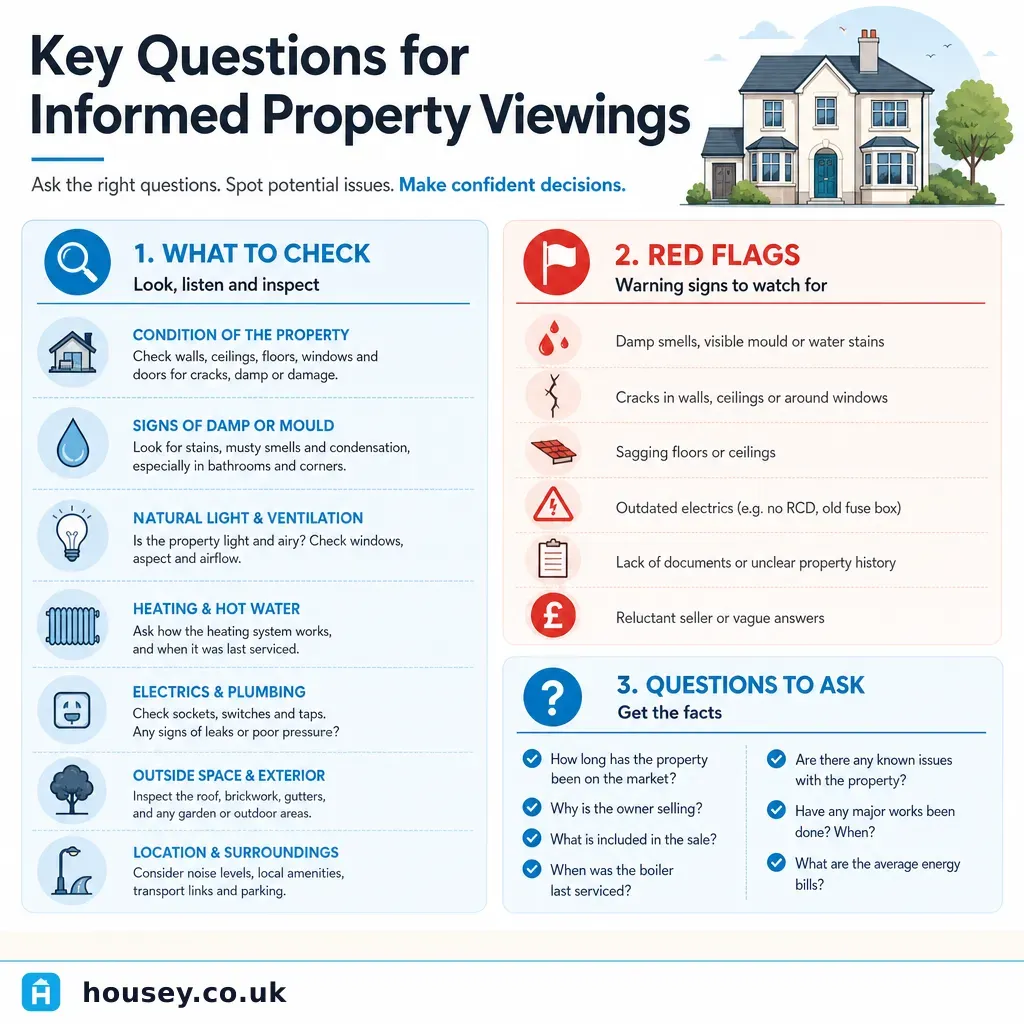
Key Questions for Informed Property Viewings
At a property viewing, ask specifically about structural movement, damp or water ingress, the age and service history of the boiler and electrics, whether any extensions obtained building regulations sign-off, and the seller's chain position.
 Surveys & Inspections
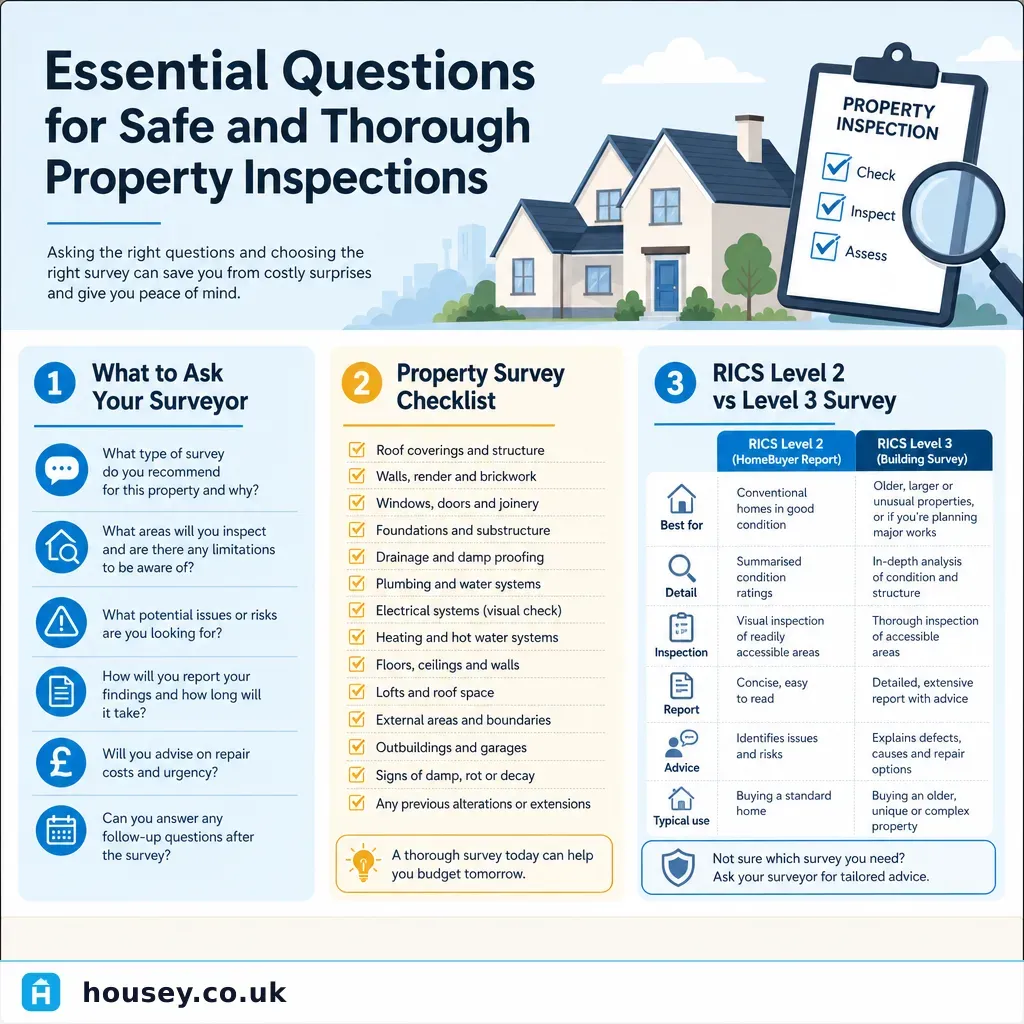
Essential Questions for Safe and Thorough Property Inspections
Before commissioning a property survey, confirm what type of inspection suits your property's age and condition, ask the surveyor what defects they will and will not assess, and understand what the report will recommend.
 Surveys & Inspections
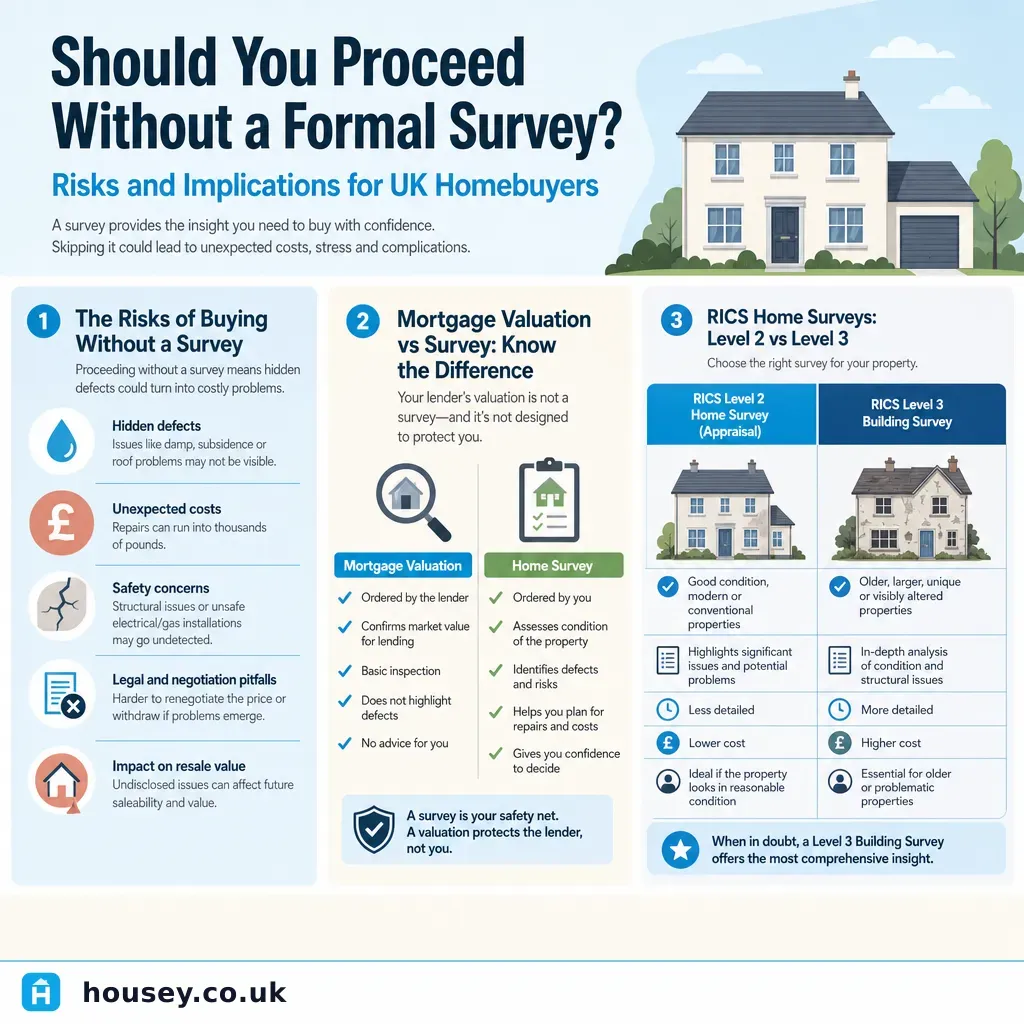
Should You Proceed Without a Formal Survey? Risks and Implications
In England and Wales there is no legal requirement to obtain a survey before exchange, but caveat emptor means any undisclosed defects become your problem the moment contracts are exchanged.
 Surveys & Inspections
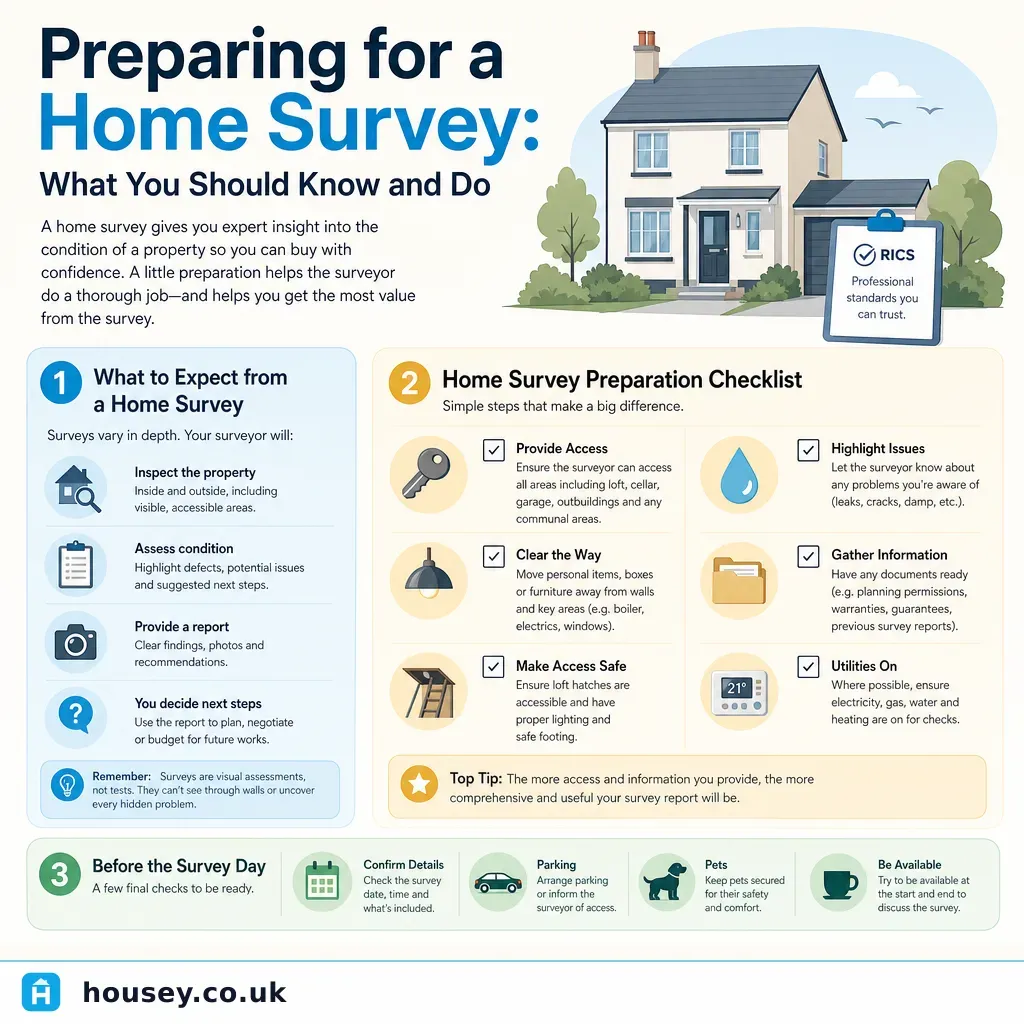
Preparing for a Home Survey: What You Should Know and Do
Preparing for a home survey means giving the surveyor clear access to all parts of the property, gathering relevant documents such as planning permissions and Building Regulations certificates, and knowing in advance which survey level has been instructed.
 Surveys & Inspections
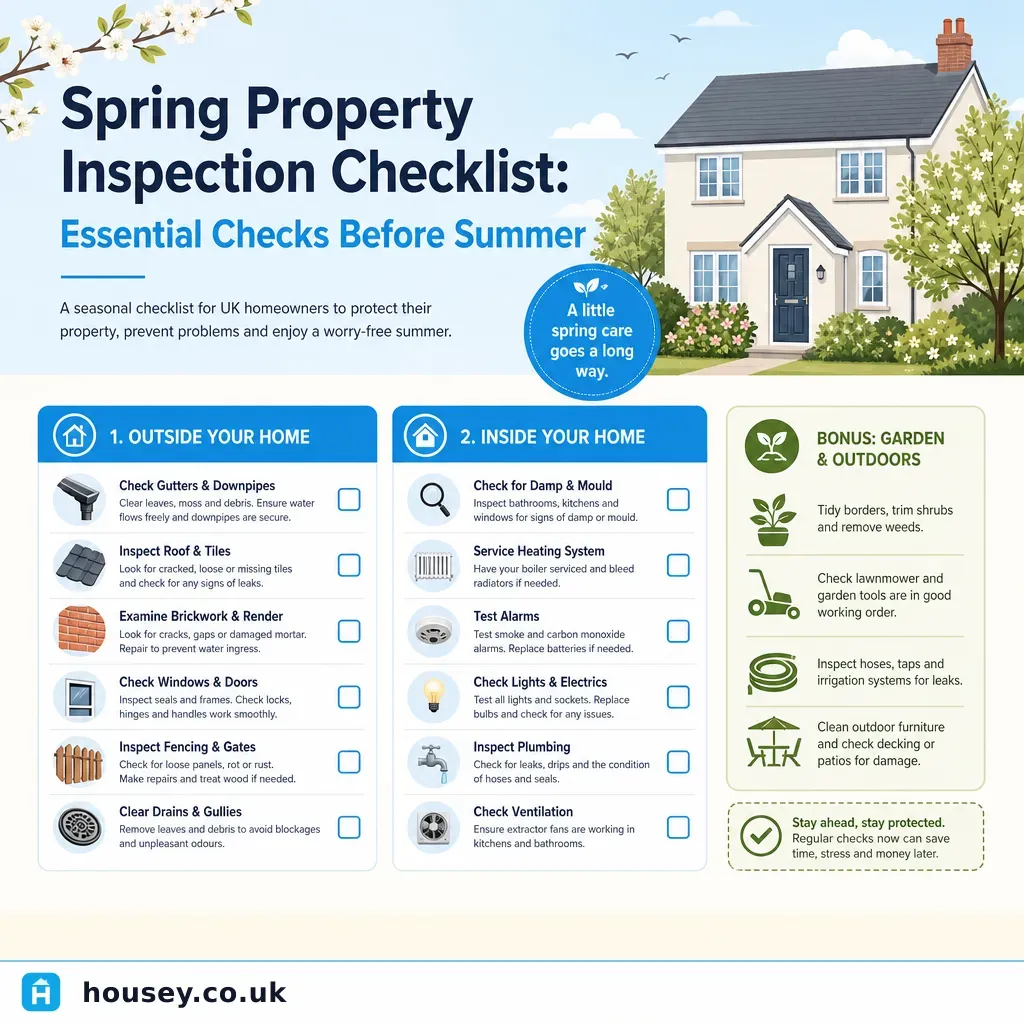
Spring Property Inspection Checklist: Essential Checks Before Summer
Each spring, UK homeowners should check the roof covering, gutters, flashings, drainage, external walls, and window seals for signs of winter damage.