Subsidence Repairs and Underpinning: What Are the Costs?
By Housey · Last reviewed 30th of May 2026
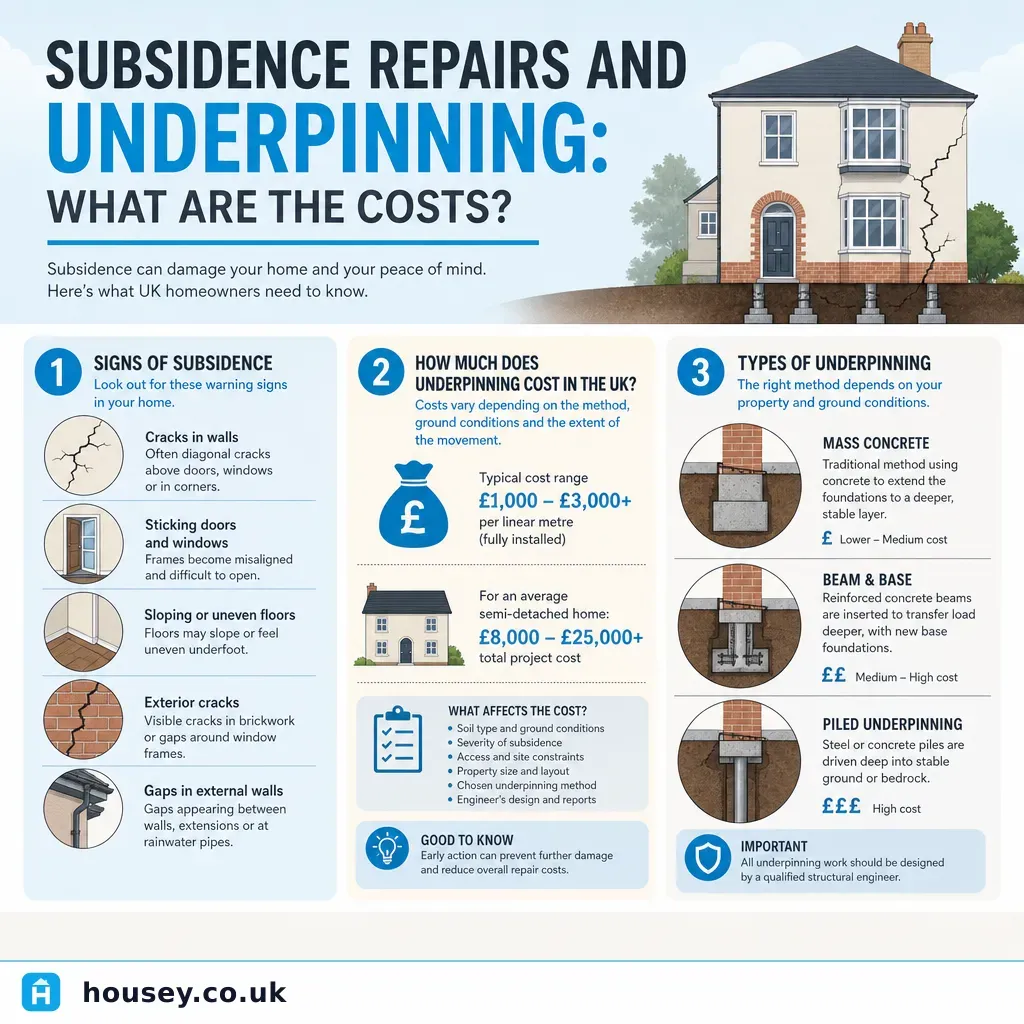
Subsidence Repairs and Underpinning: What Are the Costs?
Subsidence — the downward movement of a property's foundations — is one of the more serious structural issues a UK homeowner can face. It most commonly surfaces during a survey before purchase, after a prolonged dry summer, or when internal cracks appear that do not follow the usual seasonal pattern of expansion and contraction. Because the cause, extent, and appropriate remedy vary significantly by property type and location, understanding the cost landscape before instructing anyone is a worthwhile first step.
Key points
- A RICS Level 3 Building Survey is usually the first professional report to flag suspected subsidence; a structural engineer's investigation typically follows if the surveyor identifies active movement.
- Underpinning methods include traditional mass concrete, beam and base (reinforced concrete), mini-piles, and resin injection — each suited to different ground conditions, property types, and access constraints.
- Buildings insurance typically manages the subsidence remediation process; notify your insurer before commissioning independent repairs, or you risk affecting your claim.
- Building control notification under Approved Document A (Structure) is required for underpinning work, even where planning permission is not needed.
- Properties with a history of underpinning can be harder to insure and mortgage; retain all engineer's reports and building control certificates with your property records.
What causes subsidence in UK properties?
Subsidence occurs when the ground beneath a building's foundations moves or loses bearing capacity, causing the structure to sink unevenly. In the UK, the most common causes are:
- Tree root activity — roots from large trees (oak, ash, poplar, willow) extract moisture from clay soil, causing shrinkage. The NHBC identifies tree-related movement as a leading cause of residential subsidence claims.
- Shrinkable clay soils — much of southern and central England sits on clay that expands and contracts with moisture levels, making properties here more susceptible, particularly after prolonged dry spells.
- Drain leaks — water escaping from below-ground drainage can wash away fine soil particles (a process called soil piping), undermining foundations over time.
- Historic mining or natural voids — in former coalfield areas of the Midlands, Yorkshire, South Wales, and the North East, ground collapse can cause sudden movement.
- Poor original construction — shallow foundations on made-up ground or poorly compacted fill, found in some older and post-war properties.
Identifying the root cause matters: underpinning is not always the right remedy. Tree removal, drain repair, or soil stabilisation may resolve the issue at considerably lower cost.
Underpinning methods and indicative UK costs
The table below summarises the main methods used by specialist contractors across the UK.
Method | How it works | Best for | Indicative cost per linear metre |
|---|---|---|---|
Mass concrete (traditional) | Sections beneath foundations excavated and filled with concrete in sequence | Stable ground, shallow foundations, older properties | £1,000–£2,000 |
Beam and base | Reinforced concrete beam transfers load to new concrete bases | Uneven settlement, where mass concrete is impractical | £1,500–£2,500 |
Mini-pile | Steel or concrete piles driven or drilled to load-bearing strata | Poor ground, restricted access, deeper bedrock required | £2,000–£4,000 |
Resin injection | Expanding structural resin injected into ground to stabilise soil | Clay soils, where vibration or major disruption must be minimised | £800–£3,000 |
Indicative UK costs, last reviewed 2026-05-30. Figures represent contractor rates only and exclude structural engineer fees, building control fees, and reinstatement works. Obtain at least three quotes from specialist contractors.
For a typical UK semi-detached requiring underpinning to two external walls, total project costs — including engineer fees, contractor works, and making good — commonly range from £10,000 to £50,000. Extensive or deep underpinning on larger or more complex properties can exceed this significantly.
Additional costs to budget for:
- Structural engineer's investigation report: £600–£2,000+
- Ground investigation (trial pits, boreholes, soil analysis): £1,500–£5,000
- Monitoring period (crack gauges, regular inspections): £300–£800
- Building control application and inspections: £200–£500
- Reinstatement (plastering, decorating, relaying floors): £2,000–£10,000+
Which professional do you need?
Stage | Professional | What they do |
|---|---|---|
Initial crack or movement suspected | RICS Level 3 surveyor | Inspects property, identifies likely causes, recommends specialist investigation |
Cause investigation | Chartered structural engineer (MIStructE or CEng) | Detailed structural and ground investigation, report with remediation recommendations |
Drainage cause suspected | Drainage contractor (CCTV survey) | Identifies leaks, root ingress, or collapsed drain sections |
Remedial works | Specialist underpinning or ground engineering contractor | Carries out approved method under structural engineer oversight |
Completion sign-off | Local authority building control or approved inspector | Inspects and certifies completed underpinning works |
Decision tree: do you need underpinning?
- Choose to monitor first if cracks are hairline, diagonal, and appeared recently after a dry spell — seasonal shrinkage in clay soils can mimic subsidence. Install crack gauges and observe for 12 months.
- Instruct a structural engineer if cracks are wider than 3 mm, stepped through brickwork, or accompanied by sticking doors, uneven floors, or gaps at ceiling junctions.
- Notify your insurer before any works if buildings insurance is in place — they will typically manage the investigation and remediation process.
- Repair drains first if a CCTV survey identifies a leak beneath the property — drain repair alone may resolve the movement without underpinning.
- Consider tree management if tree root activity is the confirmed cause — remove the tree or install a root barrier and monitor for 12–24 months before committing to underpinning.
- Proceed with underpinning quotes only once a structural engineer has confirmed ongoing settlement and specified the appropriate method in writing.
Red flags that require professional help now
- Cracks that are visibly widening week to week, or that have exceeded 15 mm in width.
- Cracks that are stepped through brickwork or accompanied by bowing walls or tilting floors.
- A surveyor or engineer has described movement as 'active' in a written report.
- You can see daylight through a crack in an external wall.
- Doors or windows have jammed suddenly without a weather or seasonal explanation.
- Your insurer has declined a subsidence claim and you believe the cause remains unresolved.
Important limitations
This article provides general cost guidance only. Subsidence diagnosis and underpinning involve structural and safety matters where the specific conditions of your property — its construction, age, ground type, drainage, and local geology — determine the appropriate remedy. Cost figures are indicative and vary substantially by region, ground conditions, and contractor. Always instruct a chartered structural engineer before commissioning any underpinning works. This article does not constitute structural or legal advice.
When this becomes urgent
Seek professional help promptly — do not wait — if:
- Cracks are widening rapidly, measurably larger within days or weeks.
- A floor area has visibly dropped or tilted.
- Internal doors jam suddenly with no weather or seasonal explanation.
- A crack in an external wall is wide enough to see daylight through.
- A surveyor or engineer has described movement as active in a written report.
In these circumstances, contact a chartered structural engineer or your buildings insurer immediately.
What to ask a qualified professional
Before instructing a structural engineer or underpinning contractor, ask:
- Are you a Chartered Structural Engineer (MIStructE or CEng), and can you provide your registration details?
- Will you carry out a ground investigation, and what does that involve in terms of trial pits, boreholes, or soil testing?
- What is your diagnosis of the likely cause, and will you confirm it in a written report?
- Will your report specify the remediation method, and will you supervise the contractor during works?
- Is underpinning definitely necessary, or are there lower-cost alternatives worth exploring first?
- What documentation will the completed works include, and will it satisfy mortgage lenders and insurers?
- Can you liaise with my buildings insurer on my behalf if required?
When to get professional help
If you suspect subsidence, the priority is a structural engineer's assessment — not a contractor quote. A structural survey from a RICS-accredited professional will establish whether movement is active, identify its cause, and determine whether underpinning is needed at all. Attempting to manage underpinning without professional oversight risks building control non-compliance and may not address the underlying cause.
How Housey can help
Housey connects UK homeowners with qualified structural surveyors who can carry out an independent investigation and advise on the right remediation route. If you are dealing with suspected subsidence or have been advised that underpinning may be required, a structural survey from a chartered professional is the essential first step — before instructing any contractor or agreeing to an insurer's proposed remedy.
Frequently asked questions
Will my buildings insurance cover subsidence repairs?
Most standard UK buildings insurance policies cover subsidence, heave, and landslip. You must notify your insurer promptly — commissioning repairs without their agreement may affect your claim. Your insurer will typically appoint a loss adjuster and structural engineer; you have the right to appoint your own independently if you disagree with their assessment.
Does underpinning affect remortgaging or selling a property?
A history of underpinning does not automatically prevent sale or remortgaging, but requires full documentation of the works, an engineer's sign-off, and a monitoring period of typically 12–24 months post-completion. Some specialist insurers charge higher premiums. Retain all building control certificates and engineer's reports and disclose them fully to prospective buyers.
How long does underpinning take?
Traditional mass concrete underpinning for a semi-detached property typically takes four to eight weeks for the structural works. More complex methods such as mini-piling or resin injection may take less time on site but require longer investigation periods. Allowing for investigation, monitoring, works, and post-completion sign-off, the total process can extend to 12 months or more.
Does underpinning require planning permission?
Planning permission is not usually required for underpinning a residential property. However, building control notification and inspection of completed works is required under Approved Document A of the Building Regulations. If your property is listed or within a conservation area, check with your local planning authority before starting any works.
Sources and further reading
- Building Regulations Approved Document A (Structure) — GOV.UK
- RICS Building Survey standards and guidance — RICS
- Institution of Structural Engineers: find an engineer — IStructE
- Subsidence and insurance: homeowners' guidance — Association of British Insurers
- NHBC building standards and foundation guidance — NHBC
Useful next reads
 Surveys & Inspections
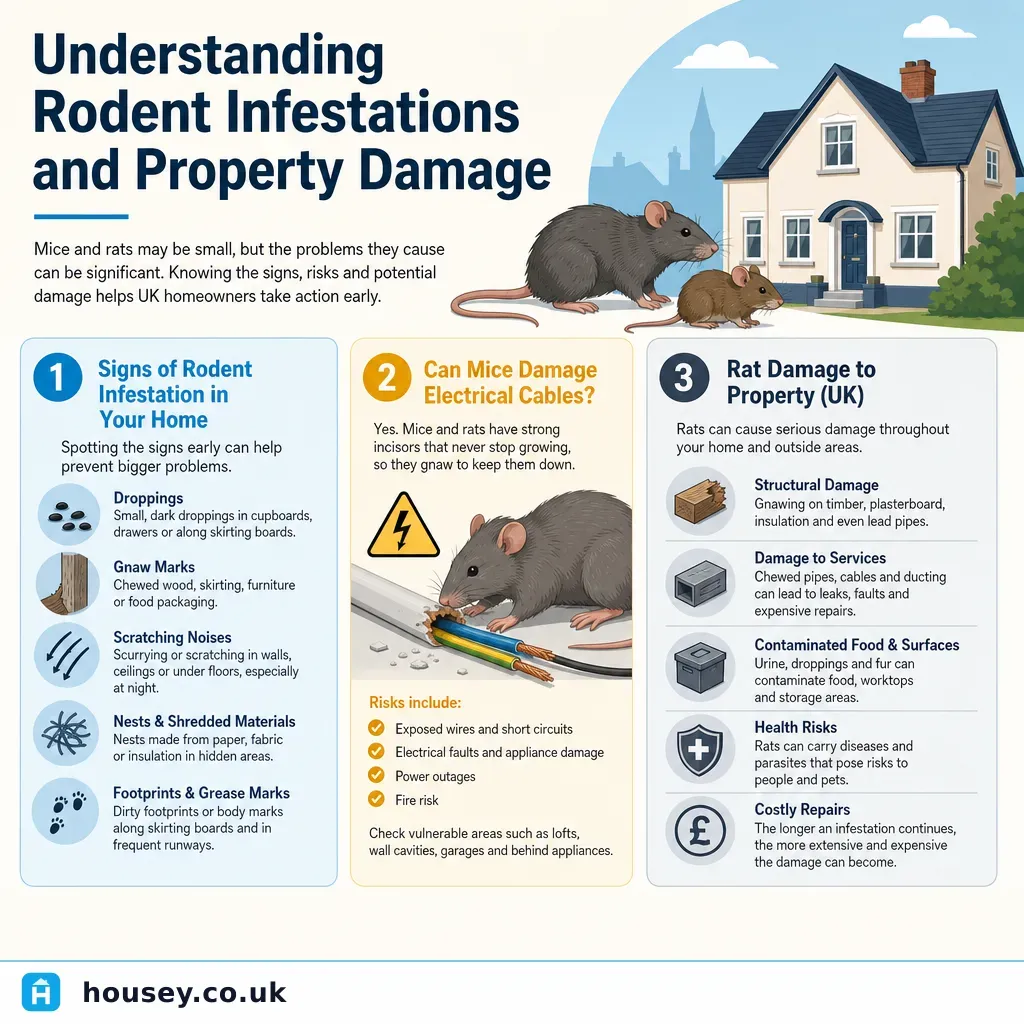
Understanding Rodent Infestations and Property Damage
Rats and mice can cause significant property damage in UK homes, including gnawed electrical cables that create fire risk, damaged pipework causing hidden leaks, and burrowing near foundations in older properties.
 Surveys & Inspections
House Survey Guide: Types and What to Expect
UK house surveys come in three RICS-standardised levels: Level 1 (Condition Report) for new or near-new homes, Level 2 (Home Survey) for conventional post-war properties, and Level 3 (Building Survey) for older, altered, or defective properties.
 Surveys & Inspections
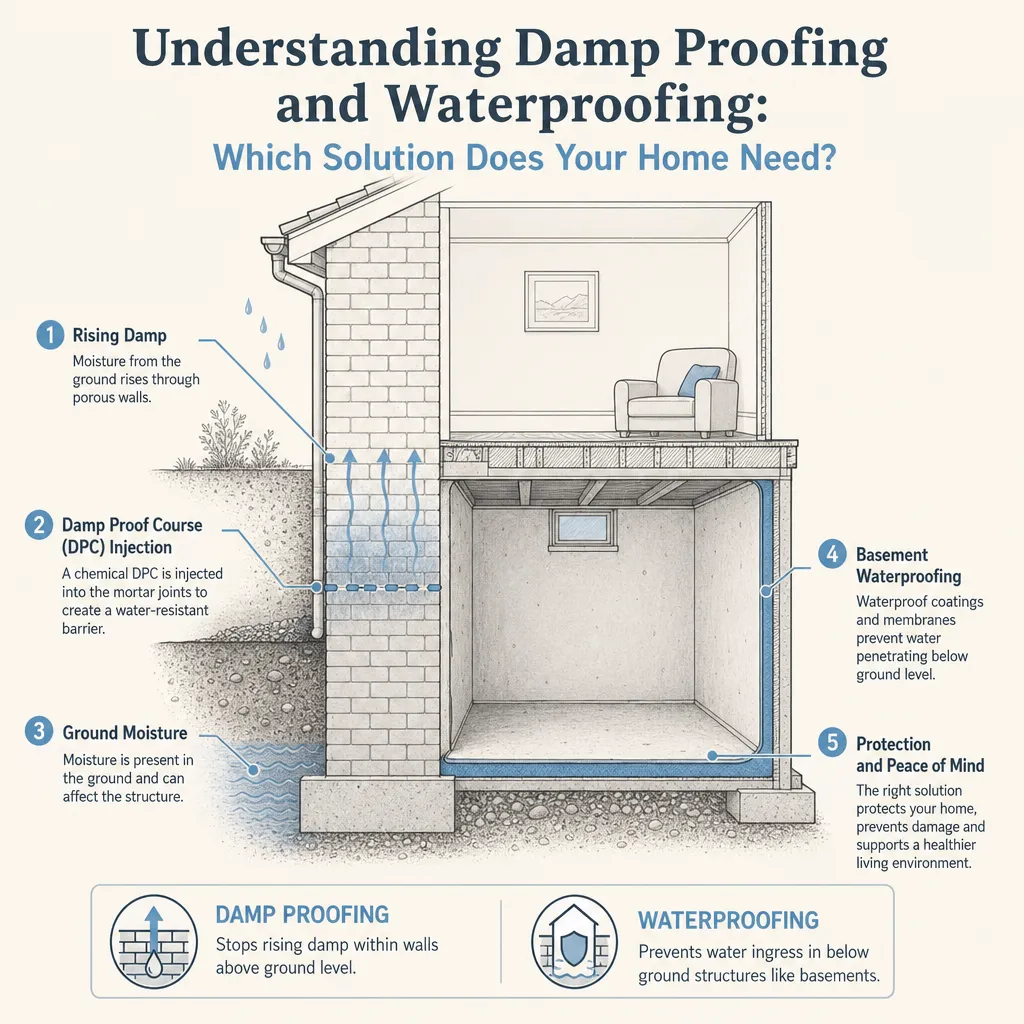
Understanding Damp Proofing and Waterproofing: Which Solution Does Your Home Need?
Damp proofing controls moisture movement through above-ground walls, while waterproofing excludes groundwater from below-ground structures.
 Surveys & Inspections
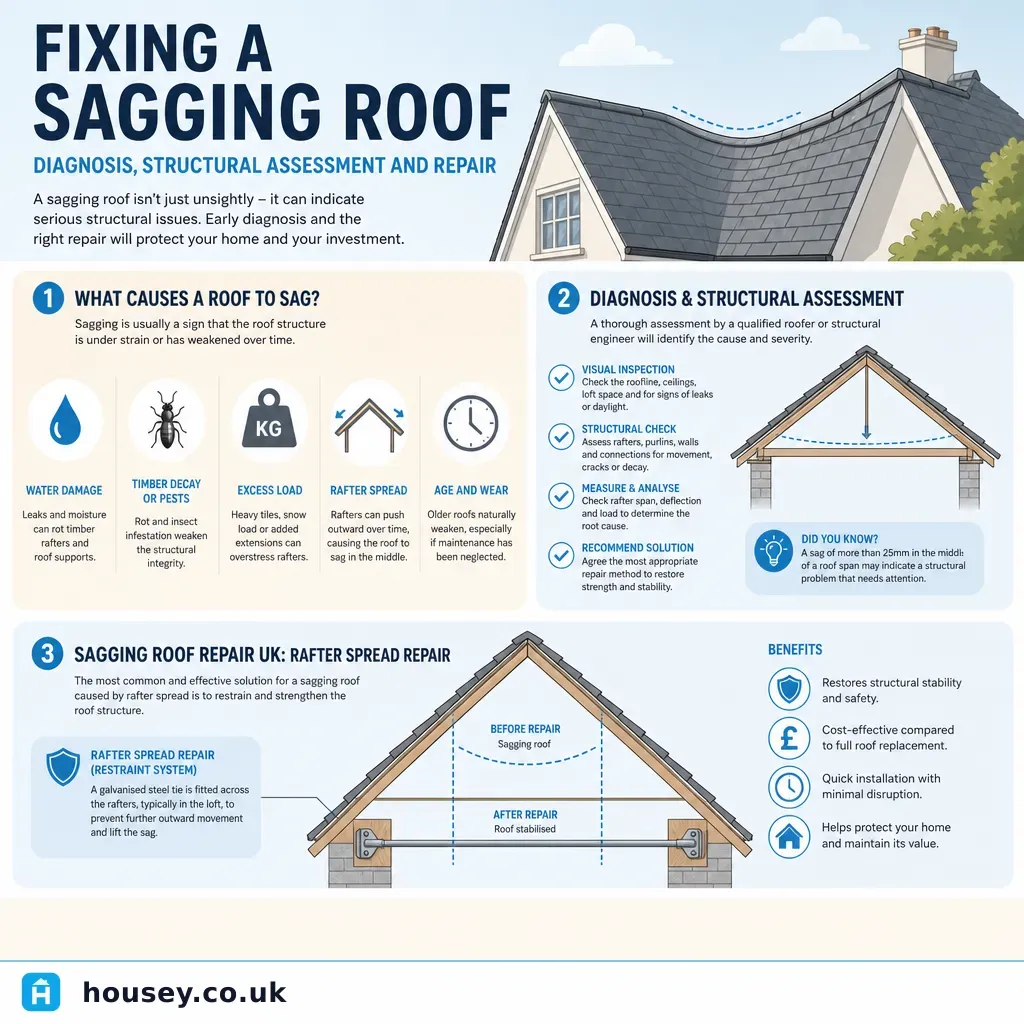
Fixing a Sagging Roof: Diagnosis, Structural Assessment and Repair
A sagging roof usually points to failed or overloaded roof timbers, rafter spread, or a compromised ridge board.
 Surveys & Inspections
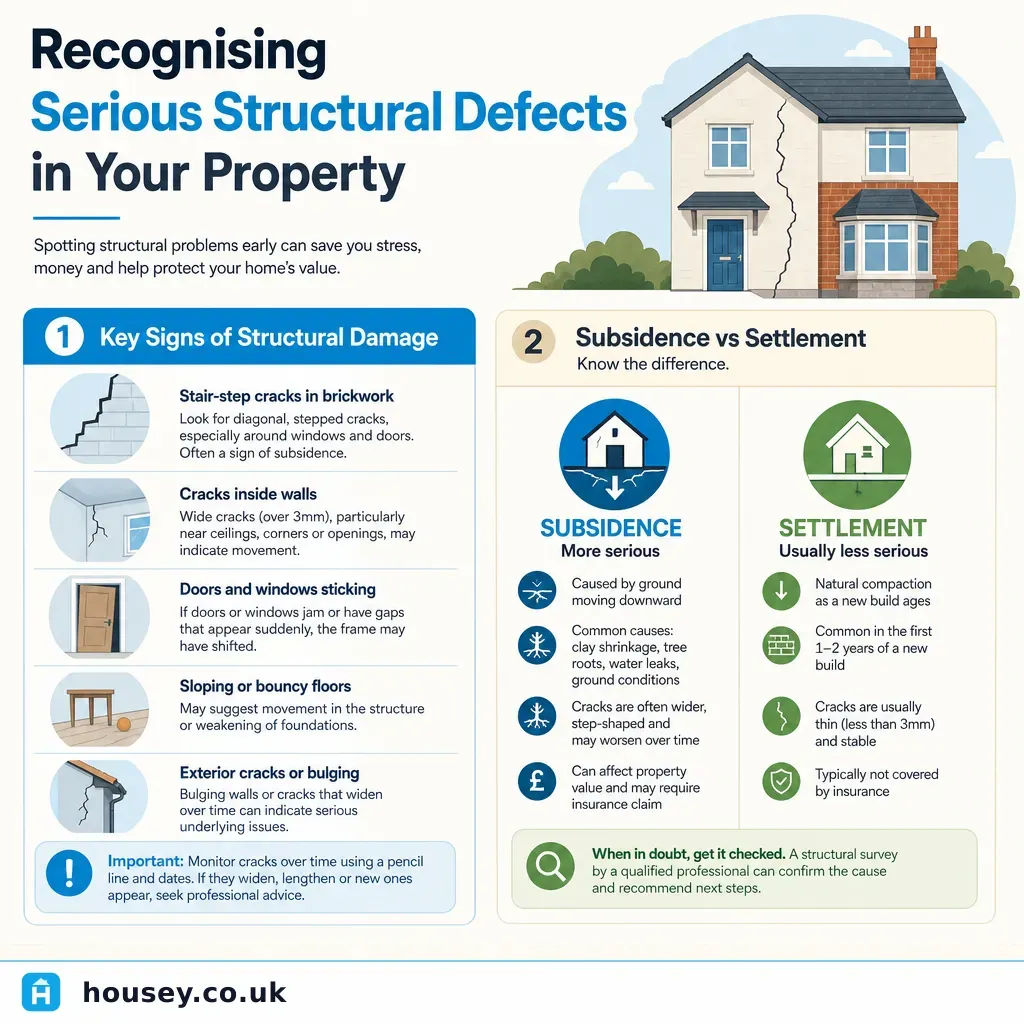
Recognising Serious Structural Defects in Your Property
Serious structural defects in UK homes include wide or diagonal cracks through brickwork, bowing or leaning walls, a sagging roof ridge, and floors or door frames notably out of level.