Damp Surveys: Purpose, Types, and What to Expect
By Housey · Last reviewed 12th of May 2026
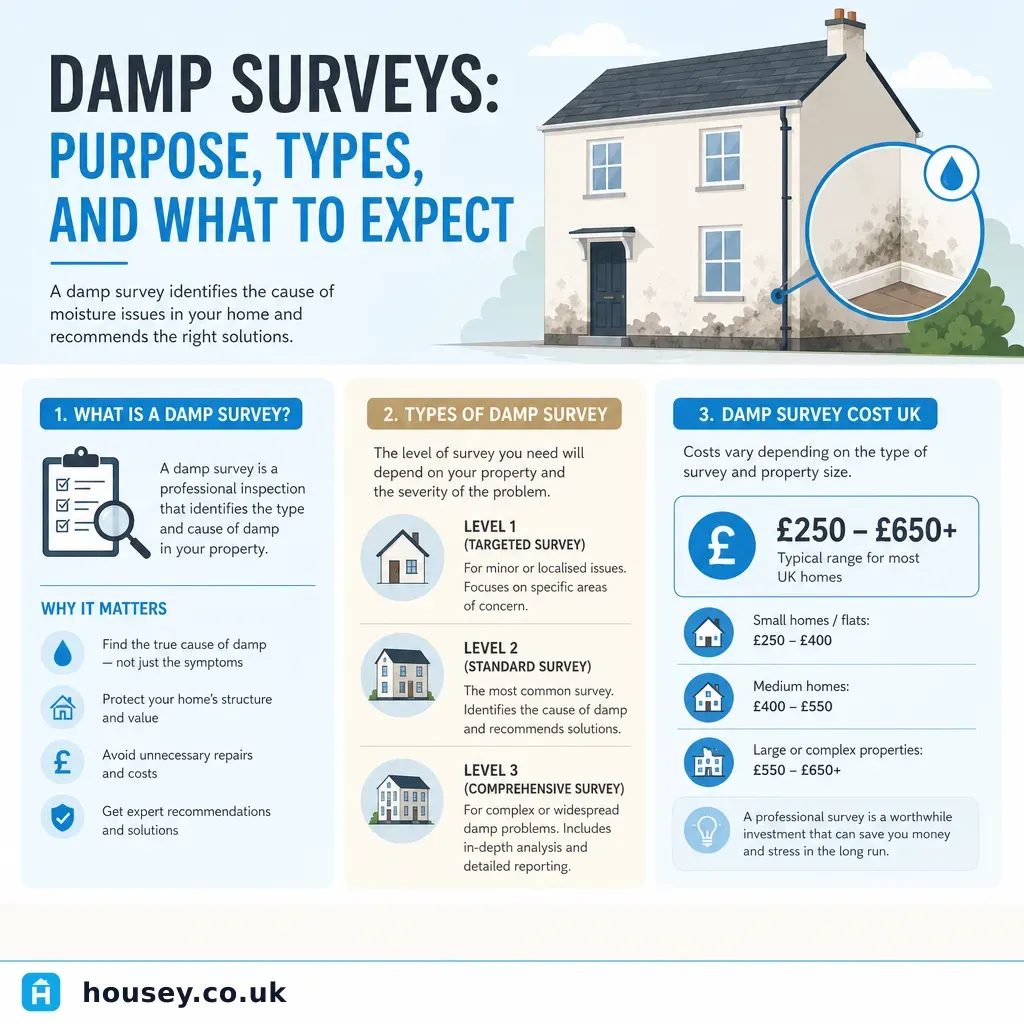
Damp Surveys: Purpose, Types, and What to Expect
Discovering damp in a property — whether you are buying, selling, or already living there — raises immediate questions about cause, severity, and cost. A damp survey provides a structured assessment from a qualified specialist, helping you understand what you are actually dealing with before spending money on remedial work. In England and Wales, where a significant proportion of housing stock predates 1919 and many homes have solid masonry walls, moisture problems are common and frequently misdiagnosed.
Key points
- Rising damp, penetrating damp, and condensation are distinct problems requiring different remedies — a damp survey aims to distinguish between them.
- RICS-accredited surveyors and members of the Property Care Association (PCA) are recognised professional bodies for damp and timber assessment work.
- Moisture meter readings alone are not diagnostic; a competent surveyor will cross-reference with visual inspection, salt analysis, and sometimes thermal imaging.
- Remedial companies that offer free damp surveys often have a commercial interest in recommending works — an independent survey from a fee-charging specialist reduces that conflict of interest.
- A written report should identify the damp type, the probable cause, recommended remedial options, and any further investigations required.
What is a damp survey and when do you need one?
A damp survey is a targeted inspection to assess moisture-related problems in a property. It differs from a general RICS Home Survey: a Level 2 or Level 3 survey will flag suspected damp as a concern, but it typically does not diagnose the precise cause or recommend specific treatments. A dedicated damp survey goes further — the surveyor uses specialist equipment and knowledge to distinguish the type of dampness, trace it to its source, and set out remedial options.
You are most likely to need a damp survey when:
- A RICS Level 2 or Level 3 Home Survey has flagged damp readings or moisture damage needing further investigation.
- You can see or smell damp — tide marks on walls, peeling plaster, efflorescence, musty odours, or black mould — and want to understand the cause before decorating or selling.
- You are buying a property and the vendor has carried out recent damp treatment; you want independent confirmation the works were appropriate.
- You are a landlord with obligations under the Homes (Fitness for Human Habitation) Act 2018 to ensure the property is free from damp that affects health.
Types of damp survey
Survey type | Typical use | Who carries it out | Key tools used |
|---|---|---|---|
Diagnostic damp and timber survey | Identifying damp source and extent; timber decay assessment | PCA-registered or RICS-accredited specialist | Moisture meter, borescope, thermal imaging, salt analysis |
RICS Level 3 Building Survey (with damp section) | General condition report flagging damp concerns; not a full diagnosis | RICS-chartered surveyor | Moisture meter, visual inspection |
Independent remedial assessment | Second opinion before accepting a contractor's remedial spec | Independent specialist with no contractual tie to the remedial firm | As diagnostic survey |
Thermal imaging survey | Detecting hidden moisture, cold bridges, and insulation gaps | Thermographer or specialist damp surveyor | Infrared thermal imaging camera |
The most thorough option for a known or serious damp problem is a full diagnostic damp and timber survey from a PCA-registered surveyor with no commercial tie to the remedial contractor you plan to use.
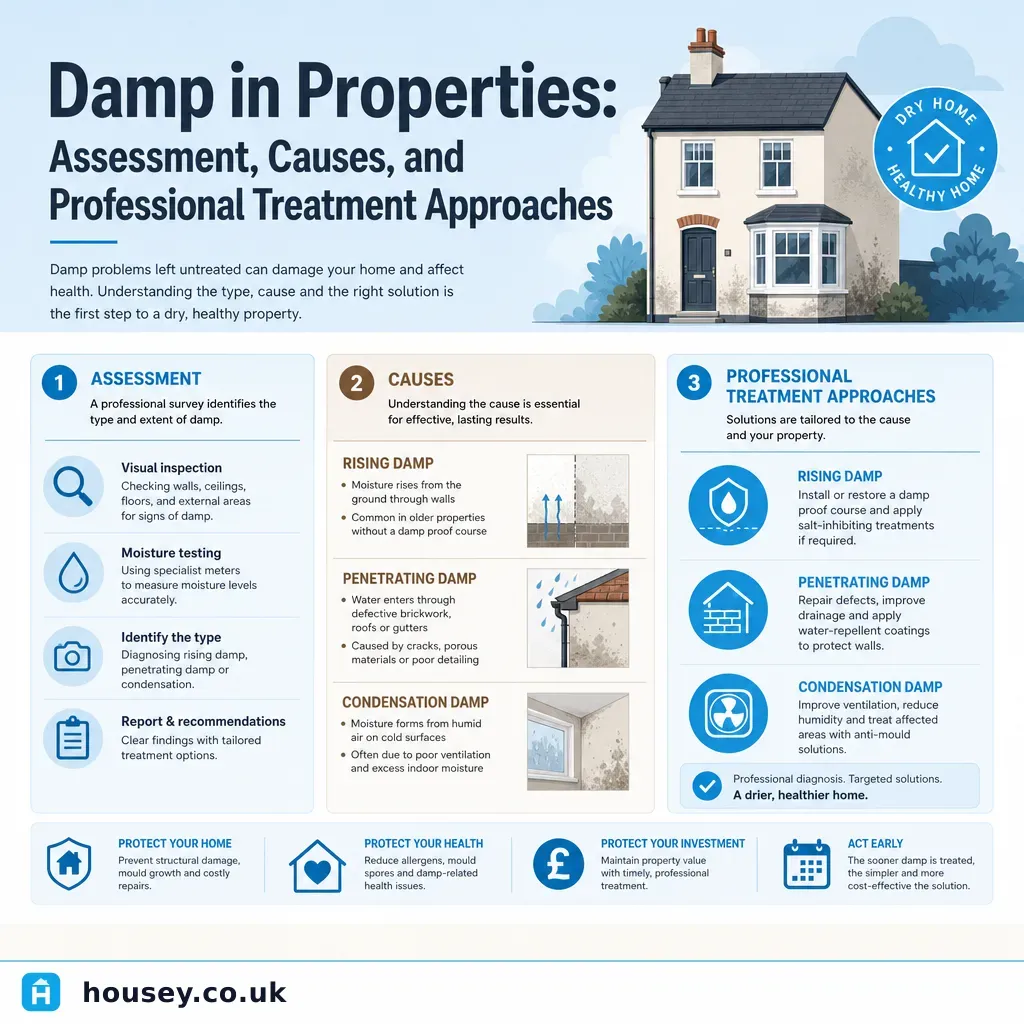
The three main types of dampness
Understanding which type of damp is present is the central purpose of the survey.
Rising damp occurs when groundwater moves upward through porous masonry by capillary action. Genuine rising damp is less common than is often claimed — a competent surveyor will test for the characteristic salts (nitrates and chlorides) that rising damp deposits, rather than relying on a wet moisture meter reading alone.
Penetrating damp enters from outside through defects in the building fabric — cracked render, failed pointing, damaged roof coverings, faulty gutters, or bridged cavity walls. It tends to produce damp patches that vary with rainfall rather than following a consistent tide mark.
Condensation is the most common cause of moisture problems in UK homes, particularly in insulated or draught-proofed properties with inadequate ventilation. It is often misidentified as rising damp; a surveyor should assess ventilation, thermal performance, and occupancy as part of the diagnosis.
What happens during a damp survey?
A typical damp and timber survey follows this sequence:
- External inspection — the surveyor checks the building envelope (roof, gutters, walls, ground level, pointing) before entering.
- Internal inspection — rooms are checked systematically, with particular attention to ground-floor walls, around windows, under stairs, and in roof voids.
- Moisture meter readings — taken at multiple heights to profile moisture distribution; elevated readings at low level with a decreasing gradient suggest rising damp rather than condensation.
- Salt testing (where warranted) — salts present in plaster or masonry indicate the historical movement of groundwater and help confirm or rule out rising damp.
- Thermal imaging — where used, identifies cold spots and hidden moisture not visible to the eye.
- Timber assessment — floor joists, skirting boards, window frames, and roof timbers are checked for rot or beetle damage.
- Summary on site — most surveyors will talk through headline findings before producing the written report.
What your report should include
A competent damp survey report should set out:
- The type or types of dampness identified and the surveyor's confidence level in the diagnosis.
- Annotated photographs or a floor plan showing the location and extent of affected areas.
- The probable cause and any contributing factors (bridged damp-proof course, failed guttering, blocked air bricks).
- Recommended remedial works, presented as options where possible rather than a single prescribed treatment.
- Any areas the surveyor could not access and the implications of those limitations.
- Recommendations for further investigations if needed — a plumber for suspected leaks; a structural engineer if movement is suspected.
Red flags to watch out for
- A surveyor who diagnoses rising damp from a moisture meter reading alone, without salt analysis or gradient profiling.
- A report produced by the same company that will carry out the remedial injection treatment — a clear conflict of interest.
- A recommendation for whole-wall damp-proof injection on a property where condensation appears the more likely cause.
- No external inspection of the building envelope before the internal survey begins.
- A report with no photographs, no floor plan, and no discussion of alternative causes.
Before your survey: homeowner checklist
Prepare the following before the surveyor visits to give them the most accurate picture:
What to ask before booking a damp survey
- Are you a member of the Property Care Association (PCA) or accredited by RICS?
- Is this survey fully independent, or is your firm also involved in damp treatment or remedial work?
- Will the survey include thermal imaging, and in what circumstances would you recommend it?
- What will the written report cover and how long will it take to receive?
- What is included in the fee and is VAT charged on top?
When to get professional help
A damp survey is itself the professional help in most cases. However, if the survey reveals structural movement alongside moisture — stepped cracks, bowing walls, or subsidence indicators — commission a separate assessment from a chartered structural engineer. If the report suggests a plumbing leak rather than a building defect, a plumber should investigate before any remedial works begin.
How Housey can help
If you have noticed damp staining, smelled mould, or received a flagged reading on a home survey report, a specialist assessment is the most efficient next step. Use Housey to find and compare quotes from independent specialists offering damp and timber surveys in your area.
Frequently asked questions
How much does a damp survey cost in the UK?
Fees for an independent damp and timber survey typically range from around £200 to £400 for a standard residential property, though larger or more complex homes may cost more. Indicative UK costs, last reviewed 2026-05-12. Always obtain at least two quotes and be cautious of free surveys from companies that also sell remedial treatments.
How long does a damp survey take?
Most surveys on a standard semi-detached or terraced house take one to two hours on site, with the written report usually delivered within three to five working days. Properties requiring thermal imaging or with complex access may take longer.
Can I do my own damp survey?
Consumer moisture meters are widely available but do not distinguish between types of dampness and can give false high readings on cold surfaces or dense materials. A professional survey is worth commissioning before committing to any remedial treatment, even if the meter reading appears clearly elevated.
Is a free damp survey worth having?
Free surveys offered by remedial companies can provide a useful starting point but carry an inherent conflict of interest — the surveyor's firm typically profits from any treatment they recommend. If you receive a recommendation for significant works from a free survey, consider paying for an independent second opinion before proceeding.
Do I need a damp survey before buying a house?
Your conveyancer or mortgage lender may require it if a home survey has flagged concerns. Even where it is not required, commissioning one before exchange gives you a clear picture of remedial costs and can support a price negotiation if the vendor is unwilling to address the problem.
Sources and further reading
- Damp and timber surveys — homeowner guidance — Property Care Association
- Find a surveyor: home surveys — RICS
- Homes (Fitness for Human Habitation) Act 2018 — legislation.gov.uk
- Understanding dampness in buildings — BRE Group
Useful next reads
 Surveys & Inspections
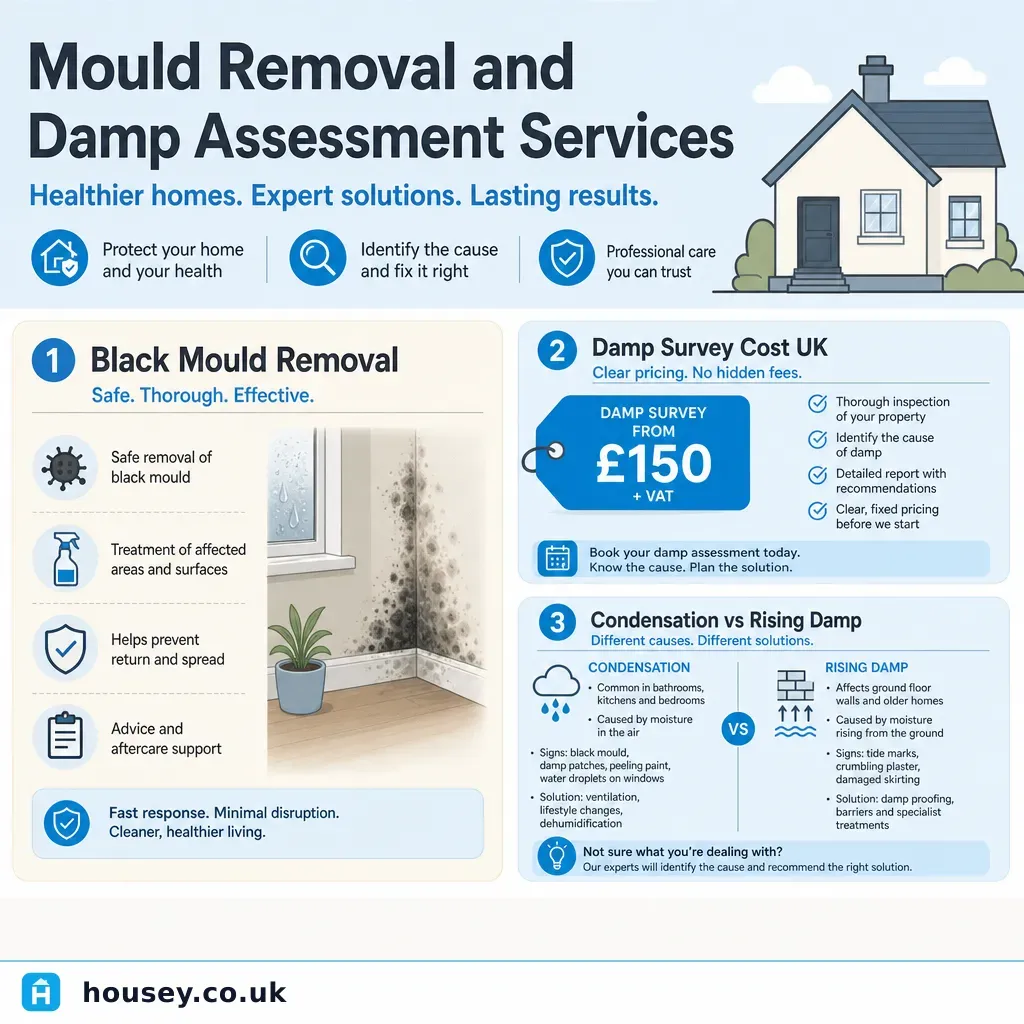
Mould Removal and Damp Assessment Services
Professional mould removal and damp assessment starts with identifying the moisture source—condensation, rising damp, or penetrating damp—before any treatment begins.
 Surveys & Inspections
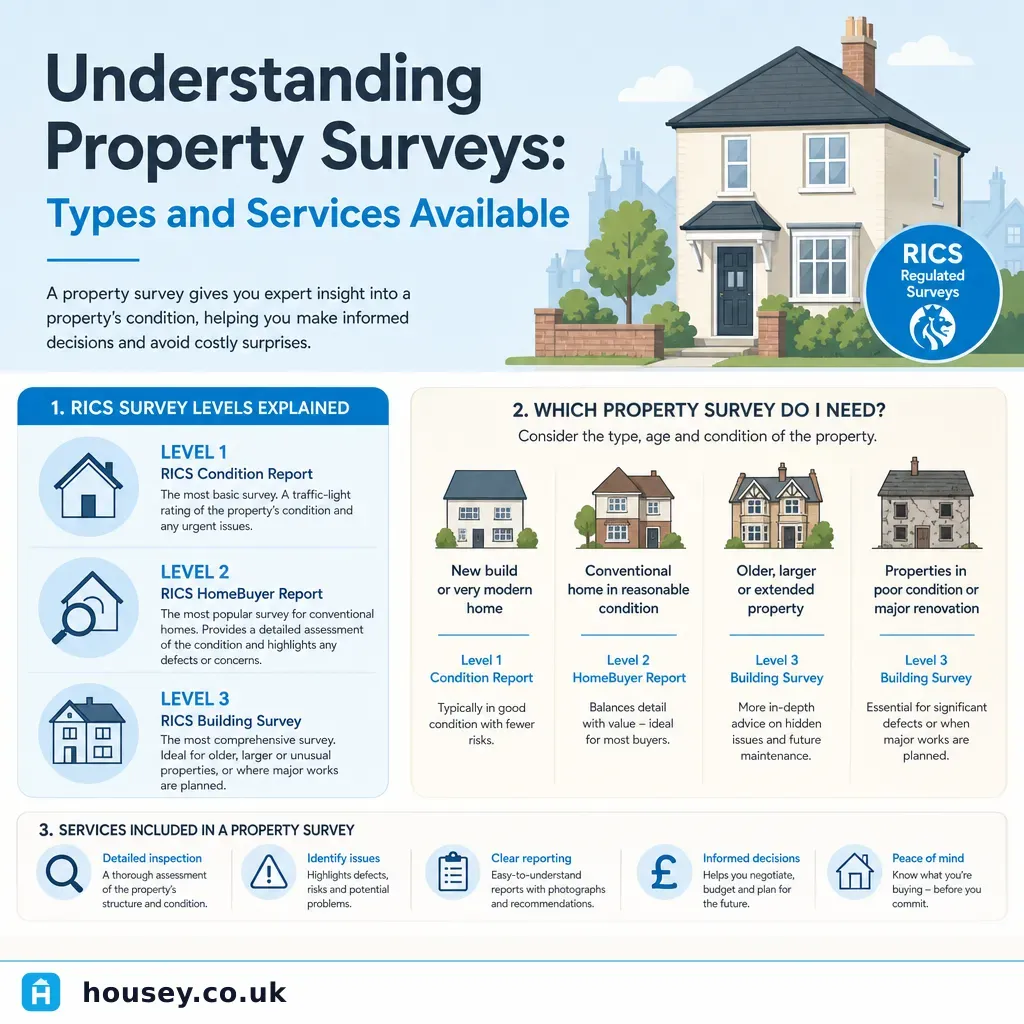
Understanding Property Surveys: Types and Services Available
UK property surveys follow three RICS-defined levels: Level 1 (Condition Report), Level 2 (Home Survey), and Level 3 (Building Survey).
 Surveys & Inspections
Getting a Valuation Survey Before Selling Your Property
Before selling, a free estate agent appraisal gives a market price guide, but only a RICS Red Book valuation carries formal professional standards and legal weight.
 Surveys & Inspections
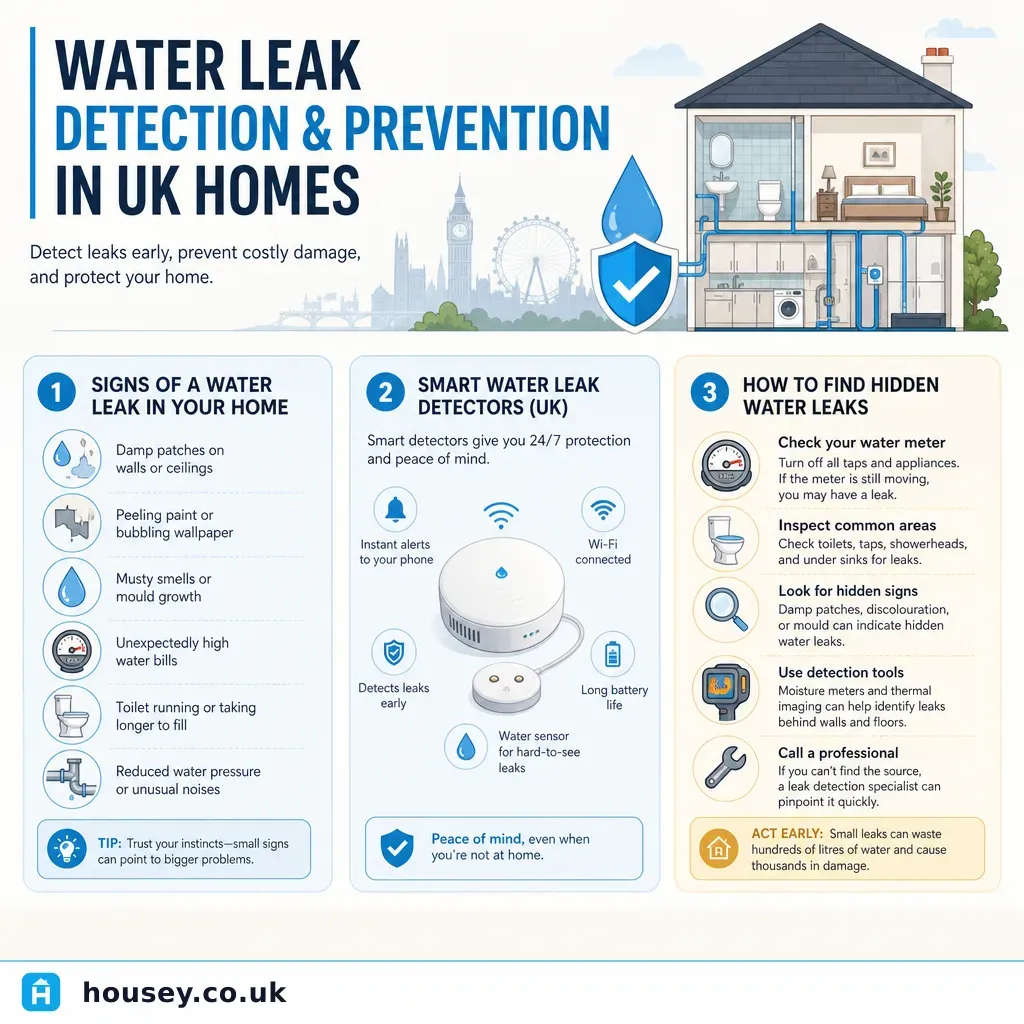
Water Leak Detection and Prevention in UK Homes
Water leaks in UK homes are best caught early through routine visual checks, water meter monitoring, and smart sensors placed under sinks and appliances.
 Surveys & Inspections
Damp in Properties: Assessment, Causes, and Professional Treatment Approaches
Damp in UK homes falls into three main categories: rising damp, penetrating damp, and condensation.