Garage Leaks and Water Damage: Finding a Contractor
By Housey · Last reviewed 11th of May 2026
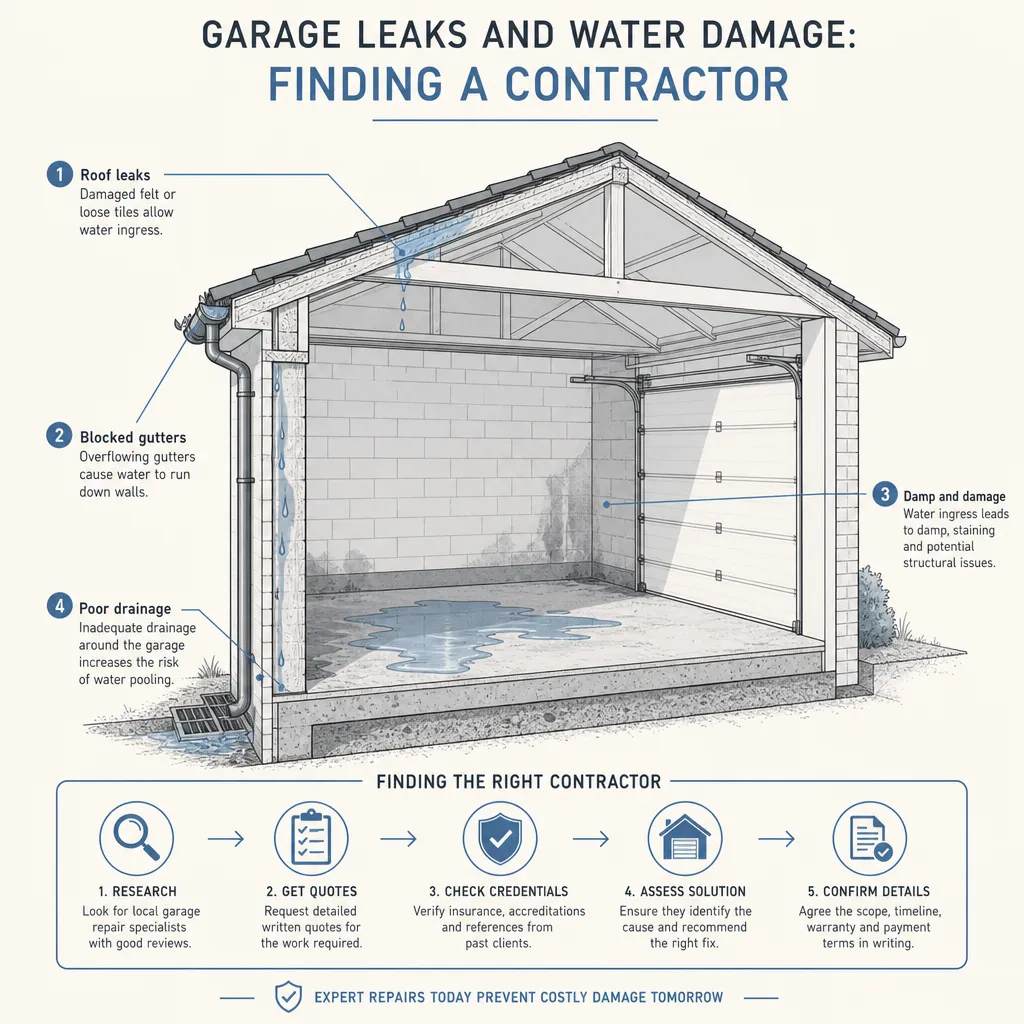
Garage Leaks and Water Damage: Finding a Contractor
Water getting into a garage can damage stored belongings, corrode tools and vehicles, and — in an integral or attached garage — allow moisture to migrate into the main living areas. The challenge is that garage leaks have several distinct causes, and the right contractor to fix the problem depends entirely on where and how water is entering.
Key points
- Flat felt roofs on UK garages typically have a lifespan of 10–20 years before repair or replacement is needed; blistering, cracking, or lifting edges are early warning signs.
- Water entering at floor or low wall level may indicate rising damp, a high water table, or inadequate perimeter drainage — requiring a different trade from a roofing contractor.
- Blocked or overflowing gutters discharging against the garage wall are a common and easily overlooked source of persistent damp.
- A CCTV drain survey is the most reliable method for confirming whether drainage is causing floor-level water ingress, typically costing £80–£200 for a standard residential run (Indicative UK costs, last reviewed 2026-05-11).
- Integral garages sharing a wall or floor with the main house may require a formal damp and timber survey if moisture is tracked through into a habitable room.
Where is the water coming from? A decision guide
Identifying the entry point before instructing a contractor saves money and avoids commissioning the wrong work. Work through these checks first:
Choose a roofing contractor if:
- Water drips from the ceiling or appears on roof timbers after rainfall.
- The flat roof covering (felt, fibreglass GRP, or asphalt) is visibly cracked, blistered, or lifting at edges or abutments.
- A pitched roof is missing tiles, or lead flashing around a parapet, chimney, or abutment is cracked or displaced.
- Ceiling or wall staining correlates directly with rainfall events.
Choose a drainage contractor if:
- Water pools on the garage floor during or after heavy rain, particularly near the entrance or along one wall.
- Drains inside or outside the garage are slow-flowing, gurgling, or backing up.
- A damp patch correlates with a downpipe, gully, or external drain location.
- The garage floor sits at a lower level than the surrounding ground.
Choose a damp specialist or surveyor if:
- Damp patches appear on walls at or below ground level with no clear correlation to rainfall events.
- White salt deposits (efflorescence) are visible on masonry walls.
- Persistent damp or condensation does not follow rainfall patterns.
- You suspect rising damp or groundwater ingress through the floor slab.
Choose a general builder if:
- Cracks in masonry walls, the lintel, or door frame are allowing wind-driven rain to enter.
- The garage door seal or threshold has failed and water is tracking underneath.
- Mortar joints are eroded and allowing water into the wall face.
Which professional should I use?
Water source | Professional needed | Typical first step |
|---|---|---|
Flat or pitched roof failure | Roofer (NFRC member preferred) | Roof inspection, written condition report |
Blocked or failed drainage | Drainage contractor | CCTV drain survey |
Rising damp or groundwater | Damp surveyor or waterproofing specialist | Damp and timber survey (PCA-accredited) |
Cracked masonry or mortar | Builder, or structural engineer if movement is suspected | Visual inspection, repointing quote |
Overflowing gutters or downpipes | Roofer or general builder | Gutter inspection and clearance |
Condensation only (no ingress) | No specialist required initially | Improve ventilation, check insulation |
NFRC = National Federation of Roofing Contractors. PCA = Property Care Association.
Getting a damp or drainage assessment
For persistent or ambiguous water problems, a professional assessment before any remediation work saves money and avoids treating the wrong cause.
Damp and timber survey: A qualified surveyor examines the building fabric for moisture content, visible damp, timber condition, and the likely source of water. This is particularly relevant for attached garages or where moisture may be migrating into the house. Look for surveyors accredited by the Property Care Association (PCA) holding CSRT or CSSW qualifications.
CCTV drain survey: A drainage contractor inserts a camera into the drainage run to identify blockages, root ingress, collapsed sections, or failed joints. A short written report with footage should be provided. This is the most reliable method for confirming whether drainage is the source of floor-level water before any excavation or remediation is instructed.
What to ask before accepting a contractor quote
- Will you carry out a diagnosis visit, or will you quote for repair without seeing the source first?
- What is the proposed repair method and what materials will be used?
- What guarantee or warranty applies to the repair, and is it backed by insurance?
- Will you provide a written condition report or survey alongside the quote?
- Are you registered with a relevant trade body (NFRC, PCA, NADC)?
- Is VAT included in the quoted price?
- What will happen if additional damage is found once work begins?
- What preparation is required on my part — clearing the garage, access to drainage chambers?
Red flags to watch for
Be cautious if a contractor:
- Quotes for remediation work without a site visit or proper investigation of the water source.
- Recommends costly internal waterproofing treatments without first checking drainage and the roof.
- Cannot provide references from comparable garage or basement waterproofing jobs.
- Offers a written guarantee but cannot evidence trade body membership or insurance.
- Requires a cash deposit significantly above 25% of the total cost before any work begins.
- Recommends chemical damp-proof injection without first ruling out penetrating damp, drainage problems, or condensation as alternative causes.
When to get professional help
While some water ingress is simple to diagnose and address, seek a professional assessment without delay when:
- The garage shares a wall with the house and damp is appearing in an adjoining room.
- Structural cracks are present alongside damp — this may indicate movement and warrants a chartered surveyor or structural engineer.
- The floor or walls show signs of sustained water exposure such as heaving, flaking render, or salt-stained masonry over a large area.
- The source of water remains uncertain after your own checks and a drainage or damp inspection has not yet been completed.
Do not install waterproof render, tanking membranes, or chemical treatments on internal walls without first identifying and resolving the water source. Masking a drainage problem with internal waterproofing can allow hydrostatic pressure to build behind the treatment and cause further structural damage.
How Housey can help
Housey connects you with local drainage contractors for CCTV surveys and drainage repairs, and with specialists offering damp and timber surveys to identify the true source of moisture in your garage. Getting the diagnosis right before commissioning remediation saves cost and avoids fixing the wrong problem.
Frequently asked questions
Why does my garage floor get wet even when it has not rained?
A wet garage floor without a rain correlation is often caused by condensation (warm humid air meeting a cold concrete slab) or rising groundwater. In both cases a damp or drainage assessment is more useful than a roofing inspection. Improved ventilation, a floor membrane, or perimeter drainage improvement may each be relevant depending on the diagnosis.
Do I need planning permission to repair a garage roof?
Repair and like-for-like replacement of a garage roof generally does not require planning permission. Significantly changing the material or roof profile may require consent under some local authority policies, particularly in conservation areas or on listed buildings. Check with your local planning authority if you are uncertain.
Can water ingress in a garage lead to damp in the house?
Yes, particularly in integral garages sharing a wall or floor with the main house. Moisture can track through the party wall or floor slab if the building fabric is not adequately separated or sealed. A damp assessment of both the garage and the adjoining room is advisable in such cases.
How much does a CCTV drain survey cost?
A standard residential CCTV drain survey typically costs £80–£200 for a single drain run, depending on access points and length of the system. The survey should include a written report and video footage so you can see the condition of the drain clearly. (Indicative UK costs, last reviewed 2026-05-11.)
How much does garage roof repair cost in the UK?
Flat felt roof repairs range from roughly £150 for a small patch to £2,000 or more for full replacement on a standard single garage. Fibreglass (GRP) roof replacement typically costs £1,500–£3,000 for a single garage. Obtain at least three written quotes before proceeding. (Indicative UK costs, last reviewed 2026-05-11.)
Sources and further reading
- Damp homes: landlord responsibilities — Citizens Advice
- Find a roofing contractor — National Federation of Roofing Contractors
- Find a damp and timber specialist — Property Care Association
- Sustainable drainage systems guidance — GOV.UK
Useful next reads
 Surveys & Inspections
Mould Removal and Damp Assessment Services
Professional mould removal and damp assessment starts with identifying the moisture source—condensation, rising damp, or penetrating damp—before any treatment begins.
 Surveys & Inspections
Damp Surveys: Purpose, Types, and What to Expect
A damp survey is a specialist inspection to identify the source, type, and extent of moisture in a property.
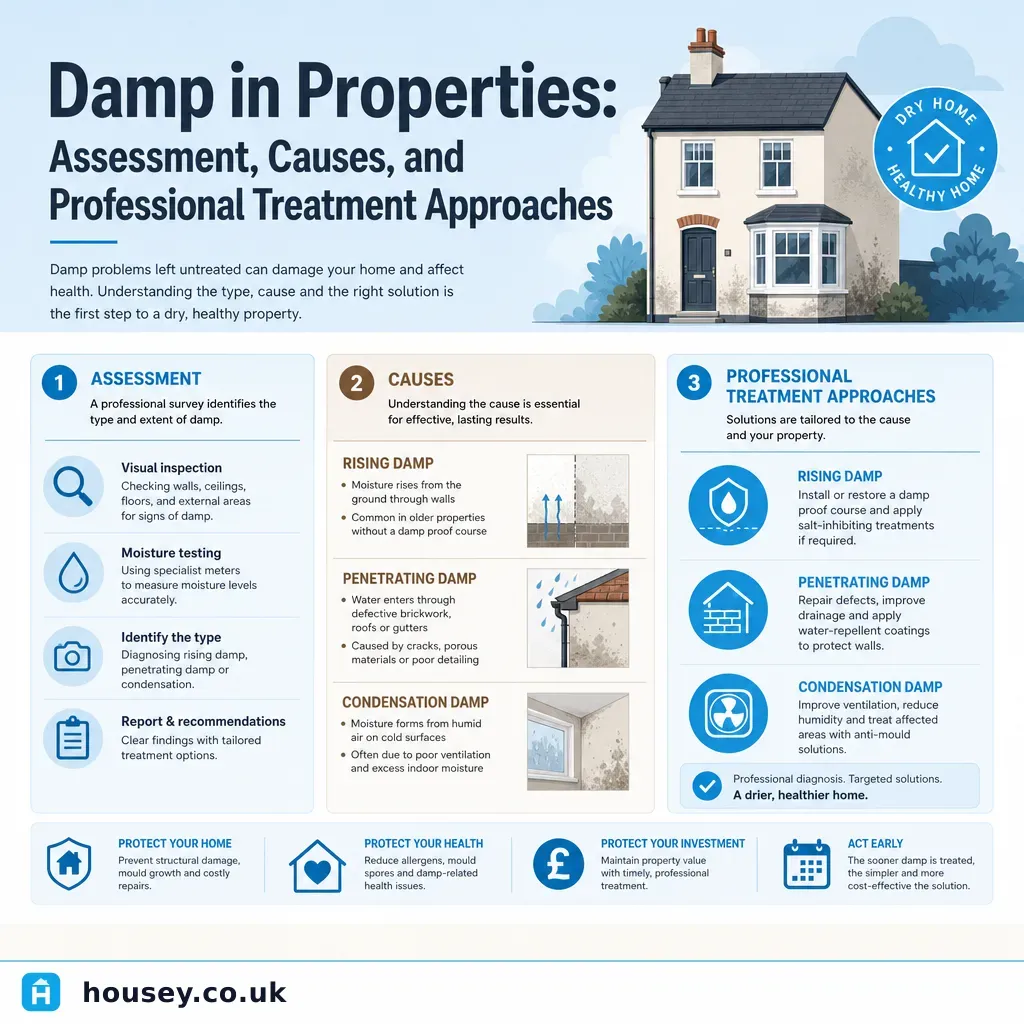 Surveys & Inspections
Damp in Properties: Assessment, Causes, and Professional Treatment Approaches
Damp in UK homes falls into three main categories: rising damp, penetrating damp, and condensation.
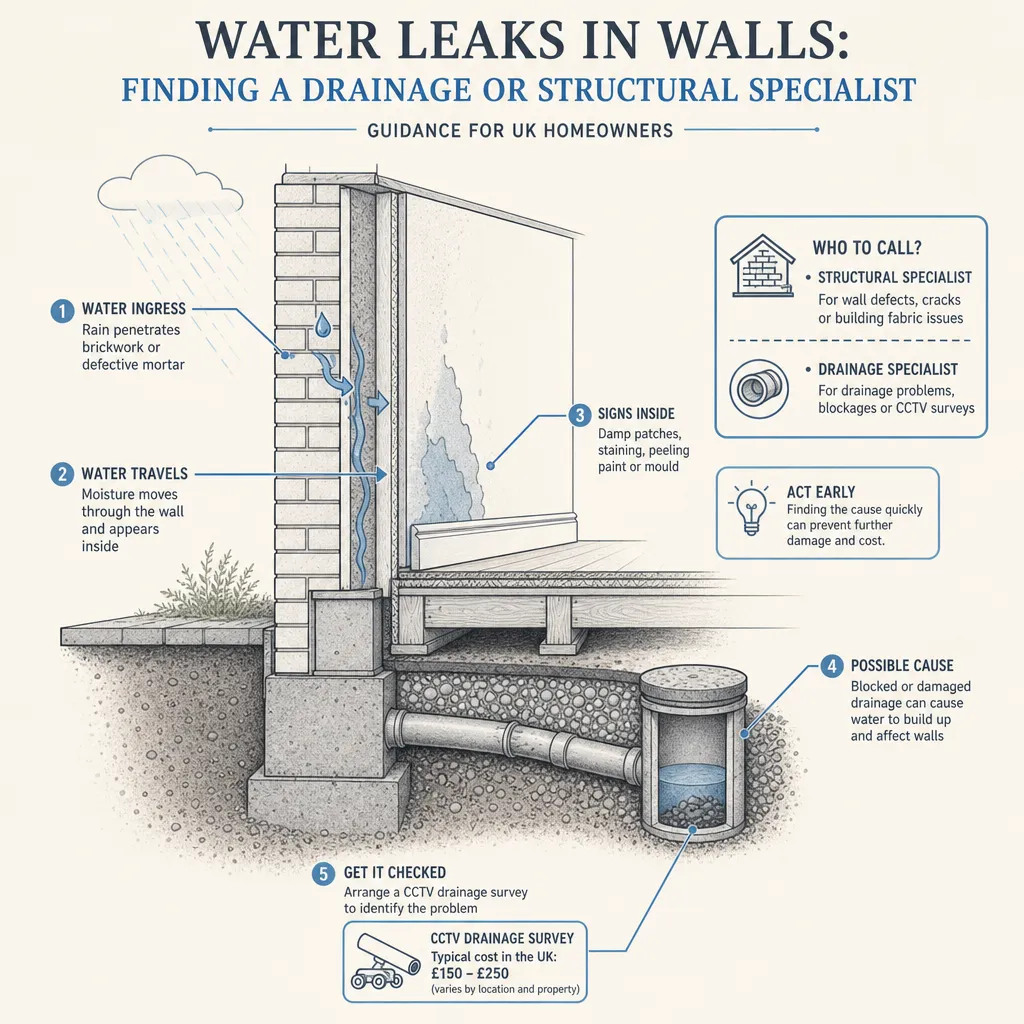 Surveys & Inspections
Water Leaks in Walls: Finding a Drainage or Structural Specialist
Water leaking through a wall can originate from a burst or leaking pipe, failed drainage, penetrating damp, a roof defect, or structural cracking.
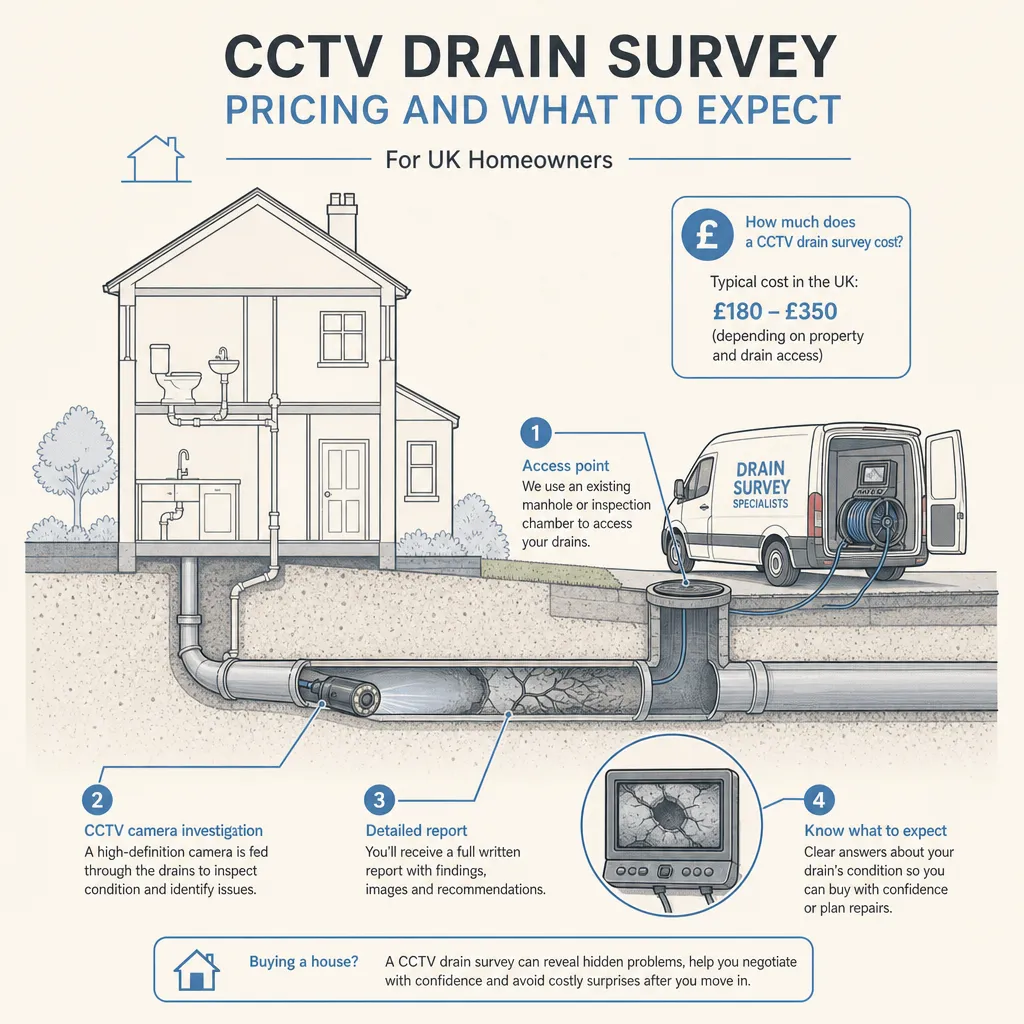 Surveys & Inspections
CCTV Drain Survey Pricing and What to Expect
A CCTV drain survey typically costs £150–£400 for a standard residential property in the UK, depending on drain length and property size.