Damp-Proof Course Installation and Remediation Costs
By Housey · Last reviewed 6th of May 2026
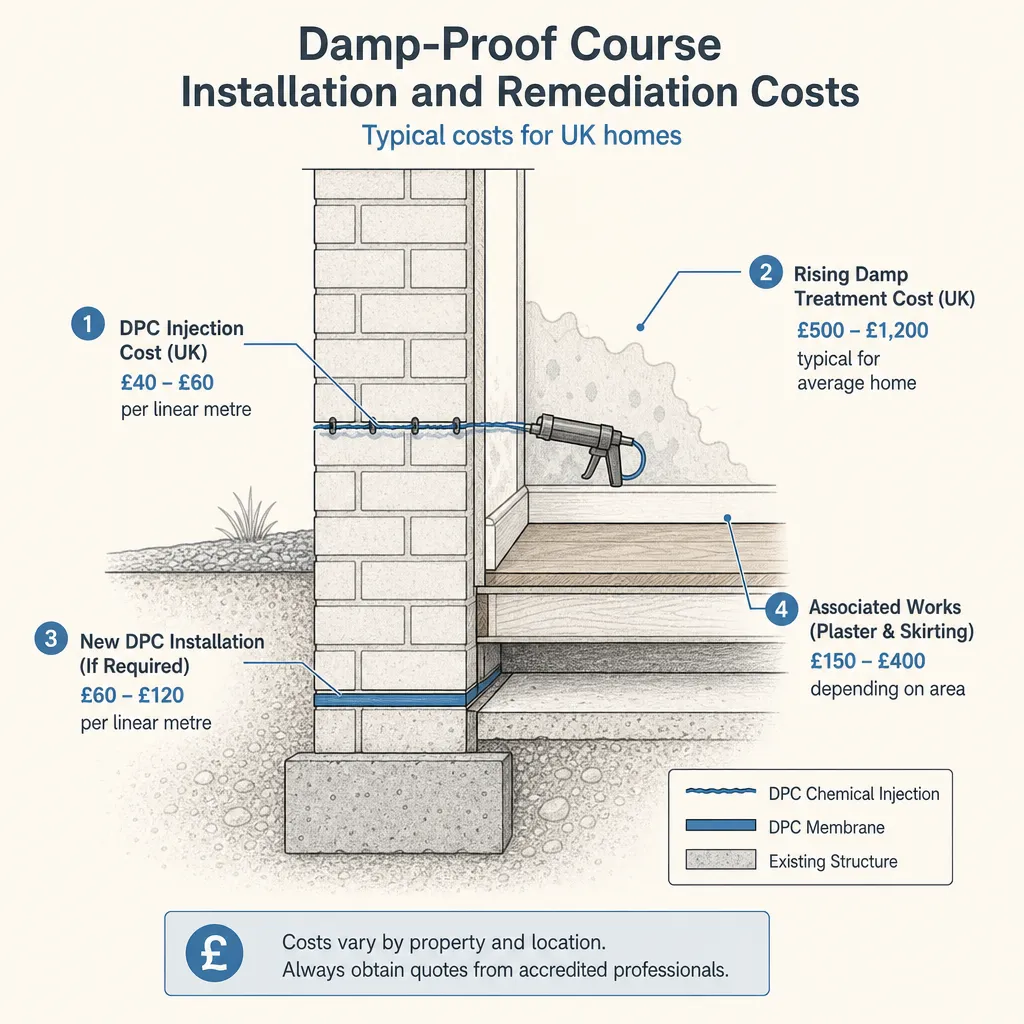
Damp-Proof Course Installation and Remediation Costs
Damp-proof course (DPC) failure is one of the most frequently flagged defects in RICS surveys of older UK homes, particularly those built before 1920. Many Edwardian and Victorian properties were built with slate, bitumen-felt, or engineering-brick DPCs that can deteriorate over time, and a significant number of pre-1870 homes were constructed with no DPC at all. Whether a survey has flagged rising damp, you have noticed tide marks forming on a ground-floor wall, or you are planning works near ground level, understanding the remediation options and realistic costs helps you budget accurately and avoid commissioning unnecessary treatment.
Key points
- Properties built before 1870 often have no damp-proof course; those built between 1870 and 1920 may have slate or bitumen-felt DPCs that can degrade over decades.
- Chemical injection DPC — silicone-based cream or liquid injected at intervals into a mortar course — is the most widely used remedial method for rising damp in UK solid-wall properties.
- The Property Care Association (PCA) is the main UK trade body for damp-proofing contractors; PCA membership indicates adherence to agreed technical standards.
- Replastering with specialist renovation plaster is almost always required after DPC injection and typically accounts for the majority of total remediation costs.
- Indicative costs range from £300–£700 for chemical injection alone on one wall, rising to £1,500–£3,500 for a full two-room remediation including replastering. Indicative UK costs, last reviewed 2026-05-06.
What is a damp-proof course and why does it fail?
A damp-proof course is a horizontal barrier built into a wall — usually 150mm above external ground level — that prevents groundwater rising into the structure by capillary action. This process, known as rising damp, draws moisture upward through masonry and produces characteristic tide marks, salt deposits, and deteriorating plaster on lower internal walls.
In homes built after the 1870s, physical DPCs were introduced using slate, bitumen felt, hessian-based felt, lead sheet, or — in later decades — polythene. Modern homes built under current Building Regulations include a continuous damp-proof membrane (DPM) at floor level, linked to the wall DPC.
DPCs fail or become ineffective for several reasons:
- Physical deterioration: Hessian-felt DPCs can rot; older materials may crack or erode over time.
- Bridging: External ground level, render, or paving raised above the DPC line allows moisture to bypass the barrier — one of the most common and most easily remedied causes of apparent rising damp.
- Absent DPC: Many pre-1870 properties were built without any damp-proof course.
- Cavity wall debris: Rubble or mortar dropped into the cavity during construction can bridge the gap and create a moisture pathway through the wall.
Not all ground-floor dampness is rising damp. Condensation and penetrating damp are frequently misdiagnosed as rising damp. An independent damp and timber survey before instructing remedial work is strongly advisable.
Types of damp-proof course
DPC type | Typically found in | How it works | Approximate lifespan |
|---|---|---|---|
Slate or engineering brick | Pre-1920 properties | Physical barrier layer in masonry | Can last a century if intact; may crack or erode |
Bitumen felt | 1920s–1960s homes | Bituminous material layer in wall | 50–70 years; susceptible to degradation |
Polythene (modern) | Post-1970s new builds | Continuous impermeable sheet | Long-lasting if not punctured during works |
Chemical injection | Remedial treatment, all ages | Silicone cream or liquid injected at intervals | 20–30 years; manufacturer guarantees vary |
Cavity drain membrane | Basements and below-ground rooms | Manages rather than blocks moisture | Long-lasting with regular sump pump maintenance |
Electro-osmotic system | Some listed or historic buildings | Low electrical current redirects capillary moisture | Variable; specialist assessment required |
For most solid-wall homes requiring remediation, chemical injection DPC is the most commonly specified solution. For basements or below-ground structures, cavity drain membranes or tanking systems are typically used instead.
How much does DPC installation and remediation cost?
Costs vary considerably depending on the extent of affected walls, property type, accessibility, and whether replastering is included in the scope.
Scope of work | Indicative cost range | Notes |
|---|---|---|
Chemical DPC injection only — one wall, terraced house | £300–£700 | Injection alone; replastering billed separately |
Chemical DPC + replastering — 2 ground-floor rooms | £1,500–£3,500 | Most common full remediation package |
Chemical DPC + replastering — semi-detached, 4 rooms | £2,500–£5,000+ | Scale and access affect price significantly |
DPC bridge removal only (e.g., lowering external paving) | £200–£600 | Often resolves apparent rising damp without injection |
Basement cavity drain membrane — small cellar | £2,500–£7,000+ | Depends on basement size and system specified |
Indicative UK costs, last reviewed 2026-05-06. These are broad guides only — always obtain at least three itemised written quotes from PCA-registered contractors. Source: Property Care Association guidance and general UK contractor market data.
Reputable contractors typically offer 20–30 year guarantees on chemical DPC work. Check that any guarantee is backed by an insurance-backed guarantee (IBG) scheme, which remains valid if the contractor ceases trading.
What affects the cost?
- Wall length and number of affected rooms: Costs broadly scale with the linear metres of wall treated.
- Wall construction: Solid brick walls are more straightforward to treat than cavity walls or rubble-core walls.
- Replastering requirement: Salts contaminating the existing plaster mean it must be stripped and replaced with renovation plaster to at least 1 metre above the visible tide mark — often the most expensive part of the job.
- Accessibility: Rooms with fitted furniture, kitchens, or restricted access take longer and may incur higher labour costs.
- Underlying cause: If dampness results from a bridged DPC rather than a failed one, ground-lowering or render removal may cost a fraction of full chemical injection.
- Location: Labour rates in London and the South East are typically higher than the rest of England, Wales, and Scotland.
Red flags: signs your DPC may have failed or is being bridged
Look for these indicators on lower ground-floor walls and externally:
- Horizontal tide marks — bands of discolouration below 1 metre on internal walls, particularly in the corners of rooms.
- Efflorescence (white crystalline deposits) on brickwork or plaster, indicating moisture movement through masonry.
- Peeling wallpaper or bubbling, hollow plaster at low level, especially in ground-floor rooms.
- Raised external ground or paving — check whether soil, a flowerbed, or paved surfaces have been built up to or above the DPC line on the outer wall.
- Musty smell at ground-floor level, particularly in older properties with solid walls.
- Soft, discoloured, or spongy timber skirtings or floorboards close to damp masonry — at risk of wet rot if the moisture source is not addressed.
If you identify any of these signs, commission an independent survey before agreeing to remedial work. Diagnosis should ideally come from a specialist with no financial interest in the subsequent treatment.
DPC remediation checklist
Before accepting any damp-proofing quote, work through the following:
When to get professional help
Commission a qualified specialist if:
- A RICS Level 2 or Level 3 survey has flagged rising damp or DPC failure and you need a remediation cost before exchange of contracts.
- You have visible tide marks, salt deposits, or deteriorating plaster at low level on ground-floor walls.
- Timber skirtings, floorboards, or accessible joists near damp masonry appear soft or discoloured.
- External ground level, paving, or applied render has been raised above the visible DPC line.
- You are buying an older property and need to understand potential remediation costs before committing to purchase.
Always seek an independent assessment before agreeing to remedial work from a contractor who has also diagnosed the problem — there is a well-documented tendency in this sector for over-diagnosis and over-specification.
How Housey can help
If you need an independent assessment before commissioning any work, Housey can connect you with qualified specialists offering a damp and timber survey to confirm whether remediation is needed and what type. Once you have a diagnosis and a specification, you can use Housey to request and compare quotes from vetted damp proofing specialists.
Frequently asked questions
How long does a chemical DPC injection last?
Most manufacturers specify a service life of 20–30 years, and many PCA-registered contractors offer guarantees of this duration. For the treatment to remain effective, the underlying cause — such as a bridged DPC or raised ground level — must also be corrected, and replastering must be carried out with specialist renovation plaster rather than standard backing coat.
Do I need planning permission to repair a damp-proof course?
For most standard DPC remediation work to an internal or standard external wall, planning permission is not required. However, if your home is listed or in a conservation area, works affecting external masonry may need listed building consent or conservation area consent. Check with your local planning authority before proceeding with any external work.
Is rising damp always caused by a failed DPC?
No. Many apparent rising damp cases result from a bridged DPC — soil, render, or paving raised above the DPC level — or from penetrating damp and condensation being misidentified. An independent damp and timber survey, separate from any contractor proposing to do the work, should establish the root cause before treatment is specified.
Does buildings insurance cover DPC failure?
Standard UK home buildings insurance typically excludes gradual deterioration, including DPC failure. Rising damp is generally treated as a maintenance issue rather than a sudden insurable event. New-build homes may have NHBC Buildmark or similar structural warranties covering DPC defects within the policy period — check your policy documents carefully.
How can I tell if my DPC has been bridged?
Inspect the external face of your wall: the DPC usually appears as a slightly different mortar joint or material in the brickwork, around 150mm above external ground level. Check whether soil, paving slabs, render, or a raised flowerbed has been built up to or above this line. Bridging is common and often inexpensive to rectify — sometimes by simply lowering paving or removing bridging render.
Sources and further reading
- Rising Damp — Homeowner Guidance — Property Care Association
- Approved Document C — Site preparation and resistance to moisture — GOV.UK
- Damp in Historic Buildings — Historic England
- RICS Home Survey Standard — RICS
Useful next reads
 Improvement & Build
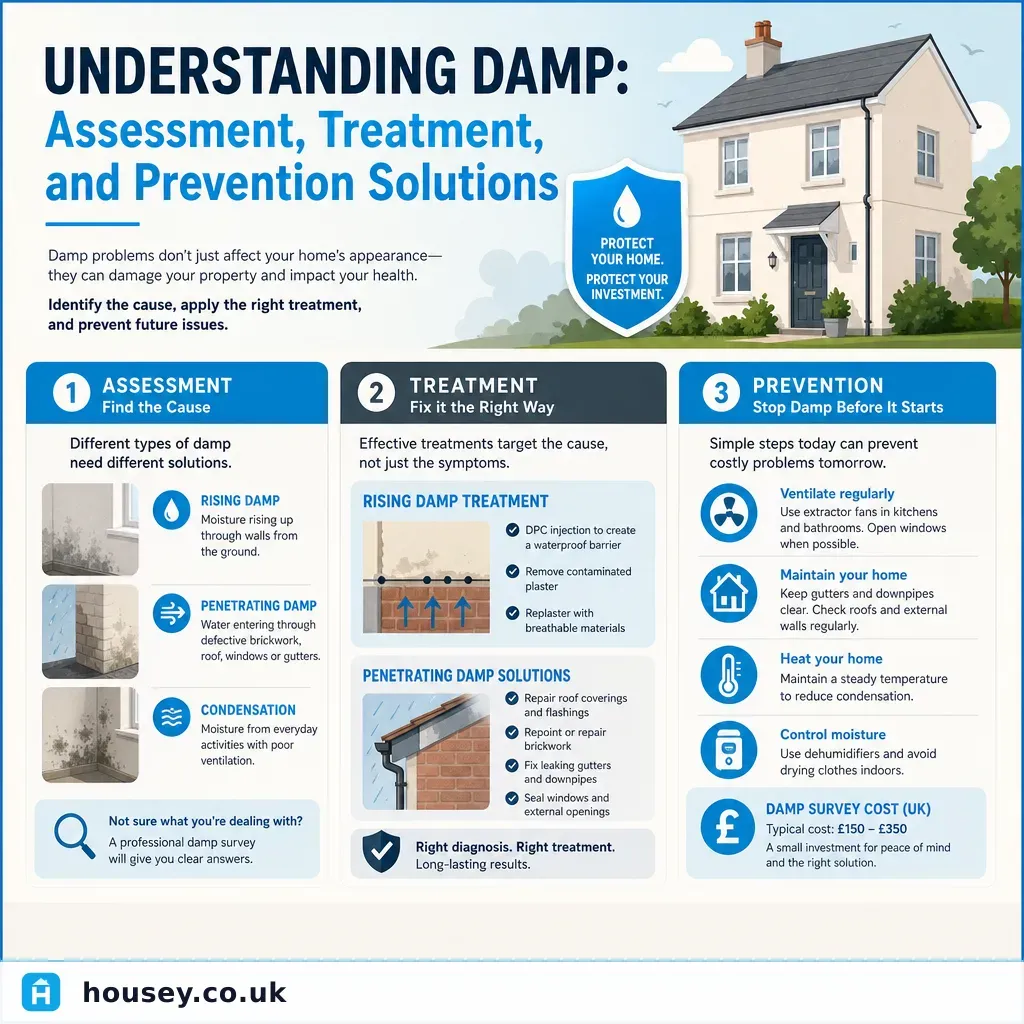
Understanding Damp: Assessment, Treatment, and Prevention Solutions
Damp in UK homes usually falls into three categories — rising damp, penetrating damp, and condensation — each requiring a different remedy.
 Improvement & Build
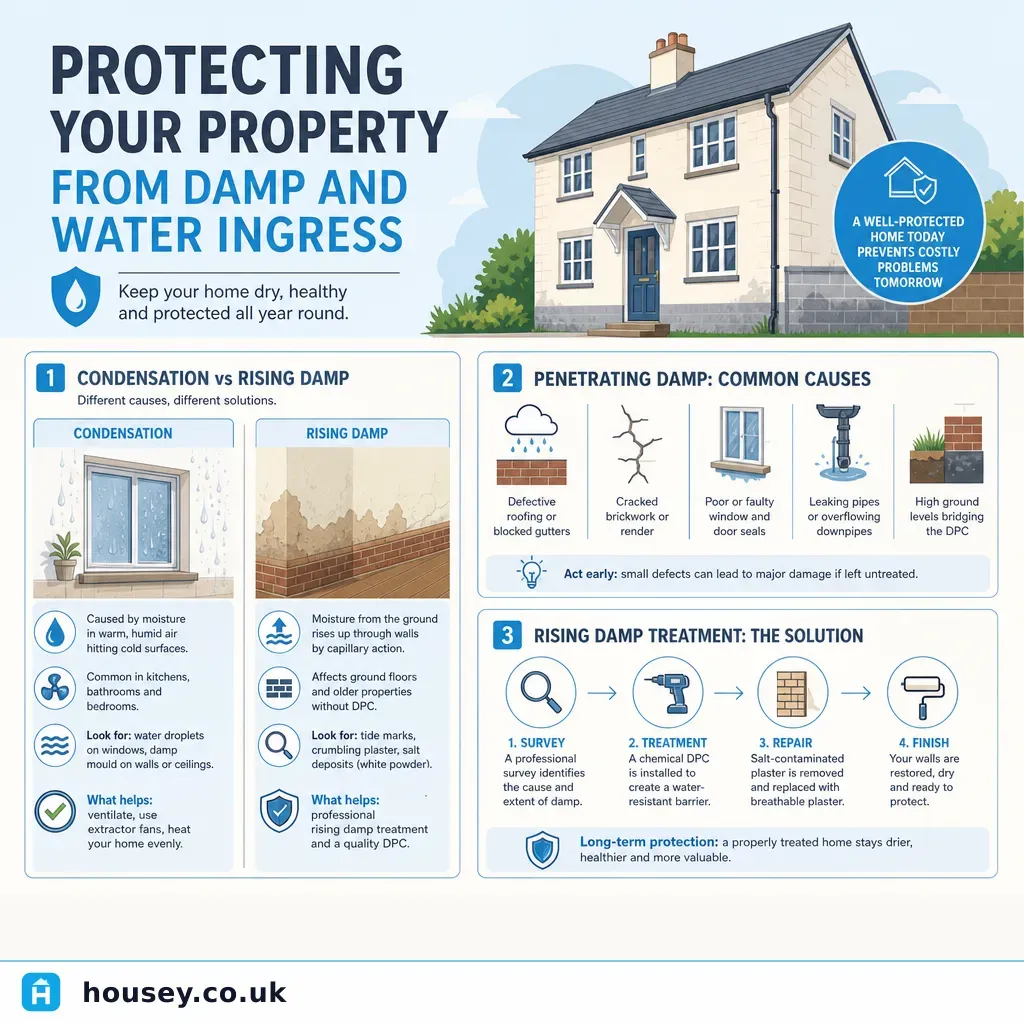
Protecting Your Property from Damp and Water Ingress
Damp in UK homes usually falls into three categories: rising damp (groundwater drawn up through walls), penetrating damp (rain or groundwater entering through the building envelope), and condensation (moisture from warm internal air meeting a cold surface).
 Improvement & Build
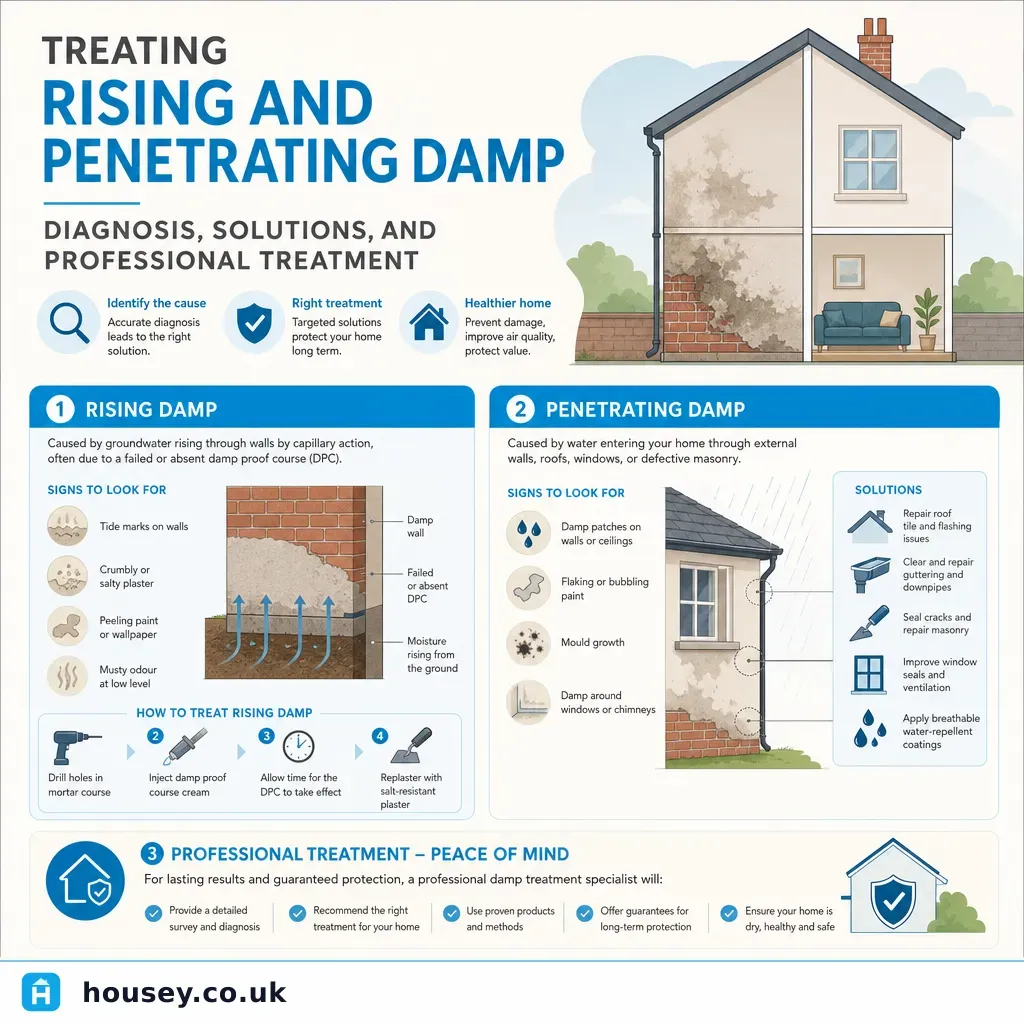
Treating Rising and Penetrating Damp: Diagnosis, Solutions, and Professional Treatment
Rising damp appears as a tide mark at the base of ground-floor walls and is caused by a failed or absent damp-proof course.
 Improvement & Build
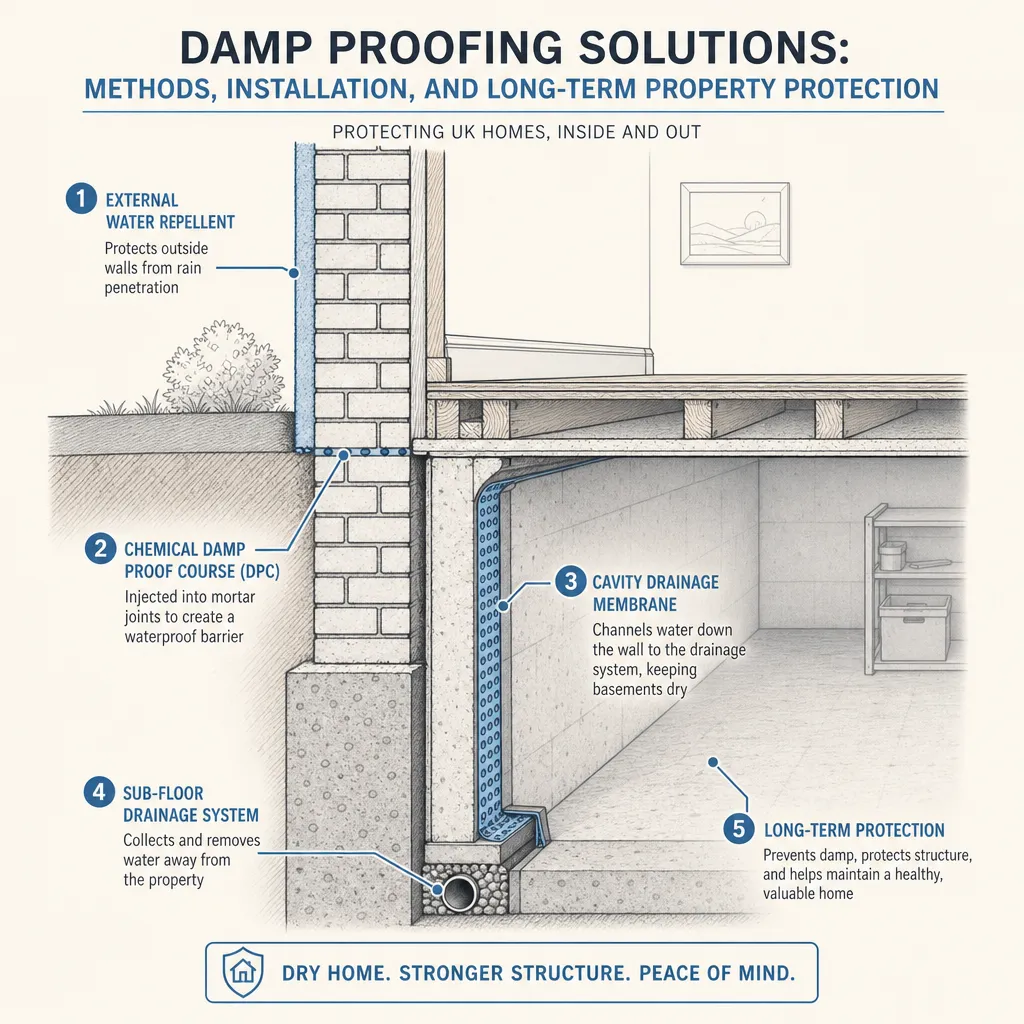
Damp Proofing Solutions: Methods, Installation, and Long-Term Property Protection
Damp proofing in UK homes typically involves chemical damp proof course (DPC) injection for rising damp, cavity drainage membranes for basement or below-ground moisture, and tanking for waterproofing solid walls.
 Improvement & Build
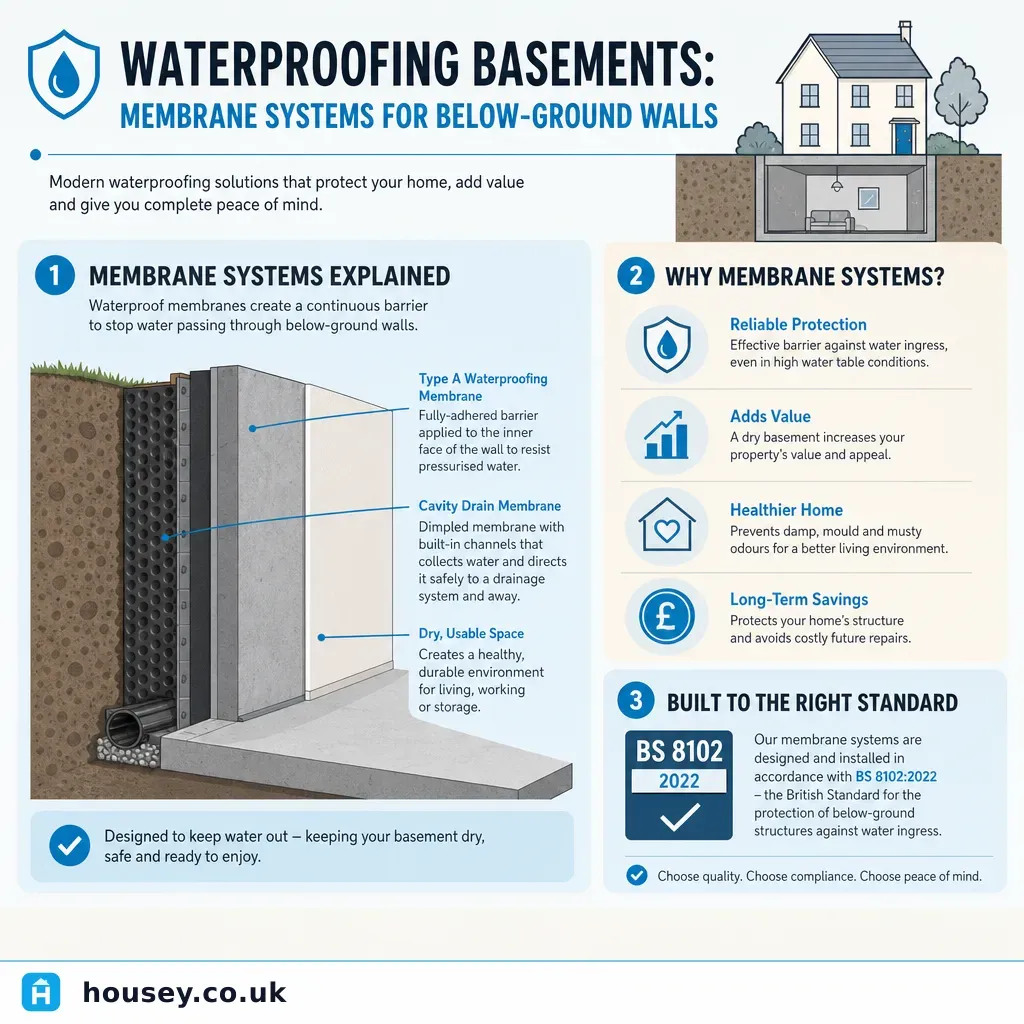
Waterproofing Basements: Membrane Systems for Below-Ground Walls
The three principal below-ground waterproofing systems under BS 8102:2022 are Type A (barrier membranes such as tanking or crystalline coatings), Type B (structurally integral waterproof concrete), and Type C (cavity drain membranes that collect and redirect water).