Waterproofing Basements: Membrane Systems for Below-Ground Walls
By Housey · Last reviewed 11th of May 2026
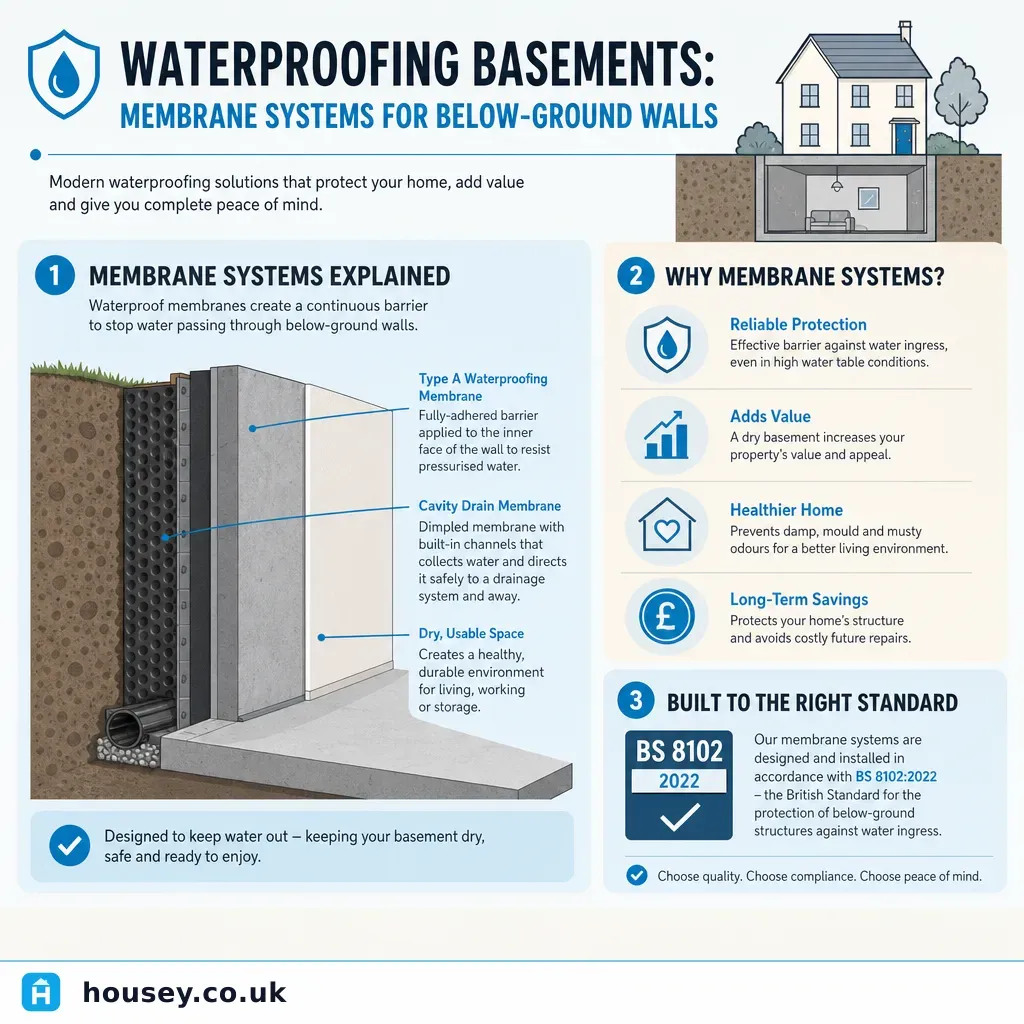
Waterproofing Basements: Membrane Systems for Below-Ground Walls
For UK homeowners converting a cellar into habitable space or managing persistent damp in an existing basement, choosing the right waterproofing system is critical to long-term performance. Below-ground walls are subject to hydrostatic pressure, seasonal ground water fluctuation, and moisture vapour transmission — conditions that ordinary masonry paint or surface sealers cannot reliably address. The standard framework for waterproofing design in the UK is BS 8102:2022, which classifies the main approaches into three types, each suited to different ground conditions, construction types, and intended uses.
Key points
- BS 8102:2022 (Protection of below-ground structures against water from the ground) is the British Standard governing basement waterproofing design; it defines Type A, B, and C waterproofing systems with distinct performance characteristics.
- Type A (barrier protection) relies on applied membranes, tanking coatings, or crystalline products to resist water entry; performance depends heavily on surface preparation, workmanship quality, and the absence of defects.
- Type C (drained protection) uses a studded HDPE cavity drain membrane to collect water that enters the structure and channel it to a sump pump; it is the most commonly specified approach in UK residential basement conversions.
- BS 8102:2022 recommends that for Grade 3 habitable basements (dry environment standard), a combined Type A and Type C system provides greater long-term reliability than a single type alone.
- The Property Care Association (PCA) publishes a code of practice for basement waterproofing and maintains a register of accredited contractors; always verify a specialist holds PCA accreditation before instructing.
The three BS 8102 waterproofing types
Type A — Barrier protection
Type A systems use applied membranes or coatings to prevent water passing through the wall or floor. Common products include:
- Bituminous sheet or liquid membranes — applied to external faces during construction or after excavation, before backfilling.
- Cementitious tanking slurries — applied internally or externally; require careful surface preparation and appropriate curing conditions.
- Crystalline waterproofing — penetrates concrete or blockwork and forms insoluble crystals that block capillary pores; can be applied as a surface slurry or incorporated into a concrete mix.
Type A systems create a continuous barrier against water. Their weakness is that any defect in the coating — a pinhole, poorly treated corner, or application gap — can allow water through, and locating the source of failure from the inside is often very difficult.
Type B — Structurally integral waterproof concrete
Type B systems incorporate waterproof concrete, designed to specific permeability standards, as the structural element itself. This approach is common in new-build basement construction and larger commercial schemes but is rarely practical for retrofitting existing UK basements. It requires specialist concrete mix design, careful detailing at construction joints, and structural engineering input.
Type C — Drained protection (cavity drain membranes)
Type C systems use a studded HDPE membrane fixed to walls and floors to create a drainage cavity between the membrane and the structure. Ground water that passes through the wall or floor is collected by the membrane and directed to a sump and pump system or to a gravity drain. The approach acknowledges that some water ingress will occur and manages it rather than stopping it entirely.
Cavity drain membranes are the most prevalent waterproofing approach in UK residential basement conversions. They are relatively tolerant of minor ground movement and substrate irregularities, and if the pump fails or the membrane is damaged the system can usually be repaired without major disruption to finishes.
Choosing between waterproofing types
System type | How it works | Best for | Key limitation | Typical professional |
|---|---|---|---|---|
Type A — Barrier | Coatings or membranes stop water entry | New construction; external applications; lower water tables | Any coating defect allows ingress; failures difficult to locate internally | PCA waterproofing specialist |
Type B — Integral concrete | Waterproof concrete as the structure | New-build basement construction | Not practical for retrofit; requires structural engineering input | Structural engineer and specialist contractor |
Type C — Cavity drain | Membrane channels water to sump pump | Retrofit; UK basement conversions; active ground water | Pump requires maintenance; not ideal where headroom is very limited | PCA-accredited waterproofing specialist |
Combined A+C | Barrier protection plus drainage backup | Grade 3 habitable spaces; high water table | Higher installation cost | PCA-accredited specialist |
Grade levels and performance expectations under BS 8102:2022
BS 8102:2022 defines four grades of internal environment for below-ground structures:
- Grade 1: Basic utility — car parks, plant rooms. Some seepage and moisture vapour tolerated.
- Grade 2: Better utility — workshops, storage. No water seepage but moisture vapour acceptable.
- Grade 3: Habitable space — living rooms, bedrooms, home offices. Completely dry, controlled humidity required.
- Grade 4: Archives, data centres. Very tightly controlled temperature and humidity required.
Most UK homeowners converting a basement to a study, bedroom, or sitting room require Grade 3. This is the most demanding standard for residential use and typically warrants a combined waterproofing approach.
Ventilation — the element most often overlooked
A waterproof membrane addresses liquid water ingress. It does not manage moisture vapour, which can still migrate through walls and cause condensation, mould, and poor air quality in a sealed below-ground space. Any basement conversion must include a ventilation strategy — typically mechanical ventilation with heat recovery (MVHR) — as part of the specification. This is a requirement under Building Regulations Approved Document F and should be designed alongside the waterproofing system, not added as an afterthought.
Important limitations
This article provides general information about waterproofing types and is not a substitute for a site-specific waterproofing design. Appropriate system selection depends on the depth of the structure, local water table, soil type, construction materials, and intended use. BS 8102:2022 recommends that design is carried out by a suitably qualified specialist. Building regulations approval is required for basement conversions to habitable use, and requirements may vary by local authority.
When this becomes urgent
Seek professional help without delay if:
- Water is actively entering the basement during or after rainfall, or when the ground is saturated.
- Existing waterproofing has failed in a room used for habitable or storage purposes.
- Mould is visible on basement walls or floors, particularly if the space is used as a bedroom or living area.
- A sump pump in an existing system has failed.
What to ask a qualified professional
Before accepting a quote from a waterproofing specialist:
- Are you a member of the Property Care Association (PCA) and does your work follow the PCA Basement Waterproofing Code of Practice?
- Will the system be designed to BS 8102:2022, and will the design be provided in writing?
- Which waterproofing type or combination are you specifying, and why is it appropriate for this property?
- Does the specification include a ventilation strategy to manage moisture vapour?
- What warranty do you offer, and is it backed by an insurance-backed guarantee (IBG)?
- Who will carry out the installation — your own employees or subcontractors?
- What building regulations approvals will be needed, and will you manage the application?
- Is VAT included in the quoted price?
When to get professional help
Basement waterproofing is a specialist field in which poor installation is one of the most common causes of persistent damp in UK properties. Always instruct a PCA-accredited specialist who will design to BS 8102:2022, provide a written specification, and offer an insurance-backed warranty.
How Housey can help
Housey connects homeowners with vetted damp proofing specialists and drainage contractors who can assess your basement, design the appropriate waterproofing system to BS 8102:2022, and manage building regulations approval. Submit your project details and receive quotes from accredited local professionals.
Frequently asked questions
What is the difference between Type A and Type C basement waterproofing?
Type A systems apply a coating or membrane to the wall surface to physically block water from entering. Type C systems use a studded cavity drain membrane to collect any water that penetrates the structure and channel it to a sump pump. Type A relies on a defect-free barrier; Type C manages ingress rather than preventing it. For habitable basements, BS 8102:2022 typically recommends combining both systems for reliability.
Does basement waterproofing work need building regulations approval?
In most cases, yes. Converting a basement to habitable use requires building regulations approval covering structural integrity, fire safety, ventilation, and thermal performance. The waterproofing system forms part of the specification reviewed by building control. Your specialist or architect should submit the application. Some repair-only work without a change of use may not require formal approval — check with your local building control body first.
How long do cavity drain membrane systems last?
HDPE cavity drain membranes, when correctly installed, can last 30 years or more. The sump pump is usually the weakest component, typically requiring servicing every one to three years and replacement after 10–15 years. For habitable spaces, specify a dual-pump sump with a high-water alarm so any pump failure is detected before flooding occurs. Ask your specialist about ongoing maintenance requirements when reviewing a quote.
Do I need planning permission for a basement conversion?
In many cases, basement conversions within the existing footprint of a house are permitted development and do not require planning permission. However, permission is required for listed buildings, properties in conservation areas, and where a new separate dwelling is being created. Always check with your local planning authority before starting work. GOV.UK provides guidance on permitted development rights for householders.
Sources and further reading
- BS 8102:2022 — Code of practice for protection of below-ground structures against water from the ground — BSI Standards
- Property Care Association — Basement waterproofing guidance — Property Care Association (PCA)
- GOV.UK — Building regulations technical guidance — GOV.UK
- Approved Document F — Means of ventilation — GOV.UK
Useful next reads
 Improvement & Build
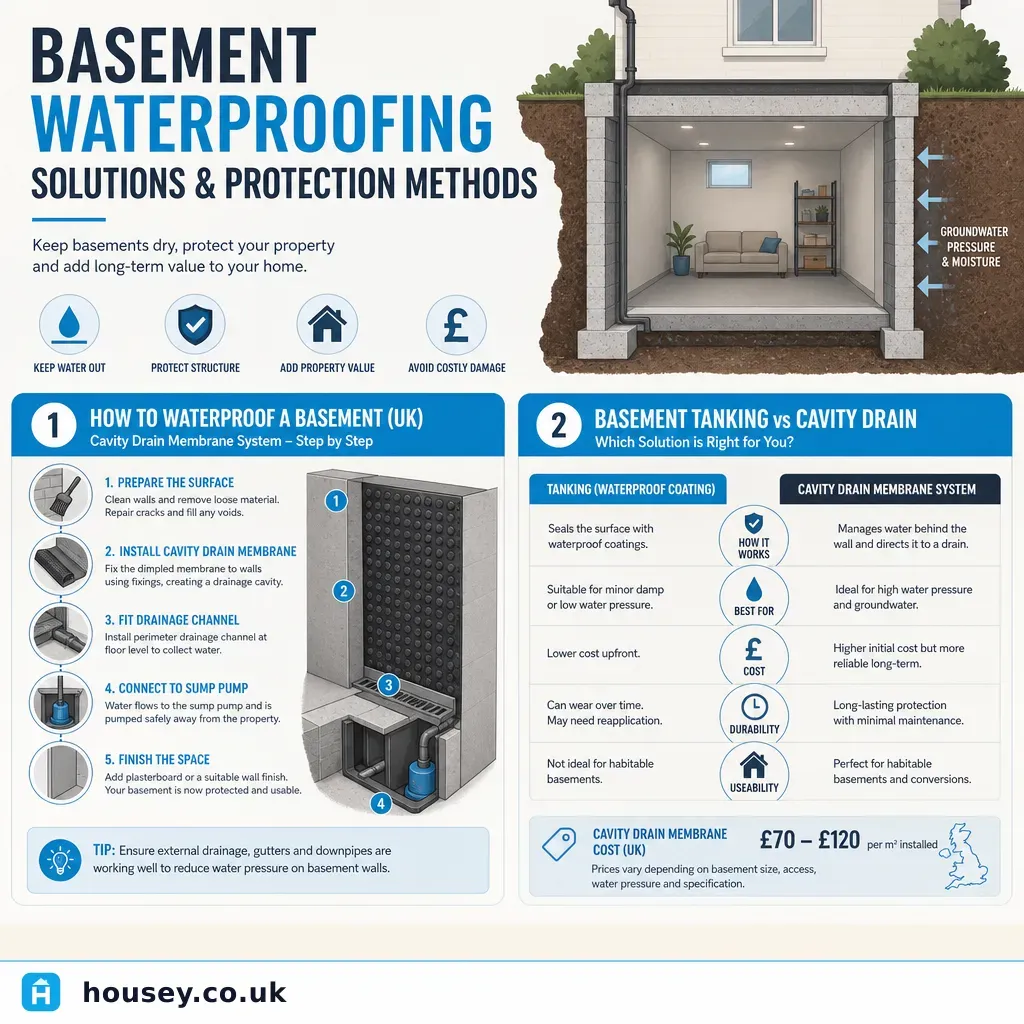
Basement Waterproofing Solutions and Protection Methods
Basement waterproofing in the UK uses one of three system types defined in BS 8102:2022: Type A (barrier tanking), Type B (structurally integral concrete), or Type C (cavity drain with sump pump).
 Improvement & Build
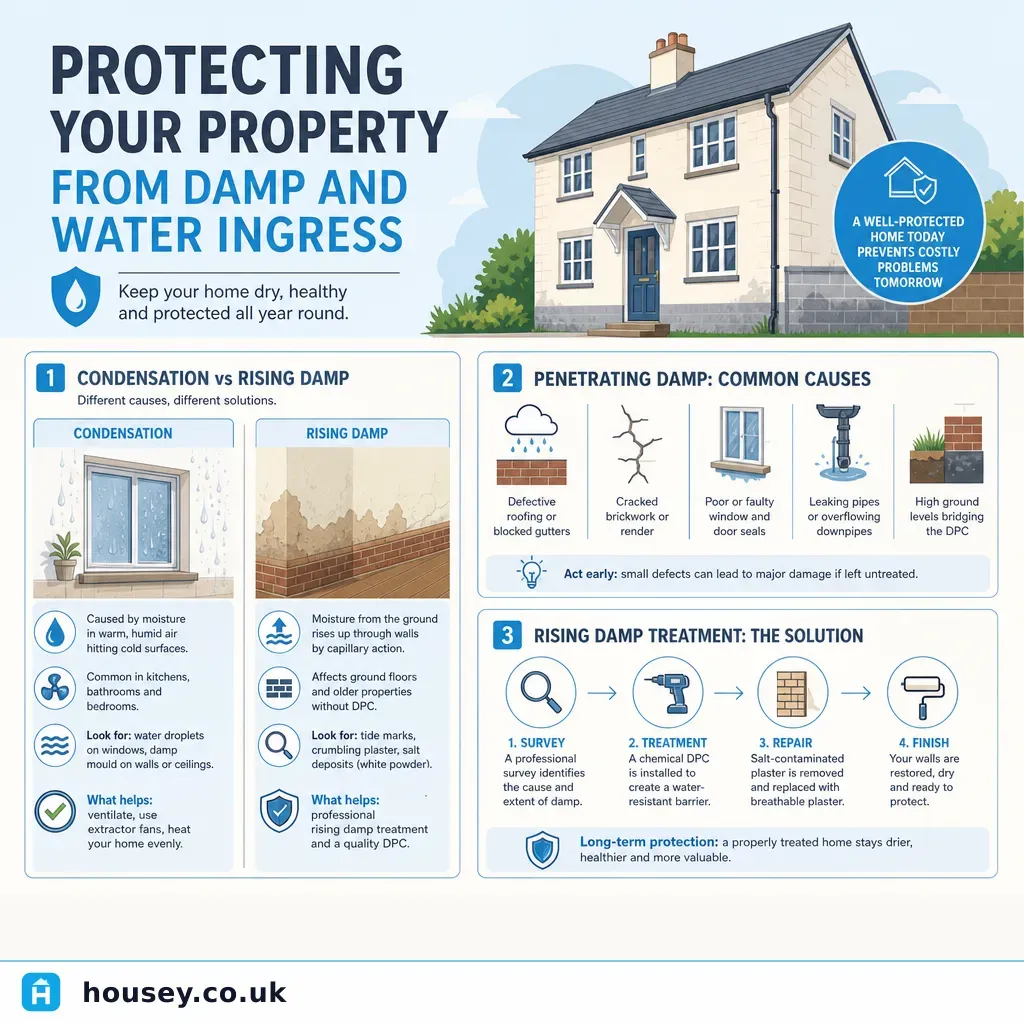
Protecting Your Property from Damp and Water Ingress
Damp in UK homes usually falls into three categories: rising damp (groundwater drawn up through walls), penetrating damp (rain or groundwater entering through the building envelope), and condensation (moisture from warm internal air meeting a cold surface).
 Improvement & Build
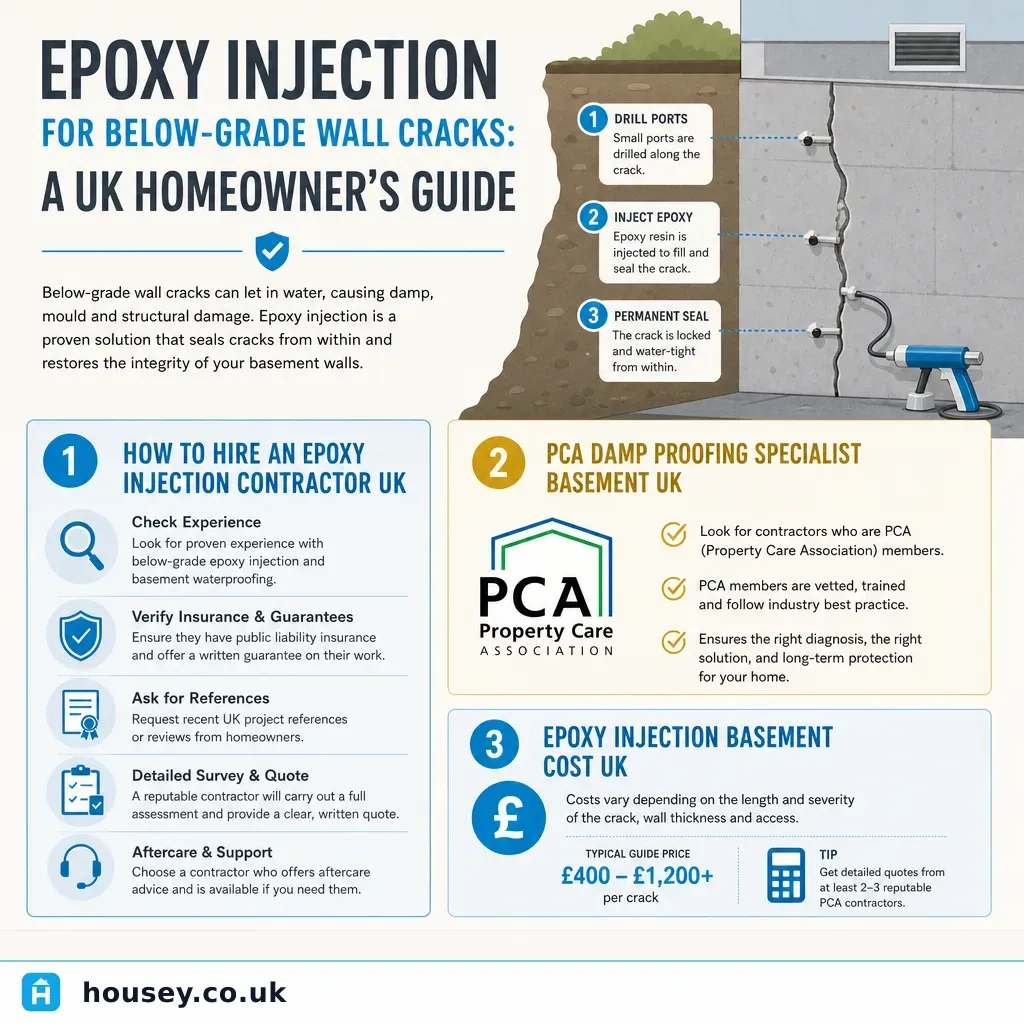
Epoxy Injection for Below-Grade Wall Cracks: A UK Homeowner's Guide
Epoxy injection seals stable, non-moving cracks in below-grade concrete walls but will not work on masonry, actively moving cracks, or as a standalone fix for habitable basement conversions.
 Improvement & Build
Understanding Damp: Assessment, Treatment, and Prevention Solutions
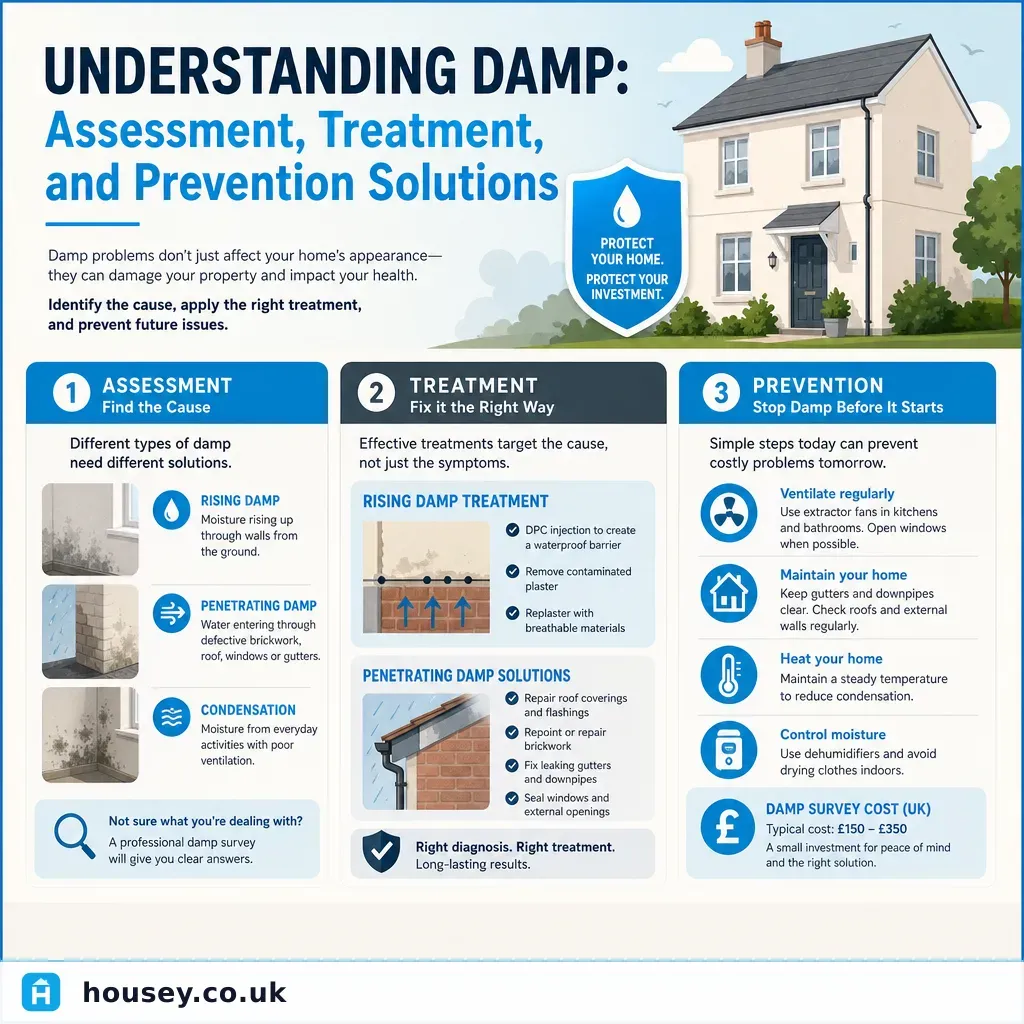
Damp in UK homes usually falls into three categories — rising damp, penetrating damp, and condensation — each requiring a different remedy.
 Improvement & Build
Installing Weather-Resistant Windows: A Guide to Proper Sealing and Fitting
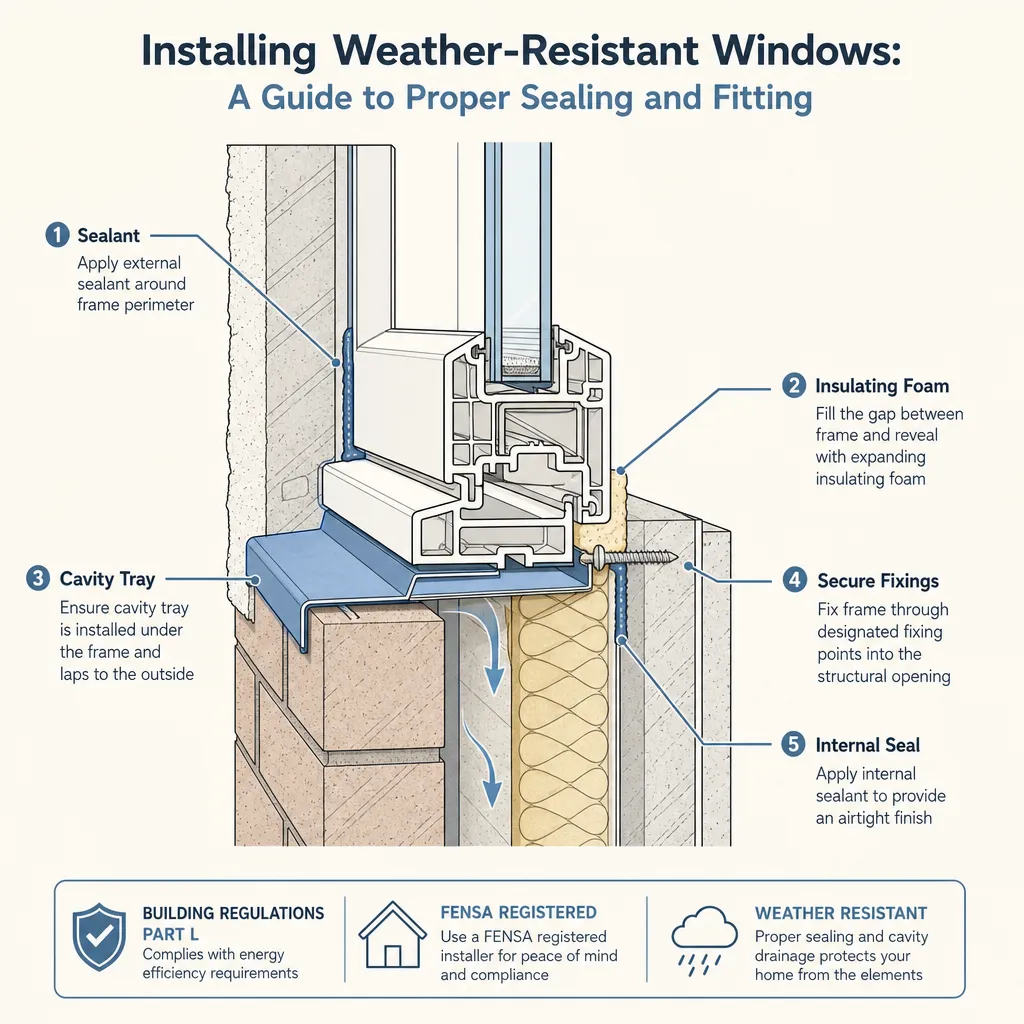
Replacing windows in England requires Building Regulations compliance under Part L — either via a FENSA- or CERTASS-registered installer who self-certifies, or through local authority building control notification.