Treating Rising and Penetrating Damp: Diagnosis, Solutions, and Professional Treatment
By Housey · Last reviewed 18th of May 2026
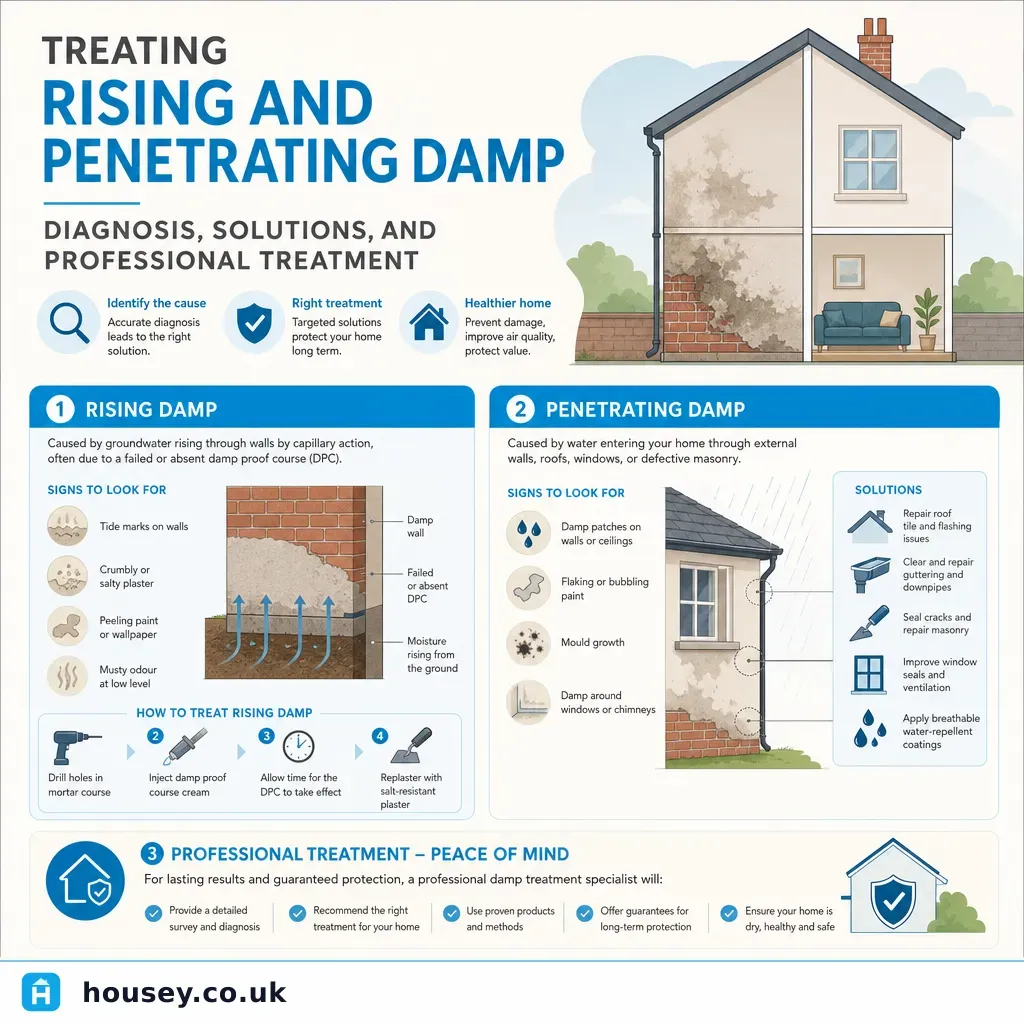
Treating Rising and Penetrating Damp: Diagnosis, Solutions, and Professional Treatment
Damp is one of the most frequently misdiagnosed problems in UK housing, and a misidentified cause leads almost inevitably to an ineffective — and sometimes harmful — treatment. Whether a property is exhibiting tide marks on a ground-floor wall, staining on a chimney breast, or peeling paint around a window frame, correctly establishing the type and source of damp is the prerequisite for any lasting solution. Homeowners, buyers, and landlords commonly encounter damp during surveys, pre-purchase inspections, and routine maintenance, and the consequences of neglect — degraded plaster, mould growth, and in time timber and masonry damage — are real and costly.
Key points
- Rising damp is caused by groundwater migrating upward through porous masonry in the absence of an effective damp-proof course (DPC); it typically presents as a tide mark up to approximately 1 m from floor level, often with white salt efflorescence.
- Penetrating damp enters horizontally through defects in the building fabric — failed pointing, blocked gutters, cracked render, or porous brickwork — and has no relationship to the DPC.
- The Property Care Association (PCA) and RICS both note that rising damp is frequently over-diagnosed; many cases are in fact penetrating damp or condensation, making independent diagnosis essential before any treatment is accepted.
- Chemical damp-proof course injection — drilling holes at regular intervals near floor level and injecting a silicone-based cream — is the standard remedial treatment for confirmed rising damp and typically carries a 20–30 year guarantee when installed by a PCA-registered contractor.
- Landlords in England are legally required under the Homes (Fitness for Human Habitation) Act 2018 to ensure properties are free from Category 1 hazards under HHSRS, including excessive damp and mould growth.
Comparison: rising damp, penetrating damp, and condensation
Type | Where it appears | Key indicators | Common cause | Typical remedy |
|---|---|---|---|---|
Rising damp | Ground-floor walls, up to ~1 m from floor | Tide mark at consistent height; salt efflorescence; no association with rainfall | Failed, absent, or bridged DPC | Chemical DPC injection; salt-resistant replastering |
Penetrating damp | Any wall; often near a specific feature | Appears or worsens after rainfall; no tide mark; localised patch | Defective pointing, cracked render, blocked gutter, failed flashing | Repair the fabric defect; allow wall to dry; re-render if required |
Condensation | Cold surfaces — window reveals, external walls, room corners | Appears in cold weather; associated with high humidity; mould growth | Insufficient ventilation, thermal bridging, high occupant moisture output | Improve ventilation, heating, and insulation; consider PIV or MVHR |
Accurate diagnosis is essential before any treatment is agreed. A diagnostic damp survey — conducted by a RICS-registered or PCA-certified surveyor who does not also sell the treatment — is the most reliable way to confirm the type and source of damp.
How rising damp is diagnosed and treated
Rising damp occurs when a building's damp-proof course has failed, been bridged, or was never installed. Pre-1875 properties may have no DPC at all; older slate, bituminous felt, or lead DPCs can crack or deteriorate over time. High external ground levels — often raised during landscaping or extension work — are among the most common causes of DPC bridging, and simply reducing the external ground level may resolve the problem without any chemical treatment.
Diagnosis involves a surveyor using a calibrated moisture meter to map moisture levels across the wall, supplemented by wall sampling or core drilling to test for salts. Elevated chloride or nitrate levels in the plaster are indicative of genuine rising damp; high moisture meter readings alone are not definitive, as all meters respond to free water regardless of source.
Chemical DPC injection is the standard remedial treatment when rising damp is confirmed. Holes are drilled at approximately 12–15 mm spacing along the mortar course just above floor level, and a silicone-based cream or liquid is injected to form a water-repellent barrier. Re-plastering with a salt-resistant renovating plaster is required after treatment — the existing plaster will contain salts that will re-crystallise even after the moisture source is eliminated, causing ongoing damage if left in place.
Work should be carried out by a contractor registered with the Property Care Association (PCA), which operates a quality assurance scheme and backs guarantees through an insurance scheme. Avoid contractors offering free surveys tied to guaranteed treatment recommendations, as these create an obvious incentive to over-diagnose.
How penetrating damp is diagnosed and treated
Penetrating damp is driven by defects in the building fabric that allow rainwater to enter. Common ingress routes include:
- Failed or eroded mortar joints in brickwork — repointing required
- Cracked or hollow render — patch repair or full replacement
- Defective or missing flashings around chimney stacks, dormers, and roof-wall junctions
- Blocked, leaking, or overflowing gutters and downpipes
- Failed window or door seals, sills, or mastic joints
- Porous brickwork on exposed elevations, which may benefit from a breathable masonry water repellent cream — not waterproof paint, which traps moisture inside the wall
Treatment for penetrating damp always begins with repairing the defect. Tanking, injecting, or re-plastering a wall while the ingress route remains open will fail. The wall must also be allowed to dry fully before redecoration — in solid brick construction this can take several months.
Red flags: when to call a professional immediately
The following signs suggest damp is more serious than a surface problem and requires prompt professional assessment:
- Timber at risk: skirting boards, floor joists, or window frames that feel soft, spongy, or discoloured may indicate wet rot or, more seriously, dry rot. Dry rot (Serpula lacrymans) can spread through masonry and requires specialist treatment beyond standard damp proofing.
- Structural wall concerns: a wall that is wet to the touch, bowing, or shows cracks alongside damp staining may have a structural issue that damp alone does not explain; a structural engineer or RICS Level 3 surveyor should be consulted.
- Category 1 HHSRS hazard: landlords who receive notification from an environmental health officer of a Category 1 damp hazard must act promptly; failure to do so can result in an improvement notice or civil liability under the Homes (Fitness for Human Habitation) Act 2018.
- Post-flood saturation: properties affected by flooding require specialist drying and assessment; standard damp proofing treatment is not appropriate and may trap contaminated water within wall cavities.
- Damp in a recently purchased property: if a pre-purchase survey noted damp, confirm whether agreed treatment was carried out and whether any guarantee has been formally assigned to you — PCA-registered contractor guarantees are typically transferable to new owners.
What to ask before accepting a treatment quote
Before agreeing to any damp-proofing work, ask the contractor:
- How have you confirmed the type of damp — rising, penetrating, or condensation?
- Have you taken wall core samples or tested for salts, or have you relied solely on a moisture meter?
- Does this quotation include the repair of any fabric defects, or only the remedial injection?
- Are you registered with the Property Care Association (PCA)?
- What does the guarantee cover, how long does it last, and is it backed by an insurance scheme?
- What plastering specification are you using — is it a salt-resistant renovating plaster?
- Is VAT included in this quotation?
- What could change the price once work begins — for example, if hidden timber decay is found?
When to get professional help
Commission a diagnostic damp survey from a RICS-registered surveyor or PCA-certified specialist if damp staining has appeared for the first time, if a buyer's survey has identified damp requiring investigation, if an existing treatment appears to have failed, or if timber damage is suspected alongside damp. Do not rely solely on a free survey provided by the contractor who will also carry out the remedial work.
How Housey can help
Housey can connect you with qualified specialists to carry out an independent damp and timber survey, giving you an accurate diagnosis before committing to any treatment. If remedial work is confirmed, you can also find accredited damp proofing specialists who are registered with the Property Care Association and can provide insurance-backed guarantees.
Frequently asked questions
How do I know if I have rising damp or penetrating damp?
Rising damp typically presents as a tide mark at a consistent level around the base of ground-floor walls, often with a white salt crust. Penetrating damp tends to appear after heavy rain and is associated with a specific feature such as a chimney, window, or length of defective pointing. Condensation appears on cold surfaces in winter. A calibrated moisture meter survey with salt testing provides the most reliable diagnosis.
How much does damp proofing cost in the UK?
Chemical DPC injection for a terraced house typically costs £500–£2,500 for the injection work itself, with additional costs of £500–£2,500 or more for re-plastering affected walls. Penetrating damp repairs vary widely depending on the defect — pointing repairs on a single elevation may cost £200–£800, while flashing or chimney work can be considerably more. Indicative UK costs, last reviewed 2026-05-18; always obtain at least three quotes.
Is chemical DPC injection guaranteed to work?
Chemical DPC injection, when correctly diagnosed, correctly installed, and followed by appropriate salt-resistant re-plastering, is generally effective. It can fail if the DPC is bridged by a high external ground level that is not corrected, if existing salts in plaster are not removed, or if a penetrating damp source has been misidentified as rising damp. Choosing a PCA-registered contractor with an insurance-backed guarantee reduces the financial risk of failure.
Can I treat damp myself?
Minor penetrating damp caused by a simple defect — a cracked tile, a loose downpipe bracket, or a failed window bead seal — can often be addressed by a competent homeowner. Chemical DPC injection and salt-resistant re-plastering are specialist tasks where poor installation leads to recurrence. For any damp problem affecting a significant area of wall, or where timber may be involved, a professional assessment is advisable before committing to treatment.
Sources and further reading
- Approved Document C — Site preparation and resistance to contaminants and moisture — GOV.UK
- Property Care Association — Technical guidance on rising damp — Property Care Association
- RICS Home Survey Standard — RICS
- Homes (Fitness for Human Habitation) Act 2018 — Guidance for landlords and tenants — GOV.UK
- Damp in old buildings — guidance for owners — Historic England
Useful next reads
 Improvement & Build
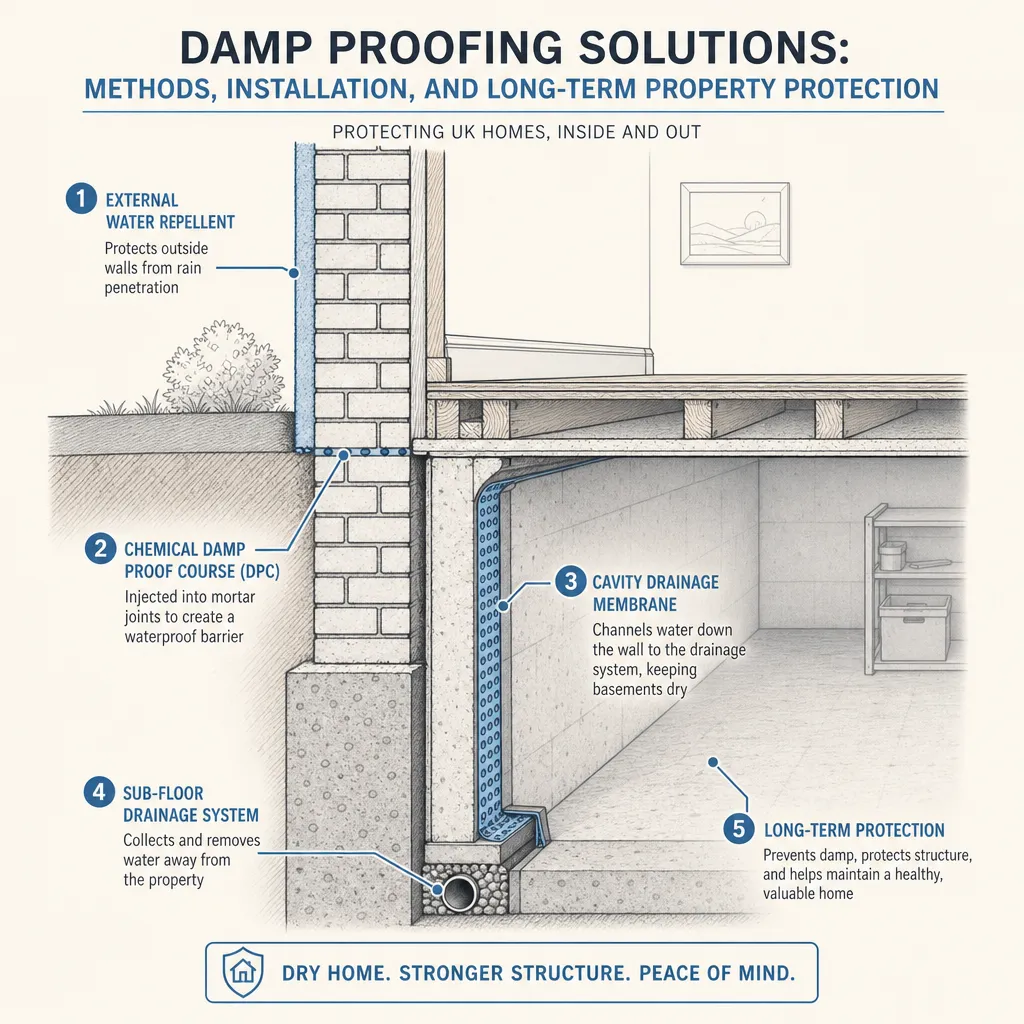
Damp Proofing Solutions: Methods, Installation, and Long-Term Property Protection
Damp proofing in UK homes typically involves chemical damp proof course (DPC) injection for rising damp, cavity drainage membranes for basement or below-ground moisture, and tanking for waterproofing solid walls.
 Improvement & Build
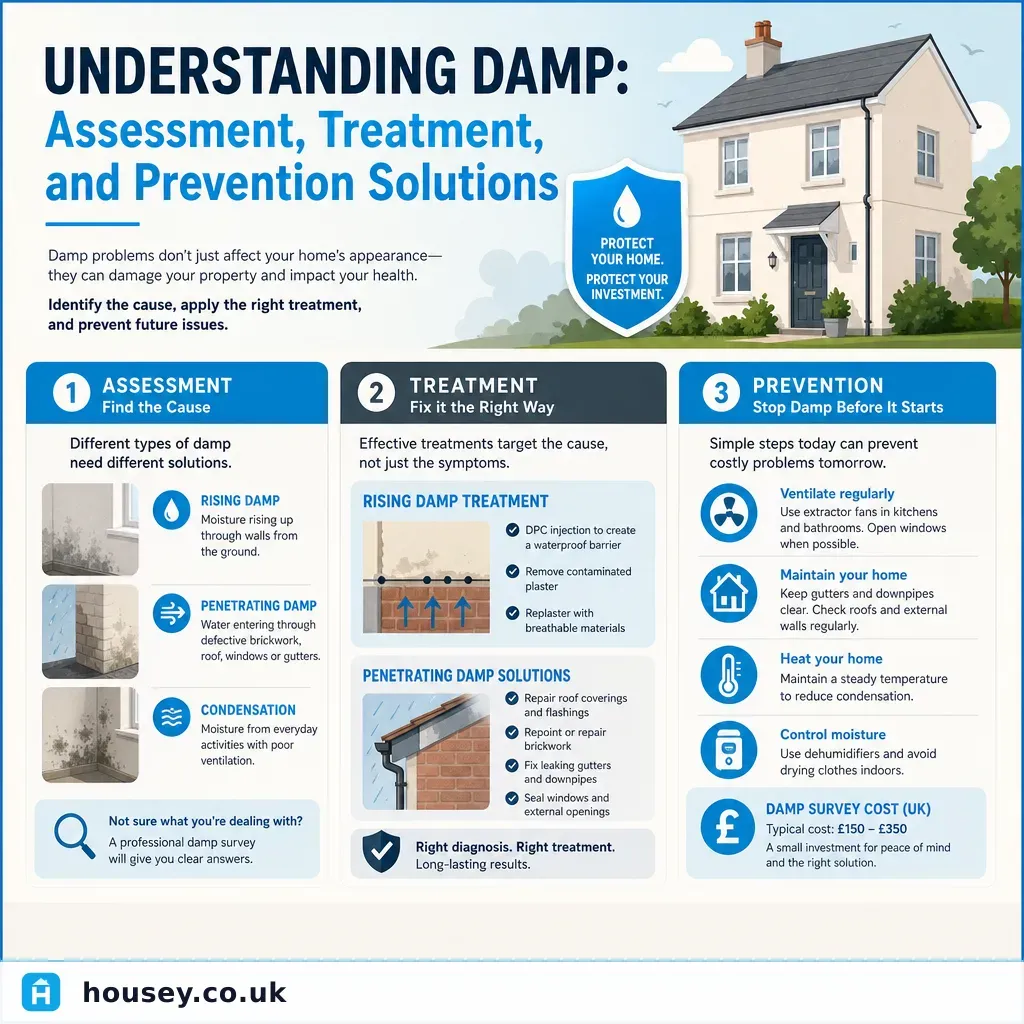
Understanding Damp: Assessment, Treatment, and Prevention Solutions
Damp in UK homes usually falls into three categories — rising damp, penetrating damp, and condensation — each requiring a different remedy.
 Improvement & Build
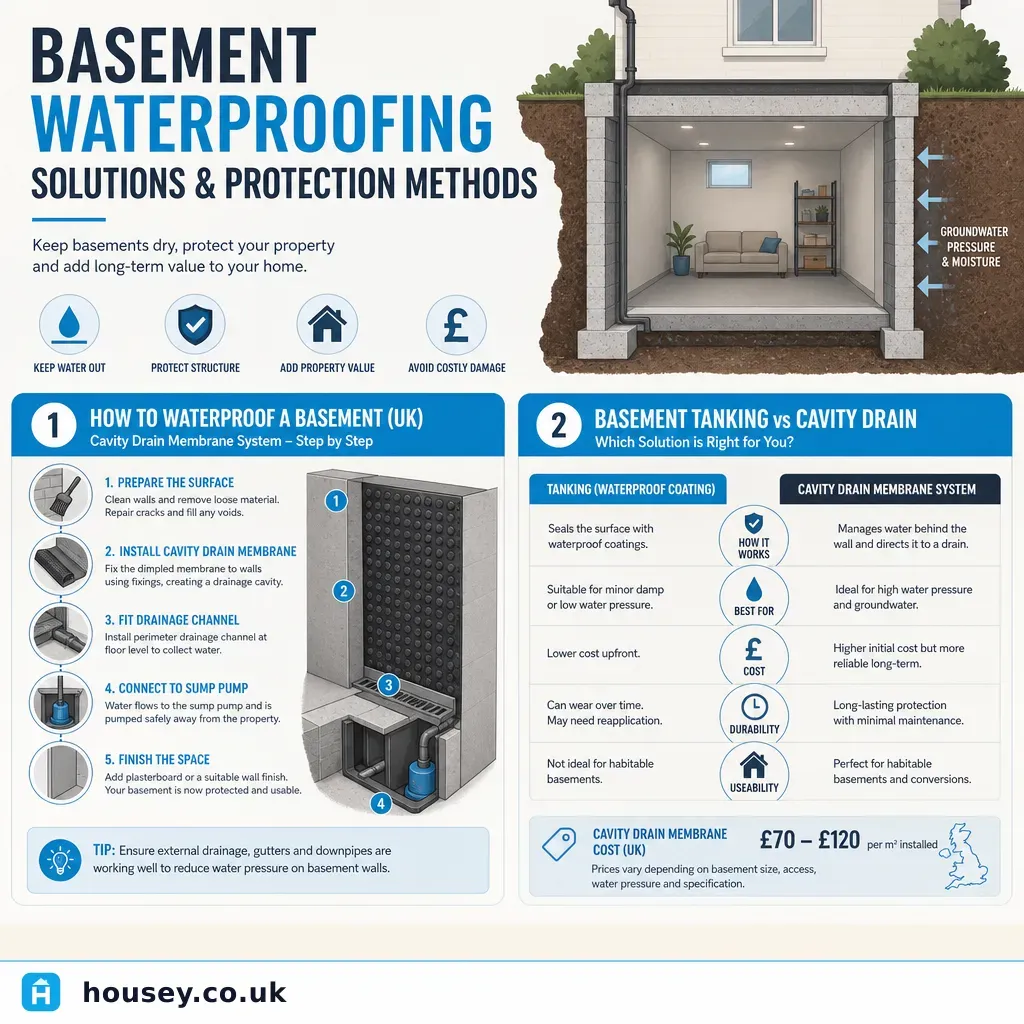
Basement Waterproofing Solutions and Protection Methods
Basement waterproofing in the UK uses one of three system types defined in BS 8102:2022: Type A (barrier tanking), Type B (structurally integral concrete), or Type C (cavity drain with sump pump).
 Improvement & Build
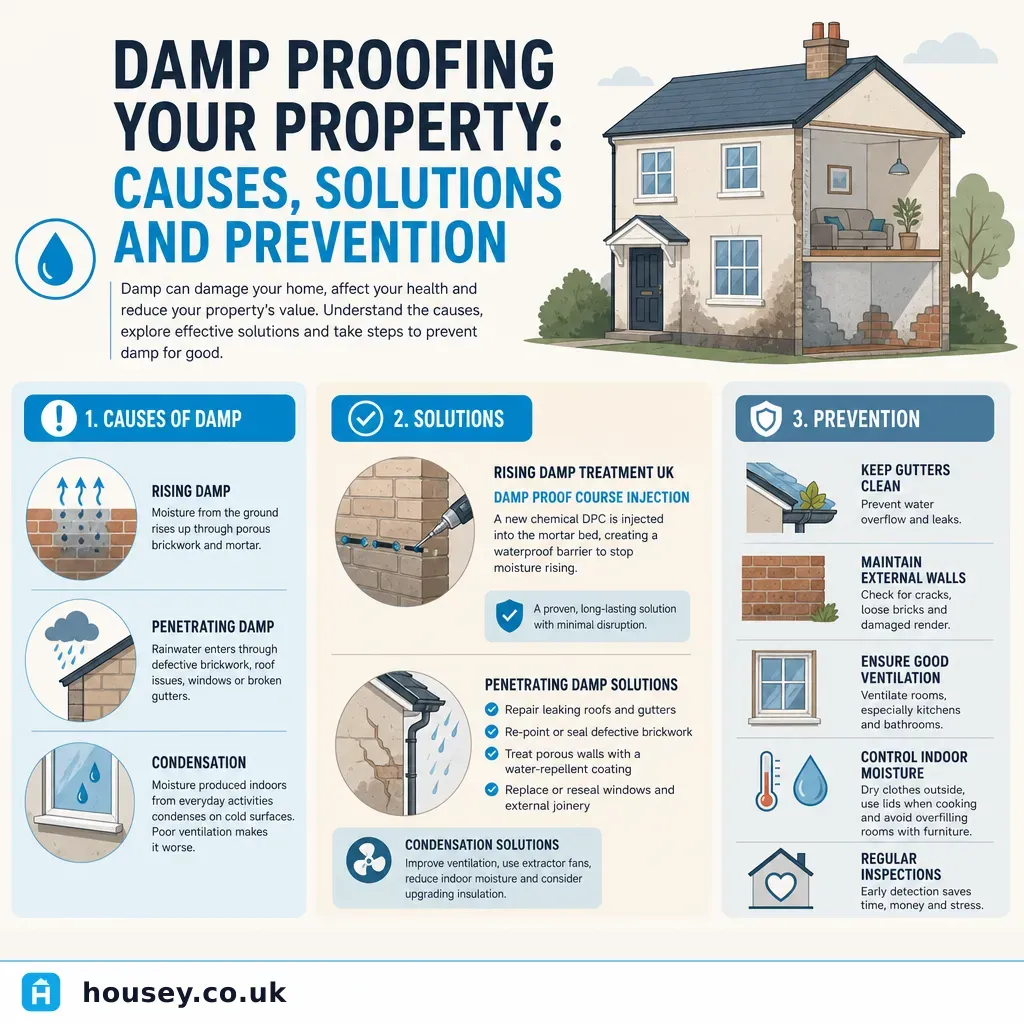
Damp Proofing Your Property: Causes, Solutions and Prevention
Damp in UK properties falls into three main types: rising damp caused by a failed damp proof course, penetrating damp from defects such as failed flashings or cracked render, and condensation from poor ventilation.
 Improvement & Build
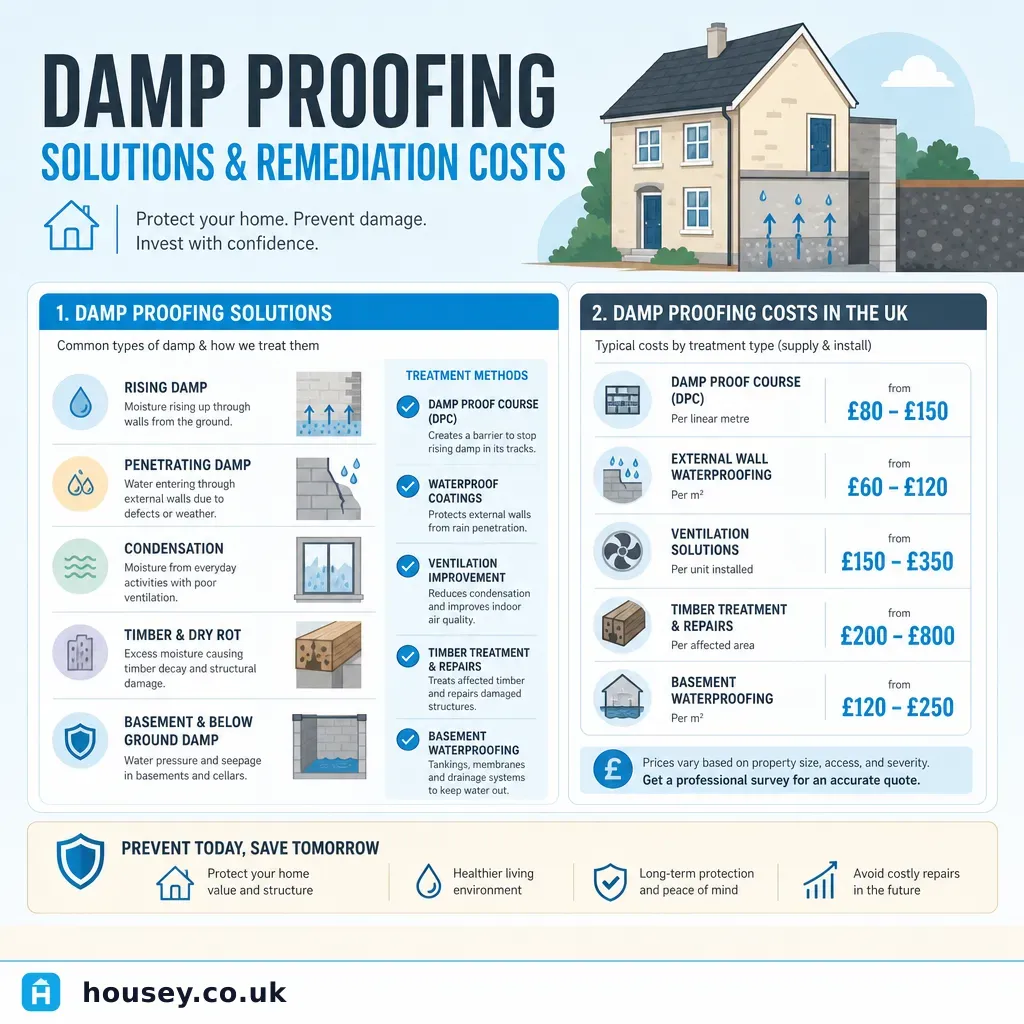
Damp Proofing Solutions and Remediation Costs
Damp proofing costs depend on the type of damp present: ventilation improvements for condensation start at around £300–£700, chemical DPC injection plus replastering typically costs £1,500–£3,500, and full basement waterproofing can reach £7,000–£15,000 or more.