Understanding Damp: Assessment, Treatment, and Prevention Solutions
By Housey · Last reviewed 24th of May 2026
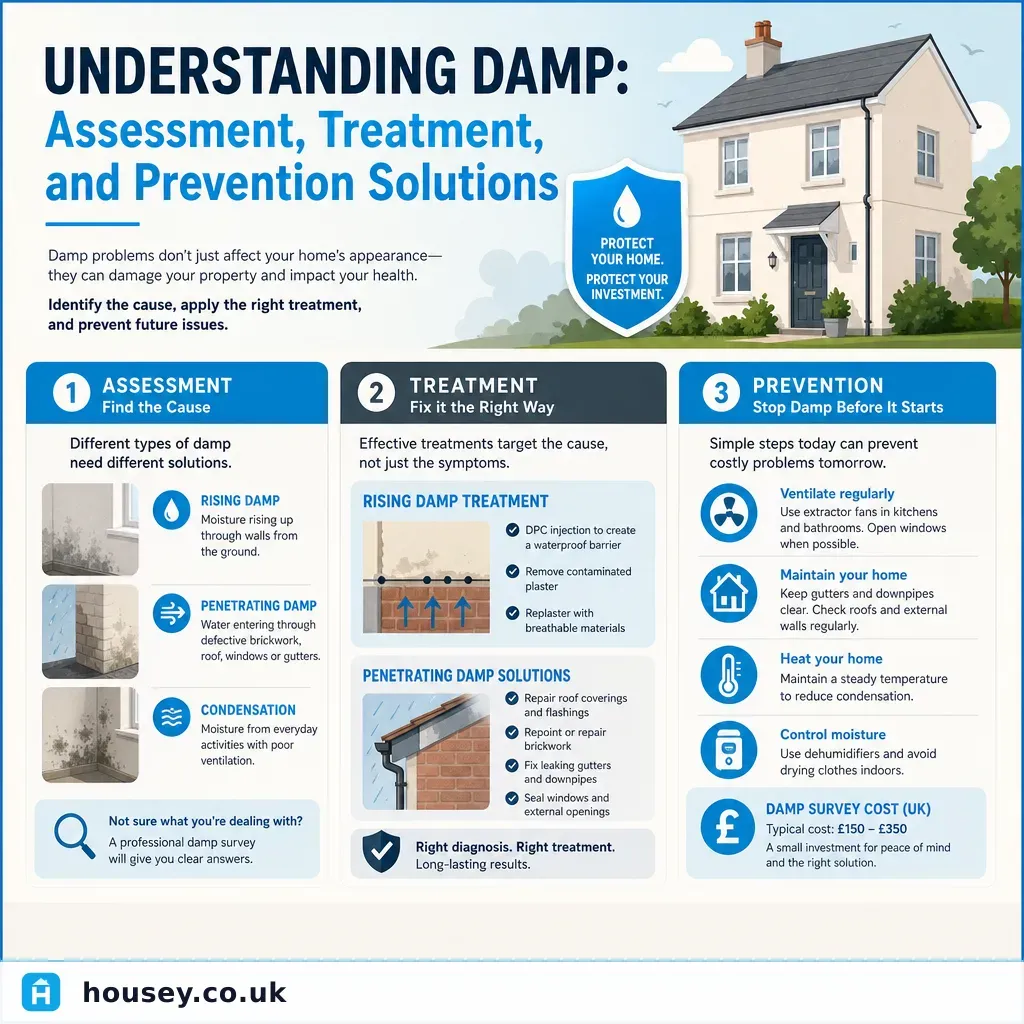
Understanding Damp: Assessment, Treatment, and Prevention Solutions
Damp is among the most common defects found in UK homes, from Victorian terraces and 1930s semis to 1960s flats and solid-wall cottages. It is also one of the most frequently misdiagnosed — and the wrong treatment, applied without a proper diagnosis, can make matters considerably worse while costing significant money. Knowing which type of damp you are dealing with, and who to instruct, is the essential starting point.
Key points
- Rising damp, penetrating damp, and condensation each have different causes and require different remedies; the same visual symptom — a damp patch on an internal wall — can result from any of the three.
- The Property Care Association (PCA) maintains a directory of qualified surveyors trained to diagnose damp independently, separate from the contractors who sell and install remedial systems.
- Chemical damp proof course (DPC) injection is widely marketed but is disputed by some independent surveyors as a default remedy; a PCA-accredited or RICS-qualified surveyor should confirm whether it is genuinely needed.
- Under PAS 2035 (the UK's retrofit standard for domestic buildings), moisture risk must be assessed before installing insulation in solid-wall or other moisture-sensitive constructions; ignoring this can trap moisture and accelerate structural decay.
- Dry rot (Serpula lacrymans) is a particularly destructive fungal decay that can spread through masonry and across dry material; it requires specialist eradication and is not a DIY project.
The three types of damp
Getting the diagnosis right before spending money on treatment is critical. The table below summarises the three main categories, their typical signs, and the appropriate remedial approach.
Type | Typical signs | Common causes | Usual remedial approach |
|---|---|---|---|
Rising damp | Tide marks, hygroscopic salt deposits, persistent damp at low level on internal walls | Failed, absent, or bridged damp proof course (DPC) | DPC repair, injection, or reinstatement; salt-resistant replastering of lower wall sections |
Penetrating damp | Damp patches following rain; staining on external-facing walls or ceilings; sporadic appearance | Failed pointing, cracked render, defective gutters, blocked downpipes, flat roof defects, bridged cavity | Repair the ingress point first — repointing, gutter repair, flashing replacement; internal treatment rarely sufficient alone |
Condensation | Black mould (often Cladosporium) on cold surfaces, streaming windows, musty smell, recurring despite surface cleaning | Insufficient ventilation, thermal bridging, cold surfaces, high occupant-generated moisture | Improve ventilation (MEV, MVHR, trickle vents), increase insulation to raise surface temperatures, address cold bridges |
In practice, most cases initially described as 'rising damp' turn out to be condensation or penetrating damp. This is why independent diagnosis matters — and why you should be cautious of free surveys provided by companies selling remediation products.
How damp is assessed
A professional damp assessment uses a combination of techniques. The findings must be interpreted together, not taken from a single meter reading.
- Visual inspection: examining the pattern, location, and height of staining; condition of the external fabric — pointing, render, gutters, flashings, sills, and copings.
- Moisture meter readings: indicating relative moisture content in walls and floors; readings vary by material and must be interpreted in context.
- Hygrometer and temperature readings: assessing relative humidity and identifying condensation risk through dew point calculations.
- Salt testing: rising damp deposits characteristic hygroscopic salts; testing can help confirm or rule it out alongside other evidence.
- Structural inspection: checking floor timbers, joists, and lintels for signs of fungal decay.
Decision tree: which professional do I need?
- Unsure what type of damp you have? → Commission an independent damp survey from a PCA-accredited surveyor or RICS-qualified building surveyor before any remedial work begins.
- Damp appearing after retrofit insulation was installed? → Ask a PAS 2035 Retrofit Coordinator to assess moisture risk in the wall assembly before proceeding with further work.
- Visible timber decay alongside damp? → Request a combined damp and timber survey to assess both issues together in a single inspection.
- Dry rot confirmed or strongly suspected? → Instruct a PCA-member specialist contractor immediately; this is not a situation for general builders or DIY.
- Condensation only, no structural concern identified? → A ventilation specialist or energy assessor may be more appropriate than a damp contractor.
Treatment options
Treatments vary by damp type, severity, and construction. An independent survey should drive the specification before any contractor is engaged.
Rising damp treatments may include:
- Physical or chemical DPC installation or reinstatement
- Salt-resistant tanking plaster or independent render to lower wall sections
- Ground-level reduction or improved drainage to lower the moisture source
Penetrating damp treatments focus on repairing the ingress point:
- Repointing mortar joints using an appropriate lime or hydraulic lime mortar for older and solid-wall masonry
- Clearing, repairing, or replacing gutters, downpipes, and hoppers
- Replacing defective flashings, sills, and copings
- Investigating and clearing debris or mortar droppings in cavity walls if the cavity is bridged
Condensation management involves:
- Increasing ventilation: mechanical extract ventilation (MEV), mechanical ventilation with heat recovery (MVHR), or background trickle vents in replacement windows
- Improving thermal insulation to raise internal surface temperatures and reduce cold bridging
- Dehumidification only as a short-term measure; it treats the symptom, not the underlying cause
Timber decay: wet rot and dry rot
Damp conditions frequently lead to timber decay in floor joists, window sills, lintels, and roof timbers. The two main categories have very different implications.
Wet rot (various fungal species) occurs in persistently wet timber and usually ceases spreading once the moisture source is removed. Affected timber may need cutting out and replacing, but the key intervention is eliminating the moisture.
Dry rot (Serpula lacrymans) is considerably more serious. Despite its name, it requires an initial moisture source to become established but can then spread across dry masonry and unaffected timber. Signs include:
- White cotton-wool mycelium or rust-red spore dust
- Cuboidal cracking (a brick-like fracture pattern) in affected timber
- Pancake-shaped fruiting bodies on wall surfaces
Dry rot treatment involves removing all affected timber with a minimum 300–600 mm margin beyond visible growth, treating masonry with fungicide, improving ventilation to prevent recurrence, and eliminating the original moisture source. A PCA-member specialist should carry this out.
Prevention and long-term management
Ongoing prevention relies on maintaining the external fabric and managing moisture inside the building:
- Keep gutters, hoppers, and downpipes clear, particularly in autumn
- Maintain pointing and render; use lime-based materials on older solid-wall masonry
- Ensure adequate ventilation in kitchens, bathrooms, and utility areas
- Never block or cover air bricks serving sub-floor voids
- Take care with indoor drying, especially in poorly ventilated properties
- Before any retrofit insulation work on a solid-wall home, seek a moisture risk assessment under PAS 2035
Red flags that need urgent attention
- Damp patches that grow or move after heavy rain — suggests an active penetrating damp defect requiring prompt repair
- White crusty salt deposits with damp plaster at low level — possible rising damp requiring independent investigation
- Black mould returning within weeks of surface cleaning — ongoing moisture source not yet addressed
- Soft or spongy timber underfoot or at window board level — possible wet rot requiring investigation
- Orange-rust dust or white fluffy growth at skirting board level — possible dry rot; do not delay seeking specialist advice
- New damp following retrofit insulation installation — possible moisture trapping in the wall assembly; PAS 2035 assessment required
Important limitations
This article provides general background information on damp in UK residential properties. Damp diagnosis is inherently complex — the same visual symptom can arise from entirely different causes, each requiring a different remedy. Rules on appropriate treatment vary by property construction type, age, condition, and tenure.
Do not commission remedial work based solely on an assessment provided free of charge by a company that also sells the remedy. An independent diagnostic survey from a PCA-accredited or RICS-qualified professional is strongly recommended before committing to any significant expenditure.
PAS 2035 requirements, Building Regulations compliance obligations, and timber treatment warranty conditions introduce additional technical and legal considerations that a general guide cannot fully address. For properties undergoing or recently completed retrofit works, consult a qualified Retrofit Coordinator.
What to ask a qualified professional
Before instructing a surveyor or remedial contractor, ask:
- Are you accredited by the Property Care Association (PCA) or do you hold a relevant RICS qualification for damp surveying?
- Is this an independent diagnostic survey, or does your company also sell and install the remedial systems you recommend?
- What instruments and methods will you use to distinguish between rising damp, penetrating damp, and condensation?
- Will your written report specify the type and cause of damp, and not just recommend a remedial product?
- If timber decay is identified, what species of fungal decay has been confirmed, and how?
- Does your proposed treatment come with a guarantee, and is that guarantee backed by an insurance-backed warranty?
- Have you assessed the moisture risk to any wall assembly where insulation has been or is to be installed?
When to get professional help
Seek a professional assessment if:
- You have identified any of the red flags listed above.
- A buyer's survey, mortgage valuation, or solicitor's enquiry has noted damp that has not been independently investigated.
- A free survey from a remediation company has recommended extensive or costly work — seek an independent second opinion before proceeding.
- You are planning retrofit insulation on a solid-wall property — moisture risk must be assessed under PAS 2035 before work begins.
- You are purchasing a property with damp recorded in the legal pack, the seller's property information form, or the surveyor's report.
How Housey can help
Housey connects homeowners with qualified professionals offering independent damp and timber surveys and remedial work from accredited damp proofing specialists. Describe the problem, receive up to four fixed quotes from vetted providers, and compare credentials and pricing without obligation.
Frequently asked questions
Is rising damp always the cause of low-level damp patches on walls?
No — in practice, condensation and penetrating damp account for the majority of cases initially described as rising damp. Misdiagnosis is common, particularly when assessments are provided free of charge by companies selling remedial products. An independent survey using a range of diagnostic instruments is the only reliable way to determine the true cause.
How much does an independent damp survey cost?
Indicative UK costs, last reviewed 2026-05-24. An independent diagnostic damp survey typically costs £200–£500 depending on property size, location, and the scope of the inspection. Be cautious of free surveys offered by remediation companies, as these may be commercially motivated. Always verify the surveyor holds PCA accreditation or a relevant RICS qualification.
Does a damp proof course last forever?
Physical DPCs — such as slate, lead, or bituminous felt — can last the life of a building if undisturbed. Chemical injection DPCs may have a more limited effective life and can fail if the injection pattern was incomplete or if ground conditions change. An independent survey is the best way to assess the condition of an existing DPC.
Can condensation cause structural damage?
Persistent condensation can saturate plaster, cause paint failure, and — if it reaches structural timber — lead to wet rot in joists, lintels, or window boards. It rarely causes structural damage in isolation but can mask or worsen other damp problems. Addressing the underlying ventilation and thermal bridging issues is the priority rather than surface treatments alone.
Sources and further reading
- Find a PCA-accredited contractor — Property Care Association
- PAS 2035:2019 — Specification for the energy retrofit of domestic buildings — BSI
- RICS standards and guidance — building surveying — RICS
- Mould and dampness in homes — Health and Safety Executive
- Approved Document C: Site preparation and resistance to moisture — MHCLG
Useful next reads
 Improvement & Build
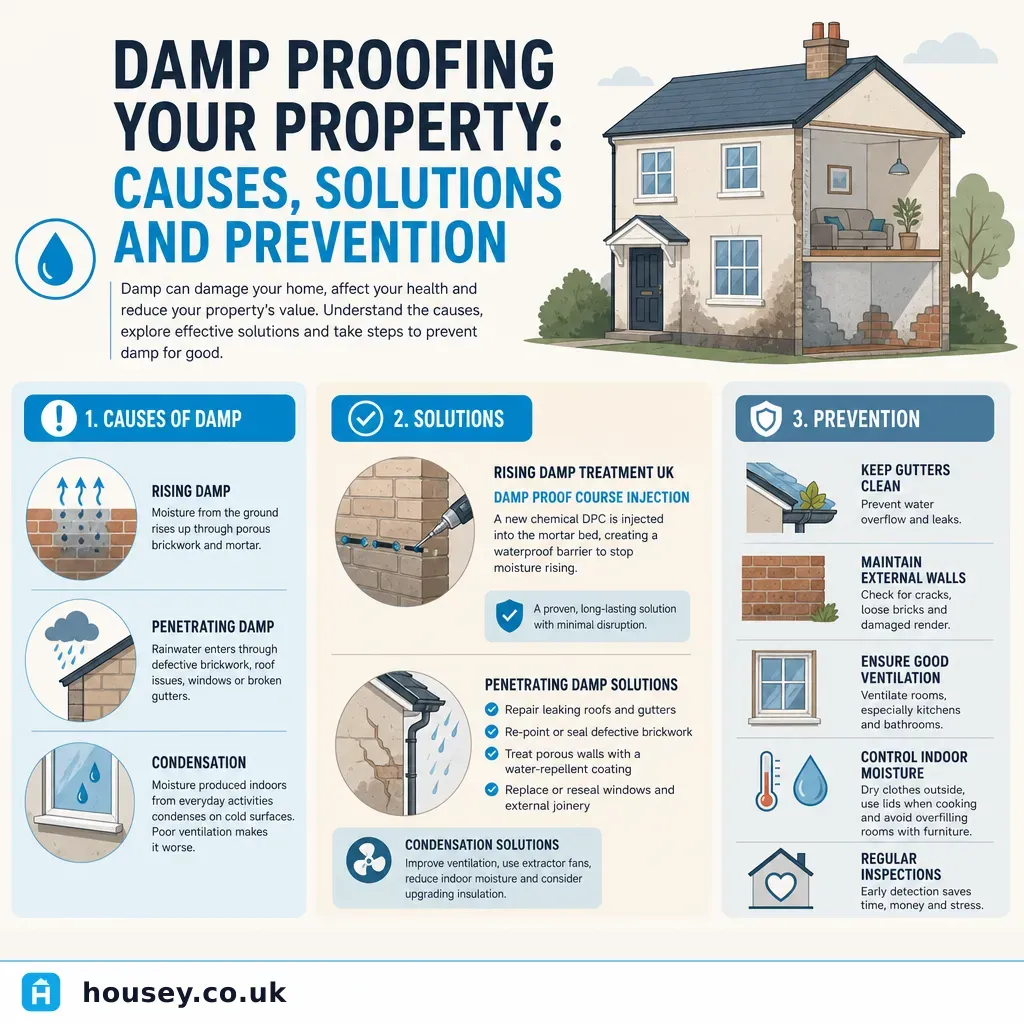
Damp Proofing Your Property: Causes, Solutions and Prevention
Damp in UK properties falls into three main types: rising damp caused by a failed damp proof course, penetrating damp from defects such as failed flashings or cracked render, and condensation from poor ventilation.
 Improvement & Build
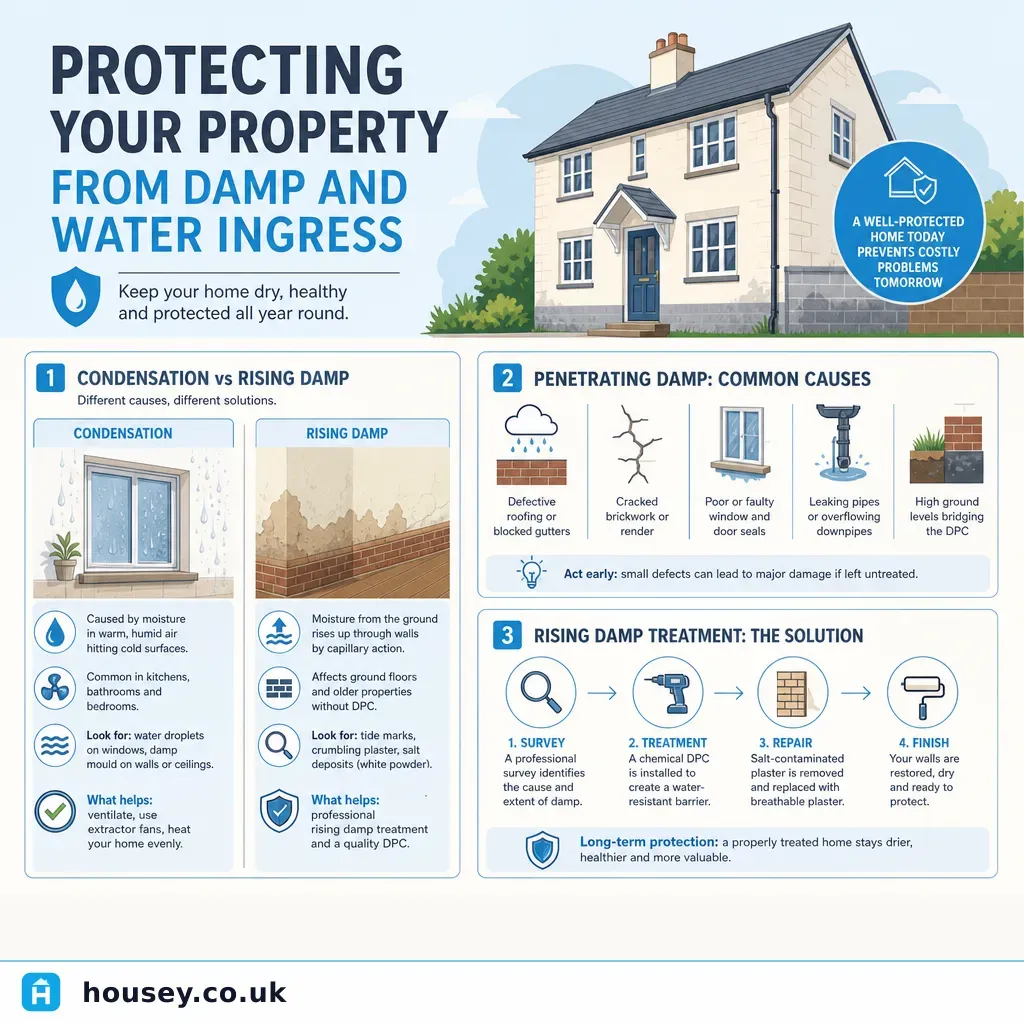
Protecting Your Property from Damp and Water Ingress
Damp in UK homes usually falls into three categories: rising damp (groundwater drawn up through walls), penetrating damp (rain or groundwater entering through the building envelope), and condensation (moisture from warm internal air meeting a cold surface).
 Improvement & Build
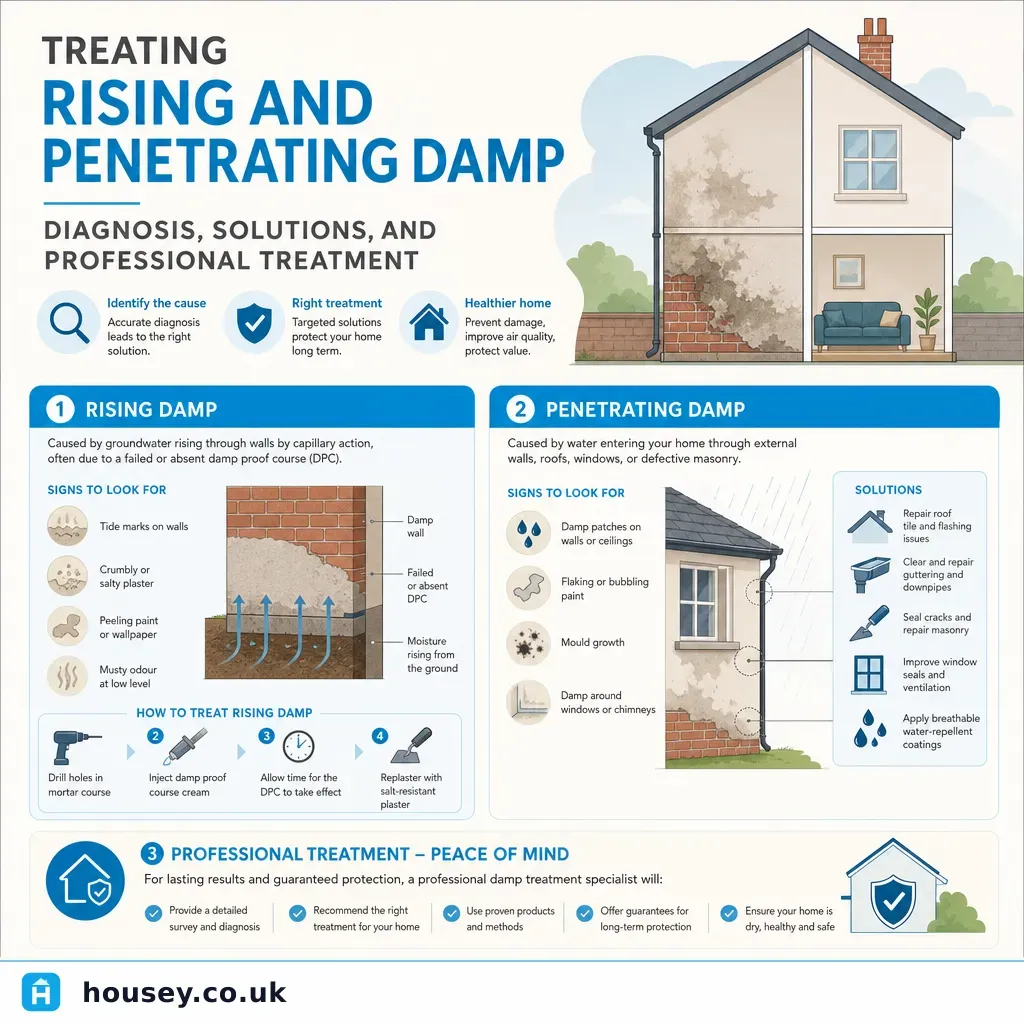
Treating Rising and Penetrating Damp: Diagnosis, Solutions, and Professional Treatment
Rising damp appears as a tide mark at the base of ground-floor walls and is caused by a failed or absent damp-proof course.
 Improvement & Build
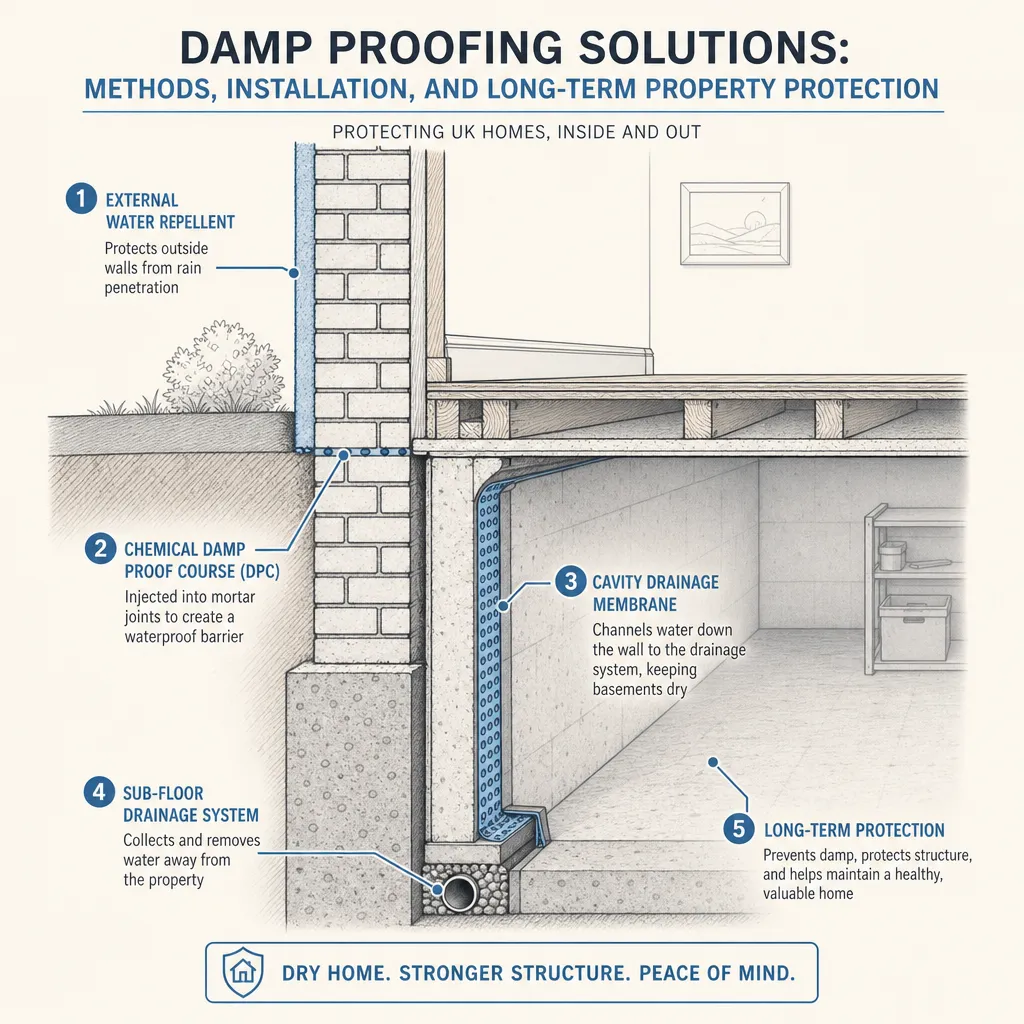
Damp Proofing Solutions: Methods, Installation, and Long-Term Property Protection
Damp proofing in UK homes typically involves chemical damp proof course (DPC) injection for rising damp, cavity drainage membranes for basement or below-ground moisture, and tanking for waterproofing solid walls.
 Improvement & Build
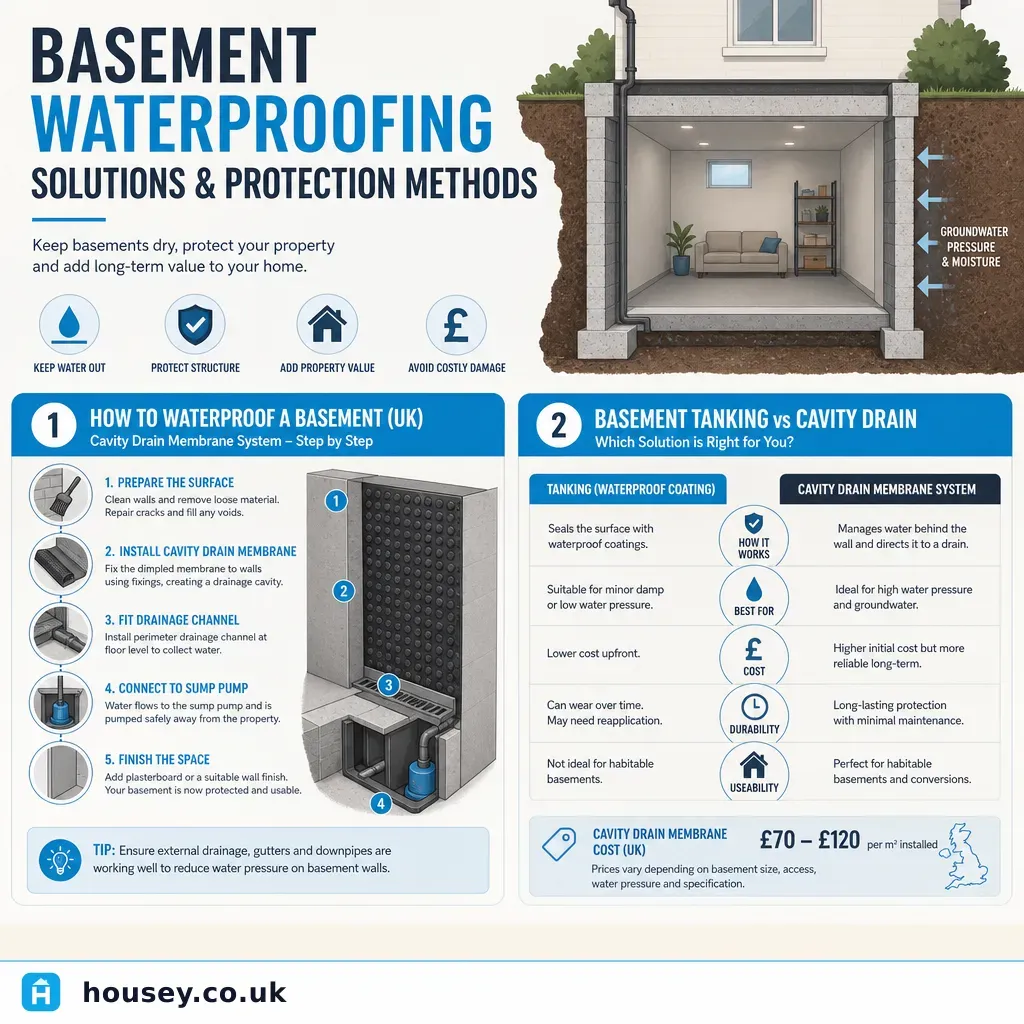
Basement Waterproofing Solutions and Protection Methods
Basement waterproofing in the UK uses one of three system types defined in BS 8102:2022: Type A (barrier tanking), Type B (structurally integral concrete), or Type C (cavity drain with sump pump).