Protecting Your Property from Damp and Water Ingress
By Housey · Last reviewed 31st of May 2026
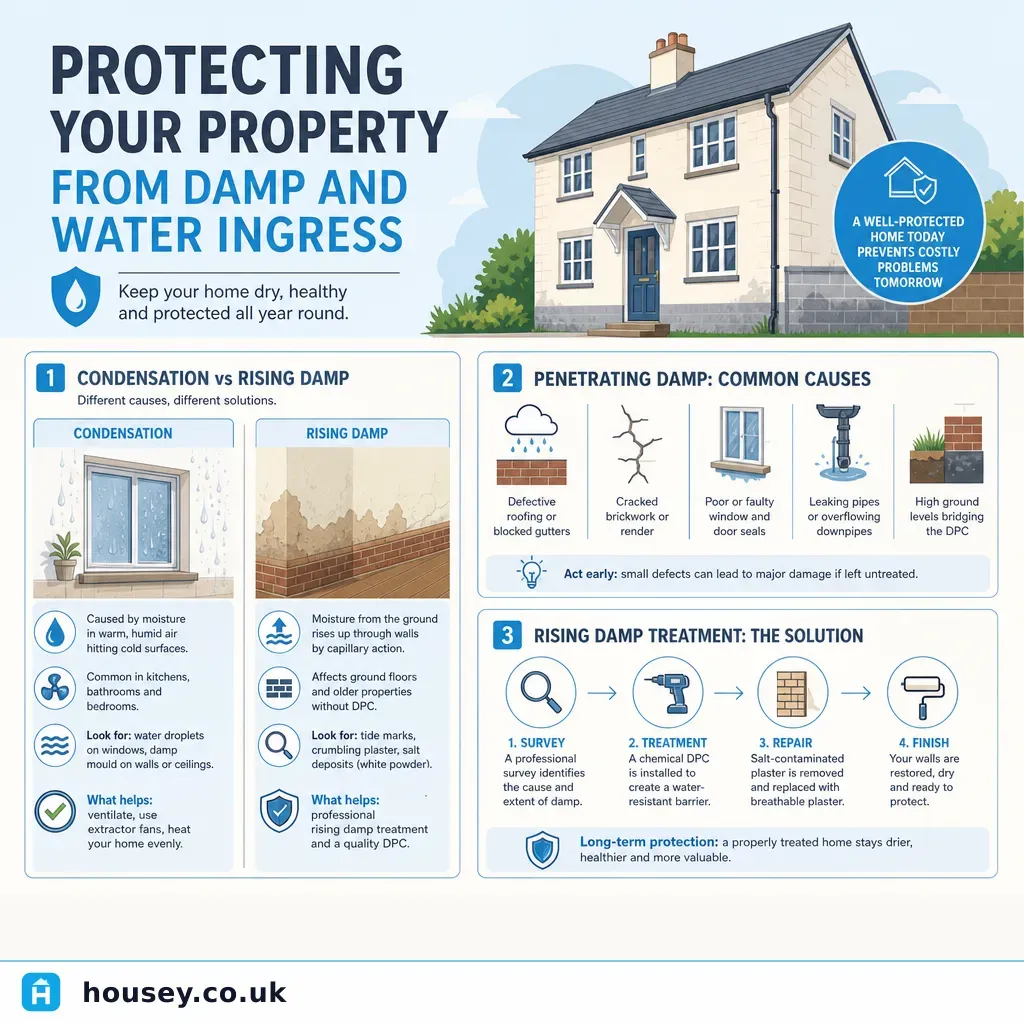
Protecting Your Property from Damp and Water Ingress
Damp is one of the most prevalent building defects in UK housing, affecting properties of every era — from Victorian solid-wall terraces to 1990s cavity-wall estates. It ranges from minor surface condensation to serious structural saturation, and the appropriate remedy varies enormously depending on the cause. Acting on the wrong diagnosis can mean spending thousands on a treatment that does not address the problem, while the true cause continues to damage the building fabric, harm occupant health, and reduce property value.
Key points
- The three principal categories of damp in UK buildings are rising damp, penetrating damp, and condensation — each has different causes, symptoms, and remedies, and they frequently coexist.
- A damp proof course (DPC) is required under Building Regulations; most homes built after approximately 1875 should have one, but it can fail, be physically bridged, or be absent in older properties.
- BS 5250:2021 (Control of condensation in buildings) and BS 8102:2022 (Protection of below-ground structures against water ingress) are the current British Standards guiding diagnosis and remediation in their respective areas.
- PAS 2035 retrofit assessments must evaluate moisture and ventilation risk before any insulation is recommended — installing insulation into a damp wall can cause serious structural deterioration and mould growth.
- The Housing Health and Safety Rating System (HHSRS) classes damp and mould growth as a Category 1 hazard in severe cases, with implications for landlords and local authority enforcement.
Understanding the three types of damp
Rising damp
Rising damp occurs when groundwater is drawn upward through masonry by capillary action, typically where the damp proof course is absent, damaged, or bridged by raised external ground levels, solid flooring, or external render applied below DPC level. It usually shows as a tide mark on walls at around 1 m height, accompanied by salt staining and deteriorating plaster near the floor. Rising damp is frequently misdiagnosed — accurate diagnosis requires moisture meter readings across the wall profile and, ideally, a laboratory salt analysis of plaster samples.
Penetrating damp
Penetrating damp enters through defects in the building envelope — most commonly defective pointing, cracked render, blocked or leaking gutters and downpipes, failed flashings around chimney stacks and dormers, or deteriorated window and door seals. It can appear at any height and typically intensifies during or after rain events. Older solid-wall homes (pre-1920s brick or stone construction) are more susceptible than cavity-wall properties because they rely on wall mass to absorb and evaporate moisture rather than creating a physical break.
Condensation
Condensation is the most widespread form of damp in UK homes and is caused by warm, moisture-laden internal air contacting a cold surface and releasing its moisture. It is most visible on window glass, cold external wall corners, and in poorly ventilated bathrooms and kitchens. Persistent surface condensation leads to black mould growth (Cladosporium and Aspergillus species), which poses health risks recognised by the NHS and HHSRS. Condensation is principally addressed through improved ventilation and heating rather than treatments to the building fabric.
Which type of damp do you have? A decision guide
- Damp low on internal walls (up to approximately 1 m), tide mark present, no correlation with rain events → investigate rising damp; check DPC condition, external ground levels, and whether render or paving bridges the DPC.
- Damp patch at a specific location that worsens during or after rain → investigate penetrating damp; check gutters, downpipes, flashings, pointing, render, and window seals externally before ordering any internal treatment.
- Black mould on window reveals, cold external wall corners, or bathroom and kitchen surfaces; no tide mark; worse in winter → likely condensation; assess ventilation provision, heating patterns, and thermal bridging before concluding the wall fabric is at fault.
- Damp appearing at basement floor and wall junction, possibly with efflorescence, unrelated to rainfall → investigate groundwater ingress or rising water table; consider a BS 8102:2022-compliant waterproofing assessment.
- Multiple zones of damp or damp that returns after treatment → instruct a damp and timber survey for a comprehensive independent diagnosis before committing to any further remediation spend.
Common causes of water ingress and typical remedies
Cause | Signs | Typical remedy |
|---|---|---|
Blocked or leaking gutters and downpipes | Damp patches below roofline; moss or algae on wall face | Clear, repair, or replace rainwater goods |
Defective pointing or cracked render | Damp following mortar bed lines; spalled brickwork | Repoint with appropriate mortar; repair or replace render |
Bridged damp proof course | Rising damp near raised flower beds, paths, or render | Lower ground level; remove bridging; consider chemical DPC injection if DPC absent |
Failed window or door seals and flashings | Damp around frame perimeter; staining at lintel level | Replace seals; re-bed or replace lintel flashings |
Flat roof or parapet waterproofing failure | Damp on top-floor ceiling or near parapet wall | Inspect and replace waterproof membrane; check parapet capping |
Defective chimney flashing | Localised damp near chimney stack or roof junction | Re-bed or replace lead flashing; consider cowl if chimney no longer used |
Groundwater or rising water table (basement) | Damp at floor and wall junction; may appear regardless of weather | BS 8102-compliant cavity drain or tanking system |
Basement waterproofing: which system is appropriate?
BS 8102:2022 defines three protection types for below-ground structures:
- Type A (barrier protection): waterproof coatings or tanking membranes applied to walls and floor. Effective where hydrostatic pressure is low; vulnerable to cracking if the structure moves.
- Type B (structurally integral protection): waterproof concrete construction. Primarily applicable to new builds; rarely appropriate for retrofit in existing homes.
- Type C (drained protection): cavity drain membranes combined with a sump and pump system that manage water rather than resist it. Often preferred for retrofit in older properties because it tolerates minor ongoing structural movement.
A qualified waterproofing specialist should select the system based on a site investigation, water table assessment, and structural appraisal. BS 8102 recommends combining protection types where risk is elevated.
Red flags: when damp becomes urgent
Seek professional advice promptly if you notice any of the following:
- Efflorescence (white or brown salt deposits) spreading rapidly up walls, indicating active moisture movement.
- Hollow-sounding or visibly stained floor joists, roof timbers, or window frames — potential indicators of wet rot or dry rot requiring urgent investigation.
- White mycelium growth or brick-like cracking of timber — signs of dry rot (Serpula lacrymans), which spreads rapidly and can cause severe structural damage if left untreated.
- Mould growth in bedrooms or children's rooms — a Category 1 HHSRS hazard in severe cases; landlords face enforcement risk.
- Plaster blowing off walls at low level or extensive cracking — indicates salt-laden moisture cycling through the wall repeatedly.
- Damp returning within months of completing treatment — the original cause was likely not correctly diagnosed or addressed.
- Damp in proximity to electrical fittings — stop using the fitting immediately and consult a qualified electrician before investigating the damp source.
Important limitations
This article provides general guidance on damp and water ingress in UK residential properties. Damp diagnosis requires physical inspection and, in many cases, specialist testing including moisture profiling and salts analysis. The appropriate remedy depends on the specific building type, construction method, age, condition, drainage, and local hydrology. Nothing in this article constitutes a structural, building science, or legal assessment. Engage a qualified specialist before committing to any remedial works.
What to ask a qualified professional
Before instructing a damp specialist or surveyor, ask:
- Are you a member of RICS, the Property Care Association (PCA), or registered with TrustMark?
- Is your diagnosis based solely on visual inspection, or does it include moisture meter profiling across the wall height and a salts analysis?
- What evidence confirms your diagnosis — specifically, how have you distinguished rising damp from condensation or penetrating damp?
- Are you proposing to address the root cause (such as poor drainage, a bridged DPC, or failed gutters) or only the visible symptoms?
- What guarantee does the proposed treatment carry, and is it backed by an insurance-backed guarantee (IBG)?
- Does your proposed remedy comply with BS 5250 or BS 8102 as relevant to my situation?
- Have you considered the ventilation implications of any proposed treatment or new internal surface?
When to get professional help
Always engage a qualified professional before committing to remediation works costing more than a few hundred pounds. Specific situations requiring prompt professional attention include:
- Visible dry rot — Serpula lacrymans spreads rapidly through wall plates and floor joists and requires specialist treatment to prevent further structural damage.
- Damp in a basement used as habitable accommodation — HHSRS compliance and tenant safety are at stake for landlords.
- A recent property purchase where the survey flagged damp — instruct a specialist before undertaking works so you understand the full scope.
- Any property where insulation is being considered — PAS 2035 requires a moisture risk assessment before insulation measures are recommended.
A damp and timber survey will identify the cause before money is spent on a remedy that may not work.
How Housey can help
Housey can connect you with damp proofing specialists who can diagnose and treat damp in UK homes, as well as drainage contractors who can address the external drainage failures that often drive persistent damp. If blocked or collapsed drains may be saturating the ground around your property, a drainage survey will identify the problem before remediation begins.
Frequently asked questions
How do I know if I have rising damp or condensation?
Rising damp typically appears as a band at low level up to around 1 m, often with a tide mark, salt staining, and plaster deterioration near the floor. It does not correlate with weather events. Condensation usually appears on cold surfaces — window reveals, external wall corners, bathroom ceilings — and is linked to poor ventilation and high internal humidity. A moisture profile reading and salts analysis can help distinguish the two.
Does a chemical damp proof course injection actually work?
It can be effective when rising damp is correctly diagnosed and the injection is properly carried out. However, the Property Care Association notes that many properties diagnosed with rising damp actually have condensation, penetrating damp, or a combination. A RICS-qualified or PCA-accredited surveyor will investigate whether injection is genuinely the right solution before recommending it, rather than prescribing it as a default treatment.
Can I waterproof a basement myself?
Simple surface treatments can manage minor surface moisture in an existing dry basement, but they are not a substitute for proper waterproofing where hydrostatic pressure is present. BS 8102:2022 waterproofing systems — cavity drain membranes, tanking, or structural waterproof concrete — should be designed and installed by a qualified specialist. Incorrect installation can lead to system failure, flooding, and significant structural damage.
Will fixing damp improve my EPC rating?
Damp is not directly assessed in an EPC, but addressing it enables insulation measures to be safely installed — which does improve the EPC score. Under PAS 2035, a retrofit assessor must confirm moisture risk is managed before recommending insulation for any solid-wall or cavity-fill measure. Fixing damp can therefore unlock meaningful further energy improvements and is often a prerequisite for funded retrofit schemes.
Sources and further reading
- Housing Health and Safety Rating System (HHSRS) guidance — GOV.UK
- Damp and mould — NHS
- Property Care Association homeowner guidance — Property Care Association
- Damp and condensation advice — Energy Saving Trust
- BS 8102:2022 Protection of below-ground structures against water from the ground — BSI Group
Useful next reads
 Improvement & Build
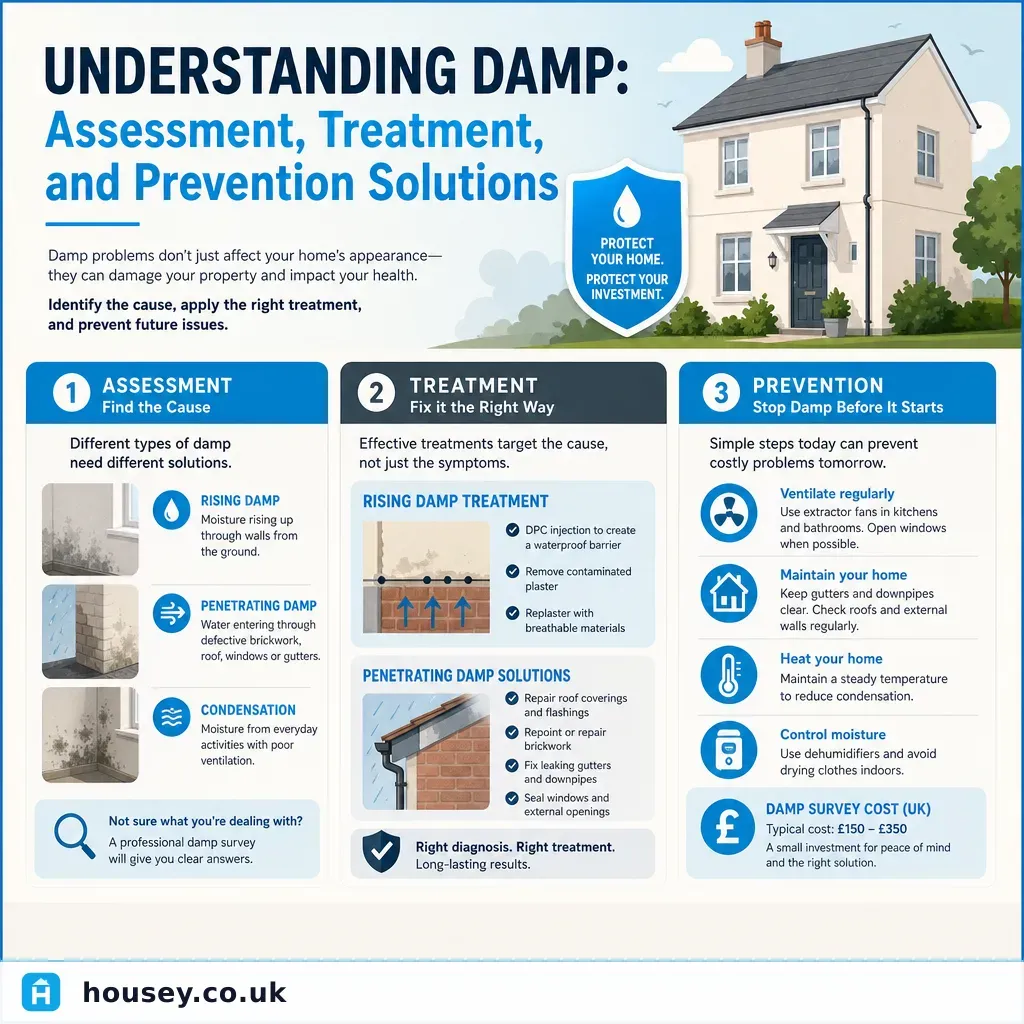
Understanding Damp: Assessment, Treatment, and Prevention Solutions
Damp in UK homes usually falls into three categories — rising damp, penetrating damp, and condensation — each requiring a different remedy.
 Improvement & Build
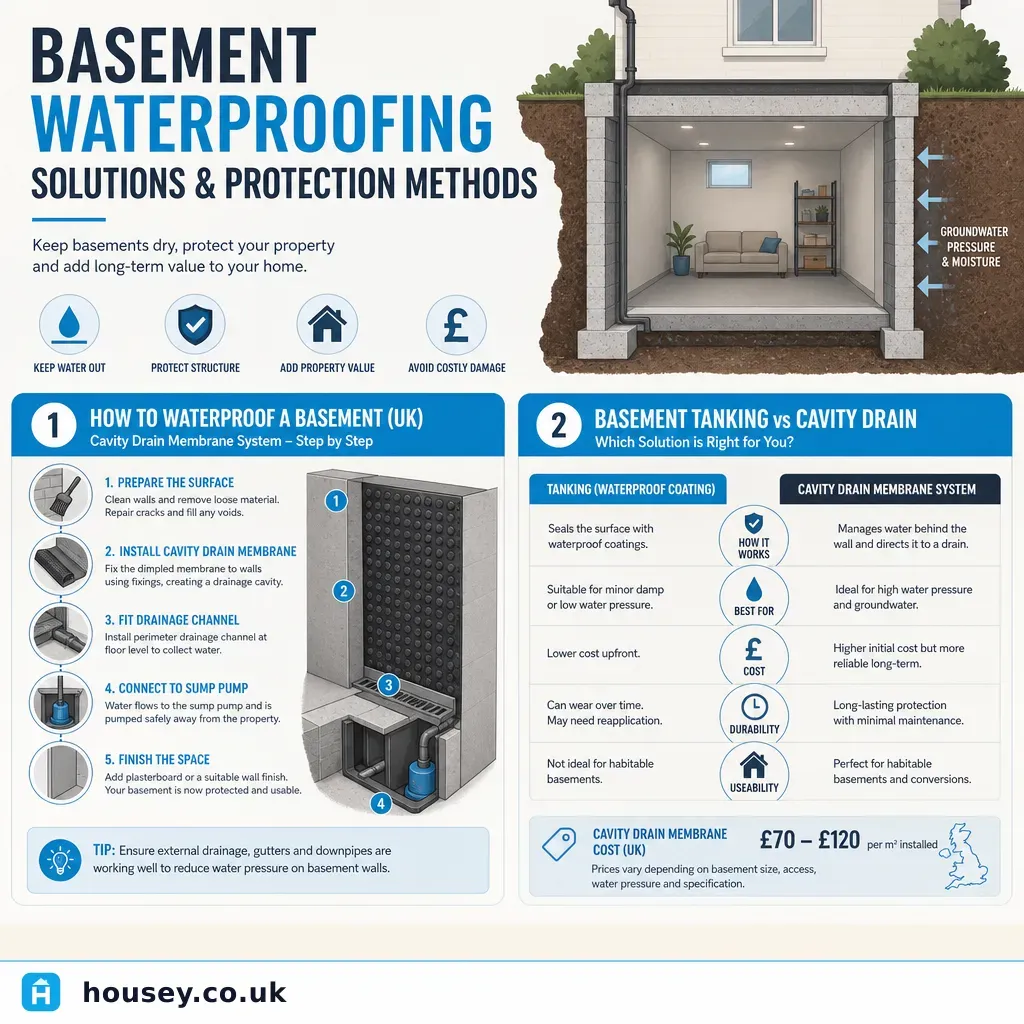
Basement Waterproofing Solutions and Protection Methods
Basement waterproofing in the UK uses one of three system types defined in BS 8102:2022: Type A (barrier tanking), Type B (structurally integral concrete), or Type C (cavity drain with sump pump).
 Improvement & Build
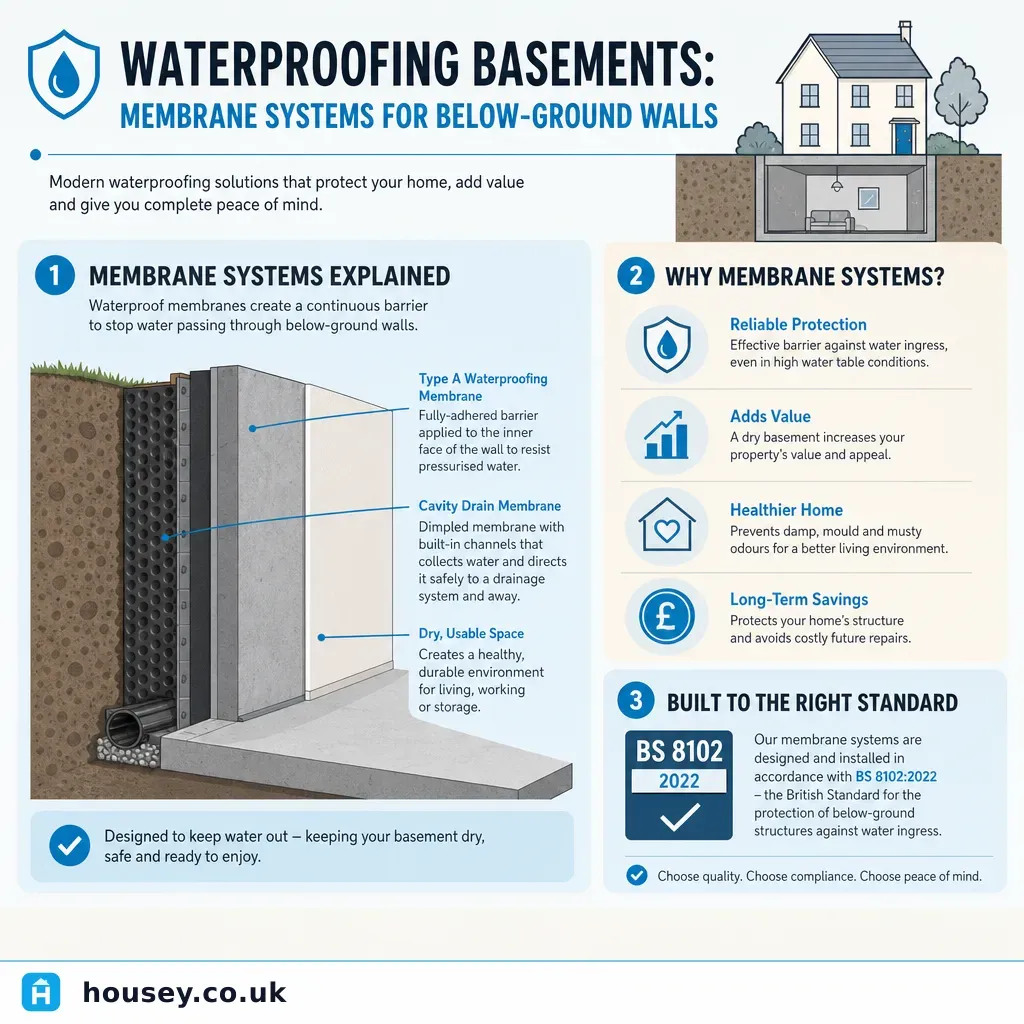
Waterproofing Basements: Membrane Systems for Below-Ground Walls
The three principal below-ground waterproofing systems under BS 8102:2022 are Type A (barrier membranes such as tanking or crystalline coatings), Type B (structurally integral waterproof concrete), and Type C (cavity drain membranes that collect and redirect water).
 Improvement & Build
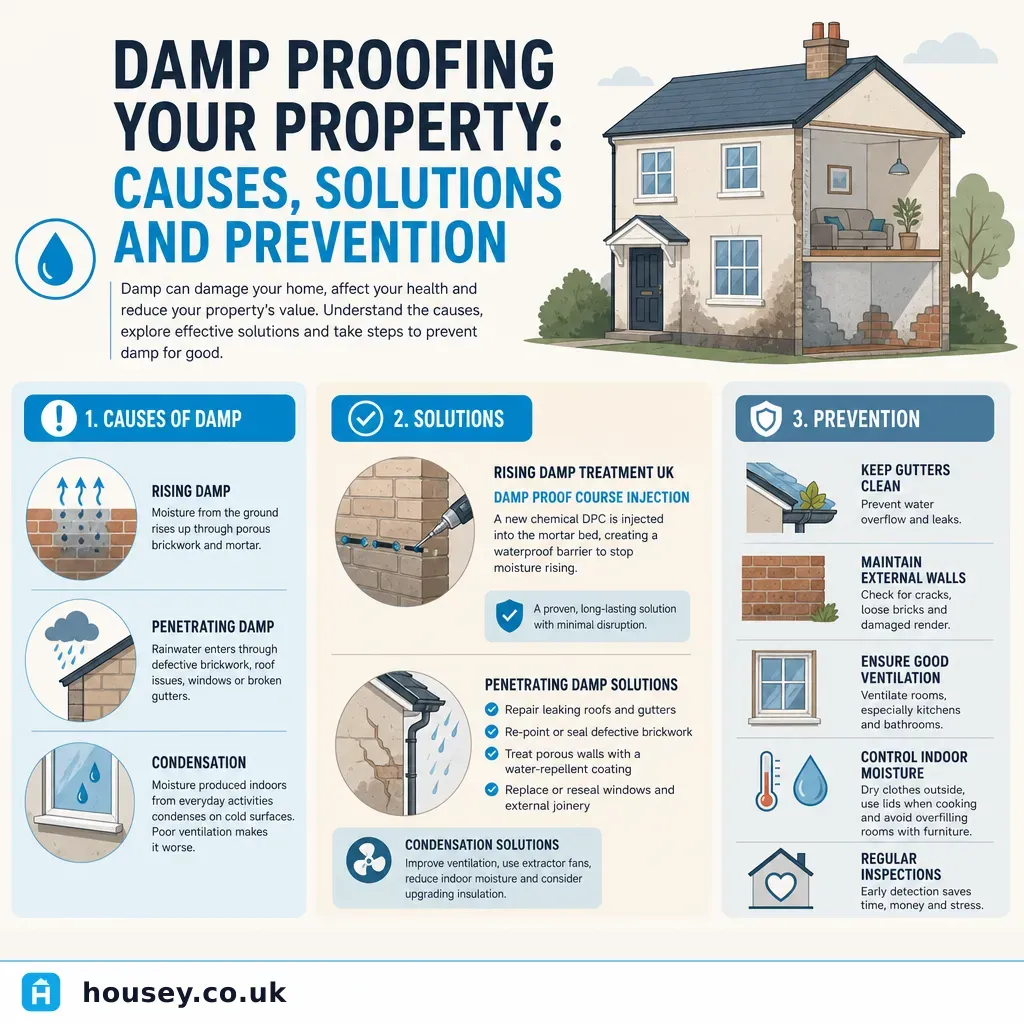
Damp Proofing Your Property: Causes, Solutions and Prevention
Damp in UK properties falls into three main types: rising damp caused by a failed damp proof course, penetrating damp from defects such as failed flashings or cracked render, and condensation from poor ventilation.
 Improvement & Build
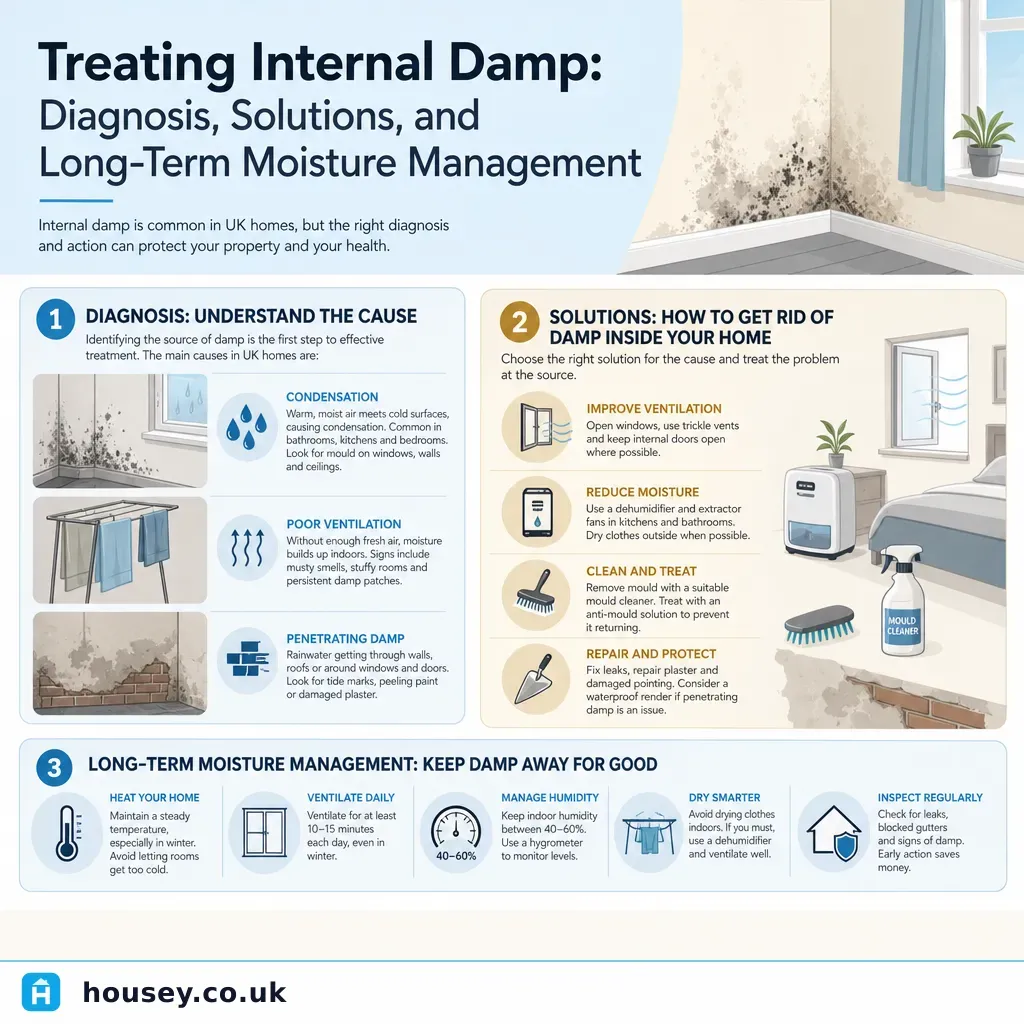
Treating Internal Damp: Diagnosis, Solutions, and Long-Term Moisture Management
Treating internal damp successfully requires diagnosing the correct type first.