Epoxy Injection for Below-Grade Wall Cracks: A UK Homeowner's Guide
By Housey · Last reviewed 11th of May 2026
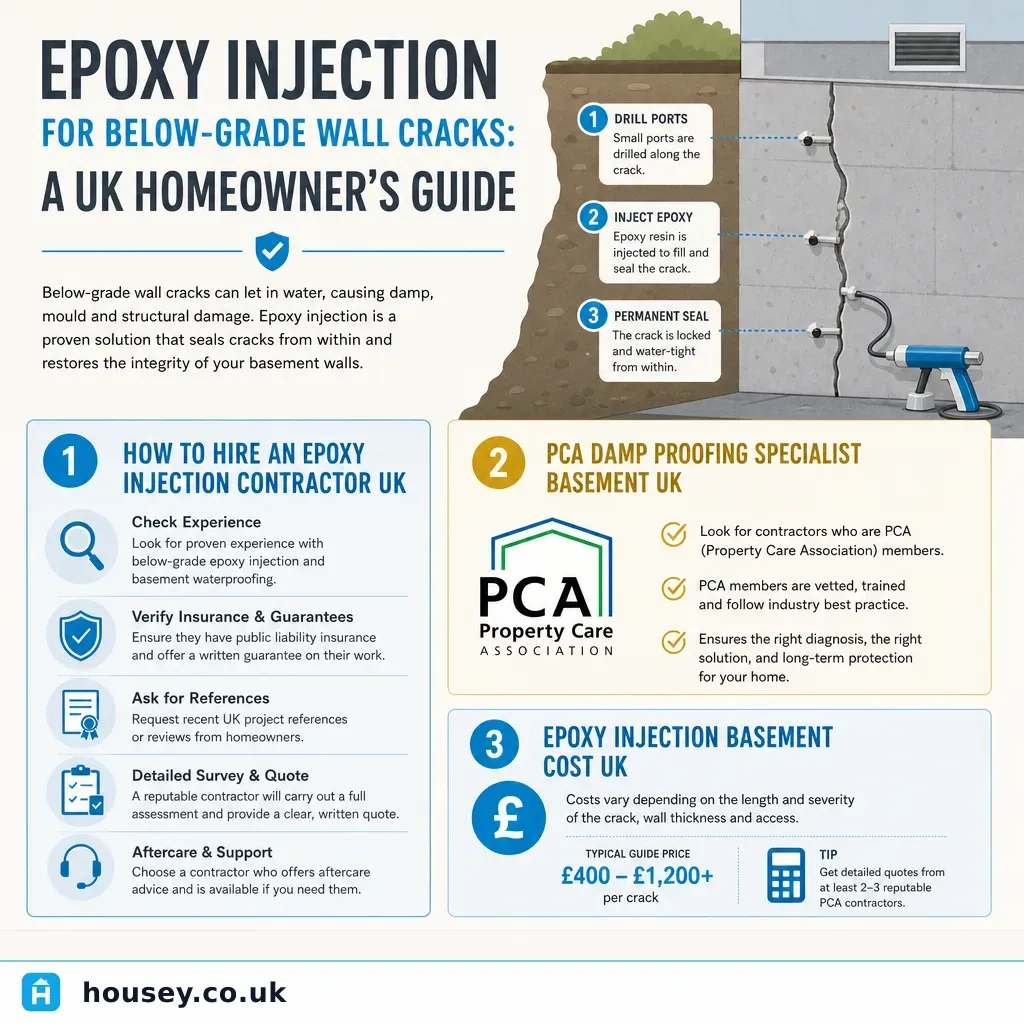
Epoxy Injection for Below-Grade Wall Cracks: A UK Homeowner's Guide
Discovering a crack in a below-grade wall — a basement, lower-ground floor, or undercroft — raises immediate questions about severity, cause, and next steps. Epoxy injection is frequently proposed by contractors as a repair solution, but understanding what it can and cannot achieve helps you commission the right work, ask the right questions, and avoid paying for a repair that will not hold or will not address the root problem.
Key points
- Epoxy injection is only suitable for stable, non-moving cracks in poured concrete — it does not work on masonry, brickwork, or blockwork where cracks follow mortar joints.
- An insurance-backed guarantee (IBG) from a PCA-registered contractor is the industry norm for structural waterproofing works; always request one before signing a contract.
- Indicative cost for epoxy injection of a single identified crack in a residential basement: £300–£1,200 depending on crack length, depth, access, and any follow-on waterproofing required. Full Type C cavity drainage systems for habitable basements typically cost £5,000–£25,000+. Indicative UK costs, last reviewed 2026-05-11.
- BS 8102:2022 (Protection of below ground structures against water from the ground) defines the UK standard for below-grade waterproofing design and should underpin every contractor's specification.
- Building Regulations Approved Document C applies when below-grade works form part of a conversion to habitable use, requiring Building Control notification and approval.
What below-grade cracks tell you
Cracks in below-grade walls are rarely purely cosmetic. Their orientation and character carry diagnostic information that should shape any repair specification.
Vertical cracks in poured concrete walls often result from shrinkage during initial curing or from differential settlement. If narrow (under 0.3 mm) and confirmed stable, they may be suitable for epoxy injection to restore water-tightness.
Horizontal cracks can indicate lateral soil or hydrostatic water pressure acting on the wall — a structural concern that requires engineering assessment before any injection work is considered.
Diagonal or stepped cracks following mortar joints in blockwork or brickwork suggest differential settlement and fall outside the scope of epoxy injection. A structural engineer or chartered surveyor should assess these.
Hairline cracks with white efflorescence (salt deposits) indicate groundwater has been migrating through the crack over a prolonged period, even where no active flow is currently visible.
What to expect when hiring a contractor: a homeowner checklist
A competent specialist should follow a structured process. Use this checklist before and during any engagement.
Before accepting a quote:
Worked UK property scenario
Property: A 1930s semi-detached house in Leeds with a semi-basement utility room.
Problem identified: A pre-purchase RICS Level 3 survey flags a 2 mm vertical crack in the east-facing poured concrete wall, with damp staining extending 300 mm from the crack base.
Initial approach: The buyers invite a PCA-registered contractor to survey the wall. Tell-tale gauges are fitted across the crack. After four weeks of monitoring, the gauges show no measurable movement in any direction — the crack is confirmed static.
Contractor recommendation:
- Epoxy injection of the static crack through six ports along a 1.2 m crack length.
- A Type A cementitious tanking coat applied to the full wall face to provide a continuous barrier beyond the injection points.
- A drain strip at the wall-floor junction to manage any residual seepage during the IBG period.
Outcome: Total cost £1,850. The buyers received a 10-year IBG from a recognised underwriter. Building Control notification was not required as the room remained a non-habitable ancillary utility space. A second quote from a non-PCA contractor had offered only the injection step at £650, with no IBG, no tanking coat, and no monitoring period.
The PCA route cost more upfront but provided a guarantee, a complete follow-on system, and monitoring evidence that the crack was stable before any resin was injected.
What not to assume about epoxy injection
Common assumption | The reality |
|---|---|
Injecting the crack will fully waterproof my basement. | Injection seals the specific crack only. It does not address porosity of the surrounding concrete or masonry. A complete waterproofing system is usually required for habitable use. |
If the crack is dry, there is no water problem. | Cracks can be dry in summer and wet in winter as groundwater levels fluctuate seasonally. Dry efflorescence on or near a crack indicates past water movement through the structure. |
Any damp-proofing contractor can carry this out. | Below-grade waterproofing is a specialist discipline. General damp-proofing contractors may not have the training or equipment for structural injection. Always check PCA membership. |
Epoxy works on brick and blockwork walls. | Rigid epoxy injection is designed for monolithic poured concrete. Masonry walls require mortar repointing, pressure grouting with a compatible material, or a different waterproofing approach. |
It is a permanent fix regardless of the cause. | Correctly applied on a confirmed stable crack, an epoxy repair can last 20 years or more. But if the underlying cause — drainage failure, settlement, or hydrostatic pressure — is not addressed, adjacent cracks may form over time. |
I can judge whether the crack is stable just by looking. | Seasonal movement in a crack can be as small as a fraction of a millimetre — invisible to the naked eye but enough to cause an epoxy repair to fail. Tell-tale monitoring before injection is best practice. |
Important limitations
This guide provides general information only and cannot replace a professional assessment of your specific property. The appropriate repair method for a below-grade crack depends on wall construction type, crack history, groundwater conditions, soil type, and the intended use of the space — all of which vary by property and location.
Do not rely on this guide to determine whether a crack is structural or non-structural. If you have any doubt — particularly about horizontal cracks or cracks accompanied by visible wall or floor movement — commission a structural engineer's assessment before any injection work is considered.
When this becomes urgent
Act quickly and seek professional advice without delay if:
- Water is visibly flowing through or pooling near the crack.
- The crack is widening, as confirmed by tell-tales or visible inspection over a short period.
- The crack is horizontal or runs at a shallow diagonal — these can signal structural failure of the wall under lateral pressure.
- The basement contains electrical installations, a gas meter, or is used as sleeping accommodation.
- A musty smell or visible mould is present, suggesting ongoing moisture intrusion affecting indoor air quality or structural timber.
What to ask a qualified professional
Before accepting any quote for below-grade injection or waterproofing works:
- In your assessment, is this crack structural or non-structural, and what is your basis for that conclusion?
- Should we install tell-tales and monitor the crack before injecting — and for how long?
- Is epoxy or polyurethane foam injection more appropriate for this crack, and why?
- Is the injection repair sufficient on its own, or do I need a supplementary waterproofing system?
- What IBG term is offered, who underwrites it, and what does it cover if the repair fails?
- Does this project require Building Control notification or approval?
- What happens if the repair fails within the guarantee period — what remediation is included at no extra cost?
When to get professional help
Below-grade crack repair is not a DIY undertaking. Correct diagnosis requires specialist knowledge of groundwater behaviour, structural load paths, and waterproofing design. Engage a PCA-registered specialist or a structural engineer if you see any crack in a below-grade wall.
A damp and timber survey from a qualified specialist can diagnose the source of moisture, identify whether structural investigation is also needed, and inform the waterproofing specification before any injection is commissioned.
How Housey can help
Housey can connect you with vetted damp proofing specialists who hold PCA membership, offer insurance-backed guarantees, and can assess and treat below-grade walls across the UK.
Frequently asked questions
How do I know if a basement crack needs epoxy injection or a structural engineer?
If the crack is horizontal, wider than 3–5 mm, or accompanied by wall movement, bowing, or bulging, commission a structural engineer before any injection is considered. Vertical hairline cracks in poured concrete that are stable and narrow are more likely candidates for epoxy injection — but a PCA specialist should confirm this after inspection and, where appropriate, a period of crack monitoring with tell-tale gauges.
Does buildings insurance cover below-grade crack repair?
Most standard buildings insurance policies exclude gradual water ingress and long-term dampness but may cover sudden and unforeseen structural damage. Check your policy wording carefully. If the crack results from a specific event such as a burst water main or ground movement from nearby construction, you may have a valid claim. A specialist report from a PCA contractor or structural engineer will support any claim you make.
How long does it take to inject a basement crack?
A straightforward single-crack epoxy injection typically completes in a day, once tell-tale monitoring has confirmed the crack is stable. The epoxy cures within 24–72 hours. If a follow-on waterproofing system is also specified, further visits will be needed — allow one to five days in total for most residential basement crack repair projects, excluding the monitoring period.
Is epoxy injection regulated in the UK?
Injection materials fall under the Construction Products Regulation and should carry CE or UKCA marking. The work specification should comply with BS 8102:2022. Where works form part of a building conversion, Building Regulations apply. There is no mandatory contractor licensing scheme, but PCA membership and insurance-backed guarantees are the closest to an industry quality-assurance standard currently available.
Sources and further reading
- BS 8102:2022 — Protection of below ground structures against water from the ground — BSI British Standards
- Property Care Association — member search and technical guidance — Property Care Association (PCA)
- Building Regulations Approved Document C: site preparation and resistance to moisture — GOV.UK
- RICS guidance on dampness in buildings — Royal Institution of Chartered Surveyors (RICS)
Useful next reads
 Improvement & Build
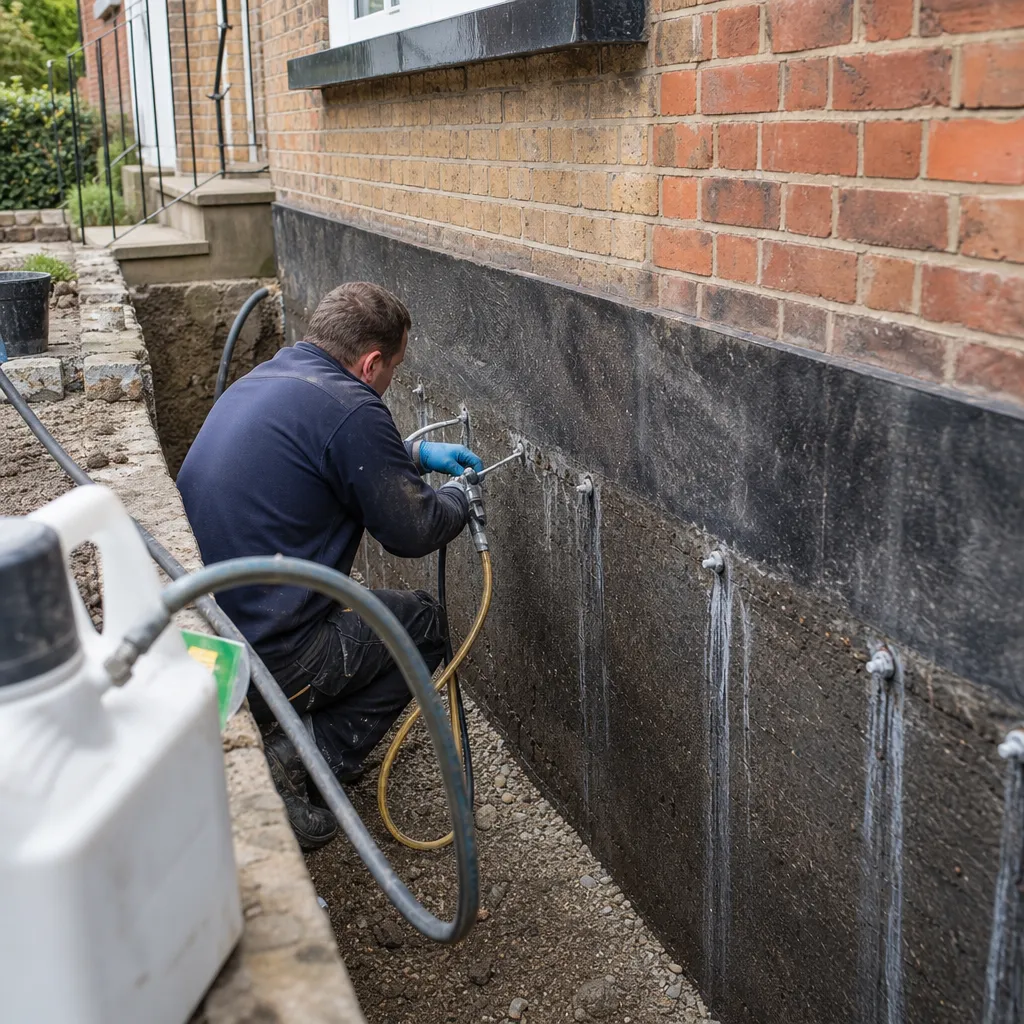
Sealing Below-Grade Walls: Epoxy Injection Repair Methods
Epoxy injection seals static, non-moving cracks in below-grade concrete walls by filling them under pressure with low-viscosity resin that cures rigid and structural.
 Improvement & Build
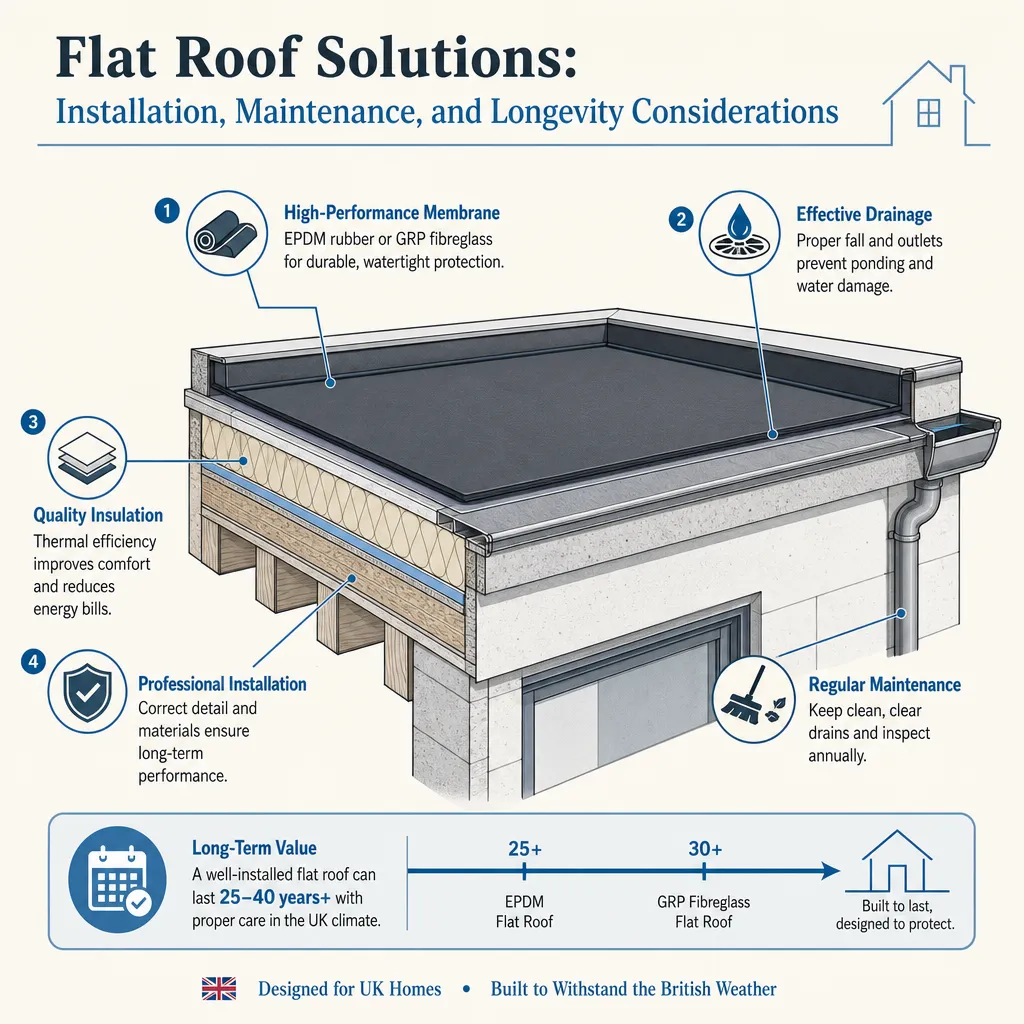
Flat Roof Solutions: Installation, Maintenance, and Longevity Considerations
Flat roofs use several waterproofing systems — EPDM rubber, GRP fibreglass, liquid-applied coatings, modified bitumen felt, lead, and zinc — each with different lifespans and installation requirements.
 Improvement & Build
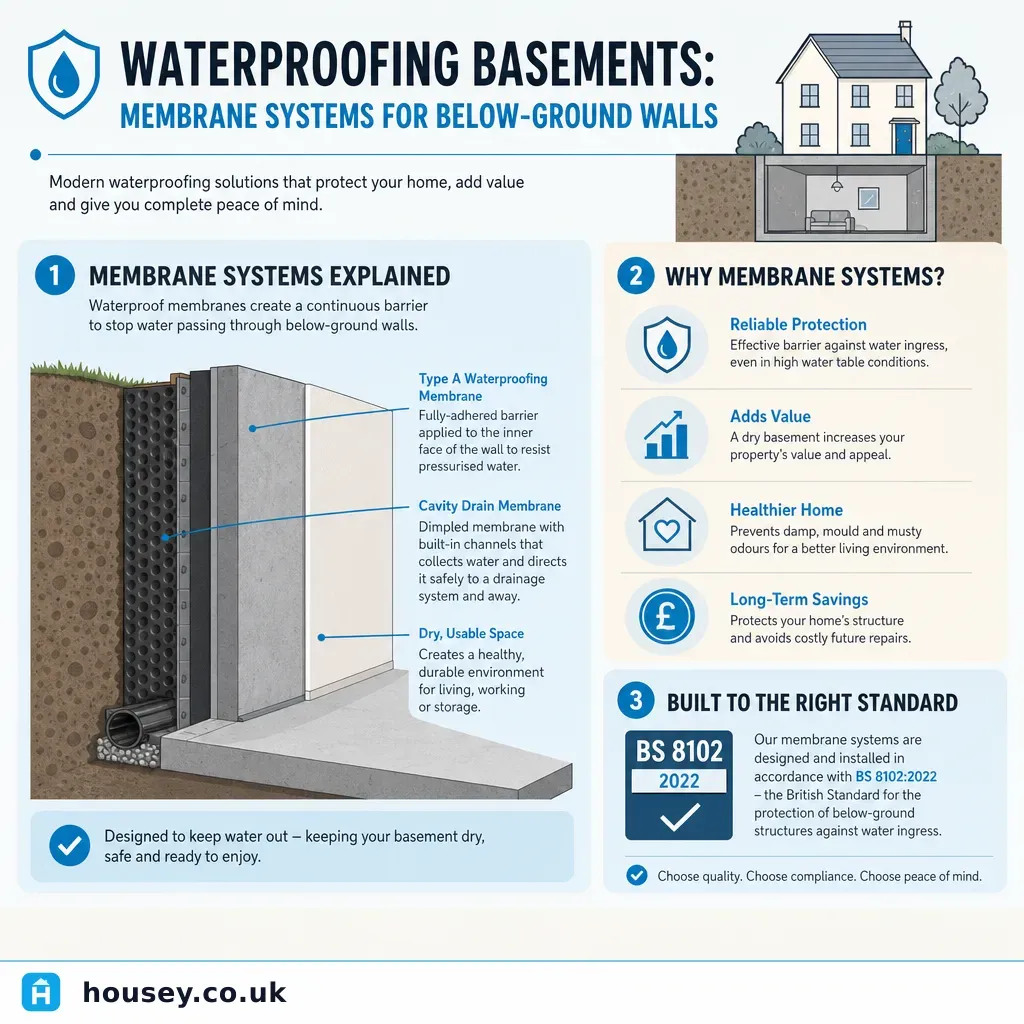
Waterproofing Basements: Membrane Systems for Below-Ground Walls
The three principal below-ground waterproofing systems under BS 8102:2022 are Type A (barrier membranes such as tanking or crystalline coatings), Type B (structurally integral waterproof concrete), and Type C (cavity drain membranes that collect and redirect water).
 Improvement & Build
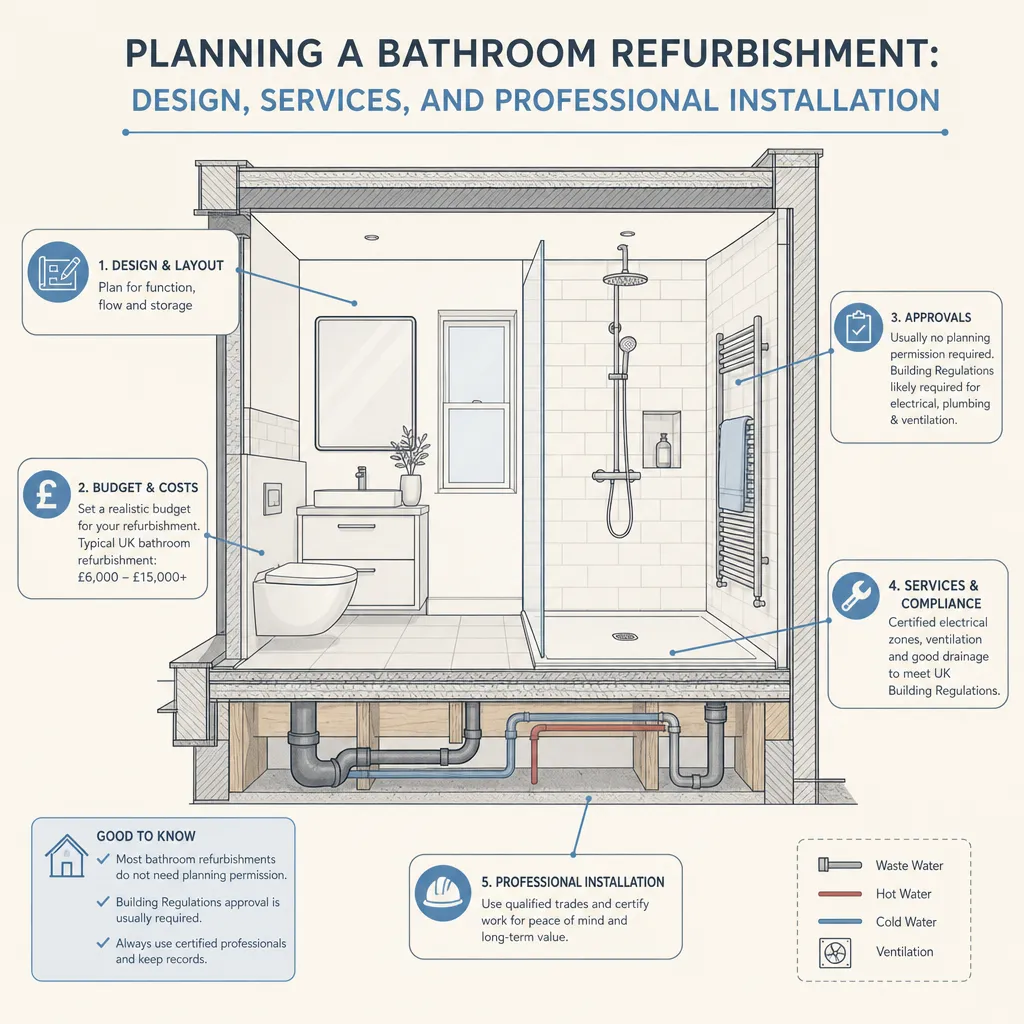
Planning a Bathroom Refurbishment: Design, Services, and Professional Installation
A bathroom refurbishment in the UK typically involves at least three trades — plumber, electrician, and tiler — and costs £4,000–£12,000 for a full project.
 Improvement & Build
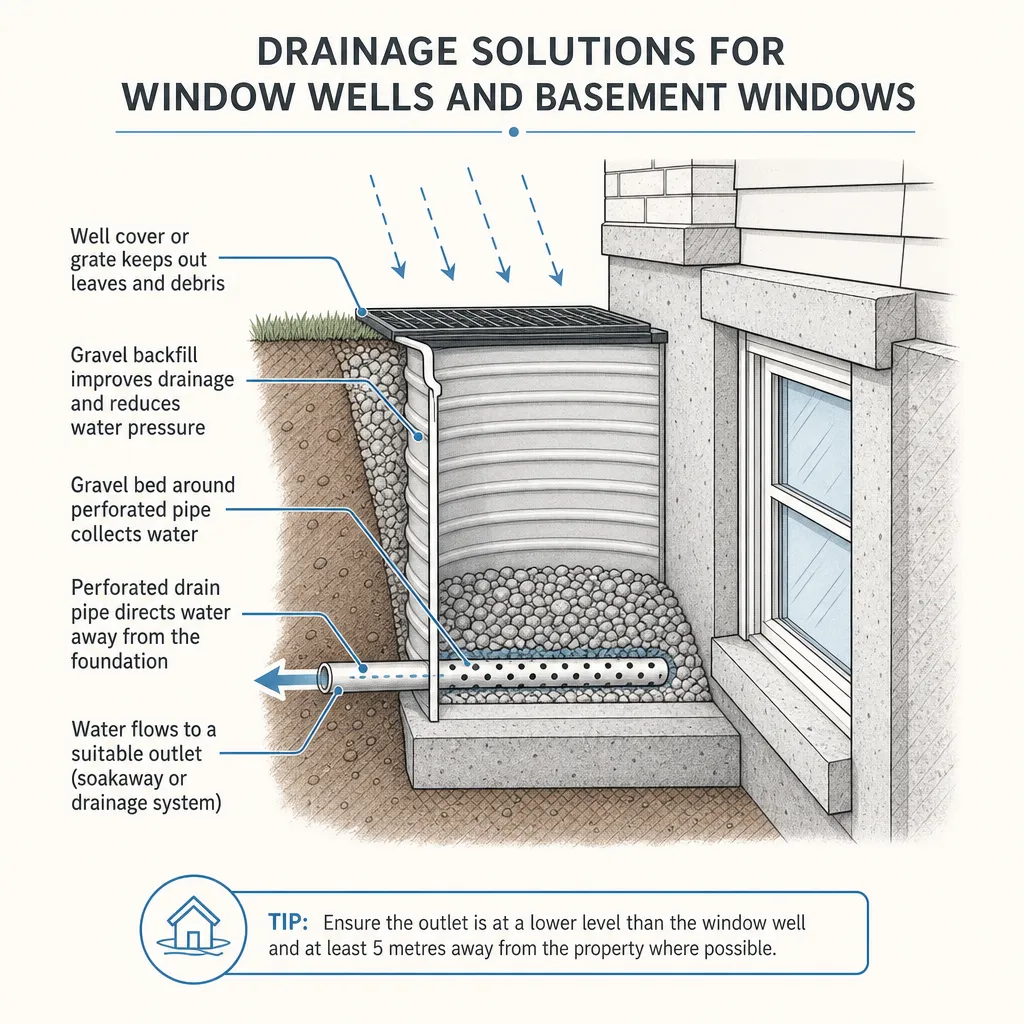
Drainage solutions for window wells and basement windows
Most UK window wells manage water through a gravel-filled sump at least 200 mm deep or a plastic liner fitted with a drain outlet connected to a soakaway or drainage system.