Damp Proofing Your Property: Causes, Solutions and Prevention
By Housey · Last reviewed 19th of May 2026
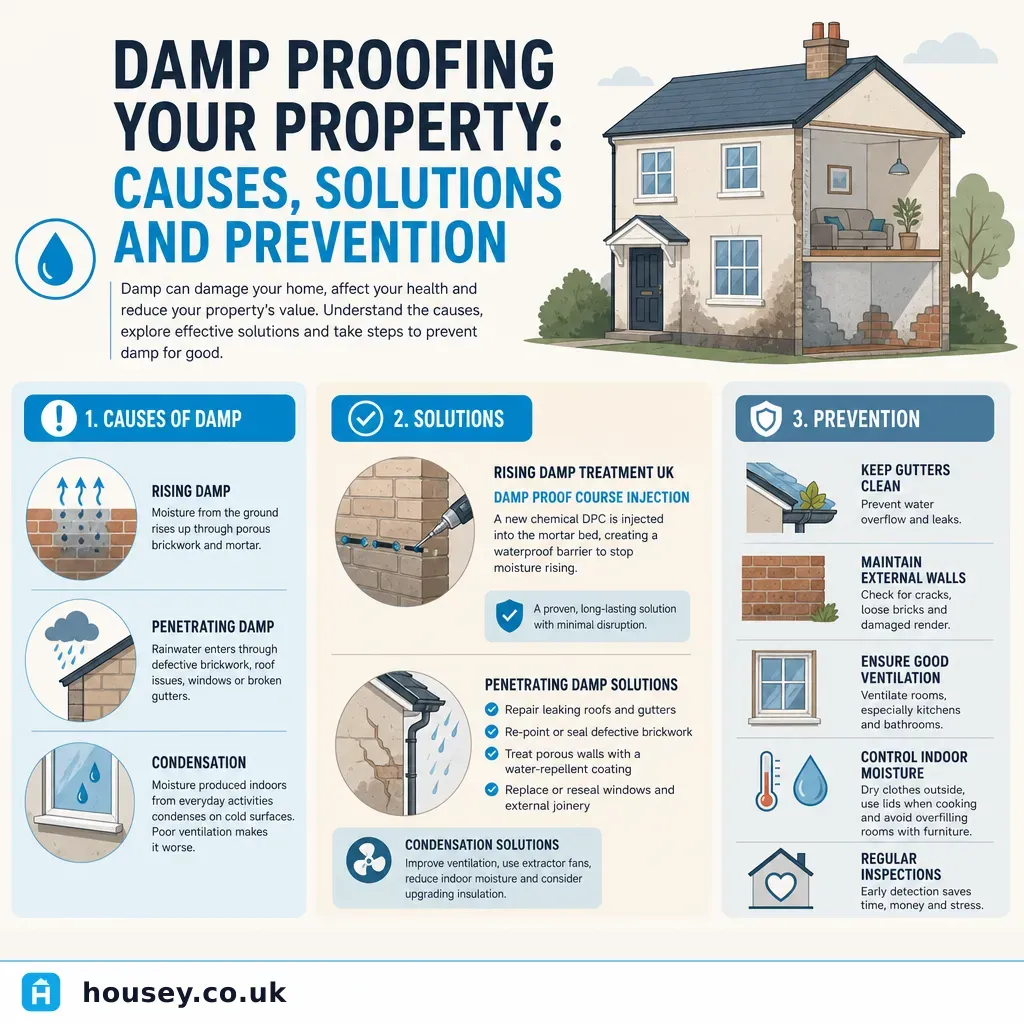
Damp Proofing Your Property: Causes, Solutions and Prevention
Damp is one of the most frequently misdiagnosed problems in UK homes. Victorian terraces, solid-wall 1930s semis, and even newer properties can all develop moisture issues — but the remediation required depends entirely on what type of damp you are dealing with and where it originates. Getting this wrong can mean spending money on treatments that address the symptom rather than the cause.
Key points
- Approved Document C of the Building Regulations requires the damp proof course (DPC) in new dwellings to be at least 150 mm above external ground level; raising paths or render above this level is one of the most common causes of DPC bridging.
- Genuine rising damp — caused by a failed or absent DPC — accounts for far fewer cases than is commonly claimed; independent surveys consistently show condensation and penetrating damp are more prevalent.
- Property Care Association (PCA) member contractors are the recognised specialists for damp and timber remediation; always check whether the surveyor diagnosing the problem is independent of the company selling the treatment.
- Chemical injection DPCs typically carry guarantees of 20–30 years, but a guarantee is only as useful as the company backing it — check whether it is underwritten by an insurance policy that survives the contractor's insolvency.
- Unventilated sub-floor voids are a leading cause of timber decay in properties with suspended timber ground floors; sub-floor air vents must not be blocked by raised soil, debris, or added insulation.
Understanding the three types of damp
Correctly identifying the type of damp is the foundation of any effective treatment. Treating penetrating damp with a chemical DPC injection, for example, will not resolve the problem and wastes both time and money.
Damp type | How to recognise it | Common cause | Typical solution |
|---|---|---|---|
Rising damp | Tide mark up to ~1 m on internal walls, white salting, peeling plaster at low level | Failed or absent damp proof course | Chemical DPC injection, salt-resistant replastering |
Penetrating damp | Damp patches after rain, often at higher level or around windows and rooflines | Defective pointing, failed flashings, blocked gutters, cracked render | External repair of the defect, repointing, flashing replacement |
Condensation | Black mould on cold surfaces and at corners, moisture on windows | Inadequate ventilation, high indoor moisture generation, cold surfaces | Improved ventilation, insulation of cold surfaces, lifestyle adjustments |
What causes damp proof course failure?
The Building Regulations Approved Document C requires all new dwellings to have a damp proof course no less than 150 mm above external ground level. In older properties, the original DPC may have been bridged, physically damaged, or may never have existed.
Common DPC failure scenarios:
- External ground level raised above the DPC through landscaping, paving, or rendered finishes
- Solid floor screed or external render extending below DPC level
- Properties built before DPCs were standard practice (generally pre-1875)
- Failed cavity drainage in cavity wall constructions allowing water to bypass the cavity
Rising damp: what treatment involves
If a qualified surveyor confirms genuine rising damp, the typical remediation process involves:
- Injecting a silicone-based cream or liquid into drilled holes along the base of the affected wall to create a new chemical DPC.
- Removing existing plaster to at least 1 m height and replastering with a sand/cement render incorporating a waterproofing admixture.
- Addressing any external bridging — such as paths or render running below DPC level.
- Allowing the wall adequate drying time before redecoration.
Indicative UK costs, last reviewed 2026-05-19: chemical DPC injection and replastering a typical Victorian terrace ranges from £1,000 to £3,500 depending on the extent of affected wall, property type, and region. Always obtain at least three quotes from PCA-accredited contractors.
Penetrating damp: finding and fixing the source
Penetrating damp is the most common type in older UK properties and is almost always curable by addressing the specific defect causing water ingress. The leak source is not always directly above the damp patch — water frequently tracks along beams, timber, or the underside of slabs before appearing at a different location.
Common sources to inspect:
- Chimney flashings and pointing
- Window and door reveals — perished mastic, failed sills, poorly detailed lintels
- External render — cracks, hollow sections, or render improperly terminated at DPC level
- Roof — cracked or slipped tiles, blocked or overflowing gutters, failed valley flashings
- Parapet walls and flat roof upstands
Fix the defect before applying any internal treatment. Internal waterproof coatings or cavity drain membranes can manage ingress but should be used as a secondary measure, not a substitute for external repair.
Condensation and mould: ventilation comes first
Condensation accounts for a large proportion of damp complaints in UK homes and is particularly prevalent in flats and properties with limited natural ventilation. Warm moist air — generated by cooking, bathing, and everyday activity — condenses on cold surfaces when it cannot escape.
Homeowner checklist for reducing condensation:
In more persistent cases, Mechanical Extract Ventilation (MEV) or Mechanical Ventilation with Heat Recovery (MVHR) may be warranted. A ventilation specialist can advise on the appropriate system for your property type.
Worked example: 1930s semi with ground-floor damp
A homeowner in a 1930s semi-detached property in the Midlands noticed persistent damp patches on the internal face of the front bay window wall, appearing after periods of heavy rain. A local remediation company suggested rising damp and quoted for a full DPC injection. An independent surveyor found a different story:
- External render had been extended below the original DPC level during a 1990s refurbishment
- The bay window lead flashing had separated at one corner, allowing rainwater ingress
- A hairline crack in the render at first-floor level was allowing water to track down the internal wall
The correct solution was entirely external: reflashing the bay, repairing the render crack, and cutting a horizontal chase to break the render bridging the DPC. No chemical injection was necessary, and the total cost was considerably lower than the original remediation quote. This example illustrates why obtaining an independent survey before instructing a contractor is a worthwhile step.
Red flags: when to act quickly
- Soft or discoloured skirting boards and floor timbers — wet rot and dry rot spread rapidly once established; delay substantially increases remediation cost.
- White crystalline deposits (efflorescence) on walls — indicates active moisture movement and salt migration through the masonry.
- Damp smell from the sub-floor void — inspect air vents and look for evidence of fungal growth on joists and bearers.
- Property recently purchased without a damp and timber survey — arrange an independent survey before starting any decoration or flooring works.
- Mould covering more than 1 m² — HSE guidance links extensive mould growth to respiratory health risks, particularly for vulnerable occupants.
When to get professional help
A qualified damp specialist or independent surveyor should be instructed whenever you are uncertain about the cause of moisture — and particularly before committing to remediation. DIY treatments applied to the wrong diagnosis are at best ineffective and at worst can trap moisture and accelerate structural decay.
Seek professional assessment when:
- Damp patches are widespread or affecting multiple rooms on different elevations
- There is evidence of timber decay — soft, discoloured, or crumbling skirting boards, joists, or window frames
- You are purchasing a property with visible damp signs and no survey was commissioned before exchange
- A previous damp treatment has failed or moisture has returned within a few years
How Housey can help
Housey connects UK homeowners with qualified damp proofing specialists and independent professionals offering a damp and timber survey before any remediation work begins. Getting a diagnosis from a surveyor who is not also selling you a treatment package is one of the most cost-effective steps you can take. Where structural concerns are also present, a structural survey may be appropriate.
Frequently asked questions
Is rising damp common in UK homes?
Genuine rising damp — caused by a defective or absent damp proof course — is less common than many remediation companies suggest. Independent surveys consistently show condensation and penetrating damp are more frequently the cause of wall moisture. A diagnosis from a surveyor who is independent of any treatment contractor is strongly advisable before commissioning any remediation work.
Does a chemical DPC injection always work?
Chemical injection can be effective for genuine rising damp, but it must be paired with replastering in salt-resistant render. The original plaster retains hygroscopic salts from years of moisture movement; leaving it in place means dampness will return even after a new DPC is installed. Check that your contractor's guarantee explicitly covers the replastering, not just the injection itself.
Can I treat damp myself?
Surface products such as anti-mould paint may temporarily manage minor condensation mould but do not address the underlying cause. For rising or penetrating damp, the root defect must first be found and corrected. Applying waterproofing compounds to walls without treating the source rarely provides a lasting fix and can mask a worsening problem.
How much does damp proofing cost in the UK?
Costs vary widely depending on damp type, extent, property size, and region. Indicative UK costs, last reviewed 2026-05-19: chemical DPC injection with replastering for a typical affected room may range from £800 to £4,000. Penetrating damp repairs are often lower-cost and depend on the specific defect. Obtain at least three quotes from PCA-accredited contractors.
Sources and further reading
- Building Regulations Approved Document C: Site preparation and resistance to contaminants and moisture — GOV.UK
- Damp and Timber Guidance for Homeowners — Property Care Association
- Dampness and Mould in the Home — Health and Safety Executive
- Damp in Traditional Buildings — Historic England
Useful next reads
 Improvement & Build
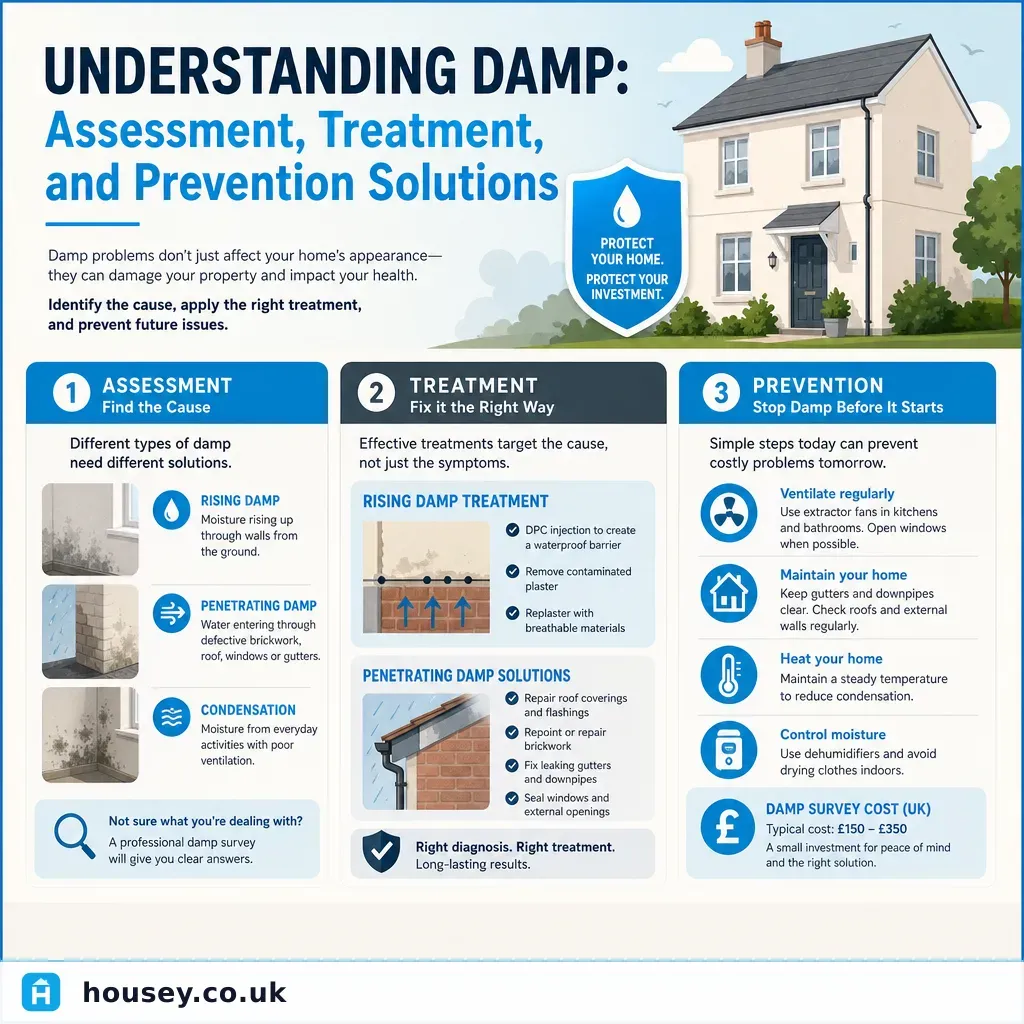
Understanding Damp: Assessment, Treatment, and Prevention Solutions
Damp in UK homes usually falls into three categories — rising damp, penetrating damp, and condensation — each requiring a different remedy.
 Improvement & Build
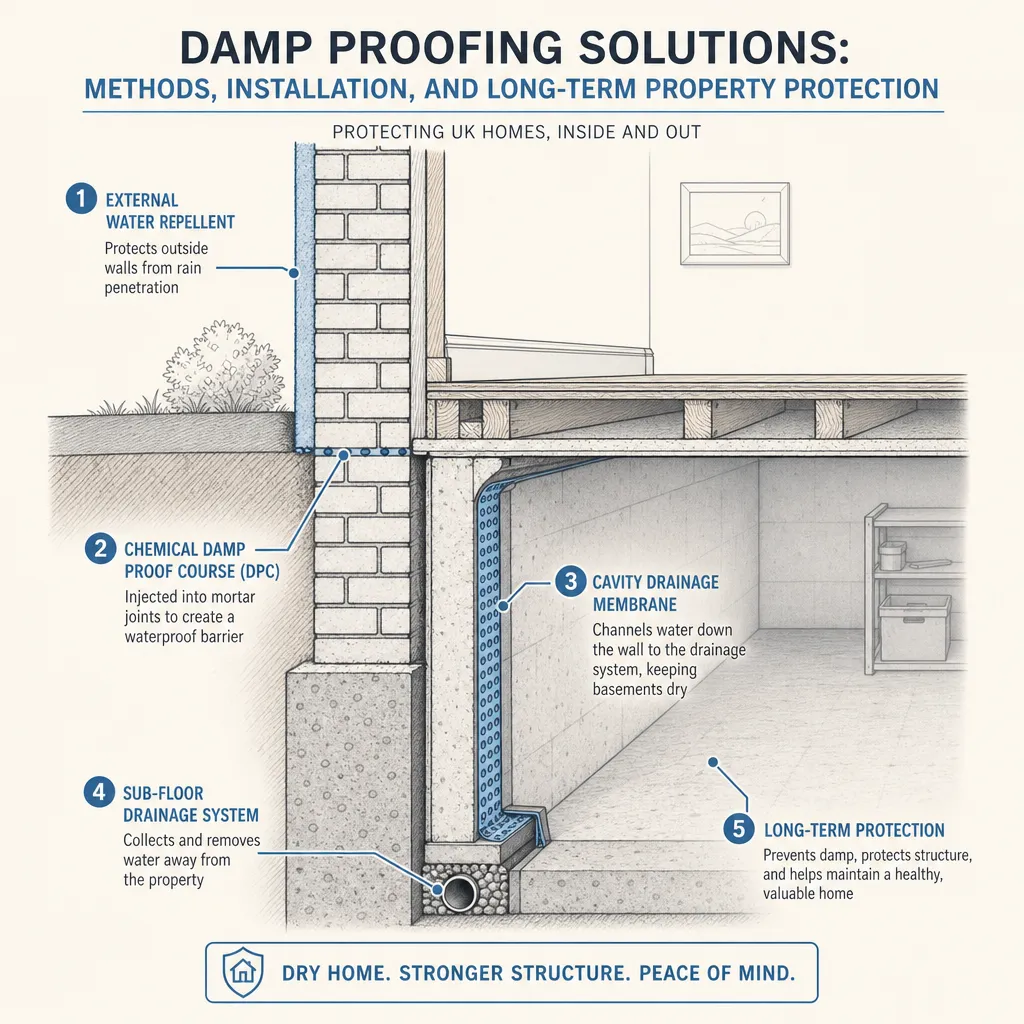
Damp Proofing Solutions: Methods, Installation, and Long-Term Property Protection
Damp proofing in UK homes typically involves chemical damp proof course (DPC) injection for rising damp, cavity drainage membranes for basement or below-ground moisture, and tanking for waterproofing solid walls.
 Improvement & Build
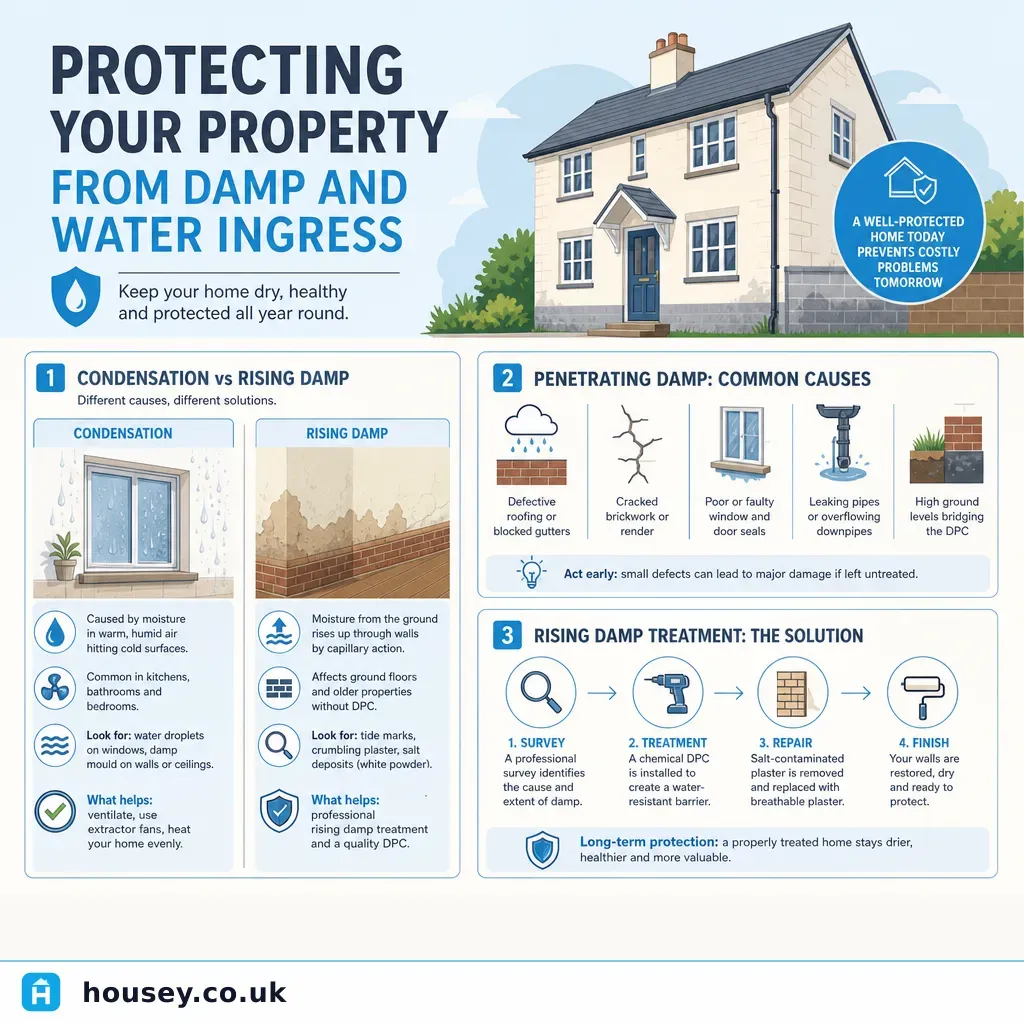
Protecting Your Property from Damp and Water Ingress
Damp in UK homes usually falls into three categories: rising damp (groundwater drawn up through walls), penetrating damp (rain or groundwater entering through the building envelope), and condensation (moisture from warm internal air meeting a cold surface).
 Improvement & Build
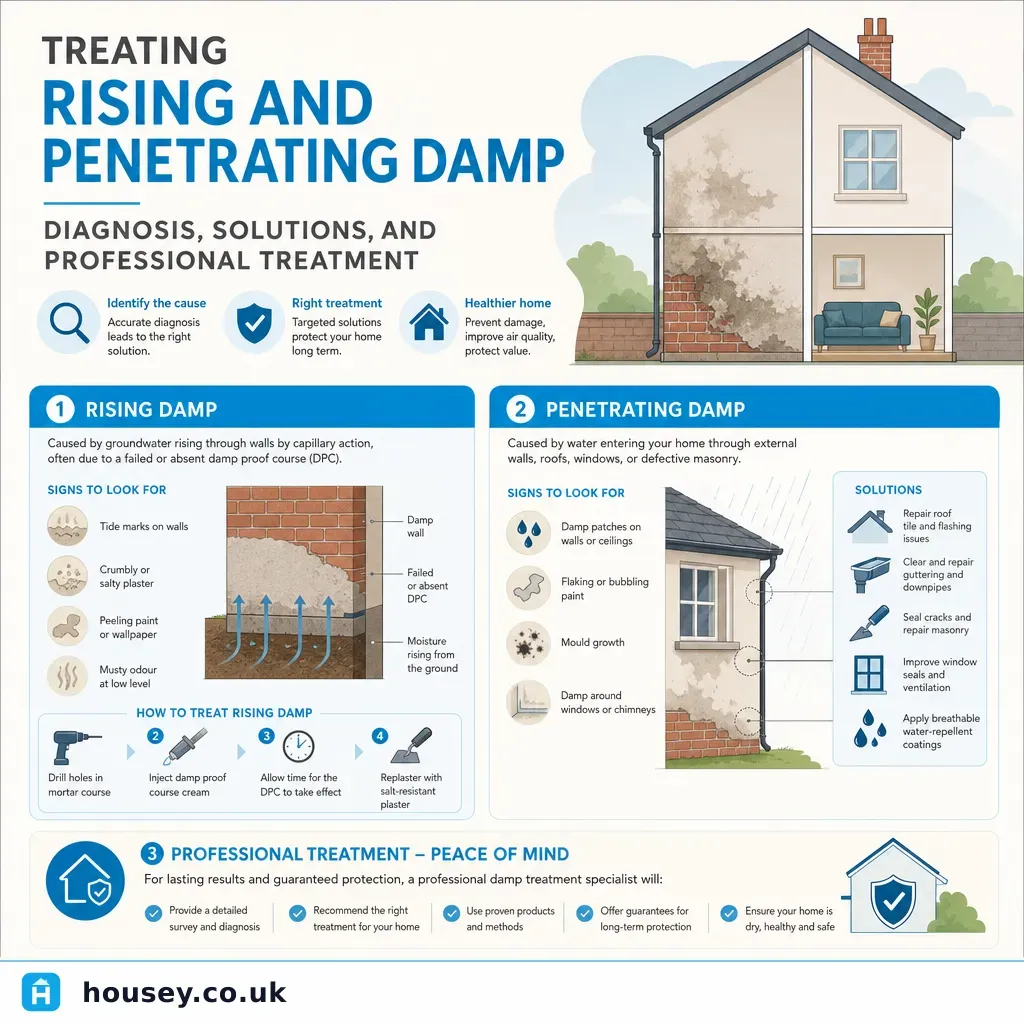
Treating Rising and Penetrating Damp: Diagnosis, Solutions, and Professional Treatment
Rising damp appears as a tide mark at the base of ground-floor walls and is caused by a failed or absent damp-proof course.
 Improvement & Build
Which Roof Ventilation Options Work Best For Your Property
The right roof ventilation depends on your roof construction.