Which Roof Ventilation Options Work Best For Your Property
By Housey · Last reviewed 31st of May 2026
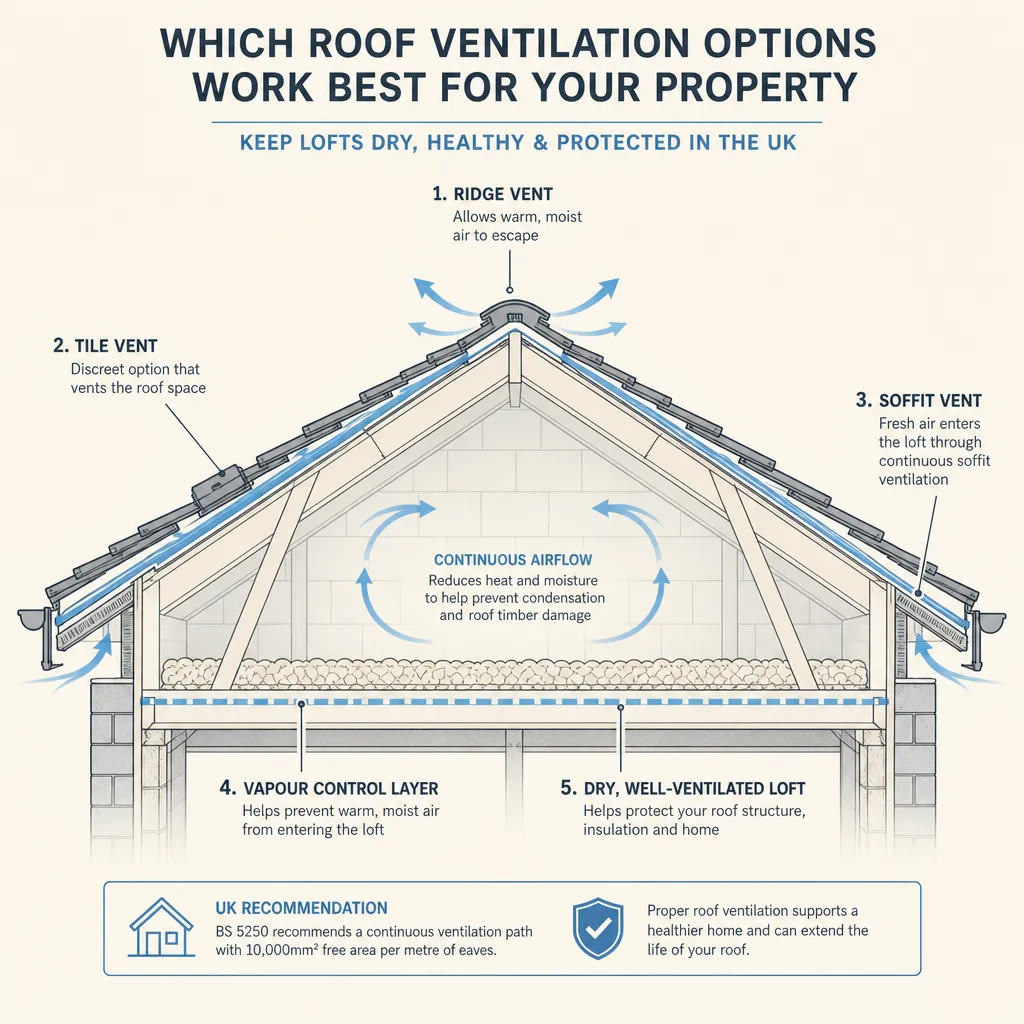
Which Roof Ventilation Options Work Best For Your Property
Roof ventilation is one of those features that homeowners rarely think about until something goes wrong — typically when condensation appears in the loft, timbers show signs of rot, or a surveyor flags inadequate airflow on a pre-purchase report. Whether you are re-roofing, upgrading insulation, or investigating persistent damp in a 1930s semi or a newer flat-roofed extension, understanding how ventilation works in different roof constructions is essential before any work begins.
Key points
- Approved Document C of the Building Regulations sets minimum ventilation requirements for roof spaces in England and Wales, with equivalent standards in Scotland (Section 3) and Northern Ireland (Technical Booklet C).
- A cold roof (insulation at ceiling level) requires a minimum 50 mm clear air gap between insulation and roof deck, with continuous ventilation openings of at least 25 mm equivalent width at eaves level.
- A warm roof (insulation between or above rafters) eliminates the ventilation cavity but must use a vapour-permeable underlay beneath the tiles or slates; some designs still need ridge-level ventilation.
- Flat roofs are particularly vulnerable to interstitial condensation if the vapour control layer, insulation, and deck are not specified and installed in the correct sequence.
- Retrospective changes to insulation — such as topping up loft insulation without addressing existing ventilation — can inadvertently restrict airflow and trigger condensation problems.
Cold roofs versus warm roofs: which needs ventilation?
The single biggest factor determining what ventilation product is appropriate is whether your roof is designed as a cold roof or a warm roof.
Cold roof (insulation at ceiling level)
This is the most common arrangement in UK homes built before the mid-2000s. Loft insulation sits on the ceiling joists and the roof void above remains unheated. Moisture-laden air from the living space rises into the loft and must be allowed to escape. Approved Document C requires:
- A minimum 50 mm clear airway between the top of the insulation and the underside of the roof deck.
- Cross-ventilation at eaves on opposite sides of the roof (minimum 25 mm equivalent opening for pitches below 15°; 5 mm for pitches above 35°, scaling between).
- High-level ventilation at the ridge for roofs with pitches above 35° or where the eaves opening alone cannot provide adequate through-flow.
Warm roof (insulation between or above rafters)
Increasingly common in renovation projects where the loft is being converted or where maximum insulation depth is needed. Insulation fills the rafter depth (often with a rigid board above) and a vapour-permeable underlay replaces traditional roofing felt. In a fully warm roof design with all insulation above the rafters, no ventilation void is needed — but this requires meticulous detailing. A hybrid approach with partial rafter insulation needs a 50 mm ventilated counter-batten space above.
Flat roofs
Flat roofs are classified as either warm-deck (insulation above the deck, no ventilation needed) or cold-deck (insulation below the deck, requires very high ventilation rates — typically 1/400th of the ceiling area — which is very difficult to achieve in practice and rarely recommended in new flat roof construction).
Roof construction | Ventilation required? | Key standard | Common product |
|---|---|---|---|
Cold pitched (insulation at ceiling) | Yes — eaves cross-ventilation, 50 mm gap | Approved Document C | Over-fascia vent, tile vent, soffit vent |
Warm pitched (full fill above rafter) | No void required; permeable underlay essential | BS 5250 | Vapour-permeable underlay + dry-fix ridge |
Hybrid pitched (partial rafter fill) | 50 mm counter-batten space + ridge vent | BS 5250 | Counter-batten system + ridge vent |
Warm-deck flat | None needed above insulation | Approved Document C | Correct vapour control layer (VCL) |
Cold-deck flat | Very high rate required — rarely achievable | BS 5250 | Not recommended for new flat roofs |
Types of roof ventilation product
Once you know which construction type you have, the choice of product becomes more straightforward.
Soffit vents and over-fascia vents
Installed at eaves level, these are the most common ventilation entry point for cold pitched roofs. Continuous over-fascia ventilators (OFVs) sit between the fascia board and the first tile, providing a consistent 10–25 mm equivalent opening along the full length of the eaves. Retrofitting these to an existing fascia is relatively straightforward for a roofing contractor.
Tile vents and slate vents
Interlocking tile or slate-format vents replace individual tiles to provide mid-roof or high-level ventilation. They are particularly useful where eaves ventilation alone cannot achieve the required cross-flow, or where the pitch exceeds 35° and ridge-level ventilation is also needed. Available in most tile profiles, though matching colour and profile on older roofs can be challenging.
Ridge vents and dry-fix ridge systems
A ventilated ridge provides the high-level outlet required on steeper pitches. Dry-fix ridge systems — now standard on most reroofing projects — incorporate continuous air outlets beneath a mechanical fixing system, replacing traditionally bedded mortar ridge tiles. These are also required under NHBC Standards for new builds.
Airtightness membranes and vapour control layers
These are not ventilation products as such, but they work in conjunction with the ventilation strategy. In warm roof or loft conversion construction, a correctly specified vapour control layer on the warm (inner) side of the insulation reduces the amount of moisture vapour reaching the structure, reducing the demand on any ventilation that remains.
Humidity-responsive vents
These are passive vents containing a hygroscopic element that opens in response to rising relative humidity. They are particularly useful in situations where thermal bridging or restricted eaves make consistent ventilation harder to achieve, and are sometimes recommended by condensation surveyors.
Deciding which ventilation approach is right for your property
Use this guide to identify your starting point:
- Loft with insulation on the joists, no conversion planned? Start by checking whether you have a clear 50 mm gap between the top of the insulation and the roof deck. If insulation has been topped up and the gap has been lost, the insulation may need to be trimmed back or deflector baffles installed at the eaves. Ensure over-fascia or soffit vents are unobstructed.
- Planning a loft conversion? You are likely moving to a warm or hybrid roof. Engage a structural engineer or architect for the roof construction specification before choosing ventilation products.
- Cold roof with condensation problems despite visible vents? Check whether the vapour barrier on the ceiling is continuous and whether any additional moisture sources (bathroom extracts, uninsulated pipes) discharge into the loft space. A ventilation and condensation assessment can identify whether the problem is airflow, moisture load, or thermal bridging.
- Flat roof extension with persistent damp? The construction sequence is critical. Unless you have access to the original specification, have a roofer assess whether the build-up is warm-deck or cold-deck and whether the vapour control layer is correctly positioned.
- Re-roofing an older property? Use the opportunity to upgrade to a dry-fix ridge with integrated ridge ventilation and replace any blocked or absent eaves ventilation as part of the same contract.
What to look for when the work is done
After any roof ventilation work, you should expect:
- Unobstructed, continuous ventilation at eaves level — check that new insulation has not been pushed into the eaves void.
- A 50 mm clear airway running the full length of the roof from eaves to ridge (or eaves to eaves on a hipped roof).
- Ridge ventilation products mechanically fixed, not reliant on mortar alone.
- Documentation from the contractor confirming product specifications and any Building Regulations compliance (required if the work forms part of a re-roofing project subject to building control notification).
When to get professional help
Roof ventilation problems are not always immediately visible, and poor decisions made during insulation upgrades or reroofing can take months or years to show as staining, mould, or timber decay.
Seek professional advice if you notice:
- Dark staining or mould on loft timbers or the underside of roof decking.
- Condensation on windows in upstairs rooms combined with persistent loft dampness.
- A surveyor has flagged inadequate roof ventilation on a RICS Level 2 or Level 3 report.
- You are converting the loft and need to change from a cold to a warm roof construction.
- Your flat roof is showing blistering, pooling water, or damp patches that return after repair.
How Housey can help
Housey connects you with vetted roofers and specialists offering ventilation and condensation assessments across the UK. Submit a single request and compare quotes from qualified local professionals.
Frequently asked questions
Do I need planning permission to add roof vents?
In most cases, no. Installing tile vents, over-fascia vents, or a dry-fix ridge on an existing roof falls within permitted development in the majority of cases. However, if your property is in a conservation area or is a listed building, additional restrictions apply and listed building consent may be required for any roof alterations. Check with your local planning authority if your property is in a designated area before instructing a contractor.
How much does roof ventilation work cost in the UK?
Indicative UK costs, last reviewed 2026-05-31. Fitting over-fascia and tile vents during a reroofing project typically adds £100–£400 to the contract. A standalone condensation survey costs around £150–£400. Retrofitting a dry-fix ridge ventilation system to an existing roof generally ranges from £500–£1,500 depending on ridge length and access. Obtain at least three quotes as costs vary significantly by region and roof complexity.
Can I install roof vents myself?
Minor tile vent replacement at low level may suit a competent DIYer, but working on a pitched roof above 2 m height carries significant safety risks and should only be carried out by contractors with appropriate access equipment. Any work that forms part of a notifiable building project must be carried out by or signed off by a competent person or building control.
What is BS 5250 and why does it matter for roof ventilation?
BS 5250: Code of Practice for the Management of Moisture in Buildings is the principal British Standard governing condensation risk in roofs and walls. It provides the technical basis for the ventilation requirements in Approved Document C and is regularly referenced by surveyors and building control officers when assessing whether a roof construction is adequate.
Sources and further reading
Useful next reads
 Improvement & Build
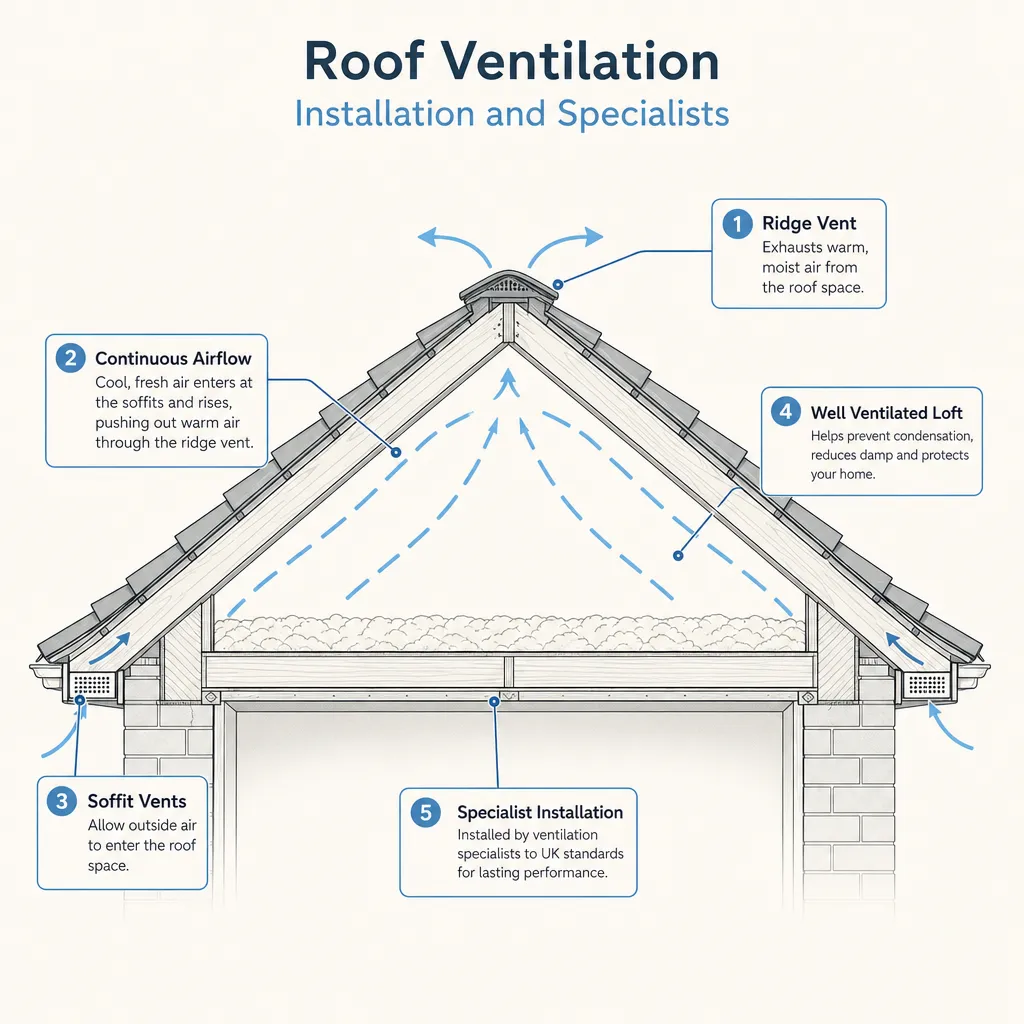
Roof Ventilation Installation and Specialists
Roof ventilation allows moist air to escape from the loft space, preventing condensation, timber decay, and mould.
 Improvement & Build
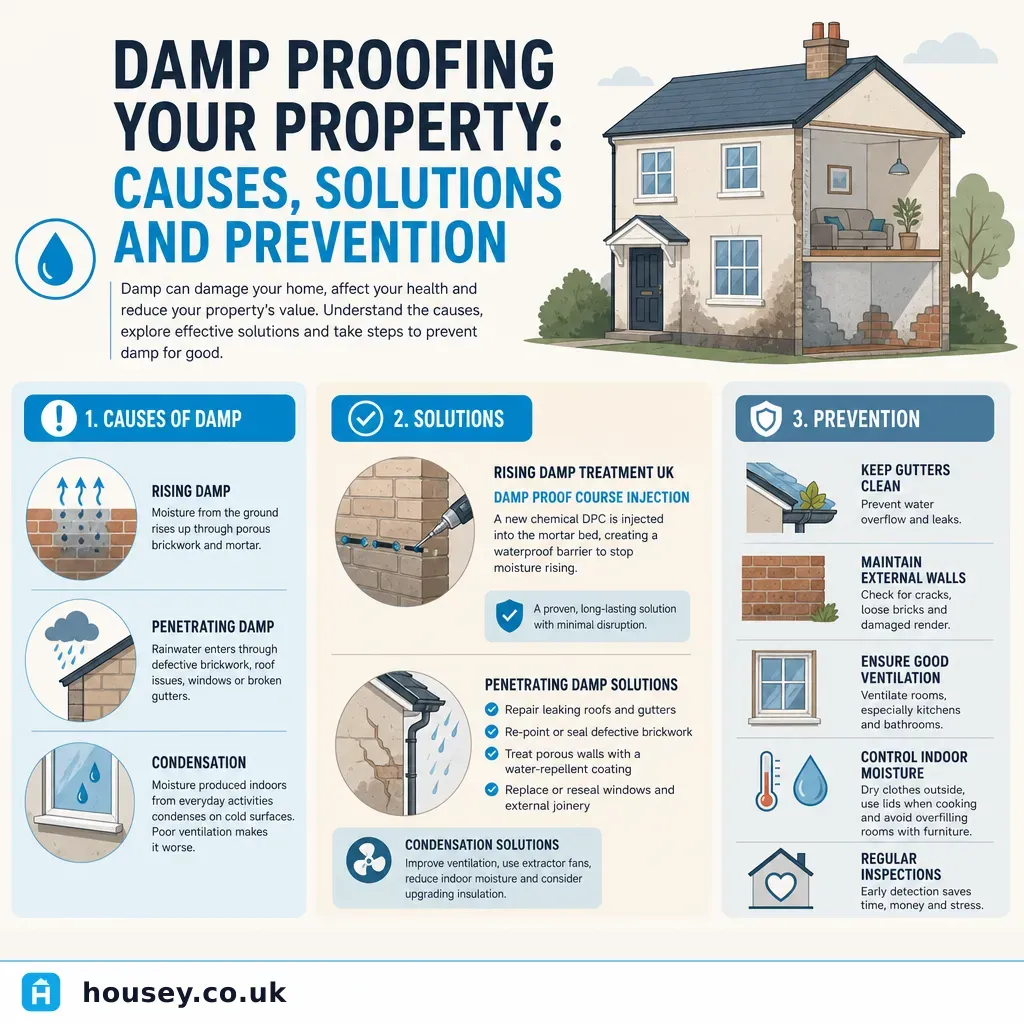
Damp Proofing Your Property: Causes, Solutions and Prevention
Damp in UK properties falls into three main types: rising damp caused by a failed damp proof course, penetrating damp from defects such as failed flashings or cracked render, and condensation from poor ventilation.
 Improvement & Build
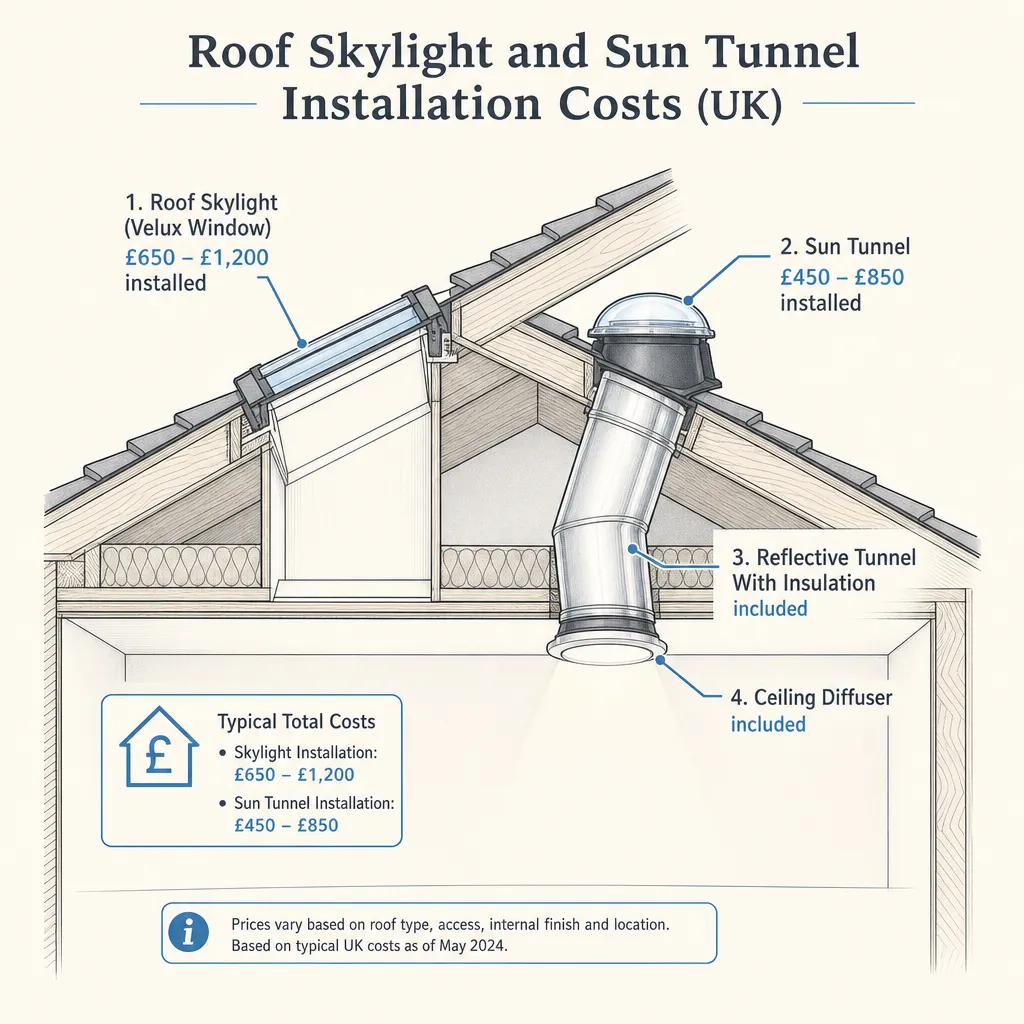
Roof Skylight and Sun Tunnel Installation Costs
A standard pitched-roof skylight costs £800–£3,000 installed in the UK, including flashings and basic making good.
 Improvement & Build
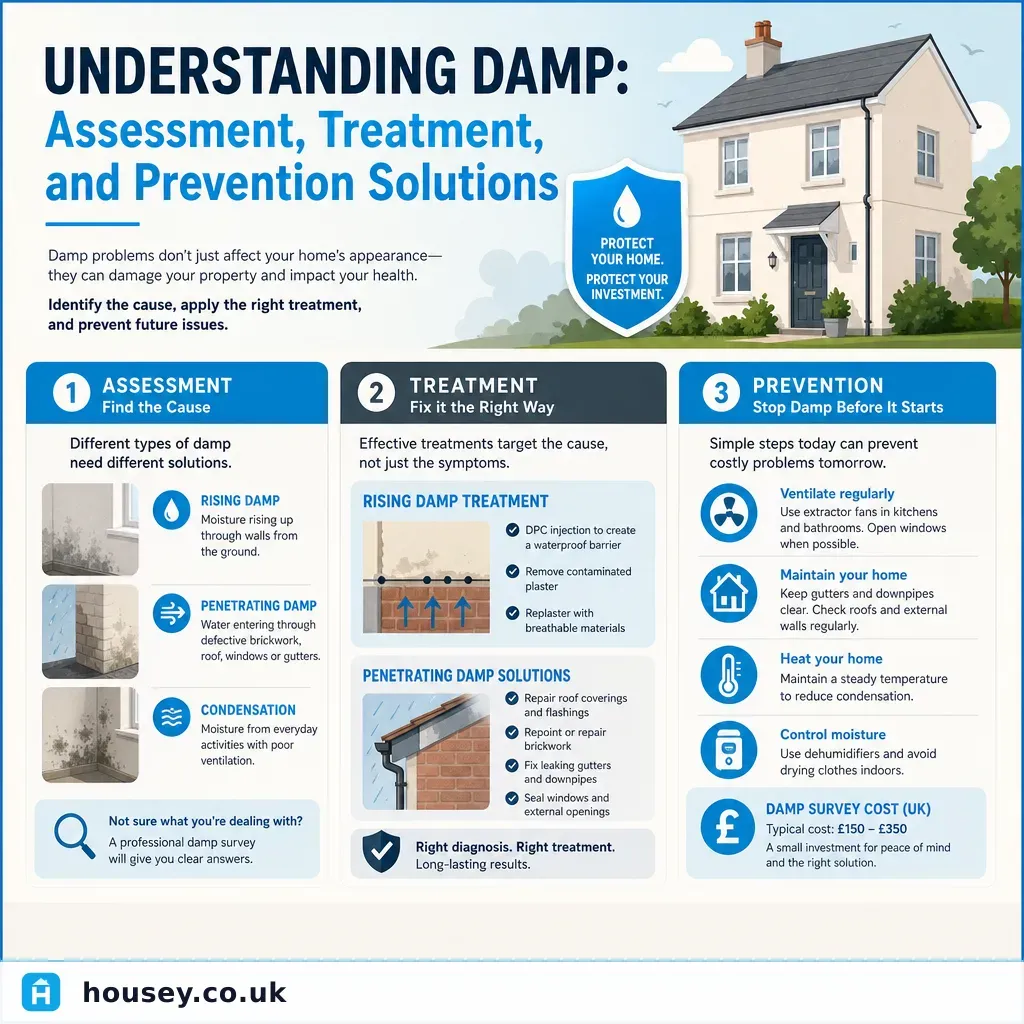
Understanding Damp: Assessment, Treatment, and Prevention Solutions
Damp in UK homes usually falls into three categories — rising damp, penetrating damp, and condensation — each requiring a different remedy.
 Improvement & Build
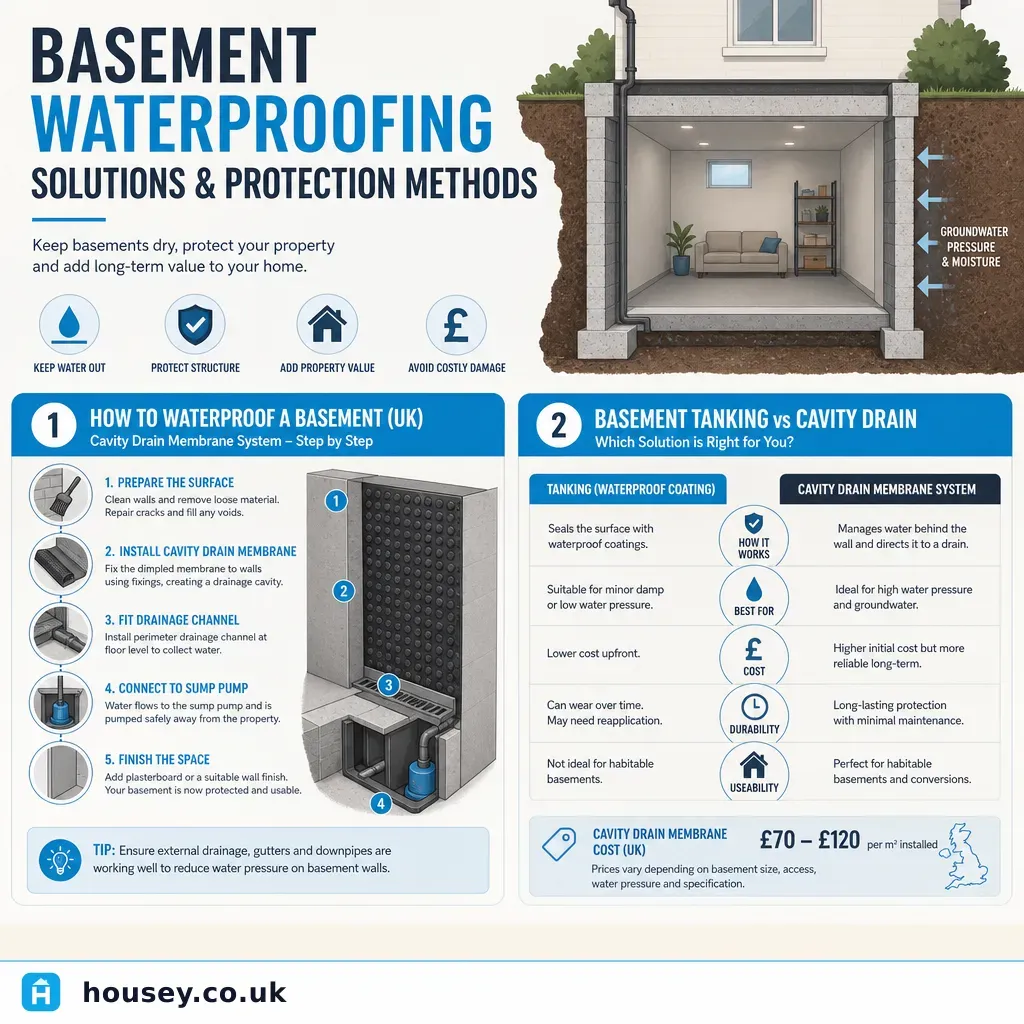
Basement Waterproofing Solutions and Protection Methods
Basement waterproofing in the UK uses one of three system types defined in BS 8102:2022: Type A (barrier tanking), Type B (structurally integral concrete), or Type C (cavity drain with sump pump).