Professional Damp Treatment: Diagnosis, Solutions, and Remedial Options
By Housey · Last reviewed 19th of May 2026
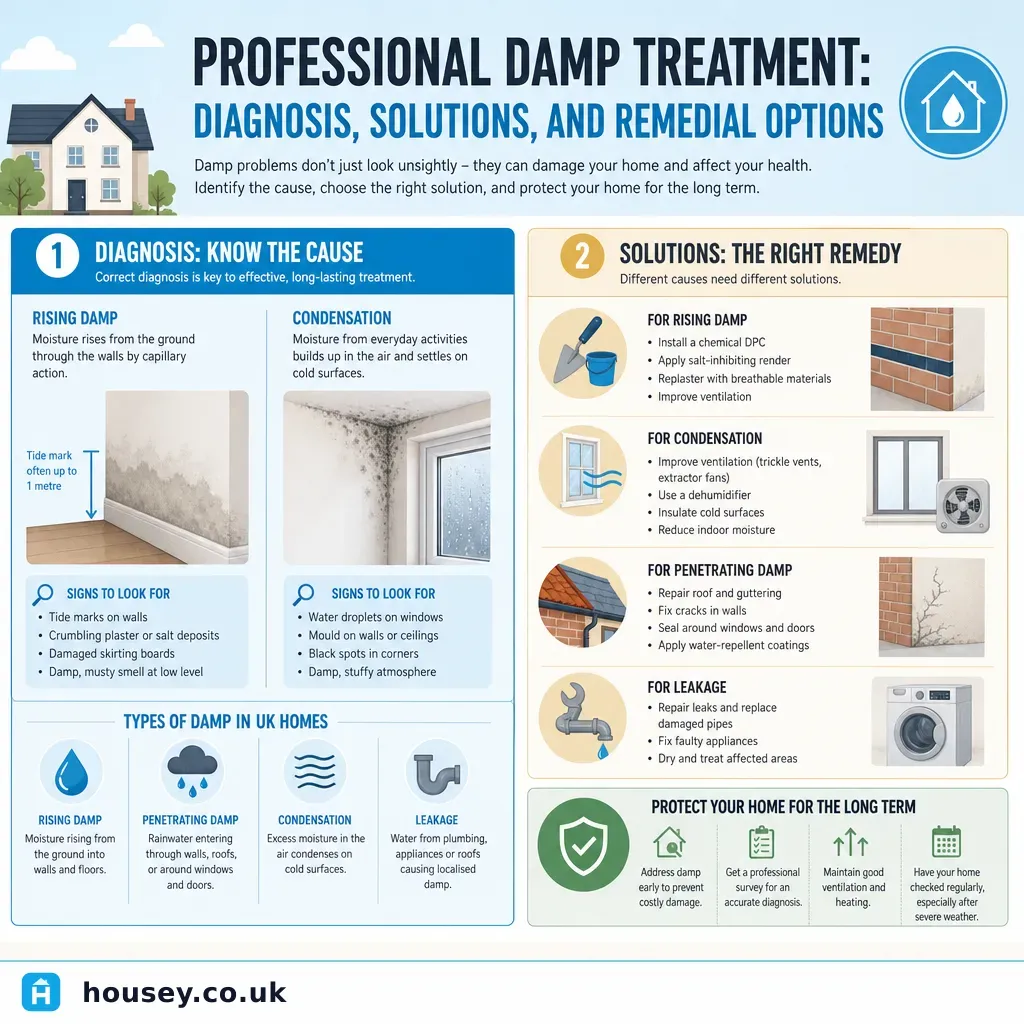
Professional Damp Treatment: Diagnosis, Solutions, and Remedial Options
Damp in a UK property can have several distinct causes — and the wrong treatment not only fails to solve the problem but can make it significantly worse. A professional diagnosis is the foundation of any effective remediation strategy. Whether you have noticed a musty smell, black mould patches, peeling wallpaper, or a salt-stained tide mark on a lower wall, understanding the diagnostic process helps you engage with specialists from an informed position and avoid unnecessary or counterproductive remedial work.
Key points
- The three main categories of dampness in UK housing are rising damp, penetrating (lateral) damp, and condensation — each has different causes, characteristic locations, and remedies.
- A proper professional damp diagnosis should include physical sampling and laboratory testing, not just surface electrical moisture readings, which can produce misleading results on salt-contaminated walls.
- The Property Care Association (PCA) is the main UK trade body for damp and timber specialists; the CSRT (Certificated Surveyor in Remedial Treatments) and CSSW (Certificated Surveyor in Structural Waterproofing) are the relevant professional qualifications.
- Condensation is the most prevalent form of dampness in UK homes according to the English Housing Survey; it is frequently misdiagnosed as rising damp, particularly in post-war properties.
- Where damp is flagged during a property purchase in a RICS Home Survey Level 2 or 3, further specialist investigation should be carried out before exchange of contracts, not after.
Understanding the three types of damp
Rising damp
Rising damp occurs when groundwater is drawn upward through porous masonry by capillary action. It is typically visible on lower sections of walls — usually below 1 m — as a tide mark, salt efflorescence (white crystalline deposits), damp patches, and associated plaster damage or skirting decay. A failed, absent, or physically bridged damp proof course (DPC) is the usual cause. Solid floors without a damp proof membrane can also allow moisture to rise through the floor construction.
The BRE has noted that rising damp is frequently misidentified: condensation and ground-level leaks are often the true source, particularly in post-war housing stock.
Penetrating damp
Penetrating damp results from rainwater entering through the building fabric. It can appear at any level and is typically associated with defective pointing, cracked or failed render, blocked or overflowing gutters, failed window and door seals, and roof defects. In solid-wall properties common in pre-1919 housing, heavy driving rain can saturate the full thickness of an unrendered wall. The pattern of staining — localised, worsening after rain, appearing near external defects — is often diagnostically useful.
Condensation
Condensation forms when warm, moist air comes into contact with cool surfaces. It typically presents as black mould growth in corners, on cold walls, around windows, and in poorly ventilated spaces such as bathrooms and kitchens. It is the most common form of dampness in UK homes, caused by occupancy patterns, inadequate heating, and insufficient ventilation — not a structural building defect. No amount of chemical DPC injection or structural damp proofing will resolve a condensation problem.
Which professional do I need?
Damp problem | Professional to instruct | Qualifications to look for |
|---|---|---|
Suspected rising damp or failed DPC | Damp and timber specialist | PCA member; CSRT qualification |
Basement or below-ground moisture ingress | Structural waterproofing specialist | PCA member; CSSW qualification |
Penetrating damp from external defects | Chartered building surveyor | RICS (MRICS/FRICS) |
Condensation and mould | Building surveyor or energy assessor | RICS; or PAS 2035 retrofit assessor |
Multiple or complex damp issues | Chartered building surveyor | RICS MRICS/FRICS with remediation experience |
Damp in a listed or historic building | Conservation surveyor | RICS; Historic England specialist register |
Decision tree: which treatment is likely appropriate?
Use this as a starting point only — professional diagnosis is always required before committing to any treatment:
- If staining is below 1 m on interior walls, accompanied by salt deposits and a tide mark → suspect rising damp → instruct a PCA CSRT-accredited specialist for investigation.
- If staining is above 1 m, worsens after heavy rain, or is located near gutters, windows, or roof junctions → suspect penetrating damp → instruct a building surveyor to identify the external source before any internal work.
- If the issue is black mould growth in corners, bathrooms, or bedrooms near cold surfaces → suspect condensation → consider ventilation improvements and thermal lining before any structural treatment.
- If the problem is in a basement, cellar, or below-ground habitable space → consider structural waterproofing to BS 8102:2022 standards → instruct a PCA CSSW-accredited specialist.
- If multiple damp types appear to be present, or the pattern is unclear → instruct a chartered building surveyor for a comprehensive defect survey before commissioning any remedial works.
- If you are about to exchange on a property with a flagged damp issue → obtain independent specialist investigation before exchange — a survey flag is not a diagnosis.
What does a professional damp survey involve?
A thorough professional damp investigation typically follows these steps:
- Visual inspection of affected areas, including external examination for potential ingress points.
- Electrical moisture readings using a surface resistance or capacitance meter — useful as a screening tool but not definitive where salt contamination is present.
- Physical sampling of plaster and masonry for gravimetric (oven-drying) analysis — the most reliable method for quantifying moisture content.
- Chemical salt analysis of samples — distinguishing hygroscopic salts (which absorb atmospheric moisture and can mimic active rising damp) from chlorides and nitrates associated with ongoing ingress.
- Structural context review — checking DPC course level relative to external ground level, condition of render, and drainage conditions around the building.
- Written diagnostic report setting out findings, confirmed diagnosis, and recommended treatment — this should be produced before any remedial contract is signed.
A survey conducted without physical sampling or a written diagnostic report is incomplete. Always ask whether samples will be sent for laboratory analysis before instructing a specialist.
Remedial options overview
Once the damp type and source have been confirmed through proper investigation, remedial options typically fall into one of these categories:
- Repair and maintenance first: Repointing, gutter repair, render repair, or window resealing may fully resolve penetrating damp without any structural damp proofing.
- Ventilation and heating improvements: The most cost-effective remedy for condensation — options include positive input ventilation (PIV), mechanical extract ventilation (MEV), and improved wall insulation to reduce cold bridging.
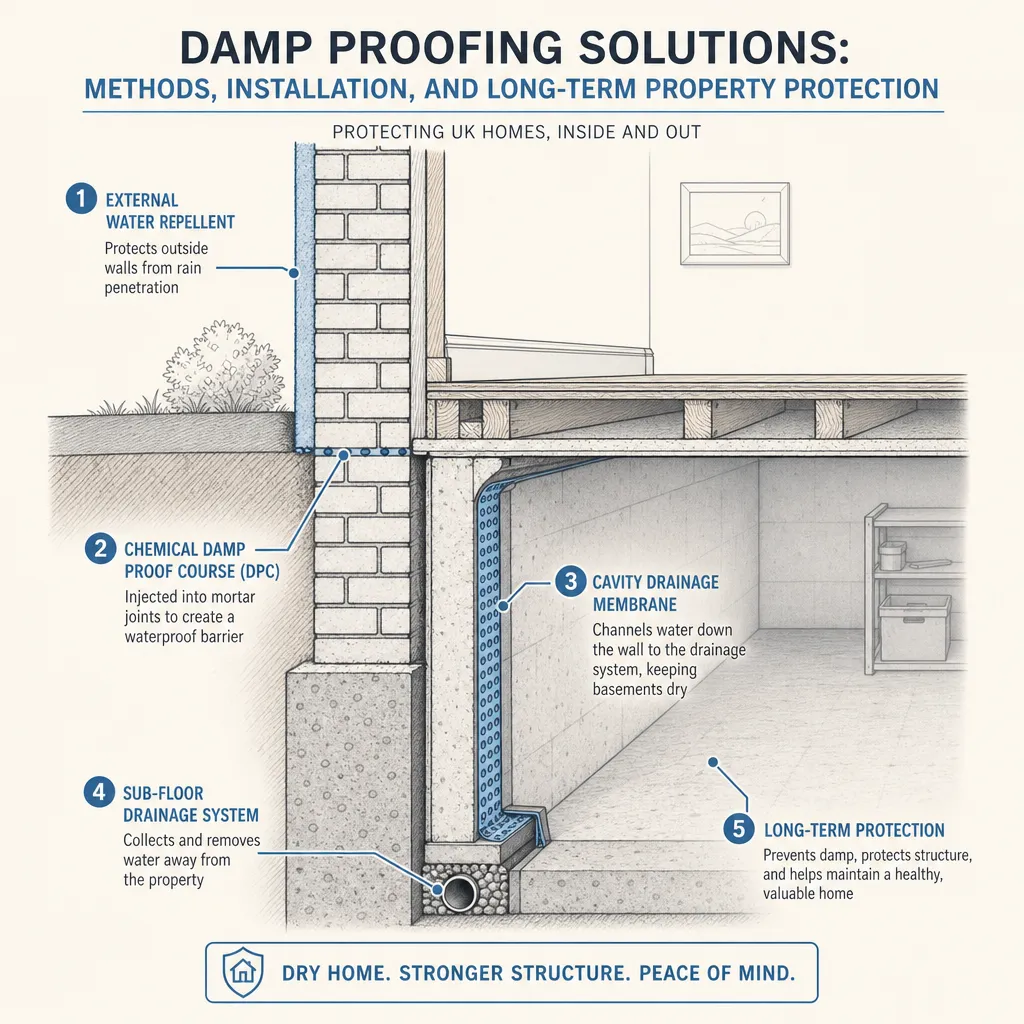
- Chemical DPC injection: Appropriate only where rising damp has been properly confirmed — reinstates a horizontal moisture barrier and requires replacement of salt-damaged plaster with renovating plaster.
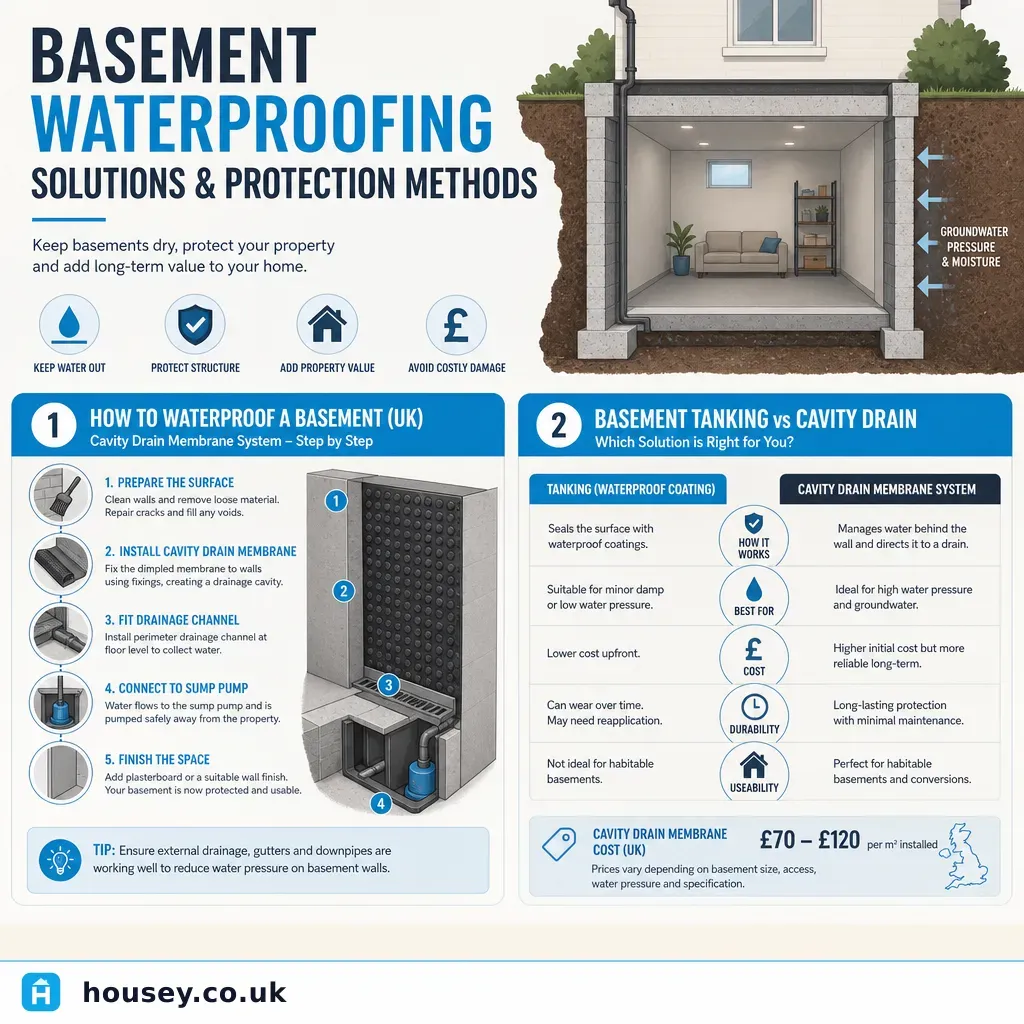
- Cavity drainage systems: For below-ground spaces where exclusion of moisture is not achievable — channels water to a sump and pump for active management.
- Tanking and structural waterproofing: For basements and below-ground structures resistant to hydrostatic pressure, following BS 8102:2022 guidance.
The appropriate method is determined by diagnosis, not default preference. A thorough investigation may reveal that a simple maintenance repair is all that is needed.
Important limitations
This article provides general educational information about damp types and diagnostic approaches in the UK. Damp can have multiple concurrent causes, and its proper assessment requires physical access, sample analysis, and professional judgement — factors that cannot be replicated by a written guide.
This guidance does not apply to listed buildings, buildings in conservation areas, or properties with complex historic construction without specialist conservation advice. Standard damp proofing methods can cause serious and irreversible harm to historic fabric if incorrectly applied.
What to ask a qualified professional
- What diagnostic method will you use, and will physical samples be taken for laboratory analysis?
- Will your survey report include a confirmed diagnosis before any treatment is recommended?
- Is the recommended treatment appropriate for this specific construction type (solid wall, cavity wall, below-ground)?
- Are you a PCA member, and do you hold the CSRT or CSSW qualification relevant to this type of problem?
- Will you provide an insurance-backed guarantee, and how long does it run?
- What maintenance or ventilation improvements should accompany the treatment?
- What risk is there of the treatment trapping moisture within the wall construction?
When to get professional help
Seek a professional damp survey rather than relying on visual assessment alone if:
- A RICS survey has flagged suspected damp before exchange of contracts
- You have applied previous remedies — replastering, mould-resistant paint — that have recurred within months
- You notice decay in skirting boards, floor joists, or structural timbers near affected areas
- The property was built before 1919 and has solid masonry walls
- You are planning a renovation or retrofit project and need to establish the moisture condition of the walls first
- Multiple rooms show different damp patterns suggesting more than one underlying cause
How Housey can help
Housey matches homeowners with qualified damp proofing specialists across the UK. Submit your project to receive quotes from PCA-accredited professionals who carry out proper diagnosis before recommending any treatment. Find damp treatment professionals near you through the Housey platform.
Frequently asked questions
How do I know if I have rising damp or condensation?
Rising damp typically appears on lower walls (below 1 m), is accompanied by salt deposits or a tide mark, and may be present even when the property is well-heated. Condensation usually appears as black mould in corners and around windows, worsening in cold weather and improving with heating and ventilation. A professional damp survey with laboratory sample analysis is the most reliable way to distinguish them.
Can I treat damp myself without a specialist?
Minor condensation can often be reduced through better ventilation, heating, and insulation — these are not specialist tasks. However, structural damp proofing (DPC injection, cavity drainage, tanking) should not be undertaken without professional diagnosis and, in most cases, professional installation. Incorrectly applied treatments can trap moisture, damage plasterwork, and void any existing guarantees.
How long does damp treatment take?
Timescales vary by method and extent of damage. A chemical DPC injection with replastering typically takes a few days for the injection, followed by 6–8 weeks for the new plaster to dry before decoration. Basement waterproofing projects can take 1–4 weeks depending on scope. Your contractor should provide a clear programme before any work begins.
What guarantees should a damp treatment come with?
Reputable PCA-accredited damp specialists typically provide guarantees of 20–30 years, which should be insurance-backed by a recognised scheme. Obtain the documentation before works begin, check it is transferable to a future buyer, and confirm what could void it — for example, subsequent structural damage, flooding, or modifications to the drainage system.
Sources and further reading
- Property Care Association: guidance for homeowners — Property Care Association
- BRE Good Repair Guide 6: treating rising damp in houses — Building Research Establishment
- Historic England: moisture in historic buildings — Historic England
- English Housing Survey 2022–23 — Ministry of Housing, Communities and Local Government
Useful next reads
 Improvement & Build
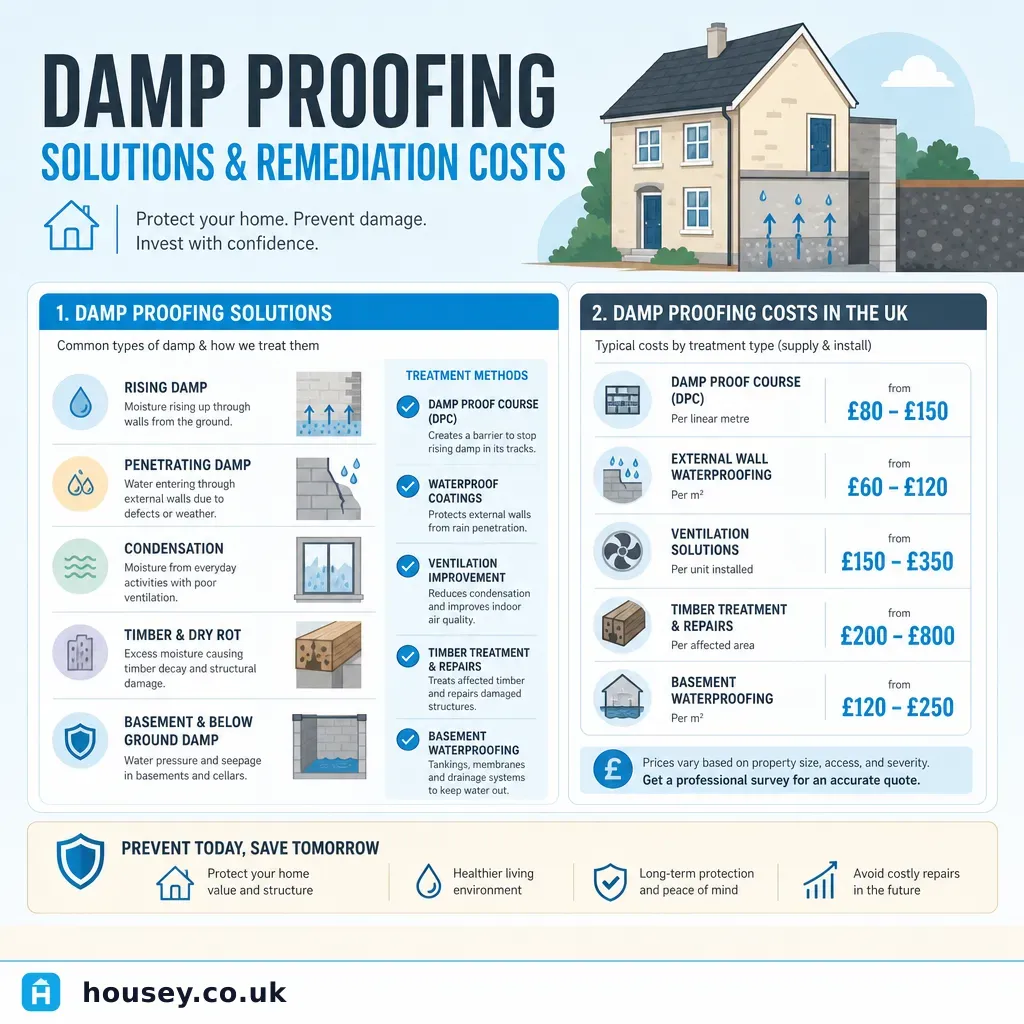
Damp Proofing Solutions and Remediation Costs
Damp proofing costs depend on the type of damp present: ventilation improvements for condensation start at around £300–£700, chemical DPC injection plus replastering typically costs £1,500–£3,500, and full basement waterproofing can reach £7,000–£15,000 or more.
 Improvement & Build
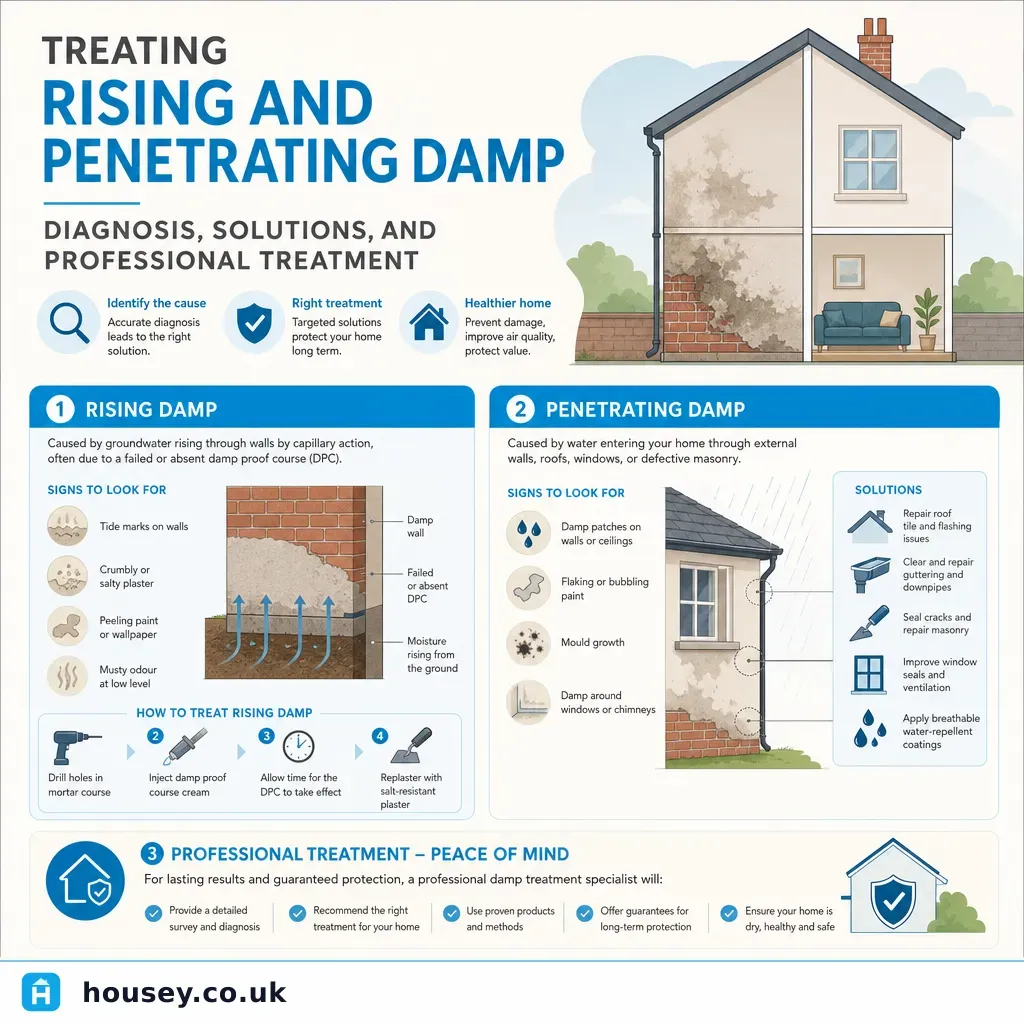
Treating Rising and Penetrating Damp: Diagnosis, Solutions, and Professional Treatment
Rising damp appears as a tide mark at the base of ground-floor walls and is caused by a failed or absent damp-proof course.
 Improvement & Build
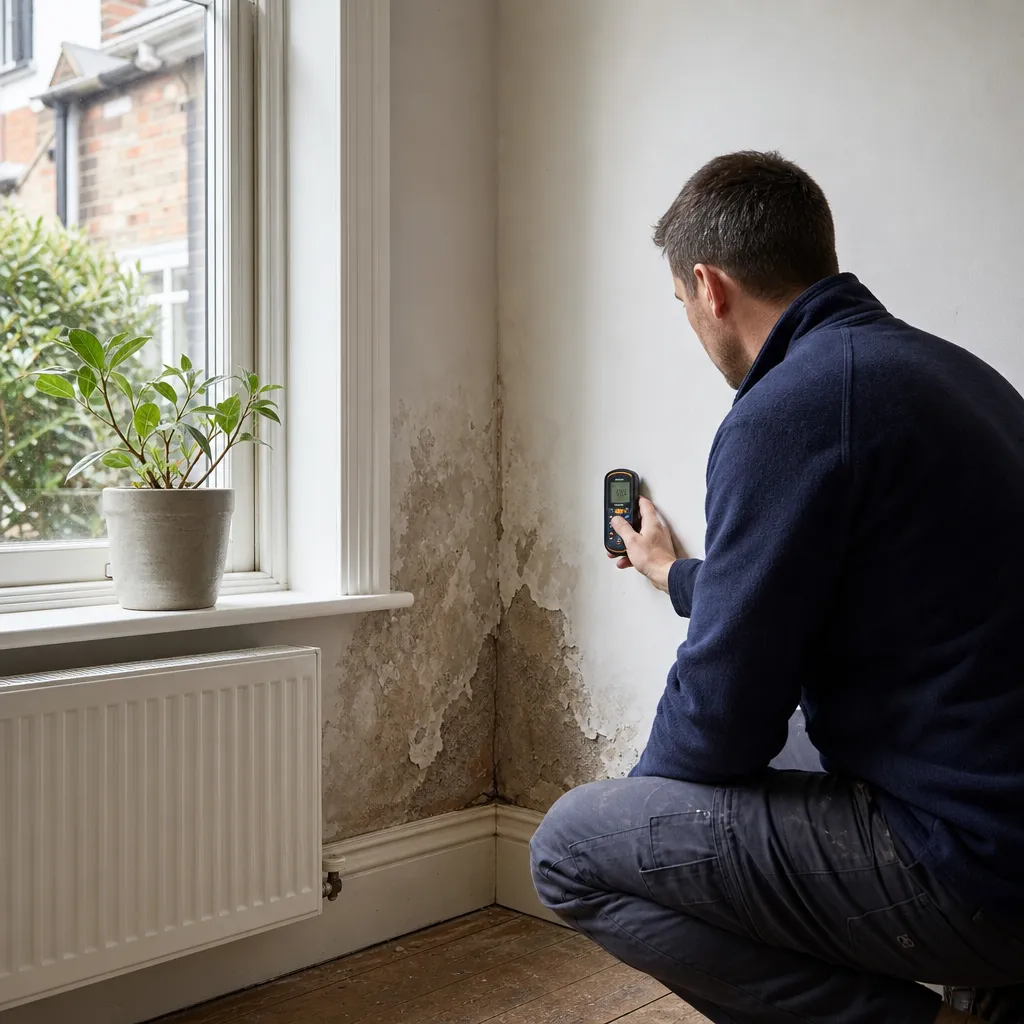
Identifying and Treating Damp Before Interior Decoration: Remediation First
Decorating before treating damp guarantees early failure — paint and wallpaper will bubble, stain, and peel within months.
 Improvement & Build
Damp Proofing Solutions: Methods, Installation, and Long-Term Property Protection
Damp proofing in UK homes typically involves chemical damp proof course (DPC) injection for rising damp, cavity drainage membranes for basement or below-ground moisture, and tanking for waterproofing solid walls.
 Improvement & Build
Basement Waterproofing Solutions and Protection Methods
Basement waterproofing in the UK uses one of three system types defined in BS 8102:2022: Type A (barrier tanking), Type B (structurally integral concrete), or Type C (cavity drain with sump pump).