Understanding Property Surveys: Types and Services Available
By Housey · Last reviewed 30th of May 2026
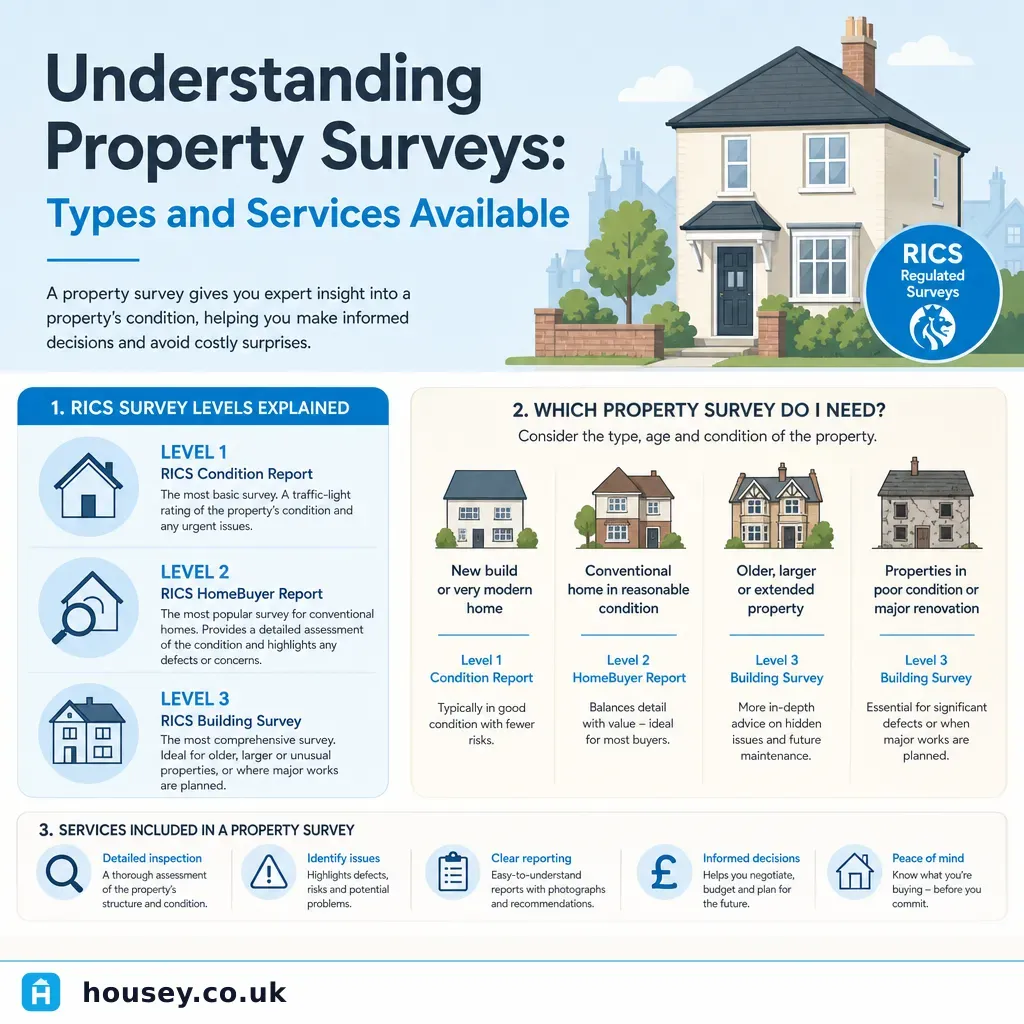
Understanding Property Surveys: Types and Services Available
Property surveys are usually commissioned before exchange of contracts on a residential purchase — and choosing the wrong level can mean missing significant defects, receiving inadequate repair guidance, or paying for more detail than the property warrants. The three RICS-defined survey levels and a range of specialist reports serve distinct purposes, and understanding the differences is one of the most practical steps a buyer can take before committing legally to a purchase.
Key points
- RICS introduced its current Home Survey Standard in March 2021, defining three levels: Level 1 (Condition Report), Level 2 (Home Survey), and Level 3 (Building Survey).
- A mortgage lender's valuation is not a survey — it assesses the property as security for the loan, not its condition, and is produced for the lender, not the buyer.
- Level 2 surveys use a traffic-light condition rating system (1 = no repair needed, 2 = repairs or maintenance needed, 3 = urgent or significant repair needed).
- Properties built before 1919 typically use solid-wall or timber-frame construction that warrants a Level 3 survey rather than Level 2.
- Specialist reports — structural engineering assessments, damp surveys, drainage CCTV surveys, and asbestos surveys — are separate from RICS survey levels and address specific defects in greater technical depth.
What is a RICS property survey?
A property survey is an independent inspection by a qualified surveyor to assess a building's condition. In England and Wales, most residential surveys follow the RICS Home Survey Standard (1st edition, effective March 2021), which defines scope, methodology, and reporting obligations across the three levels. RICS-qualified surveyors hold MRICS or FRICS designation and are bound by RICS regulation.
Scotland operates differently: sellers must commission a Home Report — comprising a Single Survey, an Energy Report, and a Property Questionnaire — before marketing their property. The Single Survey is broadly equivalent to a RICS Level 2 in scope.
Comparing the three RICS survey levels
Level | Name | Best for | Not ideal for | Report includes |
|---|---|---|---|---|
Level 1 | Condition Report | New-build or near-new conventional homes with no visible defects | Older, altered, or unusual properties | Traffic-light ratings only; no repair advice or cost guidance |
Level 2 | Home Survey | Conventional post-1919 homes in reasonable condition | Pre-1919 properties, significant alterations, visible major defects | Condition ratings 1–3, commentary on defects, maintenance notes |
Level 3 | Building Survey | Pre-1919 homes, unusual construction, listed buildings, visibly defective properties | Straightforward new-builds where cost is rarely justified | Full structural commentary, repair options, indicative cost guidance |
Source: RICS Home Survey Standard (1st edition), RICS, 2021.
Which survey level do you need?
- Choose Level 1 if the property is a new-build or near-new home of conventional construction with no visible defects and you want a concise, low-cost condition overview.
- Choose Level 2 if the property is a conventional post-1919 home in apparent good condition and you want a thorough independent assessment without full structural investigation.
- Choose Level 3 if the property was built before 1919, shows visible defects or signs of damp, has had significant alterations, is of non-standard construction (timber frame, thatched roof, concrete panels), or is a listed building.
- Request a specialist report if your surveyor flags a specific concern — cracking, suspected subsidence, rising damp, or asbestos-containing materials — that requires targeted technical investigation beyond the scope of a RICS survey.
- Ask your surveyor if you are unsure: RICS members are required to recommend the appropriate level for the property being inspected.
Specialist and supplementary survey types
RICS Home Surveys are general-condition assessments. Where they identify potential concerns, specialist reports provide the technical depth needed to understand severity and likely cost.
Structural engineer's assessment — required where cracking, movement, or suspected subsidence is identified. A chartered structural engineer (MIStructE or CEng) can diagnose whether movement is active or historic and specify remedial works. This is a separate commission from a RICS survey.
Damp and timber survey — investigates moisture ingress, rising damp, condensation, and timber decay including woodworm, wet rot, and dry rot. Ensure the surveyor is independent of any remedial contractor to avoid a conflict of interest.
Drainage CCTV survey — a camera inspection of underground drainage to identify fractures, blockages, root ingress, or drainage misconnections. Particularly useful for older properties with unknown or shared drainage arrangements.
Asbestos survey — required for properties built or altered before 2000 where intrusive work is planned, or where asbestos-containing materials are visible or suspected. The HSE recognises two types: a Management Survey (non-intrusive) and a Refurbishment/Demolition Survey (intrusive). Only competent asbestos surveyors should carry these out — do not disturb suspected asbestos-containing materials.
Electrical Installation Condition Report (EICR) — assesses whether the electrical installation is safe and meets BS 7671 requirements. Mandatory for landlords in England under The Electrical Safety Standards in the Private Rented Sector (England) Regulations 2020.
Mortgage valuations are not surveys
A lender's valuation — whether desktop, drive-by, or a brief physical inspection — is carried out for the lender's benefit to confirm the property is adequate security for the mortgage. It does not report on condition, identify defects, or protect the buyer. Both RICS and Citizens Advice recommend buyers commission their own independent survey regardless of the lender's valuation.
Important limitations
This article describes survey types in England and Wales. The Scottish Home Report system differs significantly. Survey scope, surveyor qualifications, and legal implications may vary by property type, tenure (leasehold versus freehold), and specific instruction. Nothing in this article constitutes professional advice for any specific property; a qualified surveyor should recommend the appropriate survey level for your purchase.
What to ask a qualified professional
Before instructing a surveyor:
- What RICS survey level do you recommend for this property, and why?
- Are you MRICS or FRICS qualified?
- Does the Level 3 report include indicative repair cost ranges?
- If you identify a specific concern, will you advise on follow-up specialist reports?
- How long will the inspection take, and when will I receive the written report?
- Is VAT included in your fee?
When to get professional help
Commission a survey before you exchange contracts — once exchange occurs you are legally committed to the purchase. Seek professional advice immediately if:
- Your survey flags active structural movement, suspected subsidence, or extensive damp.
- The report includes multiple condition rating 3 items (urgent repair needed).
- Asbestos-containing materials are suspected or identified.
- A Level 2 report explicitly recommends a specialist engineer's report or further investigation.
How Housey can help
Housey connects buyers with RICS-qualified surveyors across the UK. If you need a RICS Level 2 Home Survey for a conventional home or a more comprehensive RICS Level 3 Building Survey for an older or complex property, you can compare qualified surveyors and request quotes through the platform. For a new-build or near-new home, a RICS Level 1 Condition Report may be the appropriate starting point.
Frequently asked questions
Do I need a survey if I'm buying with cash?
Yes — arguably more so. Without a mortgage lender requiring even a basic valuation, there is no independent professional assessment of the property. A survey protects your investment regardless of how you finance the purchase, and the findings may inform your negotiating position or, in serious cases, your decision to withdraw before exchange.
Can a survey finding be used to renegotiate the purchase price?
A survey report is frequently used to renegotiate the price or request remedial works before exchange, particularly where significant defects are identified. Sellers have no legal obligation to reduce the price or carry out works, so the outcome depends on negotiation. Your solicitor can advise on the most effective approach and timing.
What is the difference between a survey and a Home Report in Scotland?
In Scotland, sellers must commission a Home Report — comprising a Single Survey, Energy Report, and Property Questionnaire — before marketing their property. The Single Survey is broadly equivalent to a RICS Level 2 and is paid for by the seller. Buyers can rely on this report but may also commission their own independent survey.
How long does a property survey take?
A Level 2 survey on a typical semi-detached home usually takes two to four hours on site. A Level 3 Building Survey on a larger or more complex property may take a full day. Written reports are typically delivered within three to five working days, though turnaround times vary between firms and during busy periods.
Sources and further reading
- RICS Home Survey Standard — Royal Institution of Chartered Surveyors
- Buying or selling your home — GOV.UK
- Surveys and valuations — Citizens Advice
- Control of Asbestos Regulations 2012 — legislation.gov.uk
- Electrical Safety Standards in the Private Rented Sector (England) Regulations 2020 — legislation.gov.uk
Useful next reads
 Surveys & Inspections
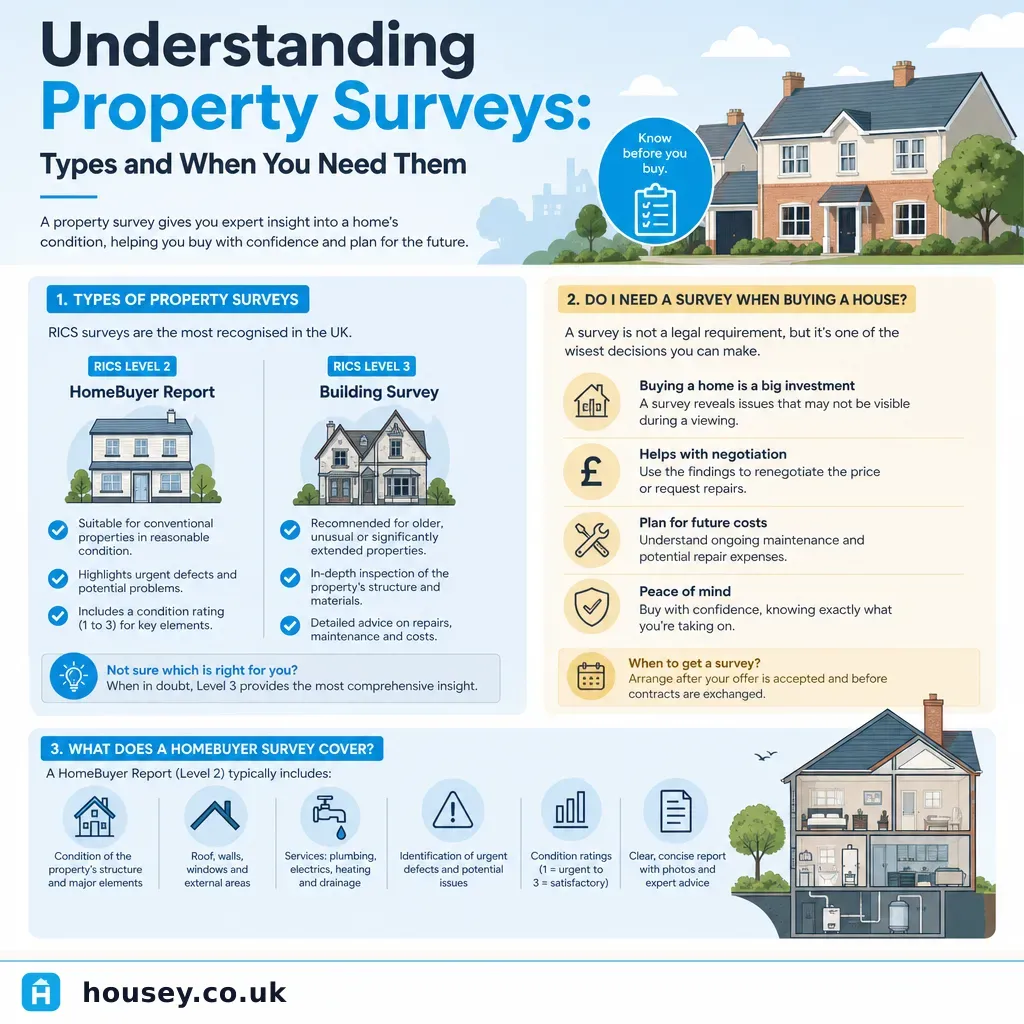
Understanding Property Surveys: Types and When You Need Them
The three main RICS survey types are the Level 1 Condition Report (for standard properties in good condition), the Level 2 Home Survey (conventional homes in reasonable condition), and the Level 3 Building Survey (older, unusual, or defective properties).
 Surveys & Inspections
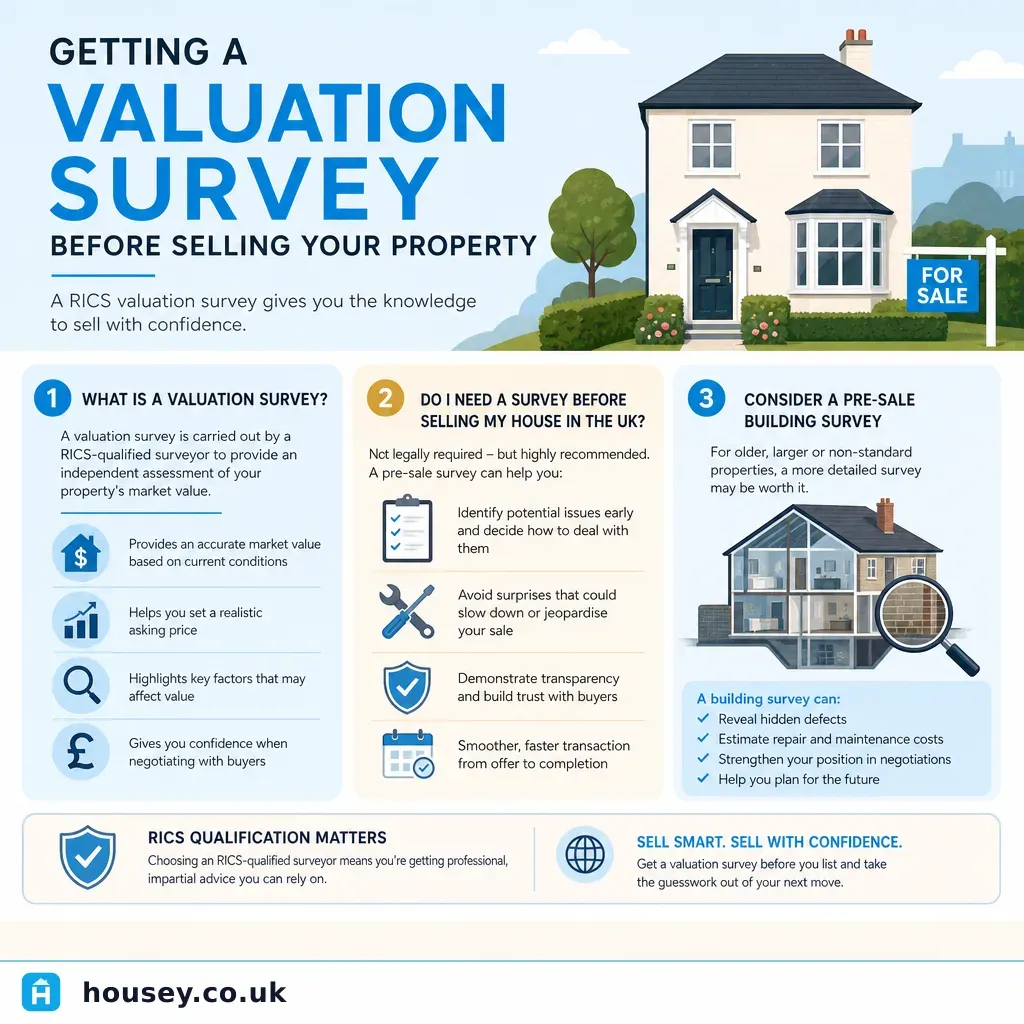
Getting a Valuation Survey Before Selling Your Property
Before selling, a free estate agent appraisal gives a market price guide, but only a RICS Red Book valuation carries formal professional standards and legal weight.
 Surveys & Inspections
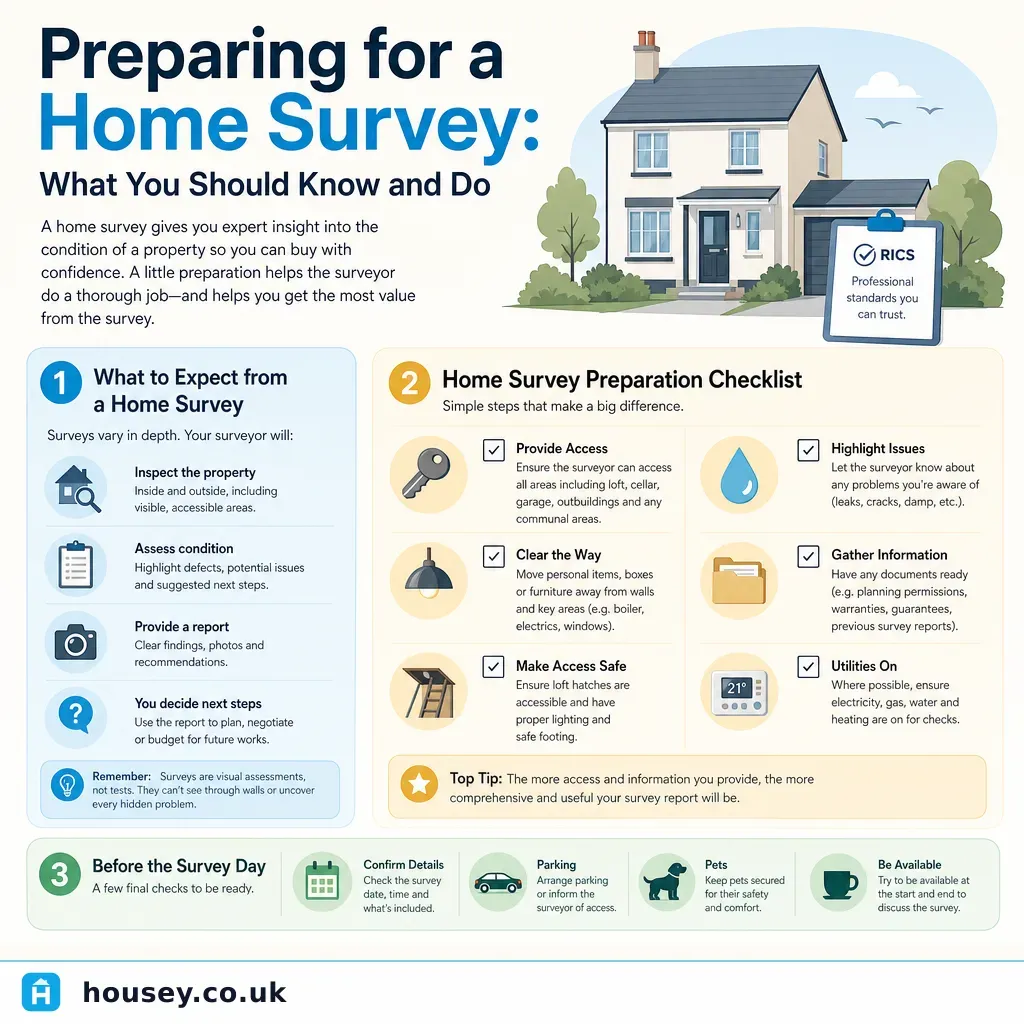
Preparing for a Home Survey: What You Should Know and Do
Preparing for a home survey means giving the surveyor clear access to all parts of the property, gathering relevant documents such as planning permissions and Building Regulations certificates, and knowing in advance which survey level has been instructed.
 Surveys & Inspections
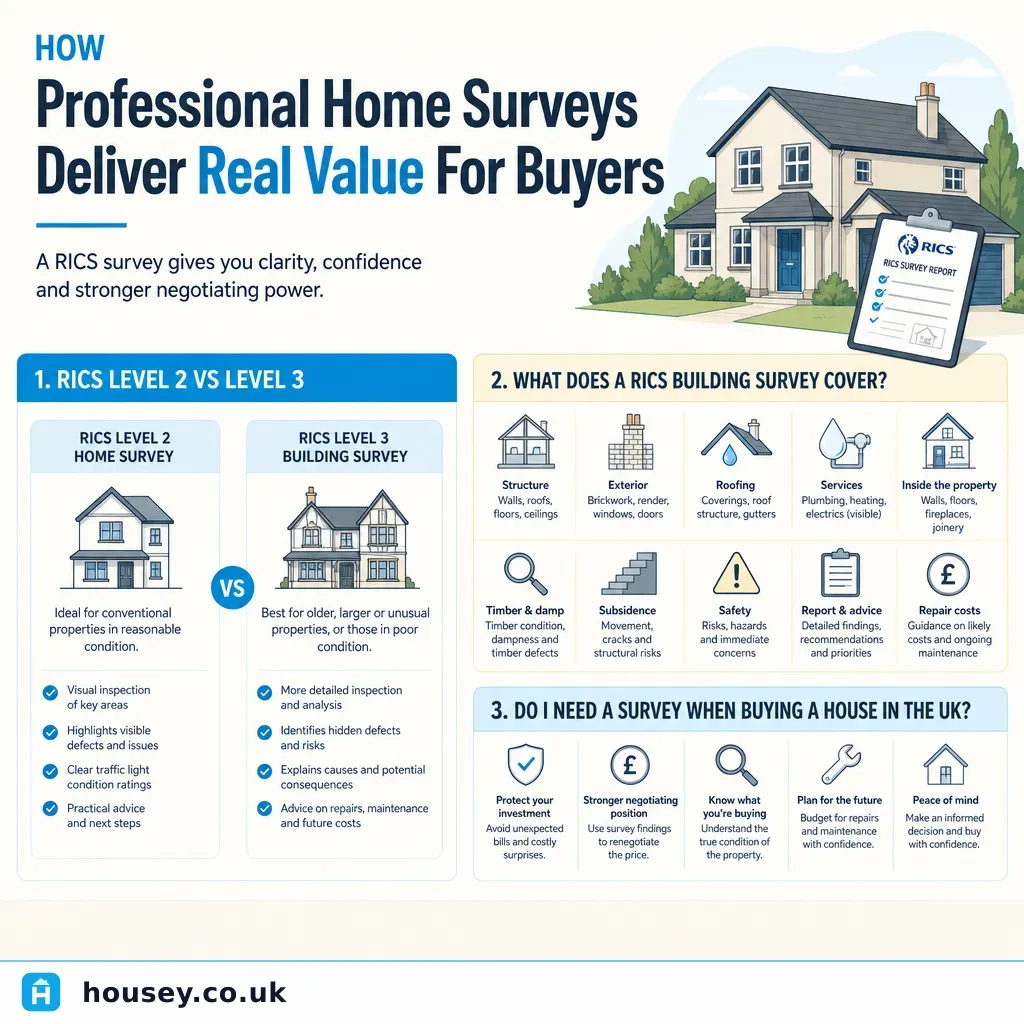
How Professional Home Surveys Deliver Real Value For Buyers
A professional home survey by a RICS-registered surveyor can identify defects, legal compliance gaps, and cost liabilities before exchange of contracts, giving buyers an evidence base for negotiation or withdrawal.
 Surveys & Inspections
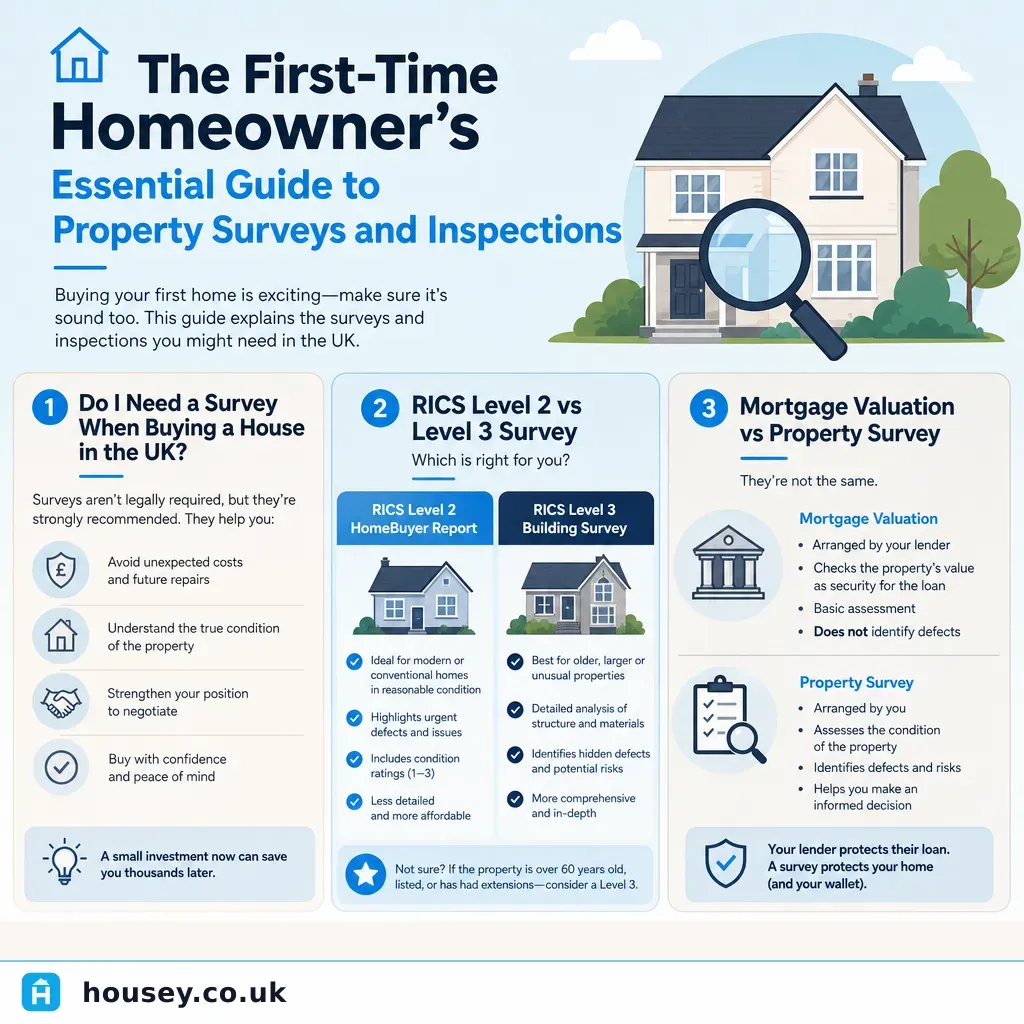
The First-Time Homeowner's Essential Guide to Property Surveys and Inspections
First-time buyers in the UK need more than the mortgage valuation — that report protects the lender, not you.