Water Leak Detection and Prevention in UK Homes
By Housey · Last reviewed 10th of May 2026
Water Leak Detection and Prevention in UK Homes
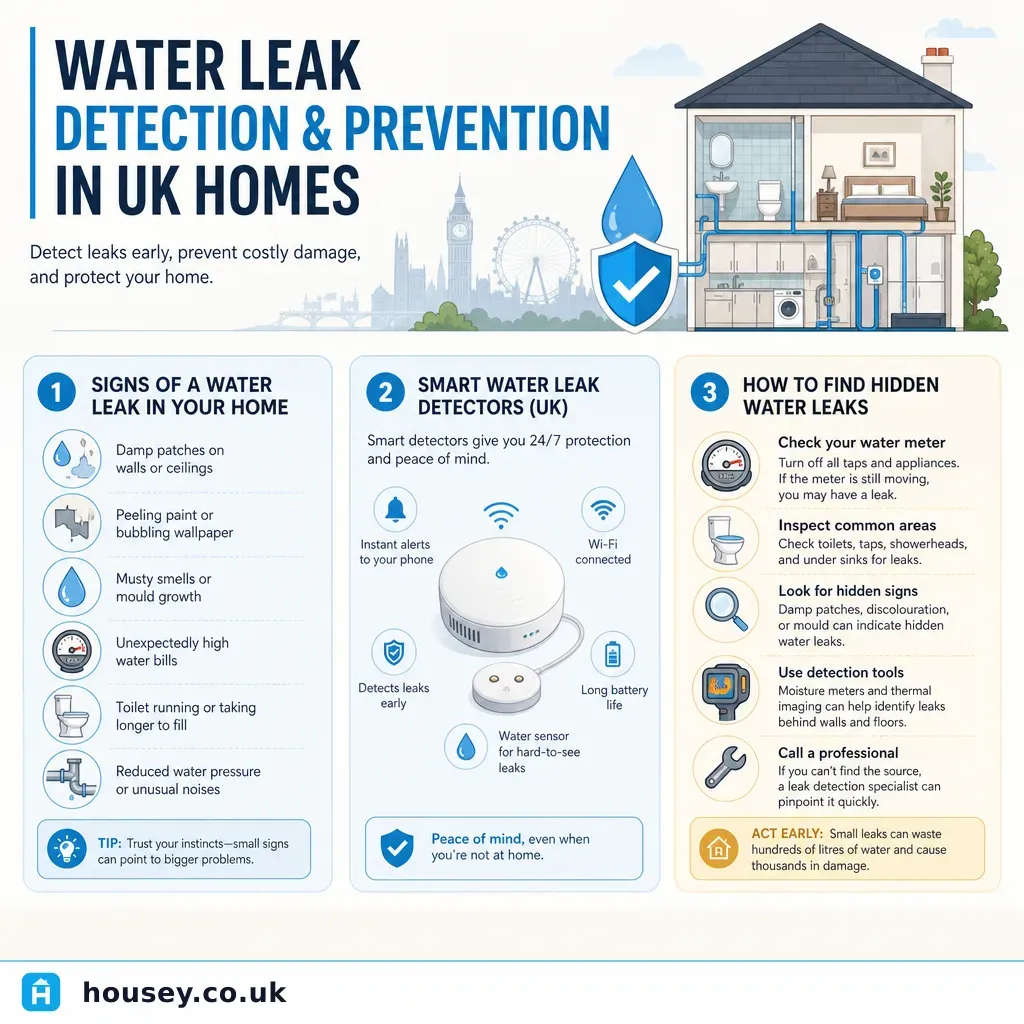
Water leaks are among the most costly causes of home insurance claims in the UK, with the Association of British Insurers (ABI) reporting that escape of water claims cost the industry over £1.8 billion each year. Damage often develops slowly over months before visible signs appear, meaning that routine checks and detection systems can save homeowners thousands of pounds compared with reactive repair after significant water damage has occurred.
Key points
- The average UK escape-of-water insurance claim exceeds £9,000, making early detection far more cost-effective than reactive repair (Association of British Insurers data).
- Smart water leak sensors start from around £15–£30 for basic battery-powered units, while whole-home automatic shutoff systems cost approximately £300–£800 installed (indicative UK costs, last reviewed 2026-05-10).
- A water meter reading that continues to rise with all appliances turned off is a reliable indicator of an active concealed leak.
- Most UK home insurance policies require prompt notification of water damage; delayed reporting may affect the validity of a claim.
- Clay-soil areas — including large parts of London, the Midlands, and Essex — face higher risk of drain movement and root intrusion, increasing underground leak frequency.
How to identify a water leak in your home
Early signs of a water leak are often subtle. Common indicators include:
- Unexplained increases in water bills with no change in household usage habits
- Damp patches on walls, ceilings, or floors — particularly persistent after rainfall or on ground-floor areas
- A water meter that continues to move with all taps, appliances, and the boiler switched off
- Soft or discoloured patches on timber floors or skirting boards
- Mould or mildew growth in rooms that are not typically humid
- A persistent musty smell in areas near pipework runs
The meter test: Turn off all water appliances and record your meter reading. Wait 30 minutes without using any water, then check again. If the reading has moved, you have an active leak somewhere in the system. Your water supplier can advise if you are unsure how to read your meter type.
Types of water leak and where they typically occur
Leak type | Common locations | Likely cause | Who to call |
|---|---|---|---|
Pipework leak | Under floors, within walls, loft space | Corrosion, joint failure, freeze damage | Plumber |
Roof or flashings leak | Ceilings, top-floor walls | Failed leadwork, broken tiles, blocked gutters | Roofer |
Drain or sewer leak | Ground floor, under slab, garden | Root intrusion, pipe movement in clay soils | Drainage contractor |
Appliance leak | Under kitchen or utility units | Failed hose, worn seal | Plumber or appliance engineer |
Shower tray or bath leak | Adjacent walls and below floor | Failed grout, cracked tray, poor silicone seal | Tiler or plumber |
Which leak detection method should you use?
- Use smart water sensors if you want ongoing passive monitoring; place them under sinks, behind the washing machine, and near the boiler or hot water cylinder.
- Use a whole-home shutoff valve if you travel frequently or have a second property — these systems cut the water supply automatically when abnormal flow patterns are detected.
- Check your water meter if you suspect a hidden leak but have no visible signs; this is a free and immediate first step.
- Arrange a damp and timber survey if moisture is already visible on walls, floors, or timber — a professional survey will identify the source and extent of any damage to the building fabric.
- Commission a CCTV drain survey if the leak appears to originate from underground drainage, particularly in properties with clay-heavy soil or mature trees close to the building.
- Call a plumber immediately if you can hear water running continuously with all taps off, if boiler pressure is dropping without explanation, or if you can see active water ingress.
Passive prevention: reducing your leak risk
Many leaks are avoidable with routine annual maintenance. Addressing small issues before they become large ones is the most cost-effective approach.
Annual checks homeowners should make:
Smart water monitoring technology
Battery-powered water leak sensors have become inexpensive and widely available in the UK. They sound an audible alarm when water contacts their probe, giving early warning before damage escalates. More sophisticated systems include:
- Wi-Fi-connected sensors that send push notifications to your smartphone — particularly useful when you are away from home.
- Whole-home shutoff valves (such as Grohe Sense Guard or Phyn Plus) that monitor flow patterns and can automatically close the main stopcock when abnormal usage is detected. These require professional installation and connection to the main incoming supply.
- Insurance-linked devices — some UK insurers offer premium reductions for properties fitted with whole-home leak detection; check with your provider before purchasing a system.
What to do when you find a leak
- Locate your stopcock and turn off the water supply immediately to limit further damage.
- Photograph everything before starting any clean-up — your insurer will need evidence of the damage and its cause.
- Call your insurer to notify them promptly; most policies require notification within a reasonable time, and some specify 24–48 hours.
- Do not attempt to dry out a wet area rapidly using only electric heaters — controlled drying with dehumidifiers and professional guidance reduces the risk of secondary mould growth and structural damage.
- Arrange a trace and access survey if the leak source is not immediately obvious; specialist contractors use thermal imaging and acoustic equipment to pinpoint the problem without unnecessary opening up of walls or floors.
When to get professional help
Contact a professional when:
- Visible water staining on ceilings grows in size following rain — likely a roof or flashing issue requiring a roofer's inspection.
- Damp patches at the base of walls persist through dry weather — a damp and timber survey is the appropriate first step to identify whether rising damp, drainage, or a below-slab pipe is the cause.
- Subsidence or movement signs accompany the damp — cracking walls or sticking doors or windows — where a drain leak may be softening the ground beneath foundations.
- Repeated drain blockages or sewage odours suggest a CCTV drain survey is needed to rule out structural damage to underground drainage.
- The leak has been running for an unknown period and significant structural timber or masonry may have been affected.
How Housey can help
Housey can connect you with qualified drainage contractors for a CCTV drain survey or with RICS-accredited surveyors for a damp and timber survey to identify the source and extent of moisture damage in your home. Use Housey to compare quotes and qualifications before instructing anyone.
Frequently asked questions
How do I find my stopcock?
Most UK homes have a stopcock under the kitchen sink, though it may also be in a utility room, garage, or under the stairs. Turn it clockwise to close the water supply. If you cannot locate it internally, there is usually an external stop tap set into the pavement outside the property, which your water company can operate for you.
Will my home insurance cover a water leak?
Most UK home insurance policies cover escape of water — leaking pipes, tanks, or fixed appliances — but not gradual seepage or damage from poor maintenance. Excess amounts for escape of water can be high; £250–£500 is common. Always check your policy wording and notify your insurer promptly to protect your claim.
How much does a leak detection survey cost?
A specialist acoustic or thermal-imaging leak detection survey typically costs £150–£400 in the UK depending on the complexity of the search and the property size. A CCTV drain survey costs approximately £100–£300 (indicative UK costs, last reviewed 2026-05-10). These fees may be recoverable via your home insurance policy if a leak is confirmed.
Do I need a plumber or a drainage specialist?
If the leak is from pipework, radiators, or appliances inside the property, call a plumber. If it appears to originate from underground drainage or sewage odours are present, a drainage contractor is more appropriate. A CCTV drain survey will confirm whether the underground system is structurally intact.
Sources and further reading
- Escape of water and home insurance — Association of British Insurers
- Preventing frozen and burst pipes — Energy Saving Trust
- Water meters and monitoring your supply — Ofwat
Useful next reads
 Surveys & Inspections
Damp Surveys: Purpose, Types, and What to Expect
A damp survey is a specialist inspection to identify the source, type, and extent of moisture in a property.
 Surveys & Inspections
How Much Does Leak Detection Cost?
Leak detection in the UK typically costs £150–£600 for a standard residential survey, rising to £1,000 or more for complex cases requiring multiple methods.
 Surveys & Inspections
Gas Leak Emergency: Identifying, Reporting, and Safety Response
If you smell gas in your home, leave immediately without touching electrical switches, call the National Gas Emergency Service on 0800 111 999, and do not re-enter until given the all-clear.
 Surveys & Inspections
Why Property Boundaries Matter: Surveying and Dispute Prevention
Property boundaries in England and Wales are recorded as general boundaries by HM Land Registry — not precise measurements.
 Surveys & Inspections
Safe Property Viewing Practices: Protecting Yourself During Inspections
When viewing a property in the UK, always tell someone where you are going and share the full address before you leave.