Dampproofing vs Waterproofing: Which Solution for Your Property
By Housey · Last reviewed 11th of May 2026
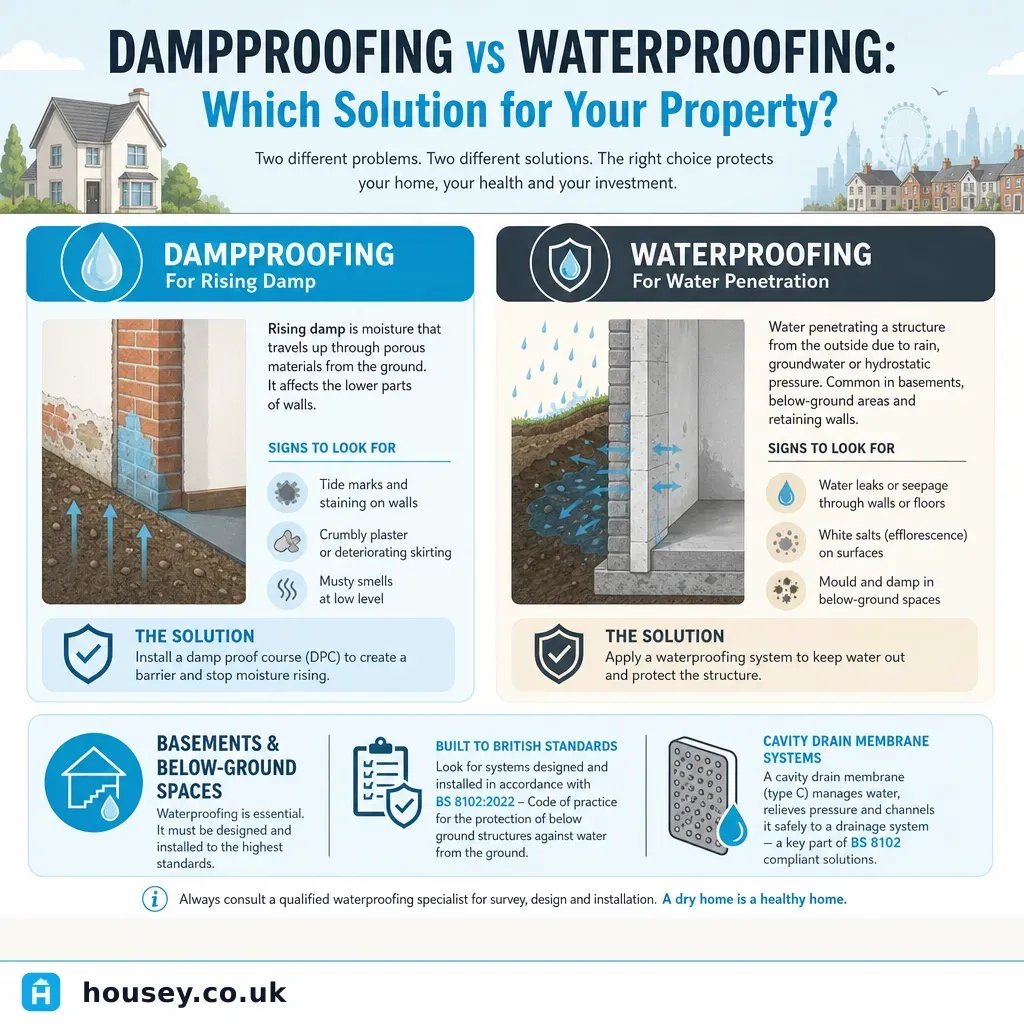
Dampproofing vs Waterproofing: Which Solution for Your Property
When moisture is causing problems below ground or at the base of external walls, the terms 'damp proofing' and 'waterproofing' are often used interchangeably — both by homeowners and, at times, by contractors pitching remedial work. They describe fundamentally different interventions with different performance limits, different costs, and very different consequences if misapplied. Misidentifying the cause of a moisture problem is one of the main reasons damp treatments are repeated without resolving the underlying issue.
Key points
- Damp proofing resists moisture vapour and capillary movement through masonry; waterproofing resists liquid water under hydrostatic pressure — the two are not interchangeable.
- British Standard BS 8102:2022 is the UK reference standard for protection of below-ground structures from water ingress and defines three distinct waterproofing types: Type A (barrier), Type B (structurally integral), and Type C (drained protection).
- BS 8102:2022 classifies four grades of protection — Grade 1 (minor seepage tolerated) through to Grade 4 (fully controlled environment) — and any habitable basement conversion typically requires Grade 3 as a minimum.
- A chemical injection damp proof course addresses rising damp only; it does not address hydrostatic water pressure, penetrating damp, or condensation.
- The Property Care Association (PCA) is the UK trade body for damp and timber treatment specialists; PCA-member contractors have met minimum training standards and can provide insurance-backed guarantees.
The core difference: vapour and capillary movement versus hydrostatic pressure
Rising damp and condensation involve moisture vapour or slow capillary movement — the water is not being forced through the structure under pressure. Damp proofing products (chemical DPC injection, breathable renders, surface coatings) are designed to resist this low-pressure moisture movement.
Waterproofing addresses a different problem: liquid water present in the ground or in a water table that is seasonally higher than the floor slab. This water exerts hydrostatic pressure and will find any gap, crack, or joint in a structure. Applying a damp proofing product to a wall subject to hydrostatic pressure is likely to fail — sometimes within months — because no damp proofing product is rated to resist sustained water pressure.
BS 8102:2022 — the UK standard for below-ground waterproofing
BS 8102:2022 (Protection of below-ground structures from water from the ground) is the primary reference standard for basements, underground car parks, retaining walls, and any habitable or usable space partially or fully below ground level.
The three waterproofing types
Type | Description | Common methods | Best suited to |
|---|---|---|---|
Type A — Barrier protection | Applied membrane or coating on the positive (outside) or negative (inside) face of the structure | Tanking slurry, cementitious coatings, crystalline waterproofing, bituminous membrane | New construction where external access is available; refurbishment where the wall surface is accessible |
Type B — Structurally integral | Waterproofing built into the concrete structure itself | Waterproof concrete with low water/cement ratio, designed construction joints, hydrophilic waterstops | New-build basements where reinforced concrete is the primary structure |
Type C — Drained protection | Cavity drain membrane system intercepts water and directs it to a sump and pump | HDPE cavity drain membrane, perimeter channel drain, electric sump pump | Refurbishment of existing masonry basements where external access is not feasible; where ongoing water ingress is expected |
BS 8102 recommends that for most below-ground refurbishments, a combination of types is used — typically Type A plus Type C, or Type C alone — because relying on a single barrier system increases risk if that system degrades or is breached over time.
The four grades of protection
- Grade 1: Some seepage and damp patches tolerated. Suitable for plant rooms, car parking, and similar utility uses.
- Grade 2: No water penetration but some humidity tolerated. Suitable for workshops, storage areas, and garages.
- Grade 3: Dry, habitable conditions required. For offices, gyms, bedrooms, and living rooms. No water ingress or condensation acceptable.
- Grade 4: Fully controlled humidity and temperature. Required for archives, server rooms, and specialist storage.
Most homeowners converting a basement to a bedroom, office, or living room need Grade 3 as a minimum.
Damp proofing — what it addresses and what it does not
Rising damp
Rising damp is capillary moisture travelling upward through masonry due to the absence or failure of a physical damp proof course. It is typically identified by a tide mark on internal walls at 300 to 900 mm from floor level, salt deposits (efflorescence), and deteriorating plaster at low level.
The standard remedial treatment is a chemical injection DPC — a damp proofing agent injected into a series of drilled holes in the bed mortar course, forming a horizontal barrier against further capillary rise.
What a chemical DPC does not fix:
- Penetrating damp through external walls (a cavity, pointing, or flashing issue)
- Condensation (a ventilation and thermal bridging issue)
- Hydrostatic pressure from groundwater
- Water entering through cracks or failed construction joints
Condensation
Condensation occurs when warm, moist air contacts a cold surface and deposits moisture. No damp proofing or waterproofing treatment resolves condensation — it requires improved ventilation, reduced thermal bridging, and in some cases mechanical ventilation with heat recovery (MVHR).
Decision tree — which treatment applies to your situation?
- Tide mark at low level on internal walls, salt deposits, high moisture readings in wall base after drilling → likely rising damp → chemical injection DPC, followed by replastering with a salt-resistant render.
- Damp patches appearing only after rain at specific external wall locations above ground → likely penetrating damp → investigate pointing, flashings, cavity trays, and the DPC at that location. Not a rising damp or waterproofing issue.
- Basement walls or floor wet, water pooling at floor level, moisture present regardless of recent weather → likely hydrostatic water ingress → waterproofing under BS 8102 required; Type C (cavity drain) is most practical for existing masonry basements without external access.
- Damp smell and condensation on windows and cold surfaces, no visible tide marks → likely condensation → ventilation and insulation review, not a damp treatment.
- Planning a basement conversion from storage to habitable use → BS 8102 Grade 3 waterproofing required regardless of current dryness — ground conditions and the water table can change seasonally and over the building's lifetime.
What to look for in a reputable contractor
Factor | What to check |
|---|---|
Trade membership | PCA (Property Care Association) member; surveyor holds CSRT or CSTDB qualification |
Guarantee | Minimum 20-year written guarantee backed by an insurance-backed warranty (IBW) |
Survey process | Written diagnosis with moisture readings and evidence provided before any quotation |
Standards reference | Explicit reference to BS 8102:2022 for any below-ground waterproofing scope |
Independence | For significant projects, consider an independent BS 8102-qualified surveyor before instructing a treatment contractor |
Indicative UK costs, last reviewed 2026-05-11: chemical DPC injection for a standard ground-floor room typically ranges from £800 to £3,000 including replastering. Cavity drain membrane systems for a single below-ground room typically range from £5,000 to £15,000 depending on floor area, access, and pump specification. Costs vary significantly by region and complexity. Always obtain at least three written quotes.
When to get professional help
Seek professional advice before any treatment if:
- Moisture is present at basement level year-round regardless of recent rainfall — this suggests groundwater rather than surface water infiltration.
- A previous treatment has failed or moisture has returned after remediation.
- You are planning to convert a below-ground space to habitable use.
- A survey has identified both rising damp and penetrating damp — each requires separate diagnosis and treatment.
- The proposed treatment would affect an existing structural warranty or building control certificate.
How Housey can help
Housey connects you with qualified damp proofing specialists who can carry out a proper diagnosis before recommending any treatment — whether that is a chemical DPC, a BS 8102-compliant cavity drain system, or a combined approach. A correct diagnosis before any spend is the most cost-effective first step.
Frequently asked questions
Is waterproofing more expensive than damp proofing?
Usually yes. Chemical DPC injection for rising damp is a relatively low-cost intervention. Waterproofing a below-ground structure to BS 8102 Grade 3 — particularly using a cavity drain membrane with sump and pump — involves more extensive labour, materials, and ongoing pump maintenance. Indicative costs vary significantly by property size, access, and specification. Obtain written quotes from at least three PCA-member contractors before committing.
Does a cavity drain membrane mean my basement will always have water in it?
A Type C system manages ongoing water ingress — it intercepts water entering through the structure and channels it to a sump pump before it can flood the habitable space. The usable surface remains dry, but the system is actively managing water. A pump failure risks flooding, so a dual-pump arrangement or battery backup pump is often recommended for Grade 3 habitable use.
Can I damp proof a basement myself?
Surface-applied products are available, but DIY application without correct diagnosis is unlikely to provide lasting results. Misdiagnosis — treating condensation as rising damp, or applying a damp proofing cream to a wall under hydrostatic pressure — can mask symptoms while the underlying cause worsens. A survey by a qualified PCA-member specialist is strongly recommended before any treatment is committed to.
What is an insurance-backed guarantee and why does it matter for damp work?
An insurance-backed guarantee (IBG) means that if the original contractor ceases trading, a named insurer will honour the remaining guarantee period. For damp proofing and waterproofing — where guarantees typically run for 20 to 30 years — an IBG protects your investment and is important evidence for a buyer's solicitor if you sell the property within the guarantee period.
Sources and further reading
- BS 8102:2022: Protection of below-ground structures from water from the ground — British Standards Institution
- Property Care Association: Guidance on dampness in buildings — Property Care Association
- Approved Document C: Site preparation and resistance to contaminants and moisture — GOV.UK
- Energy Saving Trust: Damp and condensation in the home — Energy Saving Trust
Useful next reads
 Improvement & Build
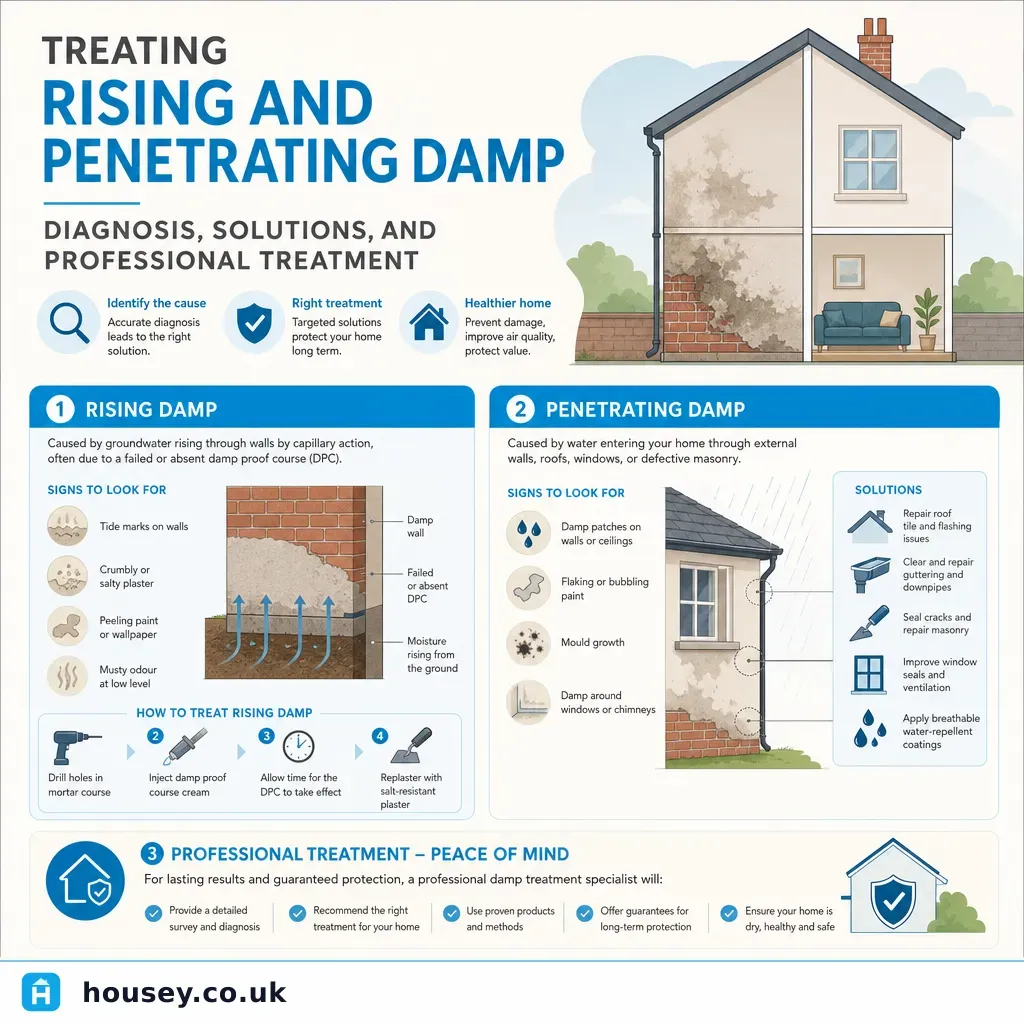
Treating Rising and Penetrating Damp: Diagnosis, Solutions, and Professional Treatment
Rising damp appears as a tide mark at the base of ground-floor walls and is caused by a failed or absent damp-proof course.
 Improvement & Build
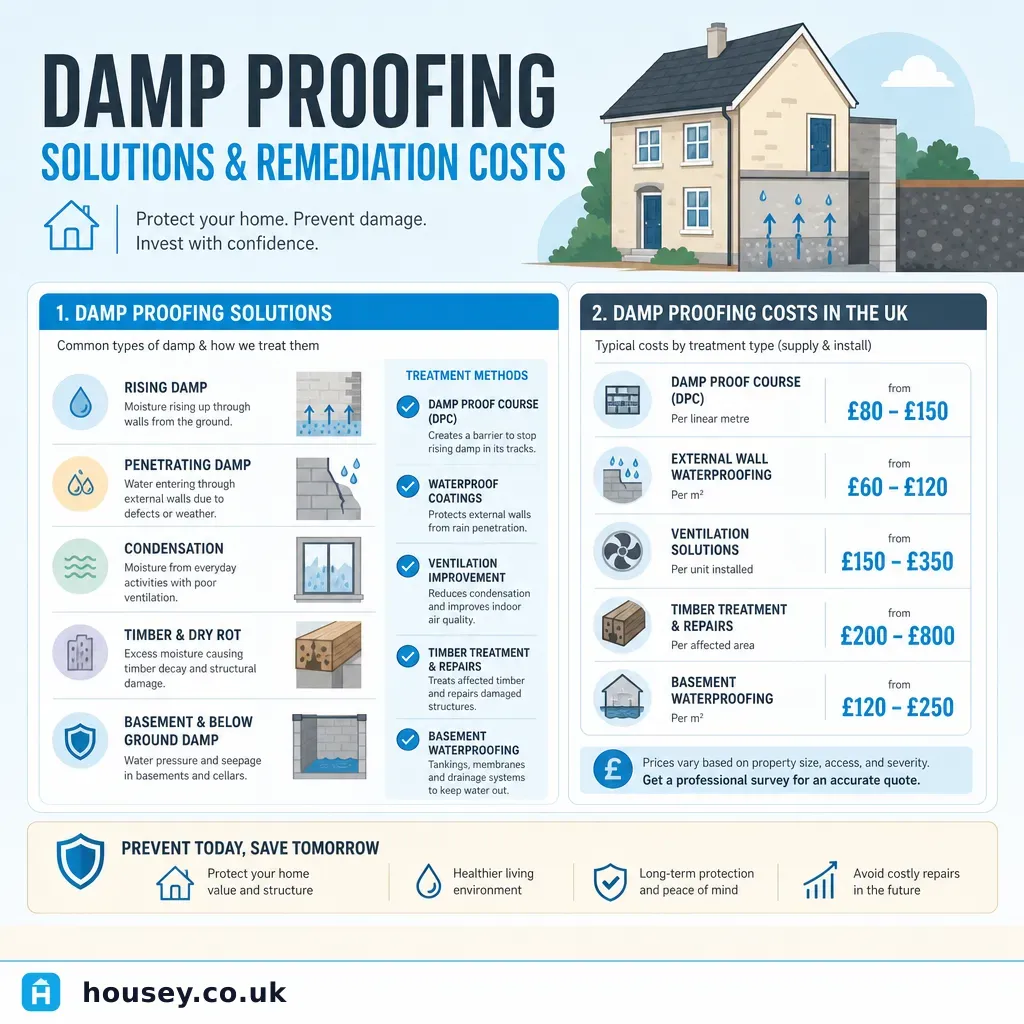
Damp Proofing Solutions and Remediation Costs
Damp proofing costs depend on the type of damp present: ventilation improvements for condensation start at around £300–£700, chemical DPC injection plus replastering typically costs £1,500–£3,500, and full basement waterproofing can reach £7,000–£15,000 or more.
 Improvement & Build
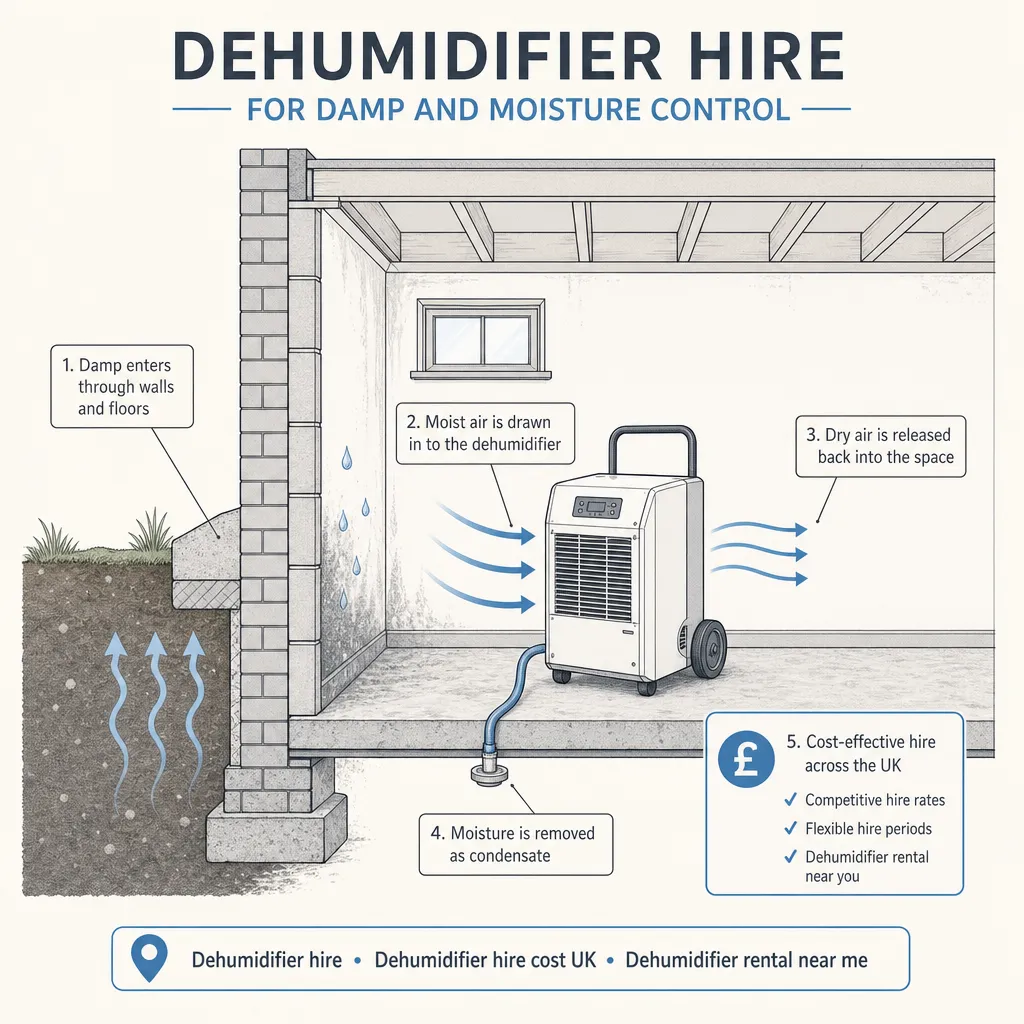
Dehumidifier Hire for Damp and Moisture Control
Hiring an industrial dehumidifier in the UK typically costs £25–£60 per day or £100–£250 per week for a standard 50-litre-per-day unit.
 Improvement & Build
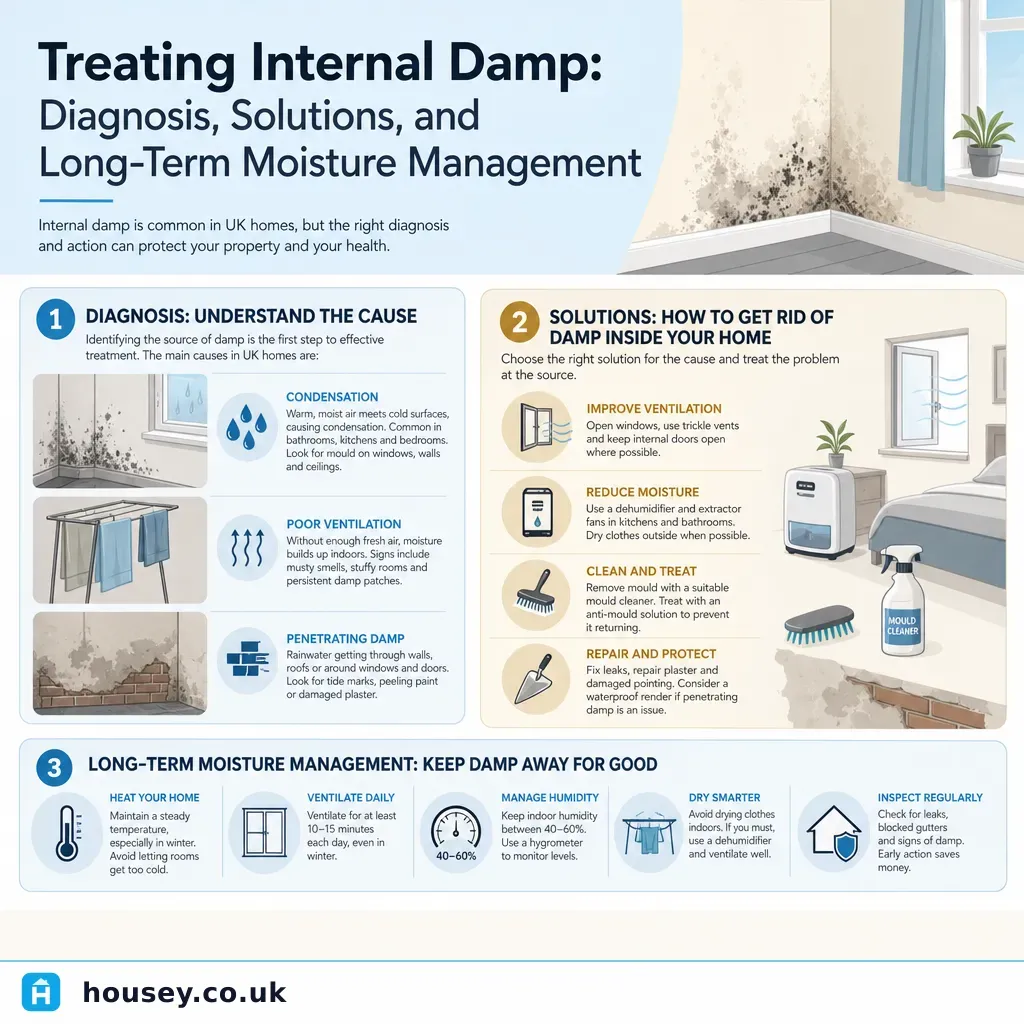
Treating Internal Damp: Diagnosis, Solutions, and Long-Term Moisture Management
Treating internal damp successfully requires diagnosing the correct type first.
 Improvement & Build
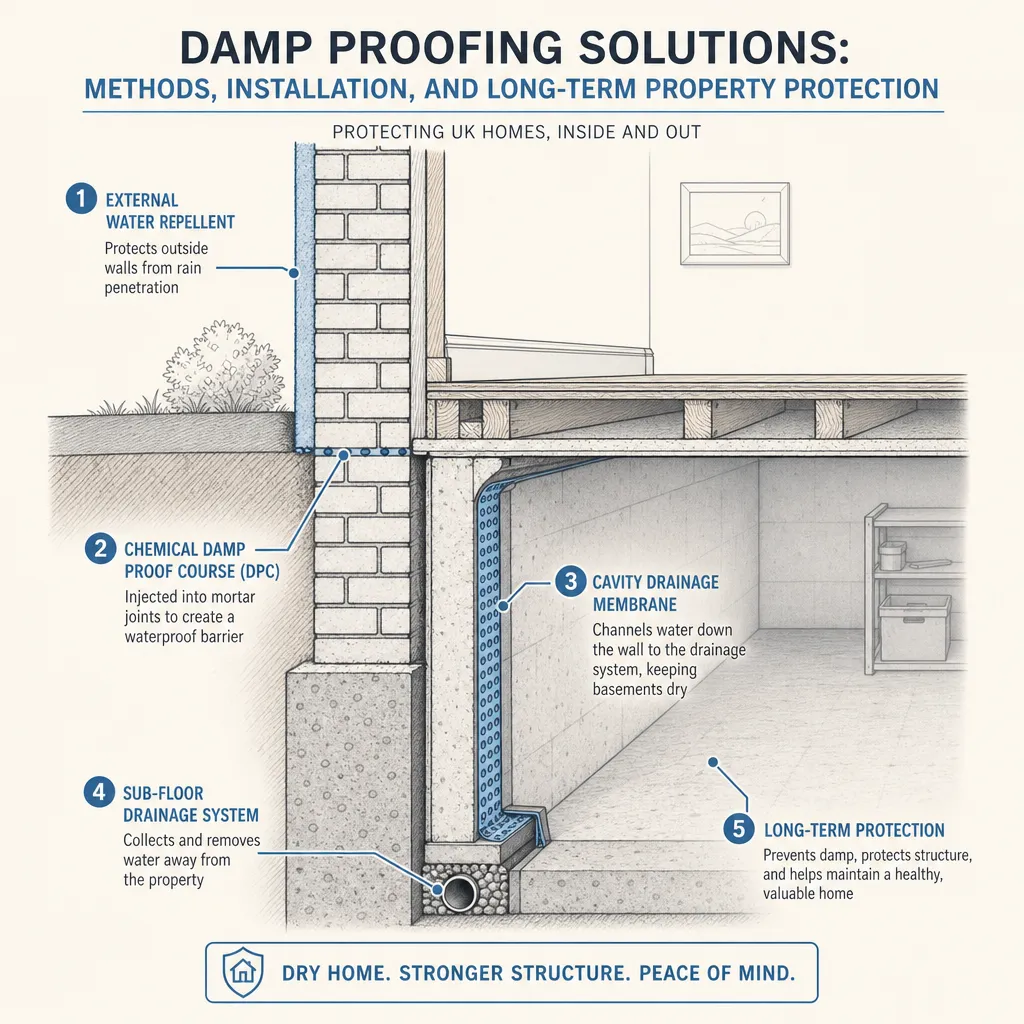
Damp Proofing Solutions: Methods, Installation, and Long-Term Property Protection
Damp proofing in UK homes typically involves chemical damp proof course (DPC) injection for rising damp, cavity drainage membranes for basement or below-ground moisture, and tanking for waterproofing solid walls.