Dehumidifier Hire for Damp and Moisture Control
By Housey · Last reviewed 6th of May 2026
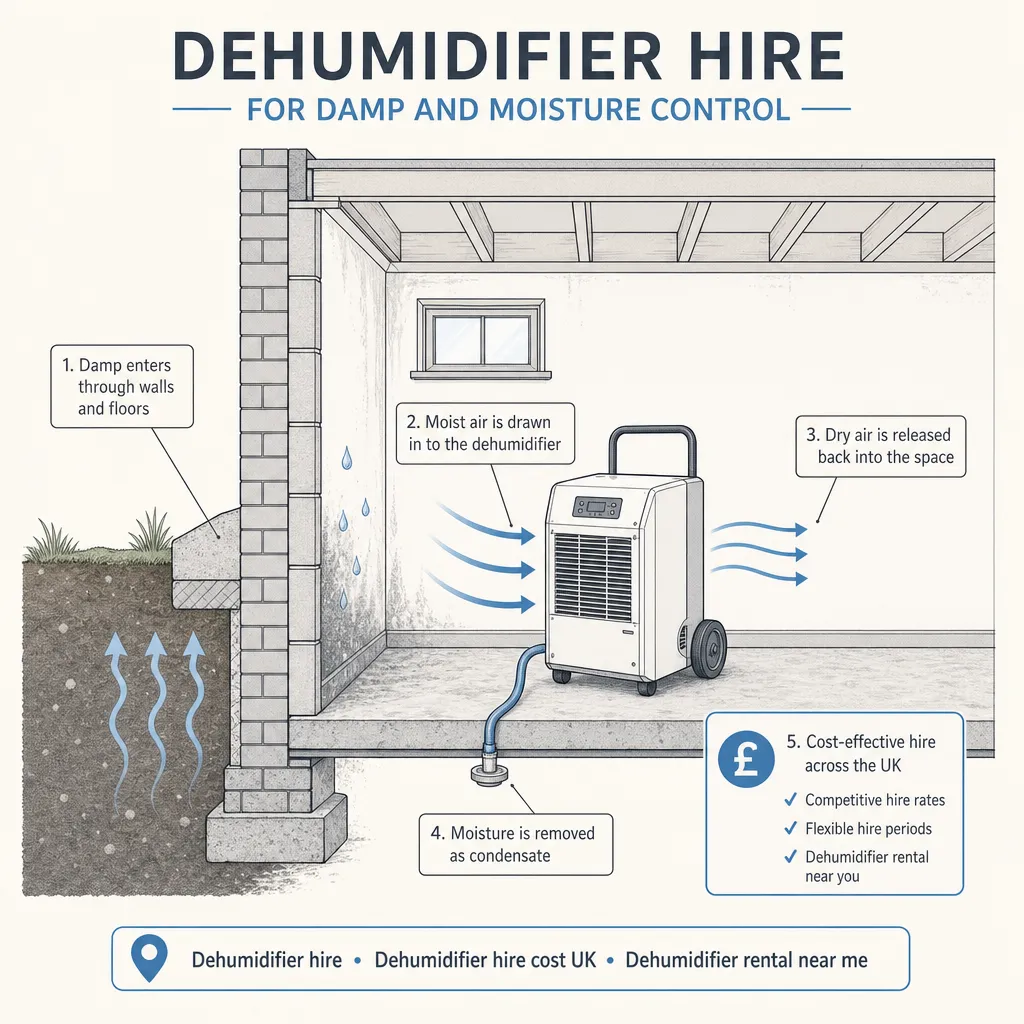
Dehumidifier Hire for Damp and Moisture Control
Whether you are drying out a flooded room, accelerating a building renovation, or managing persistent condensation while longer-term remediation is arranged, hiring a dehumidifier is often a quicker and more cost-effective first step than purchasing equipment outright. In the UK, hire is widely available through national plant-hire firms, specialist restoration contractors, and online platforms — but choosing the right capacity and type for your situation makes a significant difference to the outcome and the overall cost of drying.
Key points
- Industrial dehumidifiers used for flood drying and construction typically extract 30–150 litres per day, far more than domestic consumer units which manage 10–25 litres per day.
- Hire rates for a single industrial dehumidifier range from approximately £25 to £60 per day or £100 to £250 per week, depending on capacity and supplier. (Indicative UK costs, last reviewed 2026-05-06.)
- BS 8203 recommends that floor screed moisture levels fall below 75% relative humidity (RH) before floor coverings are laid — understanding target RH helps you judge when a drying programme is complete.
- Most hire companies require a refundable deposit of £100–£300 and charge separately for delivery and collection.
- Home insurance policies often fund a managed drying programme through the insurer's preferred restoration contractor; always notify your insurer before hiring independently to avoid affecting your claim.
What is a hire dehumidifier and when do you need one?
A hire-grade dehumidifier is a commercial or industrial unit designed for faster moisture extraction than a domestic appliance. Common applications include:
- Post-flood or water ingress drying: After a burst pipe, roof leak, or flood, structural moisture in floors, walls, and ceilings needs to be reduced before redecoration or re-fitting can begin. The PCA estimates that saturated walls in solid-construction properties can take four to six weeks or more to dry adequately.
- Construction drying: New screed, plaster, and concrete contain significant water that must escape before floor coverings or finishes are applied. BS 8203 sets out the relevant moisture thresholds for resilient floor coverings.
- Temporary condensation management: During renovation work where windows are removed or heating is disrupted, hired equipment can maintain acceptable humidity levels and reduce mould risk.
- Ongoing damp management during investigation: Where a damp cause has not yet been resolved, a dehumidifier can limit secondary damage while a long-term fix is arranged.
Hired units are not, however, a solution to the underlying cause of damp. Dehumidifiers extract airborne moisture; they do not fix leaking roofs, failed damp-proof courses, or rising groundwater.
Types of dehumidifier available to hire
Type | How it works | Best for | Limitations |
|---|---|---|---|
Refrigerant (compressor) | Draws air over a cold coil; moisture condenses and drains | General-purpose drying above 15°C | Less effective in cold or unheated properties |
Desiccant | Uses a silica gel rotor to absorb moisture from airflow | Cold environments; winter construction drying | Higher energy consumption; exhausts warm moist air |
Low-grain refrigerant (LGR) | Enhanced refrigerant cycle for very low humidity levels | Specialist flood drying; achieving very low RH targets | More expensive to hire; typically requires professional setup |
Industrial air mover (used alongside dehumidifier) | Circulates air to accelerate surface evaporation | Combination use to speed drying of surfaces | Does not extract moisture independently |
For most post-flood residential drying in UK winter conditions, a desiccant unit is often preferred because it performs consistently at the low ambient temperatures common in unheated properties.
How to choose the right capacity
Capacity is measured in litres extracted per day at standard AHAM test conditions (26.7°C / 60% RH). Real-world performance in a cold, damp UK building is often considerably lower than the rated figure.
As a rough guide:
- A single room or small flat up to 50 m²: One 30–50 litre/day industrial unit is usually sufficient.
- A mid-sized house of 50–100 m²: One to two 50–70 litre/day units, especially if moisture is distributed across multiple floors.
- Post-flood scenario with saturated floors and walls: A specialist restoration contractor will calculate the moisture load using a drying assessment. Attempting this without training risks under-specifying equipment, significantly extending drying time, and increasing total cost.
Most hire companies will advise on capacity based on your property description and the nature of the problem.
What dehumidifier hire typically costs in the UK
Indicative UK costs, last reviewed 2026-05-06. Rates vary by supplier, region, and unit type. Always request a written quote before confirming.
Duration | Typical cost (single 50-litre/day industrial unit) |
|---|---|
Per day | £25–£60 |
Per week | £100–£250 |
Four weeks | £300–£600 |
Delivery and collection | £30–£80 per visit |
Refundable deposit | £100–£300 |
Running costs should also be factored in: an industrial desiccant dehumidifier can consume 0.8–2.5 kWh per hour, so energy bills during a prolonged drying programme can add meaningfully to the overall cost.
What not to assume
- A dehumidifier will fix the damp problem. It will not. Dehumidifiers reduce airborne humidity; they do not waterproof, seal, or repair the source of moisture ingress. If damp is caused by a structural defect, plumbing leak, or failed damp-proof course, the underlying cause must be addressed alongside the drying programme.
- Any size unit will do. Under-specifying capacity means the unit runs continuously without achieving adequate dryness, prolonging the drying period and potentially allowing mould growth to continue unchecked.
- The unit can be left running unattended indefinitely. Hire units require regular monitoring: water tanks need emptying or a continuous drain hose needs connecting, filters need checking, and drying progress should be tracked using a calibrated hygrometer.
- Insurance will pay automatically. In many water damage claims, insurers appoint their own loss adjuster and preferred restoration contractor. Hiring independently without notifying your insurer first may affect your claim. Always check your policy before placing a hire order.
- Mould will disappear once the room is dry. Mould growth requires specialist cleaning once humidity is reduced; drying alone does not remove established mould colonies from wall or ceiling surfaces.
Homeowner checklist for dehumidifier hire
Before collecting or accepting delivery of hired equipment:
When to use a specialist restoration contractor instead
For significant water damage, saturated structural elements, or any scenario involving contaminated water, a specialist restoration contractor is usually more appropriate than self-managed equipment hire:
- They carry out moisture mapping to identify the full extent of saturation before placing equipment.
- They select and position units for the specific drying geometry and materials involved.
- They produce drying logs and documentation required for insurance purposes.
- They are qualified to handle Category 2 and Category 3 contaminated water damage (including sewage and floodwater) safely.
- In most insurance-funded claims, the insurer's preferred contractor manages the entire drying process; confirming this early avoids duplicate hire costs.
When to get professional help
Contact qualified damp proofing specialists or a restoration contractor rather than relying solely on hired equipment if:
- The moisture source is unknown or has not been isolated.
- Damp is present in a basement, below a suspended timber floor, or behind a solid masonry wall.
- You have been dealing with high humidity for weeks without measurable improvement.
- Mould growth covers more than approximately 1 m² — HSE guidance suggests professional remediation may be needed at this scale.
- The property was flooded with river water, groundwater, or sewage.
- You need a documented drying and treatment record for a sale, letting, or insurance purpose.
How Housey can help
If hiring a dehumidifier forms part of a broader damp problem that needs a lasting solution, Housey can connect you with qualified damp proofing specialists across the UK who can carry out a professional diagnosis and recommend an appropriate treatment programme.
Frequently asked questions
How long will I need to hire a dehumidifier?
For post-flood residential drying, typical timescales range from two to six weeks depending on the depth of saturation and property construction. Solid-wall or solid-floor properties retain moisture longer than cavity-wall or timber-frame construction. A professional moisture survey will give a more accurate drying timeline than general estimates.
Can I use a domestic dehumidifier instead of hiring an industrial unit?
For minor condensation or small areas of surface moisture, a domestic unit (10–25 litres per day) may be sufficient. For flood recovery, construction drying, or significant damp, domestic appliances are usually too slow to prevent secondary damage such as mould growth or timber decay. Industrial hire units extract moisture far more quickly and are generally more cost-effective for time-critical drying.
Will a dehumidifier prevent mould?
Maintaining relative humidity below 60–65% inhibits mould growth in most circumstances; NHS guidance identifies sustained high humidity as the primary driver of indoor mould. A dehumidifier reduces airborne humidity — it does not remove established mould colonies from surfaces or address the structural causes of persistent condensation.
Is there any electrical risk with industrial hire units?
Industrial dehumidifiers typically draw 5–15 amps. Most standard UK 13-amp sockets will accommodate a single unit. Running multiple units from the same circuit requires checking total load against the circuit's rated capacity. Do not use extension leads rated below the unit's amperage, and follow all safety instructions provided by the hire company.
Do I need planning permission to use a hire dehumidifier?
No. Hiring and using a dehumidifier for drying or moisture control is a temporary operational measure and does not require planning consent, a Building Regulations application, or notification to your local authority. Any subsequent remediation works — such as installing a new damp-proof course — may require Building Regulations approval, but dehumidifier use itself does not.
Sources and further reading
- Damp and mould in the home — HM Government
- Damp and mould — NHS
- Mould in the workplace — health effects — Health and Safety Executive
- Water damage restoration guidance — Property Care Association
- Condensation and damp — Energy Saving Trust
Useful next reads
 Improvement & Build
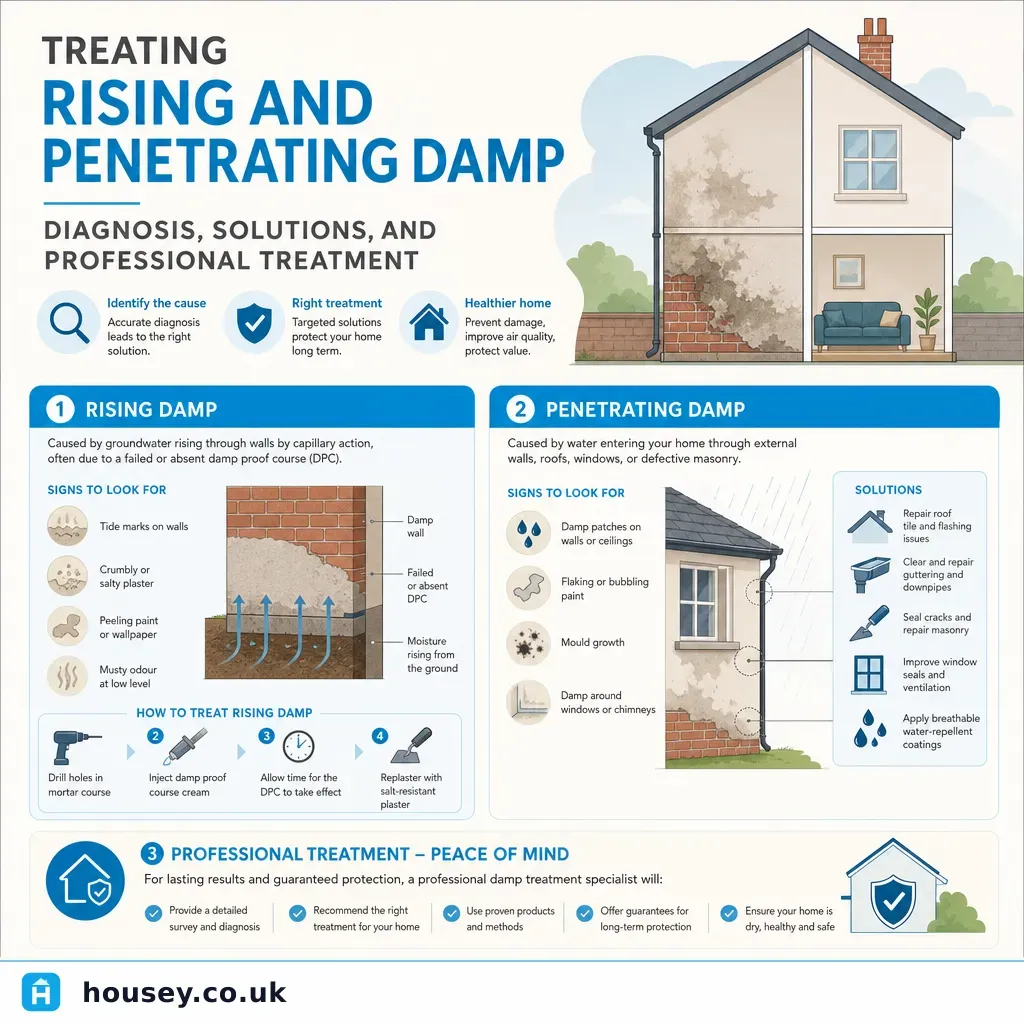
Treating Rising and Penetrating Damp: Diagnosis, Solutions, and Professional Treatment
Rising damp appears as a tide mark at the base of ground-floor walls and is caused by a failed or absent damp-proof course.
 Improvement & Build
Dampproofing vs Waterproofing: Which Solution for Your Property
Damp proofing resists moisture vapour and capillary movement through masonry and is the correct treatment for rising damp.
 Improvement & Build
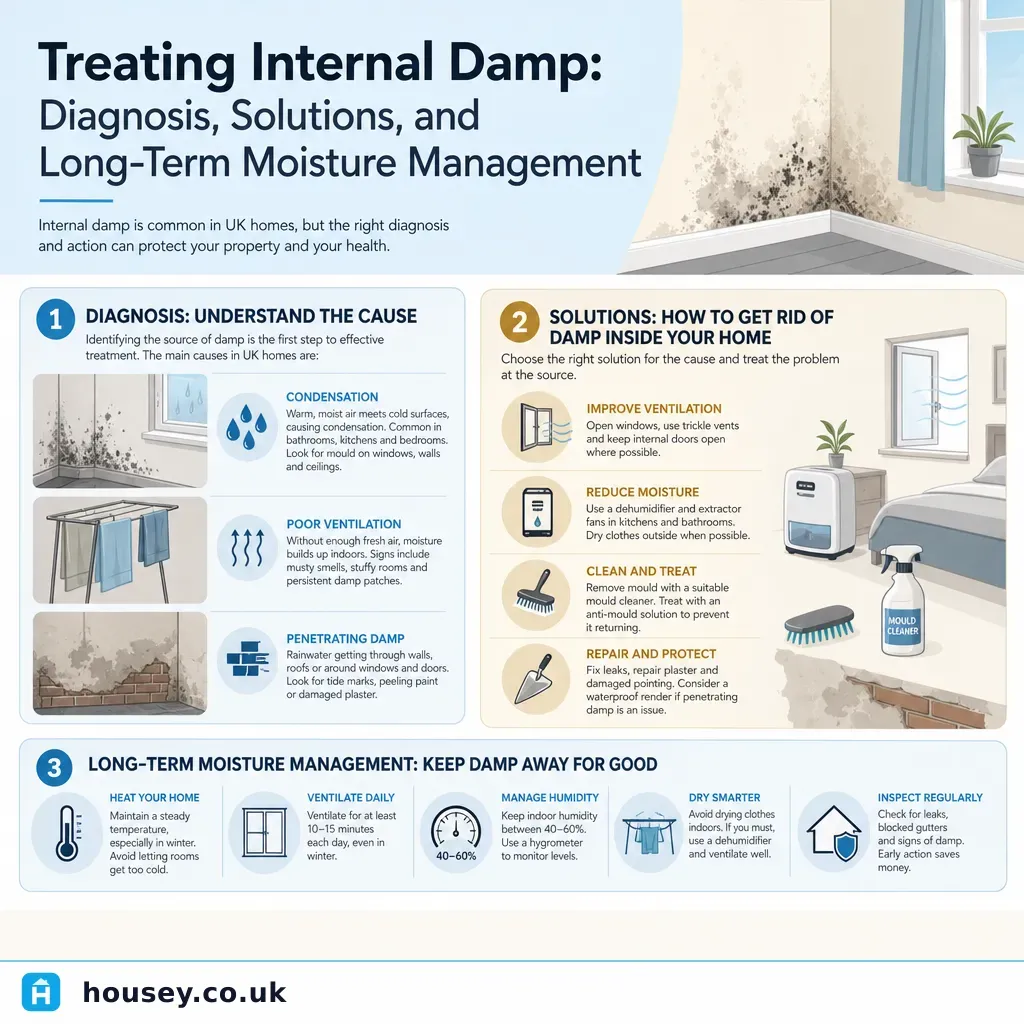
Treating Internal Damp: Diagnosis, Solutions, and Long-Term Moisture Management
Treating internal damp successfully requires diagnosing the correct type first.
 Improvement & Build
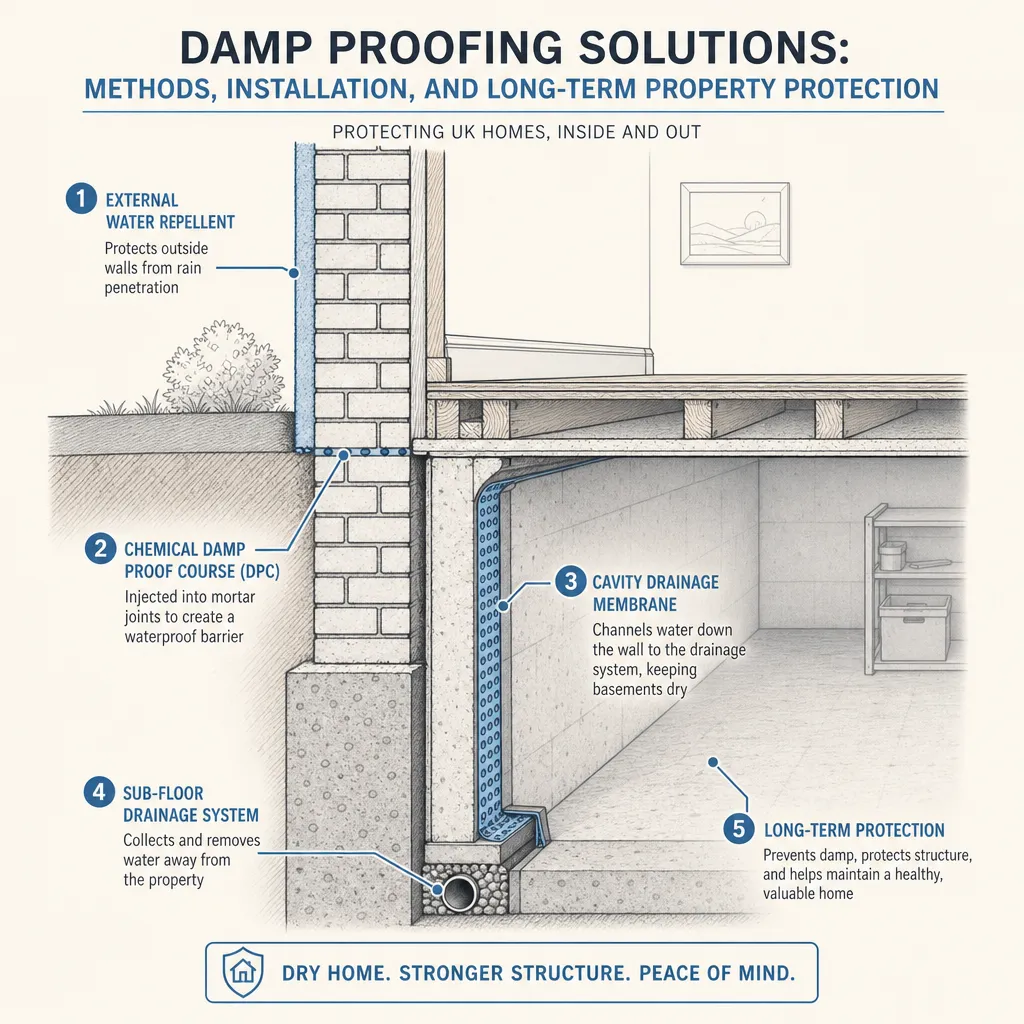
Damp Proofing Solutions: Methods, Installation, and Long-Term Property Protection
Damp proofing in UK homes typically involves chemical damp proof course (DPC) injection for rising damp, cavity drainage membranes for basement or below-ground moisture, and tanking for waterproofing solid walls.
 Improvement & Build
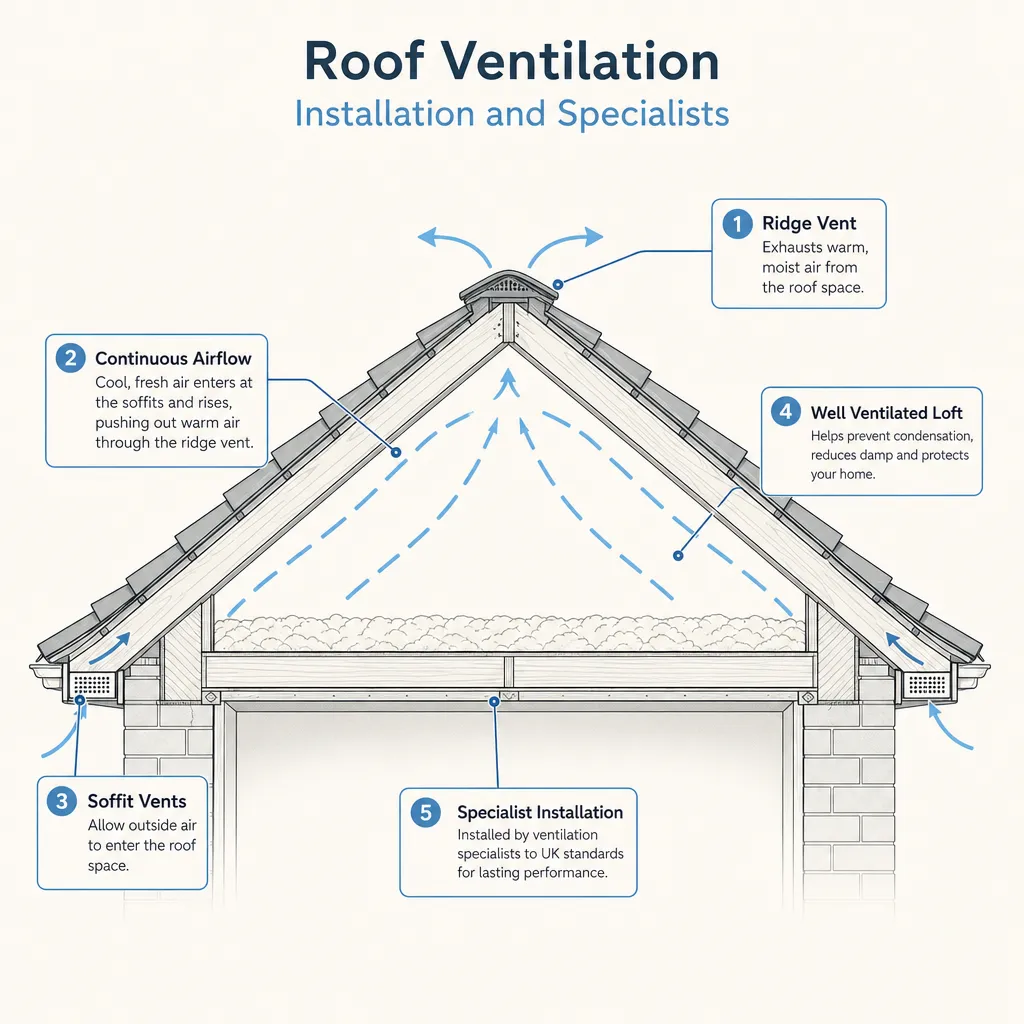
Roof Ventilation Installation and Specialists
Roof ventilation allows moist air to escape from the loft space, preventing condensation, timber decay, and mould.