Deck renovation: cost-effective strategies for maintenance and longevity
By Housey · Last reviewed 31st of May 2026
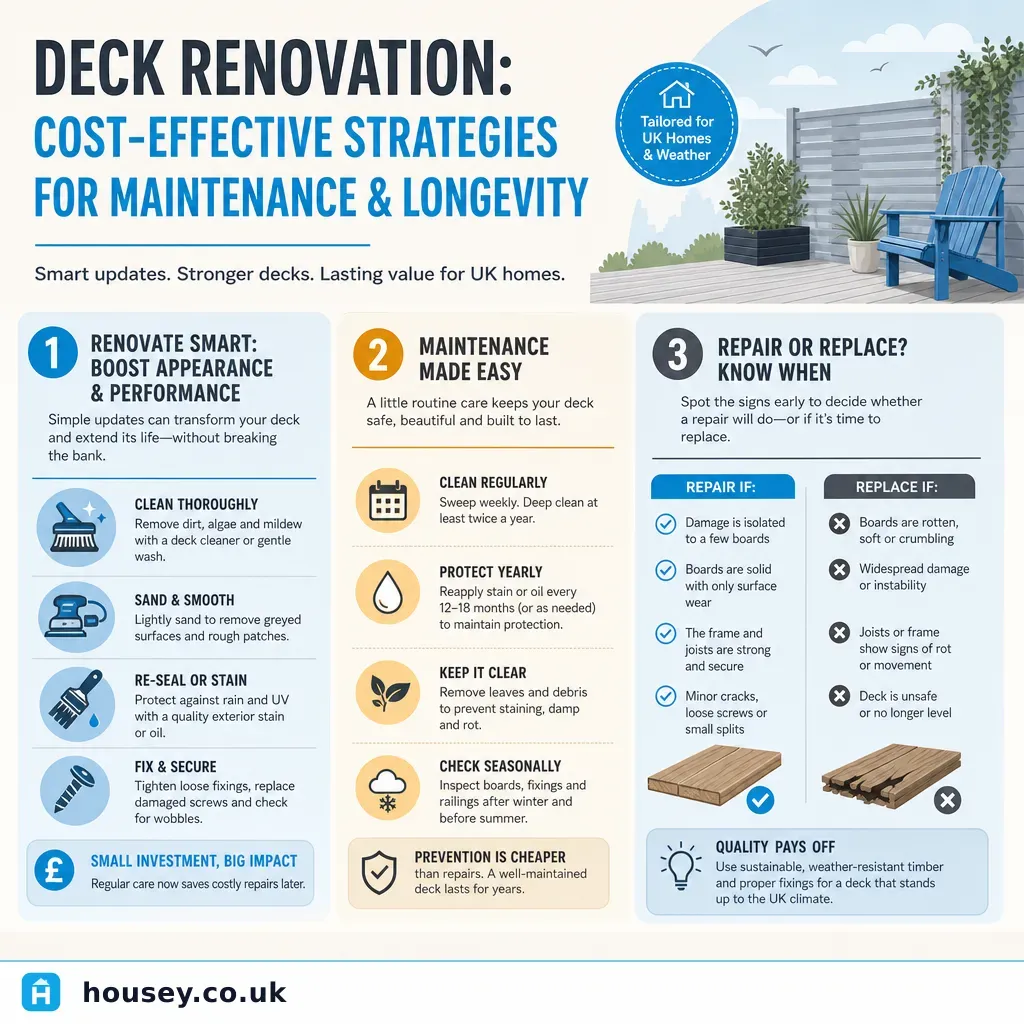
Deck renovation: cost-effective strategies for maintenance and longevity
A garden deck takes more punishment than almost any other surface in a UK property — exposed to frost, rain, UV, algae, and daily foot traffic for twelve months of the year. Renovation decisions often arise when boards start to grey and split, when the structure feels less stable underfoot, or when a homeowner has bought a property with a deck of unknown age and condition. Distinguishing cosmetic wear from structural deterioration is the first step towards a renovation that is genuinely cost-effective rather than just cosmetically satisfying.
Key points
- Decking above 600mm from ground level may require assessment under Approved Document K (protection from falling) — check with your local building control body before construction or significant alteration.
- Pressure-treated softwood specified to Use Class UC3 or UC4 under BS 8417 is significantly more durable outdoors than untreated timber; always verify treatment class when replacing joists or boards.
- Annual cleaning followed by application of a penetrating oil or stain is typically sufficient to maintain hardwood and composite decking — consistency matters more than product brand.
- Joist replacement is the costliest element of a deck renovation: indicative UK costs for new treated softwood joists run £150–£300 per linear metre installed (Indicative UK costs, last reviewed 2026-05-31).
- Composite decking typically costs £50–£120 per m² supply and fit, but requires considerably less annual maintenance than softwood alternatives (Indicative UK costs, last reviewed 2026-05-31).
Assessing your deck: cosmetic versus structural problems
Before committing to any budget, walk the deck systematically and separate what you see from what the structure is actually doing.
Cosmetic issues — address with cleaning and re-treatment:
- Grey or discoloured boards with an intact, firm surface
- Minor surface cracking (checking) along the grain
- Algae, moss, or general grime
- Slightly raised end-grain on individual boards
Structural concerns — require professional assessment or replacement before any surface treatment:
- Soft or spongy boards when pressed — possible board or joist rot below
- Boards flexing more than 10mm underfoot — loose fixings or failed joists
- Dark staining at post bases — post rot at the ground contact point
- The ledger board pulling away from the house wall — potential structural failure
- Mushroom or bracket fungus growing from the frame — active timber decay
If you find structural concerns, stop before applying any treatment. Coating over rotten timber does not arrest decay — it is likely to seal in moisture and accelerate the problem.
Red flags that mean stop and call a professional
The following signs indicate the deck may be unsafe and should not be used until inspected by a qualified builder or landscaper:
- Any post showing soft or crumbling timber at ground level — the post may no longer be safely load-bearing
- The ledger board has moved, or there is evidence of water ingress into the house wall behind it
- Multiple joists affected by soft rot — widespread joist decay is usually uneconomical to repair board by board
- Small round exit holes in the frame timber — possible wood-boring insect damage requiring specialist assessment
- Widespread movement or rocking in the deck surface that cannot be explained by individual loose fixings
Annual maintenance checklist
Consistent annual maintenance is far more cost-effective than periodic large-scale renovation. A simple routine prevents most problems from becoming structural.
- Spring: Clean the deck with a proprietary deck cleaner (avoid household bleach, which damages wood fibres and can harm garden soil). Inspect for loose boards, raised fixings, and surface decay. Re-fix any raised screws or nails flush with the board surface.
- After cleaning (dry deck): Apply penetrating deck oil or stain at above 5°C and below 25°C. Do not apply to wet or damp timber — the treatment will not penetrate correctly and will peel prematurely.
- Summer: Check for raised fixings or splinters after hot, dry spells that cause boards to cup. Lightly sand splinters before re-oiling the affected boards.
- Autumn: Clear fallen leaves promptly — tannins from oak and other species can stain the surface and accelerate decay. Remove heavy pot plants from composite decking periodically to prevent localised staining.
- Winter: Avoid pressure washing in frost conditions; this can open the wood grain and worsen freeze-thaw damage. Fit non-slip strips in shaded areas prone to algae build-up.
Treatment and finishing options compared
Treatment type | Best for | Typical lifespan | DIY suitable | Indicative cost (5L) |
|---|---|---|---|---|
Penetrating deck oil | Hardwood, composite | 1–2 years | Yes | £15–£40 |
Water-based deck stain | Softwood, pressure-treated | 2–3 years | Yes | £20–£50 |
Solvent-based deck stain | Weathered or greyed softwood | 2–4 years | Yes (ventilate) | £25–£55 |
Opaque deck paint | Concealing damaged grain or changing colour | 3–5 years | Yes | £20–£45 |
Professional spray application | Large deck areas, commercial finish | 3–5 years | No | Quoted on area |
Indicative UK product prices, last reviewed 2026-05-31. Application conditions vary — always follow manufacturer data sheets.
Composite versus timber: renovation and replacement compared
When deciding whether to renovate existing timber or replace with composite boards, the condition of the substructure is usually the deciding factor.
Factor | Timber renovation | Composite replacement |
|---|---|---|
Upfront cost | Lower (if substructure is sound) | Higher — boards plus installation labour |
Annual maintenance | Annual cleaning and treatment | Cleaning only |
Lifespan (with maintenance) | 15–25 years (hardwood) | 25–30 years |
Repairability | Individual boards easy to source | Some boards are proprietary |
Appearance over time | Natural grain; weathers gradually | Consistent; limited natural weathering |
Slip resistance | Moderate — improves with treatment | Good with embossed profiles |
If joists and posts are sound, renovating the existing structure is usually the better-value option. If the frame needs significant work, the cost gap between renovation and full replacement narrows considerably — get comparative quotes before deciding.
Which approach should you take?
- Clean and retreat if boards are structurally sound but greyed and dirty — this is the most cost-effective route by a significant margin.
- Replace individual boards if specific boards are rotten or split but joists and posts remain in good condition.
- Partial frame repair if up to a third of joists show early-stage decay — isolate and replace affected sections, then re-board over the repaired frame.
- Full replacement if the frame is widely affected by rot, posts are compromised, or the deck is approaching or past its original design life.
- Consult a landscaper or builder before committing to full replacement — a site assessment may reveal the frame is in better condition than surface appearances suggest.
When to get professional help
Most cleaning and treatment work on a structurally sound deck is within a competent DIYer's ability. However, any structural work — replacing joists, posts, or the ledger board — should be carried out by a qualified builder or landscaper, particularly where the deck is elevated or connects directly to the house structure. Building Regulations approval under Approved Document K may be required for decks above 600mm from ground level; your local building control body can confirm whether a notification is needed for the specific work planned.
How Housey can help
For deck renovation that goes beyond surface treatment, Housey connects you with experienced local tradespeople. Find landscapers experienced in garden structures and hard landscaping, or request quotes from extension builders for elevated or structurally complex deck projects.
Frequently asked questions
Does a garden deck need planning permission?
Most garden decks in England do not need planning permission if they are less than 300mm above ground level, comply with the permitted development limits in the Town and Country Planning (General Permitted Development) (England) Order 2015, and are not within the curtilage of a listed building. Decks above 300mm may need permission depending on size and location. Check with your local planning authority if the deck is elevated or near a boundary.
How long does a timber deck last in the UK?
A softwood deck that is cleaned and treated annually typically lasts 10–20 years. Hardwood decking such as ipe or teak can last 25–30 years with regular oiling. Composite decking from reputable manufacturers is typically warranted for 25 years or more. In every case, lifespan depends heavily on the quality of the original installation — particularly joist spacing, post connections, and drainage provision below the deck.
Can I paint over a deck to change its colour?
Yes, opaque deck paint can change or refresh the colour of a timber deck. Sand back any flaking coatings first, ensure the wood is clean and fully dry, and use a product formulated for exterior horizontal surfaces. Painted finishes typically require re-application every 3–5 years but can effectively conceal weathered or stained timber that would otherwise require board replacement.
When is it worth replacing a deck rather than repairing it?
Replacement typically becomes better value than repair when the structural frame shows widespread decay, when repair costs exceed approximately 60–70% of the cost of a new deck to the same specification, or when the deck does not meet current guarding requirements under Approved Document K. A landscaper or builder can assess the frame and provide comparative quotes to help you decide.
Sources and further reading
- Approved Document K: protection from falling, collision and impact — GOV.UK
- BS 8417: preservation of wood — code of practice — BSI Group
- Wood Protection Association: timber treatment and use classes — Wood Protection Association
- Decking: do I need planning permission? — Planning Portal
- Timber decking: design and installation guidance — TRADA
Useful next reads
 Improvement & Build
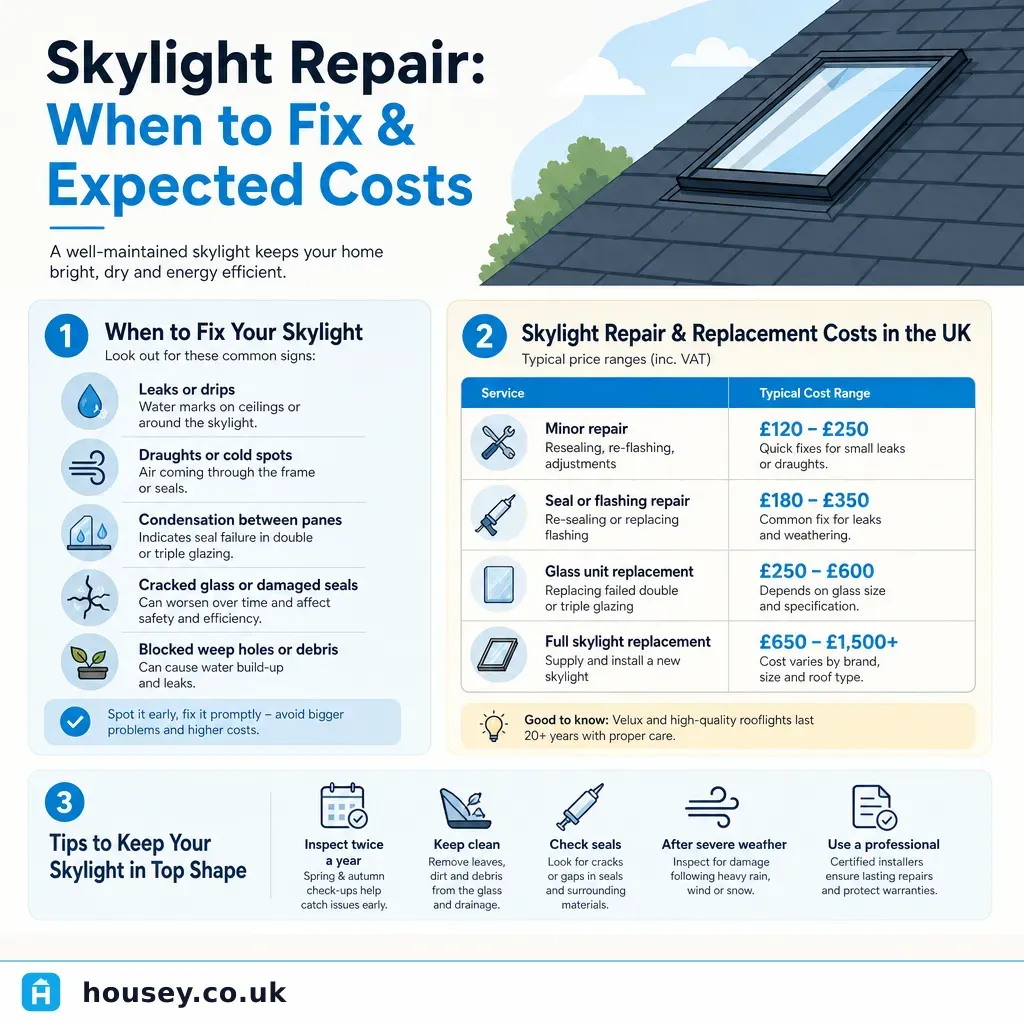
Skylight repair: when to fix and expected costs
Skylight repairs in the UK typically cost £150–£800 depending on the fault, while full replacement usually runs £500–£2,500.
 Improvement & Build
Small kitchen renovation: budgeting for costs and planning your project
A small kitchen renovation in the UK typically costs £5,000–£15,000 for a full refresh including new units, worktops, tiling, and appliances, though costs vary widely by specification, region, and whether structural changes or rewiring are involved.
 Improvement & Build
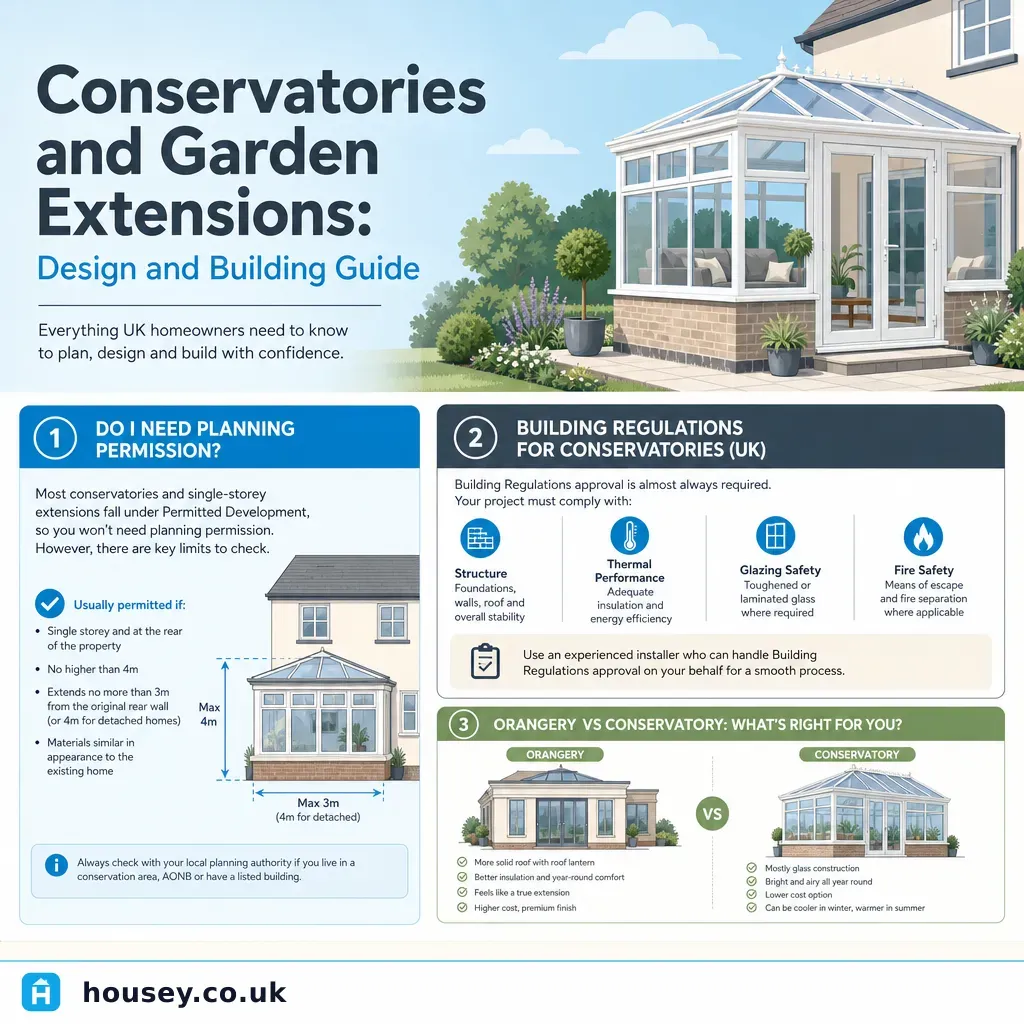
Conservatories and Garden Extensions: Design and Building Guide
Most conservatories qualify as permitted development in England if they are single-storey, within 50% of original curtilage, and meet dimensional limits.
 Improvement & Build
Installing a Fire Pit: Garden Features and Outdoor Space Design
Installing a garden fire pit in the UK is generally permitted, but Smoke Control Area rules prohibit open wood-burning in most towns and cities.
 Improvement & Build
Concrete Sealing: Protecting and Maintaining Your Driveway
Sealing a concrete driveway protects against water ingress, freeze-thaw damage, oil stains, and surface wear.