Removing Concrete: Sawing and Demolition Options
By Housey · Last reviewed 25th of May 2026
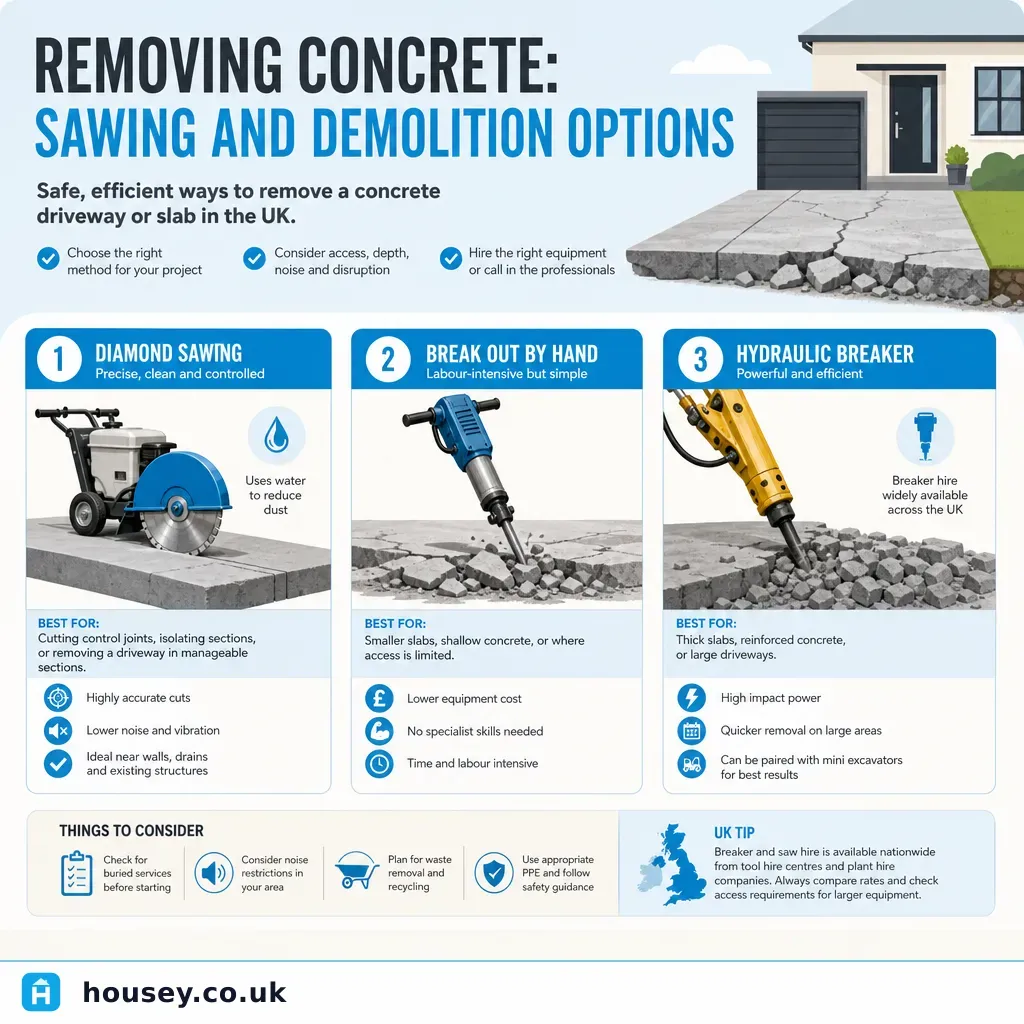
Removing Concrete: Sawing and Demolition Options
Concrete removal is one of those jobs that looks straightforward until you are standing in front of a 150 mm reinforced slab with a hired breaker and no clear plan for the rubble or the dust. Whether you are reclaiming a back garden, replacing a driveway, opening a floor for underfloor heating pipework, or clearing a site ahead of building works, the method you choose affects not just speed and cost, but also dust exposure, vibration, noise, and the risk of disturbing embedded services or adjacent structures. Getting the approach right from the outset saves considerable time and money.
Key points
- Silica dust released by cutting or breaking concrete is a Category 1 carcinogen; the Control of Substances Hazardous to Health (COSHH) Regulations 2002 require dust suppression and appropriate respiratory protection — minimum P3 / FFP3-rated mask — whenever concrete is mechanically cut or broken.
- Diamond disc sawing (wet or dry) produces clean, controlled cuts for openings, partial demolition, and service penetrations; wet cutting significantly reduces silica dust and is the professional standard.
- Reinforced concrete contains steel rebar that must be cut separately with an angle grinder after the surrounding concrete is broken — a rebar detector or cover meter is advisable before any cutting begins.
- Concrete rubble is a controlled waste under the Environmental Protection Act 1990 and must be disposed of at a licensed facility — household waste recycling centres do not accept construction waste.
- If removal work is adjacent to a shared boundary or a neighbour's structure, the Party Wall etc. Act 1996 may require written notice — check with a party wall surveyor if you are unsure.
Understanding your concrete before you start
Four variables determine which removal method is appropriate:
Thickness: A 75–100 mm domestic slab (typical for driveways and paths) can usually be broken with a domestic electric breaker available from tool hire. A 150–300 mm slab — common for garage floors, foundations, or commercial surfaces — needs heavier equipment or contractor involvement.
Reinforcement: Plain concrete breaks into chunks that can be levered away. Reinforced concrete contains a rebar grid or mesh; the steel must be cut after the surrounding concrete is fractured. Post-tensioned slabs — increasingly common in modern suspended floors — use tensioned steel tendons; cutting a tendon without understanding the tension arrangement can cause sudden and dangerous structural movement.
Location and access: A driveway slab is accessible from all sides. A basement floor, an internal room, or a confined space complicates equipment access and makes dust extraction critical.
Proximity to services: Electrical conduits, water pipes, gas pipes, and drainage are sometimes cast into or immediately below concrete slabs. Obtain original drawings from the builder, or search utility record services, before cutting.
Concrete removal methods compared
Method | Precision | Speed | Dust risk | Suitable for | Who carries it out |
|---|---|---|---|---|---|
Electric breaker (domestic tool hire) | Low | Medium — bulk breaking | High — dust suppression essential | Unreinforced slabs under 150 mm | Competent DIY or contractor |
Hydraulic or petrol breaker | Low | High — bulk demolition | High | Large-volume slab and footing removal | Demolition contractor |
Diamond disc floor saw | High | Medium | Low (wet cut), High (dry) | Straight-line cuts, partial removal, service openings | Specialist contractor |
Diamond wall saw | High | Medium | Low (wet cut) | Vertical cuts, wall penetrations | Specialist contractor |
Diamond wire saw | Very high | Low–medium | Low | Very thick or heavily reinforced concrete, unusual geometry | Specialist contractor only |
Hand breaker or SDS drill (hammer mode) | Medium | Low | Medium–high | Areas under 2 m², concrete under 100 mm, restricted access | DIY with appropriate PPE |
Which method should you choose?
- Choose a domestic electric breaker (tool hire) if the concrete is unreinforced, under 150 mm thick, and you have confirmed no embedded services below the slab.
- Choose a contractor with hydraulic breaking equipment if the slab is reinforced, over 150 mm thick, covers a large area, or forms part of a foundation or footing needing full removal.
- Choose diamond disc sawing if you need a clean, straight cut around a service penetration, expansion joint, or partial removal line — particularly indoors or close to surfaces you wish to preserve.
- Choose diamond wire sawing if the concrete is over 300 mm thick, heavily reinforced, or inaccessible for conventional floor or wall saws.
- Ask a structural engineer to assess the slab before any cutting if it appears to be a suspended floor spanning between supports, or if cracking or deflection suggests it may carry structural load.
- Check with your local planning authority if the removal forms part of a driveway replacement, as the replacement surface material may be subject to permitted development drainage conditions.
Silica dust: the critical health obligation
Silica is present in the aggregate and cement matrix of virtually all concrete. When concrete is cut, ground, or broken, fine silica particles — respirable crystalline silica (RCS) — are released into the air. Prolonged exposure causes silicosis, an irreversible and potentially fatal lung disease recognised by HSE as a significant occupational health risk in construction.
Under COSHH Regulations 2002, dust control is a legal requirement. Practical measures include:
- Wet cutting using a water feed to the blade or bit — the most effective method for saws and angle grinders.
- On-tool extraction — a vacuum attachment connected directly to the breaker or grinder, with an H-class vacuum filter.
- Respiratory protective equipment (RPE) — minimum FFP3-rated disposable mask or a half-face respirator with P3 filter; standard FFP1 or FFP2 masks are not adequate for silica.
- Zoning and barriers — preventing dust from spreading to neighbouring properties or public areas during extended works.
Professional contractors are legally required to implement COSHH controls. For DIY work the same physical hazard exists, and the same protective measures are strongly advisable.
Homeowner checklist before concrete removal begins
Concrete waste disposal
Concrete rubble is controlled waste under the Environmental Protection Act 1990. Three main disposal routes are available:
Skip hire — the most straightforward option for residential volumes. Most licensed skips accept clean concrete; keep it separate from mixed general waste, as combined loads attract higher disposal charges. Skip sizes from a mini skip (2 yard) to a large builder's skip (8 yard) cover most domestic demolition jobs.
Grab lorry — for larger volumes, a grab lorry can collect loose rubble directly from a pile on site, avoiding manual loading of a skip. More efficient for significant demolition quantities.
Licensed aggregate recycler — many facilities across England and Wales accept clean, segregated concrete rubble and process it into recycled aggregate (typically 4/20 mm or 40 mm crushed concrete) for use as sub-base material. Tipping fees are often lower than general construction waste, and the material is diverted from landfill. Check that the chosen facility holds an appropriate permit under the Environmental Permitting (England and Wales) Regulations 2016.
When to get professional help
Instruct a demolition contractor or specialist if:
- The concrete is over 200 mm thick, post-tensioned, or contains unusual reinforcement.
- The slab appears to be suspended or structural — a structural engineer should be consulted before any cuts are made.
- Embedded services cannot be confidently located or safely isolated before work starts.
- Work is adjacent to a party wall, a neighbour's structure, or close to a shared boundary where vibration or structural disturbance is a concern.
- The site is a confined space — basement, underground chamber — where ventilation and extraction require specialist setup.
- The project involves building control sign-off and the concrete removal affects a structural element or the ground floor slab.
How Housey can help
Housey connects you with vetted demolition contractors who can assess your site, advise on the most appropriate breaking or sawing method, and manage controlled waste disposal in line with environmental permitting requirements. If concrete removal forms part of a wider driveway replacement, our driveway installers can often quote for removal and reinstatement together, simplifying coordination and reducing overall project cost.
Frequently asked questions
Can I remove a concrete driveway slab myself?
A standard unreinforced domestic concrete driveway — typically 100 mm thick — can be broken with an electric breaker available from tool hire companies. You will need an FFP3-rated dust mask, eye and ear protection, water suppression for dust control, and a lawful waste disposal route such as a licensed skip. If you are unsure whether the slab is reinforced or whether services run beneath it, have a contractor assess it first.
How is reinforced concrete different to remove?
Reinforced concrete contains a steel rebar grid or mesh within the slab. Once the surrounding concrete is broken, the rebar must be cut separately with an angle grinder or disc cutter, adding time and cost. Post-tensioned slabs — which use tensioned steel tendons rather than passive rebar — are more complex still, and cutting a tendon can cause sudden and dangerous structural movement. Always seek professional advice before cutting post-tensioned concrete.
Do I need planning permission to remove a concrete driveway in England?
Removing a concrete driveway does not usually require planning permission. However, if you are replacing it with an impermeable surface larger than 5 m², permitted development conditions under the Town and Country Planning (General Permitted Development) (England) Order 2015 may require a permeable replacement surface or surface water drainage complying with Building Regulations Approved Document H. Check with your local planning authority before committing to a specification.
Where can I legally dispose of concrete rubble in the UK?
Concrete rubble is a controlled waste under the Environmental Protection Act 1990 and must go to a licensed facility. Options include skip hire, a grab lorry for larger volumes, or direct delivery to a licensed aggregate recycler where clean concrete is processed into recycled aggregate. Do not take concrete rubble to a household waste recycling centre — it is not accepted at most sites and is legally classified as construction waste.
Sources and further reading
- Control of Substances Hazardous to Health (COSHH) Regulations 2002 — HSE, legal requirements for silica dust control during concrete cutting and breaking
- Environmental Protection Act 1990 — legislation.gov.uk, controlled waste classification and disposal duties for construction rubble
- Party Wall etc. Act 1996 — legislation.gov.uk, notice requirements for works near shared structures and boundaries
- Environmental Permitting (England and Wales) Regulations 2016 — legislation.gov.uk, licensing for aggregate recycling and waste management facilities
- Town and Country Planning (General Permitted Development) (England) Order 2015 — legislation.gov.uk, permitted development conditions for hardstanding and driveway replacement
Useful next reads
 Improvement & Build
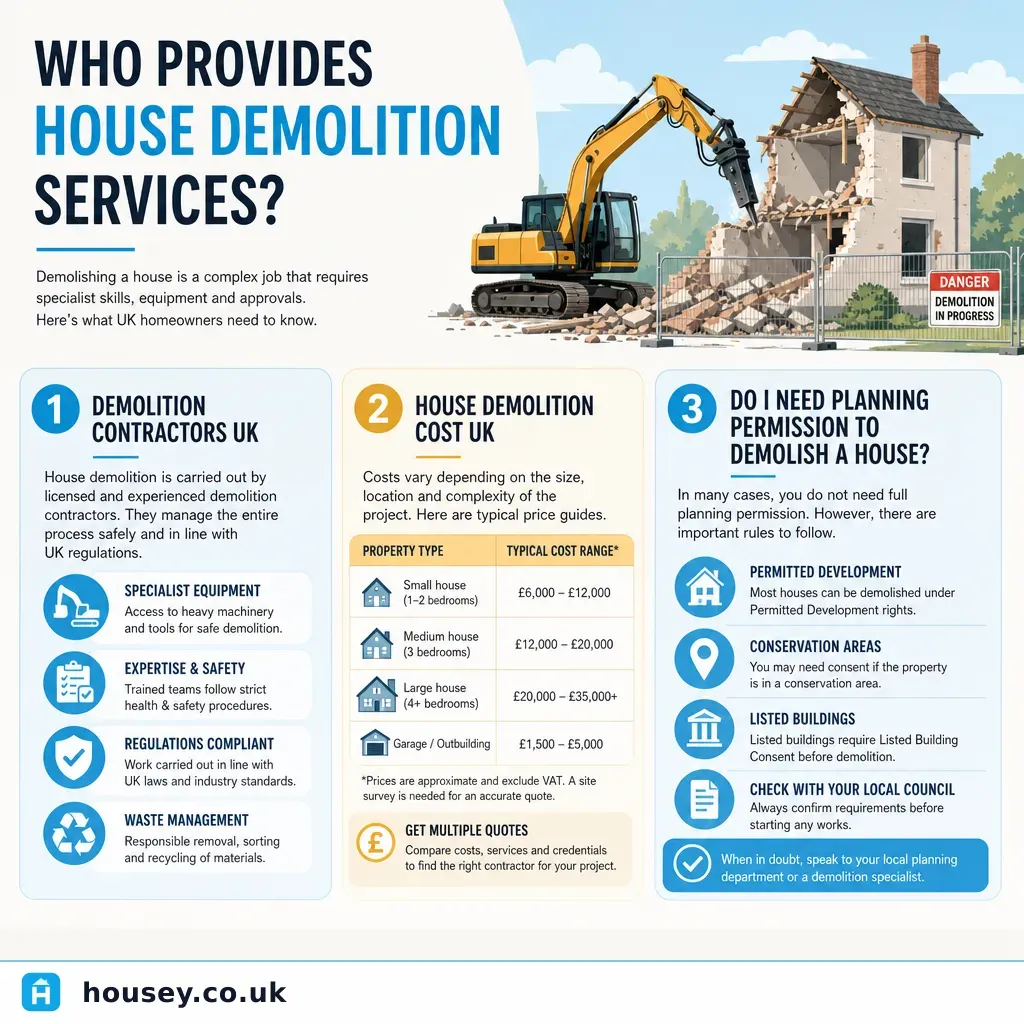
Who Provides House Demolition Services
House demolition in the UK is carried out by specialist demolition contractors, often members of the National Federation of Demolition Contractors (NFDC).
 Improvement & Build
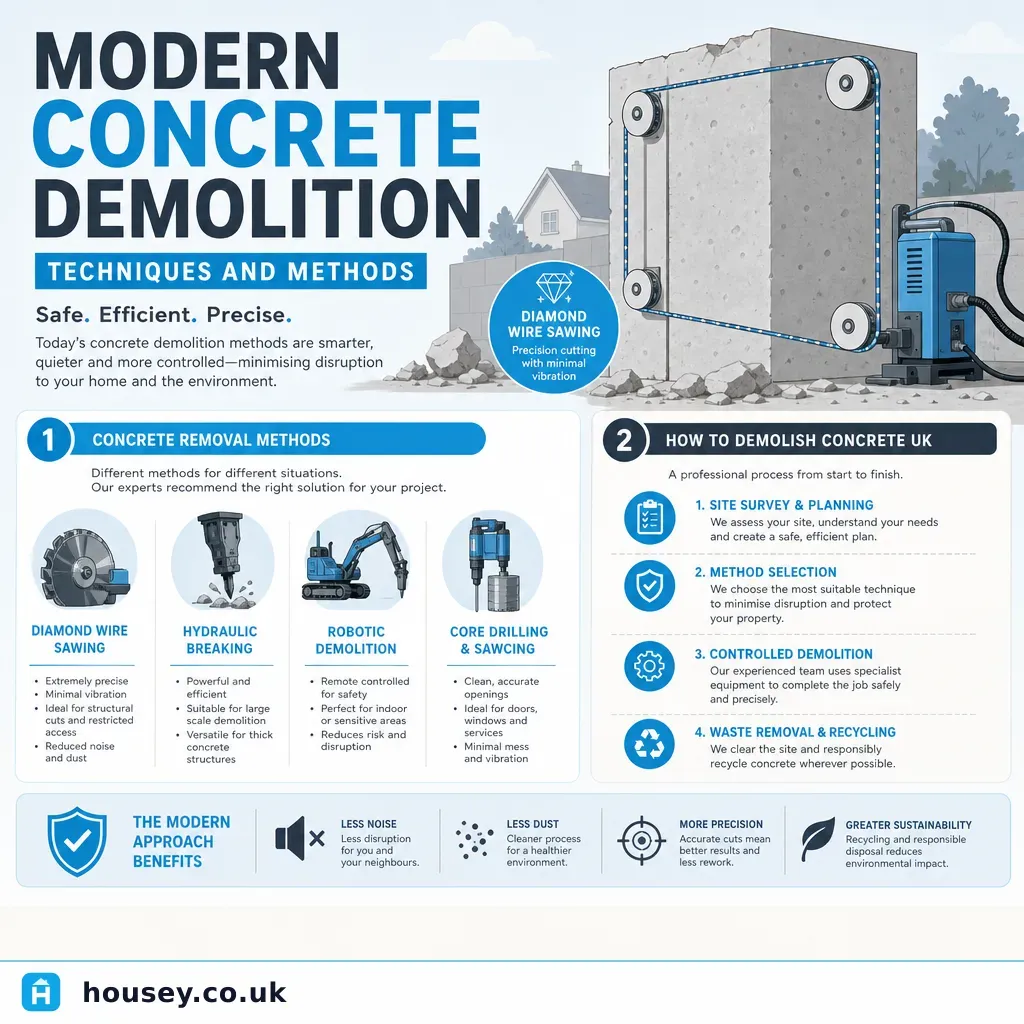
Modern Concrete Demolition Techniques and Methods
Concrete demolition in the UK uses methods including hydraulic breaking, diamond wire sawing, hydrodemolition, and hydraulic bursting.
 Improvement & Build
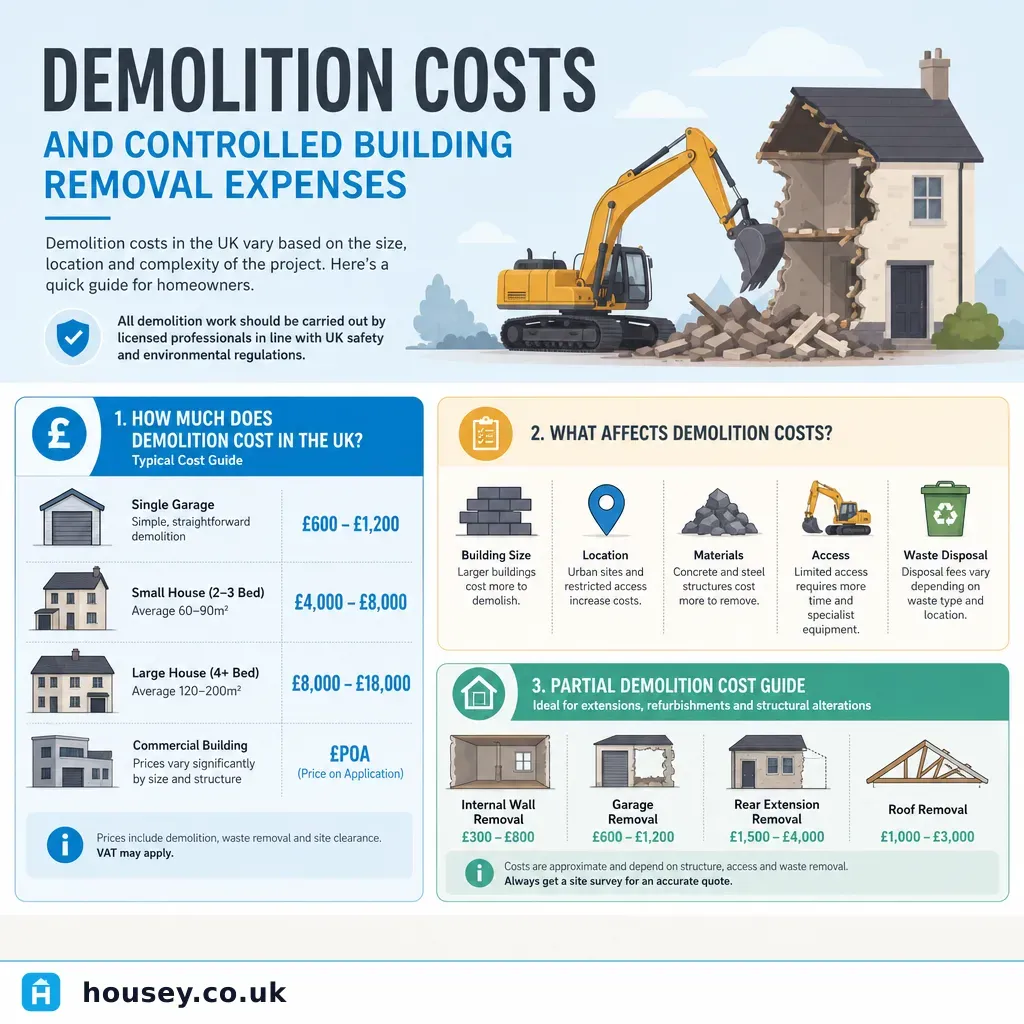
Demolition Costs and Controlled Building Removal Expenses
Full building demolition in the UK typically costs £5,000–£50,000+ depending on structure size, materials, and site access.
 Improvement & Build
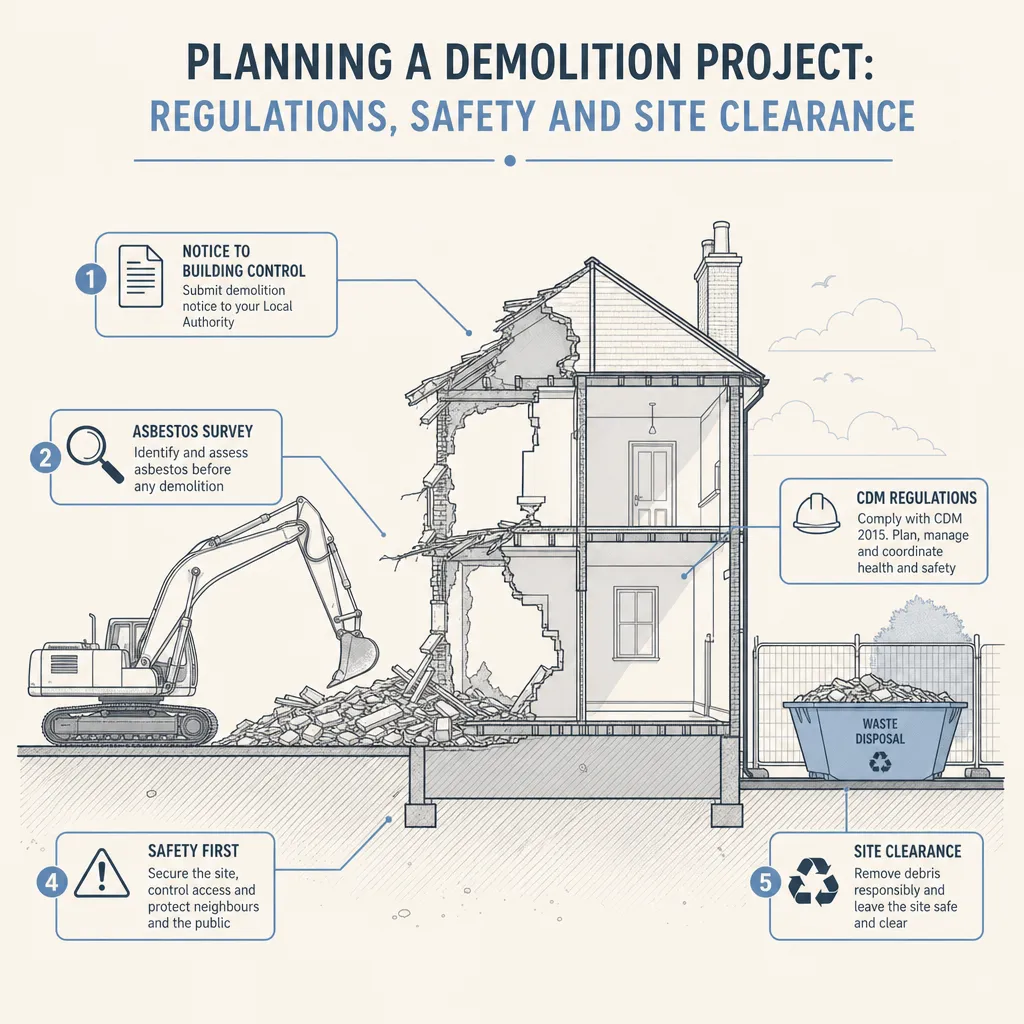
Planning a Demolition Project: Regulations, Safety and Site Clearance
Demolishing a building in England requires a Section 80 building control notice served at least six weeks before work starts, a Refurbishment and Demolition asbestos survey before any demolition begins, and compliance with CDM 2015.
 Improvement & Build
Open Plan Living Space Conversion Costs
Opening up a living space in the UK typically costs £3,000–£15,000+ depending on whether walls are load-bearing, the beam specification required, and the extent of remodelling.